Sleuthing your way to an informational edge

Much of what we write about on Stockopedia is about finding an analytical edge, such as using the Stock Report to get a quick initial assessment of a company, or a behavioural edge by using the Stock Ranks. Although it is much harder to do, investors can also get an informational edge by looking where others aren't.
Scuttlebutt & Sleuthing
Philip Fisher called the process of speaking with customers, employees, suppliers, and even competitors to gain a deeper understanding of a company, by a naval term: scuttlebutt. It typically involved gathering information about a company through informal conversations and direct interactions with stakeholders. In his 2007 book The Sleuth Investor, Avner Mandelman describes a similar approach, where he would hang out in popular lunch venues and strike up conversations with employees of the companies he was researching.
Famed short-seller Carson Block of Muddy Waters Research made his name shorting a number of fraudulent Chinese companies that had listed on foreign stock markets in the 2010s. His key advantage was going to the headquarters or factories of the companies (or paying a private detective to go) and seeing if they looked like somewhere that had the claimed scale of operations. In many cases, he found that the companies' buildings had very little activity, and he made money betting that investors would eventually find out that this was the case.
Sleuthing the easy way
Physically going to the company's offices or paying a private detective may be beyond the average individual investor unless they have a particular point to investigate and a significant position. However, the good news is that much of the research can be done remotely using freely available tools. Many investors forget to use these tools. Indeed, I often forget about them myself until I come to write a Stock Pitch article, or have to debate a stock as a panellist. Here are some of the ones I have found useful:
Glassdoor
Glassdoor is an independent employee review platform. Although it is freely available, gaining access can be a little convoluted. The site often asks for a review of an employer in return, which may be tricky for a full-time or retired investor. Still, it is worth persisting with, as the site gives investors an insight into how a key stakeholder, employees, view the business. The reviews employees leave can be enlightening. Glassdoor's summary gives an overview of the ratings, but perhaps more telling is how many people would recommend the company to a friend.
Take, for example, Gamma Communications (LON:GAMA) . Many investors rate this company highly, including the Stockopedia algorithms that give it a 99 Quality Rank:
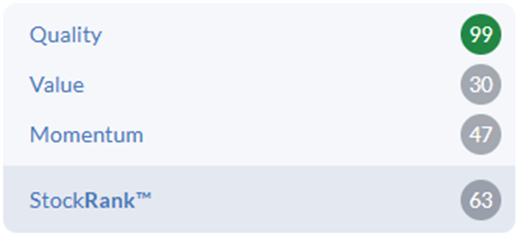
However, employees view this more circumspectly, with only around half being willing to recommend working there to a friend:

The CEO and business outlook get a more positive view. Investors can also drill down to the areas of strength or weakness:
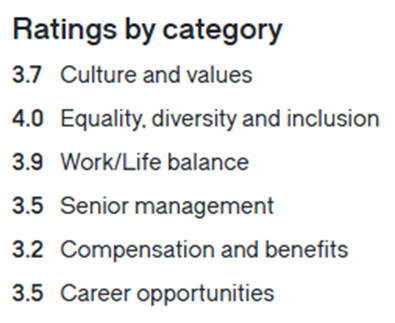
Investors can also look into the details of some of the reviews. In this case, there seems to have been a noted review deterioration in the last six months. This could be just due to economic conditions. However, a common complaint is lower-than-average pay and high staff turnover. Low compensation isn't necessarily a bad thing for an investor. In many cases, investors have the opposite problem, with high staff pay and bonuses taking the lion's share of returns. However, if many staff complain about low pay and high turnover, this may negatively impact the business. Specific reviews may also yield some more serious concerns, such as this one:
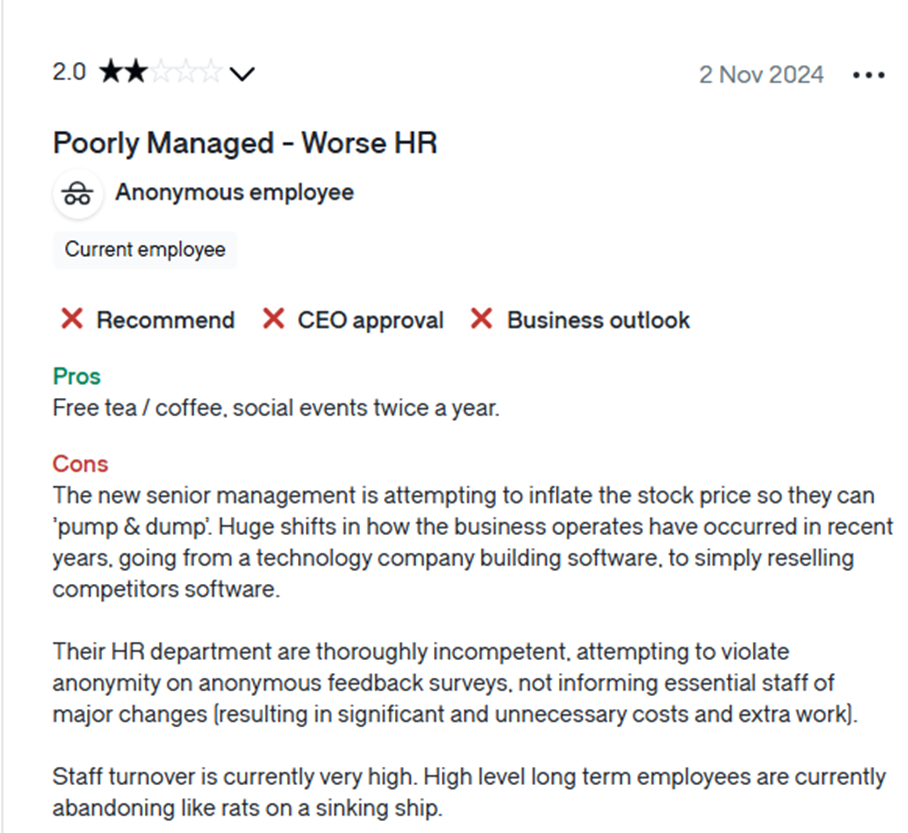
This may not be a true reflection of reality. However, it would certainly give investors in Gamma Communications (LON:GAMA) the impetus to investigate these issues further.
While Glassdoor reviews give an insight into a company, bad reviews don't always mean a poor investment. For example, the CEO of CMC Markets (LON:CMCX) has a terrible approval rating on Glassdoor:

Including some real humdingers of a review, such as this one:
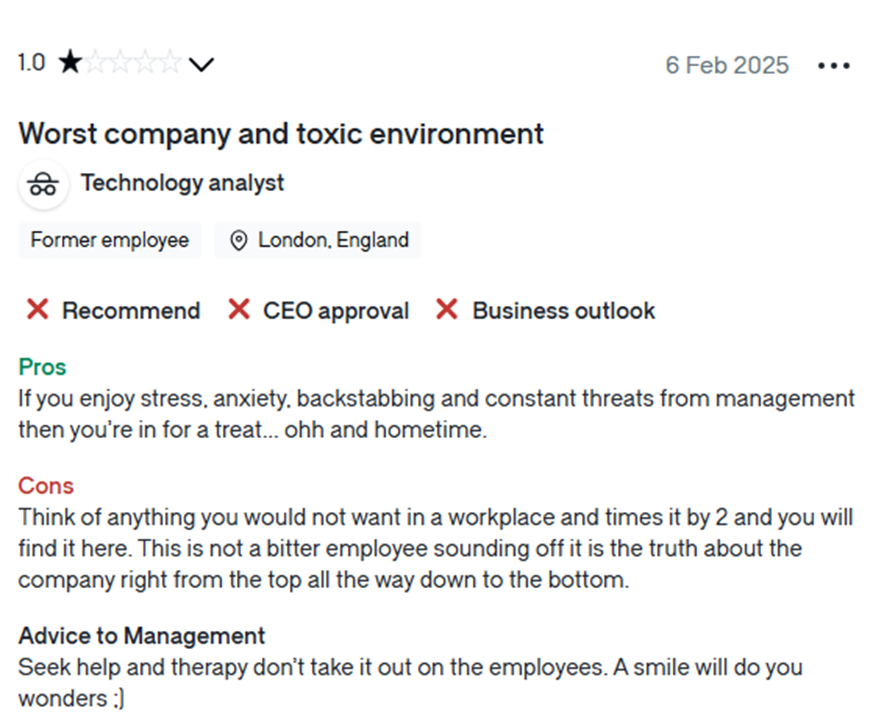
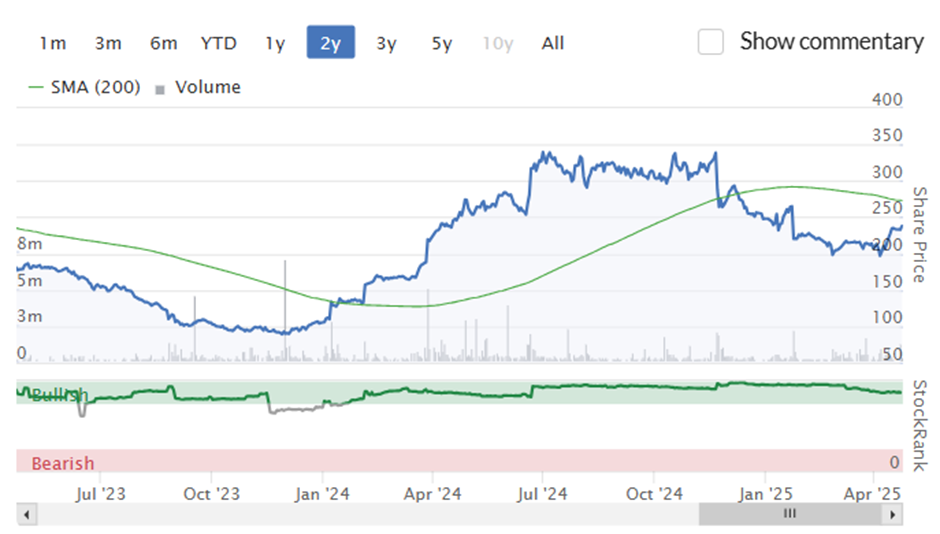
This hasn't stopped the share price performing well since many of these negative reviews were written:
Warren Buffett famously said:
I try to buy stock in businesses that are so wonderful that an idiot can run them. Because sooner or later, one will.
Perhaps CMC Markets (LON:CMCX) represents such an enterprise.
Shorttracker.co.uk
Investors who short stocks tend to be very savvy. The reason is that short-selling is incredibly hard. Short-sellers are betting against the general upward trend of the market, they have to pay an often significant borrowing fee for the shares they sell and are exposed to theoretically infinite losses when they get it wrong. With all this against them, the short-sellers that survive in the long term tend to know what they are doing. Therefore, investors should pay attention to their opinions. For long positions, the FCA requires firms to declare when they go above 3% of a company's issued share capital, and then at 1% increments. When shorting UK shares, the FCA requires disclosure at the 0.5% level updated for any subsequent change. Investors can download the FCA data and see larger short positions. However, a hedge fund called Castellain Capital has done the hard work for us by creating a website that summarises and tracks these declarations for investors. The URL is www.shorttracker.co.uk
Investors can look up an individual company or see a list of the most shorted. Here's the current one:
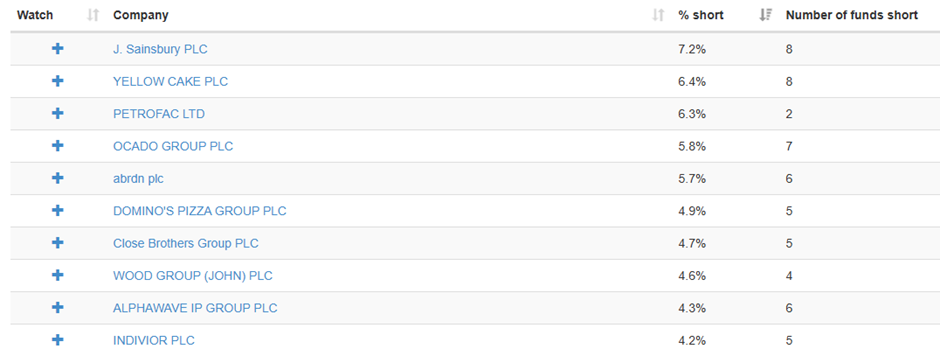
There are a few reasons why these shorts may not represent hedge funds taking a negative view of a company's prospects. The first is if there is some kind of special situation, such as a takeover. Some funds engage in what is known as merger arbitrage. When an offer has a stock component, funds buy shares in the acquiree and short shares in the acquirer, hoping to profit if the deal completes. Secondly, quant funds take positions based on their computer model. Typically, this will be based on a type of factor model similar to the Stockopedia StockRank system. While ignoring such a data-driven opinion may be unwise, such models often get it wrong for individual stocks. For example, Hargreaves Lansdown was one of the most shorted UK stocks in early 2024:
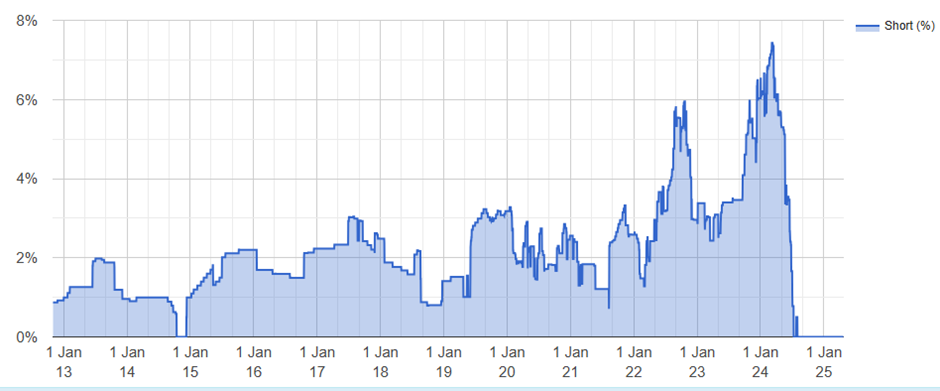
This was mainly due to quant funds, which had presumably picked up on the company's poor momentum and high price-to-book value. However, this didn't stop the company from receiving a takeover offer. With heavily shorted companies, it is always worth trying to work out why they are being bet against.
Google Trends
The trend is your friend, they say. While this maxim is usually applied to stock prices, the same is true of the underlying trends that drive consumer behaviour. Knowing the changes in desirability for products can help investors assess the investment case for the suppliers of those products. Thankfully, the largest search engine, Google, allows investors to see the trends in specific search terms. For example, here is the long-term chart for the search term "new homes" in the UK:
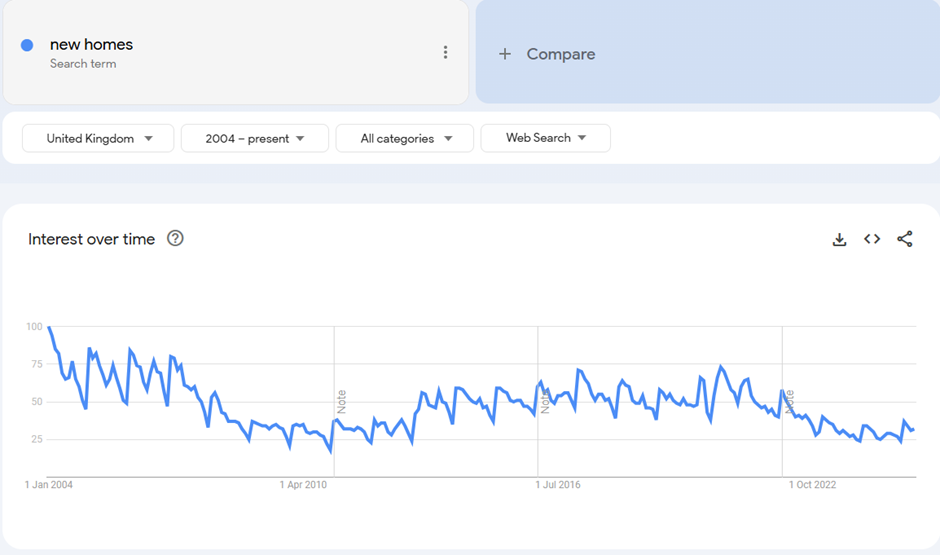
There is clear seasonality in the searches, but the overall trends are clear. Zooming in on the last two years:
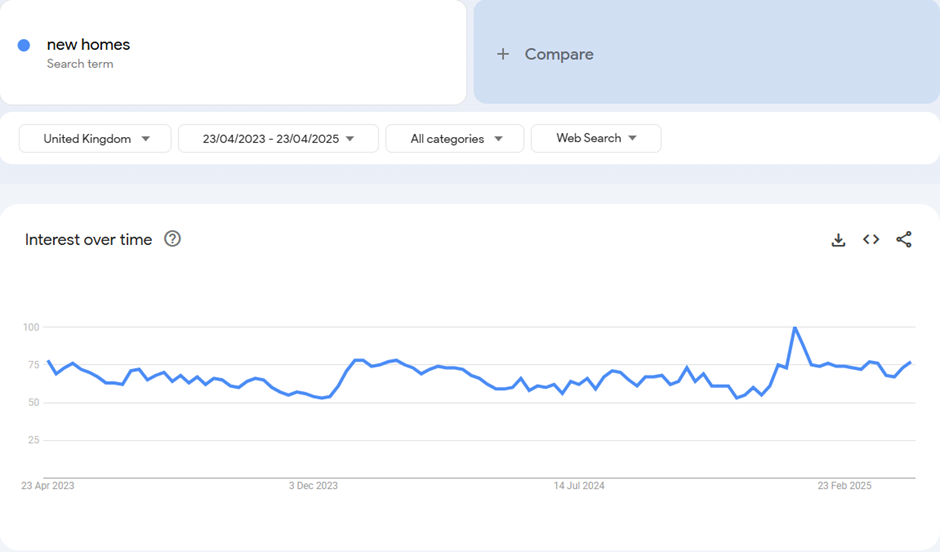
Comparing this to the share price chart of one of the large UK housebuilders, £TW is enlightening:
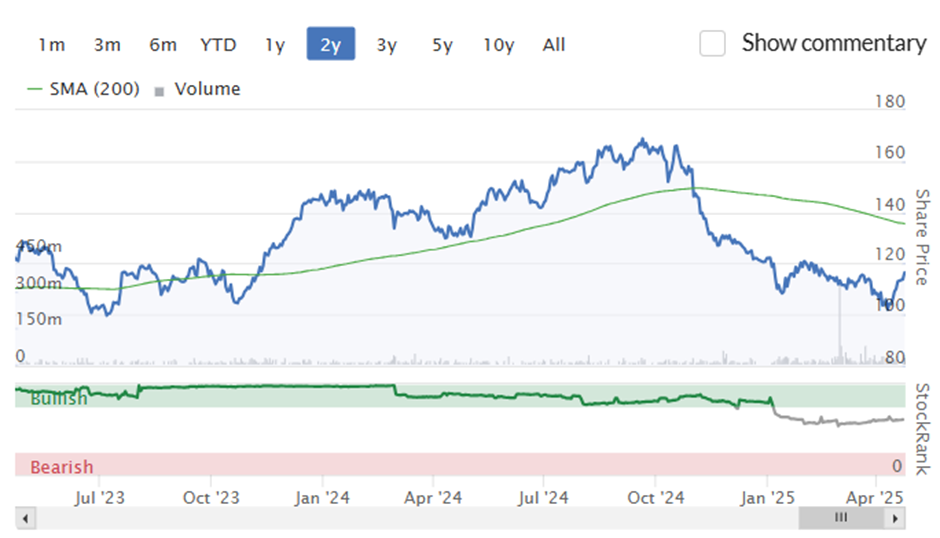
The investor enthusiasm for housebuilders in October 2024 was not matched by the same enthusiasm within Google searches. However, this year, the searches are up, but the share price is down. This type of mismatch may represent an investment opportunity.
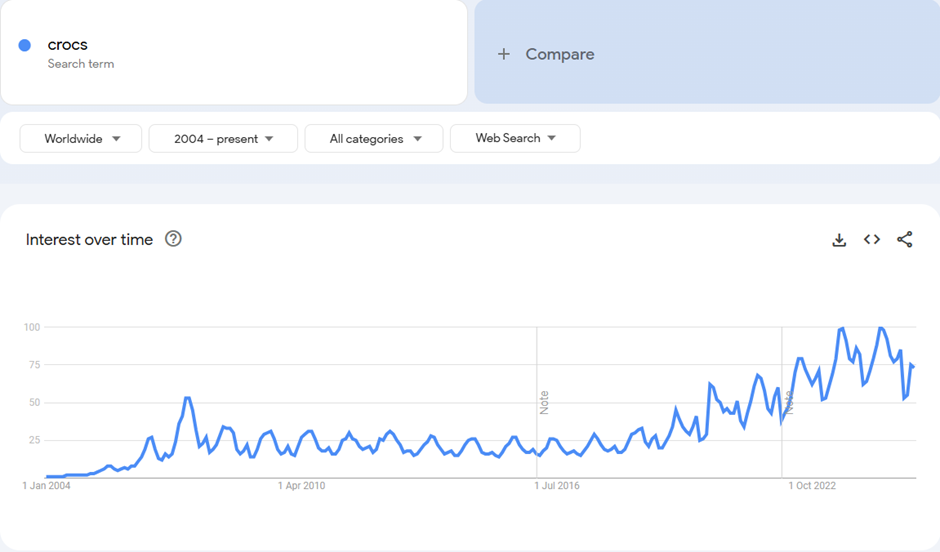
Looking wider, Crocs has been one of the most volatile global fashion trends over the years. They initially soared in popularity in the mid-2000s before becoming a pariah and then became trendy again in more recent years. This is reflected in the Google trend graph:
And even more viscerally in the share price chart:
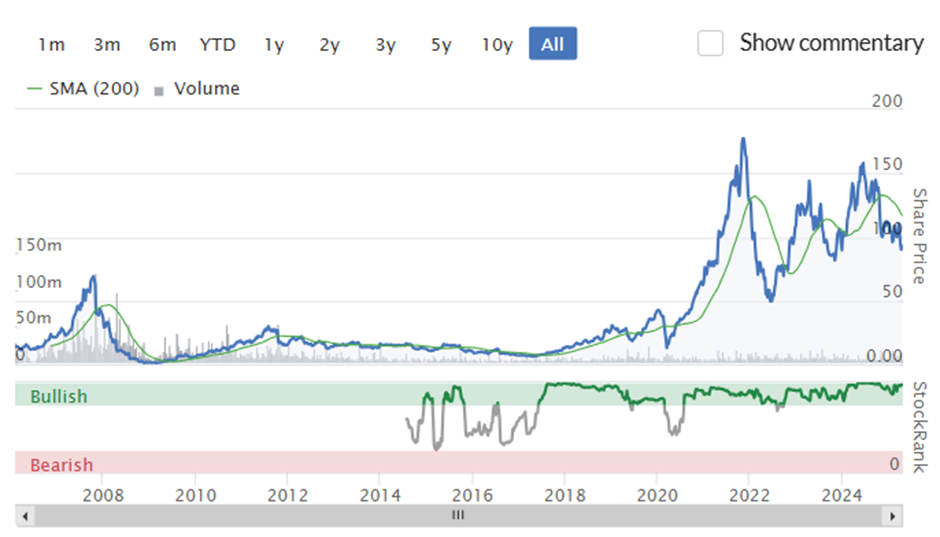
On the surface, the company looks like an excellent investment with a StockRank of 97:
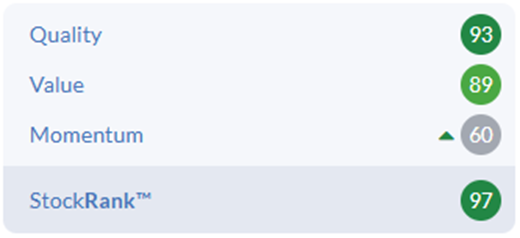
However, that downturn in search popularity for a fashion stock should give investors pause for thought.
Google Maps
While investors will struggle to do the kind of direct research that Carson Block did in China, there is often no need to visit a location physically to get a feel for its scale or upkeep. Investors can use the street view function on Google Maps to visit virtually. Even short-sellers these days use the Google map view of locations to see if they match up to expectations.
In a more benign way, I used Google Maps to confirm that there looked to be nothing untoward when RWS Holdings (LON:RWS) wrote down the value of their registered office earlier this year. In this case, a virtual drive-by revealed a fairly modern office block in a good state of repair:

The write-down here appears to be due to the general demand for office space in this location rather than a broader issue with RWS's assets.
Free Research
Finally, many investors know that Research Tree provides access to brokers' notes on many companies. While access to some research requires a paid subscription, much of it is available for free. Given that Research Tree provides the back end for almost all research providers, if investors register for free on the website of the provider, they get access on the Research Tree site, too. Since many companies provide their brokers more "colour" on trading updates and results, reading these can give investors an edge. In a worrying recent trend, some companies have started to issue profits warnings via closet broker downgrades instead of RNS. Although this is probably not the sort of company investors will want to hold anyway, it is another reason to check all freely available sources of information.
Good luck sleuthing. If anyone has found any other useful sources of "scuttlebutt", please do share them.
Disclosure: Mark owns shares in RWS Holdings (LON:RWS) ]
Disclaimer
This is not financial advice. Our content is intended to be used and must be used for information and education purposes only. Please read our disclaimer and terms and conditions to understand our obligations.

16 comments
Brilliant stuff Mark.
One of the benefits of share investor communities like Stocko and others , is that there is a huge wealth of knowledge and experience out there amongst members. To the extent that there must always be some members who have direct experience of the businesses and companies that are being discussed. I wonder if that knowledge is really being put to best use at times.
There seems to be an overwhelming focus on the numbers and metrics from some commentators. And little consideration for what you might call ‘softer’ issues, about people and management at the business in question. Which, to me, are absolutely fundamental behind the success of the company.
I would use the example of Treatt (LON:TET) . Recently announced a mild profit warning. Shares collapsed by over 30%. All of a sudden, well known investors were all over it as a great buying opportunity, based purely on the metrics. But for those who have closely followed the business over recent years, this was no surprise collapse. From the abrupt and surprising departures of both the long standing CEO and FD before their “transformational” factory upgrade was even complete, to said FD immediately selling all his shares to “fund his retirement” ( he was in his early fifties) , to the almost derogatory purchase of £10k of shares by the incoming new CEO, to the recently announced departure of the very well regarded ‘new’ FD after less than three years in post , to a sector he has no previous experience of, despite his obvious desire for an MD role in a sector he has many years of valuable experience in.
Metrics and numbers are all well and good. Company culture, quality of people and happiness of the general workforce are even more important in my view.
Very good article thank you.
I had not heard of scuttlebutting and sleuthing , but it appeared I had actually done it a few times.
The first time was many years ago questioning lots of postmen the street those that delivered to the door before the post office went public. Asking about management what the moods were how many posties would invest etc.
The second time I was sitting in my vets when a Dechra pharmaceuticals van pulled up to do a delivery. I followed the driver out with my little Cocker Spaniel in tow and asked him if he minded telling me a bit about he company he was working for, he said sure what do you want to know, started to ask him questions about how popular his company was what number of deliveries he was doing was Dechra liked in the vet world and so on. Got an amazing insight. ( previous life being a detective helped with the questioning lol :).
I bought the shares at the the approx £13.00 sold many years later with a good profit. I then heard they were bought outbid a fund a don longer exist in the same way.
I think it does help although one cannot research every company in that way I do like to explore other avenues for ideas.
Great article and very much consonant with my view on the power of differentiating informational edges.
I aggregate and analyse a lot of data sources and use data mining to relate these to extract signal from noise
I also aggregate the Daily FCA short interest and then analyse it over time as it provides more than just discrete information on individual stocks especially when integrated with price action and momentum (esp when momentum starts to rise in highly shorted shares).
Typically many of the top 10 most shorted names will be within days of 52 week lows /ATLs: many retail investors tend to "blame" shorters for the lows (confusing correlation with causation) . In reality, checking short interest before taking a position should be part of any research. Given the risk asymmetry, shorters do serious work and can uncover some serious flaws
In aggregate shorts can also give some sectoral insights as well as overall market insights (total number and values) - when separated, the trends in individual shorters positions can also give insight into developing theses . Sadly the FCA is in consultation to remove the identification of individual shorters and roll these up into aggregate numbers.: that is due later this year . A retrograde step imo
Table below also shows both the volume and value of shorts - these are very useful in identifying potential short squeezes. It includes a "Days to Cover" metric which is a useful as a tell for potential short squeezes: i.e when a catalyst/ good news arrives for a shorted name , the covering process can provide some great breakouts; converting the %shorts to volume and value related to the typically daily averages then allows estimation of the squeeze and positioning.
grab below from a daily scan I run which is freely available HERE : it's updated EOD around 18:00 along with close prices
(click to enlarge)
Great article.
I have heard of investors using satellite images to assess how full car parks are each day at shopping malls as a proxy for tracking consumer sentiment/demand - the footfall data in shopping malls can be equally valuable.
What has always been a grey area is how far you can go with this before you begin to encroach on insider dealing or market abuse territory - you don't have to spend long searching the web to come across detailed legal debates on whether the aggregation of publicly available data has the potential to be classified as non-public information. For instance you may be crossing a line if you buy the exclusive rights to satellite imaging....
I've always suspected the answer is "very far" because regulators know that trying to make it stick in court is very difficult indeed.
10/10 top, good job.
I rely on charts (technical analysis) then look for support from stocko quantum analysis.
Have Seeking Alpha for US stocks insights and the coverage is amazing and seems 'honest' with most selling to get a paid service (no fault in that).
Podcasts are increasingly imo gaining traction. Peter Schiff gives a view on the US/Trump, Joe Rogan known to many (general not investment, but gives trends and politics - won the presidency lol), Patrick Bet-David (Iranian New York). James Altucher (future tech plus general). Many others.
Stocko tried it but last heard was in Jan 31. I was thumbs up but ok hard to do and unfunded at the start.
All part of our information overload - but sitting on a train/bus/car/airplane makes time dissapear.
What a fabulous article. The usefulness of Stockopedia’s analytics and tools have made me a little lazy in this area. Thanks for the very useful reminder.
"Philip Fisher called the process of speaking with customers, employees, suppliers, and even competitors to gain a deeper understanding of a company, by a naval term: scuttlebutt. It typically involved gathering information about a company through informal conversations and direct interactions with stakeholders"
Good to hear that Philip Fishers name is mentioned. In my view Common Stocks and Uncommon Profits is comfortably the best book ever written on investing.
The key point which Fisher managed to master was not only the collection of diverse information but to determine what was the single most important issue regarding the investment.
His preparation for meetings with management was legendary with the ability to interview in some considerable detail. Unfortunately, the private investor does have the opportunity or perhaps the tenacity to do something similar to Fisher.
Having said that, the scuttlebutt idea is sound and in my view is best carried out in sectors such as retail, hospitality etc where every investor has the direct ability to interact with the company.
I don't think however that the discussion format here on Stockopedia is helpful to the scuttlebutt idea. If there were company specific threads it would then be fairly easy to develop a thread of knowledge about a company. A lot of priceless information is slowly lost in the current format, which must be to the detriment of both Stockopedia and subscribers.
Mark - this is great stuff. Completely agree. Google trends is great for this as you say - I've been tracking the popularity of Balatro (great game) using this tool for some time - Trufin (LON:TRU) own it, and it's spitting off cashflow. I'm not a shareholder yet, but can't help but think they are going to beat estimates - Balatro is also the #1 Game in Apple Arcade.
I also use SimilarWeb a lot which can be quite useful for tracking the popularity and traffic to company websites. Trustpilot (and other review sites) are excellent for snuffing out when companies have some pretty poor sales practices - e.g. Yu Group doesn't come out so well there https://uk.trustpilot.com/revi...
Yes, good point Ed. I would never invest in Yu given what reviewers on Truspilot say about their business practices. Although no doubt Trustpilot would deny it, my feeling is that the review numbers are more easily influenced, but still a very useful tool. If the reviews on trustpilot are bad then the service/product is truly terrible!!
Interesting that you should make that comment about Yu (LON:YU.) as they are up by 9.84% today. I have no idea why but perhaps somebody can illuminate me.
If I told you I would "have to kill you". But don't actually know but looks like some insiders have intel so well spotted and look forward to the RNS tomorrow or day after lol. A spread bet tomorrow? "He who dares Rodney".
I suspect the 44% fall in RWS Holdings (LON:RWS) , also today, is perhaps providing greater distraction.
There but for the grace of god go I.
Yes the TrustPilot numbers are never to be trusted - they make their money from companies not the public. They essentially are a "ratings for sale" business and if a company pays enough and puts the time in they can keep bad reviews to a minimum in there (you just need cash and people who put the time in to clear bad reviews)
Well if the staff member of Gamma Communications (LON:GAMA) is right and management are just doing everything to inflate the SP they've not done the best job since the post was made.
Base support seems to be found at 1200 so good to go, over time of course. Volume in play.
Brilliant article, Mark. I am always looking at other ways of researching shares. There were some very interesting ones here, thank you.