Small Cap Report (19 Apr) - GAW, RGS, DTG, DODS, FLYB

Pre 8 a.m. comments
Good morning! Fairly quiet today, as it usually is on Fridays, but there are a few interesting announcements to flag up.
Games Workshop (LON:GAW) have issued a refreshingly brief IMS for the period from 3 Dec 2012 to 7 Apr 2013, which looks a rather strange period, but given that their year end is 3 Jun 2014, this represents their second half (H2) to date, i.e. four months. They simply say that, "trading has been broadly in line with the board's expectations", so slightly below then.
I will buy shares in the first company to issue a trading statement which actually says "slightly below" instead of "broadly in line", as that would demonstrate putting honesty before spin.
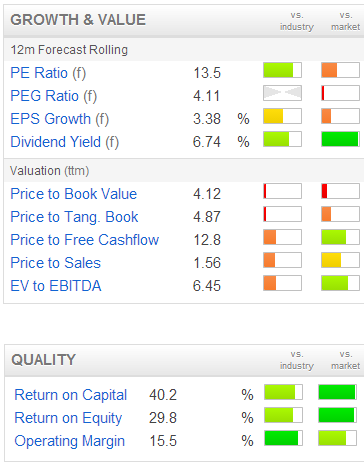
Stockopedia shows broker consensus for this year as being 47.6p EPS, down from 50.8p last year, which translates to a PER of 14.1 (an Earnings Yield of 7.1%). The dividend is forecast at 45p, meaning that almost all earnings are being paid out in dividends, for an attractive but barely covered dividend yield of 6.7%.
Note how useful the Earnings Yield is (it's the inverse of the PER. So in this case where the share price is 673p and EPS is 47.6p, then the PER is 673/47.6 = 14.1.
Flip those round to calculate the Earnings Yield, which is EPS of 47.6p/673p share price = 7.1%.
Why bother using earnings yield? Well because you can then compare it with the dividend yield of 6.7%, and instantly see by comparing the two figures what the dividend cover is. I think that's so useful, that I'll be mentioning earnings yield from now on.
You can also then compare company valuations with any other asset class (e.g. Bonds, property, cash in the bank), pretty much all of which are expressed as yields, rather than price multiples of yield.
GAW looks like a mature business to me, and the shares have done well in the last year, so I doubt there is much (if any) upside on the current share price for the time being, so it doesn't interest me. Although I do note the strong green bars in the "quality" section above, indicating quite a high operating margin, and good return on capital employed.
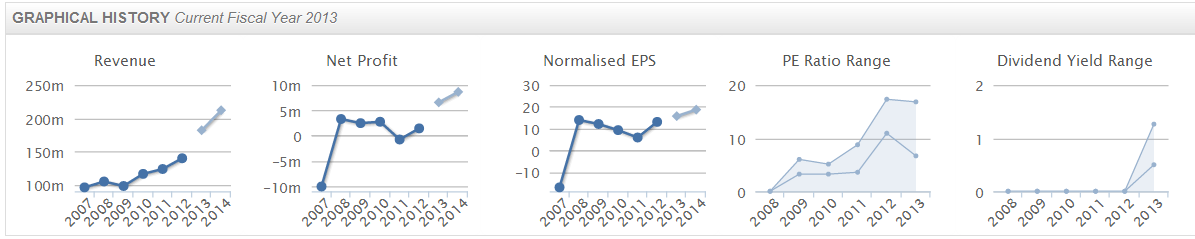
Regenersis (LON:RGS) announce a small bolt-on acquisition in S.Africa for £1.5m (paid for in cash I presume, although it doesn't specifically say that), in line with their stated strategy of targeting emerging markets where margins are better, and growth stronger than in Europe. It looks to me a good growth company at a reasonable rating, even though the shares have had a very good run it still doesn't look over-priced (forecast PER of 12.3 this year, falling to 10.3 next year).
Post 8 a.m. comments
Airline, package holidays, and logistics group, Dart (LON:DTG) issues a positive trading update, saying that pre-tax profits for the year ended 31 Mar 2013 will be ahead of current market expectations due to lower than expected winter losses.
Broker consensus is for 20.1p EPS this year, so at 149p the shares still look good value at 149p, for a PER of 7.4 (earnings yield of 13.5%). Although you have to be careful with airlines & travel businesses, as they often fund themselves using advance payments from customers, which has always struck me as unethical. Surely customer monies should be segregated & not used to finance the rest of the business? But they're not usually.
I've just checked Dart's balance sheet, and it actually seems OK - their net cash balance is almost all customer's cash, but at least they are not dipping into it to finance the planes (which was the case a few years ago when I last looked at it, because I remember querying that very point with them).

We're in more buoyant markets, and bullish signs are proliferating - e.g. the IPO market coming back, and new issues going to a premium on day one, such as Cambridge Cognition Holdings (CCH) which started trading yesterday and went to about a 10% premium.
As such, I'm relaxing my £10m minimum market cap requirement somewhat, as I think the risk of de-Listing is reducing, for companies which are profitable. So I'd tentatively go down to perhaps £5m market cap if the company itself looks sound & makes money. Although liquidity gets pretty ridiculous at that level, but a proper telephone broker can usually work orders for you and get round those problems. It's certainly a false economy using a discount online broker for small & micro caps in my experience.
With this in mind, I'm going to start looking at some smaller companies for the first time, and Dods (Group) (LON:DODS) is one such company. They have issued a trading update today, saying that the extended period of 15 months to 31 Mar 2013 will deliver turnover in line with expectations of £18.7m, and adjusted EBITDA of £0.4m. Order intake has improved.
Dods provide political information. It hasn't made any significant profit since 2006, and dividends fizzled out by 2011, so it's difficult to see why the shares are still Listed. Hence I wouldn't be interested in this, unless some catalyst for growth emerges. There must be a high risk of it de-Listing, which is disastrous for the share price. The market cap is about £6.5m.
An interesting situation has developed at VSA Capital (LON:VSA), a tiny Listed broker, where the announcement of it intending to de-List smashed the share price from 4p to less than a penny! This is why it's so vital to avoid such micro caps where there is a risk of de-Listing. The biggest risk factors to avoid?
- I would say £10m market cap is a good threshold above which de-Listings are rare.
- Dominant shareholdings of over say 20% for Directors (in aggregate), or any other large shareholder, as this might make it too easy for them to force through a de-Listing.
- Financial problems, which mean that the cost of Listing (typically £100-200k p.a. all told, even for a very small company) can no longer be justified. So profits under say £500k would be a warning sign.
Actually, thinking about it, I think I've just convinced myself that my £10m minimum market cap limit was a good idea, and should remain!
Following on from Dart Group's positive trading update, another aviation share, Flybe (LON:FLYB) announces a rather poor trading update. They are expected to be loss-making, but it's a lot of business for only £30m market cap. So the question is whether they can turn it around? To see how badly wrong things have gone for Flybe, just compare their three year chart with that of Dart Group above:
I'm tempted to look into it as a potential turnaround, as the percentage gains available from turnarounds can be spectacular, but looking at their last balance sheet I would be worried about the level of debt, and what the banking covenants are over that debt? Certainly too high risk to be able to understand quickly, this one would need a lot of research to properly understand the risks, and I've got better & simpler opportunities to research elsewhere, so will pass on this one I think.
Right, that's me done for today and the week. Thank you for taking the time to read my morning ramblings, I hope you find them useful & interesting. It's only ever one person's opinions of course, but hopefully provides a catalyst for some ideas to research yourself in more depth?
Have a good weekend all!
Regards, Paul.
(of the shares mentioned today, Paul holds no long or short positions in any of them)
Disclaimer
This is not financial advice. Our content is intended to be used and must be used for information and education purposes only. Please read our disclaimer and terms and conditions to understand our obligations.

9 comments
Hi Paul
love the blog.
But I have to take issue with your inference that GAW's trading update is spin. From memory - a couple of years ago they won a big award and didn't turn up at the award ceremony because they felt it was a diversion, their accounts don't contain photos or colour and are bound with gaffer tape. I think they are the one company on the stock market who would view spin as a waste of resource and a pointless diversion.
"Trading broadly in line" suggests an awareness of the risk of spurious accuracy.
The upside is largely around how its US expansion fares. It is highly operationally geared and if sales start to chug there will be a real earnings boost and most of that will get paid out as dividends.
Hi shipoffrogs,
I'm sure you are right.
My pet hate is companies saying "broadly in line", when we all know that actually means slightly below. But I've gone on & on about it for months now, so will probably just accept that the broadly in line terminology is the accepted norm.
There will of course be a huge fanfare from me if & when a company actually does take up my challenge & put out a statement saying "slightly below"!
Cheers, Paul.
Hello Paul,
I've always stayed clear of owning airline stocks, as these have a habit of losing investors money,
I would need to see some very serious upside potential to relax that policy and invest in the likes of FlyBe.
Airports are another matter, as these are generally monopolistic in nature. e.g. Many long haul routes are only directly served via Heathrow.
Jeff
Hi Jeff,
I agree, airline stocks are also things I usually avoid like the plague - there are just too many moving parts, and profits can suddenly vanish and become losses, so you cannot really value them reliably on a PER basis.
I did hold some Dart Group a long time ago, and they were always on a very low PER, but they just went nowhere, so in the end I moved on. Then they doubled of course!! Always the way isn't it!
There is a big risk with airlines, of the fleet being grounded - this happened at the time of the Icelandic volcanic dust cloud. If that had been worse, and planes had been grounded for a long time, then many airlines would have gone bust, since their balance sheets are so heavily reliant on customer prepayments. You can also get safety serious safety issues grounding planes for a long time - e.g. as happened with Concorde, when they needed major re-engineering after it was discovered with the Paris tragedy that they had a dormant design fault with inadequate protection for the fuel tanks in the event of a tyre blow-out on take-off.
Regards, Paul.
It's probably worth mentioning that there are multiple definitions of earnings yield and that the E/P may be misleading.
I'm a big believer that when comparing equities with different levels of debt its much more meaningful to use the enterprise earnings yield than the inverted P/E. i.e. Operating Earnings / Enterprise Value (where operating earnings is defined as earnings before interest and tax). Some may know this as EBIT/EV.
Why? Well a company can look really cheap on a P/E or E/P basis when actually it's really expensive - here's a snapshot from "The Little Book that Beats the Market" which uses the EBIT/EV preferentially.
The recent publication "Quantitative Value" also confirmed that cheap stocks on an earnings yield (EBIT/EV) basis outperformed every other definition of cheap over a very long backtest.
I'd like to have this definition of Earnings Yield in the Stock Reports but we chose to use the more commonly used EV/EBITDA figure - space is hard to come by 'above the fold' on the page. At some point we'll make all these ratios in the reports customisable. The ratio though is available in the screener / table views around the website as 'Earnings Yield".
Hi Ed,
Very interesting reply, many thanks.
The points you make are all valid, although the example you gave explains why both PER and Earnings Yield will make a highly indebted company look cheaper than it really is. So if we are happy to use PER, then we should be equally happy to use Earnings Yield, since both contain exactly the same inherent flaw.
What I tend to do is mentally adjust the PER (or Earnings Yield) to adjust for debt. So if a company has a roughly neutral cash position, then we can take the PER at face value. If the company has some debt, say 20% of the market cap, then I would mentally adjust the PER up by about 20% to allow for that, and adjust the PER down a bit if the company has significant net cash.
Enterprise Value is itself a flawed concept, because many companies stretch their trade creditors from 30 days to 60-90 days, in order to flatter the year-end cash balance. So it is perfectly possible for a company which has maxed out its overdraft for 334 days of the year, to report net cash on the balance sheet date by withholding payments to suppliers in the final month of the year.
The way to check for this is to look at the P&L interest charge, and make sure it's consistent with the balance sheet net cash or debt figure. Game Group was a good example of this - their balance sheet appeared bullet-proof, with substantial year-end net cash, but of course they had chosen 31 Jan as their year end, so that cash was at a seasonal peak, but they had not yet paid their suppliers for the product that had been sold over Xmas. So they looked to be cash rich, but the P&L showed a substantial interest cost - which meant that most of the year they were actually overdrawn at the bank!
Hence why I like to consider the balance sheet as a whole, and see how net debt sits within that bigger picture.
An alternative way of calculating Enterprise Value might be to make an adjustment to theoretically reset net current assets to zero (i.e. current assets balanced exactly by current liabilities), and add or subtract that adjustment figure to/from net debt, to reach a normalised net debt figure which could then be compared with other companies on the same basis.
After all, why should we only focus on interest-bearing debt within our Enterprise Value calculation? All creditors are debt, so just because a company doesn't pay interest on its trade creditors or accruals, that is still real money owed to someone else, i.e. debt, yet is excluded from the EV figure.
So overall my view is that Earnings Yield is better than PER, whilst both have the same inherent flaw of ignoring debt.
Regards, Paul.
Thanks Paul and Ed. Really intersting discussion this morning. As someone learning the ins and outs of investing I have found both your insights very educational
Couldn't agree more. It is this aspect of Paul's blog and Stockopedia in general which is really valuable. Both Paul's and Ed's comments, from a position of real world experience, provide information that elsewhere is either assumed or not explained for being too detailed.
A good explanation of all the 'cheap' indicators on shares is in the Stockopedia freebie, 'How to Make Money in Value Shares'.
I say freebie, but it is an extra you don't expect when registering so it does feel like an additional extra. Terrific work.
Hi Paul,
Many thanks for the info on earnings yield and how to calculate it. For a relatively new investor like myself this sort of thing is really useful.
Steve