Small Cap Report (23 May) - HFD, KBC, SSY, QED, HYD, EMR, NRR, PYM

Pre 8 a.m. comments
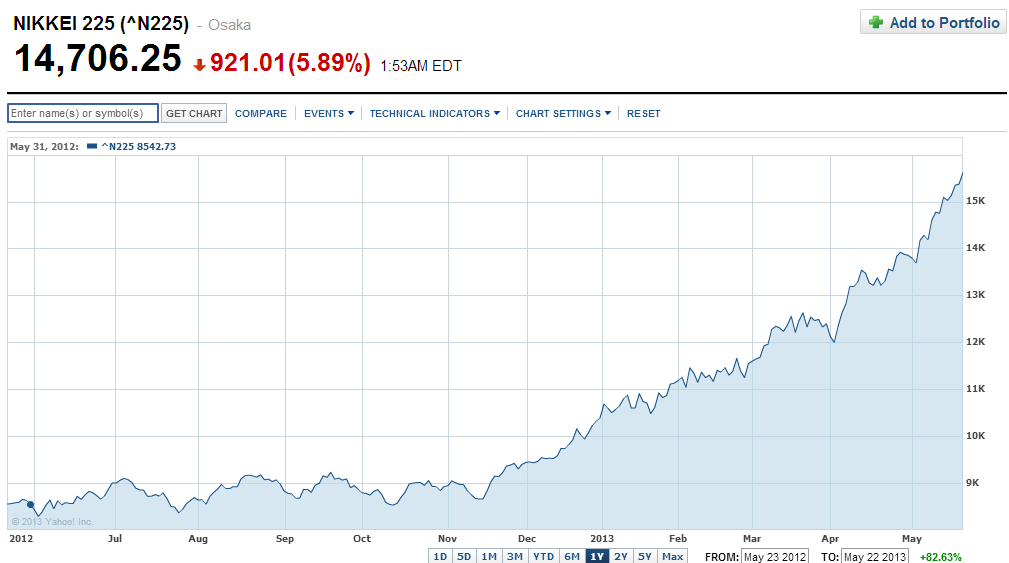
Good morning! My Twitter feed is buzzing this morning with chatter about the Japanese market having dropped 6% overnight. I'm really glad I didn't get sucked into that particular bubble. Just look at the chart - a major index going from 8,700 to 15,700 in six months is ridiculous!
FTSE futures are currently looking to open down 110 points or, 1.6%, which in my view is overdue, and a good thing. As I've mentioned here several times lately, this market has felt far too frothy and a correction is healthy. I hope everyone is prepared, with gearing at sensible levels (if at all), and gains in frothily-priced stocks having at least been part-banked.
All the stuff I'm in is reasonably priced already, or I wouldn't be in it! So whilst I'm expecting to lose a bit of money today, it doesn't change the investing case for the stocks I'm in, so I won't be selling anything today.
It's not a small cap, but Halfords (LON:HFD) have cut their final dividend by 35% from 14p to 9.1p. The full year payout is reduced from 22p to 17.1p, down 22%. I mention it because it's never worth chasing a high dividend yield that isn't well covered by earnings. What is more important is the dividend paying capability of a business, than the actual amount paid. So a reasonable, well-covered dividend (say 3% yield, at least twice covered by earnings) is, in my opinion, better than a 6%+ dividend yield that is barely covered by earnings, as was the case with Halfords.
The reason being that the more modest but well-covered dividend (say 3% yield) is likely to be sustained throughout bad patches in trading, and therefore provide strong support to the share price, whereas a 6% dividend yield that pays out almost all earnings can be cut at any time, triggering a sharp share price fall potentially.
So that will take Halfords' dividend yield at 398p a share, down from 5.5% to 4.3%. I imagine that is likely to see the share price adjust down somewhat, maybe 20%? With EPS in a down-trend, and 27.2p reported today, it's difficult to justify a PER much above 10. So I reckon these shares look significantly over-valued at 398p, and I'd only be interested at around the 200-250p level, if at all. Their stores are on skeleton staffing levels, so customer service is poor, and the product is seriously over-priced in my opinion.
A share in my personal portfolio, KBC Advanced Technologies (LON:KBC) are having their AGM at 3pm today, and have announced an upbeat assessment of trading so far this year;
"KBC has made a strong start to 2013 ...The new contract awards, together with the strong order book at the start of the year and the new operational and cost initiatives, give us confidence in meeting management expectations for the current year as well as in the Group's longer term prospects."
Another AGM statement, from SCISYS (LON:SSY) sounds positive. They say the order book has further improved in the opening months of 2013, and that they are on track to meet full year guidance. It's a £20m market cap IT company. I've had my eye on this one for a while, as it looks reasonably priced, with a PER of 8.2, although the dividend yield is only 2%, but as Roger at ShareSoc says, you don't buy small IT companies for the dividend!
Scisys is probably cheap because of market nervousness over its exposure to public spending, as a lot of its sales are to the public sector, where spending restraint is (so we are told) the order of the day, although looking at our still-gigantic annual deficit, and that the biggest Departments are ring-fenced and hence guaranteed increases in budgets, you do wonder.
Post 8 a.m. comments
Phew, that's a relief! My portfolio has barely moved this morning, just a bit of softness in one or two, e.g. French Connection, and Norcros, IndigoVision off 1%, all pretty insignificant. Also I'm seeing very little volume - hardly any selling at all in the stocks I hold, so that's very encouraging when the FTSE 100 has dropped 118 points at the time of writing to 6716.
I'm not a trader, but short term market movements do interest me, and a market downturn is a good reminder that it's important to bank some profits on the way up, and therefore be well prepared to pick up bargains if a bigger sell-off occurs. After all, you can't pick up the bargains unless you've got some cash on the sidelines ready & waiting.
Some people try to make out that short-term price movements don't bother them, but they're just trying to impress you by pretending to sound like Warren Buffett! Everyone is bothered by short term price movements to some extent, you just have to look through them, and not be panicked into making bad decisions as a result of them.
The headline figures from Quintain Estates And Development (LON:QED) don't look impressive to me. Yet again the EPRA diluted NAV has fallen, from 126p at 30 Sep 2011, 116p at 31 Mar 2012, 109p at 30 Sep 2012, and now to 105p at 30 Mar 2013. They are supposed to be building shareholder value, not dissipating it.
I've followed this company in a fair bit of detail for several years now, and reiterate that my inescapable conclusion is that it is run entirely for the benefit of its Directors and staff. They receive all the upside from their development projects, through generous remuneration packages in the bad years, and big bonuses on top when the property market does well, whilst shareholders receive nothing at the moment.
I think their overheads are top-heavy, and their projects are taking so long to develop, that it's difficult to see much upside accruing to shareholders any time soon. The discount to NAV is probably about right in my view, at 72p a share, I can't see significant upside, and that's in a booming London property market too - what would happen if interest rates shot up, foreign money pulled out, and the property market crashed? It would be a wipe-out. It's not for me.
An AGM statement today from Hydro International (LON:HYD) doesn't sound great. They say that things have remained challenging in Q1 of 2013, and their outlook is "broadly unchanged", i.e. slightly worse, than are reported in the 2012 Annual Report.
They intend investing in new initiatives under their new CEO, who joins in late July 2013.
I've looked at this company a few times over the years, but it's never looked good enough value for me to invest, and I seem to recall they lost a big client a while back, that de-railed their performance. There is net cash though, so I shall revisit when their next set of results comes out on 3 Sep 2013.
I've had to rattle this report out fairly quickly today, as I'm off for an investor lunch. If I can get a connection, then I'll update with a bit more from the train!
See you tomorrow at the same time.
Managed to get an internet connection on train! I've been looking at the AGM trading statement from Empresaria (LON:EMR) which sounds good - YTD trading is in line, and they confirm full year expectations. The PER looks cheap on 4.7 on broker consensus for this year, but they had almost the same as the market cap in net debt according to the StockReport here. That's a bit too much debt for my liking, and the Altman Z-score shown on Stockopedia is flagging potential problems. Debt can be fine when you are trading well, but is a killer when trading is going badly.
I also have to go through the results from Newriver Retail (LON:NRR) but two very noisy pensioners have just sat down opposite me & are distracting me with their incessant babbling about garden centres. Honestly, the elderly of today!!! ;-)
New River owns 14 secondary shopping centres, with a focus on adding value by redevelopment, and value tenants, which are pretty much impervious to Internet competition, and may even do better in Recessions.
It's a REIT, so pays out almost all it's earnings in dividends, in return for tax free status.
The divi is up 7% to 16p, so a very strong yield at 213p per share. My worry is that growth can only come from dilution, since all earnings are paid out in divis. On the other hand, even though rents are too high now, in the long run inflation will scrub off the excess, and with a say 5-10 year view I reckon NRR shares could make a lot of sense. I should be meeting management soon, so given my retailing FD background, that should be interesting.
I see that Phytopharm (LON:PYM) have finally admitted defeat, after many years and about £80m of shareholders money down the drain. But instead off hanging up their boots, they're trying something else! Still, I suppose the tax losses could be used, although I bet management salaries will exceed anything recouped from tax losses In the future, cumulatively.
They are planning a reverse takeover of a private company called Target, and a move to AIM. They refer to £0.6m administrative overheads in six months as being a "low cost base", which strikes me as absurd for what is really now a small cash shell! Management sound delusional to me, so even though it's trading at below net cash for the moment, it won't be long before they've narrowed the gap with ongoing and unnecessary cash burn.
Regards, Paul.
(of the companies mentioned today, Paul has long positions in KBC, NXR, IND and FCCN. He has no short positions at all)
Disclaimer
This is not financial advice. Our content is intended to be used and must be used for information and education purposes only. Please read our disclaimer and terms and conditions to understand our obligations.

11 comments
Good analysis Mark, thanks for that. Never got round to jumping on the Halfords ship myself - more luck than making a concerted effort not to.
Have to say your
"I intend to castigate the Board for wasting £68m on buying back some 5% of Halfords' shares in 2011/12, which Roger Lawson & I warned the Board about at the time. ISTM that without that, the divvy cut might have been avoided, or at least lessened considerably."
rings loudly with my negative opinion of buybacks in general. I'd personally prefer it if companies upped the divi rather than buy back shares myself - such shares usually remain in treasury for extended periods to be subsequently doled out for executive sipp/plan rewards. A higher divi, or special one, benefits me directly. I'd only buy more shares. From past experience it seems that, in the main, companies trend to buy back their stock when prices are high, only to subsequently see them drift lower post said event.
Not a fan of buybacks at all whether or not management time them to perfection - they usually don't. Good luck in your castigation of the board. :)
Hi Guys
Good analysis here. I had a few HFD and was planning to sell them last week (to raise cash for a house purchase) so was a little put out when the divi cut was announced and the SP fell :-( Thanks to Paul's article I found out about the cut early and sold straight away at £3.45 (SP now £3) so you saved me a few bob Paul and I guess I owe you a drink (I'm sure you will remind me about that next time we meet ;-).
But Mark's story sounds convincing and HFD may now be a turnround opportunity, but I'll wait for the SP to hit Paul's guidelines, say £2.25 before buying back in.
But HFD was kind to me - I originally bought it as an HYP share but I later decided it wasn't robust enough for that port but decided to keep it as a trading share mainly because of Mark's posts and it gave me an annual return of 16% (total 28%) so no complaints there. I guess that means I owe you a drink too Mark - damn, this is getting expensive ;-)
All the best
Terry
Nice write up Mark. Halfords look like one to avoid for me and have done for some time. It's an age old story. The dividend was unsustainable but the previous CEO knew it was the only way to keep the share price where institutional holders wanted it. The buy back was a disaster and was probably organised so that "important" holders could exit the stock at unrealistic levels. Once problems came home to roost and the new guy took over then all the skeletons come out and he takes the opportunity to re-base the dividend to something less demanding. No doubt "Matt" (glad you are on first name terms :-) ) will manage to award himself some nice in the money options or free stock and even some modest achievements should see him profit very nicely. Nothing like lowering the bar for yourself :-)
With a lot of high profile "shed" retailers suffering I'm not sure the market is going to rate them too highly based on this dividend cut. Having said that if the price falls to a level where a sustainable dividend yield makes them look attractive they might be worth a punt.
Good luck castigating the Board for wasting £68m on buying back some 5% of Halfords' shares in 2011/12 - I suspect it will be like water running off the bow of one of their £99 canoes. At least buying one of them you might end up sh** creek with a paddle whereas buying the stock .....
Log
Rest assured that I will be raising "executive compensation", esp. cf staff pay too.
Even though we might be ignored, unless shareholders stand up and are counted, there will certainly be no change to the growing inequality which, IMO, is seriously damaging our society. How do you expect to motivate & retain staff when their pay virtually stands still, while that of their bosses races away?
Very good points Mark & Log.
I particularly agree with your last post (no. 7) above Mark - I am appalled at the way the management class line their own pockets with absolutely no shame, whilst actively driving DOWN wages for the minions doing the donkey-work in their businesses. It's having a catastrophic impact on society, and we'll never get economic growth if we force literally half (or more) of society to simply become minimum wage slaves, unable to feed & house themselves without hand-outs from the State, in the form of so-called "tax credits", and Housing Benefit.
So what is the solution? I feel we need a new form of limited company, which is a hybrid of a company and a co-operative, set up so that a minimum of 50% of profits are distributed to staff as bonuses, every year. Companies which do so should then be exempt from Corporation Tax.
It would have a massively galvanising effect on staff, and importantly, I don't think it would cost the Govt anything - because whilst they would lose some Corp Tax (which is becoming increasingly hard to collect anyway from larger companies), they would recoup an enormous amount in additional payroll taxes, and reduced Benefits costs.
If you want to see the stand-out retailers, they are John Lewis, a partnership, where the service is second to none, because the staff are happy & own the business. But also consider Sports Direct, where Mike Ashley had the wisdom to massively motivate staff with an amazing bonus scheme which pays out a large chunk of profits if targets are met - and it's worked - Sports Direct has cleaned up in its sector.
Capitalism as it's currently working, is not working well at all. It needs re-calibrating in many ways.
Screwing the bottom levels into the dirt on starvation wages, whilst the bosses shower themselves with undeserved bonuses, is a revolting trend that has reached scandalous proportions. It's time for things to change before, ultimately we'll have a revolution if this carries on. You ask young people from ordinary backgrounds what they have to look forward to? They cannot aspire to ever own a house any more, and probably won't be able to afford even to buy & insure a car. So the reality is living with Mum & Dad until you're in your 30's, it's pretty crap really isn't it?! Surely we can do better than this?
Regards, Paul.
Hi Paul,
Though, nominally, our politics are very different, we're very much on the same wavelength there. I like your ideas.
I'd also suggest abolishing employers' NI; raising the base rate of CT to compensate but allowing some form of deduction for firms that employ more people and pay them decently.
Ordinary working people need to have cash in their pockets if the economy is to grow. At present, that cash is instead being hoarded by corporations and diverted to senior executives who already have all their consumption needs very well met.
Cheers,
Mark
The Nikkei outperformance is not that spectacular if you look at it relative to the SPX in normalised currency terms (both indices in a single currency of your choice). Even before the correction it hadn't caught up on 2 year or more.
(in other words the FTSE charts too look pretty steep in JPY.)
Hi Paul,
I think you are a little harsh on Halfords (LON:HFD). Dividends are paid from free cash flow not earnings and with £78m in FCF the previous £43m dividend was easily covered by FCF if not earnings. Hence it was not an unreasonable expectation for the dividend to be maintained even in an increased capex spend environment . That it wasn't suggests to me that they are going to go through a lean period for FCF in the future. Hence I sold today even though I held more for the cashflow than dividend.
If I'm wrong and the FCF can be maintained then I'll be back in since at the current level of their EV/FCF of 12x is better than most of the market at the moment.
Cheers,
Danger
Hi Danger & Paul,
You both make good points, to which I'd like to add a little colour.
As Danger said, there was little obvious need for the dividend cut, due to Halfords' very healthy cashflow, which appears to easily cover the current divvy and is why I did not expect a cut. However there is another critical factor that shareholders need to understand. In the light of Halfords' deteroriating customer service scores, the company sacked its previous CEO and appointed Matt Davies, formerly CEO of successful e-tailer petsathome.com.
Matt has conducted a far reaching review of Halfords business, which he set out comprehensively at the prelims analyst briefing, which was webcast live. It is over two hours long but a must view for any serious investors. Matt, agrees with Paul about the deficiencies in customer service and highlights the effect of significant underinvestment over recent years. It appears that the business has been run for cash, with little thought for the future and we're seeing the consequences in falling custoimer satisfaction levels - as Paul reports.
To resolve that, Matt is instituting a £100m investment programme over the next three years, the key elements of which are:
Apparently, there are also some £20m of past taxes that fall due in FY14.
It is for these reasons that the divvy is being cut. At the forthcoming AGM, I intend to castigate the Board for wasting £68m on buying back some 5% of Halfords' shares in 2011/12, which Roger Lawson & I warned the Board about at the time. ISTM that without that, the divvy cut might have been avoided, or at least lessened considerabiy.
Matt does seem to have retail in the blood, exhorting his audience to take advantage of Halfords current £99 inflatable kayak offer on a few occasions. :0) I was also pleased to hear that he had spent a week working in a Halfords store when he first joined the company last year.
ISTM that Matt is doing the right things to secure Halfords' future and future shareholder returns. I also feel that he has done something of a "kitchen sink job", lowering profit expectations, to avoid future disappointment. Neverheless, it remains to be seen whether this investment programme will lead to profits growth, or merely arrest an otherwise inevitable decline. With profits growth not expected before 2016, it is hard to justify investment at the current SP.
Whilst I have already trimmed my holding as the SP rose from its lows, and trimmed it further at 340p after the results were announced (BTW a 14p total divvy is forecast for next year - so lower than Paul indicated in the article, based just on the final divvy cut), I will retain a modest shareholding (and would top up at the sort of levels Paul suggests). Having been an investor for many years now, Halfords used to have a habit of surprising to the upside, (and I regretting selling out previously when I thought the price looked frothy) due to its specialisation and service offering. I hope that Matt can restore that USP.
Cheers,
Mark
Great view of the recent Nikkei madness, though if adjusted for currency devaluation during the same period it is a 'mere' 53%. Thing is the Nikkei was at about 14000 at the end of 1992 albeit with JPY worth about 35% more. Now the yield of JGB looks exposed I suspect there will be some equities, whose prospects have improved materially following JPY weakness, that will look attractive to investors who want to get out of the JGB. The latter move, if it gains momentum, could be a disaster for the economy and the consequential printing of money may generate hyper-inflation.
As you might guess I have had long positions in the Nikkei over the last couple of months (sadly not all 6 months). Possibly a GBP long spreadbet on the Nikkei will continue to ride that, admittedly ridiculous, graph. You get the percentage increase in the index delivered (or taken of course) in GBP and access to stop losses.
I don't think HYD lost a big client Paul, they finished a very big (for them) contract, which left them with a lower t/o during hard times. Used to own a few shares in them years ago, because their products are combating flooding, improving sewer flows, etc, which I've seen specified more and more in the construction industry over the last few years, and quite rightly so, imho.
They were always helpful when it came to shareholder enquiries, and I was sorry to sell them, but a decent profit is a profit.
Regards.