Small Cap Value Report (10 Apr 2017) - SSTY, CER, ESP, PHC

Afternoon everyone,
It's not too busy in RNS-land, and Paul is feeling under the weather, but let's see what we can do here today!
Regards,
Graham
Safestay (LON:SSTY)
Share price: 53p (+1%)
No. shares: 40.7m
Market cap: £18m
A reduced loss from this provider of "premium hostels":
Strong uplift in revenues to £7.4 million (2015: £4.0 million) reflecting demand for Safestay's unique contemporary hostel offer and full year contributions from Edinburgh and Holland Park
EBITDA of £2.2 million (2015: £0.7 million)
Reduced loss after tax of £0.5m (2015: loss £0.6m)
The concept, as one might expect, is to compete directly with budget hotels, primarily on price ("just under £20 per night").
The level of occupancy appears questionable - almost 300,000 bed nights were sold in the four hostel properties, which have 1,526 beds in total. Based on all of those rooms being available for 365 days a year, which as far as I can tell was the case, that's a 53% occupancy rate.
Edit: I've been helped by a commenter, who points out that the Edinburgh hostel is shared with university students. From the 2015 Annual Report:
The property has 272 hostel beds throughout the year,a licensed stand-alone food and beverage business trading as Bar 50 and leases 81 rooms to the University of Edinburgh for the academic year September through May. For the months of June, July and August the student rooms are converted to hostel rooms increasing the capacity to 615 beds which complements the surge in accommodation demand Edinburgh enjoys each summer.
If I adjust for this, my new back-of-the-envelope calculation is that occupancy was 65%.
According to PwC, occupancy in the hotel industry was 76% last year.
I suppose one could argue that since three of the properties were either bought or refurbished in mid- or late- 2015, that they have not yet had a chance to build up their reputations and attract repeat business. So hopefully the occupancy rates can improve to more impressive levels!
Outlook
Positive bookings trends, according to the Chairman:
We are continuing to generate efficiencies in the business by consolidating our Group purchasing wherever possible and improving our management structure. Our bookings pipeline for the coming year is encouraging with cash received in respect 2017 revenues as at 31 December 2016 up 51% over the corresponding period in 2015, which underpins my belief that the Group will continue to positively exploit the potential in the rapidly changing hostel arena.
Balance sheet
Heavily indebted, as one expects in the property sector. Loans and overdrafts of £17.4 million, plus finance lease obligations of £10.2 million.
At the end of March, it announced a restructuring with a new £18.4 million facility from HSBC, to "significantly reduce cost of debt".
My opinion
An interesting idea of "premium hostels", but with fairly low-margin work, it really needs better occupancy.
Apart from improving occupancy and further minimising costs to improve that margin, the other potential driver of equity returns is of course the leverage. A benign interest rate environment is crucial in that regard - finance costs have been greater than operating profit for the last two years, and that's been at a very reasonable cost of debt (3.7% at December 2016).
If interest rates stay low, I can see the potential for the company to get a much-improved bottom line as the current properties mature. Still quite a lot to prove, though.
Cerillion (LON:CER)
Share price: 136.5p (+2.2%)
No. shares: 29.5m
Market cap: £40m
It's in line:
The first half of the year has progressed well and results are anticipated to be in line with management expectations, with revenues of c. £7.5m (2015: £6.9m) and EBITDA of c. £1.5m (2015: £1.1m), increases of 9% and 36% respectively compared with the same period in the previous financial year.
A very brief statement. It's good to see operating leverage in the percentage numbers above, and the CEO also mentions "some important new contract wins" during the period.
This is a software provider which offers billing, pricing and customer relationship products.
I find it hard to differentiate between companies in this sector. But the financials at Cerillion do potentially look interesting from an investment point of view.
New IPO
This company listed in March 2016, at the same time it acquired its operating subsidiaries, and has a year-end in September,
So the official group numbers only show you a six-month contribution from the underlying business, and include the one-off costs of the IPO, etc.
The underlying subsidiaries generated PBT of £2.1 million in 2016 and 2015.
My opinion
A simple calculation on last year's results suggests to me that the company has a degree of operating leverage of 3.5x, so that EBITDA should grow at 3.5x the rate of revenue growth. That's reassuring, since today's numbers are in the same ballpark (EBITDA growing at 4x the rate of revenue growth). So relatively small increases in revenue could make a big difference to EBITDA, which would hopefully feed through to the bottom line.
I would need to achieve a lot more familiarity with the company's products before contemplating a purchase here, but the numbers look interesting at first glance. It has net cash (at the date of last year's annual results) and pays a dividend too.
Empiric Student Property (LON:ESP)
Share price: 110p (+0.2%)
No. shares: 501.3m
Market cap: £551m
Results for the six months ended 31 December 2016
Change of accounting reference date from June to December, which apparently suits the company better (since it is busiest around the start of the academic year in September).
The asset base has grown rapidly in recent years, e.g. with a £125 million equity raise last March! And now another £143 million of debt has been raised through two new facilities.
NAV is growing at a more relaxed pace, nudging up to 105.9p from 105.4p in June. But the total return is pretty good thanks to regular quarterly dividends (3p paid out in this six-month period).
Leverage has risen but is still within company limits. (31% actual loan-to-value, versus 35% target and 40% upper bound).
Valuation yield of 5.9%, which says to me that valuations are not too stretched versus rents.
My opinion
I've argued before that foreign students, who make up the majority of Empiric's tenants, are likely to continue to study in Britain, regardless of Brexit. Especially the ones who can afford private accommodation in prime locations such as Empiric's: I would lean heavily toward the idea that visas will still be made available to these types.
So I have quite a favourable view of the macro outlook for this REIT, and they seem to be executing quite well. Overall, looks like a reasonable proposition to me!
Plant Health Care (LON:PHC)
Share price: 27.5p (+1%)No. shares: 147.8m
Market cap: £41m
Results for the Year Ended 31 December 2016
Kudos to Paul for calling this provider of plant enhancing products a bargepole job back in September 2015, at a 98p share price.
Shares outstanding have doubled since then.
Last year, the company included in its financial highlights the following:
Revenue increased by 15% in constant currency, 9% in USD to $7.5m ($6.9m in 2014)
This year, we read:
Revenue of approximately $6.3 million; sales in the United States decreased by approximately $1.1million, due to our distributors having excess year-end inventories in the United States. Growth outside the United States was 15% in constant currency.
See how there was no mention of last year's total sales figure in the highlights this time? Quite silly really!
Also, isn't it unusual to blame distributors for having "excess year-end inventories"?
The Chairman/Interim CEO:
We were clearly disappointed by the sales performance of the Commercial segment. This was entirely due to several of our distributors having excess year-end inventories in the USA. Elsewhere, sales growth continued to be encouraging. Solid progress was made in developing sales with existing distributors and we continue to develop relationships with new distributors, with whose support we anticipate a resumption of rapid sales growth in 2017 and beyond.
I think investors would do well to apply Occam's Razor to this. While it's possible that a bad performance by distributors is to blame - which also involves blaming PHC for choosing bad distributors - it's safer to assume that PHC alone is to blame for not achieving target sales.
Incidentally, PHC lost its CEO of almost four years in November, and does not appear to be searching for a permanent replacement yet.
Outlook
The company is bullish on new technologies. PREtec means "plant response elicitation technologies":
All our established evaluation partners have extended the terms of their evaluation agreements into 2018. This, and their expressions of interest in Innatus 3G are encouraging signals for the competitive licensing process we plan for early 2018. In addition, we are targeting a revenue-generating licence for one of our PREtec technologies during 2017.
And it reckons it is cashed up for this year and next:
Plant Health Care has a clearly defined strategy, which we are implementing effectively. We anticipate that existing cash reserves, together with forecast commercial revenues and cost savings already put in place, will now fund the business at least until the end of 2018. As a result, we are confident that the next two years will see a step change in the position of Plant Health Care.
My opinion
At year-end, it had $10.1 million in cash and investments, having used up $9.1 million of cash in operating activities. So just over a year of cash left, at that rate.
Cost savings should hopefully put off the next day of dilution for as long as possible, although it looks quite ambitious for it to do so until the end of 2018. Being allergic to dilution, as I am, this would fall well outside of my risk tolerance!
Stockopedia agrees with me on the Value at least.
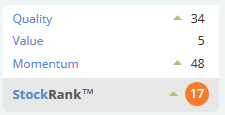
That's it for now. Hopefully there will be a few more of our usual stocks reporting tomorrow.
Have a good day,
Graham
Disclaimer
This is not financial advice. Our content is intended to be used and must be used for information and education purposes only. Please read our disclaimer and terms and conditions to understand our obligations.

10 comments
Hi Paul Really enjoy reading your notes - always very interesting. It would be great if you could attach a list most days of your high conviction calls - would this be possible? Many thanks
The Cerillion (LON:CER) CEO, Louis Hall, did a segment on Share Radio with Lord Lee. The interview can be accessed here (https://www.shareradio.co.uk/podcasts/my-portfolio-with-lord-lee-cerillion-15-mar-17/PodcastPlayer).
Very unlikely that the UK would continue to fund the university education of EU students here, but losing that cost would enable slightly cheaper fees for non-EU overseas students, which might offset any drop in demand for Empiric's properties.
I've argued before that foreign students, who make up the majority of Empiric's tenants, are likely to continue to study in Britain, regardless of Brexit. Especially the ones who can afford private accommodation in prime locations such as Empiric's: I would lean heavily toward the idea that visas will still be made available to these types.
I would tend to agree that European students would be likely to continue to get visas post Brexit (though that's by now means certain - recent governments have a poor record on understanding the scale of the foreign earnings brought into the country by overseas students).
However, visas are not the only issue. EU students can currently get funding for studying in the UK. I very much doubt that would continue in any likely Brexit deal.
It would be a mistake to assume that Brexit will have little or no impact on overseas student numbers.
I keep looking at Empiric Student Property (LON:ESP) as a potential long term income paying hold but I just can't see the dividends being covered by the net rents, which would give me comfort. I would not want to rely on the NAV going up.
langely,
Empiric Student Property (LON:ESP) is a REIT so nearly all the rent received has to go out as dividends. The management make more money by weekly extras (like laundry and food boxes). This is not income to REIT and goes straight into the pockets of directors of the "extras company" who happen to be the same as founders and significant shareholders and from memory also some overlap with directors of Empiric Student Property (LON:ESP) I have about 20% of my retirement fund in specialist REITs: Education, (ESP UTG UTG1) Health (PHP) and biggest individual holding is Tritax Big Box Reit (LON:BBOX) specialist distribution centres. If I were to do the "Desert Island Disc" choice I think I would keep Empiric Student Property (LON:ESP).
From memory most of Empiric Student Property (LON:ESP) 's students are from Asia and here for postgraduate study. They are the types less affected by tightening of migration controls as they pay their way and earn universities' money. I sold out of Empiric Student Property (LON:ESP) though because the NAV increases have been pedestrian. Personally I think there are better opportunities elsewhere that also provide a decent dividend and better NAV uplift such as Palace Capital (LON:PCA) or £BBOX
what the market has missed with Safestay is the arrival of PYRRHO INVESTMENT LIMITED on the register
Pyrrho is the family investment fund owned by a Hong Kong based property investment and development family. they are keen activist investors and now have 22% of the stock.
clearly they are not here for the sunshine and an improvement in occupancy drops straight to the bottom line.
Graham, for Safestay (LON:SSTY), working out available room nights is not as simple as taking the bed nights and multiplying by 365.
The complication is the Edinburgh hostel, which is rented out during the academic year as student dorms. I don't think they count those nights in revenue or room nights. From my understanding, Safestay only gets the rooms during the summer?
I might be wrong, and would love for someone to shed more light on their Edinburgh hostel!
Thanks very much, it sounds like some rooms are under that arrangement - I'll edit the report to reflect this.