Small Cap Value Report (10 Sep 2015) - RCDO, HYNS, COG

Good morning!
I'm starting to notice patterns in market behaviour in these more nervous/volatile conditions of late. Whenever there is a large sell-off in the USA, then the Futures seem to gradually recover the following day. Also, you see very little selling in UK small caps - no sign of panic at all today for example, even though the Dow dropped 465 points from its peak yesterday.
I find that rather encouraging - it suggests to me that UK small cap investors are committed to their shares, and not easily panicked. Although I have noticed very low volumes being traded in small caps on days like today - so it seems that buyers go on strike, rather than there being any meaningful selling on days like today. You can't dip in & out of small caps anyway, as the bid/offer spread will destroy your returns.
With a lot of positive newsflow and results being issued at the moment, this still feels like a bull market in small caps, even if the big Indices are struggling - a lot of which is due to particular sectors, such as oil/resources, and banks. So I think it's best to sometimes detach from looking at Indices, and focus on which sectors are under pressure, or doing well.
Overall, with the economic situation looking fairly positive here in the UK, and in America, and with signs of recovery in Europe, this doesn't strike me as a time to be particularly worried about macroeconomic things, any more than usual anyway. Cheaper oil is great news for most people, and most companies...
Petrol - disposable income
Some interesting read-across from big cap results today. WM Morrison Supermarkets (LON:MRW) interim results are not great, as expected, but I note that fuel sales are down 16.8% to £1.6bn. That is mostly due to the lower price of oil feeding through to the pump. So if we assume say 2% is due to lower footfall (carfall?!) and the remaining 14.8% is price deflation, then I make that a £278m "tax cut" for people who bought fuel at Morrisons in H1, or £556m p.a. I've no idea what market share Morrisons has for fuel, but for the entire market we must be looking at multiple £billions in extra disposable income in the pockets of the UK consumer. This has to be positive for consumer cyclical shares generally, and reinforces my view that this area is the best hunting ground for good shares at the moment.
Living Wage
Next (LON:NXT) is the latest company to comment on the impact of Minimum Wage increases, there's an article on CityAM here summarising it. Worst case scenario is they have to put up prices across the board by 1% - hardly a disaster, although mildly inflationary (good time to do it, when inflation is low). Although productivity gains should mitigate.
It's becoming increasingly clear that Living Wage shouldn't have much impact for investors, other than for marginal businesses which cannot pass on any price increases without losing business. Other companies will just hike prices a bit, trim staff rotas a bit, and profits should not be affected that much.
Another point to consider is the new pension arrangements coming in, I think in 2017? I've just been reading up on "auto-enrolment", and it seems to require employers to contribute up to 3% of employee wages into a pension scheme. What's the betting that, over the long-term, successive Governments will gradually increase employer obligations to fund pensions?
So it seems to me that investors need to think about these two headwinds, and ask companies how they will cope.
Ricardo (LON:RCDO)
Share price: 880p (down 1.5% today)
No. shares: 52.4m
Market cap: £461.1m
Results y/e 30 Jun 2015 - this is an engineering group, which I've not reviewed here before, but seeing as it's a quiet day for small caps results, let's check it out.
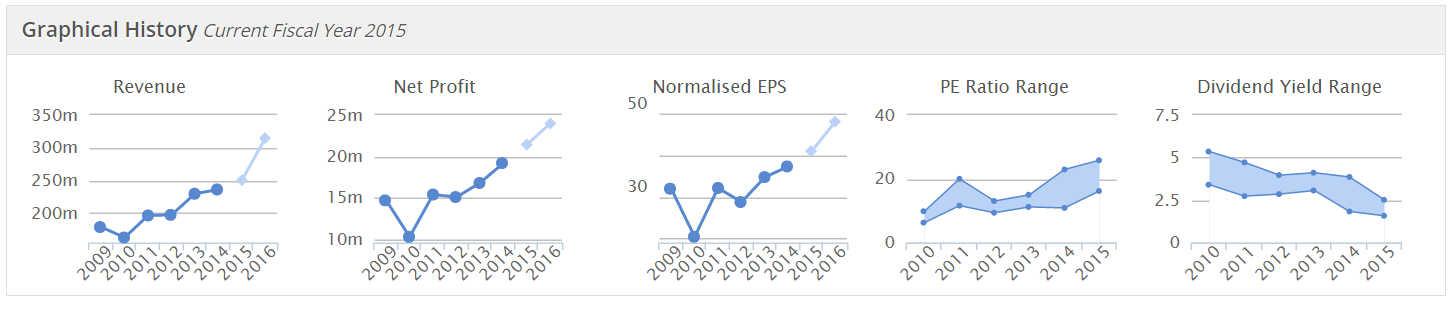
The Stockopedia graphical history shows a good trend of growing turnover and profits, forecast to continue. However, it also shows that the shares have been getting more expensive, with the PER range rising, and the divi yield range falling. That's not necessarily a bad thing, if the future potential of the business has been improving, but a higher rating eats into your margin of safety as an investor - you can't afford to get your research wrong, if you buy stocks on a PER of 20 or more!
Acquisitions - four have been completed in y/e 30 Jun 2015. Investors need to be careful not to over-value acquisitive companies - it's easy to mistake the step changes in profit from acquisitions for organic growth, and hence end up paying too high a PER for a business which might actually have little organic growth going on. You also have to watch the balance sheet, as it can rapidly fill up goodwill and bank debt. If you don't adjust the valuation for that, then you'll over-pay again, potentially.
Underlying EPS 42.4p (up 9.6%) - that doesn't seem much of an increase, so the acquisitions must have been quite small, and/or near the end of the financial year. The PER is 20.8 - rather lofty. Note the PEG will be expensive, unless more growth is feeding through into 2015/16.
The 42.4p EPS achieved is a beat against broker consensus of 41.2p (corrected from earlier typo - my apologies), which is encouraging - as it shows a company which is managing investor expectations well, and keeping a little bit back to out-perform on results day.
Dividends - total for the year is 16.6p (up 9.2%, similar to the rise in earnings). The company has established a good track record of progressive dividends, more than twice covered. The yield is an unexciting 1.9%. Still, that's better than cash in the bank, and it's rising a lot faster than inflation, so not to be sniffed at for long-term investors.
Net cash/(debt) - pleasing to see the company has net cash overall, not net debt. The figure is £14.3m. Although this net figure is split £59.7m cash, less £45.4m debt.
Ah, hang on a minute! Note that £40.6m was paid out the day after the year end, to complete an acquisition, and a further £3.2m paid for a smaller acquisition in Aug 2015, so the real position is now pro forma net debt of £29.5m, which looks fine given the size & profitability of the group.
Balance sheet - this looks solid to me. Net assets are £116m, take off intangibles and NTAV is £71.1m. The current ratio is healthy, at 2.12, but that will drop a fair bit post year-end due to the acquisition payments, but will still be healthy at 1.49 (calculated by reducing cash by £43.8m for the acquisition payments mentioned in the paragraph immediately above this one).
Note there is a pension deficit of £20.7m.
You have to think about the balance sheet in the context of how profitable & cash generative a company is, and in this case everything looks fine to me - this is a sleep fairly soundly at night type of stock.
Outlook - sounds pretty upbeat to me, although it's lacking any financial specifics;
Market conditions remain positive in the UK and Asia, with a good pipeline of defence vehicle activity in the US and recent secured wins in the motorcycle sector in Germany. We enter the new financial year with a good order book and pipeline across the Group, together with large, long-term assembly contracts and the addition of four new businesses, which all provide confidence in the further development of the Group. As we celebrate our centenary year, our order book and financial position provide a good platform for future growth and we continue to actively look for opportunities to expand and enhance our business.
Valuation - this seems to be a good quality business, which is performing well, and that is reflected in the valuation:

My opinion - based purely on a quick review of the figures, this share looks priced about right to me. I don't know anything much about the company, or its prospects - that's the research that other people need to do before buying the shares.
The market looks to have priced it about right, based on the facts as they stand today, which is good because that's what markets are supposed to do! The opportunity with this type of share, is to find companies which are likely to significantly beat market expectations, as that will then trigger a re-rating. I don't know anywhere near enough to make a judgment on that, so for the time being my view is that it looks a nice company, probably priced about right, based on the current forecasts for this year, and the historic numbers.
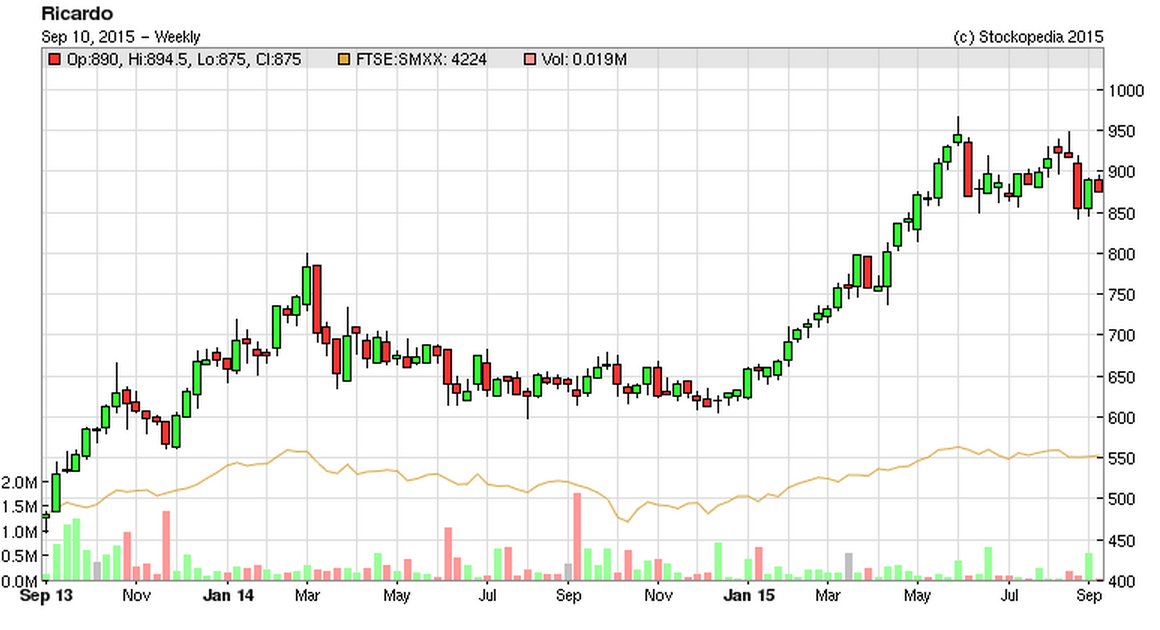
Bear in mind also that the shares have had a lovely re-rating in the last two years, so might be at the top end of what is reasonable for the time being perhaps? It looks the type of business that might get a takeover bid from the USA at some point too, so that could be a joker in the pack here possibly?
Haynes Publishing (LON:HYNS)
Share price: 112p (down 8.6% today)
No. shares: 15.1m
Market cap: £16.9m
Trading update - the company says it is required to make a "material non-cash impairment of goodwill", relating to its US operations. I don't care about writing off goodwill, because I always do that anyway, but the concern is that it is being done because their US operations are trading badly.
Overall though, group performance is in line;
The Group now expects to report a material non-cash loss after tax as a result of the impairment. Pre-exceptional items, the Group expects to report results in line with expectations.
Year to date operating performance within HaynesPro and Haynes UK is satisfactory whilst the US business is trading below expectations. The board of Haynes intends to launch an operational and cost review of the wider Group and will report to shareholders as the process progresses.
The trouble is, there don't seem to be any market forecasts, so in line with expectations could mean anything! Checking back, the last set of interims were pretty bad - turnover down 20%, and PBT only a whisker above breakeven.
The balance sheet looks superficially quite strong, but it contains very high inventories. There could be a need for a substantial write-down there at some point in future. Note also a hefty £14.9m pension deficit. It also had £1.0m in net debt.
My opinion - this is looking high risk now to me. The company is clearly going to have to strip out a lot of costs, in order to remain profitable at all, and keep the bank onside.
I suspect the divis are likely to be cut completely here at some stage, since cash will need to be preserved to repay bank debt, and keep topping up the pension fund.
Sadly, there's not much call for car repair manuals these days, so it's difficult to see much of a long term future for this company that I'm sure many fellow petrol-heads have fond memories of clambouring underneath my old car years ago, covered in oil, and constantly referring to my Haynes manual!
The best case scenario now is probably that management can successfully manage the decline, but I doubt there will be any value for shareholders, so with a heavy heart, sadly I'm putting the shares on my bargepole list.
Cambridge Cognition Holdings (LON:COG)
Share price: 75p (down 6.3% today)
No. shares: 17.0m
Market cap: £12.8m
Interim results - this is a very interesting little company, which has long-established computerised tests for detecting and monitoring dementia.
I'm a little disappointed with today's interim results. Although turnover rose 17.7% to £2.93m, the company reported a loss before tax of £0.28m - improved from the £0.47m loss in H1 last year, but I was hoping to see profitability, because it made a maiden profit of £0.18m in H2 of last year. So sequentially, this is a step backwards.
Although it's fair to say that at this stage of its development, the cashflow from profitable activities is being reinvested in growth. So as long as losses don't spiral, then breakeven or small losses are tolerable.
The company only has £1.26m cash in the bank, so not much headroom there, although no immediate cause for alarm either.
My opinion - I'll keep a watching brief on this one, as I like the company, its products, and think there is considerable long-term potential here. The CEO, Nick Kerton, who I met earlier this year at an investor event, has been seriously unwell, and receiving intensive treatment. May I take this opportunity to send him my best wishes for a full recovery. The COO, Steven Powell, is standing in as Acting CEO.
Disclaimer
This is not financial advice. Our content is intended to be used and must be used for information and education purposes only. Please read our disclaimer and terms and conditions to understand our obligations.

37 comments
Re: Haynes
Potential glimmer of hope -- chief exec is to step down:
http://www.investegate.co.uk/haynes-publishing--hyns-/rns/directorate-change/201509160904542112Z/
I note the RNS does not contain any farewell speeches, which tells me the Haynes family has indeed become serious about the 'operational and cost review' and maybe suggested that he retire. Outgoing chief exec has collected c£700k a year for at least the last five years through pay, pensions etc -- a fair whack given the size of business.
This management change does not solve the issue of declining demand for car manuals or the hefty pension deficit, but may indicate the family is (finally) taking some action to restore the group's fortunes.
Either that, or the chief exec knows how bad the situation is and simply wants out...
Mayn
Ricardo have been around for years, but as I believe a significant proportion of their work would still be automotive consulting, that's exactly the type of thing that gets cut back when there is a cyclical downturn. So I would price them as such.
As for Haynes, well:
1 A quick trip down to Halfords shows the range of manuals on the shelves covers a lot of older cars and even for some popular 5 year old cars, there is nothing on the shelves. That must hurt sales.
2 I wonder what percentage of their UK sales go through Halfords ? I suspect it is an unhealthy percentage.
3 Over the years, they have dumbed down, so there is less content in the manuals. They completely deleted certain sections claiming special tools are required, which in some cases is just untrue.
4 People now have the option of using the internet to find information on certain repairs.
Paul, I meant to ask you yesterday whether you might have the chance to have a quick look at the ATTRAQT (LON:ATQT) interims? You had mentioned them once or twice before. It seems to me that they have managed to squeak through on their bank balance without needing to raise further cash, and are now probably cashflow-positive in H2, with a strong growth profile ahead. Any comments (especially if it's a bit quiet on other companies!) would be much appreciated. I have a holding there. Cyber
Hi Cyber,
I did look at the interims from ATTRAQT (LON:ATQT) but didn't report on it, because it's too small.
I'm probably a bit biased, because I met mgt on a visit their office last year, and was impressed by the people and the product (merchandising software for websites). So when you meet, and like management, it can cloud your judgment.
Overall, I think it's too small for the time being, but that mgt could & should be running a much bigger company. So it's one to watch, but based on the figures, not one to get excited about at the moment, in my view.
Regards, Paul.
Cyber, Paul -
ATTRAQT (LON:ATQT) 's chairman is Dan Wagner who has a chequered history since the dotcom boom/ bust days, not exactly a flattering one. I personally would not invest in a company where he has an involvement.
Check out his entry in Wikipedia.
GDWN profit warning RNS timed at 4.23pm. They just don't care about PI's!!
Absolutely agree. Remember looking at the Goodwin (LON:GDWN) results and thinking they weren't too bad - but luckily never bought any shares.
This is taken from the FY results issued on the 24th July:
The Group order workload as at 30th April 2015 was 22% lower than twelve months earlier and stood at £79 million. This level of workload increased in the first two months of the new financial year such that as at the time of writing this report there is a possibility that the performance in this new financial year will not be as bad as feared.
One of todays main topics seems to be the minimum wage or soon to be "living wage". Everyone should be in a position where they do not need to receive benefits, apart from in the hardest of cases. Any pay rise should directly help them and not be taken away with one hand what has been given by another. I hear the same story now from employers about how they will not be able to afford the "living wage" and consequently they will have to reduce staffing levels and/or make cut backs elsewhere as I did when the minimum wage was introduced. Would those who are in the position of setting wages like to try and live on £6.50 hr?, have they any idea or interest in what that is like?. Do not those on the minimum wage, who work just as hard, and help make the companies profits and help to finance the huge wages of those at the top not deserve more than having to struggle to get by?. Seems one rule for one and another for others to me. It is a disgrace for companies to winge at having to pay more. Surely the employees should be viewed as the most valuable asset and not inferred the most expensive liability!. Rant (not intended) over.
On other matters - thanks Paul for the hard work you do every day and the time you put in bringing to our attention things which we could easily overlook in companies reports. It is all too easy to read what we want to and not what we need to. I know you take a lot of flack. One of the main dangers we have is getting emotionally attached and become blinkered. Yesterdays report on MONI is a classic example. I know there are many who would be up in arms about the views you expressed. You have saved many investors a lot of money by either NOT investing in a share or selling out, and then again helping to make money by buying in!. I do my own research but value your views as an additional tool.
Regards
Catsty
Paul- As a reasonably long term holder of Ricardo, i would say that your comments are spot on. Attractive, well run company with some really top end engineering projects both in the UK and beyond. Financials are good but significant uplift most likely from being acquired or making more game changer acquisitions. Given its proximity to Brighton, might be worth a visit?
I'm surprised at some of the comments on here
Auto-enrolment has been around since 2012 !!!!
This started with the larger companies - which are exactly those that readers of these boards are supposedly following - it's introduction has not only been staggered by size of employer, but also the contribution rates are being phased in
The other astonishment (imo) is that the living wage doesn't just affect those beneath it but all tiers above, especially those most close to it - as they in turn will demand pay increases to maintain differentials. Clearly this will hit companies and will involve far more than a little tweaking of the rosters - as Whitbread for example have indicated
hi Flackwell when I said "Auto enrolment is happening for from 1st October this year" I meant purely in relation to my small business.
With regards to the living wage do you think your differentials issue is a reason to carry on with state subsidised wages? Also I think this argument was one sighted when the minimum wage was brought in.
For the record I am a well right of centre self employed entrepreneur with 30 young relatively low paid employees.
Purpleski - My comment wasn't directed to you per se as a similar sentiment was expressed by the board's author which I must say took me by surprise
As to your question - I'm not sure that I have the answer but the central belief I hold true to, is that work should pay - if this has to be achieved partly through subsidy then I would accept it.
A friend of mine I believe has the simplest solution to the benefits problem - one which would save on enormous tiers of bureaucracy and that is to give everybody the same tax free flat rate sum each year.
Then if they decided to sit at home (or could not find work for example) then they would have to manage on this .
Alternatively any money earned over and above this is taxed - the beauty being that those who work receive more than those on benefits
As a solution its the best I've heard
Flackwell, I'm not sure I understood you correctly regarding the benefits payments.
Did you mean that the best idea you'd ever heard of was to give everyone in the country a fixed tax free benefits payment each year? Did you think how much this payment would cost(individually and as a cost to the country)?
To make it affordable, any fixed and universal benefits payment would need to be so low as to be of no use. So we would end up with a significant number of the population homeless and unable to buy food or clothes.
Given we're in a world-wide market place, I'd argue that as individuals and as a country, we need to sharpen up. Giving everyone hand-outs only makes us lazy and less competitive, globally. What we need to do is figure out a way to have people(and the country) become more self-sufficient, not work out a way to spend more money we don't have.
Regarding minimum wage, like purpleski, I used to be dead against it as I thought it was up to a business how it runs it's affairs. If people want better pay, let them move jobs, or retrain.....but I hadn't thought about how rampant government subsidy was, via the benefits system.
Any company requiring routine long-term subsidy does not deserve to be in business. It's quite scandalous that those on low earnings are indirectly funding dividend payments and millionaire director pay-packages. Not to mention that the debt that is funding this cycle is being passed down to our children.
If I need to pay an extra 20p for a box of eggs so that Tesco can pay it's staff enough to live on, then so be it. If Tesco's business model only works when it is underpinned by government help, then they need to make room for a company with a better business model.
Paul, thanks so much for your reports. When I resubscribe to this site later on this year, my decision to do so will be in part due to reading your informative blog. I hope Ed's giving you a kickback! :-)
Smythw - the NET cost would be lower
It would eliminate all of the duplicated administration that currently takes place and in itself be funded by all the taxes we currently raise
It would minimise fraud as every recipient would also need to file a tax return, thereby becoming fully visible to the state.
The concept of giving everyone a tax-free flat sum per year is known as a "Citizen's Income" (or similar name). It has long been a policy of the Green Party in the UK, and other parties on the Continent, but has always been seen as very 'fringe'.
Interestingly, the Finnish and Dutch government have recently started (or are seriously considering) pilots of exactly this concept in the real world.
It basically sweeps away almost the entire social security bureaucracy, pensions, means tests etc etc, saving huge amounts of administration costs for the Govt. Essentially every adult would be given by the taxman an amount, (say) £150 per week in the UK. If they are happy to sit at home and do not much at all, or are pensioners, or want to do unpaid voluntary work to help their community, or be a stay-at-home parent, or whatever, then they will get their £8K per year and have to live a basic lifestyle on that amount of money. If they want to have a better lifestyle then they can go out to work and earn (at least) the Living Wage, which would be in addition to their Citizen's Income, so a major change to their total income, thus encouraging work.
An income tax rate higher than at present would probably be required to fund this, but (as mentioned) there would also be billions saved p.a. by essentially scrapping most of the enormous social security bureaucracy and the entire concept of 'benefits', including jobseekers' allowance etc etc. The only benefits remaining would be perhaps disability benefit, or assisting other people who need specific help with their health needs. Tax-free allowances would also need to reduce to the level of the Citizen's Income, and tax credits and other in-work subsidies would be abolished.
That's my understanding of Citizen's Income anyway. Here endeth the lesson!
Able bodied people should not get long term benefits for doing nothing.
If they choose not to get a job, then after 3 months they should be picking litter or doing some other service for 2 days a week, increasing to perhaps 4 days a week after 6 months. Leave them 1 day a week to look for a proper job.
I completely fail to see why we have to pay taxes to fund able bodied people who choose a life of indolence.
I agree there is a question of 'moral hazard' with Citizen's Income. In the Dutch and Finnish pilots, the level of the Citizen's Income is a controversial one, for that reason.
However, £8K p.a. (say... it could be less) for a single person is not really enough to have anything more than a very basic lifestyle of a Council bedsit, food and drink, some budget clothes on your back, and the odd beer if you're lucky. So it's not a strong hazard.
I would be happy enough to see the stipulation that able-bodied people aged 18-65 had to do 2 or 3 days' supervised/verified voluntary work per week to help their community, in order to get their Citizen's Income.
Also consider it would remove many of the benefit traps currently in place. No taking home less money for doing more work!
It is an interesting proposal however I do think that it will lead to more people not working and maybe more immigrants coming to the UK for the money. Also more people would retire early. Just think you can get minimum wage plus £8k pa. So if less UK residents work and more immigrants work here and send money back home then maybe not so good for UK economy? Yes basic living if you have to rent or buy your own place but if living at home or a student its OK. Other problem would be more tax on those working to pay for it all.
Basic income programmes can be seen as a substitute for the minimum wage and combined with an abolition of the minimum wage. The main problem the minimum wage solves is the power imbalance between desperate low-skill people and employers thereof, which is to an extent also solved by a basic income: it means the workers are not starving so don't have to accept really crap and badly paid jobs just to eat.
Re making a country with a basic income too attractive for immigrants, you can put a citizenship or long term residency condition on it if that's a concern.
"More tax" not necessarily in aggregate: you can introduce a basic income programme in a tax-neutral way: you basically take the current welfare budget and income tax schedule, and redshuffle them so as to have the net cost unchanged (old style welfare cuts = net basic income outlay). You may not quite get 8K that way but perhaps not far off. You also want the programme to be neutral for well-off people, as the point is not to make them richer, so the well-off basically get the basic income in the form of an 8K tax credit matched by a rescheduling of the tax bands to add 8K of tax, so as to make the operation cash neutral for them (which makes the net cost much less than 8K * population).
Yes I understand it but you are giving this to everyone not just people on benefits. Re citizen would this be allowed I think the Govt. already want to do that so immigrants can't claim benefits but it seems the EU don't allow it? More tax, I still feel that is a lot to get back in tax (£400billion) so really the workers and the rich will be paying a lot more tax. Less women working?
Flackwell said;
"I'm surprised at some of the comments on here
Auto-enrolment has been around since 2012 !!!!
This started with the larger companies - which are exactly those that readers of these boards are supposedly following - it's introduction has not only been staggered by size of employer, but also the contribution rates are being phased in."
Err, the clue is in the name, this is the Small Caps Value Report, so no, I'm not supposed to be following larger companies!
I was already aware of auto-enrolment, but hadn't looked up the details. In all the hundreds of small cap company announcements I've read, not a single one has mentioned auto-enrolment, whereas they are starting to mention Living Wage.
Therefore, as I reported today on Living Wage (because it was topical, with Next mentioning it), I also thought I'd flag up auto-enrolment pensions as a related issue, that investors might want to have a think about. I've not seen this issue flagged up by other commentators, so am unsure why you have reacted in the way you have - it comes across as a bit pointless & haughty actually!
Paul.
Paul, interesting that you think of the living wage as a headwind, of course for some companies it will be however it will give a bit more money to a lot of people. Interesting to consider what they will do with this ?
which companies might benefit from this additional money ? it's going to go somewhere !
K
Hi K,
interesting that you think of the living wage as a headwind, of course for some companies it will be however it will give a bit more money to a lot of people. Interesting to consider what they will do with this ?
Ah but you're forgetting that the higher Living Wage is going hand in hand with deep cuts in Tax Credits. So there won't be more money sloshing around in the economy, it's more that employers are being forced to take up the slack as Govt subsidies to the low paid are reduced.
This is absolutely the right policy, as Govt subsidising low paid jobs is an appalling concept!
Regards, Paul.
Hi Paul,
If you're stuck for a stock or two to review, you might want to look at a few from earlier in the week - Maintel Holdings (LON:MAI) seemed rather bullish on their outlook.
Regards,
Sully.
Hi Paul,
since we're thin on results for smallcaps can I entice you to look at Dunelm (LON:DNLM) since they have reported their finals. They have the foundation set for the next phase of their growth strategy which I very much liked reading. I am more interested in their future potential as opposed to what we are getting now but mind you they have increased sales and profits every year since IPO.
I have been a LT holder since 2011. Been happy with the performance so far but feel we are still going to get more.
Hi Paul
I think there's a typo in the Ricardo (LON:RCDO) write-up - broker consensus EPS was 41.2p.
Disc: I don't have a position but it looks like a nice company.
Regards,
Imran.
Auto enrolment is happening for from 1st October this year. In principle it is a good idea but as always with so many things implement by government it is a mess.
- the compulsory contributions are not enough from either side and will mean that employees think that they will have sufficient pension when in fact they will be woefully underfunded.
- opting out is too easy and I can imagine employees being encouraged to opt out
- the contributions don't go into one pot as they do for example in Singapore. They go to the fund of the current employer so 10 employers possibly 10 pots.
All my employees work abroad so I am not obliged to enrol them but I am going to because it is the right way to go.
I think long term consumers have to learn to live with the actual cost of something not the cost because of a low savings rate or state subsidy of wages (tax credits).
I used to be completely against the MW but have come to realise that the market in wages is dysfunctional and needs to regulated in a reasonable way.
Hope this comment is not too off topic or too political.
Broker consensus should be 41.2p -not that it makes much difference. Good piece.
Hi hayashi22 & Imrankhan,
Thanks for pointing out my typo - and profuse apologies, I have now corrected it.
Making errors on the figures is unforgivable, and that's why I check all my figures as I go along. So quite how my brain didn't spot such a stupid error, is beyond me.
I wrote the figures backwards! Instead of 41.2p (correct), I typed 21.4p - what an idiot! I have now corrected the article, and thank you for pointing out this stupid mistake of mine. I'll check the figures more carefully in future.
Regards, Paul.
Although this situation does remind me of the punchline from this classic sketch! ;-)
No problems Paul - although its imranawan - not imrankhan, the famous cricket player (I wish)!
I find it amazing that you're able to produce really detailed write ups for readers and especially find your deconstruction of the financial statements really useful.
One point about the Ricardo (LON:RCDO) results - they purchased intangible assets of £5.5m, whereas the amortisation of acquired intangibles was smaller. I assume the purchase of intangibles is bypassing the P&L. Purchase of intangibles is small in comparison to net profits, but something worth keeping an eye on.
Paul,
To put your mind at rest that you might be becoming numerically dyslexic (or worse) what I think you did was to take the forecast net profit figure for Ricardo instead of the forecast EPS. It just happens these are the same numbers but in different orders. Easily done.
Could you correct the "this classic sketch" link though as I think I know what you meant to link to and it was much more fun than another Cambridge Cognition RNS! EM and Andre Preview...they don't make them like they used to do they.
A
I think I'd better just stop typing for today, as that's now 3 mistakes I've managed to make!!!
Here is the correct link I intended to provide before! A sketch which is particularly appropriate given my lack of typing skills today!
(going for a lie-down!!)
P.
thanks for the link Paul hilarious and unfortunately I am old enough to remember seeing it when it was first broadcast. I don't think they make them like that any more!
Enjoy the lie down.
I am going to really confuse you. Maybe the wires in your brain didn't get crossed and you typed 21.4p instead of 41.2p, maybe you picked up the number just above the eps forecast of 41.2p in the StockReport by mistake which happens to be net profit forecast of 21.4. :-)
Paul,
any thoughts on GED - half yearly results out today seem to indicate it is still only valued at around GBP 12M whilst having cash of USD 35M and total net assets of USD 54M.
Many thanks for all your great work.
Hi Paul - commenting here because I didn't get the chance to post yesterday:
"I must email Mr Buffett, to ask if he'll do an audiocast with me instead!"
How can we make this happen?!