Small Cap Value Report (12 Jul) - TMMG, QED, FBT, PMP, ALU, LRM

Good morning! Markets in the US and Asia have been fairly well behaved overnight, so we're looking at an open here about level, with the FTSE around 6,551.
On Weds (10 Jul) I mentioned that Mission Marketing (LON:TMMG) looked potentially interesting. It dipped 12% on that day to 23p per share after a mild profits warning, although I still quite liked the look of it on valuation grounds. The price bounced back yesterday to just over 24p, and it is announced this morning that their Executive Chairman has bought 120,000 shares at 24p each, so that's a outlay of £28,800, which is enough to be meaningful in my view.
Generally speaking, any Director purchases under £10k, especially orchestrated ones where several Directors buy at the same time, are counter-productive, since it just looks like they want to push the share price up, but are not prepared to back it with any meaningful amount of money. But £29k is a decent enough slug of dosh to lay out in a small cap, so this one gets a thumbs up from me.
Quintain Estates And Development (LON:QED) announce that their JV to redevelop Greenwich peninsula in London, has secured three positive planning decisions. I gave up on Quintain shares a while back, as it became clear that their projects were so long term (20 years in the case of Greenwich), that it was difficult to see how shareholders would benefit.
Furthermore, I am more convinced than ever that UK house prices are a huge bubble that will inevitably burst when interest rates rise. If you look at mortgage payments relative to incomes, they are currently affordable. However, if you recalculate mortgage repayments at a more normal interest rate, then they become completely unaffordable.
This will inevitably lead to a deluge of sellers, especially "accidental" landlords who thought they were onto a good thing by letting out their old house rather than selling it, and making a big profit on the rent, and assuming that prices would keep going up forever. When interest rates go up, they will begin to feel real pain for the first time, and after a time lag, many of those properties will come on the market. As supply builds, and sellers become more desperate, prices will have to fall.
The idea that interest rates will remain at 0.5% until 2015 seems unlikely to me. The economy is spluttering into life again, and sooner or later our interest rates will have to rise to prevent a serious fall in sterling.
It is for these reasons that I am completely avoiding housebuilders, and residential property companies, as it seems likely to me that they will run into serious headwinds in 2014 or 2015.
Forbidden Technologies (LON:FBT) have successfully got away a Placing & Open Offer at 20p per share. It will result in the issue of 44.56m new shares at 20p, which is a sizeable deal, at about half the existing equity being issued in new equity.
I simply don't understand the £19m market cap here, as based on the historic numbers, you would struggle to value it at a quarter of that. So investors must be convinced of the growth potential for their cloud-based video editing software. It's not my sort of thing at all.
One of my favourite shares, Portmeirion (LON:PMP) announced yesterday that they are putting some of their cash pile to use. They have bought the long lease for their warehouse & head office building, for £3.9m. This will eliminate a cash outgoing of £306k p.a. for the rent.
The P&L impact is smaller, at £220k p.a.. I queried why this was lower, and the reason is that they are now depreciating the buildings they own over 50 years (not the land), and there is also a small offset for the lost interest received.
To my mind this is a sensible deal, as at the last reported Balance Sheet they had £7.5m in net cash, generating only £39k p.a. in interest income. So investing £3.9m of that in order to eliminate a £306k p.a. cash outgoing is clearly very sensible.
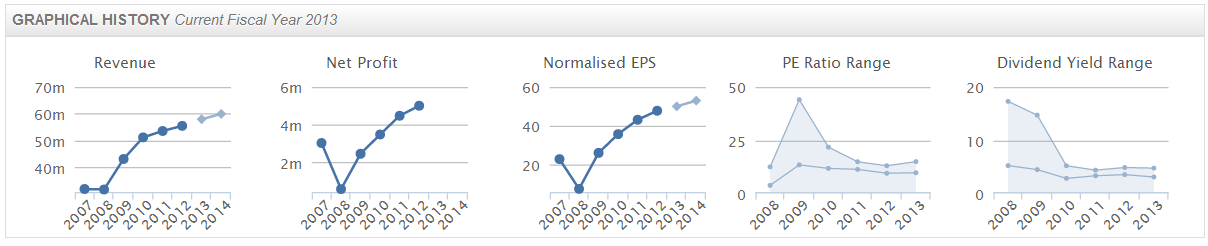
On the back of a positive write-up in this week's Shares Magazine, and possibly a positive reaction to the warehouse deal, the shares have ticked up a bit this week. I hold shares in Portmeirion, and as reported here a few days ago, have recently topped up my position. To my mind, the quality of the business: it's decent operating profit margin, earnings & dividend growth, plus the reliable nature of revenues from iconic product designs, and the bullet-proof balance sheet, deserve a much higher rating. It should be priced as a luxury goods business, on a PER nearer 20 in my opinion, not a forward PER of about 12 as it is at the moment.
There is a small pension deficit here, but it's only £5m, and is likely to disappear as bond yields rise, and in any case there is almost enough cash in the bank to eliminate it, even after this property deal.
Check out the useful graphical history charts on Stockopedia to see what I mean about the quality of the business at Portmeirion:
Alumasc (LON:ALU) was just beginning to look interesting when I last looked at it on 15 May after an in line trading update, with my comments being (and apologies for quoting myself, but it saves time by checking the archive here, and that's what the archive is there for!):
Alumasc (LON:ALU) issues an IMS today, which states that full year trading (they have a 30 June year end) will be in line with expectations. They describe the order book as "healthy". Might be worth a look? Although as I commented here on 5 Feb 2013, the valuation doesn't look quite so cheap when you factor in a fair bit of debt, and their pension deficit. I thought it looked fully priced at around a quid a share, but note that it's somewhat cheaper now at 88p. The dividend yield is starting to look interesting, at 4% forecast for this year, and 5.2% for next year.
The good news for shareholders is that their trading statement today is more upbeat, saying that "underlying group profit before tax for the year will be ahead of management's previous expectations".
Cashflow has also been good, with net debt expected to be c.£8m. Their order book remains strong at £44m.
So all looks pretty good. The shares are up 17% this morning to 110p.
It's difficult to say whether they represent good value or not, as we don't know by how much they are likely to exceed expectations. Consenus forecast for y/e 30 Jun 2013 is 9.4p normalised EPS, so at a guess I would say they might come in actually in the 10-11p range perhaps? So the shares are probably on a PER of about 10 after this morning's rise.
Net debt of £8m is fairly material, in the context of a £37m market cap.
Checking back to the last interims, the pension deficit was £13.7m at 31 Dec 2012, so again a fairly material creditor there, so I would want to read all the notes about the pension fund in the last Annual Report before even considering buying the shares.
The valuation doesn't look particularly appealing to me, but it depends on what you think the prospects for trading are like - if continued improvements in trading are likely, then the shares could be cheap based on future profits. I don't know anything about the business, so do not have a view on that, but it might be worth looking into, as the figures are showing a company that's performing well.
There are two announcements today from Lombard Risk Management (LON:LRM), a software company to the financial services sector.
They announce a smallish Placing, to raise £2.6m through Placing 23..6m shares at 11p. In my opinion, there are five things to check with all Placings;
My checklist for assessing Placings
1. What is the discount to the market price? The smaller the discount, the better, as a small discount demonstrates that there was good demand for the Placing shares. A larger discount means the company is desperate & struggled to raise the money. Also, existing shareholders don't want to see new shareholders getting cheap new shares, and there is the danger they will "flip" the shares for an instant profit, so a large Placing discount will tend to pull down the share price post the Placing, and act as an anchor on the future share price.
2. What dilution is there? i.e. how many new shares are being issued, relative to the existing number of shares. Again, less dilution is better for existing shareholders. More shares in issue means that EPS falls proportionately, as do dividend payments, etc., so generally dilution is a bad thing. The exception is where a company is investing in something that is so good, that the returns from the investment outweigh the impact of dilution (a good example of that recently was Newriver Retail (LON:NRR) doing a large Placing, but to invest in high yielding property, which should not dilute existing EPS or DPS, once the funds are invested).
3. Who is taking part in the Placing? Providing points 1 & 2 above are acceptable, then I like to see Directors taking up a meaningful number of shares in a Placing. The more skin in the game, the better (up to about 15-20% of the total issued share capital, which is the point where Director holdings become too dominant). I also like to see known shrewd investors taking part.
4. Are the adviser fees reasonable? Frankly, Placings do not involve a lot of work. I've taken part in a few, and they are quick & easy to do. So fees over 5% are taking the proverbial, but you sometimes see fees as high as 10% for very small Placings. At that level companies are better off doing Placings privately, with angel investors, or groups of High Net Worth (HNW) investors, by-passing the expensive City firms.
5. What are the Placing proceeds being used for? Each situation is different, so that needs separate analysis. Generally speaking though, if the funds are being raised to make a sensibly priced, earnings enhancing acquisition, then that is good. Other good reasons would be to strengthen a weak Balance Sheet, and to invest in new products which have genuinely exciting potential.
Going back to the Placing from Lombard Risk Management (LON:LRM) today, it passes tests 1 & 2 above, in that the discount is modest at 6.4% to the previous mid-market price. It is not unreasonable for people buying large blocks of shares in an illiquid company to ask for a bit of a discount, to compensate them for the illiquidity. A discount under 10% is OK in my view.
As regards dilution, the existing number of shares is 232.6m, so the issue of another 23.6m is slightly over 10% enlargement of the share capital, which again looks fine to me.
As regards point 3 above, there is little detail of who is buying the new shares, other than the disclosure that a new Director, John McCormick, is expected to be appointed in Oct 2013, and is buying £500k of the Placing shares. Interestingly, he is currently Chairman & CEO of Royal Bank of Scotland in Asia Pacific. So a heavyweight banker joining the Board, and buying a decent slug of shares in itself should excite some investor interest. He must see potential here.
As regards fees, I can't see any reference to what the net proceeds are.
The reasons given are: to accelerate product development, to provide additional working capital, and (same thing really) to strengthen the balance sheet.
(note: my computer just crashed, so I'll carry on updating this article, even though the 11am email is about to go out!)
Turning to the other RNS from Lombard Risk Management (LON:LRM) today, it's an AGM statement. I was initially excited on reading this statement, as it says that trading since the (31 Mar) year end has been in line with expectations. There have also been new licence wins in recent days, including a major Asian bank, and to Bank Leumi (never heard of them) in the UK and US.

The PER looks very attractive at 7 for this year, and 6 for next year, and they should now be cash positive. So I looked through the most recent accounts, but the trouble is (as with a lot of software companies) Lombard Risk are capitalising their software development costs. This actually creates almost all the adjusted profit. Adding back the development spend, they hardly make any profit at all.
In fairness to the company, they are not trying to conceal this, quite the reverse - it is stated clearly in the headline figures to their last set of accounts.
So on balance, I'm not prepared to value the business on a profits measure that strips out a large part of their costs, which I would argue are essential costs for a software company. The moment you stop developing the products, you wither away & die.
OK, that's me done for the day, and the week. Wishing everyone a pleasant weekend, and see you back here on Monday morning, from 8 a.m., which is when I start publishing these articles in stages, between 8 a.m. and 11 a.m., which is when the email goes out. There's a link to the email list below each article.
Regards, Paul.
(of the companies mentioned today, Paul has long positions in PMP and NRR, and no short positions)
Disclaimer
This is not financial advice. Our content is intended to be used and must be used for information and education purposes only. Please read our disclaimer and terms and conditions to understand our obligations.

13 comments
The December 2015 futures show short rates at 1.25% if I'm not misreading the prices. This is probably stll low enough to not cause a disaster. The market might get that wrong but then people have a way to put their money where their mouth is (and if they don't, why?), and in theory shrewd people with big floating rate mortgages can hedge away their exposure cheaply.
Personally I think the scenario Paul outlines might well happen, especially if rates overseas do move, but 2015 may be too soon. Two headwinds: central banks can sell the QE stock, while it lasts, instead of changing rates to implement monetary policy, and politics want banks to be run as solvent entities which pushes regulation, capital ratios, etc which pretty much substitutes for a rate increase too. I don't find it likely that we get healthy banks and have exhausted the entire QE stock by 2015.
It is with great sorrow that I wholeheartedly agree with the comments expressed by SevenPillars & Monty9. Why oh why cant the housing market in this country be run in a sensible economic way?
I'm an active buyer of property at the moment as in many areas in the midlands and north it generates very good yields. My hurdle for investment is a 10% gross yield , this is readily achievable and is then magnified further by portfolio finance at c. 65 % LTV. Voids are low as stricter lending criteria mean many prospective tenants are happy to let good quality well refurbished properties long term whilst they repair their credit rating and or save for a deposit. Many people are also happy to rent in perpetuity as they have lost faith in the "ladder" and now have a clearer sense that property is not a get rich quick asset class.
Those yields underpin prices very strongly in my areas of investment. Elsewhere in prime areas prices seem steady and talking to Agents they are seeing a healthy market with a higher number of cash buyers than in years gone by.
London and Home Counties property seems to be in a world of its own where different rules apply and I'd imagine it feeling overheated to those living there but recent unrest in the Middle East and Euro related issues have given it Global "safe haven" status for wealthy folk from all over the world.
I have 2 overseas friends buying homes for cash in London who view it as insurance against upheaval in their own countries, one is moving his family here whilst he continues to manage his business in the ME, the other will rent it out at a piffling 3% yield but will retire here in years to come.
So who knows where value will go?
Cheers
Greetings all
The property market in the UK is highly fragmented. London and the south are booming, elsewhere there is stagnation, and in some areas falls continue. However the relative value of the rising area (geographically small as it is) outweighs the rest, and skews the entire market. There are indeed plenty of bargains in some areas of the north, but you need to be very selective. Property up here where I live is still being dumped, and there is uncertainty and instability in the market. ( Newriver Retail (LON:NRR) really seem to know what they are at!) I cannot afford to get into this market anyway, but love to watch what is happening. Another crash may well happen, but I think that will have to wait until the recovery in prices is more complete and more widespread.
On Lombard Risk Management (LON:LRM), I bought in here a while back after looking at the fundamentals. I thought a rise to c12.5p might be possible. This would be driven partly by the fact the company is marginally profitable and pays a small dividend, but also by the perception that its products are essential, non-discretionary spending for the banking sector. However the recent rise seems to have been driven by speculation, posted on boards with no supporting evidence, that a takeover is possible or even probable. I am hoping there is little down side from here, but don't expect to be able to retire off this one!!
Sorry, forgot to say Mission Marketing (LON:TMMG) seem to have lost a couple of big contracts (inc. B&Q?) and this has not been reflected in the share price yet. This will take some replacing!
On housing, people seem to fall into 2 camps. Those that live in London and cant believe the increases, and those who live outside and wonder what all the fuss is about.
You need a long memory. In times gone by, London would lead the way and after a while the rest of the country would follow. I am sure this will happen again. And it takes many years to work through the process. The government has (quite rightly) decided to stimulate the economy by a cheap lending scheme; its a pity it wasn't done a lot earlier. Houses tend to work in chains - a new purchase sets of a trail of earlier buys and sells and many tradesmen benefit, not to mention carpet companies, B&Q etc. Some people make a windfall, and they spend that in the economy. I would be looking for regional housebuilders right now
The Government are playing a dangerous game with their latest intervention in the UK housing market with Help to Buy. Every scheme Government tends to come up with under the disguise of helping those priced out to get on the ladder only assist in keeping prices at what have become artificial levels. Prices then have a tendency to go up higher and the ladder is further out of reach.
The problem now is that UK house prices have become so central to the working of the UK economy that no Government is likely to sit back when it looks like the free market might be intervening and sending prices down. We have a housing market where it is free as long as prices are going up, but intervention is called for when it goes down. It's a farce.
What many have really failed to grasp is that the true driver of prices for many years prior to the 2008 financial crash were not just the banks loose lending practices, but also the fact that as prices went up ever higher people could only get in by going for the most dodgy mortgage products like self cert and fast track. Banks didn't check income claims, mortgage brokers turned a blind eye and encouraged people to lie. Self cert mortgage products were the fastest growing part of the mortgage market prior to 2008. We can all guess why. It was criminal fraud on a massive scale, but most got away with it. Unfortunately, we suffer the consequence of it today as most FTB's cannot afford to buy without help from the Government.
The froth in prices wasn't blown off by the financial collapse of 2008. Banks withdraw the dodgy products, people couldn't get the mortgage loans they could before or claim an income they didn't have, so now the Government steps in and offers to pay 20-25% of the deposit because the market was stagnant. The only reason why house prices didn't crash in 2008 was because it benefited from the Government intervention to rescue the UK's bankrupt banking system and BoE money printing. No recession/depression, no mass unemployment, negative equity, etc, no reason for people to sell houses at lower prices.
This financial "rescue" might be welcomed by some, but it means house prices remain artificially too high and in a permanent bubble state. The real problem is this inflationary money "printing" system that we seem to have become slaves to. By default it endangers the whole economic system if asset prices look like declining, hence policies and central banker action to prop them up.
By the way, I'm bullish on housing stocks because I can't see how they cannot fail to make money with Help to Buy in place. It's an off balance sheet scheme that could pump £billions into the UK housing market. I also believe that this scheme or something else like it is here to stay - a prop to prices forever. That and IR's will probably stay in a permanent low level state just like Japan. Eventually the Government will probably buy the whole house for people. They will do that before letting prices fall. Ironic, but this is the new housing benefit that politicians actually love giving to people.
It's always interesting to hear a discussion about the "housing market" south of Watford. Perhaps I might give a more Northern perspective?
There have been huge regional variations in the UK housing market for some time and it is no longer helpful or relevant to discuss the UK housing market as a single entity. For instance, here in the the North West prices in some areas have fallen significantly from their peak and are not showing much sign of life as yet.
There are many parts of the region where perfectly reasonable property can be purchased for 50 - 100k. In some places even lower prices exist. Does this sound expensive? If these prices have to fall further, then by how much?
If property prices were to fall further in depressed regions and mortgage interest rates rose then a huge number of decent people would be in severe financial distress. These people are mainly low income and would have to cut spending in other areas in order to fund mortgage payments. If their homes were to be repossessed they would become homeless and then have to find rented accomodation funded to some degree by housing benefit.
Needless to say the economy would suffer by the lack of spending, banks would have to make further write downs on their property loan books and the FTSE could well head down to 4000 or worse. I suspect that avoiding house builders and residential property companies as investments would offer no protection whatsoever against the forthcoming financial storm.
I dont know London that well. It seems a bloated and excessive sort of place and I can imagine that it could well have bloated and excessive house prices to match. That doesn't mean that the rest of country has the same problem. The ideal situation for depressed regions is that house prices stabilise and then rise gently and predictably so that lenders are encouraged to take a more balanced view of risk and lower the amount needed for the initial deposit.
In my view calling for the housing market to fall is extremely dangerous. I can't see that it would benefit anyone and has the capacity to completely reverse the UK economy. Its very much a case of be careful for what you wish for.
I think the issue is that sterling interest rates will, at some point, increase. Governments will do everything possible to delay this as voters will be angry and blame them, with some justification. It will also make the interest rates payable on the national debt unsustainable. They will probably print more money and even try to raise taxes further. Interest rates will increase, but perhaps after inflation returns with a vengeance. My best guess is those that can afford to pay the increased interest will find the mortgage debt will inflate more than the interest cost increase, and the real price of their house will reduce a bit but increase in nominal terms. Unfortunately it is those at the bottom end of the market that are likely to suffer, whether in overpriced London or the good value north. They will find it hard to maintain their payments and their tenure will be at risk. I do not wish for this, but fear the failure by government and citizen alike to acknowledge the true state of the economy makes it inevitable at some point. The longer it is put off ("kicking the can down the road") the more miserable the readjustment. In the UK it is housing in which people invest most of their wealth and thus what will hurt them most. All we can do is try to plan for increased interest charges.
Hi Paul. I know that like me you don't go in for mining companies, especially gold miners. However I would be interested to hear your thoughts on Anglo Asian Mining AAZ. I do have a small holding and believe that it is a reliable (to date) well run and managed business with low production costs. It looks extremely undervalued at the current price, especially considering recent newsflow. There is also talk of a small dividend in 2014. I first discovered this company at a proactive investors presentation.
Something else to consider about TMMG is that after announcing that a recent acquisition was going to mean £1.5 million in "restructuring" costs the next day they awarded themselves 2% of the company in LTIP shares.
I wonder who the company is being run for.
good point duece - i noticed that too.
Something else to consider about TMMG is that the board have now all but guaranteed a dividend this year, thought to be 1p. That gives a 4.3% yield 5x covered!