Small Cap Value Report (18 Aug 2015) - CGS, HAT, APC, MNZS

Good morning!
Trading volumes are extremely light again this morning - about a third of the companies I monitor haven't had any trades at all yet this morning (at 9:10 am). Thin markets mean more pricing anomalies occur, so I like this time of year!
I've had some excellent results recently, from reacting quickly to positive trading updates (e.g. accesso Technology (LON:ACSO) and MySale (LON:MYSL) ), as there is often a delayed response at this time of year, because so many people are away on holiday. Or, the share price may not move much initially, because the buying might be offset by a stale bull selling. All of which can create an opportunity to load up at a favourable price immediately after good news.
On that point, the key thing is to separate genuinely good news from spurious RNSs. Jam tomorrow companies are notorious for this - they put out repeated good news announcements, designed to push up the share price primarily (in advance of the next Placing), so investors develop an impression that everything is going brilliantly. Then the results come out, and they're diabolical!
So when I read RNSs, I always try to think how the news might affect the company's profitability. Above all else, the key phrase to look for, is "exceed market expectations", or similar. If that phrase is missing, then the news being announced is probably not material to trading, and should largely be ignored. Maybe a contract win has just replaced another contract lost? Isn't it funny the way companies only tend to announce the contract wins, but usually keep quiet about losing customers?! (unless it's a catastrophic loss, in which case they have to announce it).
Equally, the little graph on Stockopedia which shows changes to broker consensus EPS forecast over the last 12 months is invaluable. Most companies work quite closely with brokers, and will give them a lot more information than PIs have. So if you see earnings forecasts being guided down gradually, then it could mean something is going wrong, and is often a precursor to a profit warning.
An AIM CEO once told us at a presentation, that with small caps, the house broker forecasts are effectively the company's forecasts. Usually, the FD will have been through the numbers in detail with the analyst, and will have guided the analyst to a number that he/she is comfortable with.
Mind you, having said that, I've also seen plenty of broker research which is complete nonsense - where obviously unachievable forecasts have been put out, and missed by a mile. So everything needs double-checking for reasonableness.
Castings (LON:CGS)
Share price: 445p (up 2.3% today)
No. shares: 43.6m
Market cap: £194.0m
AGM statement - annoyingly, Castings issues these during market hours - at 9am today. This is very bad practice, as the convention is that trading updates and results should be published at 7am, so that investors have an hour to digest the news before the market opens.
It's not even because the news is issued at 9am to coincide with the AGM starting. The AGM actually starts this afternoon, so I cannot fathom why the trading update was issued at 9am today. This is distinctly unhelpful for shareholders & potential investors, to release price sensitive information whilst the market is open.
On a more positive note, my experience of Castings announcements in the past, is very positive. They have a track record of being completely open & honest about current trading. One announcement in particular sticks in my mind, where the company said a while ago that it simply didn't know what the outlook was like, as it was too unpredictable at the time. Things turned out OK in the end, which again impresses, because it suggests management err on the side of caution, rather than blagging it.
This prudent mindset also comes across from their balance sheet - which is fantastic - one of the best out there. It's bulletproof, with plenty of cash, no debt, and lots of other assets. People might say it's inefficient, or that ROCE is too low, but personally I'll happily take a balance sheet stuffed full of surplus assets, over a higher ROCE any day.
Actually, I think the whole concept of ROCE is badly flawed. I can see the value of calculating what return can be made from new capex, and obviously we want that to be as high as possible, but I would much rather a company held surplus assets so that it can survive & prosper during recessions, rather than strip its balance sheet bare in the good times, in order to increase ROCE, but have nothing to fall back on in the hard times. What use is a high ROCE if you go bust in the next economic downturn?
The ideal situation (for me anyway) is to strike a balance of reasonably good, but not necessarily sector-leading ROCE, combined with a strong balance sheet that enables everyone to sleep soundly at night. Feel free to disagree on this point, it's only a matter of opinion.
Sorry, I'm rambling around the point here. This is the trading update today;
Following the statement in the Chairman`s report in June, it is pleasing to report sales volumes are still improving in particular in the commercial vehicle sector. We see no change in the foreseeable future and provided there is no adverse economic and world news it is expected profits will improve on last year's level.
That sounds fine, but a comment about performance compared with market expectations would have been more useful & relevant, but was not provided.
Valuation - it's important to note that the market is already anticipating an improvement in profits on last year's level, so today's update is consistent with that, as far as we can tell.
Going back to what I was on about earlier (re broker forecasts), note that the consensus edged up in Jun 2015 (see graph below), which indicates that things are probably going well:
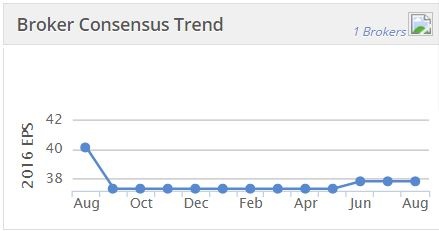
Broker consensus is for 37.8p EPS this year, up from 31.8p last year (which was a bad year). So the PER at 445p per share is 11.8 times this year's forecast EPS.
Once you adjust for the very strong balance sheet, the PER would be a good bit lower. By my reckoning, the balance sheet contains about £60m (maybe more) in surplus net asset value - i.e. you could strip out the whole £30m cash pile, and put in another £30m of debt, and the business would be able to function absolutely fine, and would be comparable at that level with many other companies.
My assessment of £60m surplus capital is equivalent to 138p per share, so if we take that off the share price of 445p, it arrives at an adjusted share price (for valuation purposes) of 307p. Using my adjusted share price, gives a PER of only 8.1. I've ignored interest costs on the theoretical debt, so it's not exactly right, but a reasonable estimate.
Therefore, when buying or holding these shares, you're really getting a nice business on a PER of 8.1, plus a big pile of surplus assets. As the company may well not do anything with the surplus assets, there's an argument for discounting the £60m I mentioned above, maybe by a quarter, or a half, in your valuation.
On the other hand, the company has plenty of scope to do acquisitions, so that could be a catalyst for a re-rating, were Castings to make a decent acquisition or two, which it could fund from its own cash pile, and maybe a bit of bank debt on top.
Outlook - no further comments are made, other than the above. Uncertain outlook has been the Achilles Heel for Castings in recent years, but it's still churned out excellent profits, at a good margin, and is forecast to continue to do so:
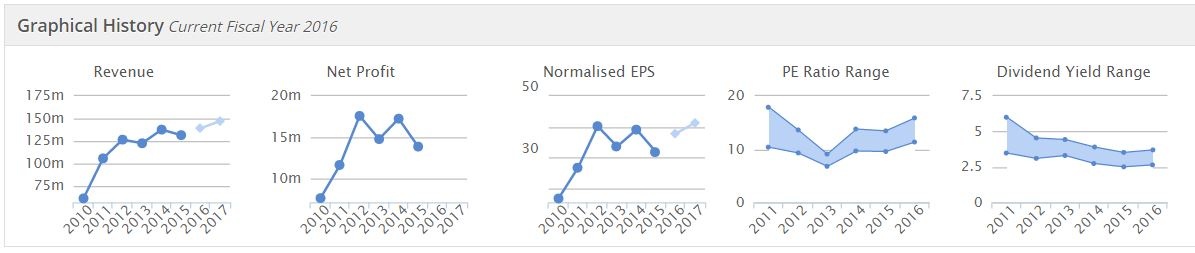
Although note the sideways trend of EPS, so it's not likely to attain a high PER, as it's currently a solid, mature business, rather than an exciting growth company.
My opinion - this looks an excellent business, with a fantastic balance sheet, and pays a useful divi of about 3.3%. It has a high StockRank of 92, which reassures.
I think there is a clear opportunity here for Castings to step up a gear, and expand through sensible acquisitions. It has the financial clout to do that, so maybe management have been too cautious?
They don't seem to be suffering from the strong pound/weak Euro so far, at least no mention is made about currencies today. How sustainable are the profits? That I don't know, but it must be a competitive sector - so will competitors erode their high margins over time?
Based on the historic figures, and the update today, it strikes me as a quality, but mature business, that looks very reasonably-priced. The shares are surprisingly illiquid though, so must be tightly held. It's the illiquidity, and wide bid/offer spread which has put me off buying shares in this company in the past, but I can see a good case for buying some and tucking them away for the long-term.
H & T (LON:HAT)
Share price: 194.9p (down 0.6% today)
No. shares: 36.9m
Market cap: £71.9m
Interims to 30 Jun 2015 - I wasn't going to look at this company today, as pawnbroking is not something I personally find acceptable as an investment. However, a reader has asked me to look at it, and it's not for me to impose my moral judgments on readers, so I'll review the figures anyway and try not to go off on a rant!
Competition - the background is that this sector has suffered (good!) in recent years due to the big fall in the price of gold, which has reduced the size of loans where gold jewellery is pledged as collateral, and also reduced their retail sales of gold items. Remember that stock market listed competitor, Albemarle & Bond, went bust in Mar 2014. Doing a bit of quick googling reveals that A&B was rescued by Promethean Investments in Apr 2014 with a pre-pack administration. 128 branches were rescued, and 59 branches ditched - so a nice way to get rid of all your loss-making shops in one go, thus arguably achieving an unfair competitive advantage. Original shareholders were wiped out completely of course.
Note that H&T's CEO, John Nichols, mentions competition in his opening remarks with today's interim results;
The trading environment remains challenging although the competitive landscape is now easing with the continued closure of competitors' stores.
So if not the last man standing, then at least H&T seems to be the largest, and strongest man still standing, by the sounds of it, with 190 trading units currently, and a very strong balance sheet.
H1 profit (before tax) rose from £2.0m last time, to £2.6m in H1 this year;
This improvement is principally the result of growth in the Retail, Personal Loan and Other Services revenues.
So this looks a solid performance, in a tough market, achieved by diversifying their services into new areas such as personal loans, FX, etc.
Outlook - they're slightly below expectations ("broadly in line"), but overall this sounds fairly encouraging;
The Group believes that the demand for small sum, short term cash loans remains strong and by increasing the range of assets it accepts, by expanding Personal Loans and Other Services both in-store and online we will be ideally positioned to grow as the market adjusts in the next year.
Current trading is in line with management's expectations for 2015. Allowing for the recent reduction in gold price, we currently expect the full year results to be broadly in line with current market expectations.
Regulatory risks - reading between the lines, it sounds as if there is a potential medium to longer term threat here, so I have included this whole section below;
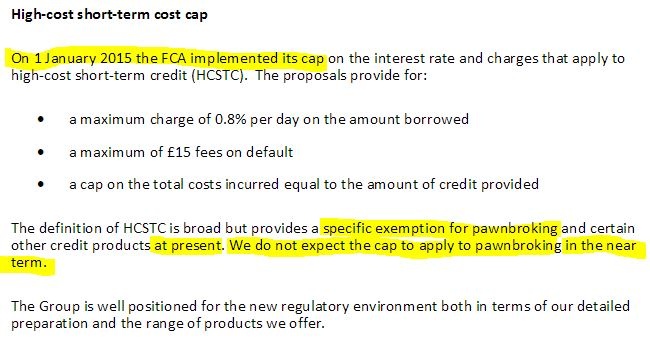
Their use of the phrases "at present", and "in the near term" seem to be signalling that there is a risk of the FCA cap being extended, or other measures perhaps being brought in to curb the charges that pawnbrokers levy. This is a major threat to their business model I would say - any punitive measures introduced by the FCA could kill this business stone dead. OK, that may not be likely, but it's a big, and ever-present risk that would make me nervous about holding these shares. At the very least, more regulation could reduce profits and increase admin costs.
Balance sheet - this is tremendously strong.
Net assets - £91.9m, reducing to £73.3m after writing off goodwill & "other intangible assets". Note that this is slightly more than the market cap of £71.9m, so very good asset backing.
Current ratio - amazingly strong, at 10.8 - that's one of the highest scores I've ever seen. Even if we move long term bank debt into short term creditors, then the current ratio would still be fantastic, at 9.0.
Debt - there is £14.8m in long term debt, plus £1.4m in provisions, but these are dwarfed by net current assets of £80.0m (which includes cash of £7.9m), so the modest level of bank debt (relative to assets) is not a concern at all. Net debt works out at £8.7m, which is fine.
Dividends - there's a big percentage increase in the interim divi from 2.1p last time to 3.5p this time. Looking at the previous payouts, it looks as if the total divis for this year may exceed broker forecast of 5.83p. It looks to me as if they're limbering up to paying perhaps 7-8p divis this year, which (if I'm right) would give a decent yield of about 3.8%, versus current forecasts of about a 3% yield. So there's upside on future divis I reckon.
Valuation - broker consensus is for 15.1p EPS this year, so they look to be heading slightly below that, say 14p. At 195p per share that gives a PER of 13.9, which looks about right to me.
My opinion - the shares look priced about right to me, on a current PER of 13.9, and with a divi yield that looks to be heading for nearer 4% than 3%, if the final divi is increased.
These shares could go higher, as the company seems to be on a modestly improving trend in profitability now, after several tough years, as you can see from the Stockopedia graphics below. It looks as if profitability has stabilised at around £5m p.a. anyway.
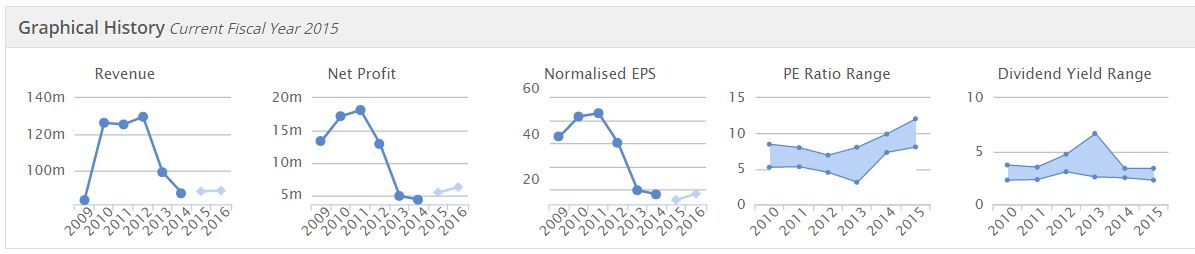
Shareholders have a fantastic balance sheet to rely on here, so this company won't be following A&B into Administration in my view. However, there's the ever-present risk of some regulatory bombshell being imposed by politicians & regulators, keen to demonstrate to the electorate that they are punishing companies that exploit the poor. There again, it can be argued that pawnbrokers are more ethical than the alternatives (loan sharks, Wonga, etc).
It's a tough one. It's not for me, but if I had to guess, I'd say these shares are probably more likely to go up than down from here, providing the regulatory position doesn't worsen. I say this because the valuation is fairly reasonable, and it sounds like a business where management have taken effective steps to improve performance.
The Stockopedia algorithms like H&T too, with a StockRank of 99.
APC Technology (LON:APC)
Share price: 11.88p (down 27% today)
No. shares: 90.6m
Market cap: £10.8m
Profit warning - the company put out an "in line with market expectations" trading update less than three weeks ago, on 31 Jul 2015. So it is worrying that today, just 18 days later, they're issuing a profit warning. That does make me wonder if management are in full control of the business? Possibly not, by the sounds of it.
For such a low market cap, there seem to be a lot of moving parts, with three separate divisions, and the balance sheet is dominated by intangibles, which looks like goodwill on acquisitions, and similar.
Interim results to 28 Feb 2015 (which I didn't review here) were poor, with a pre-exceptional operating profit of only £249k (down from £815k), and after exceptionals the profit before tax was a loss of -£732k.
The balance sheet is starting to look a little stretched too, with the previously ungeared balance sheet now showing £2.9m of gross bank debt, and £831k of long term "financial liabilities", although those were partially offset by £2.4m of cash on the latest balance sheet date of 28 Feb 2015. I worry when companies with bank debt start getting into trading difficulties - that type of situation is best avoided in my view, although banks are being extraordinarily lenient with listed companies at the moment.
Profit warning - various details are given on the reasons for the profit shortfall (cost over-runs on recent contracts, a delayed contract, etc), but the upshot is this;
Due to the above the Board expects that while the Group will be in-line with market expectations at the revenue line, underlying operating profit for 2015 will be below market expectations.
In light of this, Leonard Seelig, the Group Chairman, is leading an operational review of the business with the Board. This review will further focus Group attention and effort on the markets in which the Group currently operates that will deliver greatest profitable growth in the near term.
The Board is mindful of working capital and has already taken action in order to address the impact of the Group's recent financial performance. The Board believes that its current facilities are more than sufficient to support the business.
I can't find any forecasts, so have no idea what market expectations actually were. Given that H1 was only a small profit, I presume that the full year figures would not have been forecasting that much of a profit. Nothing is quantified today, so who knows what the full year will now look like?
Operational review - uh-oh, that's usually bad news in the pipeline - so expect redundancies, factory closures, and lots more exceptional costs.
Working capital - that worries me more. Whilst existing bank facilities might be adequate, will the bank be happy to continue extending those facillities? Are any bank covenants likely to be breached?
My opinion - I've never understood why these shares were so highly rated. Indeed, my comments on 9 Dec 2013 were almost correct, as the shares have since lost 82% of their value - "So I'm very much at a loss as to understand why this stock is valued at £38m (at 65p per share), when on the back of today's figures I'd struggle to get much above £5m valuation."
Things don't look bad enough for this share to go on my bargepole list, but that was a close call. I would certainly not consider investing here until the strategic review is complete. I suspect this company will need to raise some fresh equity, so a Placing is looking fairly likely at some point, in my view, which could exert further downward pressure on the shares.
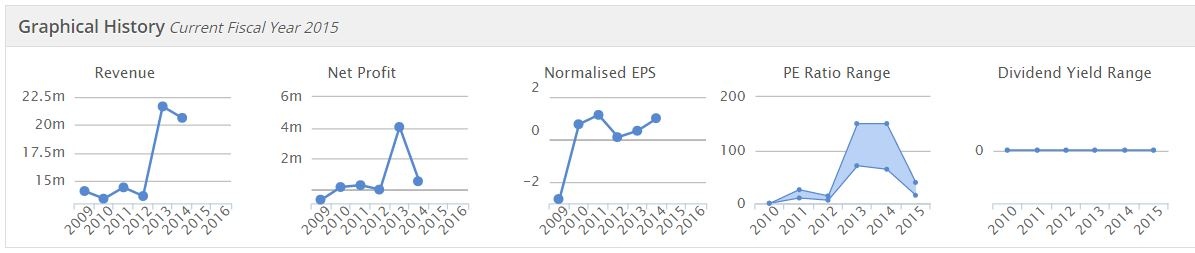
It's difficult to see much positive at this company, due to its erratic, and unimpressive track record of profitability (see below), with what looks like a one-off bonanza year in 2012/13, but very little profit either side of that year. No divis either. It's not for me. It might be an interesting one to watch for a future turnaround, but that seems some way off.
John Menzies (LON:MNZS)
Share price: 469p (down 4.8% today)
No. shares: 61.4m
Market cap: £288.0m
Interim results - a very quick review of the figures. They're not very good;
- Turnover up 0.9% to £1,001.4m for the six months
- Underlying profit before tax down 18% to £17.0m (note the wafer thin profit margin there)
- Underlying EPS 18.8p (down 24%)
- More exceptional "non-recurring" costs, which seem to happen every year - funny definition of non-recurring then!
- Interim divi reduced from 8.1p to 5.0p (forecast yield about 3.5% - not bad, if sustainable)
- H2 weighting for this year's profits reiterated;
As we previously highlighted, profits will have a greater second half weighting this year as we continue to transition the business. There is a great deal of potential across the business and we remain on track.
Balance sheet - remains weak;
- Net tangible assets are negative, at -£32.3m
- Current ratio is fairly weak, at 1.09
- Too much bank debt - gross debt of £161.3m, partially offset by cash of £37.2m = net debt £124.1m
- Pension deficit has come down to £40.1m. After tax this is £32.1m, which is about 10% of the scheme assets, which looks manageable given the size of the company & level of profitability.
My opinion - the fwd PER might look superficially good value at 10.3, but it's not such good value once you factor in the considerable bank debt, and pension deficit.
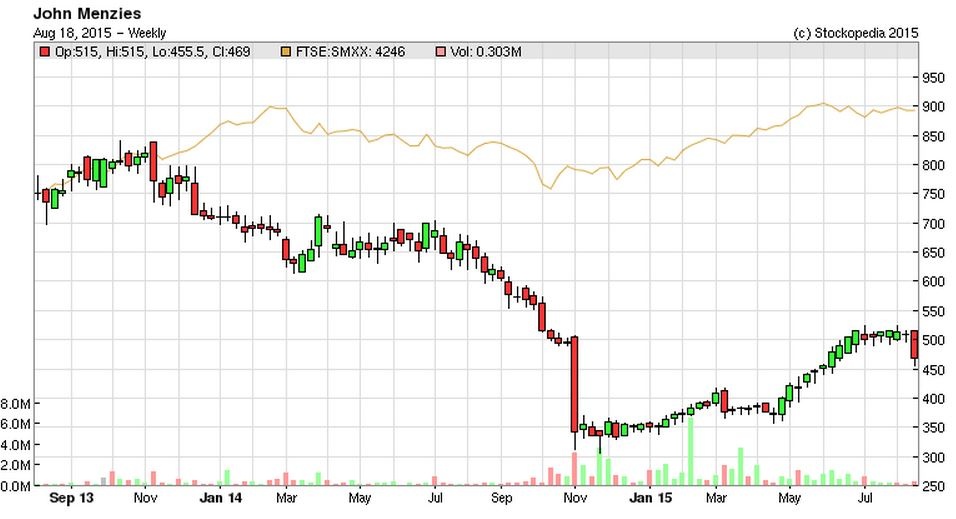
The shares have recovered nicely from the Nov 2014 profit warning, but to my mind the price looks fully up with events now. The Directorspeak is positive concerning their turnaround strategy, but this is a large, sprawling business, with lots of complex contracts, only eking out a modest profit margin. So a turnaround might take a long time, and there will always be the risk of more things going wrong. Plus no doubt more non-recurring exceptional costs every year!
As such, it doesn't float my boat, but that's based on only a superficial review of the figures.
All done for today! See you in the morning.
Regards, Paul.
(of the companies mentioned today, Paul has no long or short positions.
A fund management company with which Paul is associated may hold positions in companies mentioned.
NB. These reports are Paul's personal opinions only, never financial advice or recommendations)
Disclaimer
This is not financial advice. Our content is intended to be used and must be used for information and education purposes only. Please read our disclaimer and terms and conditions to understand our obligations.

26 comments
It's not just the uneducated poor that borrow irresponsibly.
Just look at our previous Prime Minister. Then when he gets kicked out, he actually tries to get a job at the IMF. Now that would be putting the fox in charge of the hen house.
Hi Paul -
Re. ROCE. ROCE unfortunately doesn't tell you anything about the strength of the balance sheet. You need to look at other metrics for that. Take the case of Auto Trader (LON:AUTO) for FY2015:
- a very healthy ROCE of 28%
- however Total Assets < Total Liabilities
- huge Net Debt of £519m
- negative equity of £176m
So it's possible to have in the same sector, 2 companies with similar ROCE, one cash rich and the other saddled with huge net debt with negative equity.
Regards, Ram
Example:
Non-Current Assets £10m
Net Working Capital £12m of which operationally surplus cash is £4m
Net Income £2m
Capital Employed: Non-Current Assets £10m + Working Capital Requirement £8m = £18m
ROCE £2m / £18m = 11.1%
This is only one possible method of calculating ROCE but as Ramridge suggests, it is independent of the company's balance sheet strength vis-à-vis long-term liabilities.
Return on Equity does change (it increases) as a company takes on more leverage.
Return on Assets increases if a company returns excess, low-yielding cash to shareholders, or borrows to invest in assets with a greater return than the average return on its existing asset base.
Return on Invested Capital uses the sum of debt and equity finance in the denominator, and is therefore agnostic between different forms of funding and won't change in response to changes in leverage. It is similar to ROCE but it focuses on the company's funding rather than on its use of funding.
This post should thoroughly refute anybody who thinks that finance isn't exciting.
Hi Ram & Graham,
Useful points, many thanks.
I need to be more precise in my comments, as I've tended to slip into commenting on ROCE & ROE interchangably, where as you both rightly point out, they're very different concepts wrt debt. Although my point that lots of freeholds will pull down ROCE, but make a share much more attractive & safer to hold (in my eyes anyway) still stands.
I'll sharpen up my use of these terms in future, so thanks for the refresher course!
Regards, Paul.
Paul
You last wrote about Digital Globe Services (LON:DGS) in the SCVR of 20 March, when you said that the problems that had led to the share price halving looked as though they might be temporary.
The share price has picked up recently, rising 10% in each of the last 2 days. There has been no news that I have seen.
I just thought you might like to know about the price jump! (and that, maybe, some other reader might have an idea about why the price is rising).
I know the people at Castings pretty well and they are very sensible specialists. I very much doubt they will buy anything though they could expand on their present site and they have the interest in their technology to keep developing. Just going to be dull and developing. If someone told me this was a company in Germany I would believe them. Watch that liquidity though.
ROCE is a key tool, it shows if the management can use their money correctly overtime. As someone else even more famous said, but I paraphrase, it means the company can be run by a numpty and still keep getting better
I appreciated your thoughts on ROCE. I recall Lord Weinstock when in charge at GEC made a similar comment not long before he was forced out and GEC broken up (by the City Moguls). That worked out well didn't it!!
Paul,
I do agree with you about careful scrutiny of the outlook statement and excitement when, "exceed market expectations" occurs. This phase almost always generates upward price momentum so that you could create a system where a new "exceed expectations" is the buy trigger. I believe there is academic acceptance that profit warnings are very rapidly factored into the SP, but that upgrades are much more slowly accepted, especially when the SP is near its 52 week high. accesso Technology (LON:ACSO) is a case in point. A case for buy high, sell higher. Ian
Company's been around since 1876, listed on AIM 2006.
Solid list of major investors.
(https://www.handt.co.uk/about-us/investor-relations/major-shareholders/)
Might well take up a few of these, not least for the IHT benefit.
Thanks to whoever asked you to take a look!
I once did a study on how poor people in towns in County Durham managed their finances and regular access to pawnbrokers was always seen as very fair and beneficial, rather than as an abuse. At that time, facilities such as what were called "clothing clubs" were often used on a rolling basis, that was something like the Provident Financial business which gave cheap loans to people in the form of a ticket that could only be exchanged for tokens and then spent at one particular store. There was then an informal trade in these tokens which could be sold at a steep discount for "real money". There were also "Christmas clubs" where people would put money aside for the end of the year, rather like the Park Group business. Was all of this unethical? No, it was simply recognising the reality of poor people surviving in life. The considerations are very different when one is poor. As Graham N says, much better this kind of known, understood and controllable facility than what is offered by exorbitant payday loan sharks. Imo, pawnbrokers and the like are to be encouraged.
Would have these people been worse off, on a consolidated lifetime basis, without access to these facilities? Did your study compare the lifetime consumption level of user and non-user households within the same income group? It's one thing to understand and have sympathy for what lead people to use this, and another thing to find out whether it's good for them.
That was not the purpose of the study which included other elements, actually including doorstep lenders, the Wongas of their day, tolerated but operating illegally then but with almost certainly less implied licence to abuse than today's payday loans providers seem to ( legally ) have. We're now rather off-topic but if there is a social question (which you would perhaps term "a moral question") to be answered, it's perhaps not the one you seem to be leading on to, of whether "it's good for them" to have "access to these facilities" but whether the situation of poor people ought not to be seen as simply one more economic circumstance from which profit is to be extracted mercilessly with little effective legal or social regulation. That does seem to be the situation in UK today with regard to job insecurity, housing insecurity, the cost of higher education, etc, etc and I'd suggest that tackling the causes of poverty would be a more productive approach rather than talking about whether the solutions poor people devise to survive in life are "good for them". This is a debate the Victorians would have recognised and, in one of the World's richest countries, that is perhaps in itself a terrible failure, whatever your political persuasion may be.
I actually agree with your end point. I'm just not convinced that the benefit your study saw do exist in net terms, even within your own definition of good. Sometimes people devise solutions to their own problems that make the problems worse, and part of the solution involves trying to help them away from such self-harm (though not necessarily through an outright ban, as that can be counterproductive). By and large, I see distressed consumer finance as facilitating self-harm.
Thanks providing clarity Jane. For what it's worth, I am not sure you are off topic, the ethical aspects of investing are on many peoples minds.
Hi Paul
Apropo RNSs today there is an interesting one from Seeing Machines (SEE)
"it is in advanced negotiations with Caterpillar Inc. for Caterpillar to take over responsibility for manufacturing, marketing and sales of Seeing Machines' existing DSS rugged off-road product. This represents phase four of the alliance between the two companies announced in May 2013."
This is an interesting blue sky investment which has the benefit of a product (DSS) that it sells to the mining industry, makes a profit then spends it on R&D to widen the product range. SEE has a number of "alliances" for development and it looks as though this might be the first to bear substantial fruit. The question is what will be the outcome of phase four? My guess is an exclusive marketing and sales agreement allowing CAT to incorporate DSS into its Mine Star service which it could supply on lease. This should lead to increased royalty payments possibly with cash from CAT which will leave SEE to get on with the development of additional products. As with any blue sky investment its jam tomorrow. The problem with SEE seems to be its very wide range of target markets balanced against its cash burn. Any thoughts?
Hi Delpher,
Re Seeing Machines (LON:SEE) - yes I saw the announcement today, which is interesting, but it doesn't give any financial information, or even an indication as to how it might affect the company's finances. For that reason, it's not something I would include in today's report.
I've been a shareholder in SEE for a couple of years now, and I think the company's products are proven, and have great potential, particularly if they crack the road transport markets, starting with coaches, trucks & high end cars.
Then the icing on the cake could be aviation, and consumer electronics. As you say, lots of potential, and a proven product.
The downside is mainly that the company has been quite cash hungry, and I was hoping for more tangible progress by now, so it's taking longer than I anticipated. There again, new products nearly always do.
Regards, Paul.
Hello Graham N: I would say that blaming the banks for not extending credit to individuals who are not credit-worthy is not very business savvy either. I think that successive (all denomination) governments that permit businesses to stay afloat which wouldn't be sustainable without a miserably low minimum wage threshold, are as much to blame as the naive financial habits of some low paid individuals (I've been in that 'naïve' bracket in the distant past).
Re H&T: Without alternative forms of credit, my view (which I really don't think should be a controversial one!) is that you'd get a lot more people who can't eat or who get evicted from their homes when they fall on hard times. These are the people the banking system wants nothing to do with, remember. Rather than blaming pawnbrokers and the like, it would make just as much sense to blame the banks for choosing not to provide the finance to help out people on low incomes and poor credit ratings.
Pawnbrokers are special in the sense that their interest rates are not extraordinarily high but the loans themselves are non-recourse: the borrower can walk away from it whenever they want, with no impact on their credit rating and with no further obligation. In fact, if the pawnbroker sells the pawned goods and makes a profit on the amount owed, it is they who are obliged to return any profit back to the borrower! Can you get any fairer than that?
Payday loans are a separate issue entirely. But I have no ethical qualms with them either and would argue that a business model which relies on bankrupting your customers can't last in the long-term. Putting your customers into unsustainable financial distress means in the end that they won't pay you back, which is obviously a bad outcome for everyone. Payday loan companies have suffered from extending too much credit and are learning from their experience, just as consumers learn from the experience of borrowing short-term credit that they would be better off if they developed a savings habit. This is economic evolution.
Ultimately, payday loan companies and pawnbrokers aren't the problem. They are a short-term or medium-term solution for people who have experienced some bad luck or who haven't yet developed a savings habit. Again, why not blame the banks for not extending credit to all?
Hi Graham,
Thanks, interesting points, have a thumbs up!
I'm not saying that pawnbrokers should be closed down, and I accept your points, especially that they can help people avoid being evicted, etc, in extreme situations. It's more that I would not feel comfortable making a profit from that misery by investing in shares in a pawnbroker.
My experience of friends & acquaintances living in poverty (I have a surprisingly broad circle of friends, from multi-millionaires to people living on benefits) is that the mindset of many people on low incomes today, is to live from hand to mouth, day by day. So they will borrow from wherever they can, often maxing overdrafts (the banks DO lend to the poor, arguably far too much), borrow from friends/neighbours/relatives, absolutely anyone who will lend to them. Then each week is a constant juggling process of robbing Peter to pay Paul. Pawnbrokers can come into that mix once other sources have been exhausted. Their circle of friends will be almost all people who live the same way, so that normalises this dysfunctional behaviour.
I'm sorry to say it, but people who live like that are simply dysfunctional, and unable to manage their own affairs, often due to poor education. Very often income is frittered away on cigs/booze/drugs, which are prioritised over paying essentials like rent. So they lurch from one crisis to another, never learning from it. Not everyone on a low income is like this of course, but a helluva lot are.
(and I'm talking from my personal experience of what I've actually seen, and talked to people about, not from watching TV programmes - although TV confirms what I've already seen happening).
It doesn't seem to occur to people that breaking out of the cycle of borrowing, and becoming a (modest) saver for a rainy day, is the solution. Or rather, they know this, but don't have the self-discipline to actually do it. There's always a large flat screen TV at home though, and plenty of toys for the kids strewn all over the place, and general junk that's been bought in pound shops, etc.
So low income isn't the core problem, it's more that income is spent unwisely, and there is almost zero planning for the future done in probably a million or two households in this country - each day is just a challenge to face, and tomorrow will look after itself, seems to be the mentality amongst many of the poor these days.
All of this provides fertile ground for high cost lenders, such as pawnbrokers. It's such a pity. We somehow need to educate people, drum it into them (at school perhaps) about the importance of financial management. Most kids seem to leave school totally unaware of even the basics of how to run a household, so they just emulate what they think is normal from their own upbringing. Often parents don't seem to bother doing much parenting either, in terms of teaching kids how to sensibly manage their lives as an adult.
So massive cultural, and educational changes are needed to fix these problems.
In the meantime, H&T will probably have a nice, profitable business, for years to come.
Regards, Paul.
P.S. Before anyone jumps down my throat with a "Do you actually know how hard it is to live on Benefits?!" type of comment, the answer is yes. I've had 2 or 3 episodes in my life where I've been totally skint, and had to rely on Benefits whilst I sorted out a new job, home, etc, and it's very tough. However, it's do-able, and I managed on £19 a week Income Support for a few months in 1993, because I had to. And guess what the first thing I bought each fortnight was? A packet of cigs. So I do know from first hand experience how these things work.
Thanks for the reply, Paul.
Another way of looking at these things is that those of us who fund pawnbrokers are increasing capacity in the sector, thereby lowering the prices (interest rates) faced by those who use it. We're the real bleeding hearts, not those who refuse to invest ;-)
I think Paul hit the nail on the head. Schools don't teach (or didn't in my day) kids how to save, invest etc etc. In my mind this should be a core subject at school.
Whether more or less people get evicted/starving because of distressed lenders targeting the poor is a controversial question: to know the answer we need to subtract the bad cases (all these interest payments that did not buy food or pay rent, plus the additional distress debt spirals can cause, e.g. suicide, depression, domestic violence, etc) from the good ones. Is the net effect positive?
I'd also be interested in getting your thoughts on £H&T. Saw their results this morning, and thought they looked good. However, outlook statement was a little wobbly, and they said they would broadly be in line with market expectations - which translates into just below. I think the gold price volatility isn't helping, but they look priced about right to me. The price to free cashflow metric on their stock report is fantastic. On reflection they are priced about right. I've got them on my watchlist, and would like to take an initial position on any significant dips.
Best wishes,
Imran.
Paul
Any comments on H&T interims today? Very high stock rank on this one and the management seem to be building a strong balance sheet with good growth in the retail business. No movement in price so maybe this is all priced in but looks a good result to me.
Hi MGerard,
I'll try to look at H & T (LON:HAT) but to be honest, pawnbrokers and the like turn my stomach. I don't want anything to do with them, let alone being paid divis funded from other people's financial distress.
There again, you could argue they are a lesser evil than the alternatives. I probably should review the numbers anyway, and allow readers to make their own minds up on the ethical side of things.
Regards, Paul.
Many thanks Paul