Small Cap Value Report (18 Jun 2014) - WYN, SNTY

Good morning! It's starting to feel decidedly choppy in smallcapsville - confidence seems to be ebbing away again, with the FTSE AIM ALL SHR (FTSE:AXX) hitting a new low for the year-to-date this week, at 785.8 (down 7.6% on the year, and down 12.4% from the peak on Mar 6 2014). So if your small caps portfolio is struggling a bit, then you're not the only one. A lot of crazy valuations are correcting, but the good are pulled down with the bad, in the short term.
However, as always, good earnings reports should allow quality, reasonably priced companies, to bounce back in due course. Whilst the over-priced, speculative stuff is left behind as euphoria dissipates. It's all part of the usual stock market cycle, and is a healthy process in my view, although nobody likes seeing our portfolios shrink in the short term.
I see that the papers are saying that the Bank of England is going to act because house prices have now reached an astonishing 10 times average salary. That is madness. Although in reality it reflects the fact that home ownership is now closed completely to a large section of lower income people. How sad to see things going backwards in that regard, so that realistically home ownership is only now possible for the middle class, and people who inherit enough to finance a large deposit.
Although housebuilders keep coming up on my value screens, with average prices at 10 times average salary, it's just an accident waiting to happen once interest rates normalise, in my view. Prices have to come down, sooner or later. I think we might have already passed the peak of this latest bubble, so will be steering clear of housebuilders. Negative equity is likely to be a phrase that re-enters our vocabulary in the next few years, in all likelihood.
Wynnstay (LON:WYN)
This is an agricultural feeds (and similar) business, supplying farmers in Wales, the Midlands, and North. I last looked at this share on 28 Jan 2014, concluding that there was little of interest, and the shares looked rather expensive at 650p.
That remains my view after reviewing their interim accounts to 30 Apr 2014, published today. A mild winter saw reduced demand, which is understandable. EPS dropped 18% to 19.4p, which partly reflects reduced profits, and partly is due to dilution from more shares having been issued.
Current trading and outlook sound encouraging;
Current trading remains in line with management expectations and prospects for the balance of the financial year are encouraging, with a good harvest expected. This will benefit our arable activities. Looking towards the year end and beyond, we are therefore encouraged that the Group remains well positioned.
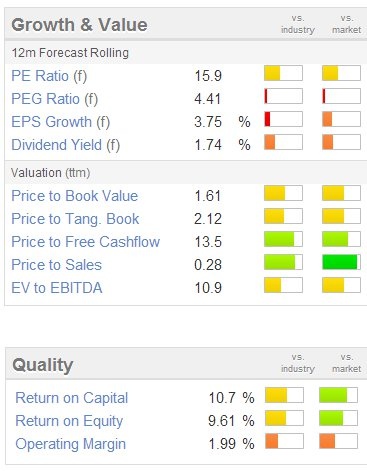
So that sounds as if full year forecast EPS of 35.7p should be achievable, which at 607p per share means the shares are on a current year PER of around 17. That seems a rich valuation for a mature, and boring, low margin business.
The dividend is poor, at a forecast 1.7%, and the business seems to tie up a lot of capital for not much of a return. I'm surprised that it scores as high as 70 in Stockopedia's StockRank.
Here are the usual valuation graphics, which as you can see show unexciting value & quality rankings.
Therefore, perhaps the market sees some growth potential here which is not reflected in the historic numbers?
For me, I would only begin to get interested if the PER was below 8, and the dividend yield above 4%, so it would need to at least halve in price before it would interest me.
I'm terribly sorry, but there's really nothing else of interest in this morning's results or trading statements, so I'll wrap it up here.
My next Brighton investor social evening/dinner is next Thu, 26 Jun 2014, with Synety (SNTY) presenting, so if you can make it, the booking link is here. Should be good fun & interesting. The first one was a great success, so I hope to share a beer or three with many of you this time too!
Incidentally, Synety (LON:SNTY) has announced another integration with a CRM system this morning. A fairly routine announcement, but it's good to see their momentum continuing, although it's still an early stage growth company, so should be seen as high risk.
Regards, Paul.
(of the companies mentioned today, Paul has a long position in SNTY, and no short positions)
Disclaimer
This is not financial advice. Our content is intended to be used and must be used for information and education purposes only. Please read our disclaimer and terms and conditions to understand our obligations.

34 comments
Hello Paul,
Thank you for the further analysis / info on Synety
You're entirely correct - the numbers stack up in terms of recurring UK revenue growth - and the US prospects could present a huge amount of further growth.
I appreciate my comments were less than well balanced.....
MV
Synety (LON:SNTY) are actually reporting excellent growth (from a low base admittedly) - and remember that their key metric is annualised recurring revenue. So far the growth has been as follows;
You can see that the percentage growth rates are excellent, indeed in Q1 of 2014 a growth rate of 47% was achieved, in just one quarter! So if they can continue growth at this kind of rate, then in a year or two there should be a viable business generating say £3-5m in annualised turnover, at a good profit margin.
This is just UK sales. However, the exciting bit is that they're launching in the USA around now. That market is almost 10 times the size of the UK market, and Synety say that they have been pulled into the USA by the CRM companies whose software they integrate with, which are mainly American-owned.
Therefore I am hoping that we might see a big acceleration in growth once USA sales kick in too. The Placing was done to finance growth for the next two years, and personally I'm glad they are going for it, rather than the usual tentative, miss the boat type of UK attitude to expansion.
Synety is definitely not one for widows & orphans, it's a high risk speculative investment.
The company has never claimed that their integrations with the CRM cos software is complex, indeed they have stressed that it's simple & quick to integrate. However, the reason they RNS integrations is because each integration is a big new potential market, and a new business relationship with a CRM company.
I think this is a land grab type of situation, where once a customer is signed up, paying a cheap £25 per month, and recouping that cost with dirt cheap phone costs, then that customer will have no incentive to change to any other provider of integrated cloud telephony.
It was obvious from some of the questioning at the Mello Central meeting where Synety presented a few months ago, that some people didn't understand what their product actually does! The key part is that it integrates into the CRM systems, providing effectively a cheap switchboard for phone calls with customers, and with no capex, and allowing companies to quickly & easily access recorded phone calls with clients for e.g. regulatory or review purposes.
When you see how the product actually works, it's a no-brainer, and that is evidence by the fact that Synety report astonishingly high conversion rates from free trials into customers.
Anyway, we'll see what happens. I like the balance of risk/reward here, although the growth has to continue, as clearly if they slow down and the USA operation doesn't work, then the market cap could easily halve or more. On the other hand, if things go well, then we could have a 4-5 bagger on our hands within a couple of years.
DYOR as usual!
Regards, Paul (long)
Hi Intuitive6191
The major point here is that Synety are now scrabbling for growth - hence my comment on the non news that was the most recent integration with the CRM product of a seemingly insolvent company.
They have an enterprise level product - which is great for large companies. But the truth about their market place is that they are dealing with the PPI claims market, the Road Traffic Accident Claims operators - these firms was low cost solutions. There are plenty to choose from.
Salesforce integration was the big win for them - companies that use Salesforce will probably use Synety. But there's only one Salesforce in the world - and it's all downhill from there.
I'm reminded of one of Lynch's books - think it was One Up - where he said to look out for new products in companies in relation to the Cap - a new product in a £100m cap is significant, can transform the financials - but it wouldn't be material to eg, Unilever.
That's the issue here. Salesforce is won. No one in my office has ever heard of TrackerRMS - it's not going to change Synety's prospects in any discernible way - it's definitely not RNS worthy.
Synety to me looks like a takeover waiting to happen - I wouldn't be surprised is Salesforce made a bid. It could be traded on that basis - but the barriers to entry are very low. Salesforce could probably develop their own product for less.
MV
Thanks MacroVal - some useful points to digest.
In the very early days of CRM we used ACT in conjunction with WinFax to support a small technical marketing team. It took the hard work out of sending and recording the many detailed faxes to customers. I remember we evaluated Salesforce and it appeared to be a reasonable product.
I am not sure that every customer needs to record telephone converstaions etc but I suppose if it is provided cheap enough as a package some will sign up.
Regards
Here's some scuttlebutt for you all....
I run a CRM and integration services company in the UK. A salesman from Synety calls me every other week pushing a low quality integration.
We've done a few of these jobs - I'm astounded that this kind of thing is RNS worthy. We integrate the big names - MailChimp, Zoho, Easycall dialler products - on a daily basis. It represents about 30 minutes work.
It's the equivalent of one of those overvalued house builders telling us down the RNS "Hey - we laid a brick in London today!"
The whole company is based on dialling for dollars - large commission based sales team pressuring CRM companies and client's to integrate their product and make more calls.
And their new partner? Their UK company have £428 (Yes, four hundred and twenty eight pounds of cash). Their net worth? -5.4k (Reported negative equity!)
https://www.duedil.com/company/06719858/trackerrms-limited
Maybe US operations are a different story - but how stable is any client that operates subsidiaries in negative equity?
There's an untold story here...
MVI
Hello MacroVal
I went negative on Synety when they stuffed existing Shareholders with a heavily discounted placing. Paul reported on it here . For that reason it fails my first rule of investing that requires complete confidence in the management.
In your view does Synety offer anything that is unique? Or is it sales company offering a bog standard product?
Regards
I would love housing to become more affordable in London, but I really can not see it happening at all (especially not 50%!). There is just too much demand and not enough supply and for someone who rents and wants to buy, it's a very depressing prospect. Many of the housebuilders are sitting on large land banks and Berkley especially have a good record of acquiring land in the South East at the right time and holding on to it and therefore restricting (managing) supply. London attracts people from all over the world to work in financial services and this is an ever increasing force - London wants to become the center for trade in Renminbi and most of the worlds banks are located in the City. The FED has stated that it wants to keep interest rates low over the long term and the Bank of England will surely maintain low interest rates for as long as possible (low but increased) and only increase them very steadily as an when inflation rises. In conclusion, I wish prices would fall to a level whereby I could afford to buy in London - but i'm certain that they will not and therefore I will have to relocate!
"The other factor that makes me comfortable with my potentially risky strategy is that if house prices do continue rising, I'd expect my portfolio & especially the real-estate exposed parts of it to do well too
You must have a very large chunk in real estate exposed parts in your porty in that case. I'm personally of the view that the interest rate cycle has turned - not long before they rise. Property is very exposed with many unable to afford even the most humble of abodes without taking on a massive mortgage. I see House prices, bonds and equities all falling in unison. Will be interesting to see how things pan out.
I only assumed you were looking at London is because most people, if they could afford, would be doing so and I know you live a long way out of town currently (passed me in - You're Luton? Or St Albans?) Quite a trek for all those regular company meetings you go to....
"Most people have far too much of their net assets tied up in real-estate (generally geared with hefty mortgages)"
Agreed. But many buyers are foreigners loaded with capital so little in way of mortgages, and the "Greater Fool" theory doesn't apply to them as they're looking to often park their assets in secure and safe climes. UK property in london fits that bill perfectly.
"Even in Kensington & Chelsea the CAGR in house prices over the 10 year period between 2004 and 2013 has been 8.5%, whereas my main portfolio has grown at 12.9% p.a. over that same period"
Terraced properties sold for an average price of £3,791,645, while semi-detached properties fetched £7,555,808. Kensington And Chelsea, with an overall average price of £1,766,820 was more expensive than nearby Hammersmith And Fulham....
Prices which say one thing to me - when's the sell off coming......
But best of luck with your strategy.
The biggest problem that the housebuilders face right now is more one of sentiment than anything else. It's clear that a bubble exists in the housing market, especially London and parts of the South and has for some time. The market was not allowed to deflate to an affordable level after 2008 and housing is still too expensive for many without help from silly schemes like Help to Buy and low IR's. The level of sales is still quite low compared to pre-2007.
However one thing stands out about the quoted housebuilders and that is that most of them actually don't build that many houses.
At random I looked at the following.
Barrett - total completions half year to Dec 2013 6,195
Taylor Wimpey Completed 11,696 homes at an average selling price of £191k to the end of 2013.
Crest Nicholson - Housing legal completions up 15% at 2,172 (2012:1,882); open-market legal completions up 35% at 1,806 (2012: 1,342).
Bovis Homes - 19% growth in legal completions to 2,813 homes (2012: 2,355).
Berkley Group Holdings - 3,742 new homes completed in the year.
In other words none of them are building masses of properties that they cannot shift at the moment and this was true even before Help To Buy. The numbers are incredibly low considering the housing crisis that the UK faces. That's not to say that their share price would not be affected by any housing market downturn or bursting of the bubble as the stock market will do what it always does, overreact. The reality is however, that there aren't really any quoted builders building masses of properties they can't sell and most of them don't rely on London prices holding up.
@paul - Interesting call, and you may be right. The big question is timing... I think the prices are ludicrous and should halve but I dont see why they will until the lack of supply is eradicated... Obviously a massive swing upwards of int rates would also be a catalyst
Merrill Lynch has taken an interest rate focused view to argue that the home builder sector has historically rallied after the first interest rate rise, referring to the last cycle in 2003, and that they are only concerned if mortgage rates push through 5% on 75% LTV 2 year tracker.
Also the Council of Mortgage Lenders (unsure how much can rely on the data) says mortgage interest cost as a percentage of income are currently much lower than the middle of the last cycle.
http://www.sharecast.com/news/merrill-lynch-calls-uk-housebuilder-sell-off-overdone/21793880.html
Here's a great example of the London housing bubble.
I rented a big 1-bed flat in Hertford St, Mayfair, in 2004, and it was AMUNDI SP 500 ETF (LON:500) pw. That was a bargain. The flat was worth about £500k then. It is now worth c.£1-2m. It is up for rental at 550pw now.
So no change in rent, but capital value has gone through the roof.
It's a bubble - you heard it here first - I reckon central London prices are due to HALVE.
Outer London down 30%.
Everyone assumes the BoE can control interest rates. If they lose control, it will be carnage. Why even risk it? Inam happy to rent right now. My landlady is getting a terrible yield, pays for all the maintenance, and is taking all the downside risk when the flat plummets in value, as it will.
I will buy it at 40% lower price, when sentiment collapses, seen it all before.
p.
UK house prices must be one of the longest running asset bubbles ever.
Assume 10x earnings, as stated.
Any new buyer paying 6% interest needs to pay 60 % of his gross income just for the interest. After firstly subtracting taxes & paying the mortgage, I suspect our home buyer has no free cash fro living. So he cannot buy the house.
It's a bubble.
Mark,
"However, this partly a hedge against further house price rises for me, as I don't own a house at present, having sold recently, but am renting whilst I grow my porty until I'm ready to make an outright cash purchase"
Wish you the best but that sounds quite a dangerous strategy. What if property prices remain buoyant(presume you're looking at London) due to ongoing foreign buying interest but stockmarkets take a bath. Much being made of the relative highs the world markets are at and how we're due this so expected correction. Much of the rise in world markets has, as you know, arisen from the hunt for yield, such that assets whose previous rating merited yields of 10-12% die to their relative riskiness now only yield 5-7%! Dicey but due to the risible deposit rates people are being forced to take exposure to equities,high yield bonds and structured finance products(eg Investment funds focused on loans obligations etc)
House prices in London are ridiculous and many of those wanting to buy in the South are just unable to due to the watering multiples. Those also at risk are the temporary renters who sell out on a relative high but then find they can't get back on the ladder at the same level further down the line.
Just noticed this article...
The Hunt for Income - bond beating yields in funds and stocks
"http://www.stockopedia.com/content/the-hunt-for-in...
Hi Fangorn,
Nope, your presumption is wrong, I don't live in London and have no intention of moving there. The other factor that makes me comfortable with my potentially risky strategy is that if house prices do continue rising, I'd expect my portfolio & especially the real-estate exposed parts of it to do well too.
Most people have far too much of their net assets tied up in real-estate (generally geared with hefty mortgages). They're reliant on the "greater fool" theory for achieving a return. I have no debt and the bulk of my assets are pretty liquid, so I'm comfortable with my position.
Even in Kensington & Chelsea the CAGR in house prices over the 10 year period between 2004 and 2013 has been 8.5%, whereas my main portfolio has grown at 12.9% p.a. over that same period.
Cheers,
Mark
Its worth mentioning that during the financial crash we were building even fewer homes yet the price still declined. If the price of property was linked to pure supply this couldnt happen.
The reason the price of property increases is in the main down to the availability of finance. When finance is easy to obtain more people are then able to purchase which in turn drives the price up. Finance dried up during the crisis and this led to a fall in house prices - irrespective of how many homes were actually being built or needed.
The exisiting housing stock has a surprising ability absorb demand through varied and flexible use. I think that Kate Barker refered to this as "Hidden Households" in her report. This is where two families occupy one dwelling or larger houses become shared or HMOs or where there is a return to the old fashioned lodger. This is the main reason why we can cope with a perpeptual shortfall in builds.
The next financial crash will freeze the supply of credit and cause house prices to decline. Until that happens Housebuilders should do well in my view.
Just for the record I'm heavily exposed to certain housebuilders - and happy to remain so. However, this partly a hedge against further house price rises for me, as I don't own a house at present, having sold recently, but am renting whilst I grow my porty until I'm ready to make an outright cash purchase.
I agree with Paul that in certain areas house prices are unsustainable - but think about the reason for this: too many buyers chasing too few homes! All political parties acknowledge the need to increase the pace at which houses are being built, which is what is needed to satisfy demand. So, IMO housebulders' margins may decline a bit, if prices are controlled, but I expect this to be outweighed by increasing sales volumes.
I am invested in the following builders:
What has been the undoing of housebuilders in the past has been overindebtedness, by borrowing to finance land banks that then decline in value and have to be impaired. So, a key criterion for me has been modest debt, which all three of my selected investments in this sector possess.
Cheers,
Mark
I live in North London where there is a current shortage of properties to buy and a surfeit of buyers. Because of this properties are being sold at a premium. I guess this isnt sustainable in the long run, but it will take a long time to unwind in my view. I currently hold Barratt Developments (LON:BDEV) and Taylor Wimpey (LON:TW.), topping up on recent weakness in Taylor Wimpey (LON:TW.) and feel these are still good long term investments.
10 times earnings would be nice!! I have just done a quick calculation and here in London it is more like 15 times earnings based on the average London price of £475,000.... and for me it's more like 18! It is scary stuff - I have decided to move out of London very soon! However, I recon that the house builders are still looking very good value. Paul Kavanagh of Killik and Co did a good talk about this at the recent Master Investor Show - which is now available to all on youtube: www.youtube.com/watch?v=645y9kZOPO4 I would also highly recommend the Jim Mellon and Terry Smith talks (also on youtube) Cheers, Ben
Ben, where is the "average London price of £475,000" coming from? Average of what? And what constitutes London?
With all statistics bandied around in the media, in pubs, and around dinner tables, it's always a good idea to be very, very sceptical about the data, I recommend everyone listens to "More or Less", the weekly Radio 4 programme about statistics in the news, presented by Tim Harford, who is also the FInancial Times's 'undercover economist'. It's generally eye-opening, consistently entertaining, and is available as a podcast.
As they say you can prove anything with statistics and you ask where all the averages come from. So see the following link for UK House Price data from the ONS. This bear out what people are saying here about London and SE vs. the rest. This seems to indicate a mix adjusted UK average of £260,000 - looks like Northern Ireland is the place to go for cheap houses!
While there was an interesting piece covering the builders on Money Week today from Dominic Frisby if that's of any interest.
Website:Compound Income
Twitter: @CompoundIncome
I obviously picked the wrong datum to question! Skimming over the ONS commentary there is little doubt that they have employed world-class rigour in their analysis — as indeed one would hope. Clearly the figure of £485k is as true a picture of an 'average price' as any that can be arrived at using statistics.
My apologies Ben for doubting the veracity of your source. Just goes to prove that just because a fact is unbelievable does not mean that it shouldn't be believed.
I still think there's something in the argument that if house prices do fall it will equate to greater sales volume. And I am a long-time admirer of, and investor in, Berkeley Group (LON:BKG), which I have no intention of selling any time soon.
Cheers, Kevan
Hi, I agree that statistics can be manipulated. The data came from the ONS (they give detailed background notes and methodology on their website.
"Average House Prices in Countries and Regions
Average mix-adjusted house prices in April 2014 stood at £271,000 in England, £166,000 in Wales, £132,000 in Northern Ireland and £187,000 in Scotland (Figure 7). In April 2014, London continues to be the English region with the highest average house price at £485,000 and the North East had the lowest average house price at £152,000. London, the South East and the East all had prices higher than the UK average price of £260,000.
Excluding London and the South East, the average UK mix-adjusted house price was £199,000."
Also, I see that the Managing Director of Berkeley is calling for a rate rise in London:
http://www.ft.com/cms/s/0/b633a422-f6b4-11e3-8ed6-00144feabdc0.html#axzz34zh7SIGO
Cheers,
Ben
Paul
Two of us yesterday asked if you could look at Red24 (LON:REDT). Any chance?
Hi FREng,
OK, OK! I've had a look at Red24 (LON:REDT), and I can see what you like - net cash, solid track record of profitability. However, my feeling is that it's too small - this is a tiny company, that is only showing pedestrian growth, I cannot see any reason why it is Stock Market Listed at all.
So it should be seen as a tiny, private company that happens to have a Listing. I would therefore rate it on a forward PER of about 6, as it will be reliant on the owner/managers for its profits. It seems to be priced a good bit higher than that.
Not for me. Too small, and earnings tend to be too reliant on individual customers/contracts for this size of business. If they were going to do something exciting in terms of growth plans, then I'd look at it again, but for the moment, it looks boring & expensive to me.
Regards, Paul.
Me again
Christie (LON:CTG) have put out a good sounding statement this morning at 11:16 (perhaps after you knocked off) http://goo.gl/AbNLFt but I think they are worth a look.
Christie (LON:CTG) is my biggest holding.
Hi Paul, You always make me think about my positions which is good. Am I being blinkered on Berkeley Group? You say when interest rates normalise. What is normal? Given the affect the slightest interest rate rise is likely to have on the over indebted consumer I think the BofE will step very carefully. The last thing they want is to tip the country back into recession. I should think merely the mention of rate rises will slow things down and there is anecdotal evidence that is happening in London. Sterling strength will help keep wider inflation under control which may also limit the scope for interest rate rises. Also there is a lot of talk about housing bubbles and in London there is no doubt that things have gone too far but in other parts of the country there is some way to go before we get to bubble territory. So whilst we may see a slowdown in house price inflation I think while there is still too little supply a collapse in prices is unlikely. Berkeley Group, results this morning, has a very healthy balance sheet and is returning 270 p cash to shareholders over the next 15 months, equivalent to 12% of the current share price. I appreciate I may be p*****g into the wind, as they say but I do think the sell off has created an opportunity to get into a well managed house builder at a decent valuation.
As for bubbles, apart from the South Sea Bubble I don't think I had heard of a bubble before the dot com boom of the late 1990's; now there are bubbles everywhere!
Before the tech boom, back in the 1980s, didn't Michael Jackson once sing "I'm forever blowing bubbles"? Something to do with his pet chimpanzee if I recall correctly...
Steve
I think "I'm forever blowing bubbles" predates Michael Jackson by 50 years or more. It was the signature tune of the late comedian Jimmy Edwards and I seem to remember Harpo Marx had a go at it to.
Re: John Rosier's comment, the history of "bubbles" goes back a long way, look at Dutch bulbs and the railway mania of the 1800's. People seem to have a tendancy to want to get on a bandwagon without reference to underlying value.
Andrew
I'm with you, John, on Berkeley Group, given their net cash position, committed forward sales drastically increased to nearly £2.3bn and the over £200m personal stakes of the key directors. Not that I'm looking for more than a retrace to the high of the past year. Would still mean a 25% uplift in price from here, with a 4% div to be picked up in a couple of months. Have just increased my holding at this level. Fingers crossed!
I'm always very hesitant of saying the market is wrong but in this case I think it is. If house prices are going to collapse in London then I wouldn't touch BKG but I am not of that view. I could see a period of flat lining or even drift-off but not a collapse unless interest rates are jacked up significantly which I see as unlikely. The dividend is being paid out of earnings and as you point out is 4% ex-div in August and another 8% over the next 12 months. This is not an end of cycle "drawbridge up" return of capital in my opinion. I have bought BKG this morning for the JIC Top Ten fantasy portfolio on Stockopedia
Hi Paul
I live in the west middles and there is no bubble/10 times earnings prices here and the market is very slow, I would say turgid.
I hold Barratt Developments (LON:BDEV) and still like the look of them. I bought some at 364p and some at 323p and am sitting on a £4 loss at the moment but I just can not see anything wrong with the Stockopedia figures. I am still trying to educate myself as to how to read a BS properly (asa far as investing goes) but net debt at 60% forecast net profit, book value at 62% of Mkt Cap, value rank of 82 and a Quality rank of 97 makes it very appealing for a long term investment. And a divi of 2% to 3%. So if it continues to drop more I see it as a buying op.
I will let you know how it goes.
"I see that the papers are saying that the Bank of England is going to act because house prices have now reached an astonishing 10 times average salary"
Nothing like 10 times salary in the North West of England. Hopefully Mr Carney doesnt read the papers and forms his own judgement.
"So if your small caps portfolio is struggling a bit, then you're not the only one."
My performance during this tax year has been truly awful, and is one the worst performances I have experienced, especially given the short time-frame.
Here's some interesting statistics: The Footsie is up 53% over 5 years, whilst the midcaps are up 102%. According to Stockopedia, the trailing PEs are 17.6 and 16.0 respectively. So the mid-caps look like they're actually providing better value at the moment.
The T1X (techMARK Focus) is up 138% over the same period, with a trailing PE of 23.1. Analysts seem to be expecting 12.4% EPS growth for the Footsie, which seems absurdly optimistic in aggregate, but would actually put the forward PE on a pedestrian value if you believe the estimates. Analysts are expecting 13.9% EPS growth for the T1X, which is not much more than the Footsie. Given the rather more modest valuation of the Footsie, it would appear that the tech stocks are a bit pricey at the moment.