Small Cap Value Report (2 Jun 2016) - PRV, FJET, PURP

Good morning!
I was amused this morning to see on an American website, they were asking New Yorkers for their views on Brexit. One confused respondent asked, "Is it something to do with breakfast?"
Is it affecting the markets much? Things feel a little more nervous this week. Looking at the small & mid cap indices for the last year, it all looks fairly stable to me, apart from a nasty spike down in Jan-Feb:
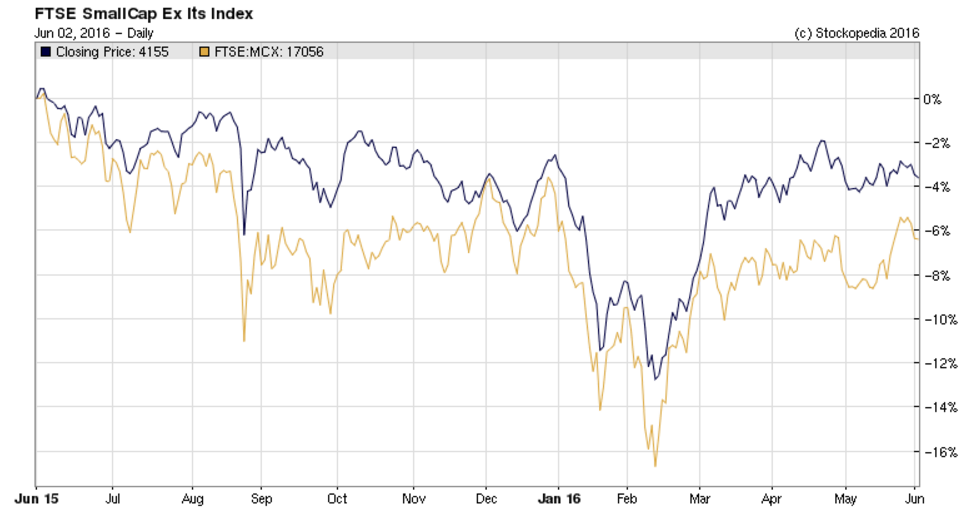
The SMXX is down about 4% in the last 12 months, and MCX is down just over 6% over the same period. So not a very good market. A lot of people I talk to are saying that their portfolio is flat, or slightly up or down so far this year. By the way, the blue links on SMXX & MCX are worth clicking on, as that takes you to the Stockopedia page which shows all the constituents of each index. It's interesting to have a rummage, sort them by various criteria, etc.
Personally, my long-term portfolio is about flat this year-to-date, but my geared trading account is up strongly - due to catching the HOME takeover bid, and being heavily overweight (and geared) in BOO. Although one needs a few big winners to mop up all the mistakes. I've not done my stats yet for this year, but last year my win:lose ratio was 60:40, which gave a satisfactory overall result. We shouldn't beat ourselves up over getting some investments or trades wrong - it's perfectly normal. As long as there are more (and bigger) winners than losers, then everything should be fine.
I'm padding this out a bit, because there are only 2 companies in my universe which are reporting today, and only one of them is any good.
Porvair (LON:PRV)
Share price: 330p
No. shares: 45.1m
Market cap: £148.8m
Trading update - for the 6 months to 31 May 2016.
I've re-formatted the trading update into bullet points, and bolded the most important points:
- Constant currency revenue growth of around 10%
- Most markets experiencing good demand.
- Interim profits are in line with management expectations and will be ahead of those reported in 2015.
- Order books for the second half are healthy.
- During the period the Group acquired TEM, which is performing well.
- Investments were made in expanding manufacturing facilities in both the US and UK.
- Net cash at 31st May 2016 was £7.0m
Valuation - broker consensus is 16.0p EPS for the current year (11/2016). Therefore the PER is 20.6. A growth company rating. The trouble is, there's not actually that much growth happening. As you can see from the Stockopedia graphics below, this stock is looking expensive on all measures:
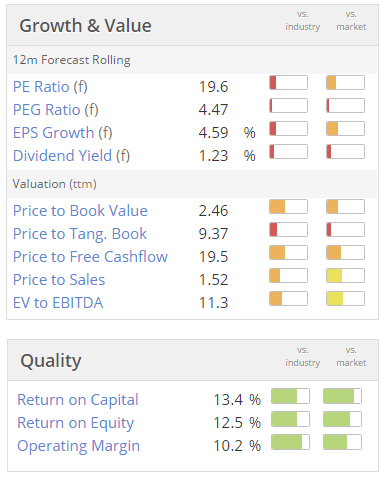
In particular, note that forecast EPS growth this year is only 4.59% - very modest. So why is it on a PER of over 20? (which implies much higher growth). Maybe investors think that earnings will rise more rapidly in future?
The dividend yield is poor, at 1.23%.
My opinion - this is undoubtedly a high quality company, with a very charismatic CEO. However, I wonder if investors have got used to the stock being highly rated, without noticing that earnings growth has slowed down to a crawl now?
As you can see from the Stockopedia graphics below, the company has performed very well for the last 6 years, but the growth rate is now apparently slowing. That's assuming market expectations are correct of course. The company could prove doubters like me wrong, by thrashing forecasts for the full year, perhaps? There's no indication that's on the cards in today's update though.
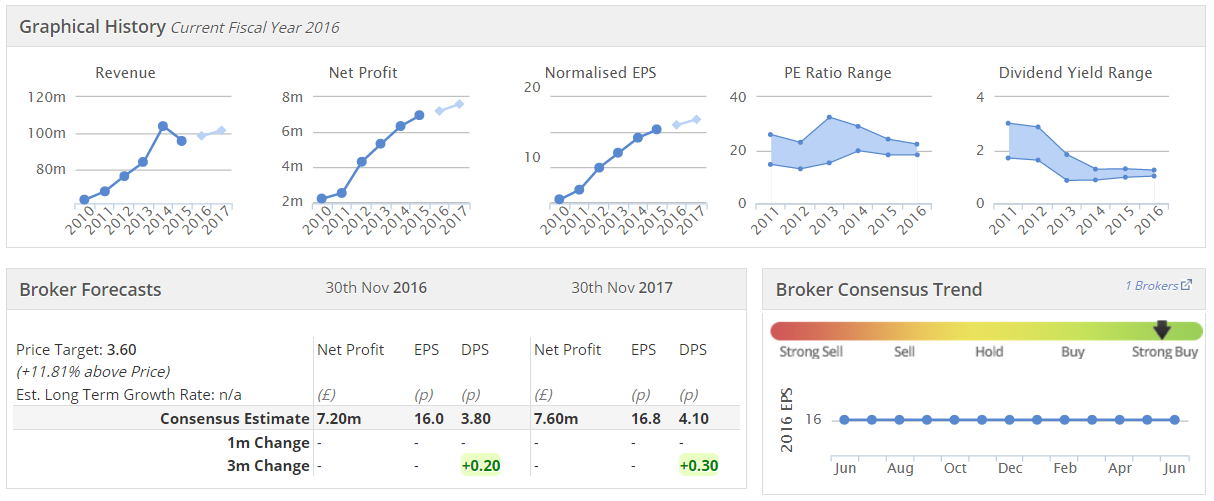
So overall, I'd say - nice company, but the price looks considerably over-valued right now.
Fastjet (LON:FJET)
Share price: 27.1p (down 4.0% today)
No. shares: 66.4m
Market cap: £18.0m
Results y/e 31 Dec 2015 - it beggars belief that any company would be reporting 2015 numbers, here we are in Jun 2016. So that's a very bad sign to start with.
The operating loss on continuing operations was a staggering $37.9m, on turnover of $65.1m. The rather obvious comment on those numbers, is that this clearly is not a viable business.
So how much cash is left before it goes bust? At 31 Dec 2015 it had $28.9m in cash. This had fallen to $13.7m by 30 Apr 2016. If the same cash burn rate continues, then the company will be out of cash before the end of Aug 2016.
The company seems to be trying to cut costs, and 2 aircraft leases expire in 2016. Although it's rather late in the day to be restructuring. I doubt whether investors are likely to inject any more funds. Amazingly, Fastjet managed to raise $75m in Apr 2015.
On funding, it today says:
Based on current forecasts, the Company has sufficient funds to meets its operational requirements for the foreseeable future. However, these forecasts are sensitive inter alia to changes in passenger numbers, yields and foreign exchange rates. Accordingly, the Board is considering a range of funding strategies in the short term, including asset sales, and expects to raise further funds in the near future to provide additional headroom and to ensure the Company has the resources to fund future growth as markets improve.
The company's forecasts have, in the past, been completely delusional. So I wouldn't place any reliance at all on any reassurances from the company.
There's a lengthy going concern note in today's accounts. Shareholders should read this very carefully - it's basically telling you that there's a high risk of insolvency. Note this bit:
The Directors are confident that, with a new CEO and a revised business plan, additional funding will be available. However, as at the date of approval of these financial statements, no commitment has been made or received for any future financing and there can be no certainty that additional funding will ultimately be raised.
I'd be amazed if investors are willing to pour more money into this black hole, with or without a new CEO.
Looking at the balance sheet, I think there is one owned aircraft within fixed assets. So it's look very likely that will need to be sold, giving a last ditch cash injection.
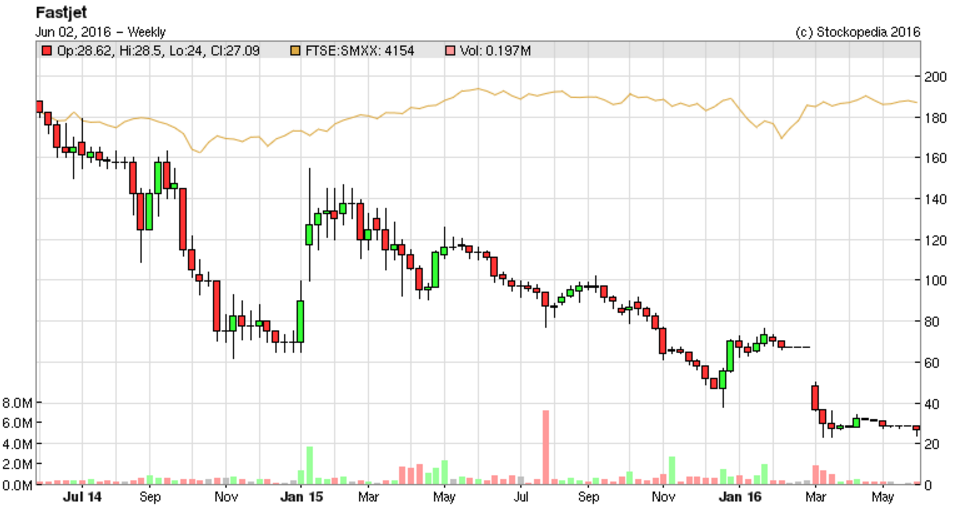
My opinion - this concept just hasn't worked. I think it's inevitable this company will go bust, probably before the year is out. My local share club owned £120 of shares in it, and I urged them to sell. It took a couple of months to convince them, but as I pointed out, if there were 6x £20 notes lying on the floor, we wouldn't leave them there for the cleaner!
When something has comprehensively failed, I think it's best to sell up, even if only a small amount remains. It gives a psychological boost too, to clear a losing trade off your portfolio. It's important to learn the lessons. What went wrong? Could it have been anticipated? In this case, it was blindingly obvious that there was never a viable business. However, as is so often the case, people bought into a story of future glory. Story stocks hardly ever work out, so why do we keep being taken in by them?
PurpleBricks (PURP)
Just a quick comment on this one. I see that shares in this disruptive online estate agents are slipping. I've looked at lots of online businesses over the last few years, and the common factor is that to succeed, they have to spend vast amounts on marketing.
Very few manage to reach profitability. Once they do, they have to continue spending heavily on marketing, in order to drive further growth. Take Boohoo.Com (LON:BOO) for example (in which I hold a long position) - it spends about 10% of turnover on marketing. So that's about £20m p.a. Previously, it was spending even more in percentage terms on marketing - 13 to 17% about a year ago. Start-ups just can't compete with that - where would a start-up get £20m p.a. from, to spend on marketing?
Koovs (LON:KOOV) is an earlier-stage company which is burning cash like there's no tomorrow, a lot of it on marketing, for very little actual result. Sure the growth rates look high, but that's because it's from a tiny starting position. This one, in my view, looks highly dubious - it has a mountain to climb, to get anywhere near breakeven.
Hostelworld (LON:HSW) (in which I hold a long position) is spending a staggering 45-50% of turnover on marketing, to protect its market leadership.
So going back to PURP, I don't think it has anywhere near enough cash to fund itself through to profitability. The trouble is, doing estate agency work is not repeat business mostly. People usually only move house occasionally. So PURP will need to keep spending huge amounts on TV ads, etc, to prompt potential customers to check them out.
Plus there are competitors. Existing estate agents aren't going down without a fight. I've seen TV ads for other online, or hybrid estate agents. The market cap of about £310m for PURP (at 128p) looks totally bonkers. Why are investors happy to pay up-front, assuming a start-up will be successful, before it has got anywhere near to commercial success??
Disclaimer
This is not financial advice. Our content is intended to be used and must be used for information and education purposes only. Please read our disclaimer and terms and conditions to understand our obligations.

16 comments
Re: Purplebricks, I am convinced that the way property is bought and sold will change fundamentally, in the same way as, for example, many of us now by insurance (through the likes of MoneySupermarket, GoCompare etc.). I do therefore expect in a few years time there will be 3 or 4 major internet-only UK estate agents, and PurpleBricks may well be one of them.
It is not clear to me whether an online agent or an hybrid agent such as PURP will sell your home more conveniently, efficiently and quickly than a traditional agent. Selling your house of course means having the buyer's cash in the bank, not just a verbal offer at your asking price.
Having the cash in the bank as efficiently as possible involves the agent correctly assessing whether the buyer has the finance available and all the subsequent managing of the chain, paperwork, etc,.
PURP’s interim results presentation (https://pbstaging.blob.core.windows.net/web-images/marketingWebsite/investors/media/press/Interim-Results.pdf) indicated the firm had 180 Local Property Experts (LPEs) and that its instruction run-rate was 24,700 a year.
In other words, each LPE is handling 137 instructions a year or 2.6 a week. Assuming four months from advert to completion, an LPE may be handling about 40 different property sales at any given time. I am not sure whether I would to compete with 39 other vendors for the attention of my LPE.
PURP employed an average of 48 people (excluding most LPEs, as they are generally self-employed) during the year to April 2015. Guessing the employee figure has since tripled to 150, and that LPEs now top 200, PURP may have a total of 350 people looking after 24,700 instructions a year (i.e. 70 per person).
For a quick comparison, traditional agent LSL sold 29,311 properties in 2015 — 5,000 more than PURP’s current run-rate. And yet LSL employed 3,935 staff at its estate agency division and, based on a proportion of revenue, I reckon perhaps 1,400 are involved in sales and the subsequent admin of the group’s 29,311 sold properties (i.e. 21 per person).
So either LSL is vastly overstaffed, or PURP is vastly understaffed, when it comes to sales and admin employees.
Which is it? Well…the fact PURP effectively takes its fee upfront at instruction speaks volumes in my book — I suspect the admin between offer acceptance and completion takes a lot longer at PURP given the LPE/employee numbers involved.
Such protracted admin could mean the conversion rate of offer acceptance to completion at PURP is relatively low. And getting the money in the bank is of course the ultimate aim of the house vendor.
For what it is worth, LSL’s average selling fee last year was £3,170 ex-VAT or £3,804 inc-VAT. — which is £3,006 more than PURP’s basic £798 inc-VAT fee. If it means a successful and/or more timely completion, an extra £3,006 might be worth paying.
Hello Mayn,
I do agree with this:
It is not clear to me whether an online agent or an hybrid agent such as PURP will sell your home more conveniently, efficiently and quickly than a traditional agent. Selling your house of course means having the buyer's cash in the bank, not just a verbal offer at your asking price.
Having the cash in the bank as efficiently as possible involves the agent correctly assessing whether the buyer has the finance available and all the subsequent managing of the chain, paperwork, etc,.
But my relatively recent experience (admittedly as a buyer) is that in actual fact, the agent did more or less naff-all to actually ensure the sale went through. I was quite surprised at this, expecting them to be much more proactive in pushing things to completion. Perhaps it's different if you are in a chain, which we were not.
So in practice it isn't clear to me that a traditional agent adds any extra value. Certainly, even if Purplebricks (LON:PURP) 's current business model needs some tweaking, it seems pretty clear to me that estate agency is an industry that is absolutely ripe for disruption (after all, it's still designed around a pre internet business model - what is the need for all those branches in today's world where everyone starts their search online?). And I have seen no sign in any of the estate agents I've either personally dealt with, or looked at from an investment standpoint, that they're responding to the threat in anything like an adequate manner.
Some really interesting things afoot here IMO and I expect quite dramatic changes over the next decade. It's not just about the position of traditional estate agency either - one interesting possibility is whether the dominance of the property portals, Rightmove (LON:RMV), Zoopla Property (LON:ZPLA) et al, could be challenged by the likes of Purplebricks (LON:PURP).
Regards,
Phil
Hello Phil
Thanks for the reply. All good points. I think it may eventually boil down to the sector diverging into two camps -- i) the likes of PURP and vendors accepting a cheap and cheerful service post-offer, and: ii) a traditional agent and vendors perhaps receiving a better all-round service (with a local office to at least drop off the keys)
Not sure if the likes of Rightmove will be challenged by PURP. Rightmove's power lies in it carrying all the properties from all agents -- I doubt PURP would ever enjoy similar comprehensive coverage from just its own customers.
Maynard
People think PURP is just an Estate Agent - remembers its also a letting agent as well.
In terms of value, I agree its fairly pricey but the Estate Agent/Letting Agent market is HUGE.
Back of the fag packet calculations here quick search on google suggests:
£1.1bn - Size of the London Estate agent market alone.
Circa 2 million properties registered with Letting Agents - Average rent £899 PCM
Even if PURP gains 10% market share - the share price today will look very cheap.
Paul,
I wonder what you think about Smart Metering Systems (LSE:SMS) "is a United Kingdom-based company engaged in providing metering services". They are in the smart metering business including running back office systems to support smart meters on others behalf.
They have had a good day today I believe on the back of appointing a heavy weight non-exec. http://www.heraldscotland.com/business/14530608.Glasgow_smart_meter_firm_recruits_prominent_corporate_financier/?ref=eb
The article also mentions a similar company who were recently bought over although SMS say they haven't been approached.
The accounts look good to me and they pay a dividend but I'm no expert.
https://docs.google.com/gview?url=www.sms-plc.com/~/media/sms/documents/investor%20docs/Smart%20Metering%20Systems%20plc%20Annual%20report%20and%20accounts%202015.pdf
I bought a small amount a couple of weeks ago.
TIA
Re: Purplebricks, I am convinced that the way property is bought and sold will change fundamentally, in the same way as, for example, many of us now by insurance (through the likes of MoneySupermarket, GoCompare etc.).
I do therefore expect in a few years time there will be 3 or 4 major internet-only UK estate agents, and PurpleBricks may well be one of them.
The estate agency market is ripe for being disrupted because it is inefficient and many customers don't value the profession. It is also a huge market: there are 75,337 properties in London alone listed on Prime Location today. PurpleBricks only has 7,436 listed across the whole of the UK so there is massive potential for growth and one would hope that word-of-mouth and it's estate agents boards would mitigate some of the advertising spend required to generate consumer awareness.
However, the PurpleBricks valuation seems stratospheric to me despite the huge growth potential. If it sells all 7,436 properties on it's website at a commission of £798 it will generate just under £6 million revenue, yet market cap is £329.8 million according to Stockopedia!
Compare this with competitor eMoov which successfully sold 5% equity for £1 million via a crowdfunding site last November, then valuing the company at a more attractive £20 million. eMoov also has venture capital funding; one of its VCs having previously invested in Zoopla and Betfair reportedly. eMoov has 4,283 properties on its website today, and to my knowledge at least has not undertaken any TV advertising.
TrustPilot scores for both Purplebricks and eMoov stand at 9.4%, suggesting it's customers are happy.
Purplebricks (LON:PURP) get their money as an instruction fee irrespective of whether the property sells. When I looked the customer paid upfront unless they also agree to use the Purplebricks conveyancing service which generates another fee for them. The £798 is outside London, in London it's £1,158.
They claim to find a buyer in 14 days average, so the listings on the website at any given time are just a snapshot.
None of which is to deny that there's a lot of growth and success already assumed in the share price.
Re. Purplebricks (LON:PURP) I was never convinced of this company's rating since it first joined AIM in December last, heavily backed by Woodford.
Basically they would have to spend a lot of money to establish the brand and the new business model, and yet there are just no barriers to entry. Similar business are already springing up to challenge PURP.
It only needed Jefferies a few days back to say , this emperor has no clothes, for the share price to start dropping. Jefferies make their target price 94p, about 40% below the open price of just a few days ago.
Great analysis, Paul!
Agreed - I think Fastjet (LON:FJET) is pretty much doomed. I am a bit fan and a holder of easyJet (LON:EZJ), but don't see what the management sees in Fastjet (LON:FJET) at this point.
Purplebricks (LON:PURP) is interesting. I agree it is overvalued and that the model isn't conducive of repeat business. I think there is room here for growth for a company of this type, not necessarily Purplebricks (LON:PURP) though. As you say, a lot of marketing spend is required and even then the odds are slim, but I think there is room for an internet estate agent, who can smooth out and expedite all the painful inefficiencies associated with the traditional high-street estate agents. Having said that, this gambit alone doesn't mean Purplebricks (LON:PURP) will be the one to break through. There a few competitors in this space. My experience is the more successful internet companies are the ones that fly under the radar and then come to our attention with solid financials and substance. As opposed to, as you say, start-ups fuelled on hype and optimism, which ultimately end up disappointing!
Are easyJet (LON:EZJ) into £FJET? I thought not; I thought that Stelios was but not specifically easyJet (LON:EZJ). Hooe not anyway. Correct me if I am wrong.
Ah, you appear to be right. easyGroup are invested, not easyJet (LON:EZJ) - my mistake! Thanks for questioning!
Wouldn't be surprised if it was impacting the easyJet (LON:EZJ) share price though, I still remember when the announcement of Brother's takeover bid of Domino Printing became public shares in Domino's Pizza (LON:DOM) were up 10%!
I noticed quite a few Purplebricks (LON:PURP) sales boards as I was driving around yesterday. Not sure about the repeat business analogy either; I think it will depend on word of mouth and the sales boards themselves maintain visibility. I don't hold myself because it looked too expensive for me at the time, but I can see it being a successful business.
I do think Purplebricks (LON:PURP) are likely to make it to success. They are rolling out their service and offer a nice half way house between the traditional expensive route and complete DIY. In most people's minds all that matters these days is to get your house listed on Rightmove and Zoopla which you can do via Purplebricks and potentially save many thousands of pounds.
I'm fortunate to live in area with very high demand and houses selling within a few days of listing so I'll definitely call them when it's time to move. There are lots of houses like mine and we all know what they are selling for. Why pay the agents their percentage for that, especially when the Chancellor is dipping into your other pocket for the Stamp Duty when you buy.
I'm not buying much at the moment on the basis I expect a summer sale on share prices at some point but I've added them to the watchlist. They are a Neil Woodford backed stock (for better or worse I know but I trust his judgement more on financials than techs) so I think he will be there if/when they need more capital.
PRV
The aluminium, low value market still accounts for a significant amount of income and it is difficult to see how the 27 June interims can be insulated from this. I am very interested in increasing after a significant drop on this news sinking in.
Regarding the CEO's charisma - with his salary he can buy the best.
apad
Re indexes looking fairly flat, I think there has been a shift this year with oil/commodity stocks rising while the rest of the index constituents have, in general, declined since the start of the year.
May seemed to be a tough month, as for the near future, with interest rates still so low, I can't see any better investments other than equities at the moment. Bonds look like a disaster waiting to happen should interest rates increase, although this may be quite some time before this happens. AIMO but while I will keep circa 20 - 25% in cash, I see no reason to believe that a market crash is due.
Cue Wall Street opening 7% down......
kalkanite
Re "Bonds look like a disaster waiting to happen should interest rates increase, although this may be quite some time before this happens. " I'm keeping quite a lot in linkers because several possible scenarios (including a collapse in sterling) may trigger inflation. £NG1Q has done well for me so far.