Small Cap Value Report (23 Sep) - HYNS, KBC, GBO, FIF

Good morning! Before I get into this morning's results, here are a couple of possible dates for your diaries, for London investor meet the management events (I will be attending both, so hope to see some of you there):
25 Sep, from 5:00pm - Equity Development Investor Forum - their usual quarterly meeting, hosted at Faskin Martineau's offices in Hanover Square. Companies presenting are: Nature Group, Global Energy Development, and Matchtech. Details of the meeting & how to book in, are here.
2 Oct, 5:30pm - ShareSoc Technology Company Seminar - similar format to last time, companies presenting are: Ideagen, Armour Group, and Regenersis.
Thank you to both ED and ShareSoc for organising these very useful events - personally I really enjoy meeting management of interesting companies, and they are also great fun to network with other investors over a few glasses of wine.
Results for the year ended 31 May 2013 have been issued by repair manual publisher Haynes Publishing (LON:HYNS). As you would expect, it's a declining market, and their turnover dropped 7.4% to £27.6m, with operating profit down a fair bit from £5.1m in 2011/12 to £3.8m for 2012/13. Basic EPS drops out at 16.4p (down from 20.0p). The dividend has been roughly halved too, to 7.5p, so it all sounds pretty disappointing. The outlook section of the narrative doesn't inspire much confidence either.
So at 193p, I think the shares look rather pricey, that's 11.8 times EPS, which is not cheap for a declining business. Having said that, they do have a very interesting niche, and the product is superb, as I know from personal experience rebuilding a Vauxhall Cavalier Mk I using a Haynes manual in the late 80's.
However, they seem to have used the cash pile sensibly, in making an acquisition post year-end which will pay for itself in four years, they say. This is a tricky one - declining sector, but making cheap bolt-on acquisitions. Overall, the dividend being halved puts me off, and I'd rather find cheap growth companies, rather than try to work out reasons why an old business might survive.
Oh, there's a pension deficit too, and I seem to recall there might be something funny about their share capital structure - two classes of shares from memory, so that would need verifying to the Annual Report, to be sure the valuation used is correct.
Software and consultancy firm to the oil refinery sector, KBC Advanced Technologies (LON:KBC) announce their interim results to 30 Jun 2013. The headline bullet points look good - revenues up 15% to £31.7m, and EPS has recovered from a loss of 1.6p in H1 of last year, to a profit of 4.9p this H1.
The outlook is good, with them saying that "we expect full year results to be slightly ahead of market expectations".
Their Balance Sheet passes my quick review, with current assets pretty healthy, at 161% of current liabilities, so no liquidity issues there. Net tangible assets are £11.4m.
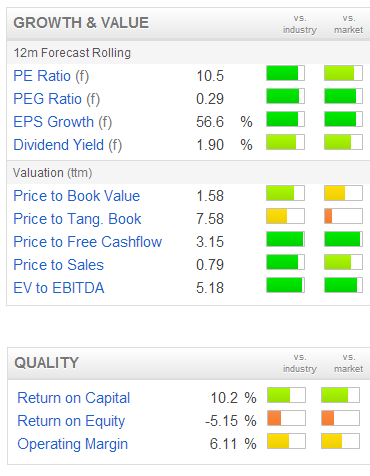
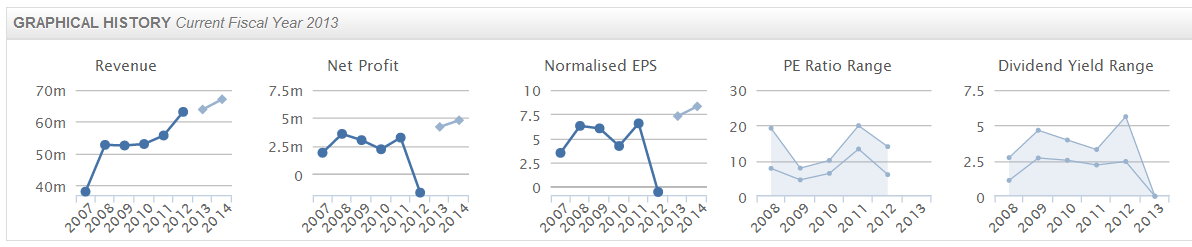
Market consensus seems to be for 7.3p EPS this year, and 8.3p next year. So at 84p the shares look fairly good value, especially since they are expecting to be slightly ahead of this year's 7.3p, Hence the PER is probably about 11, by my rough estimate.
Plenty of green (i.e. good!) on the Stockopedia growth & value graphic shown to the right.
KBC has been somewhat accident prone in the past, so let's hope they have steadied the ship now. There is also an issue here with respect to a high taxation charge - caused by losses in low tax countries not being offsettable against profits in high tax countries, something like that anyway. Note 4 to today's results says their effective tax rate is 50%, so it looks like this is an ongoing problem. There is a one-off tax credit of £1.4m in respect of prior years, which masks this issue in these interims though, and I note there is only an overall tax charge of £66k on the P&L against £2,949k profit. So that will flatter the EPS figure.
This is a Simon Thompson (of Investors' Chronicle) favourite, so he tends to pull in an ethusiastic stream of buyers, but people who buy on tips in magazines or newspapers tend to have a very short attention span, so I might use any further surge here as an opportunity to lock in some profit.
Plus of course, as he showed with his bitter attack on IndigoVision a little while ago, hell hath no fury like a tipster scorned!
I'd like to see the dividends resumed at KBC, and they indicate today that their intention is to "return to a progressive dividend policy in respect of the current financial year", so that's encouraging. Anyway, the market seems to like it, with the shares opening up 4.5p to 88.5p. I would expect them to get to a quid fairly easily in the next few days, whereupon I intend selling mine.
As regulars will know, I've never lked Globo (LON:GBO), because they capitalise a load of costs into intangible assets, thus greatly inflating EBITDA. Plus Debtors are far too high, which is a massive red flag of aggressive accounting treatments, and probable problems ahead. It generates lots of profit, but no cashflow.
So let's see how their interims for the six months to 30 Jun 2013 look.
First red flag, the bolding of "UP"five times in the bullet points (see below). Quindell do this too. I just don't like it, it's rampy:
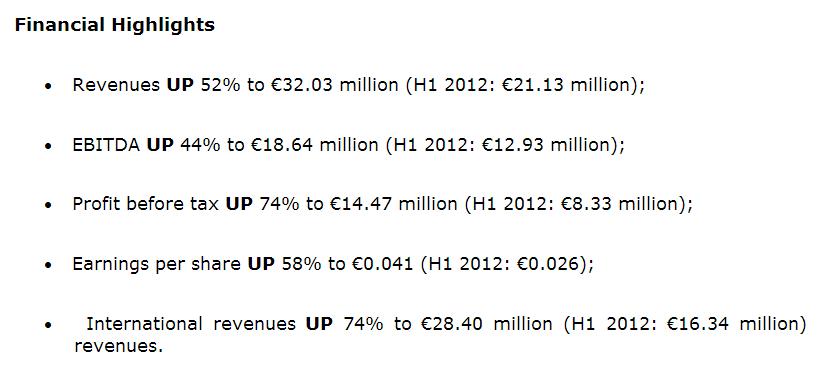
This may be a small point, but conservatively run companies don't do it.
At 65p per share, the market cap of Globo is about £216m, so that's a very high multiple of sales, even if you double the interim turnover to E64m, and convert it into sterling, that's annualised sales of £54m, so a Price To Sales Ratio of 4 - the sort of multiple you would only give a high growth company that achieves high margins.
The next red flag is that the profit margins are too high, which to me indicates either highly aggressive accounting treatments, and/or some sort of one-off gains. They report operating profit of E14.5m, on turnover of E32.0m, so that's an operating profit margin of 45%. That is too high to be believable as far as I'm concerned.
The biggest red flag for me is the Cashflow statement. It only generated E2.36m in operating cashflow, and then spent E6.0m on capex. Given that there are hardly any tangible assets on the Bal Sheet (only E1.4m in property, plant & equipment), then it is safe to say that this capex is actually internal costs which have been capitalised. So the true picture, for this highly profitable company with 45% profit margins, is that it is not generating any cashflow at all! It's consuming cash.
Finally, another huge red flag for me is the Balance Sheet, which is stuffed full of unexplained debits, where there shouldn't be any debits. For example, E9.3m in "other receivables" in non-current assets. Within current assets there is E6.1m in inventories (seems strange for a mobile phone software company, what inventory do they hold, given that presumably the product is an App that people download?).
Also, "trade receivables" of E27.9m are far too high, that's almost 6 months turnover! Do mobile phone App customers pay on 6-month deferred terms? No. Then we have "other receivables" of E2.9m, "Other current assets" of E15.6m, which if you tot it all up means that the profit is just all flowing into the Debtors, but not cash.
These figures just don't look believable to me, not by a long shot. That's just my personal opinion, but I wouldn't touch this share with a bargepole. It's not cheap at all, it's very expensive, and these figures look like something nasty will happen at some point when all those Balance Sheet items have to be written off.
DYOR as usual, but this share has a huge flashing neon warning sign from me over it.
Prelims for the 52 weeks ended 29 Jun 2013 from Finsbury Food (LON:FIF) look pretty good. Adjusted profit before tax rose 19% to £5.5m, despite a slight fall in turnover to £176.6m - note also the low profit margin, as with most food companies.
As reported before, they have done a great job in sorting out their Bal Sheet, with net debt drastically reduced to an acceptable level, of £7.4m (prior year £33.9m), mainly from the proceeds from a disposal, but also a small Placing.
The dividend is reinstated at 0.75p. The shares are down 5% to 73p this morning, so presumably these figures didn't match expectations. It's a bit confusing, as there are adjusted items, etc, which it's not always clear if brokers used in calculating their forecasts.
Anyway, by the looks of it, the adjusted PER is about 12.4, which is probably priced about right.
Having another look at the Bal Sheet, it's a lot better than it was, but actually still not great. Current assets are only 79% of current liabilities, with another £7.8m in long term creditors. So that looks a bit stretched to me, suggesting that they are probably relying on extended payment terms from suppliers to run the business - because it's unusual to see trade payables higher than trade receivables.
I'm not keen on food companies anyway, as margins are too slim, and there's a pension deficit here too, so overall it gets the thumbs down from me.
Time to sign off for today.
Regards, Paul.
(of the companies mentioned today, Paul has a long position in KBC, and no short positions)
Disclaimer
This is not financial advice. Our content is intended to be used and must be used for information and education purposes only. Please read our disclaimer and terms and conditions to understand our obligations.

18 comments
Hi Roger,
Thanks for clarifying the points about their revenue model, I stand corrected - so the product is sold through resellers, who appear to be incredibly slow to pay. Even so, having trade debtors of almost 6 months turnover is a massive red flag for me. It says to me either that they have such a lack of control over their finances, that they cannot collect in their sales proceeds on a timely basis, or that it's a form of vendor financing, whereby resellers are being bankrolled by Globo. Or, it could be worse - i.e. fictitious or exaggerated sales, which are rolled up into debtors and masked by rapid growth.
Whatever it is, the debtor position is so bad that I think that makes these shares uninvestable. It's not the first time this has happened either, Globo repeatedly fails to generate any real cashflow, and has only grown so far through raising equity and loans to fund itself, so no real cashflow from their commercial activities. Whilst reporting enormous profits on 45% margins - which even allowing for growth, should be throwing off bucketloads of cash if the P&L figures were true, in my opinion.
It might turn out to be alright, but why take the risk, when so many other companies displaying similar warning signs have failed in the long run?
Regards, Paul.
Foreign company, AIM listing (lax regulations), glamour products (that nobody you know owns), rapid growth, long cash conversion cycle, tricksy accounts, rocketing share price.... yet still a v. v. cheap price - I've seen this kind of story a few times ;-)
Hi Bonitabeach -
There are company accounts which are a delight to read: clear and transparent with copious notes to explain outliers, large differences and anything that might require further elaboration. But there are others which require a financial savvy contortionist to figure out the numbers and how they stack up. Usually these latter accounts leave you with more questions than answers.
As a rule I don't invest in the latter for the simple reason that the companies perform the equivalent of gaming the accounts in order to tart up the results. Not worth the risk of being wrong-footed.
Regards, Ram
Re: Globo et al
The very fact that this debate is taking place on "did they or didn't they make a profit or a loss and if so how much?" identifies the elephant in the room. Despite the world being awash with highly educated and remmunerated accountants what constitutes a profit is still as precise as "how far will a piece of knicker elastic stretch?"
The failure of accountants and auditors to even get close to measuring “profitability” was a major contributor to the 2008 financial crisis and it is a huge unaddressed, unresolved problem. Stock market investment will remain a big gamble until this situation improves.
I think you have to take into account that the majority of their revenue is still from CitronGo and GoSocial which is certainly sold via partners - mostly in third world countries, and one can guess that these would be very slow payers - and always have been. The GoEnterprise stuff is also primarily being sold via partners, but it certainly still leaves some questions on cash flow and revenue recognition.
As regards CantEatValue's comments, software companies do not sell software up front for cash. They typically sell (i.e. license) the software for the normal 30 or whatever day terms, plus support for a year or more ahead, but the latter is paid on 30 day terms so you have a "liability" introduced into the balance sheet for the "advance" aspect of the sale of support. Alternatively they licence the software and provide support on a rental basis. They therefore would normally have accounts receivable, which can extend more than 30 days if they have delayed delivery or some custom building work associated with contract completion. That would apply to "corporate" level software sales as Autonomy was selling. But Globo seems to be using a somewhat different model which is more akin to the "retail" software model with sales via channel partners.
One of the questions I often like to ask Globo shareholders is 'have you actually ever tried their software?'
Thanks Roger. It seems odd they have absolutely zero deferred revenue in the accounts or any other liability (apart from a E2m 'other liability') that could plausibly be the the advance aspect of support here, so it must all be the second 'rental basis' method you note.
I still find the suggestion that this is now the 'standard' method of charging for software implausible. Almost all major corporate IT providers these days have some large deferred revenue balance because payment is expected upfront - check out Microsoft, IBM, Dropbox, Amazon Web Services etc - all now charge 'as a service' which by definition is upfront payments (Microsoft and IBM are public so you can see their accounts - both have a huge deferred revenue component). Even the GO!Enterprise website is quite clearly a SaaS business model which generates upfront payments: http://www.goenterprise247.com/frontoffice/portal.asp?cpage=NODE&cnode=27
The only explanation I can think of is that the bulk of their real customers are the channel partners, who appear to be giving Globo very bad payment terms. I make the sum of their WIP/Receivables balance to be E49.5m, which I make to be 10.4 months of TTM sales - absolutely gigantic and even worse than Autonomy's 4 months which was already bad enough for forensic accountants to declare 'suspicious' and even HP claim they were fraudulent.
Paul, re the comments on Globo, some of your thoughts are certainly justified, but I would argue about others. The "Other receivables" figures might not have been explained in the Interim report but certainly was in the last Annual Report - it represents the amount due from the buyers of the Greek business which is payable over several years. Also the "Inventories" figure actually represents "Inventories and Work in Progress" and if you look at the last Annual Report almost all of it was Work in Progress, which probably is the case for the interims also.
I think complaining that they said "Up" when all the figures are "Up", also seems a bit carping.
Re Globo, in the 2012 accounts "Other Current Assets" includes Eu 9 million for "Accrued income and amounts recoverable on long term contracts" which is surely trade receivables by another name.
Dear Globo investors,
A quick lesson on accounting for software companies:
http://brontecapital.blogspot.co.uk/2012/11/hewlett-packard-and-autonomy-notes-from.html
Here's the key extract from John Hempton's notes on Autonomy:
"Sales were $870 million.
Receiveables were $330 million - which is four and a half months of receiveables.
Deferred revenue is $177 million - just over half of receiveables.
This is really perverse for a software company. Software companies sell stuff that is barely tangible - they sell it up front and for cash. They have very few receiveables.
They do however have an obligation to service that software for a long time after they sell it - so the unearned income is relatively large (usually a multiple of receiveables).
Autonomy was booking as income lots of cash it had not received (which is why the receiveables were large) and not booking any obligation to provide future services for that income.
This is prima-facie suspect (and you could tell simply by looking at the balance sheet). All it required was basic applied accounting."
Let's compare to Globo:
E27.9m of receivables - I make that over five months worth of receivables (and I'm excluding the "other receivables" from the Greek divestment)
E0.0m of deferred revenue - Yep, that's right, zero. None. Nothing. Globo is a 'software company' which apparently takes no cash upfront. This seems contra to their website for Enterprise247 (http://www.goenterprise247.com/frontoffice/portal.asp?cpage=NODE&cnode=27) in which the pricing is clearly the standard for a software company - i.e. you pay up front.
I offer no explanation for Globo's bizarre finances other than it is clear that their business model is definitely not that of a standard 'software' company. Their customers are clearly not paying them promptly at all, which is why the cashflow generation is so poor. Delays in customer payment are a bad sign, as investors have been finding out recently with a number of Chinese companies.
If anyone could shed light on their business model actually is, that would be very illuminating.
Very interesting thoughts on GLOBO Paul-many thanks-nice quick profit!
Ian
Globo was flagging the Beneish M-Score for high Earnings Manipulation Risk until the statements were updated recently. It's now gone back into the safe zone, but the M-Score, the lack of Cashflow and the fact that personally I couldn't see how I would use their app in my business kept me away from investing in it.
I personally think the 'walled garden' approach to CRM management is fading.. we use Google Apps, Dropbox, Trello, Hipchat etc etc - a whole range of services to do what Go Enterprise appears to be trying to do with its walled garden app. I think single focused services (+APIs) are going to win out in these markets myself.
But that can't deny the growth Globo has shown in recent years - it's been qualifying for a lot of growth & momentum screens & as a result it's been a big feature of the Stockopedia Screen of Screen's performance in recent months - http://www.stockopedia.com/screens/the-screen-of-screens-171/ - and tripling in a short period has made a lot of subscribers happy I'm sure.
Your analysis Paul is as always extremely enlightening.
Paul,
re GBO I believe the E9.3m in "other receivables" in non-current assets is related to the sale of the legacy Greek software business last year, if I recall correctly they retained a minority stake & will receive deferred payment based on the performance of the business. Agree completely with the rest of your analysis of their balance sheet.
Hi Paul,
Thanks for the menton of the ShareSoc Technology Seminar on 2nd October.
Please could anyone that would like to attend sign up here: http://www.sharesoc.org/techseminar.html , so that we can make arrangements appropriate to the number attending. Readers will also find further details of the seminar on that page.
Look forward to seeing you there!
Cheers,
Mark
Hi Paul,
Any ideas on why ZIOC has fallen drastically over the last week, despite the news of their revised project?
Cheers,
Khalid
Hi Khalid,
I'm amazed that Zanaga Iron Ore Co (LON:ZIOC) has fallen back so sharply, when you would imagine it should have actually risen on the company-making news about Glencore. But the price is driven by day traders, so they just stampede in & out of things.
Personally I've used the price weakness to top up, but obviously DYOR as usual.
There are some concerns about what dilution ZIOC will have to accept to advance the project, but having met the company I'm pretty relaxed about that, as they clearly have a close working relationship with Glencore, and both companies want to develop the project.
Cheers, Paul.
Cheers for the response Paul.