Small Cap Value Report (25 Jun) - LOQ, PLA, KBT, IOF, TRI, BYOT, ACM

Good morning. It looks like we should get some respite today from the considerable market falls in the last month, triggered by the Fed saying they would be looking to wind down QE. There was another big rally in the US markets last night, although as previously it didn't hold to the close. FTSE 100 futures are indicating that our market will open up strongly around 50 points at 6,076.
It seems to be the resources sector that's bearing the brunt of the falls, and indeed I'm beginning to hurt on my recent punts in this sector (Medusa Mining (LON:MML) and £AGB), which are about 7% and 20% down on my average entry prices only about a week ago. Ouch!
Results from Lo-Q (LON:LOQ) are for the seasonally very quiet winter period, when most of the theme parks they supply with virtual queuing systems are closed. So turnover rose from £3.7m to £5.6m, and the underlying loss worsened from £1.1m to £1.6m. They have also moved from a net cash position of £5.3m to net debt of £1.8m due to an acquisition.
I don't think anything much can be gleaned from these results, since H1 represents just 12-15% of annual turnover, whilst fixed costs continue being incurred. Surely it would make more sense for the company to pick a year-end date which creates roughly equal H1 and H2 performances?
The outlook statement & narrative are more important, and there are some nuggets in there which might keep the bulls happy with the very high market cap. The "accesso" acquisition is said to be trading ahead of initial expectations. Also, they confirm full year expectations, which is for 16.5p EPS. So at 547p that puts the shares on a PER of 33 times this year's consensus forecast! Clearly the company needs to beat expectations, not just meet them, to justify that sort of rating. It's a nice growth company, but it remains much too pricey for me.
Plastics Capital (LON:PLA) announces its preliminary results for the year ended 31 Mar 2013. They look reasonable, given the weak economic backdrop in the UK & Europe. Turnover is slightly down by 2% to £31.4m. Adjusted profit before tax is down 12% to £3.3m, and adjusted EPS is down 1% to 10p.
I note that they had P&L tax credits in both 2012/13 and the previous year, so that will be flattering EPS somewhat. Put it on a normalised tax charge, and the figures would be somewhat lower. Net debt has reduced by £1.8m, but still remains fairly considerable at £8.4m, so that gives little scope for further acquisitions without an equity fundraising, in my opinion.
The outlook sounds encouraging, with management expecting trading to improve over the coming months. Also, I like the fact that they have doubled the dividend to 2p, so the yield is now 2.3%.
Taking all these things into consideration, I reckon the shares are probably priced about right at 87p. Long term I think there is reasonable upside though, once the debt has been brought down, and more growth achieved.
I see there is another profits warning from K3 Business Technology (LON:KBT) due to order deferrals. They say that "K3 will report revenue and pre-tax profits below current market forecasts". The shares are down 9% to 100p.
As mentioned before, this company fails my balance sheet review, where I usually won't invest in any company whose net assets become negative once your write off all intangibles. In this case, the £64.7m intangibles takes the balance sheet to net liabilities of £17.3m.
Underlying debt is also too high, once you adjust out customer prepayments included in cash, and revealed by the deferred income line. I note they did a small Placing of £2.7m, and I suspect it probably won't be the last equity fundraising here, hence it's not of interest to me. The company seems very accident prone of late too.
Yesterday struck me as the first time lately that I'd detected real panic, especially in some resource stocks. Mention has to be made of a bizarre move in the price of Iofina (LON:IOF) which literally collapsed yesterday, before rebounding strongly. Check out the intra-day chart, and bear in mind this is a fairly liquid stock with a market cap of £250m
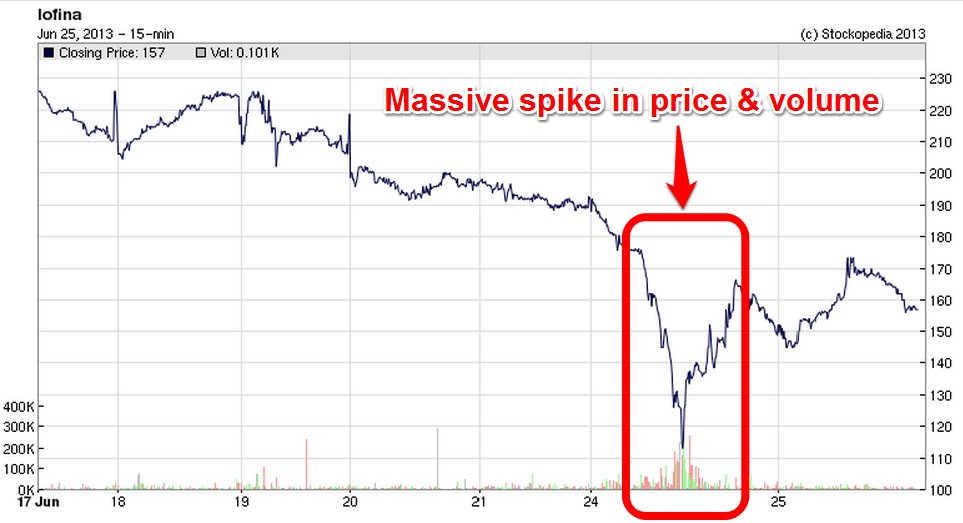
What could possibly have caused such a spike down?
It seems to be that speculative shares popular with private investors are susceptible to this type of bear raid. I believe the reason is that many punters use spread bets, and include stop losses typically at 10-20% below the current price. So a bear raider knows that if he can quickly punch the price through that sort of level down, then it will trigger waves of forced selling by the Spread Bet companies, who hedge positions usually by owning the underlying stock (via CFDs).
The bear raider also knows that the same punters who have been stopped out will be rushing to buy back in as soon as possible, so it offers guaranteed profits on both the way down (when he is short), and on the way back up again (by which time he's gone long).
It's possible that there might not actually be a bear raider behind this, but that Spread Bet punters created the situation themselves, by moving as a herd both up & down?
All in all, it's a very interesting situation, and to my mind it is a reminder that highly speculative stocks really do not work well with Spread Bets. You have to be able to ride out spikes down in price, yet with a loss-making blue sky type of stock, there are no earnings or dividends to attract value buyers at any level. Hence crazy spikes in price can happen.
Personally I do use spread bets, but NEVER use stop losses on individual stocks, for this very reason. By including a stop loss, you've just set a target for someone else to trigger by forcing the price down to that level. I've heard that stop losses are usually bunched around round-sum figures, and are easy to estimate. So a concerted effort to smash the share price through the level where most punters will have put their stop losses is just an open invitation for unscrupulous market participants to steal your money.
The lesson to learn, is don't use spread bets at all on risky stocks, or if you do, size the position sensibly (i.e. keep it small) and don't use a stop loss.
The other lesson to learn from this is how flaky some share prices really are - traders have been buying them on momentum for months now, often well above a sensible valuation, and when the bubble bursts, everyone rushes for the exit at the same time.
I've never liked momentum-based strategies for this reason.
More episodes like this will happen, so be very careful with those spread bets!
Industrial fastenings group Trifast (LON:TRI) have announced excellent results, with turnover up 8% to £121.5m, and underlying profit before tax up an impressive 45% to £7.25m.
Adjusted EPS drops out at 4.73p, so at 59.25p a share, that puts them on a PER of 12.5. The outlook statement is non-specific, but sounds positive.
The market cap of £63m is nicely asset-backed too, with the Balance Sheet showing net tangible assets of £42m. Although there is net debt of £5.2m, this has reduced from £8.4m a year ago, and it needs to be seen in the context of it being needed to finance a fairly large stock holding.
The working capital position overall looks solid to me, with current assets of £68.4m being almost double current liabilities of £34.6m. There are only £6.1m of long term liabilities, so that Balance Sheet gets a good thumbs up from me. Remember that a fairly low margin business like this will always tend to have a heavy stock position, which requires funding.
There doesn't seem to be a pension deficit at Trifast either, which is good - although the recent sharp rise in Gilt yields should have had a knock-on effect on the corporate bond yields which are used to value pension fund liabilities. So we could see companies like AGA. TNI, and NXR see their pension deficits reduce considerably on the back of recent moves in Bond yields.
Overall then, I'm impressed with the results from Trifast, but don't think it's the type of business that is likely to ever attract a premium rating, so it's probably priced about right for now. Stingy dividend too, although it has been increased 60% from a very low base.
Results from Byotrol (LON:BYOT) look pretty grim. By my rough calculations, they need to increase turnover by a factor of about 4 just to reach break-even. Although they have won a contract (previously announced) to supply Marks & Spencer's UK shops with its hand sanitiser products. I don't know what size or margins the M&S contract are, so it's impossible for me to value this company at the moment. Based on the historic numbers, I wouldn't go near it, and I don't like buying on future expectations unless those expectations are very firmly grounded & quantified. Why takes risks when you don't have to?
Although they do say that "the business is well positioned to accelerate growth in 2013/14, and thus achieve break even and profitability in the near term, despite slower than planned progress in this difficult economic climate". So who knows?
It's a fairly busy day for small cap results today, and the next one I've been assessing is Accumuli (LON:ACM). As always, this report can only ever include my first impressions from a quick scan of results. So always be sure to check things yourself, and if you spot something important that I've missed, then please do flag it up in the comments section below.
Accumuli looks potentially interesting. They have disposed of some IP to Juniper Networks for £6.3m, which has boosted their cash pile. Although I note that of the £7.2m cash in the bank on 31 Mar 2013, all of this effectively came from customers paying up-front for goods or services that had not yet been provided. This is shown by accruals & deferred income of £8.9m in note 7 to the accounts published today.
I appreciate that not everyone agrees with my treatment of deferred income, as I've debated this with several other investors at length, but in my opinion deferred income should be taken off the cash balance, to arrive at the company's own true cash balance.
If you do that with Accumuli, then they haven't got any cash left at all. So it would be quite wrong to take this customer's cash into account when calculating Enterprise Value.
You also have to be terribly careful about EBITDA with software companies, as it can be a very misleading figure, as a load of costs get capitalised as development spend, and then ignored for EBITDA. However, that does not appear to be the case with Accumuli, as I could only find £122k in capitalised development spend for year ended 31 Mar 2013.
All in all, with acquisitions and disposals all going on, these are not the easiest of accounts to interpret, and I'm not sufficiently excited by the valuation to continue unscrambling the numbers. Although the maiden dividend of 0.4p is a good sign, and means they start with a yield of 2.7%, which isn't bad considering that could well rise in future years.
I might revisit this one when the interims come out, but for the time being am happy to park it.
That's it for today! Hopefully some of you will be able to see mine & Ed's Webinar tomorrow at 12:30, I think it's almost full to capacity now. Apologies if it is less than perfect, but it's the first one for me, so please excuse any gabbling, umms & errs, and general lack of polish!
See you same time tomorrow morning.
Regards, Paul.
(of the companies mentioned today, Paul has long positions in AGB, MML, and no short positions)
Disclaimer
This is not financial advice. Our content is intended to be used and must be used for information and education purposes only. Please read our disclaimer and terms and conditions to understand our obligations.

5 comments
Hi Paul,
I don't think it's possible for the company to do that. AIUI LoQ makes the bulk of its theme park revenues from just a few popular weekends, when the parks are packed and queues for rides can be horrendous.
Cheers,
Mark
Just in passing Paul is right about the round number thing and stop losses, I wrote about it here: Irrational Numbers and Stop Losses. It's known as price clustering: people just like round numbers it seems.
Interesting points about stop losses.
I recently experienced the type of spike down which you mention which took out a 10% stop on a smaller company which I had a small spreadbet open on. What made this interesting is that the company itself was not particularly volatile and it's upward trend had been steady, history showed that it rarely moved that much at all at least not quickly. There was a sudden spike down of around 10% which lasted for all of about 10 minutes soon after the open. Then the price went back to where it was before, almost as if nothing had happened. At first I thought it might be an error as it didn't show up as a price move on any charts other than the spreadbetting package, but when I checked a different site for the price moves for the day it was recorded as having happened, so who knows who was at work at that time? Annoying to be taken out like that, especially when the price reverts back to where it was before, in this case about 10 minutes after it happened. In this case, historically a 10% stop looked more than enough, but it just shows that anything can happen in the world of smaller companies.
Stops are often placed around or just below potential support points on charts. It is not obvious from the Iofina chart which support points would have been aimed for by someone trying to take out stop losses as depending on the time frame traded, a fall of that magnitude would have taken out most stops at support levels created over the last 6 months. It more or less took the price down to the 110-120 support range from Jan this year.
Do you use stops at all? The main problem with spread betting and not having stops is the sudden drop that doesn't come back, that's when the losses that a stop would have saved you from suddenly mount up. At what stage might you decide to give up on trade if it goes against you?
Hi SevenPillars,
These bizarre intra-day spikes down nearly always happen in stocks which are popular with PIs using Spread Bets. So it looks to me like a deliberately targeted attack on these positions, by someone who knows they can trigger peoples stops.
That's why I never use stops on Spread Bets. They are totally illogical anyway. You should be selling after a big rise, not after a big fall!
Personally I only ever spread bet on companies with good solid earnings & balance sheets, and which pay dividends. They tend to find good support even if the company does issue bad news.
More importantly, I never use spread bets for highly speculative companies, they are just not suited to that. Far better to buy speculative shares outright, then you cannot be stopped out. The most important thing is to weigh up risk/reward before you buy them, and calculate what the maximum potential downside is. I do that for every share, whether buying them, or Spread Betting on them.
So depending on the company, I would usually estimate the worst case scenario to be a 30% drop in the share price (for my type of value small caps that is usually ample). Then I work backwards from a figure of £x that I would be prepared to lose in the worst case scenario, and it not be too painful to my portfolio overall. That then determines my position size.
Leveraged products are so dangerous, and simply are not suited to illiquid shares, and speculative companies. Also, people use far too much gearing. One should always consider the underlying value of the position, so instead of saying it's £100 a point on Iofina at 150p, think about it as £15,000 that you are risking, as if you had bought £15,000 worth of shares. Often you will then find that you've wildly over-sized the position.
This is the stuff that got me into trouble in 2007-8, when I had massively over-sized leveraged positions in illiquid stocks. Then the world went into melt-down, and I couldn't get out of the positions. Total nightmare.
However, when operated with strict controls on limited gearing, care in position size, diversification into a basket of stocks, and only selecting sound companies, it actually is possible to run a Spread Betting account very profitably. Very few people manage it though, but with the right rules in place that you stick to, it can be done.
Regards, Paul.
An interesting strategy would be to reverse this, and determine where the stop losses are and place buy orders there! Any spike downs will cause you to buy, and then be in profit 10 minutes later!
I'll let somebody else try this out though ;)