Small Cap Value Report (25 Oct) - SND, BSST

Good morning! Just a short report this morning, as there's very little relevant company news today. Also I have to prepare for my talk on the Stockopedia stand at the London Investor Show today, at 2pm. Hope to see some of you there. I'll be chatting about current issues with small caps - e.g. adjusted EPS manipulation, pension deficits, are shares getting too expensive?, how I use Stockopedia to keep on top of 500 companies, and anything else that pops into my head! There will also be Q&A. I hate doing public speaking, so will be glad when this is over, but hopefully people will find it interesting.
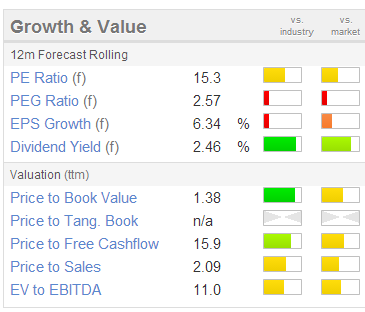 Software company Sanderson (LON:SND) issues a trading update for the year ended 30 Sep 2013. Results are in line with market expectations, for £13.8m turnover, and (unspecified) operating profit in line with expectations. Stockopedia shows broker consensus of £1.9m net profit, and 4.0p EPS.
I thought this company looked pricey when the shares were just below 50p earlier this year, so the recent rise to 64p has left me puzzled. That gives a market cap of £28.5m, which strikes me as rather warm for what seems to be a mature business, with probably fairly limited growth potential.
It's got a ropey Balance Sheet too, with £22.4m in intangible assets. So once you write those off, from the £20.6m net assets, you end up with tangible net assets which is negative to the tune of £1.8m. Net cash was last reported at £4.5m, but it all relates to money paid up-front by customers (deferred income is £4.3m), so doesn't really belong to the company yet (until they deliver the services paid for in future periods).
Surprisingly, there is a pension deficit of £4.3m, which is very unusual for a software company, since most similar companies were created after final salary pension schemes had (rightly) fallen out of favour. It seems crazy now that companies willingly took on such massive potential liabilities without a qualm, but I suppose nobody foresaw the dramatic improvement in life expectancy. After all, for my grandparents generation, the main bread winner retired at 65, and died in his early to mid 70's, so the pension schemes were only designed to pay out for a few years. Whereas today, many people are living into their late 80's or beyond, hence a potentially crushing burden on companies which created these generous pension schemes in the past.
I cannot see how a PER of about 16 times can possibly make sense here, for a small and barely growing company, unless investors are expecting strong growth in future. There is a dividend yield, which has grown strongly in recent years, and is now about 2.3% forecast yield.
Having said that, the outlook statement sounds reasonably confident, with two acquisitions having recently been made which will kick in for the new financial year (ending 30 Sep 2014);
Whilst general economic conditions have shown some slight improvement in 2013, the outlook continues to be uncertain and business confidence, although increasing, still appears quite fragile. The Group's strong order book, improved market position and the two recent acquisitions provide the Board with an expectation that Sanderson will achieve significant progress during the current financial year ending 30th September 2014.
Although as mentioned recently for other companies, I am sceptical about applying a growth company PER multiple to groups which are picking up small, cheap private companies, and thus achieving growth by bolting on new stuff, rather than organic growth from their existing stuff. To my mind a growth multiple needs to be reserved for companies that have organic growth prospects. Otherwise you end up on a treadmill where you are essentially over-paying for the shares, but it will be fine as long as they can keep making cheap acquisitions. When the acquisitions stop, then you suddenly realise you've got an ordinary group of businesses (often with little to no real world synergies) priced as a growth company. That's more a general comment about acquisitive small groups, rather than specifically about Sanderson.
I Tweeted earlier this week about another De-Listing, this time from a micro cap called BlueStar SecuTech Inc (LON:BSST). It seems to have been Listed for about 7 years, and looks to be a Chinese company. Profits have collapsed in recent years, as has the share price, from 50p to just 2.5p now. So the game's up as a UK Listed company, and unsurprisingly they announced their intention to De-List from AIM. The shares dropped 50% on that news, as is usual, so this is a massive risk that all micro cap investors should consider.
A tender offer is being made for a maximum of 23.5% of the company's shares, at 2.5p (which was about half the share price at the time of the announcement).
This got me thinking about Chinese shares generally (which I avoid like the plague), and what the likely end game will be. It seems to me that few UK investors are now interested in Chinese stocks, with good reasons, so they are unlikely to wish to continue spending money on a UK Listing that gives them no benefit. The £150k cost of maintaining a UK Listing is one factor mentioned in BlueStar's reasons for de-listing, which is worth a read here.
I suspect we will see many more Chinese, and other foreign companies decide to De-List, hence regard this whole area as so fraught with risk that it's totally uninvestable in my view. The apparently low PERs are value traps in my view - because UK shareholders are unlikely to ever see any dividends, or any benefit at all from owning shares in these companies. All you have is a bit of paper saying that you own part of a business that you've never seen, and have no control over. So what is that actually worth? Nothing, in many cases I would suggest!
There's nothing else to report today, so I'll wrap this up now.
Have a smashing weekend, and see you back from 8 a.m. on Monday morning.
Best Wishes,
Paul.
(of the companies mentioned today, Paul has no long or short positions)
Disclaimer
This is not financial advice. Our content is intended to be used and must be used for information and education purposes only. Please read our disclaimer and terms and conditions to understand our obligations.

9 comments
The classic Ponza is to pay out to early arrivers to generate the magnet for others, then when the time is ripe pull the plug. Of course I am not referring to any particular company Chinese or otherwise, but for me the former are all bargepole territory.
Scotty's 2pm chat is absolutely mobbed. Ed will have to hire a bigger marquee next time round! Good to see he is plugging (in the nicest possible way) SAL.
I agree with Paul's assessment of many of the AIM-listed Chinese companies, most of them are ropey, but there is always the exception that proves the rule. I also have some Naibu Global International (LON:NBU) - I was a bit nervous about it, but (a) they have now paid out a dividend twice, and it's a whopping 8% or so, (b) reasonably respected UK-based instis have recently taken substantial stakes, (c) the founding investors appear to have been selling it down since IPO but they are now out, (d) it's on a p/e of under 2 even while growing fast, which more than compensates for the risk... something like a p/e of 5 would be fairer in my view.
All IMO of course, no advice intended
Sanderson probably have a following courtesy of the free 'objective,incisive' comment of Investors Champion !
On things Chinese, I have tried for some time to do some research on Naibu Global International (LON:NBU) , but have been unable to find anything about them that does not have its origins with the company itself. I haven't even been able to locate any of the brands they claim to make. Their figures look fantastic, if not really unbelievable!!! I have visions of a bloke in a shed in a Beijing suburb just cranking out RNSs and counting dollar bills. Not good!
Hi Beginner
There is quite a lot of info if you search hard enough. Check out bulletin boards etc. I am invested in it and so is Simon Caukwell. He writes on it quite regularly.
The key risk with Naibu is that given a number of exposed Chinese frauds can their figures be 100% trusted. I am sure Paul would refer to this as a value trap. If it is a genuine company with genuine figures it is fantastically cheap. What I can say to you is that it recently paid its maiden dividend and when I have emailed the CFO I have had a really prompt response.
I of course am bullish on this but of course DYOR.
Cheers, Ric
Thank you very much. Will have a look now.
Hi Paul,
The attraction of SND is its move into mobile retail that has added some excitement to this otherwise fairly dull stock. This may well be the route to revenue growth as a Business Director if your not doing something either in the Cloud or Mobile you have nothing to talk about at dinner parties.
Cheers Maddox
Hi Maddox,
Good points. That could well explain the warm valuation on Sanderson, together with the acquisitions. I was impressed with the CEO when he appeared at a Mello evening some time ago, but didn't like the valuation then, and like it even less now!
Cheers, Paul.