Small Cap Value Report (26 Aug 2015) - IGR, HSS, LTHM

Good morning!
At last we have some interesting company results and trading updates, so I'll be able to get stuck into some proper reporting, rather than waffling on about chaotic market conditions!
US markets
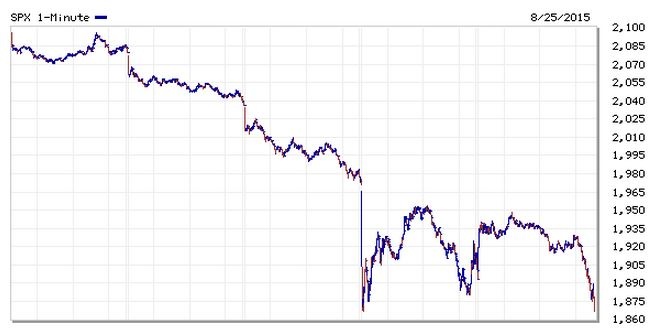
The amazingly strong recovery that we saw yesterday, fizzled out in the US markets in the last hour, as you can see from the five-day chart below of the S&P 500. It has bounced strongly this week, twice now, but closed last night's session at or around the lows (of around 1870) which have been hit three times now this week. So traders are looking to see if this level holds again. If it does, then the market will have probably put in a bottom, and it will be time to gear up & go long. If c.1870 doesn't hold, then we might see another lurch down, who knows? So far, so good this morning, with the S&P futures currently at 1900 (at 9:12 am)
This chart is the last five trading days, from Wed 19 Aug 2015, to yesterday, Tue 25 Aug 2015. So you can see the two big plunges on Mon, then a big bounce followed by another big fall, on Tue (yesterday):
I'll stick my neck out, and say that I reckon this could be the low point, and I'm leaning a bit towards a decent recovery from here. Although that's purely a hunch. Why? Because the economic recovery in the USA is looking good now, inflation is low, and lower oil is feeding through into more consumer spending. When the American economy grows, it tends to pull the rest of the world up too. Cheap oil has historically always been good for growth too - fairly obviously, as it gives people and companies more money to spend, more than offsetting the reduction in capex by oil companies.
Stock markets fundamentally go up & down because of expectations about future company earnings. So markets crashed in 2007-8 because the market realised that corporate earnings were likely to drop heavily, which they did. Then markets recovered, as the financial crisis stabilised and corporate earnings began to recover strongly.
So I don't think there is any particular reason for shares to have another big move down, unless the market becomes convinced that earnings growth is stalling, or even likely to go into reverse. It's obvious why resources stocks have sold off, but it's difficult to see much of a valid reason for everything else to sell off too, apart from pockets of over-valuation in some sectors. Unless you think that we're going into recession again, or even worse, that a new financial crisis is brewing (bank shares have sold off a lot, so the market is clearly getting jittery about that).
Debate is already raging about what caused the "flash crash" on Monday. High Frequency Traders (HFT) say it had nothing to do with them, and that they actually help create liquidity. I think most other people realise that's nonsense/PR, and that it's fairly obvious that computerised trading creates more volatility, because it rams through a much higher volume of trades at periods of peak market uncertainty, and sometimes does so at irrational prices.
I think we just have to live with the fact that modern, inter-connected electronic markets, are inherently more volatile than we're used to. So every now and then, there will be large & very rapid moves down. The last week has felt really bad, but it's only been a 10% move down - which is a normal market correction. It just happened so fast, that seems to be what spooked some people. Or at least, we're not used to this level of volatility anyway, since corrections have been few & far between in recent years. As they say, if you can't take the heat...
China ... again!
As regards China, what the TV news here last night forgot to report, is that the Chinese have had a stock market crash because it had previously gone on a wild, speculative frenzy. Amazingly the Chinese market is still actually up in the last year, even after having crashed recently! One year chart below, courtesy of Bloomberg:
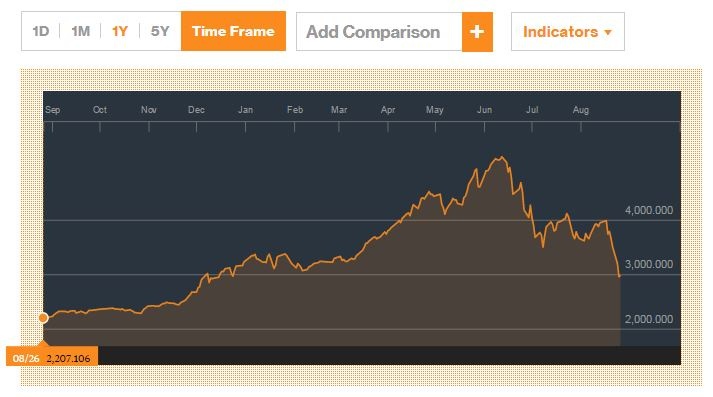
Silly people, who don't know what they're doing, just bought stocks on margin because they thought markets would keep rising irrationally forever, even though valuations were already absurdly high. It's a classic stock market mania, which happen repeatedly throughout history, and mankind never seems to learn from them, despite there being striking similarities between all market boom & busts.
Why is it, that the financial sector seems to be an area where, unlike almost all other areas of human endeavour, we collectively fail to build on the knowledge and experience of previous generations? In almost all other areas (medicine, science, engineering, etc) each generation builds on the expertise of the last. Yet in finance, each generation seems to simply repeat the same mistakes made by previous generations.
I've done this myself of course, so am not preaching. Even though I knew what the main mistakes were, I still made them (in 2007-8). My view now, is that many people (myself included) have to personally experience bad things before those lessons are seared onto your memory strongly enough to make you resist the powerful greed/fear urges in future.
Also, making a lot of money in a bull market can develop a sense of hubris, over-confidence, which again makes you over-ride your natural caution, and start doing things which you already know are dangerous, but you do them anyway. People see everyone around them making money by being reckless, so after a while they throw away their discipline and join the crowd - which is usually right at the top of the market!
I think the only way to avoid boom & busts, is through experience of having personally seen it before, and being badly burned. Then you're older & wiser next time things stoke up to boom time again, and you take your money off the table when things are getting too hot. Most of the best & richest investors that I personally know, are people who are happy to take their money out of the market, and sit in cash - if there are no suitable opportunities which give them adequately favourable risk:reward. That's the no.1 key skill for investors, in my view - the self discipline to sit on the sidelines, in cash, when investments are over-priced, thereby protecting your capital, and having a bulging wallet when you need it most, when the market has a big fall, and there are bargains to be had.
Boom & Busts
Here are the Wikipedia links to some famous boom & busts, which are interesting to refresh your memory if you have time: Tulip mania in 17th century Holland, the South Sea Bubble in the 18th century. Plus numerous stock market booms & busts since, with the most notable being the Wall Street Crash of 1929, and of course in our lifetimes, the Dot.com bubble in 2000, and more recently the Financial Crisis of 2007-8. There have also been numerous property market boom & busts as well, so it's certainly not confined to just stock markets. Any asset market is susceptible to boom & bust cycles, it just seems something that humans are fundamentally programmed to do, as waves of fear or euphoria alternate.
These boom & busts are nearly always caused by a bull market that gets out of control, due to punters with little knowledge of the fundamentals, chasing asset prices too high, often using gearing. That's exactly what happened in China this year. The Chinese are culturally massive gamblers, so they have a natural pre-disposition towards this kind of thing, so it really should not come as a shock that the Chinese market has blown itself up. It is likely to happen over & over again, maybe every 7 to 15 years (depending on how bad the last crash was), which seems to be how long it takes for memories to fade, and a new generation of mugs to appear.
I think the Chinese Govt made a fundamental mistake in trying to reverse crashing share prices, through a variety of ill-conceived interventions, all of which failed. They're learning the hard way, that markets will find their own level, one way or another. Although being a strange hybrid of a command economy and capitalism, China is unique in that the population expects the State to intervene and control market forces. The population seem to tolerate State control, and lack of personal freedom, in return for the economic miracle which has happened in the last few decades. If the Communist Party can no longer control the economy, then demands for freedom/democracy could resurface perhaps?
On a personal level, of course I feel sorry for the Chinese punters who have lost their savings, but life carries on. Sure, Chinese GDP growth might be slow, they could even be going into a recession, who knows (since the economic data is unreliable). However, whilst this might cause some problems for large, international companies, it really shouldn't affect the earnings of the companies that I invest in at all, in most cases. So, I'm gradually coming back round to my starting view, that Chinese stock market gyrations are fairly irrelevant, for my small caps portfolio anyway. That's why I haven't sold anything in my long-term, ungeared portfolio.
I said I wasn't going to waffle today, then proceeded to do exactly that, sorry about that! It's all fascinating stuff though.
International Greetings (LON:IGR)
Share price: 134.5p (unchanged today)
No. shares: 58.8m
Market cap: £79.1m
Trading update - in a bull market, today's update probably would have put 10% on the share price, however it looks like buyers are sitting on their hands, due to volatile market conditions.
This all sounds reassuring, particularly because it confirms that order visibility is fine, as well as current trading, and forex risks seem under control too, so that all seems to largely eliminate the risk of a profit warning this financial year;
Across the Group, sales during the first quarter, together with overall customer order levels already received for the balance of the year, have been in line with management expectations.
The Board believes the Group is on track to deliver against market expectations and is in good shape to combat the anticipated impact of a weak Euro and Australian Dollar exchange rate as we enter our peak operational and trading periods.
Further details are given about expansion in the USA, and launch of more toy products, e.g. Minions characters. Funnily enough, I recently saw these Minion items in Primark, when on my annual mission to buy 10 identical black polo shirts (£4 each) for the year, and I noticed that on the back of the Minion products the name International Greetings appeared.
Judging from today's update, the company seems to be expanding in toys, whereas in the past it was more about wrapping paper.
My opinion - for more details on the financials, I did a positive write-up here on 21 Apr 2015, when the shares were 96p, noting that there looked to be scope for the shares to go higher, as a convincing turnaround seemed to be happening. That's confirmed again today.
Note that the balance sheet isn't great, with too much debt, but it seems to be coming under better control, with excessive levels of stock being reduced, so I think it's alright overall.
The StockRank is tremendous, at 99, which gives me confidence this might still be a good buy, even though it's almost doubled in price, in the last four months.
Earnings forecasts have risen twice in recent months, and the forward PER is 11.0, which still looks reasonable. The divi yield of 1.79% is small though.
In normal market conditions, I would have bought some of these shares after today's announcement, but given market volatility, I don't want to add any new positions at the moment. So it's going on my watch list as a possible future purchase.
Gervais Williams of Miton was raving about this company when I had the pleasure of sitting next to him at a dinner earlier this year. He really rates the management, and thinks it's a good turnaround. Looks as if he's correct, judging from today's update. So it gets a thumbs up from me too.
HSS Hire (LON:HSS)
Share price: 83.5p
No. shares: 154.8m
Market cap: £129.3m
Interims 26 wks to 27 Jun 2015 - this chain of tool hire shops has only been listed just under 7 months (it joined the main market, as opposed to AIM, on 4 Feb 2015). The IPO price was 210p, and look at it now, down 60% at 83.5p - what a disgrace.
So who are the people responsible for this shambles? Well obviously the company's management must take the bulk of the blame, and it seems to me that the CEO's position is now untenable. It never should have been floated if problems were looming - I don't think it is at all credible to suggest nobody knew (or at least suspected) that profits were shortly going to collapse, so this leaves a very bad taste. I see that 19% of the IPO shares went to retail investors too, so a pity to see them take a hit - although if they had read the Prospectus, it was pretty obvious that the company was being floated at a high valuation. The deal only just happened too, with the 210p IPO price being the lowest point in the indicative range.
Looking at the IPO Prospectus, this was a Private Equity deal - the worst type of IPOs, as they nearly always leave behind a trashed balance sheet, and there's a very high likelihood that the deal will be over-priced, and that the PE owner might be selling because they've realised that there are problems, e.g. slower growth, ahead. The former PE owner still holds 37.5% of the company today, so it's good to see that they have taken a big hit today too.
This type of thing is hammering the nails into the coffin for future floats. Who would want to buy into any new floats now, given the lamentable recent track record of the city, in floating things at prices that are so high, and with so many recent floats warning on profits so soon after listing? You'd have to be certifiable to even consider investing in any more IPOs now, in my view, since it has been so clearly demonstrated by the city firms that their main intention is to earn massive fees, and they don't really care who they stuff in the process. Does nobody care about their firms' reputations any more? Doesn't look like it.
The lead role appears to have been taken by J P Morgan Cazenove, assisted by Numis as Joint Bookrunner. Berenberg is also mentioned, as "Co-lead Manager" but in a smaller font on the front page of the Prospectus.
Previous profit warning - I reported on HSS's profit warning here on 1 Jul 2015, a couple of days after the shares had plunged to 128p. So why have the shares dropped heavily again today, to 83.5p, and is this a buying opportunity?
The company says that today's results are in line with the guidance given on 29 Jun 2015, and this is true as far as it goes - the company said that adjusted EBITDA would be in line with the previous year, which doesn't sound too bad. The figures today confirm this, with adjusted EBITDA indeed flat against last year at £28.9m in H1.
However, it now transpires that adjusted EBITDA gave a highly misleading overall impression of performance (what a surprise!). There's been a massive increase in the D in EBITDA (depreciation), such that EBITA (effectively operating profit, before amortisation of goodwill) has plummeted by 60% to only £4.5m in H1 this year.
Ah, I've just discovered a fresh profit warning in the narrative!
New profit warning today - this says;
Recovery and activity levels in the repair, maintenance and improvement ("RMI") and housing markets have continued to be slower and more erratic than predicted by most commentators and this has continued into Q3 15, with customer demand more variable than we would traditionally expect at this time of year.
While the Directors have seen more reasonable revenue growth in July, there is some softening during August across a variety of sectors and customers. This variability period on period and week on week is making it more challenging to predict the out-turn for the year. Against this backdrop, we now expect revenue and earnings for the full year will be below current market expectations.
Going back to the figures, EBITA of £4.5m in H1 this year isn't the end. There are also large financing charges to take into account when considering profitability. Finance expense of £12.6m was incurred in H1, taking the company into a loss overall, of £14.1m. Although they do point out that £4.3m of the finance expense is exceptional.
Note 5 gives a breakdown, see below;
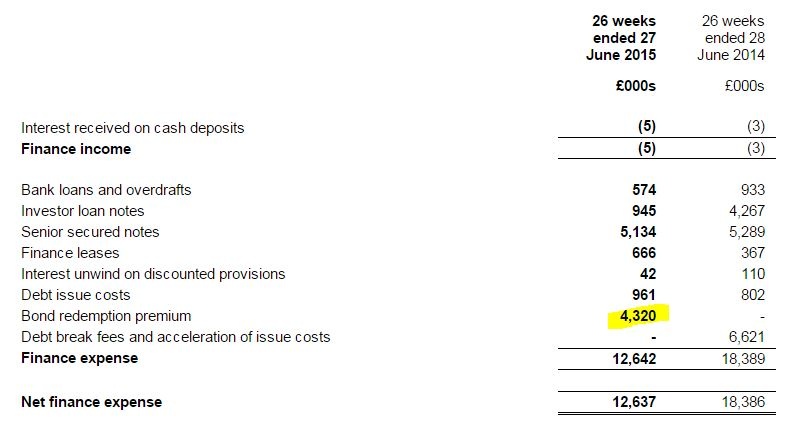
What concerns me is that the recurring interest costs are so high, given that adjusted EBITA was only £4.5m - the ongoing interest costs are almost double that, taking it into losses. Some of the debt was paid off as part of the IPO, but that happened near the start of H1, so the ongoing interest charges should, I imagine, be in a similar ballpark to the non-exceptional charges totalling £8.3m above, per half year. That looks way too high.
Balance sheet - this is in poor shape, as I would expect after the company has been owned by Private Equity ("PE") - a sector which is a scourge, in my view. They load up companies with excessive debt, as a tax dodge mainly (since the interest charges they effectively charge themself, eliminates corporation tax).
The trouble is, PE also have a tendency to leave behind far too much debt, and that's certainly the case here.
Net assets are £159.0m, but once you write off the intangible assets of £179.5m, then net tangible assets is negative at -£20.5m. Not good.
Current ratio - is less important for hire companies, as they always have debt, but in this case it's still very weak, at 0.77, so another black mark.
Long-term debt - as well as a weak working capital position, there's also a ton of long-term debt, in this case total long-term liabilities totals a whopping £166.3m, of which the bulk, £130.6m is borrowings.
Note there is also £11.5m trade payables in long-term creditors, which is very unusual, almost unprecedented. So on checking note 12, that is described as "obligations under finance leases", so it's really just more debt, not a trade payable as such, the way I look at it.
Note 13 then gives more detail on the borrowings. The bulk of it, £130.6m is a senior secured note, which looks to be left over from the horrible PE days, which has a fixed rate coupon of 6.75%, matures in 2019, and is listed on the Luxembourg stock exchange. The nominal value of the bonds is given as £136.0m, so that looks to be a £9.18m p.a. annual interest bill on those bonds, and of course the capital will have to be repaid in 2019.
There's an overdraft of £8.9m, and a revolving credit facility of £33.5m shown in current liabilities, so that's over & above the senior secured note.
Net debt is £197.2m, which is far too high, in my view, plus it's expensive at 6.75%, although the company mentioned refinancing its debt to get a lower interest rate. Although I imagine the company would have to raise some fresh equity to fix the holes in its balance sheet, before finding a lender who would charge a lower interest rate.
Fixed assets are £173.4m, so these are funded entirely by debt, which is higher at £197.2m (net debt). That's not good. I would expect net debt to only be about half fixed assets, for a hire company, which suggests to me that HSS has about £110m of excessive debt on that basis. That's close to the market cap now, so to fix this balance sheet would require a near 1 for 1 equity raise, in my view.
Cost-cutting - these points are mentioned today;
· | Rebase of cost structure to reduce operational gearing, targeting cost savings of between £8m and £12m in FY16 and £1.5m and £3m in Q4 15 |
· | Capex investment will be below FY14, matched to expected customer demand |
· | Assessing further cost saving opportunities through refinancing in 2016 |
That's good news, but what on earth are they doing, putting out profit warnings, moving into losses, whilst at the same time opening new branches at a frenetic pace? If a business cannot predict customer demand, and is having significant problems, surely the last thing they should be doing is opening 50 new branches this year? (39 already done).
On the other hand, I suppose the losses from the new branches might be obscuring decent profits from the existing branches? It would have been useful to quantify this, but I don't see that information in today's statement (unless I missed it, which is possible, as I have to skim read things to save time).
My opinion - HSS looks a real can of worms to me. A bit like Speedy Hire (LON:SDY) and its profit warning at the same time, these companies both seem to have management that are not in full control of the business. So who knows what more bad news could come out?
In the case of HSS, its PE owner has wrecked the balance sheet, so for me it's uninvestable whilst it remains so highly geared. Especially so, with all this bad news coming out about trading, and the company now loss-making.
Above all, it's reinforcing my inclination to avoid IPOs like the plague! I think new issues really should be treated like AIM overseas stocks - there's usually something wrong with them!
James Latham (LON:LTHM)
Share price: 697.5p (down 1.1% today)
No. shares: 19.4m
Market cap: £135.3m
AGM trading update - this reads well, with sales in the first 4 months up 7%, and at higher margins too. The key conclusion says;
Overall the Company is trading in line with full year market expectations.
Valuation - I went through the figures in detail here on 24 Jun 2015, when the Mar 2015 year end results were issued, and the shares are almost 6% higher now, but broker forecasts have edged up a bit too (as I predicted they would), so the valuation has remained about the same.
My opinion - it's a super company, well managed, and with a cracking balance sheet. It's rewarded very long term shareholders handsomely. However, I think it's priced about right now, so today's steady update is reassuring, but doesn't make me want to rush out and buy the shares, since expectations are unchanged.
So, a good company, priced about right.
SkyePharma (LON:SKP)
Interim results - there's only time for a very quick comment on these figures, which I skimmed through this morning on my iPad.
This is a company which I've reported positively on before, as it looks a solid GARP share. Today's figures and outlook read fairly positively, which has been reflected today in a 9% rise in share price to 291p.
It has a good balance sheet. It's quite a complex business, so I don't really feel qualified to plough through all the narrative, and try to explain the various moving parts - figures can be lumpy because of milestone payments dependent on product sales, etc.
Pharmas are really not my thing, and I don't really understand the sector, but I do like this stock, on a simplistic basis that it scores well as a GARP share, and the outlook comments have been strong for a while, with new products selling well.
Outlook - here is an excerpt from the detailed comments given today;
The Board expects continued substantial growth in revenues in 2015 compared with 2014, due to ongoing momentum from the products launched since March 2012, especially flutiform®, EXPAREL® and the GSK Ellipta®-range of products, as well as the exceptional performance of Solaraze® in the U.S. in H1 2015. Based on current forecasts by analysts who follow Pacira, the next sales milestone of U.S. $8.0 million (£5.1 million) receivable by Skyepharma, which is due when annual net sales of EXPAREL® (on a cash received basis) reach U.S. $250 million, is expected to be triggered in 2016.
The Directors expect that flutiform® product supply revenues for 2015 will be ahead of the Board's previous expectations given recent growth in customer demand forecasts. As a result, after allowing for the likely shift of the EXPAREL® milestone into 2016, the Directors believe that underlying trading for the year will be ahead of previous expectations.
That all sounds pretty good!
My opinion - I'm kicking myself for selling these shares a few days ago, as I wanted to de-risk my geared portfolio in the light of market volatility. So it's a stock I no longer hold.
I'm considering buying back on the back of today's update, which looks very solid, and the forecast PER is still quite reasonable. at about 14.
All done for today! See you in the morning.
Regards, Paul.
(of the companies mentioned today, Paul has no long or short positions.
A fund management company with which Paul is associated may hold positions in companies mentioned.
NB. These reports are Paul's personal opinions only, which like everyone else's, will sometimes be right, and sometimes wrong.)
Disclaimer
This is not financial advice. Our content is intended to be used and must be used for information and education purposes only. Please read our disclaimer and terms and conditions to understand our obligations.

37 comments
Excellent analysis of the US and China Paul. Good reading with some very valid points. It does seem that we all probably do need to get badly burnt before we learn lessons. These days I seem to get singed rather than the full cremation. Maybe it will just be boring if we don't make the occasion mistake, although I am happy to give it a go.
About the difference between finance and other domains of knowledge: finance is constantly altering its own reality. Innovations and reform of institutions change the environment the institutions are trying to control. Of the other domains you (Paul) mention maybe only Medicine can also do this: antibiotics are changing the nature of bacteria, and we'll see a crash if they fail.
I took a history of finance course by Robert Shiller, and he was optimistic that there is actually a slow improvement in financial knowledge. But he looks so sheepish and apologetic it's hard to know if he really believes that.
http://www.ted.com/talks/yuval_noah_harari_what_explains_the_rise_of_humans
We are always making our own narrative based realities. Sometimes the fundamentals interrupt, then a new narrative is needed.
Hi Paul. It is at times like these in which value investors lick their lips at the value being offered in the summer sale. Somewhat fortunately I was dramatically reducing my portfolio size over the past year. I would like to say that was entirely because I expected a correction or worse but in reality it was because i'm moving into a more 'liquid' market (if you get my meaning!) Anyhow there were quite a few alarming statistics i was aware of leading up to the Chinese crash, one of which is a report i read on the number of retail broker accounts that were opened in China in the Spring - 2 weeks in March 2.8 MILLION ACCOUNTS WERE OPENED and in April 4 MILLION NEW ACCOUNTS WERE OPENED!!! I found this quite shocking and was a BIG red flag! Conversely as a stock picker it's also good to see the stock markets being mentioned (for the wrong reasons) on the radio 2 news and as headlines on most of the TV broadcasters and newspapers - A very good indicator that we are near to the bottom (along with more technical indicators such as the VIX and RSI) - If I had any cash that wasn't going into the beer business i'd be buying selectively now and concentrating on good cyclical mid/small caps with exposure to the domestic economy. It's a pity that i'll have to sit this one out but i'll be back soon when (hopefully) I start selling some beer (and competing with the likes of Greene King (LON:GNK) and Marston's (LON:MARS) lol!
Cheers,
Ben
I haven't taken up any private equity IPOs. I can't believe that PE is going to be able to float anything for the next 10 years. Surely there comes a point when retail investors and even the dopey of the dopiest fund managers say
"Enough. The rule of thumb is: whatever PE is selling, I'm not interested."
Superb reportage re HSS. Anyone looking at an IPO should consider two main rules;
1. Never get involved in a private equity sponsored IPO
2. Never get involved in a private equity sponsored IPO.
BQE Bioquell have reported interim results this morning and is a company you have commented on before without any enthusiasm but it is a special situation now you might be interested in. They are now sitting on £47million cash largely from selling one of their businesses and looking at returning cash to shareholders and also selling remaining businesses. Market cap is £56million.
Simoan,
SUGGESTED HEADLINE (facts presented otherwise):
"Chinese investors still have two-thirds of the gains they have made on the Shanghai stock market over the last eighteen months"
So immature, inexperienced, greedy gamblers have lost only one-third of their gains, having still blindly and luckily (and perhaps undeservedly) doubled their money.
Sorry but why the kneejerk panic in the West at a time when our own economies now seem set for steady recovery?
Yes, if investors still have exposure to China in resource stocks, mining stocks, banks, luxury brands, heavy exporters, etc, doing business with China, despite all the warning signs that have been showing up for months now, well, what can one say other than "bad call, you pay the price"?
Yes, I do appreciate the risk of contagion but this is, imo, definitely not a re-run of 2008-2009 when the problems were centred in the West and affected just about everyone in Western countries.
So, yes, I do see this as a cautious buying opportunity.
My opinion, its little to do with the Chinese stock markets which are like casinos anyway, however many investors there are new sucked in by the large gains, they have lost lots of money, some seems funded by the banks. I believe its more to do with the Chinese economy which is 2nd largest in the world I think, if that suddenly goes into recession it will affect the west. As its a large market many companies will have exposure to it, directly or indirectly. The largest exporter to China is the European Union. The USA were going to put up interest rates but that now seems to be delayed.
There are actually quite conflicting views on whether China is going into recession or is simply starting to make, rather bumpily, the transition to a middle-income, medium-growth services and consumer economy that other countries have made in the past.
Here's an extract from an article I read today on seeking alpha:
"In the last two days, we have had multiple reports by companies that actually do business in China. The data reported do not depend upon a Communist government's biases. Anything said can either be immediately confirmed by official US filings, or soon will be. I watch for this information like a hawk, scrolling back on TIVO to get the full story.
•Apple (NASDAQ:AAPL) CEO Tim Cook reports that business has never been better in the Chinese Apple stores, and that new connections are at a record rate. (I know that deniers want to attack him for saying this, but we will all know soon whether or not he lied. Do you really think so?) This is confirmation of the consumer demand.
•BHP Billiton (NYSE:BHP) CEO Andrew Mackenzie stated on CNBC that internal data confirmed the official claims of 7% growth. He quietly and patiently explained to a skeptical and aggressive Cramer that the company had been trading with China for 20 years. Its internal indicators worked just fine in past periods and showed 7% growth right now. He cited supply chain evidence. See the full interview.
•DHL CEO Stephen Fenwick made similar comments in his interview, saying that business in China was good and fears were overblown."
http://seekingalpha.com/article/3466556-what-every-investor-must-know-about-china?ifp=0
Are these people telling lies?
I read all kinds of contradictory stories about the situation in China.
Whatever the situation is in China and its future, my point remains which is that making investment decisions in a climate of ignorance, fear and panic is perhaps not the wisest thing to do.
Jane,
Thanks for that information. Yes I was thinking about Apple as China has now taken over the USA for phone sales, so it is rather exposed to a Chinese recession. I guess at the moment things are ok, as these things are probably bought on credit. Anyway the fear in the west is China is slowing down, why did they cut interest rates? Also concerns about their banks.
Hi Jane -
What we know is China's history of manipulating economic data that it puts out to the world. We are debating now if the 7% growth rate is believable or not because past history tells us that China has been guilty of massaging the figures. Here is a good article from the Economist on this issue:
http://www.economist.com/blogs/freeexchange/2015/07/chinese-economy
Only time will tell us if the doubters are right. If the Chinese economy is indeed slowing down, then the impact on all major economies and hence stock markets will not be trivial.
More evidence that China is slowing down, this time German car manufacturers, I guess the big ticket items will get hit first. Also from 21 August "A detailed breakdown of China's PMI survey showed conditions deteriorating on almost every level in August. Factory output sank to a near four-year low as firms laid off more workers, while domestic and export orders fell at a faster rate than in July."
Sure some companies will still be doing well.
My reading of it Herbie is that investors are concerned about the level of investment from Global Banks and the impact of declining growth on that despite increasing levels of investment. That is to say investment in non productive assets. Another financial meltdown couldn't be supported by Govts or Banks.
Yes good point. The problem is if there is another banking crisis what do Govts do, cant cut interest rates as they are so low already.
Personally I am of the opinion they will have to grin and bear it. King Canute found out what happens when you try to hold back an unstoppable force. The interventionism so far has made asset holders richer and everyone else poorer. Accepted it would be horrible. The only way out of the current demise is inflation which will be horrible also. Problem is politicians can't deal in horrible, doesn't tend to win votes so we keep kicking the tin down the road.
What a super, well written article. Many thanks.
Love the introductory quote
At last we have some interesting company results and trading updates, so I'll be able to get stuck into some proper reporting, rather than waffling on about chaotic market conditions!
And then exactly how many paras follow on the US and chinese markets + boom or bust prior to that very same 'proper reporting' ?
Thank you Paul and Herbie. Paul your reflection is interesting in that I have unwittingly changed my investment approach. I have found too often in the last year stocks running up and showing a decent profit, which I should have taken and didn't only to see it disappear and me kick myself. This has been a characteristic of the recent "stable" background markets have had. I shall take your advice and return to the longer term. It does leave me with a question though, if I create a trading account what in your opinion is the minimum sum one should begin with? I am presuming because the duration is shorter (and therefore risk is greater because decision becomes right or wrong) the investment size is smaller. Equally the choice becomes one of where my skill lies, am I good at reading prices or am I good at company analysis.
Hi Camtab,
If anyone I knew told me that they were going to try trading the stock market, I would strongly urge them not to! Very few people have the ability to consistently beat the market over the long term, and spread betting accounts are a money pit for the vast majority of clients. That's why the Govt is happy to leave them tax-free - as the overwhelming majority of clients lose money overall.
I once asked my a/c manager at a big SB firm how many client accounts were worth following, as the people consistently made money. His reply? Six! (out of many thousands of accounts).
Momentum trading has worked brilliantly in the last few years, but I suspect we might now be coming out of that period, into more sideways markets, with a lot of volatility. If I'm right about that, then people who have traded the upward momentum in recent years may now find that approach becomes loss-making - as they will buy things that are rising, only to be stopped out when they fall back again.
I don't think there is any substitute for buying good quality companies at reasonable prices, with a good outlook. That's what I try to do, but obviously sometimes I'm wrong and sometimes right, because the future is unknown. It's also very much the Stockopedia approach, with StockRanks, which is I think a brilliant system that screens for good quality, improving stocks, and steers us away from over-priced junk.
Although there are lots of different ways to make money. A wise friend of mine said to me, "Just do more of what works!", so I have that pinned on the wall next to my PC!
Cheers, Paul.
Paul just wanted to say excellent comment in replying to Camtab. Very useful for me to.
Paul really excellent analysis of the situation at HSS.
Paul, the issue I have with automatic trading is every time I place a stop loss with my broker, at some point the market loops down to take it out and then retraces its steps. I am interested in views here, putting aside recent volatility I believe it to be wrong to place the stop loss as the market obviously sees it and opportunists seem capable of buying cheap stock. This happened with Norcros recently I bought in 19.75p and put a stop loss at 18.75p. I never physically saw 18.75p but nontheless the stock was taken out before recovering to 19.25 bid on the day. All comments welcome.
Camtab, I'm not keen on auto stop losses for the reason you mention and others. But I would suggest your stop loss is too close to the buy price, I suggest something like 15% depending on the type of share and its normal trading behaviour. For a company like Norcros I would consider probably 20% lower say 16p. Otherwise you will be getting stopped out all the time. Yes Ive read market makers do that to pick up cheap stock. Small companies you only need 1 large sell and the sp can dip down considerably then buyers come in and sp bounces back.
Hi Camtab,
I never use stops on value shares. So something like Norcros (LON:NXR) is totally unsuited to a stop, in my view. Especially the one you used, which was way, way too close to the market price. Norcros can on some days have a 0.75p bid:offer spread, so putting your stop only 1.0p away from your buy price of 19.75p, was in effect giving your money away - it was virtually certain that your stop would be triggered just on a blip down in the market bid price.
If I was going to use a stop on Norcros (which I wouldn't), then I'd put it in at maybe 15.5p or lower. Then there's not much likelihood of an erratic price taking out the stop.
I think the last week has demonstrated what a curse stop losses are. The market, even (well, especially!) in large caps, has been so erratic, that stop losses are most likely to take you out at exactly the point you should be buying! In any case, I want to make the sell decision myself, manually, based on up-to-date information, not have some arbitrary price programmed in to sell, based on what i knew about the company in the past.
A lot of the smartest people I know are not geared at all, don't use stop losses, and are currently on holiday abroad, largely ignoring the markets, other than an end of day catch-up on their iPads!
I think you're either a trader, in which case you should be trying to make money by timing the market, and stop losses can be an important part of that, and are vital if you're using a lot of gearing, otherwise big moves could wipe out your capital completely, if no stop loss is used.
Or, you're an investor, in which case you generally should not be trying to time the market's unpredictable short-term volatility. You just invest your money into stocks you like, and then run with it long term, or until the share is no longer good value, when you sell it.
Where the problems arise, is that I think a lot people think that they are investors, but are actually (& unwittingly), traders. Usually bad traders too - who panic sell when they should be buying, etc. Going in & out of the same stocks, selling when they drop, then buying back once they feel comfortable again because the stock has gone up. We've all done it, and it's the best way to dissipate your gains.
I can remember a few year ago, looking at a share that had gone up dramatically for a year or two, and wondering why I managed to lose money on it, or at least, make very little profit. It was because I constantly tinkered with my holding in it, buying & selling on a whim, and missing the big moves up on results day, etc.
So these days I just buy stocks & keep them, for a year or two usually, as a start, unless the fundamentals go wrong. That's in my long term portfolio.
Then I put on my traders hat, and adopt a completely different approach for doing short term trading. It's very important to compartmentalise things - before hitting the buy or sell button, it's vital to be clear in your own mind whether this is an investment, or a trade. Either is fine, whatever floats your boat, but problems arise when people muddle up the two.
Regards, Paul.
Hi Paul
You commented on SkyePharma (LON:SKP) in February last, and today's half year report seems to be pointing to results running ahead of expectations.
Worth a mention today?
Paul, very sensible waffling, thank you. As far as I know, the companies I'm invested in have little or no revenue exposure to China. Many are consumer-facing and most are UK consumer-facing or UK economic recovery-facing or are likely to benefit from falls in the prices of oil and commodities. Of course, there may be some knock-on effect from China that I`m unaware of but the only one I can identify is a positive one, namely that one of my holdings sources heavily from China and I'd expect they would now be able to buy even cheaper than in the past. Oil and resource stocks and exporters to China are the ones who will take a hit to profits, as will luxury and aspirational retailers who have grown fat on the rise in the Chinese middle class. I think it's the fear of knock-on effects, the fear of contagion that is hitting the markets in the West, indiscriminately as always happens. Isn't it always like this? If your portfolio is carefully positioned, yes, it's uncomfortable to see your stocks down but if nothing fundamental has changed to your particular companies and their businesses and the environment in which they operate, then perhaps one should be looking carefully and cautiously for buying opportunities, rather than thinking of selling good investments at low prices.
As far as I know, the companies I'm invested in have little or no revenue exposure to China. Many are consumer-facing and most are UK consumer-facing or UK economic recovery-facing or are likely to benefit from falls in the prices of oil and commodities. Of course, there may be some knock-on effect from China that I`m unaware of but the only one I can identify is a positive one, namely that one of my holdings sources heavily from China and I'd expect they would now be able to buy even cheaper than in the past.
Jane,
Surely the big concern though is that as the tide goes out the Chinese banks are shown to have been swimming in the nuddy?This is my overriding concern about the Chinese economy. IMHO the stock market crash is a mere sideshow but could be a pre-cursor to something far worse. The actions of the Chinese Government to date do not inspire great confidence in how they might handle a proper financial crisis.
I'm sorry to post twice in one day, but I mentioned James Monitier earlier, and remembered reading this earlier in the year (see link below). It's a Q&A with him from December last year which seems quite prescient and is worth reading IMHO:
http://www.zerohedge.com/news/2014-12-03/james-mon...
Si
Hi Paul, not learning from our mistakes reminds me of a great quote from my old sales manager: "when I see 10 year's experience on someone's cv, it usually means one year's experience 10 times".
Unfortunately it seems we must personally feel the pain before truly believing in a certain risk. I guess it's hard to override 3B years of evolution!
Rrt
I was hovering over International Greetings (LON:IGR) yesterday - still think its a buy so probably should have bought. Never mind.
I said I wasn't going to waffle today, then proceeded to do exactly that, sorry about that! It's all fascinating stuff though.
Paul,
Really loved your long "waffle" this morning. Thanks for reminding us of our in built biases and the wider biases of the financial industry which never seems to learn. In many aspects of life technological change is a very positive thing but this is not true of HFT which is simply an arms race with people trying to gain the system. IMHO it should not be allowed and the powers that be should ensure that the playing field is completely level whether your are Goldman Sachs or a PI.
Please feel free to waffle away as much as you want as I for one enjoy reading it!
Si... off to read that James Montier book again :-)
Personally I believe that we are in a Dead Cat Bounce phase which will continue for at least a few weeks/ months. No pundit can tell us when and at what level the next point of equilibrium will be reached.
But then what do I know.
Thanks Paul. Looking at the 1yr chart above of the Shanghai index reminds me of most AIM stocks.
Not great news from HSS today either!!!
Cheers, Mark
I think you are right about computerised trading. Also I think auto stop losses are partly to blame once these start being triggered the whole thing escalates very quickly with electronic trading.
Paul I'm surprised "I don't want to add any new positions at the moment"
I thought you looking to pick some bargains?
Paul
If "computerised trading creates more volatility, because it rams through a much higher volume of trades at periods of peak market uncertainty, and sometimes does so at irrational prices." then surely the traders must lose money on the trades?
I also wonder if these type of flash crashes make leveraged trading more risky.
Hi Paul
I wondered whether you had any thoughts about the interims published by HSS this morning. I think reinforces your point that recent IPOs offered to private investors at launch have performed poorly.
Disc: I don't hold HSS.
Best wishes,
Imran.