Small Cap Value Report (29 Apr 2016) - RTN, FFY, FLOW

Good morning!
Sorry I didn't get round to doing any more updates to yesterday's report. I was too tired after a 5-hour drive home, in heavy traffic.
Today is one of my "it's not a small cap, but it is a retailer, and it's interesting" days! I'm talking about this company:
Restaurant (LON:RTN)
Share price: 290p (down 22.5% today)
No. shares: 201.0m
Market cap: £582.9m
(I am actively trading this share today, and at the moment am long, but this may change throughout the day)
Trading update & Board change (profit warning) - key points:
The long-standing FD has left with immediate effect - so clearly some kind of Board Room bust-up has occurred. Not good - and suggests that there could be more problems ahead.
Current trading has been weak:
Since we updated on current trading with the preliminary results on 9th March, we have seen a further deterioration in trading conditions, with our Leisure business, in particular, continuing to be impacted by the structural and business challenges referred to in the March Preliminary results statement. As a result for the 17 weeks to 24 April, total sales are up 4.7% and like for like sales are down 2.7%.
Clearly that's bad news, but it's hardly a disaster. LFL sales down 2.7% over 17 weeks suggests to me problems that are probably fixable.
However, note that the company last reported LFL sales were down 1.5%, for the first 10 weeks of this financial year.
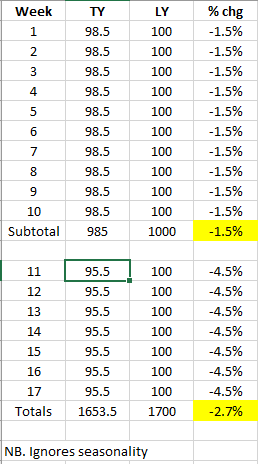
I want to quantify what the LFLs were for the last 7 weeks (not specifically stated today), so have created a very simplistic spreadsheet (see below) which calculates approximately what the LFL might have been in the last 7 week period. Note that I have ignored seasonality, which will skew the figures somewhat, since I do not have any data on the seasonality of the business on a weekly basis.
Here are my workings, which suggest that LFL sales down c.4.5% in the last 7 weeks - so a deteriorating trend.
Sales guidance given today for the full year, is LFL sales down between -2.5% to -5.0%
Revised profit guidance is given today of £74-80m profit, at the PBT level. So still a very substantially profitable business, on an excellent margin too.
Valuation - I've not seen any revised broker forecasts yet today, but using the old figures, and taking them down about 10% gets me to an estimate of around 28-30p EPS for 2016.
Given that the shares have fallen heavily again today, to 290p, we're getting into quite good value territory, for a PER of about 10.
The big unknown is whether things are likely to get any worse. The company is doing a dreaded "strategic review" - which usually means stored up bad news is unleashed in conjunction with write-offs, restructuring provisions, etc.
A comprehensive review of our current operating strategy has also commenced. This will include our property portfolio, site roll out programme, brand positioning and overheads. We will update on this review at the Interim results in August.
Mind you, looking at the 4 examples I have bolded above, these look fairly sensible things to be reviewing. Indeed, I would say the company should be reviewing all of those things every single day, just as the normal process of running the business. Isn't that just what management are paid (handsomely I might add) to do?
Listening to the webcast this morning - recording here - I can't help feeling that new management is needed, to breath some fresh energy & ideas into what is fundamentally a very sound business.
Balance sheet - this is good, and note that fixed assets includes £108m in freehold property.
Last reported net debt was only £24.8m, so nothing in relation to the size & profitability of the business, and in any case covered over 4 times by freehold property.
One concern is whether management is allocating capital correctly. I think this is a question mark. Also the £35m figure noted in the conference call today for "maintenance capex" seems extremely high.
I think this business is likely to attract Private Equity bidding interest, as it has the sort of strong balance sheet & cash generation which is well suited for such a buyout. Also the price is now appealing, after the share price halving in recent months.
Dividends - mixed messages from the company today, but there seems little doubt that a decent yield is likely to be a continuing feature.
My opinion - there are problems at this company - which seem to mainly surround issues with its brands becoming tired & needing a refresh. Plus additional competition in its out-of-town retail park sites.
That said, the core business remains highly profitable & cash generative. It also has a strong balance sheet - which is absolutely key when looking at falling knife situations. If a company is soundly financed, then it doesn't usually matter if you miss the exact low point to buy, because you can afford to sit back and wait for it to recover, with patience.
Therefore I feel this is a potentially interesting turnaround situation, where the share price appears to have overshot on the downside. The main risk is that we could easily have another lurch down in August, if the strategic review comes up with more nasties.
What would you rather do - pay a PER of 20 for a growth company, then lose half your money when something goes wrong (as has done here)? Or pick it up on a PER of 10, with a great divi yield, when something already has gone wrong, and disillusioned holders are throwing out the baby with the bathwater? I'll take the second choice any day - but only where there's a strong balance sheet to protect the downside.
Fyffes (LON:FFY)
Share price: 120p (down 2.4% today)
No. shares: 297.2m
Market cap: £356.6m
Trading update - the key trading message is that the group is in line with expectations:
Overall, the Group's existing business has performed in line with expectations in the year to date.
Although guidance is being raised due to the acquisition of a mushroom company. Look at this for a model of clarity:
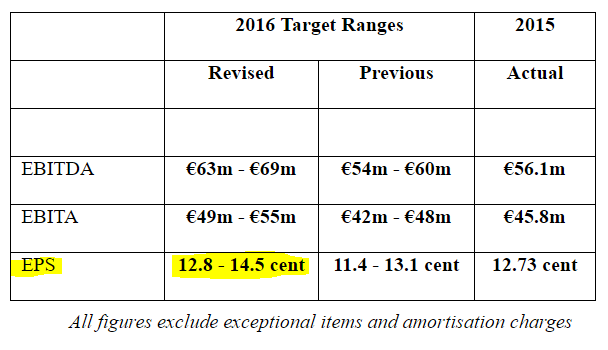
You know what I'm going to say next! Why can't all companies do this?
Providing specific guidance, as above, removes a lot of the guesswork for investors, and means that private investors (who often can't get hold of broker notes) can make informed decisions. Businesses where profitability is more variable could still do the same thing, but with a much wider range of profit guidance, which would narrow as the year progresses.
My opinion - this is a decent value share, in my view. I like it, but don't currently hold.
The divis are a bit mean, but that seems to be because the group is growing by acquisition.
Also note that the shares are surprisingly illiquid, for the size of company - I had difficult when buying/selling these in the past. So you can get stung for a wide bid/offer spread if you're not careful. For that reason, it's best to consider as a long-term buy & hold, not as a thing to trade in & out of.
The guidance today has been raised due to an acquisition, so wouldn't necessarily cause any share price movement, as acquisitions have to be paid for. It's not free extra earnings.
Flowgroup (LON:FLOW)
Share price: 21.5p (down 14.8% today)
No. shares: 317.5m
Market cap: £68.3m
Results y/e 31 Dec 2015 - you know that any company releasing 2015 results now is going to be reporting awful figures, and that's very much the case here.
These are really terrible figures. An increased operating loss of £17.1m, on turnover of £40.4m.
The original product launch, of a new type of domestic boiler, flopped basically. Although possible changes to VAT rates didn't help. So it was withdrawn, and they're now trying to reduce the production cost, with the contract manufacturer Jabil.
It is however noteworthy that Jabil, a substantial company, invested £7.4m in FLOW's last fundraising, a considerable indication of commitment.
Balance sheet - if cash burn continues at a prodigious rate, then the company will need to do another fundraising. Will investors be quite so keen next time? I have my doubts.
My opinion - the valuation here looks nuts, for a jam tomorrow company.
A friend (who is an engineer) looked into the new boiler product, and told me a while ago that the claims made for it are questionable. In my view, FLOW has solved a problem that doesn't exist.
I haven't really looked into its other business, as an alternative energy supplier. The overall picture is too poor to make me consider investing here. It's going on theBargepole List, due to the initial product launch not working, and the need for more cash. This type of share nearly always goes wrong in some way, leaving "believers" in the story nursing heavy losses. Maybe this time it's different? Why take the risk?
Got to dash now.
I hope you have a lovely long weekend, let's hope we are blessed with some pleasant weather!
Regards, Paul.
(usual disclaimers apply)
Disclaimer
This is not financial advice. Our content is intended to be used and must be used for information and education purposes only. Please read our disclaimer and terms and conditions to understand our obligations.

47 comments
Always interested to read your comments. I have been reviewing the future and relative value of the key UK airlines. The one that always stands out as under performing is Flybe (LON:FLYB). You always seem to have interesting discussions with senior management, Would you be able to have a one to one with the CEO to ask him to explain what is going on? Your discussion with the Brady guy was very interpreting though I accept that he asked for the chance to reply. How about inviting the CEO to take the opportunity to get his defence in first!
Like Danpollard I also went to Frankie & Bennys last weekend at Stansted Airport, on my way back from Masterinvestor, I can honestly say that it was the worst meal I have had in years and it took about six pints of lager to get rid of the taste.
I would never go to one again and I am sure that I am not alone, I am surprised that sales are only down 4.5% and am sure that there are plenty of new chains who will do better, I would also think that they will suffer from the new wage regulations.
I just wish that I had realised that they were listed and put a short on last Monday.
1: the age of basic principles is not relevant.
2: pound coins are not relevant - costs and subsidies can and do change all of the time
3: CO2 can be a very misleading, single parameter. We are creating systems that use more energy from cradle to grave than they produce.
4: Where you draw the boundary in an energy accounting system is critical - e.g. do you account for mining, manufacture and disposal. Doing energy accounting in this way is extraordinarily time consuming.
5: if you want a decent, modern primer I recommend the free download of David MacKay's "Sustainability without the hot air".
6: Ask yourself what information would change your mind.
7: This company will not survive, but if the principles were sound a system would be produced somewhen, somewhere in the world.
8: Don't hold your breath.
apad,
Yes, but this energy accounting argument misses the point: it's a boiler, you need a boiler, whether it's boiler A or boiler B, you still need a boiler. The Flow boiler is a direct substitution; when boilers give up the ghost, they need to be replaced - arguing that you're not cradle-to-grave accounting doesn't magically make the need for a new boiler disappear!
I assume, by the way, that because you haven't poked a hole in them, my sums add up. In this instance, pound coins are relevant, because I'm an investor, so as long as there is a sound economic case I'm happy! Point taken about the subsidy though; do note that given the nuclear power replacement saga, there will be pressure on the government to keep carbon emissions in check, and a 20% saving (however imperfect the CO2 measure, I agree with you on this too!) this should continue to attract a subsidy (it is, of course, a business risk).
Note too that it's not just FLOW doing mCHP: the Japanese have gone for fuel-cell based mCHP units in a big way; other players (e.g. Baxi) have larger sized units using Stirling engines but they're more than double the cost. I'd read MacKay's book a few years ago - interestingly, just looking at his chapter on CHP again, he doesn't come out against them, he just states that while they're better than a condensing boiler, they're not as good as a heat pump. Fine, they're still better than a condensing boiler! (My main reservation here from an investment point of view is that it's not a no-brainer better product, i.e. it doesn't necessarily sell itself, if ever there was such a product!).
I'll change my mind on FLOW as an investment (rather than energy accounting as a superior way of looking at the world!) when either a) the sums don't add up; b) they don't make money or they can't sell the boiler. The point is, the share price of FLOW currently attributes zero value to the boiler - when I was buying (in the 12-14p range), the value case was compelling. At ~21p I still think these are ~50% undervalued (e.g. fair value of the whole business at this stage is about 30p).
Again, I don't disagree with you main points but, despite being an engineer too, we live in a real world and, with an investment hat on, you can argue all you like about the imperfections of the product w.r.t. e.g. energy accounting, feed in tariffs, emissions, but if it can make money, it can make money, and if the company is selling for cheap on the stock market, I'll buy it. 30-40p a couple of years ago was very clearly too expensive, I suspect we've now gone through the hype stage and, certainly last year, went into "it's doomed" mode, whereas the reality is somewhere in the middle.
I remember a quotation along the lines of "If you have to explain, you've lost the argument". People can't be bothered with a technical evaluation of a boiler. Guaranteed savings like solar panels and they'll take notice, but this sounds an expensive complicated solution to saving CO2. Reminds me of a company called Vphase which made domestic voltage regulators which were hyped to a dizzy height to enable an exit for early investors.
Samsgrandad,
Quite! But we're investors... if other potential investors don't understand the product then this is good reason why the company might be under-valued. From a product sales perspective, absolutely, but this is then an issue for sales and marketing (which is a business risk, I totally agree) but Flow have done a good job or making a clear customer proposition for their boiler, and they're selling into their existing customer base, who are enthusiastic about the brand, which is half the battle won. And, also should be noted that because they have customer energy consumption data, they can be very targeted in their sales effort.
I went to a Frankie & Benny’s last weekend located on a depressing retail park in Stoke for my missus little brothers birthday. I skipped a starter and went straight for a soggy and oily peperoni pizza. Woodfired in a clay oven this was not. My other half went for a veggie burger which she said was “edible” . Other members of the party had “rubbish” burgers and dull and insipid olives. Would I go again? – of course not it’s absolutely awful. But I guess it’s not aimed at me. The families with kids seem to love it, especially when they blast out Happy Birthday followed by Congratulations at full whack every 5 minutes. Would I invest in Restaurant (LON:RTN) ? – maybe. They seem to have a lot of competitors now, most of whom offer far superior food, many of their outlets are located on retail parks which seem old fashioned and themed restaurants are all a bit 90s. On the other hand, the debt is small and manageable, the shares look very cheap and I’m expecting a decent short term bounce – can this be sustained though? I don’t think so.
£5,475! That's very expensive. Even British Gas don't charge that much.
Yes but its not a normal boiler. They claim you will get the money back: "a FIXED reduction in your home energy bill, irrespective of how much electricity your Flow boiler generates, that means your Flow boiler pays for itself in just 5 years – so you effectively don’t have to."
I had a quick look at FLOW roughly 18 months ago, when the price was in the 40s. I didn’t make notes so my recollections may be faulty, but my thoughts were along the lines of:
i) Boilers vary in their reliability. I wouldn’t fit a boiler that my plumber didn’t recommend, and I would have guessed that plumbers would avoid recommending a boiler without a track record of reliability.
ii) Okay, that point may be redundant because if you buy a FLOW boiler you have to use a FLOW installer, but I wouldn’t be happy with that. I only use people whose work I know and I imagine other people might agree.
iii) The price of the FLOW boiler was something like £4,000 (or maybe £4,000 + VAT) including installation. I recently bought a Vaillant combi boiler (for a 4 bedroom Victorian house, top recommendation from Which, plumber gave it the thumbs up) for £1,000 inc. VAT, and my plumber charged AMUNDI SP 500 ETF (LON:500) for installation (neat job, and thorough). Okay, there will have been an element of mates’ rates but even without these we’d have been talking something like £2,000, half the price of a FlOW boiler, or less.
iv) I seem to remember the FLOW boiler is a combi. Fine, most people have those, but I’ve noticed that people in the know (builders, plumbers) choose a hybrid system (indirect or non-combi boiler with Megaflo hot tank operating at mains pressure) for themselves, and some of their clients follow suit.
v) FLOW boilers are only recommended for larger properties e.g. a 4 bedroom Victorian house. If they’re not suitable for smaller Victorian properties then they’re probably not suitable for larger modern properties with decent insulation. Points iv) and v) suggest the addressable market is not that great.
vi) My new boiler is supposed to be 92% or 93% efficient. If that figure is correct then that places a bound on maximum savings from a FLOW boiler, and even allowing for a high feed-in tariff I couldn’t get my arithmetic to agree with FLOW’s figures on savings.
I think the Flow boiler inc. installation is more than £4,000, the last figure I saw was £5,475.
http://www.sciencedirect.com/science/article/pii/0305048376900360
apad
So, here are my calcs. The current boiler is only suitable for large/high consumption properties (i estimate break even at 27500 kWh gas consumption) - Flow estimate there are 6 million properties in this category in the UK.
Some baseline figures.
Cost of gas 3p/kWh
Cost of elec 14p/kWh
CO2 per kWh (Defra figures) 0.185kg for gas, 0.527kg for electricity
Gas consumption 27500 kWh
Elec consumption 5000 kWh (Although the electricity side of this is not relevant, I'll include for completeness)
The normal boiler situation:
Cost of gas = £825 pa
Cost of elec = £700 pa
Total = £1525
CO2 = 7723 kg
With a Flow boiler
A good condensing boiler and a Flow boiler have similar thermal efficiencies, so this drops out and we can ignore. (Though not strictly true, this is a fag-packet calc!)
The flow boiler produces hot water and electricity in the ratio 7:1
Electricity generated = 27500 / 7 = 3929 kWh
New gas total = 27500 + 3929 = 31428 kWh
New electricity total = 5000 - 3929 = 1071 kWh
Total gas bill = £943 (this goes up)
Total electricity bill = £150
Total bill = £1093
Saving = £432 per annum
Additionally, you get a 13.45p feed in tariff which is fixed for 10 years and is inflation linked. This is then worth £528 per annum
Total saving = £960 per annum or £4800 over 5 years (which is the Flow energy offer), and then the boiler still goes on saving money and attracting the feed in tariff for a further 5 years.
The CO2 situation with flow is 6378kg or a reduction of 17%, which is why the feed in tariff exists.
This works because you've replaced a significant proportion of your electricity with own-generated electricity at a far lower cost, and far lower CO2 production level. The underlying reason is that centrally generated electricity from fossil fuels is something like 40-50% efficient at the power station doors, and incurs a further 10-15% transmission loss. This bumps up to 94% efficient in the Flow boiler with no transmission loss.
apad, again, I'm not sure why a 40yr old paper is relevant to these sums when technology has moved on so much. E.g. Condensing boilers only really hit the market 30 years ago. Do critique my sums, it's obviously central to my investment case that the product has merit!
Does this not assume that electric usage is when the boiler is using gas? I would say over 90% of my electric is used when the boiler is not heating water.
Yes, that's true, though you then export back to the grid and get paid for it. The take-home point of the sums should be that the savings/environmental benefits come from using more lower-priced and lower-CO2 gas in place of higher-priced, higher-CO2 electricity, rather than the erroneous conclusion that there's not net benefit because the overall efficiency is similar to a condensing boiler.
Hi Paul, a bit of topic here but have you ever considered doing your own Guru Screen here on Stockopedia for small caps? as a bit of fun I been putting companies you given the thumbs up to in a fantasy fund on here, theres only 7 in there as sometimes I don't bother with it, but its up :)
All of the 'energy accounting' analyses and research in the 1970s pointed to the sense in combined heat and power being a local solution for communities and Denmark has gone down this route (although they have special characteristics) and there is a lot of sense in CHP for EfW plants. What it doesn't do is to scale down to the individual household, either on a cost or efficiency basis. Every house in the street generating power makes about as much sense as every house in a street owning a lawnmower :-) Energy Accounting looks at the cradle to grave energy costs of building, running, maintaining, disposing of systems. The arguments in favour are simplistic and superficially seductive.
apad
Sorry, but a lot's changed since the 70s! Every house in the street already has a boiler, it's not as if this is a radical concept. Given this is the case, mCHP totally makes sense on both cost and efficiency grounds. It's Friday night now, but I'll do some sums for you over the weekend - this "doesn't scale" and "superficially seductive" claim against mCHP doesn't stand up to scrutiny.
I did ask Flowgroup (LON:FLOW) for a quote but when they saw my energy consumption they said you need to use far more gas, lol. They said you need to use about £1,300 per annum of gas to make it viable. Anyway its been so delayed I bought a normal one instead. Not keen on the finance plan either.
I don't know the specifics of the Flow boiler, but its one of these combined boiler/electric generators isn't it ?
These seem to make a lot of sense to me, if you had a electric generator the waste product would be heat, if you could use this heat to heat water, that would surely be more efficient ?
Add to that the fact that gas is half the price of electricity, the only issue is the cost/ efficiency of the boiler.
And now, any excess electricity can be sold back to the grid at a profit. I suspect the issue with the product is the initial cost, I think in principle it's sound, obviously in implementation it's a dud. However I think it's something that could work, but the problem is you're up against established and refined boiler designs, with a newly designed product, where the advantages, just don't add up financially.
Sounds like the valuation is crazy, unless they can show they have a winning product
K
kenobi,
yes, exactly, it's a Rankine cycle micro Combined Heat & Power unit, and you're correct about the benefits - the electricity price premium over gas reflects the inefficiency and losses of generating electricity centrally and transmitting it to people's homes. You capture some of that with this boiler.
The feed-in tariff exists because there's a significant carbon saving compared with using a regular boiler and the standard mix of UK grid generated power (this is something like 30% lower), over and above the baseline economic case, and this is offsetting the higher cost of the boiler itself. I should add, the Flow boiler is a game changer in its pricing, because most existing mCHP systems are 2+ times the price. The big big risk is the adoption in a very well established market; on the other hand, the market is huge, both in the UK and internationally.
Paul, you're completely wrong when you say that this product is solving a problem that does not exist - instead of casually rubbishing the product, why not ask your engineer friend to show us his calculations and then we can have a sensible debate about its merits!
The valuation is not crazy when you consider the energy supply business alone is probably worth 20p per share, and they've got good traction and growing scale in this marketplace. The boiler is in for free.
The problem is they're competing against condensing boilers which are pretty efficient. Basically they're converting exhaust energy from the main heat production process to electricity while a condensing boiler is reusing the same exhaust energy for more heat. The product is worth something from a law of physics viewpoint if if the sum of primary heat + electricity (flow) > primary heat + secondary heat (condensing) per unit of energy input, and economically you need to include the lifetime amortised manufacturing/maintenance cost difference if any. For some reason Flow seem a bit shy about giving numbers that would prove that...
"The problem is they're competing against condensing boilers which are pretty efficient. Basically they're converting exhaust energy from the main heat production process to electricity while a condensing boiler is reusing the same exhaust energy for more heat."
No, this is wrong, and this is the heart of the misconception. You're right about condensing boilers; the Flow boiler is generating electricity and using the waste heat to produce hot water - it's a subtle difference, but your law of physics statement needs to also include the power station energy/efficiency, which is where the gains are made - the Flow boiler is, in effect, replacing the power station, not the boiler (though it's physically in place of a boiler!). I'll do the sums for you later...
Paul,
What is your opinion on how companies can start to standardize their approach to releasing ranges? I don't think one person will disagree it needs to happen and your blog will have some influence no doubt, but where we seem to struggle is a voice in bringing that change about, rather than waiting/hoping.
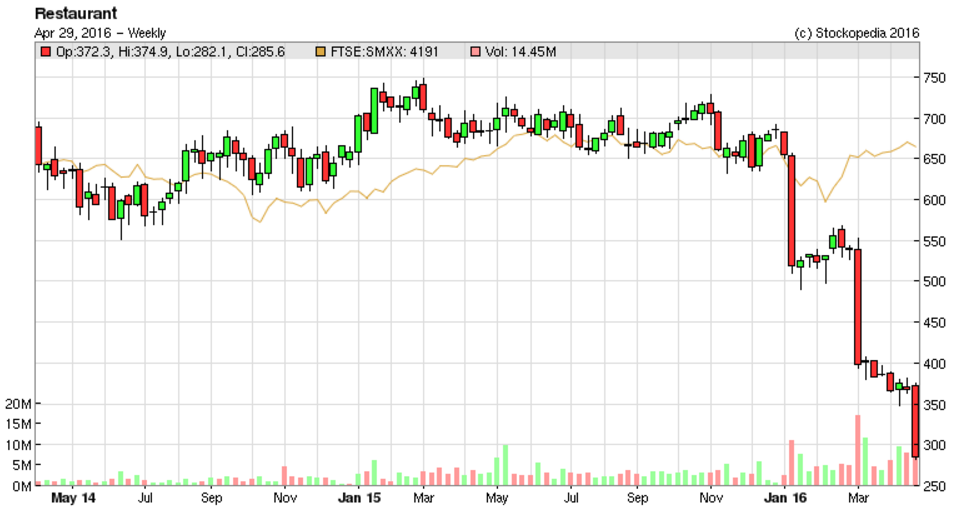
been watching The Restaurant group for a while (LON:RTN) as it had formed a bear flag over the past few weeks but that price movement was fairly enormous. Huge volume as well so a lot of capitulation selling and ATs from stops hit . FWIW, today is the second highest volume it has traded in its 26 year history: the previous being in 2006 so impressive numbers
Reasonable chance of a bounce from here. There is long term support around the 277p , if that holds then it's worth a long on a bounce from there with a bit of volume for conviction.
If it gives then it may well revisit 250 down to 220 or even 200p. May well trade sideways for a few days now as that pummelling takes a bit of digestion
actually today is the highest volume it has ever traded: and very bearish looking too... anyone who is an advocate of the wisdom of crowds might suggest there is a potential heuristic insight to the FD departure.....or just madness and panic.
I'd wait a bit before going long..trend is your friend until the bend at the end. There's a small bend on the hourly but that was from a brief rally into the close.
For a fundamentalist Mr Scott you do like the odd white knuckle ride, but as you say on your 60:40 , as part of a portfolio play and with the right risk management it can be well worth it
pps
www.telegraph.co.uk/business/2016/04/26/sse-smart-tech-partner-raises-23m-ahead-of-winter-heating-revolu/
ps
All FLOW's other activities are attempts to row back from the initial mistake and anybody of the existing large companies can play the game.
Flowgroup.
In my opinion energy generation is not suitable for cottage industries unless they are guaranteed government subsidies in perpetuity. A Cambridge school introduced a biomass boiler system rather than insulate for the same degree of energy saving despite an upfront cost excess of seven times, because of the distorting effects of subsidies. Energy generation is an industry where scale is paramount and the accounting needs to be done for a lifetime. If one does this in energy terms rather than in distorted, subsidised payments the notion of us all generating energy is risable.
Never mind, its got a Which commendation, so that's allright then?
apad
apad,
I don't get your argument? Local micro generation is effective because: a) it avoids the ~15% transmission losses from a power station; b) given that the UK power mix is something like ~50% gas (and thus, effectively electricity is priced off the variable gas production cost), you gain the 50% thermal efficiency that's lost in the cycle; c) given you're using gas to produce hot water anyway, you might as well take advantage of the need to have a process that produces hot water locally. Where's the beef?
I separately have question marks about the overall strategy, but there is no doubt a market opportunity here that the big six are not reacting too (mostly because they're encumbered by legacy systems/processes/structures), and while there are a bunch of smaller players, they need critical mass to be profitable. Flow at least have a distinctive market offering, and are genuinely a good provider (I'm a customer, I recommend you try them, both for keen pricing and customer service!)
Equity Development, introduce their report on FLOW, by stating that: " Flowgroup is a pioneering energy product/services business which could transform the global boiler market".
Certainly they will need a stronger balance sheet if they are to achieve that.
Isn't it Interesting how opinions on individual companies vary.
Michael
On FFY liquidity is greater on the ISEQ (Irish) quote rather than AIM.
I liked this company and held it for many years. I have exited due to the aquisition - which is funded by debt. The debt looks fine but the sort of businesses FFY are involved in are commodity-type so a fall in prices can rapidly make geared balance sheets look overstretched. This may well be a bit pessimistic. I am also skeptical about an acquisition in an unrelated area - what is the business logic ?...
Blog post here if anyone is interested ../.
https://deepvalueinvestments.wordpress.com/2016/04/05/ffyfes-exiting-position-c58-dislike-aquisition/
Hi rjmahan
I think you are being a bit harsh on FFY. I believe the rationale for the acquisition was diversification from the two current product categories:
"This transaction fits perfectly with Fyffes strategic objective of adding an additional product to its existing three through the acquisition of an established, successful, integrated operator in a category with significant scale"
Also, things would need to go wrong fairly quickly as the business expects to be reducing the debt reasonably rapidly:
Fyffes net debt after this acquisition will be less than 2.5 times EBITDA, based on Fyffes current target EBITDA range for 2016 and Highline's pro-forma annualised EBITDA above. It is anticipated that this multiple will reduce to below 2 times within 2 years based on the expected cash flows of both businesses.
Overall, I think diversification is a valid strategy, the debt manageable. It may be slightly higher risk / reward, but crucially, I trust the management, and they have a track record of protecting their margins when commodity prices change.
Cheers
I agree debt looks manageable now - but what happens if food commodity prices fall more generally?
These things can happen - and are very hard to predict.
I agree the management are high quality, unfortunately the historic record of acquisitions adding value for shareholders is not a good one.
Best of luck anyway.
Rob
Couldn't agree more with your engineer pal.
Looked at Flowgroup ages ago and fell about laughing.
apad ( a renowned engineer :-)
Why is it so funny? I looked at it and was sceptical about the payback, and the current oil and gas prices certainly won't help there, but it seems a genuine product and the Jabil backing is a serious advantage for them.
Restaurant (LON:RTN) - Crikey Paul you are braver than me. I would be running a mile from this. For me to invest it will need new management and some improving trading numbers. But good luck!
Hi Paul
I do think Restaurant looks interesting but I'm skeptical for two reasons:
1. Tired brand. Inside their restaurants it looks as if they haven't been updated for 10, 20 years and the British public's taste I believe has certainly grown towards more 'exotic' food should I say - why would you go somewhere as generic as F&B's when you have Nando's, or any fast food joint for that matter?
2. Cinema slate. Last year's results will have most definitely been boosted by the strong cinema listings (which was evident at Cineworld's results) with new Star Wars, Hunger Games & James Bond movies. There are very few blockbusters out this year so that surely must play a big part in footfall, with family's traditionally going for a meal then off to the cinema after
Paul,
Do Restaurant Group have major cost implications with regard to the minimum wage?
Bear in mind that they may not get full value for freehold property on a net basis as if they close units and sell the closure costs will need to be deducted and if they go for sale and leasebacks the yield is likely to be higher for a tenant whose institutional rating is presumably falling.
I have just taken a long position as the fall does look overdone.
Dave
FFY has a history of conservative guidance that they often raise later in the year. It is a fantastic company, very well run with both room to grow organically, bolt on acquisitions and potentially a takeover target itself. Part of the reason for the low divi yield is the rise in the share price over the past year. Deserves a much higher profile with UK investors. Forms a core part of my long term portfolio.
Very unimpressed with the handling of questions on the analysts' call. No LFL by brand is appalling and he made a complete pig's ear of the question over the dividend - at one point saying that it would fall if eps fell and then implying it would be retained due to good cash generation.
I'm an accountant and the numbers are actually quite well presented which will be, at least in part, down to the departing CFO (whose background looks impeccable for the role). The CEO sounded (and looks on paper) a bit of a lightweight. He absolutely floundered on the call.
But, as you say, well backed by assets and now on a low multiple. Yield of nearly 4% just with the final div alone.
Presumably at least some of the footfall issues here and at other retailers are down to the fears of an IS attack on shopping malls. Good news for Boohoo.Com (LON:BOO).
Not for Boohoo.Com (LON:BOO) today it isn't! I am long.
Re Restaurant (LON:RTN), the statement was all about footfall and yet the Finance Director is leaving immediately. Unwanted resignations will usually have a notice period - they even had/have one at Lakehouse when the departure was inevitable - so looks more live a shoving. When a finance director is ejected with immediate effect, and there is a 'strategic review', it suggests a suspicion that a couple of skeletons may have been buried in the numbers. But nothing in the statement to help understand.
Hi Paul
Thanks for the reply and explaining your thought process on buying back into the stock. I think the fall looks overdone, but am wary of falling knives and I suppose the market is punishing it for the three poor updates they've issued since the start of the year. Best of luck with the trade.
In terms of Fyffes (LON:FFY) the Stock report for the company already listed as the EPS forecast for 2016 as 14c - so I assume the updated figures in the trading update are already factored into the price - hence the reason we've seen no real movement in the share price. As normally you would expect to see an uplift in the shareprice when guidance is raised?
Best wishes,
Imran.
Re. FFY, the revised guidance looks like they are going to report somewhat above expectations...? On the other hand, I always get scared when a company says they are trading "overall" in-line... because this implies that at least one division is doing worse than expected and there is something wrong... which could get worse.
Hi Paul,
Thanks for the write-up of Restaurant (LON:RTN). I'm intrigued about your comment that you're actively trading the share and at the moment you're long. Are you buying in small chunks and then selling for a small profit. Just curious that's all.
From Twitter I picked up the conference call wasn't well received, and I guess three bad trading updates, coupled with the FD leaving and the "strategic review" have hammered the share price this morning.
Best wishes,
Imran.
Hi Imran,
Re Restaurant (LON:RTN) - I sold at the open for about 320p, then intended waiting until it got to about 250p before buying back in. However, on digesting the information, and listening to the Conf Call with management, I then decided to buy back in in various tranches at 283-289p.
In all likelihood, I'm probably going to hold now for the duration. However, if it did spike up to say 310p or more, then I'd probably bank some profit, and run the balance.
So given that I'm actively trading it today, and possibly in the next few days, I thought a specific disclosure to that effect would be better than just saying I am long.
Regards, Paul.
P.S. I'm not claiming to be especially good at trading this type of situation, and in fact I usually buy too early, and often make a mess of them! However, the ones with strong balance sheets usually recover, and end up in profit. It's just a game of averages. Last year my win:lose ratio on trading was 60:40, which resulted in a good outcome for the year.