Small Cap Value Report (3 Aug 2016) - NXT, CTO, PDG, FTC, GRG, ZTF, DIA, WAND

Good morning!
Next (LON:NXT)
Always of interest (for wider read-across on consumer spending generally) are the trading updates for High Street bellweather, Next (LON:NXT) . Its update today is perhaps surprisingly solid. Q2 sales showed an improving trend on Q1. Although not specifically stated, you can deduce from the figures today that LFL sales are still negative.
Its comments on Brexit are particularly interesting;
With only a few weeks since the EU referendum it would be unwise to draw any firm conclusions of the effect the decision to leave the EU will have on UK consumer demand, particularly as the week after the referendum was an unusually strong week the previous year. So far, we can see no clear evidence of any appreciable effect on consumer behaviour, apart from the first few days after the vote.
So this confirms my view that Brexit has had little to no impact on consumer behaviour. Obviously, more poorly performing companies are going to blame their poor results on Brexit, and/or the weather! Remember how Bonmarche Holdings (LON:BON) blamed the weather for its terrible performance in Q2? Funny that it hasn't affected Next, despite them having the same weather. So BON are looking rather a bit daft for those weather comments.
Next also makes some very interesting comments about the devaluation of sterling, as this is a key issue for clothing retailers. Most import the bulk of their product from the Far East, and it's usually invoiced in US dollars. Therefore the recent plunge in sterling will increase the cost of imported goods - meaning that selling prices in the UK are likely to rise in 2017.
On this issue, Next today says;
- Currency is hedged for all of this year (y/e 31 Jan 2017), so no impact.
- Imports expected to be 9% more expensive next year.
- Mitigating factors mean this can be squeezed down to c.5% higher cost prices next year.
Outlook - Q3 is expected to be tough, due to very strong comparatives from last year (+6%). However, Q4 could be stronger, due to exceptionally mild weather last autumn, which depressed sales of warmer winter clothing ranges.
Profit guidance (why can't all companies do this, it's so helpful?) has been narrowed from the previous range of £748-852m, to £775-845m. Note that the main movement in the range comes from a £27m increase in the minimum expected profit - clearly a positive thing.
My opinion - this is an amazingly high quality business. It executes so well, and makes a sector-leading operating profit margin of almost 21%. You can buy it now on a PER of about 12, which looks great value to me. Although there's not much growth potential, and online competition does seem to be slowly eroding their market share. So perhaps a PER of 12 is the right price for a mature business like this?
Importantly, if the economy does deteriorate, then a company like this will fare very much better than smaller, lower margin competitors. With a 21% profit margin, profits are very robust, even in a downturn. Whereas smaller retailers with profit margins of say 3-5% end up swinging into losses, and even going bust, in an economic downturn. So at this stage of the cycle, I would be avoiding apparently cheap smaller retailers, as they could be value traps. Instead, I think the ones to go for, are the big, highly profitable ones on reasonable valuations (like Next), or the fast-growing (but much more expensive) online players (e.g. Boohoo.Com (LON:BOO) & MySale (LON:MYSL) - in both of which I hold long positions).
There are not many results/updates from companies of interest to me today, so I'll go back to some of the ones I missed yesterday:
T Clarke (LON:CTO)
Share price: 68p
No. shares: 41.8m
Market cap: £28.4m
Interim results to 30 Jun 2016 - this was one of the shares that I culled from my personal portfolio before the Brexit vote, in order to de-risk. So I'm looking at it with a view to whether or not to buy back in.
Based on these interim figures, I'm inclined not to buy back in. Not because there's anything particularly bad about the numbers, it's just that my previous reason for holding was an expectation of rapidly rising profit margins, which doesn't seem to be happening after all.
Key points for the 6m to 30 Jun 2016;
Turnover rose 13.3% to £121.6m
Operating profit (underlying) rose 4.8% to £2.2m (H1 2015: £2.1m)
Note the wafer-thin margin of 1.8% - leaving no room for any mistakes on big contracts.
Net cash of £1.3m is a big improvement over net debt of £8.7m a year earlier.
Order book flat at £320m
Pension deficit has risen to £21.9m (H1 2015: £15.7m), which is the accounting basis. So actuarial deficit likely to be worse.
Outlook comments - probably more upbeat than I expected;
Whist there is some inevitable uncertainty, our order book has been fully replenished demonstrating our continued ability to secure landmark projects with blue chip clients. Our cash position continues to strengthen and with several contracts having just commenced we expect this to be sustained.
The Board's confidence in the future of the business is demonstrated by its decision to maintain the interim dividend. Our long term client relationships leave us well positioned and looking forward we can see a number of opportunities.
and CEO comments;
"We are pleased to be presenting a solid performance based upon our strategy of targeting quality projects and clients and are excited about current bidding opportunities that will give us good revenue opportunities into 2017 and beyond."
My opinion - everything sounds fairly upbeat (for now). However, it's important to remember that this contractor works on buildings that are nearing completion - it's mainly fitting-out (electrical, IT, etc). So it wouldn't see any downturn for some time (1-2 years) after a downturn in new building activity starts.
London looks like a giant building site right now - the crane count is astonishing, whenever you look across the city from the upper floors of any tall building.
Previous announcements from CTO indicated that margins would improve as availability of suitably trained staff tightened. The trouble is, yesterday's interim results show no sign of that actually happening, with the operating margin still stubbornly low, at only 1.8%.
The balance sheet is just about OK, but probably not strong enough to justify the fairly generous dividend yield. I would prefer to see cash being retained within the business, in order to strengthen the balance sheet ahead of the next downturn, whenever that happens.
Overall, I like management here, and it seems a well-run company. However, the margins are just too narrow to entice me back into the share. Especially now the cycle may be topping out, if Brexit does cause a slowdown in building activity.
Pendragon (LON:PDG)
Share price: 31.6p
No. shares: 1,452.3m
Market cap: £458.9m
Interim results to 30 Jun 2016 - I won't go through the numbers in detail. My interest here is mainly so see what they say about industry trend, Brexit impact, etc.
Surprisingly upbeat here too;
Whilst there is great speculation about the effect of the UK’s decision to exit the EU, to date we have not experienced any noticeable change in our customers’ behaviour and, based on discussions with our franchise partners, we do not anticipate any material effect on new vehicle pricing as a result of exchange rates.
The comment on forex is particularly interesting. This seems to suggest that European manufacturers are intending to absorb the impact of recent forex movements, rather than increase prices. That's very significant, and of course rather bullish for the sector.
My opinion - I really like this sector at the moment, on valuation grounds. The market has slammed share prices down, on expectations that demand would soften, prices would rise, and hence profits would fall substantially. However, it doesn't appear to be the case that any of that is actually happening.
Moreover, the market has changed radically. Many people are now getting new cars on very affordable personal contract hire arrangements. The monthly payment I'm paying on my car for example, is less than I was paying for an inferior, used car, 20 years ago. For that reason, new car sales seem to have stepped upwards, and I think are likely to remain at this new, higher level.
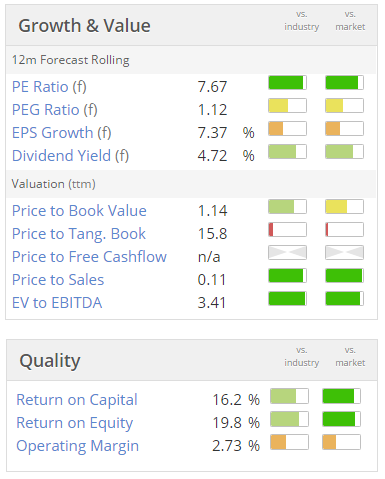
That creates opportunities for car dealers, who make a lot of their profit from aftersales. Balance sheets are generally good in this sector now too. So overall, I feel there's a good opportunity right now to pick up bargains in this sector. The results & commentary from Pendragon have reinforced my conviction, so I may do some more bargain hunting in this sector. There's plenty of green below, on Pendragon's Stockopedia graphics:
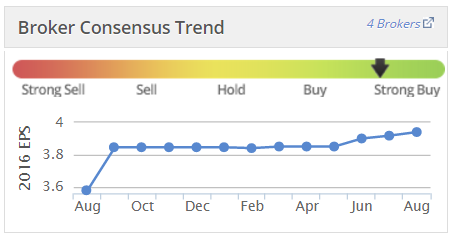
Also, I am surprised to note that in recent months, brokers have actually been increasing their earnings estimates for this company. This augurs well, and reinforces my view that there are bargains to be had right now in this sector, after share prices seem to have been wrongly smashed down on Brexit worries;
Filtronic (LON:FTC)
Share price: 14p
No. shares: 196.9m
Market cap: £27.6m
Results y/e 31 May 2016 - another set of absolutely terrible figures from this struggling "designer and manufacturer of microwave electronics products for the wireless telecoms infrastructure market".
If these numbers are the highlights, I'd hate to see the lowlights;
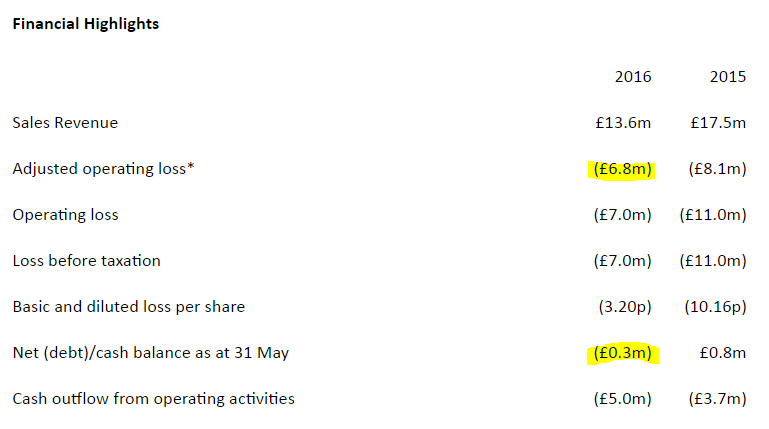
Having a quick skim through the figures, trade debtors jumps out at me as looking far too high at £9.0m. That's way out of kilter with full year turnover of £13.6m. Even allowing for H2 being double H1, then H2 turnover was £9.5m, practically all of which was sitting in debtors - so it looks like customers didn't fancy actually paying for anything that they bought in H2. That needs investigating.
Net cash of £2.7m at the interim stage, 30 Nov 2015, has all gone. The company had net debt of £0.3m at 31 May 2016 - despite the stronger H2 turnover. So the £4.5m raised in fresh equity in Nov 2015 has all been burned.
The company is now relying on credit from its invoice discounting arrangements, so clearly cash is now very tight - expect another Placing fairly soon. The company would be mad not to do another Placing, given how buoyant its share price is right now.
Outlook - so why is this car crash of a company valued at £27.6m? The reason is that it has convinced investors that newly launched products will be winners, and take it into future profits.
Broker estimates - I see that Panmures have raised this year's (05/2017) earnings estimate to 0.53p, and 05/2018 to 1.19p. That would be a huge turnaround from the heavy losses of the last 2 years, so clearly relies on the sales of new products being buoyant.
My opinion - relying on hockey stick shaped predictions for future profits is a very high risk strategy. Things can & often do go wrong. Personally I wouldn't touch anything like this - a company that has historically performed dismally, doesn't become a fantastic company overnight. Being asked to pay up-front for possible future success, seems a ridiculous proposition to me. Also, this type of product only has a short lifetime, before it becomes redundant, and replaced by something better - often made by a competitor.
Risk:reward looks lousy to me at the current price, and having 3-bagged, I would be banking profits now. But each to their own. There again, if the new products do take off as hoped, then people who took a punt on that might end up doing well, who knows?
Greggs (LON:GRG) - just a quick mention about yesterday's interim results, for read-across purposes.
This High Street bakery/fast food chain delivered sound interim results to 2 Jul 2016.
Underlying profit up 6.7%.
LFL sales were good for the half year, being up 3.8%. Retailers need to achieve that kind of increase in sales, to cover all the cost increases (especially with Living Wage, pension costs, and the forthcoming 0.5% Apprenticeship Levy).
Outlook comments sound fine;
We have made an encouraging start to the second half of the year and are alert to any change in consumer demand that may result from the current economic uncertainty....Overall, we expect to deliver full-year growth in line with our previous expectations as well as further progress against our strategic plan.
My opinion - a nice business, probably priced about right for now - or possibly a bit too rich, at a PER of 17, and divi yield of c.3%? Given the fairly limited growth potential, I think the rating here could drift downwards possibly. Personally I wouldn't pay more than a PER of say 12-13 for it, so it doesn't interest me.
Interesting though that it's another High St chain which is saying that consumer confidence is fine.
Zotefoams (LON:ZTF) - somewhat underwhelming interim results, given the warm rating on which these shares trade. Key points;
- Turnover up 2% to £27.1m
- Adjusted profit before tax up 1% to £3.21m
- UK exporter mainly, so should benefit from forex movements (mainly in 2017)
- Positive comments about growth in H2, but broker forecasts for full year anticipating 20.8% increase in EPS. Very little delivered in H1, so looks susceptible to an H2 profit warning later this year.
For me, the rating looks too rich, given potential risk of H2 profit warning. Also note the broker forecasts have been steadily falling in the last 12 months. Seems a good quality company though, but I wouldn't pay the current price for it (266p = 17.9 times forward earnings).
Dialight (LON:DIA) - I've had a quick skim of its interim results to 30 Jun 2016. This LED lighting company has had lots of problems, but looks to be starting to get back on track, so it might be worth a closer look possibly?
A few snippets;
- Underlying profit jumped nicely, from £1.7m last time, to £4.2m this time (6 months to 30 June 2016).
- H2 order book up 10% on last year.
- Production is starting to move to outsourced partners - sounds sensible, as DIA proved themselves pretty hopeless at manufacturing in-house.
- Directorspeak is positive - market growth opportunity, new products, and expertise in its niche.
- Strong balance sheet.
My opinion - it looks expensive on a forward PER basis, but turnaround situations like this can sometimes out-perform against forecasts. So I might do a bit more research on this one.
WANdisco (LON:WAND) - another set of diabolical figures from this company. It amazes me that shareholders keep pouring money into it every time it burns through the last lot.
No revenue growth! Flat against H1 LY at only $5.6m
Sales bookings up 36% to $5.9m, but hardly transformational.
Loss from operations of $9.7m (reduced from $17.1m loss in H1 2015) - but still clearly diabolical - it's not a viable business at all, based on performance to date.
Out of cash at 30 Jun 2016, but raised $14.3m in a recent fundraising - I wonder how long that will last?
Cash overheads reduced by about a third (but still heavily cashflow negative).
My opinion - I see this as the worst type of jam tomorrow company - they created a huge central overhead, and have struggled to make much progress on sales. So investors have to keep pouring in large amounts of cash just to keep it afloat.
The trouble is, having been in that situation myself, you feel obliged to keep throwing in more money, to protect the value of your existing holding. So when it does eventually fail, you've lost far more money than putting in a small initial amount & writing it off if the original plan did not materialise.
AIM is littered with failing/failed jam tomorrow companies, of which this is one. Given its terrible track record, the £65m market here today (at 178p per share) looks completely bonkers to me.
Disclaimer
This is not financial advice. Our content is intended to be used and must be used for information and education purposes only. Please read our disclaimer and terms and conditions to understand our obligations.

24 comments
Paul,
I’m still fairly bearish on Dialight (LON:DIA) despite undoubted progress from the new management.
Although they are quick to champion the £4m underlying operating profit & £13.4m cash flow there is reason to think that both figures are optimistically presented:
Underlying operating profit:- Without exceptionals and capitalised development
costs stripped out Dailight have failed to generate any real cumulative return
over the last few years:

Net cash from operating activities:So add in the c.£13m H2 cash outflow and net debt at year end will be c.£6m and you have an enterprise value of at least £210m. This seems to me to be pricing a lot of hope for a company that has not generated any meaningful return over the last few years and still has significant cash costs & risks of restructuring to come in the short term.
The cyncic in me thinks they were desperate to get some good numbers in before all the costs hit the cash flow statement & balance sheet in H2 and have squeezed everything to the max to get them.
Apparently and the USA have previously toyed with Bonuses/Tax refunds to taxpayers as a more direct form of QE. The criticism of this would no doubt be that this increases consumer spending rather than 'investment' by the banks which QE is meant to encourage (but which arguably it doesn't achieve very efficiently).
I have no doubt that lower interest rates will encourage some money to go into equities. There is apparently already a movement of savers to withdraw funds - presumably to either put under the bed, buy gold, purchase equities, or take a holiday.
The potential problem with Tax refunds is that part of the Govt's policy has been to take a class of workers out of the tax band up to £10k of earnings, so it will not benefit them, unless they could think up some other mechanism.
Personally I think we have had a blip in the various factors leading up to Brexit. The real issue is likely to be later when the Govt realises it can't reliably keep the economy going, and significantly reduce immigration in the short term.
Cig, you might be interested in these comments by Bill Gross on the unsustainability of continuing to rely on the now very obviously clapped-out and ideoologically-driven monetary easing route to economic salvation:
https://www.janus.com/insights/bill-gross-investment-outlook/july
https://www.janus.com/insights/bill-gross-investme...
In the July comment, he draws an analogy with the "Monopoly" board game. It seems whimsical but contains a lot of common sense.
Example:
"All right. So how is this relevant to today’s finance-based economy? Hasn’t the Fed printed $4 trillion of new money and the same with the BOJ and ECB? Haven’t they effectively increased the $200 “pass go” amount by more than enough to keep the game going? Not really. Because in today’s modern day economy, central banks are really the “community chest”, not the banker. They have lots and lots of money available but only if the private system – the economy’s real bankers – decide to use it and expand “credit”. If banks don’t lend, either because of risk to them or an unwillingness of corporations and individuals to borrow money, then credit growth doesn’t increase. The system still generates $200 per player per round trip roll of the dice, but it’s not enough to keep real GDP at the same pace and to prevent some companies/households from going bankrupt."
His monthly comments often debunk financial commentatorati shibboleths.
Well worth the read, imo.
John, I agree completely.
Sensible and targeted fiscal measures aimed at areas of need, such as housebuilding, hospitals, infrastructure and local and regional transport would be far more sensible than yet another round of monetary easing, seemingly ever more ineffective as rates near zero.
Jane,
I agree. 0.5% interest rates are already at a level where it's giving as much stimulus as it can.
So to my mind, a knee-jerk reduction to say 0.25% is both pointless, and likely to trigger a negative reaction - it says that the central bank is in panic, not in control, and thinks that things are far more seriously bad than most of us reckon.
Govts & their offshoots need to sometimes DO & TALK LESS! Just let businesses adapt, and get on with things. The trouble is, we don't have enough business people in positions of power in the public and political sectors, that's a big problem.
Regards, Paul.
A view contrary to the analyst crowd wisdom on the likely Bank of England rate decision tomorrow:
"Opinion: Bank of England should worry about a Brexit boom, not a Brexit bust"
http://www.marketwatch.com/story/bank-of-england-should-worry-about-a-brexit-boom-not-a-brexit-bust-2016-08-03?link=sfmw_tw
It's a view that may well have merit, whatever Govenor Carney and the MPC decide tomorrow.
( I love his judgement on Carney's performance to date, " An East German Trabant was more likely to get you to your destination on time." )
I can't see that a rate cut from these levels would do any good - in fact I think it would be net a bad thing from the impact on bank margins and the prospect of negative interest rates on bank deposits.
To be fair to Mr. Carney he has been saying for some time that monetary policy has reached the limits of what it can achieve and that the focus must be on fiscal policy - it was just that Osborne wasn't listening.
Add in the loosening of bank capital ratios post the referendum and the devaluation and I agree that it all adds up to a strong stimulus even before the Autumn Statement.
Why would lower base rates impact bank margin? Banks earn a spread, which is not directly linked to nominal rates.
Cig,
This is from the BIS
This paper investigates how monetary policy affects bank profitability. We use data for 109 large international banks headquartered in 14 major advanced economies for the period 1995–2012. Overall, we find a positive relationship between the level of short-term rates and the slope of the yield curve (the “interest rate structure”, for short), on the one hand, and bank profitability – return on assets – on the other. This suggests that the positive impact of the interest rate structure on net interest income dominates the negative one on loan loss provisions and on non-interest income. We also find that the effect is stronger when the interest rate level is lower and the slope less steep, ie that non-linearities are present. All this suggests that, over time, unusually low interest rates and an unusually flat term structure erode bank profitability.http://www.bis.org/publ/work514.pdf
What do you think of OPG Paul? Results out recently looked pretty good I thought, pretty low P/E but good growth, operating in high-growth area (India) not exposed to Brexit obviously! AIM... but doesn't seem jam-tomorrow.
Thanks Paul.
I couldn't agree more regarding NXT. Such a great company and even if the scope for significant growth isn't there, it's formidable cash generation means there's always those special dividends. And touching on your post the other day about the importance of quality Management, Lord Wolfson has to be one of the best examples across UK plc. 12x seems a bargain for a 20% margin cash machine, growing topline at 5-7% pa and returning excess cash to shareholders on a regular basis.
I remain keen on the motor dealing sector too and PDG results seem pretty ok.......BUT I completely agree with andrea341 that MMH and CAMB look even better bets. MMH interims out 16 August and CAM should issue a Trading Update in early September.
I think the outlook for Greggs (LON:GRG) is quite promising though you probably have to look beyond 2017 to see it.
1. After nearly three years, they are reaching the end of the refurbishment of their entire store estate. The remaining stores should be upgraded to the Food on the Go format by the end of the year.
2. The net company owned store count has grown for the first time in 3 years in 1H16 which hopefully signals that revenue will grow faster than just LFL in coming years.
3. There are 108 re-sites to come in the second half (about 6% of store count). These are generally low or negative contribution locations. Since these are occurring in 2H16 we should see a better full year profit contribution from the re-sites next year.
4. The five year plan to transform manufacturing and distribution is now underway. At the end of the 5 year £100m (gross) investment plan, Greggs will have the manufacturing and distribution in place to support store expansion "well into the 2,000s" which I interpret as about 2,500 compared to about 1,700 today ie 50% expansion potential relative to today's store count. In future, it's possible that LFL plus store count increase could grow sales at say, 6-8% per year.
5. I like the company's positioning relative to competitors as they are a vertically integrated, low cost, low price provider. Greggs sells coffee and a savoury for £2 where you might struggle to get just a coffee.
6. Coffee sales (I think it was the 1H15 update last year) were stated to be £1m per week and growing at 10% per annum. Breakfast continues to be the biggest growth area. I like the fact that a significant portion of the LFL growth is coming from coffee which tends to be high margin.
7. The capex in the past three years (store refurb) and the next 5 years (manufacturing and distribution) is abnormally high. All of the capex is internally funded. Despite the unusually high funding commitments, they found a spare £20m for a 20p special dividend last year. I would hope that special dividends could become a more regular feature (maybe every other year) in another year or two when peak capex subsides.
8. The company has a good long-term track record of value creation and dividend growth. Morningstar says the 10Y total return CAGR is 13.0%. If correct, 1.13^10 is 239%.
I am a holder.
I think that the results from Greggs bodes very well for Crawshaws.
I see one of the P2P portals is proud they bailed out WAND this time..... crazy
Paul, I think your question as tp whether PE12 is good level for a company that seems low or ex-growth (in this case NXT) is a fascinating subject, and would be very interested in hearing other people's views. In general, what do people think about investing in low/ ex growth companies?
Yes, an interesting topic at the moment. With little or no income available from the usual safe assets should equities be valued differently? The likes of Fundsmith have done better than they "should have" because people are buying into perceived safe dividends. Do we accept interest rates being on the floor for the foreseeable future and adjust the historic PE's we are prepared to pay for equities? Is it different this time? I think it could be but it's a risky game - be ready to be trampled in the rush to the exit at the first hint of rates heading higher, assuming we live that long.
I had a bet with a colleague in 2009 that the next rate rise would be up - six years later I may be about to lose that bet.
I remember a comment from Jim Slater when hardly anything qualified for his Zulu screen that he would relax his price limits but not the quality or growth criteria.
Brackendale
The Gordon growth model simplifies Equity valuation to three factors :
i.e. P = D / ( r - g )
This can be transformed with basic algebra (*) into : P/E = (1 - (g/ROIC)) / ( r - g )
So for a company capable of sustaining ROIC of 20% but capable of growing only at 2% per annum, then a p/e of 12x is clearly incorporating a discount rate in excess of 9%, which appears excessive.
(*) need to assume g = ROIC * ( 1 - payout ratio )
PJ007 Thanks very much indeed for taking the time to put that together. I have been looking for a way to relate ROIC to PE for ages and missed this, so I am delighted with this, thanks! You made my day (I must be quite a sad individual!)
Interesting article on this topic by Chris Dillow in the IC today showing that even intelligent people do not approach this topic rationally.
We have an "anchored" yield number that we want to achieve and will take on more risk as necessary to get it.
http://www.investorschronicle.co.uk/2016/08/03/comment/chris-dillow/reaching-for-yield-sBkJE0F3zhLBNm65lRuGTK/article.html
Paul
Trevor Finn of Pendragon (LON:PDG) was on Ian KIng live (on Sky) last night. It can still be seen on catch-up. (I hold). Here is link http://news.sky.com/video/car-market-no-change-sin...
Thanks for the continuous flow of insightful reports.
Will you look at Interquest (LON:ITQ) purchase of Rees Draper Wright by any chance? (I don't hold)
Regards
Howard
Thank you for the PDG/T Finn link. Re Paul Scott's comments, the only concern I have with the sector is the aspect of OBS obligations and gearing, which I have come across specifically in relation to PDG. I believe this reflected in their Stocko page. I was in email contact with a Stocko analyst who promised a piece dedicated to this topic generally. I'll follow up with a search on that.
Novae, the International Insurer, is also making positive, post Brexit comments in its half yearly report issued today: "Novae remains confident that a London Insurance company outside the EU will continue to flourish, and the longer-term impact on the Group is not currently anticipated to be significant".
Personally I don't feel PDG is the best buy in this sector, having a wee look at the results all the metrics are up only single-digit percentages (apart from tax, which is an expense). The likes of MMH and CAMB look stronger to me.