Small Cap Value Report (3 Jul 2014) - CRAW, AXS, MPOW, AGA, THT

Good morning!
Crawshaw (LON:CRAW) & fundraisings generally
If I were a shareholder here, I'd be very unhappy with a Placing that has been announced this morning. It involves the enlargement of the share capital by 36%, to raise £8.8m at 42p per share. That would have been a sensible price when the roadshow started a few weeks ago, but the share price has risen very strongly since, on the AGM announcement about accelerating the roll out of stores nationally (it's a small Northern butchers chain at the moment).
The trouble is that the share price was 54p last night, 60p the day before, and peaked at around 70p a few days before that. So doing a Placing at 42p dilutes existing holders considerably at what is now an unfavourable price.
You can see from the chart below that the Placing was probably set up in early June, then there would have been maybe a fortnight of meetings with Institutions, etc, so at first the 42p price would have seemed sensible. However, the big spike in price since mid-June has caused the problems here. Anyone who bought in that spike must be feeling very bruised now, especially as a lot of the spike was caused by the company itself putting out a bullish strategy statement in the AGM trading update. This would not have been a problem if existing holders had a chance to buy at 42p too. The additional costs of an Open Offer are not a lot, about £30k I've been told. So this could, and should have been done.
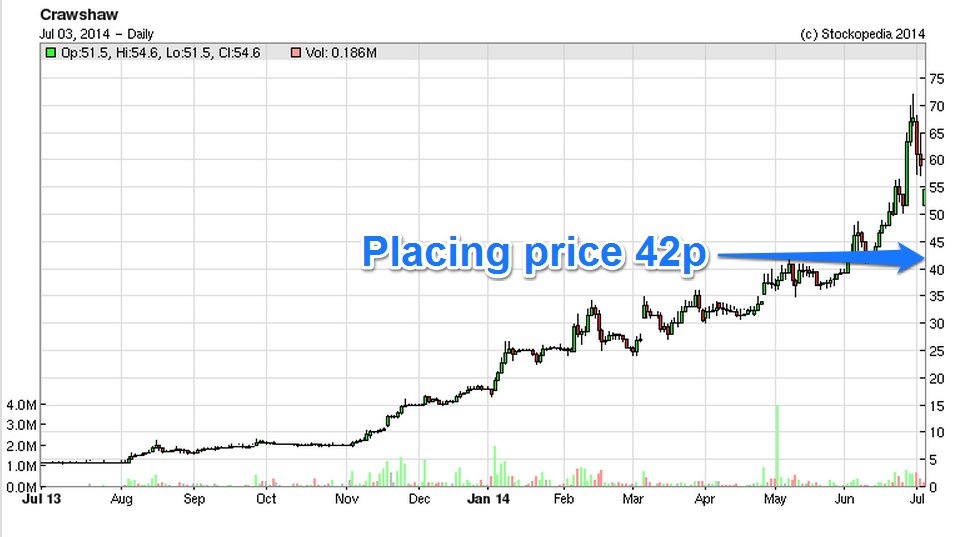
The big mistake, as we so often see with fundraisings, is that existing shareholders were completely excluded. I don't hold here, but in principle this is totally unacceptable. Unless there is a very good reason not to do so (e.g. an emergency fundraise, which this wasn't), then companies should ALWAYS allow existing shareholders to participate in a fundraising on equal terms to people taking part in the Placing. A sensible fundraising would be 50:50 between Placees and existing holders through an Open Offer.
Better still, you can do what Volex (LON:VLX) recently did, and give priority to existing holders in an open offer, and then have placees lined up to take any shares which existing holders don't want. That's the best way to do a fundraising, as it respects the pre-emption rights of shareholders, which is a core legal principle in company law.
It infuriates me the way Placings are increasingly being used with complete disregard for existing shareholders. This is wrong! Companies and their advisers should be strongly condemned by shareholders who feel put out by this - nothing will change unless we all kick up a fuss, so all existing CRAW shareholders who feel angry that they have missed out on some cheap stock at 42p in the fundraising should blast the company & its advisers.
In this case particularly, the company was raising money from a position of strength, so the company should have insisted on a substantial part of the fundraising being an Open Offer. They have really let down their existing shareholders with this deal, in my opinion.
Also I don't understand why they have raised so much money in one go? A better idea surely would have been to raise perhaps half this amount (£8.8m has been raised), which would have been ample for about 16 new shops (an almost doubling in size of the business), then on the back of that more money could have been raised at a much higher share price probably in a couple of years' time, if the roll out went well.
So a massive thumbs down for a bum deal for existing shareholders. I can understand companies wanting to get quality Institutions onto their shareholder register, so there is a role for Placings, but they should never disadvantage existing holders by letting in new shareholders at a deep discount, without giving existing holders the right to subscribe at the same price. It's just not fair otherwise.
You get the feeling, over & over again with small caps, that the City sees private investors as the cannon fodder to get the share price up, and then be diluted when a fundraising happens and the Instis are let in on the cheap. It's not good enough, and these Placing-only deals should be challenged by us, otherwise nothing will change.
If you agree with me, then do something about it by contacting companies that do Placing-only deals, and tell them that you expect any future fundraisings to included an Open Offer of at least the same amount as any Placing.
I know that companies prefer a Placing, because it gives certainty over the funds being received. However it should also match such a fundraising with an equal (or larger) Open Offer. Too many Directors forget who actually owns the business - reminder, it's the shareholders. Therefore their interests should be paramount at all times, but rarely are in my view..
Accsys Technologies (LON:AXS)
This company is commercialising a new type of processed wood, called Accoya. It looks the real deal to me - i.e. a growth company with big potential markets, a credible product that is in demand, and a realistic growth plan. It's currently loss-making, but seems to have enough cash in the bank to get through to profitability, probably.
Results for the year ended 31 Mar 2014 are out this morning, and note the company reports in Euros. It's always worth double-checking the currency, as otherwise you can end up over-paying if you accidentally value it as if the figures were sterling. Helpfully, Stockopedia converts the currency correctly when working out all the valuation measures on the StockReports here, which makes life easier, and avoids any such errors.
Turnover has grown an impressive 78% to E33.5m, although the gross profit is low at 23.3%,, and there is an underlying loss before tax of E7.5m.
It's now a pretty binary investment outcome, where they will either succeed in scaling up the business into profit, or they won't. The key element seems to be a deal with chemicals company Solvay, who I believe are close to setting up a factory to make the product under licence. So the terms of that deal, what royalties will be due, likely sales volumes, etc, are key to valuing this company.
I'm baulking a bit at the £86m market cap at E0.245 per share. The trouble is, decent growth companies are rarely cheap. So in this type of situation, a lot of research is needed. Or you can ride on the coat-tails of existing shrewd investors. Henderson, Invesco & Fidelity all hold about 5%, and seem to be generally successful in small caps from what I've seen. Tricky one - I really like the company, but am a bit put off by the valuation at the moment. Although if it works as planned, I wouldn't be at all surprised to see these shares be considerably higher in a couple of years. High risk though, as they could tank if the growth slows, and more cash is required.
MoPowered (LON:MPOW)
An announcement this morning says that the FD has left with immediate effect (which usually means has been sacked) at this car crash IPO, which has now lost almost three quarters of its 100p float price in Dec 2013.
Cash is the main concern here. They didn't raise enough when they floated, and most commentators now agree that the company floated far too early. The market cap is just under £5m now, which based on the figures reported so far is still too high in my opinion.
The company needs to deliver some sales fast, or it could be in real trouble. Investors might not be prepared to back a rescue fundraising so soon after IPO.
I am grateful to Shares magazine for pointing out that contract deferrals from H1 into H2 will also affect the full year numbers because revenues are recurring in nature (i.e. a stream of royalties), rather than one-off contract wins. So my apologies for not being aware of this point the other day, when I thought there was an apparent contradiction in the trading update on this issue. So I'm happy to correct that point here.
AGA Rangemaster (LON:AGA)
There's a reasonably solid update this morning from the famous range cooker manufacturer, here are the main bits;
Good progress for the full year is expected. Group sales and orders have continued to improve although markets remain variable. May was quiet but Junewas strong. The strength of sterling impacts us. A strengthening UK housingmarket is clearly a positive factor and this has fed through slowly intoincreases in spending on cookers.
Order intake year-to-date is up around 6% and sales are up close to 4% - the rate of increase in the second half of 2013. Fired Earth and AGA Marvel inNorth America saw order intake increases of over 10%. AGA and Rangemasterorders were up by over 6%. Waterford Stanley and Grange were significantlydown.
The Group is investing in products and marketing this year to support its growth plan.
There's no comment on performance against market expectations, so we have to just assume that they're in the right ballpark. Broker consensus is for a big rebound in EPS to 12p this calendar year, and 15p next year. So the shares look superficially cheap on a PER basis - at 150p per share that's 12.5 times this year's estimate, and just 10 times next year. Not bad for a company that will probably do well for the next 5+ years if the economic recovery continues. Also, as they sell to the relatively affluent, who are the only significant beneficiaries of economic recovery so far, then that's a positive for the company.
However, there is something bigger than an elephant in the room, there's a blue whale in the room - namely its pension scheme, which is absolutely humungous. A liability of £35.8m was shown on the 31 Dec 2013 Balance Sheet, but this is the tip of the iceberg. Look at the size of the scheme (bearing in mind that AGA's mkt cap is £108m at 150p per share):
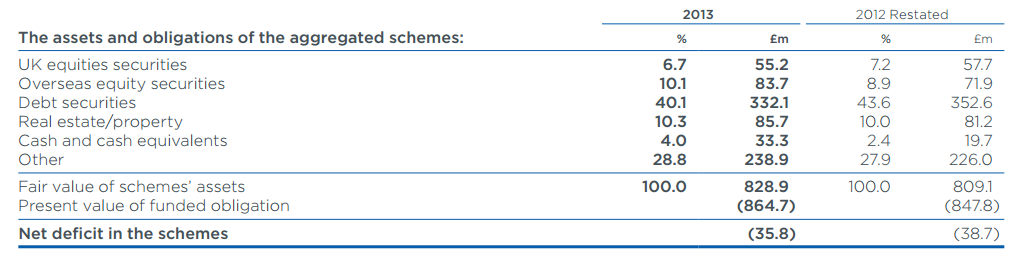
There are lots of moving parts with pension deficits, so they can be very volatile.
Just look at the size of the movements in the pension fund liabilities that are shown in the sensitivities analysis from the 2013 Annual Report. These would scare me witless if I were a shareholder in this company. The pension scheme could easily bring down the whole company if something unexpected happens:
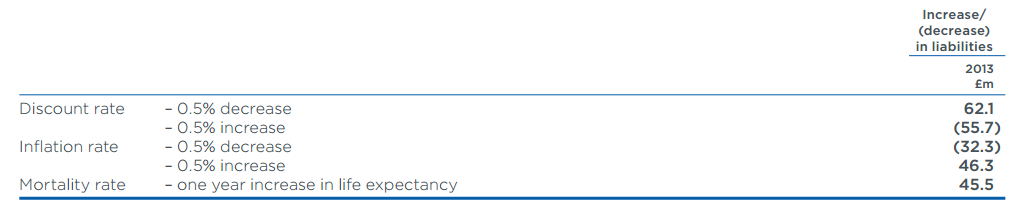
I can't find what the current overpayments are on the pension deficit, but a year or so ago it was effectively going to hoover up all the company's profits for the next 7 or 8 years. That might have changed now, I don't know, but it's a massive risk that could resurface. For that reason I consider the shares uninvestable.
Thorntons (LON:THT)
There's a Q4 trading update from Thorntons today. I like their clear quarterly reporting, all companies should report on trading on a quarterly basis, rather than the rather irregular & ad hoc basis that we currently have. There can be long gaps between reporting, and why have a trading update whenever the AGM happens to be? A more logical pattern is needed, and quarterly is the way forward in my view.
On full year trading the company says;
The Company's UK Commercial channel returned to double-digit percentage revenue growth in Q4 and full year pre-exceptional PBT is anticipated to be in line with the market expectation of £7.1 million compared with £4.7 million (restated) last year. The Board remains confident that its strategy for the business continues to be effective.
I find it most impressive that the company can give such a precise steer on profitability just four days after the year end date - this demonstrates excellent financial controls, which gives me confidence about the company. Again, why can't all companies do this? Admittedly it's easy for retailers, as they have instant data from the EPoS system, but even so.
I must be missing something with Thorntons, as they seem to have access to enormous bank facilities without any problems. Today it is announced that the bank facility has been renewed to Oct 2018, and has been extended to an astonishing £75m. What's more it is unsecured! The bank seem to have an extraordinary degree of confidence in the company to extend such a massive facility (relative to modest profits), and not even require any security over it. I cannot fathom that at all. It might possibly be due to the freehold property that Thorntons own - I believe it's quite a large HQ site, which might be worth more than book value, does anyone know?
There was a technical breach of the Articles of Association which is being corrected in a General Meeting. This seems neither here not there to me, so it's not something to worry about in my view. Just a technicality.
These shares look reasonable value to me, if you disregard the pension deficit & the debt. With my trader's hat on, it looks to me as if the shares might go higher from here, but it's not something I would put into my long term portfolio due to the weak finances. There are also question marks over whether the brand is being cheapened by selling increasingly cheaply through supermarkets? That said, I was given a box of Thorntons chocolate by family as part of my birthday celebrations, and we demolished the two layer box in under five minutes, with everyone agreeing that they were rather good!
I shall leave it there for today. See you again tomorrow! US markets are closed tomorrow I think, so it's likely to be a quiet day in the UK too, with lots of people taking the day off to enjoy the good weather too probably!
Regards, Paul.
(of the companies mentioned today, Paul has no long or short positions)
Disclaimer
This is not financial advice. Our content is intended to be used and must be used for information and education purposes only. Please read our disclaimer and terms and conditions to understand our obligations.

24 comments
Maddox, I hold shares in Barclays and Halifax nominee accounts. Both, if requested, send me letters confirming my holding allowing me to attend all AGMs etc and enclose postal voting forms for all shares that I hold in these accounts prior to the meetings. They ask that I renew the instruction every three years. There is no charge for this service.
With PIs encouraged to hold their shares in nominee accounts they don't get the opportunity to reject the standard resolution to 'disapply pre-emption rights'. The term itself is utter gobble-gouk - I wouldn't be surprised if very many investors don't understand what it in means or the implications.
This is not a nominee issue as such, brokers can ask their clients how to vote their nominee shares, and some brokers do. Maybe they should all be required to.
What I was pointing out is the inequity of a process reliant on shareholders' voting away their rights, in advance, to participate in a fundraising: when the nominee system discourages shareholder participation. Whilst their are exceptions, in practice it is difficult, time-consuming, paper-based and the language used opaque.
We thus already have the right to participate in fundraising but as a result of the nominee system we give up those rights. One way to shift the balance in favour of PIs would be to require a vote to allow a private placing each time - making it more costly to cut out PIs than to include them.
It seems to be a standard wheeze that companies have a special resolution to disapply pre-emption rights, sometimes somewhat obfuscated.
Small shareholders should vote against it as well as rail against it.
An internet based rights issue must be a practical basis for the future. It should be possible to reduce the cost of disclosure requirements given an assumption that current holders are informed. It can be done quickly and it only requires that the current rules and regs are looked at through a more "crowdfunded style" internet prism.
Institutions/banks can then back up, rather as they do now by providing a guaranteed line of credit to support commercial paper issues. The obvious missing piece here is the whole tribe of those currently doing placings, and reducing their involvement is a) why the costs would be much lower and b) why it probably won't happen.
Re THT, Peter Smedley (Charles Stanley) views re refinancing in Guardian (Business) today for interest....
Agree,startybarfast,much the simplest way,but those directors/employees with options don't like it,although it wouldn't be difficult to adjust the option strike price for a deeply discounted rights issue open to all shareholders.
It is also the cheapest way,as no underwriting is required,and for that reason also the least likely to be recommended by fee hungry brokers!
Surely, if you offer a deeply discounted rights issue which is not underwritten then nobody loses. If you don't take up our rights then they are sold (or you can sell them ) for your benefit thereby compensating for your dilution.
If the price goes below the discounted price (not impossible, in this case the discount is just 2 weeks' worth of price movement...) and it's not underwritten, the rights issue will fail (nobody will buy new shares if secondary market ones are cheaper).
For a growth situation fundraising (as opposed to a rescue one), the company can just cancel the expansion plans, but still people may be unhappy after a share price crash caused by a misfiring right issue, and the credit of the company may be impaired for a while.
Ironically, I believe it was Margaret Thatchers' Big Bang (sorry for that image) and the 'private shareholder revolution' that brought in the opportunity for companies to offer private placings. The idea was to reduce the cost of fundraising and improve the attraction of The City. However, in those days the full offer document would be published over several pages in a broadsheet newspaper - it must have cost a fortune. Now with the internet - a fraction and the offer document is pretty much ready canned - all those disclaimers - are effectively irrelevant - does anyone read them?
Time to change this blatantly unfair system.
Regards, Maddox
Re:quarterly reporting
Could not disagree more - encourages short-termism and hence why there is discussion in both the UK and USA to move away from that
In my days as an institutional investor in the City I seem to remember there were placings that involved a firm element and an element which was subject to claw back depending on the take up by existing shareholders. This seemed like a good compromise to address the issues you discussed. Guess it would be a bit more complicated and expensive to administer though but would at least recognise some of the existing shareholders pre-emption rights.
Hi jjjs,
Absolutely, that's the best way to do a fundraising for a small cap in my view - a firm placing, so the company has certainty of funds, then an open offer of at least the same size on top, with any shortfall being taken up by backstop placees.
There's no reason at all why this cannot be done in most situations.
The reality is that advisers push for the quickest & easiest way to do a fundraising, so that they can earn their fees for doing minimal work - namely a placing. Companies need to fight back against this, and INSIST on an open offer for existing shareholders too. There might be some circumstances where that is not do-able, but in most cases it is.
Also, the token Open Offers (such as done by SEE and SNTY) are the worst of both worlds - i.e. top whack costs, but only an insignificant number of shares going to existing shareholders. It must be at least 50:50 in number of shares going to existing holders.
The only reason that advisers get away with doing Placings that dilute existing holders, is because most investors are so passive, that we effectively have an absentee ownership class. That is also the reason that executive remuneration has spiralled out of control.
Regards, Paul.
Hi Paul
The problem with all Open Offers is the rate of return for underwriting balanced against the share price plus the cost of administration. An Open Offer has to be underwritten and the cost will reflect the risk of it not being taken up and so will the price of those shares not taken by private investors. Hence the reason for Open Offers of the type you envisage not being popular. A 50/50 Placing and Open Offer is likely to be at a greater discounted price than a Placing alone to ensure take up on the Open Offer. All of which are relative to the liquidity of the shares and the quality of the company.
Hi Delpher,
I take your points, but we're in a bull market, and if an Open Offer in a company like Crawshaw were made to existing shareholders at a 10-15% discount, they're going to bite the company's hand off!
So companies should do a Placing for most of the money they need, and then do the same amount again for an Open Offer - i.e. in total ask for MORE money than they actually need. That way you don't need to underwrite the Open Offer at all - if the take-up is low, it doesn't really matter, because you've secured the money you need via the Placing anyway.
Or the best option is to have Placees ready to take up any shortfall.
I can see that companies might need to fall back on a Placing only, in a bear market, and/or when they have their back against the wall in terms of funding, but really it's not acceptable at other times to block out existing holders from being able to buy new shares at a discount. Doesn't matter too much if the discount is low (under 5%), as it was with Volex. But when it's a whopping great discount as with Crawshaw, the lack of an Open Offer is a big mistake that has alienated a lot of the private shareholders.
It's a situation where I'm afraid the advisers run riot, and often choose the method that suits THEM best, not the method that is in the company or its shareholders' best interests, in my opinion.
When you get down to real micro caps doing tiny fundraisings, then realistically a Placing is the only way to do it.
Regards, Paul.
And I thought I'd just invented a new process ;)
Paul,
Thanks for your fantastic daily postings.
Any thoughts about the Thorntons statement today?
Solid update from Somero Enterprises Inc (LON:SOM) today. looks decent value if they continue to beat expectations.
Placings
I can't see any immediate change in the attitude of the city towards private investors unless it costs. Whilst I am generally against Government intervention and more regulation this Gov's approach to change might just do the trick by legislating for a proportion of all placings to include PIs which would encourage investment in UK plc by wider share ownership.
Presumably, the advisor advises, but the company makes the decision.....
Who decides on how placings done - Company or advisor or mutual?
The advisor is W H Ireland, I think, - aren't they brokers that you use?
What do they say?
I agree with your comments Paul about fund raising, however a real solution needs to be found that benefits and is fair to all.
Why can't II's simply subscribe for X million shares, with the proviso that they have to sell on to existing shareholders if they request them by a certain date. For example in this case an II could purchase X million shares at 42p, thus guaranteeing the company the placing/cash, but forced to sell on to existing holders at 45p, and being fully compensated for the admin costs etc. Everybody is happy?
I agree strongly with your polemic about Placings!
I see that Getech (LON:GTC) announced another contract this morning, for delivery this financial year, which tipped their share price back above the 50 day MA.