Small Cap Value Report (3 Oct 2014) - AVON, EZJ, SRT

Good morning! The futures have rebounded quite strongly overnight, so the mood of despair, even slight panic that seemed to be setting in yesterday should abate today. It will be interesting to see which stocks rebound the most this morning - as that will show where the pent-up buying interest is.
I'm glad to have made it to the weekend without another profit warning anyway - although I suppose there's still time...
Avon Rubber (LON:AVON)
Share price: 654p
No. shares: 31.0m
Market Cap: £202.7m
Trading update - all trading statements should be presented like this - i.e. summary of the key points in the first paragraph, then more detail below - that way readers can instantly ascertain how to interpret the information, without having to wade through a load of positives & negatives, wondering what the conclusion is.
So the key first paragraph says;
Avon is pleased to report that trading in the second half of the financial year has continued to be strong. Currency headwinds have also reduced since the trading update made on 5 August 2014. The Board therefore expects that the full year result will be comfortably ahead of current market expectations.
The year end of 30 Sep 2014 has just passed, so barring any audit adjustments, they should know pretty much where they are.
Valuation - broker estimates at the moment are for 37.6p EPS, so "comfortably ahead" might mean about 10% perhaps? So the ballpark is probably 40-42p at a guess? That puts it on a PER of between 15.6 and 16.4, which is a fairly standard middle of the road price for a company of this size & type.
Checking my previous notes from nearly a year ago, I see that there is a relatively small pension deficit here that potential investors would need to check. It's always worth checking the last Annual Report (near the back of the notes usually) to ensure that the Balance Sheet deficit is not the tip of the iceberg, which it can be with some companies.
Another issue to check is that last year the company capitalised £4.7m costs into intangible assets. This boosts profits of course, so if it is done aggressively, it can lead to investors over-valuing the company (i.e. valuing it on a multiple of inflated profits).
Outlook - nothing is said today about the outlook, so I suppose commentary on that will come with the results which are being announced on 19 Nov 2014.
My opinion - this company seems to be performing well, and looks priced about right. As with most companies, the crux is to dig into the business model, and try to ascertain what the company's future prospects are like. This type of company can be heavily dependent on large individual orders, which could dry up at any point, so drilling down into forward order visibility is probably the most important consideration.
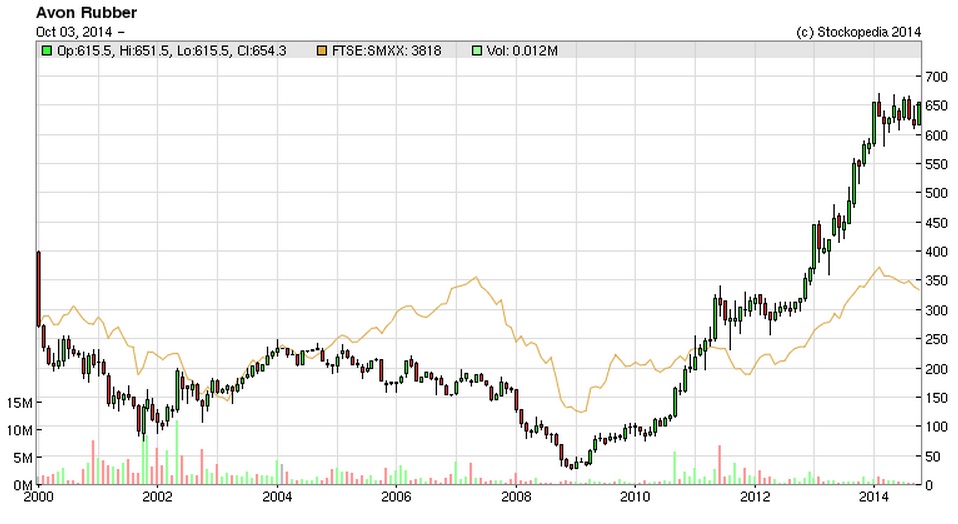
It's been a spectacularly good investment since the depths of the financial crisis though - check out this long term chart. The price looks up with events now though;
Currency headwinds
A few months ago lots of companies warned on profits due to currency headwinds caused by the strength of sterling against the dollar. I wish I'd made a list now, as there could be an opportunity now to buy stocks that were beaten down due to currency issues, and could now be recovering - because there has been a fairly dramatic reversal in sterling:dollar since July - see the chart below courtesy of IG, which covers Feb 2013 to Oct 2014;
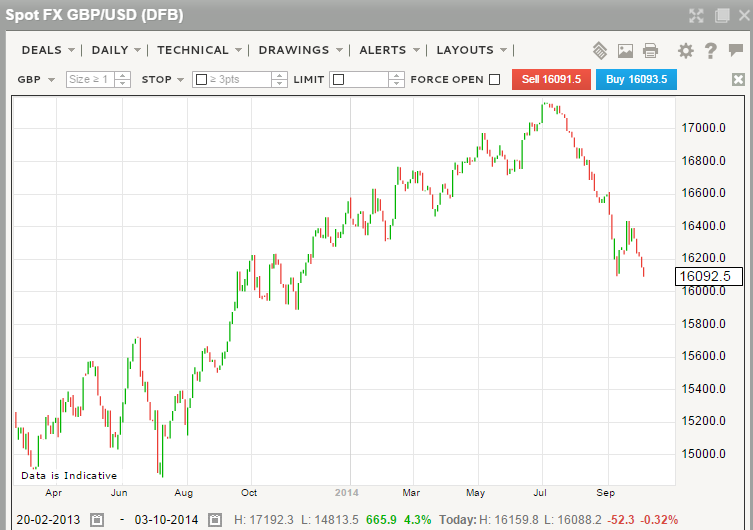
Avon Rubber is the first company I've seen that has specifically mentioned that currency headwinds are now easing, although that should be obvious just from looking at recent exchange rate movements.
There should be opportunities to anticipate better trading from some companies which had issues earlier this year with currency conversion, now that this factor has reversed fast, hence why I'm flagging it up here for readers to ponder.
It's mainly the Sterling:Dollar rate that has moved recently - i.e. sterling has weakened against the dollar since Jul 2014. So opportunities are going to be bunched in companies which report in sterling but make a lot of their profits in the USA, e.g. £FOUR - their US profits will now translate into a higher sterling figure.
Other companies that should benefit from recent dollar strength are companies which generate their gross profit mainly in dollars, e.g. Indigovision (LON:IND), and UK exporters (since the weaker pound makes dollar denominated sales overseas more competitive & hence more profitable for UK companies).
Currency hedging needs to be taken into account too, since this negates, or at least defers the impact of currency movements, depending on if, and how much hedging a company does. It might all be too complicated & unpredictable to work out the various moving parts - I tend to ignore currency movements for my long-term holdings, since it's swings & roundabouts, and companies will take action where necessary to remedy any problems caused by currency movements.
The main losers from the stronger dollar will be UK importers - because an item that is bought overseas at a cost of $1.70 would have cost £1 a few months ago, but will now cost about £1.06, thus meaning that the UK retailer of this imported product now has to either raise the UK selling price to compensate for the higher cost, or absorb the 6p cost increase through a slimmer profit margin.
So especially non-food retailers are likely to be hit by this, where most production is bought in the Far East and invoiced in US dollars. Although retailers forward plan their buying, so can mitigate this kind of thing.
easyJet (LON:EZJ)
It's not a small cap, but it's worth mentioning today's upbeat trading statement from this airline, since it could have read-across for Flybe (LON:FLYB) and Dart (LON:DTG).
Full year profit guidance - at Easyjet has been raised from £545-570m to £575-580m. Important to note this is not a broker upgrade, it's the company itself raising guidance. Which begs the question, if Easyjet and other large caps, such as Next, can give profit guidance to the market (usually done by giving a range, that narrows as the year end approaches), why on earth can't this become widespread practice for all Listed companies?
Companies, even small ones, will have spreadsheets internally where they forecast and plan their own performance. They should have a good grasp on what the range of profit outcomes is for the year. Therefore investors should be told, instead of it being routed through an intermediary (house broker), with everyone then pretending that the forecasts are independent, when you know full well that in most cases they will have been discussed and cleared by the FD!
I don't mind companies saying that there is a wide range of possible outcomes for the year - that is par for the course with small caps, but I think we would avoid a lot of lurches up & down in share prices if companies better managed market expectations, by being more open about how trading is going.
Instead we have to unpick statements, and try to interpret the precise wording used in announcements, companies sometimes backtrack if people misinterpret an RNS, etc. It's madness. More openness is needed, that way there are fewer surprises.
In my days as an FD from 1993-2002 for a private group of companies, I always ran three forecasts - the base case (which was what we thought was most likely), then an upside case, and a downside case. That's what I presented to the shareholders. It should be the same for Listed companies. So my preference would be for quarterly updates to the market, for all companies, on the range of likely profit outcomes for the current year, and the key factors that will drive the final outcome (e.g. big contract wins where timing is uncertain - this should be quantified, i.e. we should make £2m profit if we win a big contract, or £1.5m if we don't).
Back to airlines - Easyjet today notes these factors;
- strong finish to the summer season
- revenue per seat slightly higher than expected
- favourable effect from lower fuel prices (a large element of airline costs is fuel)
- favourable exchange rate movements
- gains from Air France's pilots' strike (yet another own goal by the French)
.
Some of those could help other airlines too. Although it's worth noting that the Ebola crisis could escalate and impact air travel, we don't know yet.
Another negative to consider is that there is over-capacity in the airline sector, so profit margins could be squeezed.
My favourite stock in this area is Flybe (LON:FLYB) where a major turnaround is underway. The new CEO has drastically remodelled the business, stripping out costs & uneconomic routes, greatly strengthened the Balance Sheet with a large Placing at 110p, and the forecasts for next year put it on a modest rating, despite forecasts having been lowered. As always though, please DYOR.
I also quite like Dart (LON:DTG) which is worthy of further research, especially since the price is now a lot lower after a disappointing trading statement in Jun 2014.
Miller Homes
This housebuilder was trying to IPO, but has announced today that the IPO is being pulled.
A statement today says;
In light of the recent financial markets volatility, the Shareholders of Miller Group have elected not to proceed at this time with a public offering of Miller Homes. The Shareholders are excited to support Miller Homes in its next phase of growth as the Company builds upon the momentum evidenced in its recent operational and financial results.
IPOs - bear market?
What is interesting about this, is the way the IPO market is so binary - when the market is strong, IPOs come through at quite a pace, but the moment the market goes a little wobbly, as it has done in recent weeks, then the IPO door just slams shut instantly. Suddenly nobody is interested. It's very highly linked to market sentiment.
I generally avoid IPOs, but there is upside to putting in the work looking at them individually - because most will be under-researched to begin with, so you have a window of opportunity of perhaps several months, to buy into the reasonably-priced ones.
I would like to see more normal companies List - i.e. well-established, profitable, dividend paying companies with good management & sound Balance Sheets, and priced at reasonable levels. Instead we get far too many hyped-up growth stories being floated - and so many of them go wrong, it damages the appetite for decent stocks by sucking out money.
In the last year, I've seen clear echoes of the 1998-2000 TMT boom, when value shares would grind down in price, because nobody much was interested in them. Instead people were chasing the latest sexy growth stories, which went to more & more daft valuations. Until it all collapsed of course in Mar 2000. Value shares did well afterwards actually, even in a falling market.
Personally I like to do mainly value investing, but with a bit of growth stuff on the side too in a bull market. Although you have to question whether this is still a bull market? Consider these statistics;
FTSE Intl-aim UK 50 Index (FTSE:AIM5) - down 29% from its peak in Feb 2014
FTSE Intl-aim All Share Index (FTSE:AXX) - down 17.5% from its peak in Mar 2014.
Those figures indicate a bear market, not a bull market. So for those of us who go hunting on AIM, things have been pretty grim this year. Remember these are the averages for a whole basket of stocks, so within that there are plenty that have done even worse.
Clem Chambers made a very good point in a recent interview, where he said that because smaller company indices are "clean" - i.e. there are no speculators playing around with index futures (as happens with the big indices like FTSE 100) - then these actually give you a clearer indication of true market sentiment. The chart is clearly showing us that, for the moment, we're firmly in a bear market for small caps overall, at least for AIM stocks anyway. Of course for longer term investors, that means it's time to buy, not sell, because we need to BLASH. Panic sellers end up doing the opposite of course.

I find at times like this there is an emotional instinct to throw out the baby with the bathwater - to prevent any further pain by cashing out & protecting what you have left. That's completely the wrong strategy in my opinion. Instead I think one needs to carefully re-assess each position in turn, maybe throw out some more speculative stuff, and definitely don't have any significant gearing, then if the remaining stocks are good companies with sounds finances, and priced attractively compared to their likely prospects, then I would keep them, indeed consider buying more.
Some we'll get right, some we'll get wrong, but over the long term the winners outweigh the losers.
Anyway, each reader has to decide for themselves how they cope with a more challenging market, I'm not giving advice here, just thinking out loud. Companies that are growing profits tend to see their share prices go up, even in a falling market, so it's the performance of the underlying company that matters the most, not the short term share price movements.
Sorry this is such a long report today, but things keep popping into my head!
Software Radio Technology (LON:SRT)
Share price: 26.25p
No. shares: 119.0m
Market Cap: £31.2m
Trading update - looks much improved from previous updates. Today's update covers the six months to 30 Sep 2014, so it's impressive to have flash figures available just three days later, indicating decent internal financial controls;
Key points;
Revenue of £5.4 million, a 70% increase over H1 in 2013/14
Profit before tax of £0.5 million (H1 2013/14: loss of £434,000)
£2.6 million cash balance at the Period end
Outlook - the company today says;
With many more projects in progress, coupled with the existing mandates and the pending US mandate in particular, we are excited about the future and look forward to providing shareholders with further updates in due course.
My opinion - It would be good to see this company succeed, as in my opinion management are genuine. However, the company's financial track record to date has been very patchy - as it relies on lumpy orders often from public sector bodies, where decision-making can be slow & unpredictable. It's therefore very difficult to value the company.
Buying these shares is really a leap of faith, all about backing management, rather than something you can base on reliable forecasts, since there are not going to be any reliable forecasts. The market cap is a bit on the warm side for me given the uncertain risk:reward.
I shall leave it there for the day, and the week - certainly a week I shall be glad to see that back of.
Sorry for writing so much today, my brain must have been stimulated by all that cabbage I ate yesterday - am doing the 5:2 diet thing, where you eat vegetables only, on 2 days per week.
Regards, Paul.
(of the companies mentioned today, Paul has long positions in FLYB and IND, and no short positions)
(a fund management company with which Paul is associated may hold positions in companies mentioned)
Disclaimer
This is not financial advice. Our content is intended to be used and must be used for information and education purposes only. Please read our disclaimer and terms and conditions to understand our obligations.

25 comments
Are there any listed cabbage growers? And which of the publishing houses churns out fad diet books? There's clearly a growth market in both!
@MrWhits.
Disagree - the two are noticeably different in their application.
It's calorie restriction yes, but the methodology of achieving such is without regard to actually calorie counting.
The latter implies you regulate your food intake on the basis of a set dietary plan that works out portions/food types you can or cannot eat according to their calorie counts. The Horizon 5:2 has no such regulation as far as I recall - you just eat what you'd normally eat for the 5 regular days..Where's the set rigid menu and the counting of calories?
"its the combination of food that you eat that makes us fat and sick"
Agreed - which is why calorie counting diets focus on this very thing - the type and combination of foods,and portion sizes. Often such diets require significant upheaval to ones normal routine - hence why most fail. As soon as you revert to a normal routine and diet the weight returns. Horizon 5?:2 is different - you keep the routine you are already accustomed too, there is no focus on types of food you eat(as you graze as normal), nor portion sizes. Such a methodology is far easier to adhere to as you really aren't changing your menu you consume, nor your routine, nor the combinations of foods you munch on. Chance of success - far higher.
Real food, real portion sizes is the way forward. Seconded. Intake of sugar also needs to be restricted as well.
My personal failing is Wine and Cheese
p.s It's Fangorn, no "H!"
I wish I'd never mentioned cabbage now!!!
Hi Fanghorn,
calorie restriction is calorie counting, dress it up how you want, it's calorie intake that are concentrating on.
its the combination of food that you eat that makes us fat and sick, as the body will store fat if eaten with carbs, as it cant store carbs it uses them first, then the liver converts any excess carbs to fat, for storage.
the problem is that to access your fat stores your blood sugar levels need to be normalised, i.e. no insulin in your blood, but typically before you get to that point you eat again, carbs and fat combined, and so the cycle goes on, using carbs, storing fat.........
if you ate mostly fat you would loose weight(ketogenesis), which is counter intuitive and goes against conventional wisdom(pah....) that the vast majority of doctors peddle in the western world.
BTW, the "link" between saturated fat and heart disease/stroke was wrong, ancel keys made a wrong association with bad science, but he did show that eating too much carb in your diet caused heart disease and strokes but didn't represent that view as he was out to prove another scientist wrong that saturated fat causes heart disease.....
nothing to do with small cap investing mind......
real food is the only way forward...
sorry paul.
mrwhits, thought ide stumbled onto a foodie website for a minute!! How did all this calorie counting stuff get started? Am fascinated by what you wrote, do you know a link to these facts so I can read it myself? Personally as far as dieting goes I find halving the amount of stuff I normally shove in my mouth coupled with a bit of exercise keeps me nice n trim!
Is that the Horizon 5:2 diet Mr Whits because it certainly wasn't calorie counting.
You fast on two days, but eat as normal for the other five. No counting at all but the weight loss arises as you effectively do, without focusing on calories, reduce your consumption by 30% odd over the course of the whole year. Far easier way to lose weight without having to calorie count, stick to strict dietary regimes which most cannot keep to for the rest of their lives.
Or is this another 5:2 diet?
Paul,
chuck out the 5:2 diet and read zoe harcombe instead! seriously, 5:2 is calorie counting, harcombe is real food, how can you argue against that.
have a good weekend, and I look forward, as ever to reading your small cap report on monday.
Regards
mrwhits.
Hi Paul
No worries regarding a long report - its the short ones that are disappointing! :)
Colin
Thanks for the information related to Norcros Redrumtum. I see from the Crystal Amber webpages, that they sold their holding in Norcros for a £3.9m profit so presumably they have completly exited their position. Do you have a link to the negative article by Crystal Amber Fund?
Regards,
Imran.
Completely agree with colinhow! The longer the better!
Have a good weekend and here's to a better week next week.
Hi Paul,
Thanks Paul for you considered response on Norcros; much appreciated.
Hi Paul,
Unrelated to todays posts, but just adding to the comments of others in regard to the webcast you posted with Mello David last week. It perked me up no end from my hospital bed on Monday morning, so if the mood takes you I am sure it will be well recieved again.
Watson
Hi Paul,
That was an interesting comment about how changes to the futures overnight gave an indication of what would happen to share prices today. Is there any way that private investors can get access to that information either on a general market, or specific share basis, without having to pay for it? It looks like it could help with decisions on timing trades?
Hi Warranstar,
Yes, you can see Futures prices (of the main Indices) on the home pages of most Spread Bet companies. So I can see each morning before 8am what the FTSE100 is forecast to open at. It was indicated about 40 points up this morning. This is useful info to be armed with before 8am, as you can then nip in and buy any stocks you like first thing, before they have risen too much. Although the bid/offer spreads sometimes take a while to settle at sensible levels with smaller caps.
Regards, Paul.
One share that was impacted by the strength of sterling earlier this year was Pittards (LON:PTD) . There has also been some small scale director buying of the shares recently with another one announced today.
Andrew
Today's rns for pittardds is a non-exec director sale of shares not a purchase.
Hi Investimouse
Looks like a purchase not a sale?
Pittards plc ("Pittards" or the "Company"), the specialist producer of technically advanced leather and luxury leather goods for sale to retailers, manufacturers and distributors, has been informed that on 2 October 2014 Stephen Boyd, Chairman, purchased 9,000 shares in the Company at a price of £1.14 per share.
investimouse,
Nope, you're wrong. Today's RNS from Pittards (LON:PTD) is a purchase by its Chairman of 9,000 shares.
Screenshot:
Whilst on the subject of profit warnings, it’s being a bit of a worry for a share well covered here, Norcros (NXR) which has had a relentless grind downwards since January: possibly down to bored investors! I was expecting to see yesterday their update on trading for the 26 week period ending 30/9; they usually update on a Thursday and we may have to wait until the 9/10 but although their recent statements have been boring yet encouraging; most recent interim management statement on 23/7 said “the Board remains confident that the Group should continue to make progress in line with market expectations for the current year”. I will remain slightly apprehensive about a profits warning until I see a positive update. As I write, the shares are now below 15p having drifted a little this morning.
Apologies for comments not directly related to a share covered today but more on the theme of Paul’s comment about making it to the weekend without another profits warning.
Hi Dosh,
I'm also concerned about the price drift at Norcros (LON:NXR).
The newsflow from the company has been fine this year, but the price just drifts relentlessly down.
So the big unknown is whether the stock is just drifting down in sympathy with a bear market in small caps since Mar 2014, with small holders getting bored, or having stop losses triggered.
It looks as if that is the case, as volume has been very low over the past 3 months, see the volume bars on the chart below - most days under 1m shares change hands, which is only £150k-worth. Peanuts for a c.£100m market cap company.
Director selling recently didn't help at all, and unnerves me a little.
So you do wonder if a profit warning might be on the way? Having said that, it's so cheap now that under-performance is baked into the price already.
The dividend yield is now 4%, and is over 3 times covered by earnings.
The Balance Sheet looks OK to me, with freehold property offsetting net debt.
There is the pension fund issue of course, but that's a constant - nothing much has changed there, and it's reasonably well funded.
S. African currency issues shouldn't make much difference to profit, because the S.African operation trades at around breakeven, so has negligible impact on the group profit, whatever the exchange rate. I would like them to divest the S.African operations, as they dilute the quality of the UK business - which on a standalone basis would I think command a higher rating.
Anyway, we'll just have to wait & see what they say about trading next week.
Regards, Paul.
Re Norcross, it's worth noting a director buy of 120,000 shares a couple of weeks ago - so a profit warning now would look rather strange! Also I remember reading a negative article by Crystal Amber Fund, who were selling down their holding. They are below 3% now so further selling would not appear on RNSs.
Good points Redrumtum-but why were they negative?
Sorry tads my memory isn't what it used to be and i can't find the article. Crystal Amber sells themselves as 'activist' so I assume they tried - and maybe failed - to influence company strategy to unlock value.
"currency headwinds" - dependent on the export market the co. is exposed to. I haven't looked but does AVON sell mainly to the US or countries with US - pegged currencies?
Since August GBP has strengthened further against EUR so Eurozone exposed co's will still be facing "currency headwinds".
Much of their trade is in the US, supplying respirators to the military. Eurozone exposure is much more limited.