Small Cap Value Report (30 Jun 2015) - PLA, TRK, SNCL, ALY, AMS, CSG

Good morning!
It certainly feels a lot more calm today than it did this time yesterday, when we were seeing something of a mini panic sell-off. Encouragingly, a lot of the small caps I follow started to bounce mid to late morning yesterday, and recovered a lot of their losses by the end of the day. I'm seeing tentative buying this morning in some small caps too.
The general view seems to be that Greece is a nuisance, but widely expected, and something of a storm in a teacup as regards how we should value UK small caps. I think the EU will do whatever they have to do, to protect the Euro, and the banking system, and if that means cutting Greece adrift, then so be it.
On a human level, of course I feel sorry for ordinary Greek people. But this is what happens if you keep over-spending - eventually you run out of other peoples' money. There is no easy solution to what is going on there. I remain of the view that the most likely outcome is a compromise. It's inconceivable to my mind that the Greeks will voluntarily go for economic collapse, even if it would probably be in their best interests long term.
Plastics Capital (LON:PLA)
Share price: 97p (down 4%)
No. shares: 35.3m
Market Cap: £34.2m
Final results y/e 31 Mar 2015 - adjusted profit before tax has come in at £3,673k, which is 2.4% up on last year, and looks to be in line with broker expectations. Although adjusted EPS of 10.8p looks below broker expectations of 11.7p, so at this point I'm not entirely sure if they have undershot, or not. Although the shares being 4% down suggests that the market is slightly underwhelmed by the numbers.
The trouble is, turnover is up 21.9%, driven by acquisitions, but profits are only really flat. So that implies the existing business has gone backwards in profitability.
PLA is also prone to making lots of adjustments to their figures, which leaves me feeling a tad uneasy - e.g. how exceptional are exceptionals, if they happen every year? This year £1.1m of costs are classified as exceptional. Last year it was £1.3m.
There is then a second layer of adjustments, for amortisation of intangibles, and deal fees, then a third layer of adjustments for forex & derivative gains/losses.
So investors can be forgiven for feeling somewhat confused as to how much genuine profit this group actually makes? Going from 10.8p adjusted EPS to an actual loss, of (0.8)p basic EPS, makes me feel uncomfortable about the extent, the nature, and the repetition of these accounting adjustments.
Note that there is only a very small tax charge, in both 2014 and 2015, so under HMRC rules the group doesn't make much taxable profit. Worth bearing in mind when valuing the company.
The company is transparent about it though, and provides this useful table:
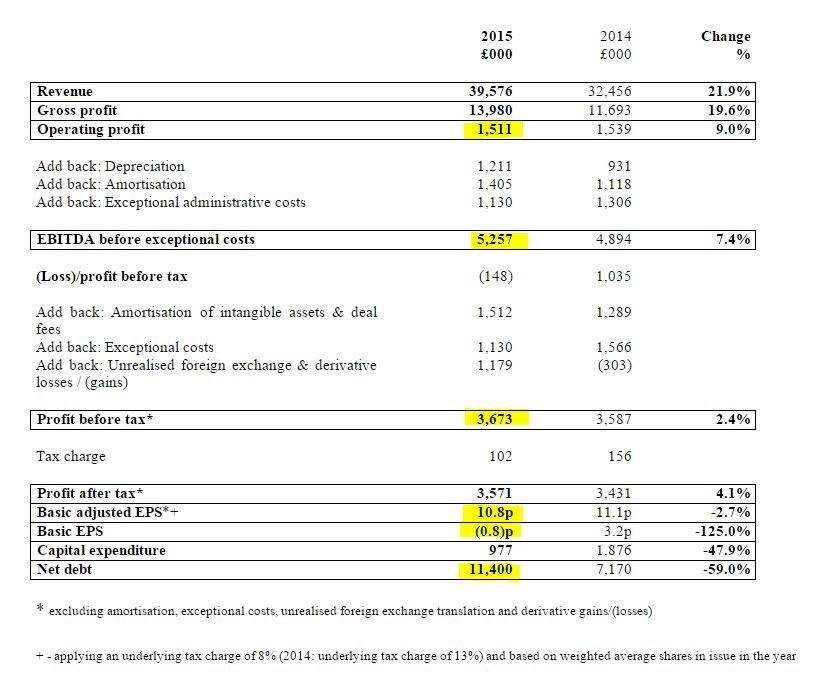
Net debt - is getting a bit on the high side again, in my opinion. Although the narrative mentions that a property sale & leaseback was completed after the year-end, realising £1.4m.
It's all very well the company saying that net debt is only 1.6 times EBITDA, but that's in the good times. What happens in a downturn? EBITDA would drop sharply, and all of a sudden the net debt looks too much, just at the time that banks are getting jittery & looking to slim down their own balance sheets.
PLA sailed close to the wind on debt in 2008, so let's hope they don't over-gear in the good times again this time.
Dividends - these have been rising nicely, and the company is proposing a 2.67p final divi, taking the total to 4.0p this year. So a healthy yield of 4.1%, although I have my doubts about how solid the foundations are for these payouts.
Remember that the number of shares in issue has gone up, from historically around 27m, to 35.3m now, to part-fund acquisitions. So in a way, the dividends are giving with one hand, whilst taking away (issuing more shares) with the other. Therefore it could be seen as a bit of a mirage.
Generally I like to see companies growing without issuing new shares, and would rather forego divis in order for that to happen. Whereas here, you get a nice divi, but are seeing your earnings (and future divis) diluted from the issue of new shares to fund expansion, which has only managed to hold earnings flat, rather than increasing them.
Outlook - sounds generally OK, but being cynical, they've given themselves wiggle room to warn on profits if sales leads don't convert into sales.
(please note my improved highlighting below - I cleaned the food debris off the bottom of my mouse & mouse mat, and it's easier to move sideways in a straight-ish line now!)

My opinion - sorry if the above all sounds a bit negative. It's not a bad company, but it's difficult to see any immediate upside on the share price, given that the results are lacklustre - showing no benefit from acquisitions, but now carrying more debt, and with more shares in issue.
I'm not convinced the dividend is sustainable at this level, and if it is, then there will probably have to be more dilution to finance any further acquisitions. I'm not convinced that the group structure adds any value, i.e. bolting heavy central overheads onto a small group of operating subsidiaries.
So for me, I'll pass on this one.
Torotrak (LON:TRK)
Share price: 7.2p (down 5.9% today)
No. shares: 276.3m now + 197.6m new shares = 473.9m + 71.4m re Flybrid = 545.4m
Market Cap: £19.9m now. £39.3m after fundraising completes.
Fundraising - as I predicted here, yet again Torotrak has come back with the begging bowl. The amazing thing is that anyone is prepared to keep funding this company, which has serially disappointed for over 15 years now. Although since the original gearbox technology wasn't really getting anywhere commercially, they've added on other similar automotive development projects into the company.
There's a Firm Placing with institutions for 128.6m shares, plus I am pleased to see that a 1 for 4 Open Offer for existing shareholders has also been included. Well done to the company and its advisers - this is very much best practice - after all, the principle of pre-emption rights is a core principle of company law. So an Open Offer of a meaningful size should always be combined with a Placing, unless there are exceptional circumstances.
Better still, it looks like the Open Offer shares will be taken by Institutions, if existing shareholders don't want them, so that's ideal. It gives existing shareholders first refusal, but there's a backup buyer, in case existing shareholders don't want them.
The amount being raised (before costs, which I expect will be hefty) is £13.8m. Ah I've just found it, the net amount is £12.4m, so the costs of £1.4m are just over 10% of the money being raised! Not exactly appealing - of the 7p subscription price, only 6.3p will actually end up with Torotrak, and the rest goes to advisers. Hmmm.
Earn out - an existing arrangement to pay up to £15m to the vendors of a previous acquisition, Flybrid, have been amended to be less onerous. Also, £2.8m in loan notes are restructured. Instead of £10m cash, the vendors will now get 71.4m new shares (£5.0m at the Placing price). That could become an overhang though, depressing the share price subsequently, possibly?
Note that today's announcement says if this deal doesn't get agreed by shareholders, then the company only has enough cash to continue operating until Sep 2015. Yikes! So the company and shareholders have sailed very close to the wind here - without a fundraising it would have shortly gone bust, or had to drastically down-size. I wonder how many shareholders were blissfully unaware of this risk? Probably quite a few - it amazes me how many people punt on shares without properly understanding a company's finances.
I'm sure this won't be the last fundraising for Torotrak. What price will the next one be at? 5p? 4p? 3p? 2p? Who knows?
On the plus side, operating costs are being reduced by 20%.
Final results y/e 31 Mar 2015 - as I suspected, the results are pretty awful. £3.8m turnover (similar to last year's £3.5m), and a thumping great operating loss of £8.4m (up from a loss of £4.8m prior year).
There is a tax credit though, of £626k, which I imagine is under the generous R&D tax credits scheme, whereby companies do actually get cash from the tax man.
Balance sheet - this has obviously been strengthened post period end, with today's announcement of the fundraising. So the company probably has enough cash for the next year and a bit, before it comes back for more.
Outlook - as always, the company makes upbeat noises about new products, although at least shareholders can see a product coming into commercial production, so will be able to gauge success or failure accordingly, in a reasonable timescale:

I wonder whether a system for the UK bus market is a big enough market to be worth bothering with?
My opinion - given the many £billions spent every year on R&D by numerous car & vehicle companies, I've never really believed that Torotrak could deliver a commercial return for shareholders. So far it hasn't, it's just been a huge money pit for optimists. Let's hope they do eventually succeed with something.
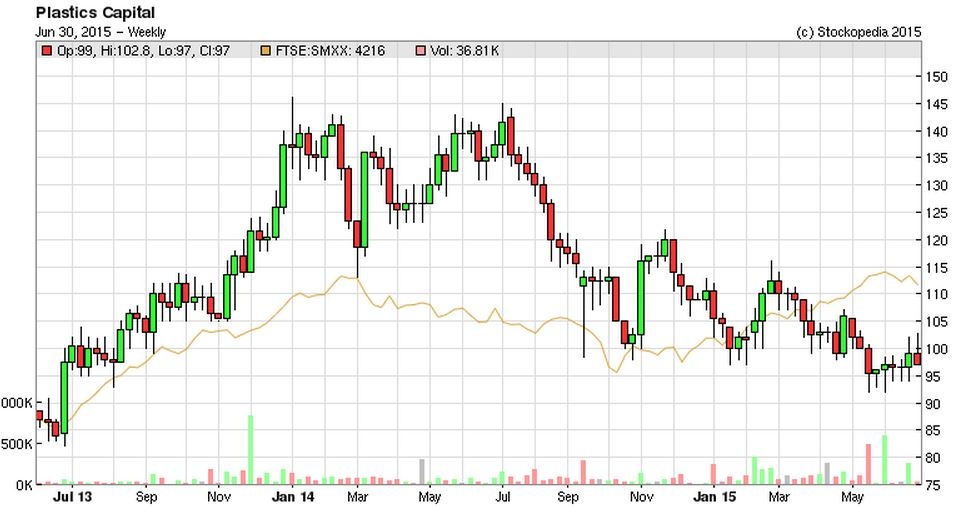
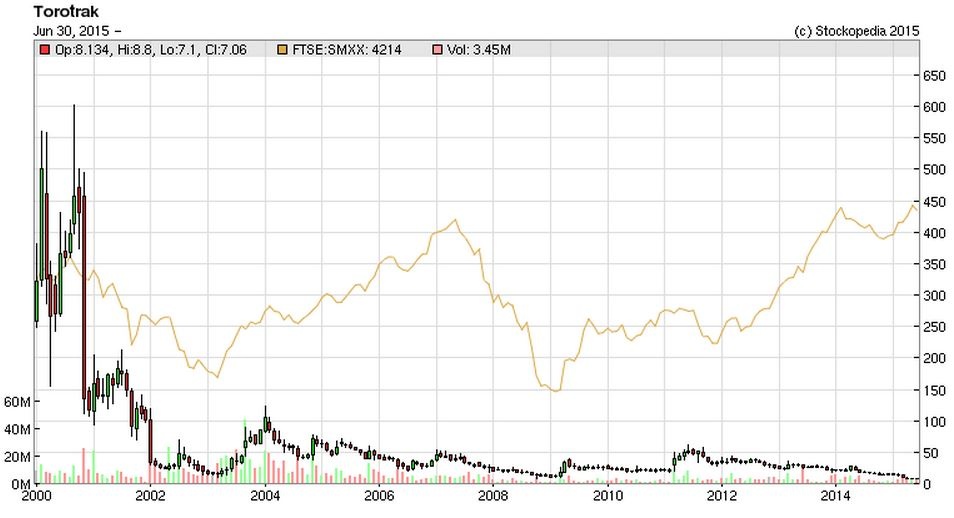
The long term chart for Torotrak is sobering. If you had invested in Torotrak shares in 2000, at 250-600p, you would now have 7.2p left. If you'd invested the same amount in the FTSE Small Caps Index, you would now have 440p.
Note that about every two years there is a flurry of excitement in Torotrak shares, before it goes back into a downtrend again. It would be interesting to plot the fundraisings on the chart too, but I don't have time. Maybe it will be different this time!
William Sinclair Holdings (LON:SNCL)
Share price: 10.95p (down 27% today)
No. shares: 17.4m
Market cap: £1.9m
Interim results to 30 Jun 2015 - I'm only covering this to keep the archive up-to-date, as this used to be a much larger market cap, but sadly this peat distributor has very nearly reached the end of the road I think.
The results are terrible - a loss before tax of £8.9m, which includes exceptionals of £4.5m.
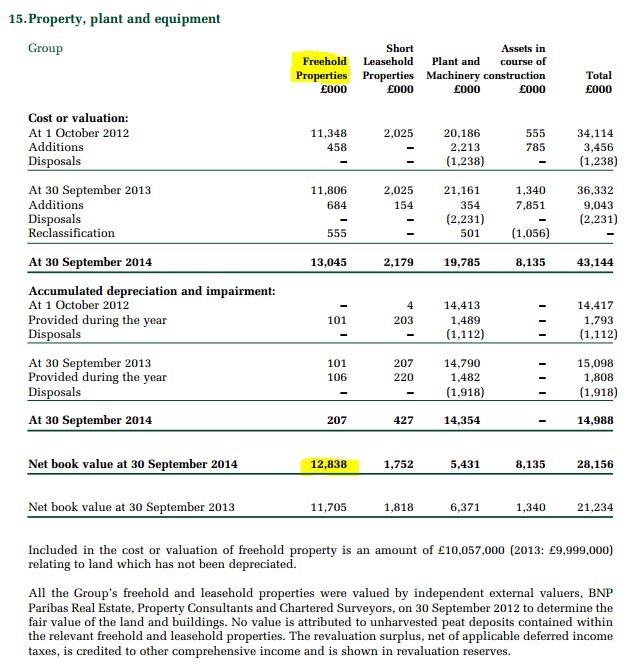
Balance sheet - this is groaning under the weight of net debt at £23.7m, and a pension deficit of £18.5m. Although I note that net tangible assets are still just about positive, at £2.9m. So the key question is what the fixed assets are worth? If it's valuable land, worth more than book value, then the company could have a future.
I've checked note 15 to their last Annual Report, and it seems that freehold land (at 2012 valuation) is in the books at £12.8m. That's only just over half the net debt, so sadly I don't think there is enough asset value on the balance sheet to save the day.
Fundraising - the new, turnaround management make it clear in today's statement that fresh funding is urgently required. So it's now a question of whether a fresh funding deal will attribute any value to the existing shares, or whether new financial backers will want to ditch liabilities (which would be sensible) through a pre-pack administration.
My opinion - in my view the existing equity is now worth nothing. Therefore I have (belatedly, since I've always been bearish) put the share on my Bargepole List - i.e. things that are too high risk, or too highly valued for me to consider investable.
Laura Ashley Holdings (LON:ALY)
Share price: 29.9p (down 10.2% today)
No. shares: 727.8m
Market cap: £217.6m
(at the time of writing, I hold a long position in this share)
Property purchase - an unusual announcement from Laura Ashley today. It has decided to spend £31.1m buying the freehold to an 8-storey, 98,254 sq.ft. office building in Singapore. This is to give the company a Far Eastern base, apparently. That's a lot of office space, for a company which does 90% of its turnover in the UK!
However, its overseas operations are via franchisees, and there are 303 such stores, which is greater in number than its 205 UK stores, and the segmental analysis shows that its overseas operations are decently profitable.
Today's announcement sounds like the company is gearing up to expand significantly in the Far East - "the Board has identified significant growth prospects for the Group in Asia".
Even so, to go all-in with a £31.1m office property purchase seems bordering on the bizarre, or worse. Given that Chinese companies on AIM have recently spirited away cash through buying apparently unnecessary land/factories, this unusual property purchase by ALY is bound to raise similar suspicions, especially as the company is controlled by Far Eastern shareholders. To be blunt, I think the market is wondering whether this is a device to defraud the company? Hence the 10% knee-jerk drop in share price today. After doing some digging myself, I believe this is not the case. The controlling Malaysian shareholders have a good track record - paying modest Director salaries (the entire Board only cost £648k in 2015, and £586k in 2014), and looking after all shareholders by paying generous dividends each year.
It has also been noted before that the major shareholder in ALY is going through a messy divorce, widely reported in the press. Although that does not seem relevant to today's announcement. I only mention it because someone else will do so in the comments, if I don't!
My opinion - Singapore is very different to mainland China, and ALY has today given full details of the property they are buying in Singapore, including its address, and the price paid, £31.1m, which is £316/sq.ft. outright purchase remember, not annual rent! So assuming say a 5% rental yield, that would become a rental value of £15.82/sq.ft. equivalent rental.
(Edit: note that a reader has helpfully put a link to Google Streetview in the comments below, so you can view the property concerned. Thanks for that).
Therefore I am in the process of googling to find out if this is a reasonable price. However, ALY also mentioned today that big name international property firm DTZ have independently valued it at the purchase price, and the report will go on their website, which gives comfort;
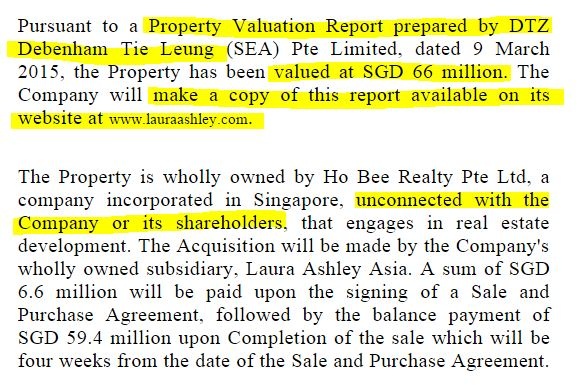
Overall I reckon that cynics will say that this deal smells fishy, which to be honest, at first sight, it does. However, once investors have had time to inspect the valuation report, and conduct our own desktop due diligence on Singapore property, then attention should begin to turn to the expansion possibilities in the Far East. Who better than Far Eastern Directors and shareholders to manage that expansion? Therefore I expect today's 10% share price drop to rebound in due course.
Remember that ALY pays a fabulous dividend, and has done so for years. That's the crux when considering whether majority shareholders are feathering their own nest or not. If outside shareholders get a whacking great divi every year, and Directors remuneration is modest, as is the case here, then we haven't really got anything to complain about.
Overall this company is one of my favourites at the moment, and the Stockopedia computers love it too, with a StockRank of 99. It's just a pity that the ownership structure is so concentrated.
Advanced Medical Solutions (LON:AMS)
Share price: 143p (down 1% today)
No. shares: 208.2m
Market cap: £297.7m
Trading update - for the half year to 30 Jun 2015:

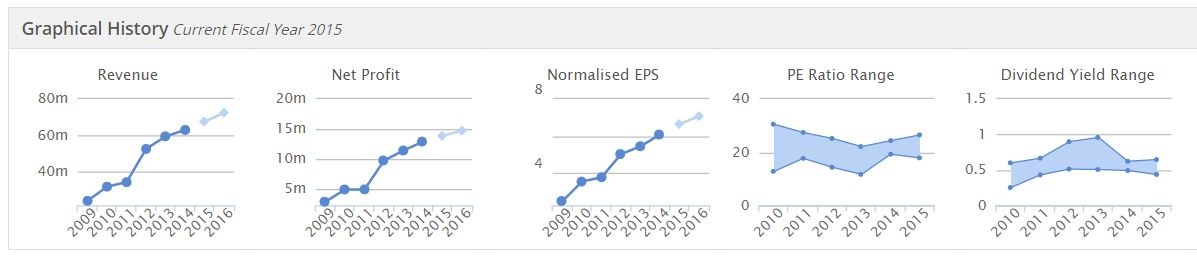
Looking at the Stockopedia graphs, the company has an excellent track record of growing profits and EPS, despite about a 30% increase in the number of shares in issue in 2012:
Trouble is, it looks fully priced for now:
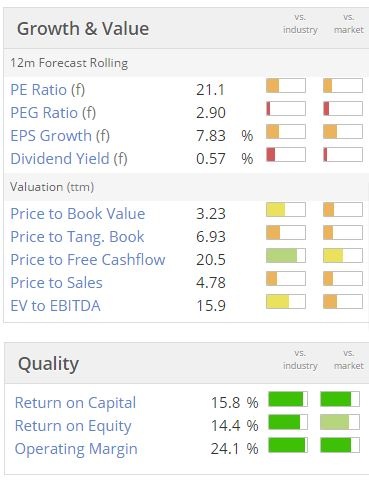
My opinion - this looks to be a quality company, but the price reflects that. So the only way to assess it would be detailed research, and trying to ascertain what competitive advantages the company has, and how the future might pan out. You'd need to see continued good growth to justify the current price, let alone any increase in share price.
Sweett (LON:CSG)
Final results are out today, but since they have an ongoing SFO investigation against them, then I don't think this share can be considered investable until that is resolved, unless you're prepared to take a complete punt.
The level of debt at £9.7m is a worry here too. There are no divis this year.
I think it's just too risky at the moment. The Asian, and Indian businesses are being sold.
Phew, I'm melting in the heat now, that's got to be it for now!
Regards, Paul.
(of the companies mentioned today, Paul has a long position in ALY, and no short positions. A fund management company with which Paul is associated may also hold positions in companies mentioned.
NB. These reports are Paul's personal opinions only. They are NOT financial advice, nor share recommendations. We very much encourage readers to do your own research, and make your own investing decisions)
Disclaimer
This is not financial advice. Our content is intended to be used and must be used for information and education purposes only. Please read our disclaimer and terms and conditions to understand our obligations.

39 comments
Re dividend has the Laura Ashley Holdings (LON:ALY) dividend been cut I see they paid out 3p in 2014 and 2013 but looks like only 2p this year?
I took the opportunity to look through the Laura Ashley accounts yesterday. The item that is not taken into account in the profit figure is the increase in stated pension liabiity to c. £17m. If you take the increase off the earnings figure it halves it, giving a P/E of 20ish not 10ish. It wipes out the dividend cover too. Similarly if you look at the 10 year account history helpfully given at the end of the the last annual report the pension liability would account for the drop in net asset value over that period.
The defined benefit scheme appears to have been closed to new members and future accruals since 2005, and the general view seems to be that pension deficits numbers are widely suffering due to low interest rates and that position will cure itself if and when rates go up. Nonetheless I'm finding it hard to ignore half the year's profits vanishing into a pension deficit and I'm struggling to understand whether this is a one off or a sign of something worse. Would appreciate any comments!
On the other comments made so far the size of the dividend almost counts against the company for me as over the last ten years virtually all profit has been paid out and none retained. That suggests a lack of faith or ambition in management given the return on equity they are getting should in theory suggest that retaining profit to invest in the business would over the long term produce excellent returns. On the plus side there seems to have been no share dilution - its hard to discern any mistreatment of minority shareholders in this company.
Thanks guys.
Can someone please help clarify the question I asked earlier in the thread with regards to a company paying dividends when it has negative retained earnings, £79m in the case of ALY.
I thought that was why companies carried out a capital restructuring, as in the case of TNI, in order to remove that deficit to enable them to start paying dividends again?
Thanks
Hi Tiswas
Can someone please help clarify the question I asked earlier in the thread with regards to a company paying dividends when it has negative retained earnings, £79m in the case of ALY. -
Dividends are paid from the parent holding company, which in ALY's case does have retained earnings (see red box below):
It looks as if ALY may have various subsidiary companies, some of which have retained earnings and some of which don't, which add up to a negative £79m in the consolidated group balance sheet.
Mayn
(EDIT no problem longbeardranger!)
Tiswas,
You need to distinguish between solus and consolidated accounts. For dividend paying purposes, it's the solus balance sheet that is relevant, not the group's consolidated position. So before knowing whether ALY has a dividend block you need to look at the parent company's non-consolidated balance sheet.
(Of course, there may still be dividend blocks lower down the corporate structure....)
EDIT: Maynard got there before me!
Laura Ashley Holdings (LON:ALY) Property Valuation Report (from Corporate Website):
http://www.lauraashley.com/content/ebiz/lauraashley/resources/images/File/29%20New%20Industrial%20Road%20%20-%20Valuation.pdf
I have done very well out of ALY and would buy more but it already comprises a substantial proportion of my portfolio. Odd how Investors Chronicle got this company wrong.
Hi Paul
Re. Laura Ashley Holdings (LON:ALY) - I had a good look at this company accounts and the questionable purchase of the Singapore property.
Firstly the accounts. I think Stockopedia have got it wrong by showing FCF as negative for the past 3 years at least. It isn't negative. The figures are roughly £18m, £8m and £14m for years 2015, 2014 and 2013 respectively. I can see where the error may have crept in. Unusually ALY shows dividends paid as an accounting entry in the Operating Cashflow section, whereas most company subtract dividends paid as a financing activity. The dividends are pretty substantial, hence the distortion.
So to my mind, if the company is throwing up cash, then in this low interest environment, the financial case would probably tip in favour of buying rather then leasing. As long as they leave themselves headroom for possible acquisitions.
Overall I like the look of ALY and have taken advantage of the 10% drop in taking up a long position.
Regards, Ram
Hi Ramridge,
Yes, you are absolutely correct in what you say about the free cashflow - the data from Thomson Reuters on Stockopedia is indeed wrong, for the reason that you state - that Laura Ashley Holdings (LON:ALY) show divis at the top of the cashflow statement, incorrectly.
I spoke to an adviser of ALY today, and they told me that the company had looked at renting a HQ in Singapore, but also considered buying, and the business case for buying was stronger, so that's what they have done. They have flexibility to sub-let space that they don't need, but can then take that space back at any time in the future, so it's a clever deal actually.
I find the UK reaction to this deal quite bizarre actually, but there we go!
Regards, Paul.
One nagging doubt I do have on Laura Ashley Holdings (LON:ALY) is whether the team at Malayan United Industries have the capability and experience to effectively build an international upper-end brand. Their experience in retail is largely limited to the Metrojaya stores in Malaysia itself, stores which, tbh, I've always found to be quite ordinary and uninspiring and which seemed to gain custom simply because there were few other shopping options. It was very noticeable that when Japanese retailers, such as Isetan, set up shop in Malaysia,people deserted Metrojaya in droves. The present CEO of Laura Ashley is an ex-Metrojaya man. I do appreciate that they are looking to a franchising model to achieve their goals and their stated ambitions are to be applauded but will they be up to the task?
@Cleeve,
Hong Kong would've been a better place to put down roots imv. Lost track of the rental rates for both Honkers and Sing as I no longer live there - last I heard rental rates were bordering on the ridiculous. Still - plenty of construction still going on from what I saw last year.
Very strange move for LA - personally I'd have rented as a first foray into setting up a local Asian operation. Risks are just that high splashing out and going all in from the off. Still, Laura Ashley is a quality brand so they might pull it off - not quite in the same league as Burberry & co though and its still al about brands o'er that way.
Surely the issue for Laura Ashley to explain is why they are buying an asset that has a way lower ROCE than their own business even when geared up with a mortgage ? Particularly when as they say they can see major opportunities for expansion in the region with the requirement for and risk to capital that that implies. A smaller purchase would be potentially explicable but one on this scale suggest that we are missing something.
It looks ludicrous or suspicious take your pick IMHO
Hi Paul
"However, they are funding it 65% from a loan in the same currency as the purchase price. So forex risk not particularly worrisome, given that the asset and the associated debt are in Singapore dollars.
I would have worried if there was a currency mis-match, e.g. a loan in sterling, and property asset in Singapore, but there isn't."
I completely agree with Jane here. My biggest problem is not any currency aspect (which I agree is limited) but the timing of this purchase when Singapore office property prices have been through a boom and look toppy and interest rates are very low but on the way up. From what I can make out the interest rate on the debt repayment is floating (SIBOR + 2%) with SIBOR currently ~0.8%. Even if they rented the building, the current yield would only be around 4% - so even as a commercial property transaction it doesn't appear to make any sense, especially if interest rates rise and property prices fall leading to higher repayments and a depreciating asset on the balance sheet.
It makes absolutely no sense from a shareholder perspective. Why buy in the current property market and use up £10m of balance sheet cash which management should be able to use to generate far better returns for shareholders? TBH I'm surprised the shares are only down 8%!
Si
Hi Simoan,
Well you're entitled to your opinion, but I disagree. Personally I love it when companies buy freeholds, because it means that my shareholder returns will improve long term. After all, property companies wouldn't exist at all, if owning property was a bad thing! So just because it's fashionable to concentrate on ROCE, and eschew holding physical assets if possible, personally I take the opposite view - the more assets there are buried in a balance sheet, the better, as far as I'm concerned.
If you own a freehold, over the long term, you should clean up - you won't have any rental increases to worry about, and the bank will support you in recessions because you have proper security to offer them.
Laura Ashley Holdings (LON:ALY) had surplus cash, so they used 35% of it to put the deposit down on a big F.East HQ, and have taken advantage of low interest rates to borrow the other 65%. The business had overall net cash, so introducing a small amount of gearing, to buy a valuable property asset, is fine by me.
If you look at that building, it's clear they are planning a pretty major expansion in the Far East. Which makes sense since mgt & major shareholders are Malaysian.
With a bit of PR, I reckon this could easily turn into a positive factor, once the market's knee-jerk negative reaction has subsided.
In my view, well financed companies buying freeholds, is almost always a positive thing. But others disagree, which is fine, that's what makes a market!
Regards, Paul.
Paul
Does it concern you that ALY shows a small financing charge for the last financial year even though it is meant to have significant cash balances?
There is also "Other comprehensive expense for the year net of taxation of (8.5m)" with no covering note.
Total equity also fell year on year and the negative retained earnings also increased. I thought there were issues paying dividends with negative retained earnings, although clearly I must have that wrong.
I like the LA brand for its appeal in the far east, and the yield is very attractive but the property purchase will just be the first step in a big investment and I wonder if that is the excuse they need to cut the dividend materially?
Regards
Rob
Hi Tiswas,
The £0.4m financing charge in Laura Ashley Holdings (LON:ALY) accounts for y/e 31/1/2015 is a red herring, because if you check note 7 of the Annual Report, it relates to pension fund accounting only. So it looks as if the company will have held significant net cash throughout the year - i.e. there are no bank interest payments at all.
ALY held £27.8m net cash at 31/1/2015, so paying the 35% deposit on the Singapore office block (c. £11m, plus say £2m costs) is easily within their existing cash resources. The 65% loan against the freehold will of course be secured on the freehold, so is fine.
ALY has a completely ungeared Balance Sheet at the moment, and generated £23.8m cash inflow from operations last year, therefore it could easily handle say £25-50m in net debt, if required. So the company has bags of headroom on cash, in my view, even after the freehold purchase.
Having slept on it overnight, I like the freehold purchase. It indicates an intention to seriously expand in the Far East, which is a good idea for an iconic British brand. The brand is very valuable I think, and not reflected at all in the market cap at present, giving potentially exciting upside.
Also, if you think it through, buying an office block outright gives them enormous flexibility - they can use perhaps one floor to start with, and sublet the rest (at a rental yield of c.4.5%, which is well above the current funding cost). Then as they grow, they can take additional floors as tenants short term sub-leases expire. Or they could buy out tenants if they need the space urgently.
Cantors say this morning that ALY also want plenty of space to showcase their product ranges for potential franchise partners. Cantors also say that despite having c.300 overseas franchise stores, ALY does not yet have any stores in China or India - obviously two huge markets, where British brands have kudos. So those are clearly amongst the overseas markets they are planning on expanding into.
The more I think about it, the more I like this freehold acquisition - back in my days as a retailing FD, warehouse & office space was a constant problem - we were forever out-growing existing space, and in the space of 8 years had to have 2 extensions built, and then relocate the entire HQ to a much bigger site, which we initially sublet part of, and then grew into that additional space quite quickly.
Also, as ALY is buying the site over a 15 year loan term, gradually over that time they will gain a bigger & bigger advantage from reducing costs. Instead of paying rent to a landlord, and it being money down the drain, they are instead using a similar cash outflow to actually buy the building.
Think of companies like Churchill China (LON:CHH) which operates from a large multi-acre site, which it bought for peanuts in the 1960s, or something like that. It gives them a big competitive advantage now - effectively they operate free from that site.
I looked back again at ALY's 2014 Annual Report last night, and there are no funnies at all. It's completely clean. OK, the share ownership structure is not ideal, but the Malaysians haven't done anything to disadvantage minority shareholders - quite the opposite, they pay themselves very modest salaries for the size of company - the entire Board (2 Execs and 5 Non Execs, plus another 3 NEDs for part of the year) only cost £648k in 2014/15, and £586k the prior year).
Plus the company has consistently paid very generous divis - the yield is about 6.5% now, and that looks sustainable.
So overall, I reckon this is a very good opportunity with ALY shares looking a bargain. Also the StockRank is 99.
DYOR as usual!
Regards, Paul. (long ALY, obviously!)
Hi Paul,
Don't get me wrong, I completely understand where you're coming from as a value perspective. For the record I have quite a large (for me) position in ALY hence my frustration with this property deal. I think how you see it depends on what your intended holding time is for the shares. Mine is clearly not as long term as yours and I could be long dead before the upside of this deal is realised hence I would prefer any cash to be used to improve short term growth as opposed to the asset backing on the balance sheet, particularly if those assets are a large underutilised building - I prefer any assets held by companies I hold to sweat as hard as possible :-)!
All the best Si
ALY-Maybe it is a full list company -the heat scrambles the senses. Should be on the beach. Anyway its the exercise of an option.
Its entirely wrong to use company funds in this way. If you want to invest in Singapore property there are lots of other vehicles. Believe this would require shareholder consent for a full list company.
hayashi22,
Laura Ashley Holdings (LON:ALY) is fully listed.
Also I think it's important to remember that they are taking a loan against the property, so it's not actually using that much capital. I think the knee-jerk reaction may reverse after a while.
Regards, Paul.
Paul, perhaps the question many shareholders are asking is whether Laura Ashley Holdings (LON:ALY) could have found a better way of using £34.5m. Yes, it will be a top-rate commercial building ( I know the Tai Seng Drive area in Singapore ) and Singapore, where I used to live, is efficient and convenient as a business location but is it the best way of using shareholders' money? The Singapore property boom may go on but the returns from this use of funds are unlikely to match the returns from investing them directly in the business and, instead, renting in S'pore or KL or elsewhere. I'm not surprised the SP has dropped 10% on this news.
PS: Here's a link to the Urban Redevelopment Authority site which seems to show (see under "Office Space") that sale prices are actually already topping out and with an enormous amount of new office space due to hit the market in 2016:
http://www.ura.gov.sg/uol/media-room/news/2015/apr...
Taking on the property price risk in Singapore, as well as a GBP/SGD exchange risk? Is this a good deal for shareholders?
JB, couldn't agree more.
It's one thing investing in a manufacturing company who own their own factory and it's book value is ancient, so there's hidden asset value there.
It's quite another for a company to buy an expensive office building for a large amount of money in a territory away from their domicile.
You don't buy shares in Laura Ashley Holdings (LON:ALY) for property speculation in Singapore. You buy them for the expansion of the clothing and interiors ranges. Why not, as you say, lease and wait until you see how the business performs, then decide later on if this warrants such a large office space?
I'm neither long nor short of the shares, it just seems a strange transaction for such a company to make, regardless of whether the building is fair value or not.
In my book companies should 'stick to their knitting', not have managerial attention focused away from the business in hand.
Hi Cisk,
I agree the Laura Ashley Holdings (LON:ALY) property deal is very unusual.
However, they are funding it 65% from a loan in the same currency as the purchase price. So forex risk not particularly worrisome, given that the asset and the associated debt are in Singapore dollars.
I would have worried if there was a currency mis-match, e.g. a loan in sterling, and property asset in Singapore, but there isn't.
Looks a nice swanky building, from the picture on Google StreetView (thanks to the member who posted a link here). So clearly they mean business with Far Eastern expansion.
Regards, Paul.
I used to travel a lot to asia (most months) and really if you want to be based there you have two choices Hong Kong or Singapore so if they are putting down substantial roots maybe thats no bad thing. I was waiting for an opportunity to buy some stock for my kids ISAs so today was that day!
I too lived in Singapore — nearly 40 years ago. Rents and property values seemed astronomical, and the talk was often about when the boom was going to bust. I have no idea how prices compare now to what they did in 1976 — but I'll offer good odds that they are many, many multiples of what they were then.
Here's a new rule to add to all the adages we know and love about investment: you will never, ever, lose money buying property in Singapore.
Paul
Any thoughts on Laura Ashleys purchase of a building in Singapore the market does not seem to like it!
Market may not like it, but it looks pretty impressive - hope this link to Google Streetview works: http://tinyurl.com/ogm594e
For a company currently with 2,500 employees, judging by the size of the building it looks like they are really going for it in terms of growth in Asia, or are looking to sublet. At what point does a retailer become a property company?
Si
Yo Paul, thoughts on CSG. Various adjusted EPS values, divi dropped etc.
looks like ALY.L is also taking a hit on a property aquisition and hit on earnings.
down about 10% so far.
regards
PLA's consensus EPS f/c for 2015 a year ago was 12.58p, reduced in steps to 10.95p by Apr this year. How much confidence can I have in the 2016 f/c?
They made an unadjusted profit of 3.2p in 2014 but this time a loss.
I like the Executive Chairman but it's not one for me.
Open offers are good in principal and should be incorporated in the city code - but the cynic in me wonders if it's a sign of desperation in this case.
Monty9,
"Open offers are good in principal and should be incorporated in the city code - but the cynic in me wonders if it's a sign of desperation in this case."
The cynic in you is wrong! In this case Torotrak (LON:TRK) has got Institutions lined up to take any surplus shares in an additional Placing. So as I understand it, they are giving existing shareholders first refusal on the Open Offer shares, including an excess application offer (which is good), and then any not taken up will then be Placed with Institutions.
So I think that's the ideal scenario actually - i.e. company has certainty of raising the funds, and existing shareholders are given priority to take up a decent chunk of the new shares.
Regards, Paul.
Point taken. Lets hope it pricks the conscience of others.
Noticeably the FX and derivative losses against profit last year has caused a worsening of the reported operating profit of roughly £1.4MM. I one accepts these sum to zero over time, and excludes the effect we get operating profit of 2014 £1.0MM vs 2015 £2.7MM. I guess in the real world when you are enjoying exchange gains it is harder to generate turnover as your prices tend to be higher, but not that much! Even against the gross profit the effect is material. Suggests a good result next year is on the cards.
Totally agree exceptionals and depreciation/amortisation are real and should be applied to the success or otherwise of management's investment in the business. IMHO EBIT should only be used when assessing the value of a potential purchase, and even then with care as the cash flows may cost a greater or lesser ongoing investment of capital or increasing maintenance to preserve.
Paul, did you manage to have a look at HSS Hire (LON:HSS), ?
Recovered 4% already today...
Hi Herhie47,
Sorry, I didn't get round to writing anything on HSS Hire (LON:HSS) yesterday in the end - I read some broker notes on the beach, got sunburned, and had to have a lie down on my return.
I'll try to update yesterday's article tonight, as it's a stock I do want to look at in more depth, not least because I bought a few yesterday!!
Regards, Paul.
OK thanks Paul, I thought the beach may have won.