Small Cap Value Report (30 May 2014) - CFYN, WSG, HSP, APC

Good morning! A quick whizz through the morning's small cap trading statements & results, as usual. I'll have to finish by 10am this morning, as am off to another investor lunch in London.
Caffyns (LON:CFYN)
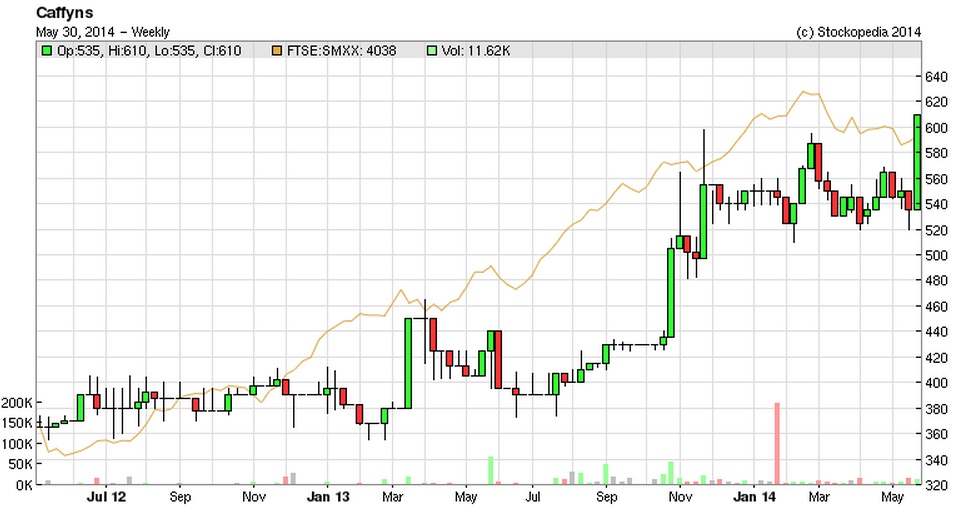
Results from this micro cap car dealership caught my eye first thing. The most striking headline number is that underlying EPS shot up from 37.3p last year to 75.5p for the year ended 31 Mar 2014, a 102% increase! So at 570p to buy at the open that put it on a PER of only 7.5, although I note that the shares are already up 40p to 610p to buy at the time of writing (08:12).
As usual with car dealerships, the profit margin is small, since large turnover is generated by new and used car sales. However car sales are very buoyant at the moment, and it's the follow on servicing work that is the lucrative part.
The total dividends for the year have been hiked 50% to 18p, which is very positive. That's a 3.0% yield based on the 610p per share buying price right now - not bad, considering it's rising strongly.
The main things I don't like are the net debt, of £11.9m, and a pension deficit shown at £11.4m at 31 Mar 2014. The deficit recovery payments are not onerous though, at £358k in the current year, rising 3.4% thereafter, so that looks OK - an irritant rather than a deal breaker.
On the positive side the company operates mainly from freeholds. Can I just say that it may be fashionable to regard freeholds as somehow "inefficient", and I often hear people say, "they're not a property company, so why do they own freeholds?". I could not disagree more! Personally I love freeholds, the more the merrier - mainly because they hugely de-risk investments. Banks will lend against them, even when the business is trading at a loss, so companies with freeholds tend to survive recessions, whereas their more efficient competitors go bust.
Also, why give away some of your profit to a property company? If you lease your property, then every five years the freeholder hikes the rent up (sometimes massively). That's a big drag on profitability over the very long term. So a company that operates from freeholds gets a bigger & bigger competitive advantage over time, as the cost of occupancy relative to turnover goes down rather than up, over the long term.
So often I will offset freeholds against net debt, since instead of paying rents you are paying interest on a mortgage. You also get the long term capital appreciation in the freeholds, again why give that away to a third party? I would much rather that companies I invest in capture that capital gain, on top of all the other benefits of owning freeholds.
Finally, freeholds often provide hidden upside in investments. So you suddenly find that someone bids for the company, based on doing a sale & leaseback of the freeholds, to help finance the deal. Many investors ignore freeholds, so if you invest in companies which have them, you're often getting that extra hidden value for virtually nothing. Why would that ever be a bad thing?!
Therefore, I don't care what anyone says, to me companies that own freeholds make better investments. It also tends to be a good indicator of prudent management, who are less likely to blow up the company.
Note that the freehold property had a net book value of £28.7m at 31 Mar 2013, and in today's statement the company says that;
A valuation of the Company's freehold premises was carried out at 31 March 2014 by chartered surveyors CBRE Limited on the basis of existing use value. The excess of the valuation over net book value of freehold properties...was £6.0m. In accordance with the Group's accounting policies (which reflect those utilised throughout the industry), this surplus has not been incorporated into the Company's accounts
So that takes the valuation of the freeholds up to almost £35m! Bear in mind that the market cap here is just under £17m at the current buy price of 610p. Net tangible assets were £17.6m, so add on the freehold property surplus of £6m, and you're at £23.6m, therefore the shares are trading at a 28% discount to net tangible assets.
Overall that looks a very attractive proposition to me - a decent discount to net tangible assets, mainly freeholds, and a decently profitable business growing strongly, on a sub-10 PER, plus a rapidly growing 3% dividend yield as well.
Downside risks include a slowdown in the car market when interest rates rise, and higher borrowing costs. The Director salaries look slightly warm to me, given the small level of profitability - the Board cost £885k in 2012/13, which means they took getting on for half the pre-remuneration profit of about £2.1m.
As usual this is not a recommendation, but merely a suggestion for further research. It ticks a lot of the boxes I like anyway, so is worth a deeper look. I'll do more thorough research on it over the weekend, this was only a quick review today.
Westminster (LON:WSG)
This is the first time I've reviewed this company's accounts here. Figures for the year ended 31 Dec 2013 are released today - are they serious? Five months after the year end?!! Late reporting is always bad, in my experience.
The P&L is poor, with turnover down a little to £7.4m, and a thumping loss of £1.9m. A breakdown is given for that, working back to £0.8m EBITDA loss before exceptionals, still not good at all.
The Balance Sheet would be alright for a profitable company, but given that this is loss-making, it's weak - with net cash of only about £50k. So who is going to fund any further losses? A small amount of cash (£300k) has been raised post year-end, from a strategic investor. Plus they are using an equity drawdown facility from Darwin, which personally I don't like.
The market cap of £28.6m at 57.2p per shares seems very much out of kilter with the historic figures, which would struggle to justify a valuation of more than a couple of million quid. Therefore people must have high expectations for the future.
The narrative is mainly about future expectations, and refers to a remarkable figure of £11bn as the lifetime value of their prospective customers. Personally I'd want to see the figures showing that it is a viable business before paying up for future growth. There's no sign of that from the historic figures, so it's a bargepole job for me I'm afraid.
Hargreaves Services (LON:HSP)
Hargreaves is mainly a coal distributor, but also distributes other bulk materials, and operates a few open cast coal mines in the UK (which amazingly, are profitable).
It looks like a mild profits warning. It's rather confusingly worded, as there is no overall group outlook, just by individual division. Three divisions are trading in line with management expectations, but the coal/coke production division is expected to fall short on profit by £3-5m for the year.
That doesn't sound disastrous to me, in the context of £46.4m forecast profit for this year, so perhaps a 10% shortfall? So it's still cheap on a PER basis, very cheap actually. If we reduce forecast EPS from 138.2p to say 125p, then at 791p the shares are on a PER of just 6.3. However, it is almost certainly moribund in terms of coal use inevitably declining.
Therefore it's likely to remain cheap, unless there is a complete change in Govt policy on coal, which is possible - e.g. Germany is building new, cleaner coal-fired power power stations. Dependence on Russian gas is a big issue at the moment across Europe. So I don't know, it might be interesting, but the shares never seem to go anywhere, so I sold mine a little while ago, as I felt the money could be better deployed elsewhere.
This is the problem with investing generally - there's an opportunity cost to leaving money sitting there in something that is dormant. Even if you know it's cheap, if nobody is interested in buying, then it can stay cheap for a long time, meanwhile you miss out on big rises elsewhere. Tricky.
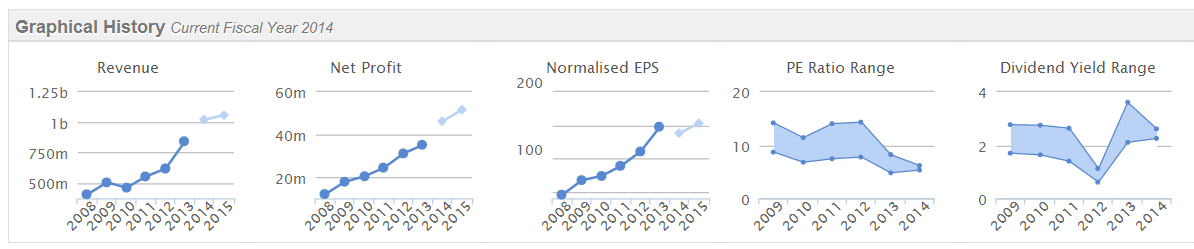
Mind you if you just looked at the track record, and ignored what sector it is in, then this share would be a no brainer! See these Stockopedia historical graphs;
Apc Technology (LON:APC)
Interim results for the six months to 28 Feb 2014 have been issued by this small distributor of electronics. It's looked very expensive to me in the past, but has delivered strong interim figures this morning. Revenue is up 32% to £12.1m, and PBT is up strongly to £761k. It also has net cash of £1.4m.
Looking at the divisional breakdown, the uplift in profit all seems to have come from a subdiary called Minimise. It might be worth looking into, to see if the profit growth can be extended.
Right, I have to dash, off to London. Have a lovely weekend & see you back here on Monday morning. No Bank Holiday thank goodness, I'm sick of them!!
Regards, Paul.
(of the companies mentioned today Paul has a long position in CFYN, and no short positions)
Disclaimer
This is not financial advice. Our content is intended to be used and must be used for information and education purposes only. Please read our disclaimer and terms and conditions to understand our obligations.

12 comments
Paul,
Excellent reports - been reading daily every day since I found you earlier this year - most importantly never stop stating your honest opinion regarding stocks, especially those 'story stocks' that may have considerable bulletin board holders with blinkers on.
Thought you may enjoy the following, it's the new fund from Terry Smith and as usual he is pretty funny in taking a side swipe at all the usual fund management practices:
http://feetplc.co.uk/docs/default-source/direct-investor---t-class-(1-amc)---application-forms/fs0514d_feet_owners_manual_v7_web_sprds.pdf
For the record I hold a small holding in the regular Fundsmith fund (my only 'fund' holding), otherwise I'm 90% trackers and 10% active/for fun/small caps/U.K equity.
I think Hargreaves Services (LON:HSP) may have more prospects than suggested. They have an engineering division that offers support to coal burners across the world, notably in India and China. They are also now involved in running down UK Coal, and could well snaffle some of their assets in the process. On top of that they have considerable surplus property holdings. Coal must have more of a future than is being suggested, though I am biased as I burn a lot of the stuff at home!!! If the price falls much further the yield will rise and make this quite attractive as a very long term punt.
(Thanks Paul. Great report as usual. Please don't take down your old site. I still look back at it regularly and learn from doing so. If nothing else it is proof of just what an astute young man you really are!)
Re freeholds, the "free rent" is at the expense of locked up capital, plus exposure to a market which is not their business. If the company needs to move the friction may be higher than renting (though sadly UK commercial leases are not a model of flexibility) so as to keep people in suboptimal premises longer than they should. Also while it obviously makes them more resilient, too much resilience can support complacency, so you can get a structurally loss-making operating business kept alive longer than sensible by the implied profits of the property side of the business, possibly until it's too late and the value of freehold gets consumed by the losses of the main business.
I'd rather see companies first reduce debt (to zero if need be), second negotiate better terms with their suppliers (prompt payments against discounts, should be popular), before contemplating entering the property business. These measures get you similar advantages regarding resilience -- you are in a good position to borrow a little bit starting from a low debt position, or to get your suppliers back to industry standard terms, if need be, without the distraction of running a little REIT on the side.
Paul,
From recollection when I looked the last time, I think there is something funny about Caffyns (LON:CFYN) 's preference shares, i.e. that unlike most preference shares they carry voting rights, and so give the Caffyn family much more control over the company that their %age of the ordinary shares would suggest.
I can't remember the details, but if you're going to investigate further you might want to take a look at this - I might be barking up the wrong tree, though.
Francis
Francis,
"I think there is something funny about Caffyns (LON:CFYN) 's preference shares, i.e. that unlike most preference shares they carry voting rights, and so give the Caffyn family much more control over the company that their %age of the ordinary shares would suggest."
Thanks very much indeed for this - you're absolutely right.
The Preference Shares have little financial impact, but as you correctly state, one class of the three types of Pref Shares carry voting rights, which give the holders a disproportionate level of control over the business.
This type of arrangement is very unusual, and frowned upon by most people.
However, in this case I can't see that the family are doing anything untoward, and their increasing the ordinary divis by 50% gives me considerable comfort. However, it should really be seen as a private company that happens to have a Listing.
Thanks again for flagging this important point.
Regards, Paul.
I like the story at WSG and also the fact that keep finding partners to put in additional equity - it implies that the partners believe the story. I met some of the Directors at the Investor Show and they were convincing. I wish the the non-airport business was higher quality with ongoing sales rather than being project based though!
Hi Paul,
APC - Looks good growth. I wonder if perhaps there might be a read across to PhotonStar LED? (the ones that blew you out of a visit at short notice last year !!)-- their new Halcyon range is due our in a month or two...
Have a good weekend !!
Mike
Re Hargreaves Services (LON:HSP) the shortfall was a production delay on the start up of the open cast mines and due to wet weather earlier this year. However, presumably the coal remains in the ground so it should be dug up in future. On the dividend it might not be that high but they have said they are going to bring the cover down dramatically so if they hit earnings forecasts then the dividend should increase strongly over the next few years as I wrote about on here earlier in the year and an update on my Blog today, if that is of any interest.
Website: Compound Income?
I could overlook Hargreaves remaining unfashionable if they paid a decent dividend. The current payout amounts to less than a sixth of earnings.
Paul
How do you hold free cash? Do you leave it as cash, or hold it in a liquid interest-earning fund?
I read in April that two of the largest remaining operational coal mines in the UK will close down within 18 months - Kellingley Colliery in Yorshire and Thoresby Colliery in Nottinghamshire. There will only be one deep coal mine in Britain by the end of 2015... How will this effect Hargreaves Services (LON:HSP) ?
re. HSP, perhaps it's a get rich slowly situation. Think I'll stick with them just now.
Cheers
Mike