Small Cap Value Report (31 Oct 2016) - SPL, POS, PPH, CTO

Good morning!
I can scarcely believe that it's November tomorrow. I was out cycling in a t-shirt yeaterday, it was so mild. Yet again we're having such mild autumn weather that it must be playing havoc with clothing retailers' attempts to sell us winter clothing. Mind you, the same thing happened last year, so the prior year comparatives this year are actually like-for-like in terms of weather. So any retailers blaming the weather for poor sales this year will be given very short shrift in my reviews here!
My newish Windows 10 laptop has an incredibly annoying tendency to switch itself off without warning when the battery has depleted. This happened today, and I lost the whole section below on SPL. After some swearing & ranting, I remembered the feature on Google Chrome which re-opens recently closed tabs. It worked - Chrome had saved my work! So top marks to Google, and a big fat raspberry noise for Microsoft, quite frankly.
I suppose the next factor for us to all worry about is the US Presidential election. What an absolute farce the whole thing has turned into. I'll resist the temptation to comment further. If the most powerful country on earth can only come up with these 2 appalling candidates, then something has gone very badly wrong with its democracy. America has become a laughing stock - I think they've got horrendous problems over there. Anyway, let's hope it doesn't end up affecting our portfolios, or more importantly sowing the seeds for WWIII.
Let's start today with announcements from 2 companies which have been lousy investments in my portfolio, and the lessons learned.
SKIL Ports & Logistics (LON:SPL)
Share price: 12.12p (up 15% today)
No. shares: 44m (before fundraising) + 376m new shares = 420m
Market cap: £5.3m before fundraising / £50.9m after fundraising
Fundraising & name change - the market cap has collapsed here to just £5.3m. It's been obvious for a while that the wheels had come off, and that all the previous assurances from management were hogwash.
The only surprise is that they've actually been able to pull off a further fundraising at all. So far, the company has partially built a barge loading & unloading port in India. It then ran out of money to complete the project, hence the share price collapse as people dumped their shares.
I dumped my shares too a while back, as it became obvious that things were going badly wrong. To my mind, the market cap had fallen to such a low level, that the Indians would have been hoovering up cheap shares themselves in the market, if all had been well. They weren't, so obviously things were not going to plan.
Also the company began to admit over the summer of this year, in its updates, that more funding would be required. Not a good idea to pre-announce that, and then spend months arranging the finance. As you can see from the chart, the share price dropped from c.55p to c.10p over this period, as people understandably bailed out, to await details of the new financing.
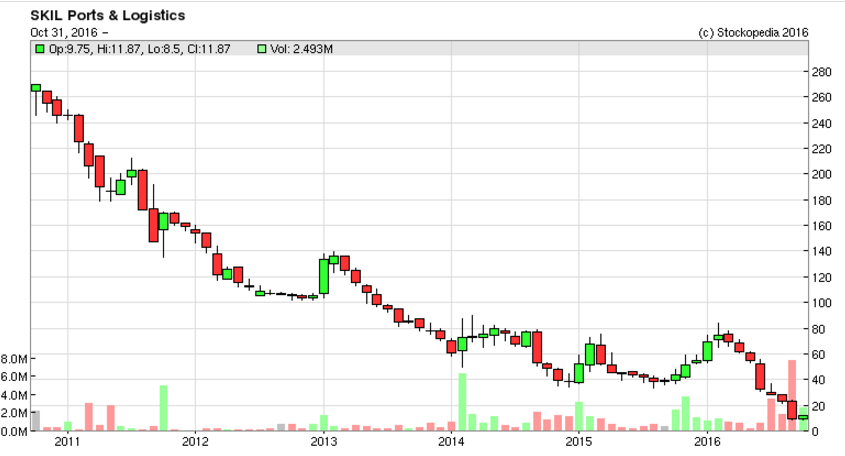
My opinion - as mentioned previously here, I suspended my usual rule of never buying overseas AIM shares.
Clearly that was a mistake. Although for speculative stocks I now tend to use a trailing stop loss at 50% below the peak. That's a very loose stop loss, but it's clearly worked in this case, getting me out at about 40p-ish (I can't remember exactly).
We've debated stop losses here many times, and it's an interesting discussion. Some people like them, others don't, I can see merit in both approaches. The key thing is to do whatever works best for you - and we're all different.
Generally I don't use stop losses, as it's a substitute for proper research. However, I have warmed to the idea of using stop losses for speculative stocks only. Since they are inherently very difficult to value, and the price is mainly sentiment-driven (rather than on fundamentals), then it makes sense to bail out once a speculative share has fallen out of favour.
That saved the day for me with SPL, and I can now decide at my leisure, whether to re-enter now that the project is being refinanced. On balance, I'm not going to give it the benefit of the doubt. I don't like management here, and they've made a hash of things so far. Therefore I imagine there is plenty of scope for more things to go wrong in future too.
Lessons learned - yet another AIM overseas disaster. Suspending my usual blanket rule of avoiding all of them, ended up being a mistake here. Plenty of people warned me, but I (wrongly) thought I knew best. Although in mitigation, I did stick to my 50% trailing stop loss, and chuck them out once that level had been reached. As it turned out, that wasn't much below my original purchase price, so the losses here were actually quite small.
Also, I think infrastructure building shares are nearly always a bad idea - projects almost always take much longer, and cost much more than planned. Therefore the initial financiers end up, as in this case, funding the difficult bit, only to be diluted to almost nothing when a further, distressed fundraising is required. Early stage investors should really be seen as donors, not investors.
Overall then, it's just further reinforced my aversion to speculative shares, especially when they are overseas & listed on AIM. The odds are so stacked against you, why bother to take the risk?
If however we do become beguiled by one of these speculative shares, a trailing stop loss could be a very good idea. It breaks the infatuation which can otherwise lead to 90%+ losses in our portfolios.
Optimists might say that SPL (which is changing its name to Mercantile Ports & Logistics Ltd) is now funded to complete the project, and that the difficult work has been paid for by the original shareholders. The key thing now would be to find out what sort of revenues & profits the completed project will be able to achieve? The valuation now is well below the construction cost, so if they do manage to complete the project, and assuming it becomes a commercial success, then who knows?
Plexus Holdings (LON:POS)
Share price: 58.6p (down 2.9% today)
No. shares: 105.4m
Market cap: £61.8m
(at the time of writing I hold a long position in this share)
Results for year ended 30 Jun 2016 - note the sloppy reporting schedule - it should not take 4 months for a small company to produce its preliminary results.
I last reported on this company back in Jan 2016, when the company put out a major profit warning for the year which is being reported on today. I guesstimated turnover of c.£12m, which tied in with a broker update at the time. The broker forecast a loss of £6.7m. Let's see how the actual numbers compare.
Key figures;
Revenues £11.2m - even worse than expected, and a huge fall against prior year revenues of £28.5m - that's a drop of nearly 61%, which is horrendous.
Loss before tax of £6.9m - versus a prior year profit of £5.9m. So pretty disastrous results, but the £6.9m figure is close to what was forecast, at £6.7m.
EBITDA - is less horrendous, as profit is stated after quite large depreciation & amortisation charges. So adjusted EBITDA is a loss of £1.6m (vs. profit of £9.5m).
Cash - whenever I see a company making heavy losses, the first thing I check is how much cash does it have left? i.e. is the company likely to go bust? Plexus has £9.9m in net cash, so it looks fine for now. Management had the presence of mind to strengthen the balance sheet when things started to get sticky.
Cashflow - it's interesting to note that the company was actually cashflow positive, due to modest EBITDA losses, and working capital unwinding (mainly a big reduction in debtors). It raised £16.9m in fresh equity too, which now looks a very smart move.
Dividends - obviously no divi is being paid, so no surprises there (prior year it paid 1.75p divis). The policy is to reinstate divis "at the earliest opportunity".
Outlook - Plexus doesn't do brevity, so its outlook comments run to 7 long paragraphs. Its comments mainly concern macro factors. To summarise;
- Current lack of oil exploration is sowing the seeds for a future supply crunch.
- Supply glut due to Russia & Saudi Arabia defending market share, "could quickly go into reverse".
- Demand for oil will continue to rise.
- Cleaner gas will be more in demand than dirtier oil.
- Plexus has cut its costs, in response to lower demand, halved workforce.
- Two capital raisings were well supported;
We view this as testament to the strength of our technology and the potential for Plexus to deliver significant shareholder value over the coming years.
My opinion - this share is obviously going to be closely tied to the outlook for the oil & gas sector, not my area of specialism at all.
As far as I can tell, Plexus seems to have very interesting technology, and between 2011-2015 the company was demonstrating strong profitability and growth. Therefore it seems reasonable to believe that profit should come surging back again when the oil & gas sector eventually normalises, and resumes a higher level of exploration activity. In the meantime Plexus seems to have adequate funding to ride out the downturn.
The trouble is, it could be seen as dead money, with an opportunity cost, leaving money invested in this company. Personally I only hold an absolutely tiny position here, which is just in a dormant account that I hardly ever touch. So it's not something that I have any conviction about really, and might chuck them out at some point.
Is Plexus worth £61.8m? Definitely not, based on its current performance, but of course the market looks to the future potential, not just what's happening right now. So it might be the case that, in a few years' time, if profits recover on a rising oil price, that it might end up looking cheap.
Overall, I think I'll probably chuck out the small long position I have here. After all, it's not really worth holding a tiny scrap of something. I should either bail out, or buy in more sensible size.
PPHE Hotel (LON:PPH)
Share price: 700p
No. shares: 42.2m
Market cap: 295.4m
Q3 & YTD trading update - it's been a while since I've looked at this hotels group. I quite like hotel companies, as you can check out what their properties are really like from review sites like TripAdvisor (taking care to sift out bogus-sounding reviews). Or visit the hotels yourself - a good excuse for a jolly! It has 38 hotels currently, mostly operating under the Park Plaza brand.
Lots of data is given on revenue, occupancy, etc, in both Q3 and YTD (year to date), which I must admit to finding a little confusing. So to simplify things, I'm latching onto the most important sentence, which says;
Based on the results to 30 September 2016 and the outlook for the final quarter of the year, the Board anticipates the full year results to be in line with its current expectations.
It's taken me a couple of hours to get up to speed with events over the last year, reading through RNSs, and the presentations on the company's website here.
Key points are;
30 Mar 2016 - refinancing of £87m debt, relating to the Park Plaza Victoria London hotel. 10 year facility, at a fixed rate of 3.41%.
12 May 2016 - refinancing of £182.4m concerning the Park Plaza Westminster Bridge Hotel. 12 year term. All bar £10m of the borrowings will be at a fixed rate of 3.8%.
16 June 2016 - refinancing of £294.3m of debt (relating to 2 London hotels, and all its Dutch hotels), for a 10 year term, and at very attractive fixed interest rate costs of 3.25% (London) and 2.17% (Holland hotels).
Given that PPH has a lot of debt on its balance sheet, I think these refinancings, onto long term facilities, at attractive fixed interest rates, is a very shrewd move. The company is now well insulated from any rise in interest rates, and inflation.
Put together, this resulted in it having surplus cash, and the company paid a 100p special dividend in Aug 2016.
Several new hotels are also under construction in London.
Interim results - I've had a skim through the company's figures for the half year to 30 Jun 2016. The figures are quite complicated, with lots of moving parts.
There was also a mild profit warning, due to delays in hotel openings;
"As we continue to invest in the quality and expansion of our portfolio with a number of renovation projects and new hotel openings, trading for the 2016 financial year remains in line with the Board's previous expectations.
However, due to slightly delayed hotel openings, for which pre-opening expenses have been incurred without a significant amount of revenue contribution to offset such expenses, the Board expects that this timing difference may result in the Group's results being behind market expectations."
(31 August 2016)
To my mind this is largely irrelevant. The share price measures the future value of the company. So a bit of a delay in opening a new site doesn't matter at all really, looking at it long term.
It did knock the share price down by around 100p, so I wonder if this might be a nice buying opportunity, possibly?
Property values - several of the RNSs referred to above note that the property valuations done for lending purposes, delivered valuations considerably above the book value on the balance sheet.
So there is an interesting angle here in terms of hidden asset values - i.e. the hotels could be worth a lot more than book value. Mind you, ultra low interest rates are inflating asset values, so once interest rates are rising again, then the capital value of the hotels is likely to reduce somewhat.
London market - another factor to consider is that the London market may now be becoming oversupplied with hotel rooms? That is alluded to in the narrative of PPH's interim results. Occupancy rates seem to be falling, even when one-off factors are stripped out, in their LFL comparisons.
Set against that, is that of course sterling devaluation should mean a boom in overseas visitors coming to London, which has already been reported in some stats.
There's the ever-present terrorism risk too, a real worry here for a portfolio of hotels that is quite concentrated on London, although it does have operations overseas too.
Rising costs - especially business rates and Living Wage are headwinds for London hotel operators.
My opinion - it's quite a complex company to analyse, with all the various refinancings, acquisitions, special divis, etc, going on.
In the past I've disliked the heavy debt burden here. However, refinancing that onto cheap, fixed rate, long term facilities, has drastically reduced risk in my view, and makes this share much more attractive. My key question is whether the new borrowings have any covenants attached? I wonder if any readers know the answer to that?
Management are clearly very shrewd, and like paying out divis, with a cracking 100p special divi being a lovely bonus for shareholders.
Overall, I quite like the look of this share.
T Clarke (LON:CTO) - bad news announced a few minutes after the market shut - financial irregularities have been uncovered at a subsidiary company. An employee appears to have stolen over £2.8m over a number of years. How on earth did that happen, and not get detected earlier? It clearly suggests that financial controls here are not good enough.
I am struggling to understand these comments from the company;
Investigations indicate that the incident is limited to DGR and does not impact the wider TClarke Group. Our findings to date suggest that if anything the Group's historic trading results and balance sheet net worth may be understated to the extent that any of the misappropriated funds are recoverable.
The Board believes that any necessary accounting adjustments in the current period are unlikely to have a material adverse effect on the Group's results taken as a whole and, overall, the Group remains on track to meet market expectations for the year.
Clearly more explanations are needed, as the above doesn't make sense to me.
I imagine this might knock 10% off the share price tomorrow, as it's a very unsettling development. A low margin business like this needs to have absolutely watertight financial controls.
All done! See you in the morning.
Regards, Paul.
(usual disclaimers apply)
Disclaimer
This is not financial advice. Our content is intended to be used and must be used for information and education purposes only. Please read our disclaimer and terms and conditions to understand our obligations.

24 comments
Paul
I think the comments from T Clarke mean that the fraud was perpetrated before anything was accounted for - i.e. the company lost sales / stock / money it did not even know it had. Hence if anything is recoverable (which must be unlikely) it will go straight on the bottom line. Looks very sloppy.
Cheers
My interpretation is different. The wording suggests to me that false invoices have been paid. That is, money has been paid out for goods and services that were never received. The invoices have thus been processed through the system and reflected in the financial statements.
In this case (if I may briefly put on my rose-tinted glasses), any recoveries made would directly benefit the bottom line and margins may improve now the fraudulent invoicing has ceased.
EC
I don't disagree. Effectively the fraud is already in the figures and had the fraud been avoided the figures would have been better.
Cheers
The thing about stop-losses is that they work if the price continues to fall: they are a trend-following strategy. They are an attempt to predict the future by looking at the past.
How often will it be the case that the price of a stock continues to fall after the stop-loss is triggered? If markets are efficient then this is a question about whether the mean return of the market is positive or negative in the immediate future. If the market return is negative in the near future then on average stop-losses will result in a net gain. If the market return is positive in the near future then on average stop-losses will result in a net loss.
This is a basic result from the MPT/CAPM view of the world. It assumes that the selling point chosen and the stock affected are effectively random (because the future is not known and is not predicted from the past) and we sum over all possible outcomes in the whole market.
As a corollary, if stop-losses are triggering often for you and in most cases protecting you from worse outcomes, then your stock selection/buying rules should be reviewed because you are fishing in a pool with negative returns on average (or equivalently, you are in a bear market).
The point I would make about stop losses is that they are fine for most companies but it tends to be a matter of personal choice rather than right or wrong. I do not use them because the companies I invest in are rigorously screened to ensure they are of the highest quality and will, almost inevitably, provide a decent but boring return over the long term, so temporary setbacks are not a problem for me as I am a long term investor. My strategy is based on the business of the company, not the share price so the only time I would sell a holding is when the nature of the business fundamentally changes for the worse which, in my experience, is quite unusual.
Some interesting views on stop losses. I used to set them only to be shaken out sometimes when the tree was shaken by the market makers. I now set an alert at a 10% loss on Stockopedia and this alerts me to look at the share and try to discover why it might have dropped. Sometimes I then sell and sometimes I decide to keep.
I also have a 'sold' portfolio which sometimes makes you feel good that you acted and sometimes annoyed with myself when it rises quickly after my sale. Hey ho, share investing is never dull and never an exact science.
Paul, best tweet I saw about the US election candidates:
The evil of two lessers.
Paul re PC switching off - Apple are no better. I have a MacBook which flashes a little warning top right but does not show if you are in full screen mode (at least I dont think it does - so easy to miss it). The concept of an audible warning seems a bridge way too far for these geniuses from silicone valley.
It's very difficult knowing when or whether to sell.
I recently bought Trakm8 Holdings (LON:TRAK) thinking it looked good value and it was well off recent highs. It has since dropped about 20% and IMO looks even better value, but with results due in a few weeks I feel a bit blind. Will the results be terrible (and is the insider trading, which doesn't happen!, dragging the price down) or will they be okay as indicated in the latest trading announcement and market sentiment is wrong, in which case I should be topping up.
If I used stop losses I would probably have sold by now crystallising a loss, but would be protected from further falls. But if results are okay it should bounce back.
I wouldn't mind this conundrum but I can't help feeling that news leaks out but doesn't reach us PI's until the RNS hits the screen. Am I just feeling hard done by?
Ditto!
have been in Trakm8 Holdings (LON:TRAK) for over a year to various degrees. I thought all was rosy when they placed additional shares at 330p that was oversubscribed, and was sitting on a very tidy profit, all of which has been wiped out. I guess a stop loss would have prevented this, but given that the price movements for this one can be significant, I didn't want to be stoplossed (?) out!
Paul has (rightly) been quiet on this share given the amount of trolling there is on other fora, and the frankly unprofessional personal mutterings of TW, but are you likely to comment on the results later this month?
Dave
Hi Dave,
Oh yes, I'll definitely rummage through Trakm8 Holdings (LON:TRAK) next set of accounts & do a detailed article here.
I just don't comment on day-to-day price movements when there's no newsflow, as it's pretty pointless - prices in illiquid small caps go all over the place in between announcements, as we know!
I thought TRAK's last update was a bit wobbly, and explained why here. So it's a share I've not held since June, and will wait to see what the results say before deciding whether or not to buy back in. I'm not keen on updates which say that they're expecting a stronger H2, as sometimes that fails to materialise & leads to a profit warning.
The share price has come down a lot, but I think that's because the market probably thinks it won't hit forecast earnings. The Stockopedia graph shows a dip down in broker consensus this month:
Regards, Paul.
Trakm8 Holdings (LON:TRAK
"It's very difficult knowing when or whether to sell"
I too am holding TRAK, bought at a price substantially higher than it is today.Unlike you, however, I am not, in any way, concerned by this situation. Whilst not expecting "mind blowing" interims next month, I am content in my anticipation of excellent Finals next summer.
Perhaps you are "just feeling hard done by" but please, DYOR
Like many others I like TRAK. The management has bent over backwards to present its case to private investors whether by presentations after its AGM or at ShareSoc events etc, and these presentations have been made available to wider audiences by easily accessible videos (many thanks to the PI film maker). I may be a terrible judge of character, and am not a technical expert, but the management come across as knowing their business and understanding the twists and turns of the markets in which it operates, albeit as one of the smaller players.
My main problem with TRAK is that there are no major shareholders apart from the directors - John Watkins (17.8%), Cowley bros (11.0%) etc. I would have much more faith in TRAK if there were a few solid long-term institutional investors like Liontrust, Schroders, or Henderson. If they have done their due diligence on TRAK, and decided to invest a sizeable amount so their stake is notifiable, then I could sleep a bit more easily.
The only institution with a notifiable stake is Hagreave Hale. According to latest shareholdings listed on TRAK's company website, HH has a 3.4% stake which implies that it has reduced its holding by 0.5m shares over the last year . Hardly a rousing show of confidence in TRAK’s future.
I must admit I always regard directors with large shareholdings as more significant than any amount of institutions as the directors, particularly founder(s), know better than anyone about the business and it is their personal money. However, I do tend to look out for Hargreaves Hale on the register as they are AIM specialists and, in many cases, tend to invest in the types of solid companies I am interested in as they hold them in their inheritance tax exempt funds. I am not implying that TRAK is a good investment at current levels but I would view the above indicators as being positive for the business.
I've been wondering lately if institutions use stop-losses, I get the impression they don't.
It's reassuring to find certain of them, including Hargreave Hale, listed as a major shareholder. But once in IIs seem to stick with a company that unexpectedly hits the buffers, regardless of a clearly disintegrating share price, I'm not sure why.
Paul,any view on recent float LUCE ,tipped in Sunday Dail Mail?
Hi Paul.
Good commentary as ever.
On the subject of SKIL Ports & Logistics (LON:SPL) , the last time I had any involvement with an Indian based company that changed its name, the company in question (Allied Deals/RBG Resources c.2003) collapsed with the auditors (PWC) resigning and the SFO (and I think the FBI for that matter) successfully prosecuting several of the Directors for fraud. Hopefully not an omen for this particular venture. The company wasn't listed but several banks and finance companies lost several hundred million USD in loans and receivables.
In terms of the use of Stop Losses, I have recently become a convert having read and digested the collected works of Robbie Burns (aka the "Naked Trader"). I'm not yet fully cured of my old habits but have become more ruthless in pruning stocks that drop more than 15% from the time of purchase. The hard part has been clearing out some very long term holdings (> 5 years) that are well down but have recently been showing signs of life.
One thing I have done is to set up a Folio on Stockopedia and whenever I close out of a stock position through a Stop Loss I notionally "buy" £1,000 worth of stock. So far, in the past 6 weeks this portfolio has fallen in value by about 7% (it would have fallen more but for a premium MBO of SWP (LON:SWP) that I missed). In the absence of these stop losses, this would have been the order of magnitude of my loss in my live holdings. Going forward, I may also use this "portfolio of ex's" to flag stocks to consider buying back into as and when any positive momentum returns.
Best,
Gus.
On the subject of stop losses, a word of caution if you are going to use them for small caps or illiquid stocks.
Give yourself a margin when you set the level you want to trigger the sale. Your dealer might not be able to get the price you have set, and because the market for this share is illiquid, he is forced to obey your instructions and sell it at best, which might be several percentage points below your limit. Especially when everyone else is rushing for the exit door.
Hi Ramridge,
Yes, that's a good point about stop losses being triggered by erratic trades.
I should have emphasised that I don't actually use automatic stop losses. Instead, I make a manual note of when a speculative share has dropped 50%, and make a decision to sell it myself. So I always like to stay fully in control of the actually trades, and not have a spread bet firm do them on whatever terms suit them!
Regards, Paul.
SKIL Ports & Logistics (LON:SPL) still not a buy IMO. They have proven beyond doubt that their RNSs cannot be trusted.
Honest TV
https://www.youtube.com/watch?v=16K6m3Ua2nw
That is a little bit brilliant, thanks for posting the link. Having said that, this year I read the history of the building of the Panama Canal and you will not believe how malevolent the US's role was, and also just finished the novel 'King Coal' describing working conditions in the early 20th century. It is sentimental and incorrect to suggest that 'in the past' the US was the greatest country in the world that its people were better informed and more moral. It has plenty of previous to be ashamed of, just like us.
"The past is a foreign country; they do things differently there."
Ref boohoo
Thanks for the mention of this share last year Paul - i have today bottled it and sold the lot at 124p - nice gain from the 24p i paid when you flagged up the depressed price last year. I try to run my winners nowadays but i can't bring myself to do anything other than cash in my chips at this valuation. Good news for for current holders is that invariably when i sell a share that has done well its not long before the price is 10-20% higher again :) (or 200% in the case of Easyjet not so long back!!)