Small Cap Value Report (5 Aug) - PEN, NARS, TNO, CPP

Good morning! Pennant International (LON:PEN 89p) issues its interim results for the six months to 30 Jun 2013. These shares have risen a remarkable nine-fold in the last three years (see chart below). Pennant supplies flight simulators for training pilots, and other similar services. The figures this morning look very impressive - turnover is up 38% on last year's H1, and pre-tax profit has risen from £755k to £1,140k, a 51% increase.
EPS is 3.31p, so doubling that to annualise it, that's 6.6p. At 89p that puts the shares on a PER of 13.5, which doesn't look expensive for that rate of growth. The key question is whether the growth is sustainable, and although the outlook section contains very little specific information, it generally sounds good (my bolding of the key sentence):
The order book provides good visibility through 2014 and beyond and during the period there has been significant on-going activity with a broad global spread of potential customers on a number of significant opportunities particularly in the defence and rail sectors.
In the defence sector these requirements range from basic training aids for ab-initio students to complex platform specific simulators, computer based training and virtual reality. In the rail sector there are major new opportunities relating to the provision of documentation and training for operators and maintainers of rail assets.
The pipeline is robust and active and the Group's good relationships with its customers and its strong balance sheet continue to provide a firm position from which to build and realise the opportunities arising.
Instead of all that waffle, I would have preferred a clear statement about where the company is versus market expectations for profits. Although it looks to be on track, as broker consensus is for 6.56p EPS this year, and that looks about right, as mentioned above.

The Balance Sheet is strong, with net cash of £1.2m, although I note that cashflow has been poor for this six months, with debtors ballooning to £5.8m. This is mentioned in the narrative, as being something they see unwinding in H2, so I shall be looking out for an improved cashflow & debtors picture with the full year results in early 2014.
I hold some shares in Pennant in my long-term portfolio, and will be sitting tight on them - whilst the shares are no longer in bargain basement territory, they deserve a premium rating given the excellent growth being delivered. I could see the PER rising to 15-20 without too much of a stretch, so that suggests 100-130p might be possible based on this year's earnings maybe?
Nationwide Accident Repair Services (LON:NARS 58.5p) has issued a profit warning this morning. H1 trading is expected to be turnover of c.£79m, and profit before tax of £1.4m. That's not good, since on checking last year's interims, they made profit of £3.0m on turnover of £92.3m, so it's quite a big miss.
The dividend is now under review, which was always an accident waiting to happen, as the 8.2% dividend yield indicated. Anything with a dividend yield of over about 6% usually has some sort of underlying problem in my opinion, so it can be dangerous to chase very high yields.
The shares have fallen 10.5% to 58.5p, which in my view is a fairly mild reaction, I think the shares should probably have fallen more, as a key support for the price (the big dividend yield) has now been kicked away. I don't like their Balance Sheet either, with a nasty pension deficit now showing. That would also inhibit the chances of a takeover bid being tabled by anyone, so it's difficult to see much upside on these shares. I might look at it again if they fall to 40p, but at this level they don't interest me.
According to the Scottish press today, shareholders in RSM Tenon (LON:TNO 1.65p) might be completely wiped out if an unsolicited approach by rivals Baker Tilly goes ahead. The last announcement from RSM Tenon struck me as sounding odd, and I did wonder if they had been pushed into putting up the for sale sign by their bank, and it sounds as if that is indeed the case. I hope no readers got caught on this one. If you did, then you need to stay behind for remedial lessons on reading Balance Sheets!
Investors have become too sanguine about highly indebted companies, as the Banks have been so lenient in recent years. However, now the economy is improving, expect more Banks to pull the rug out from underneath zombie companies. I think that is likely to drive an improvement in business for Begbies Traynor (LON:BEG 36p) at some point, but I don't know when. I'm mulling over whether to buy back into those shares?
Cash is king, so a net cash position is one of my top priorities for potential investment. A cash buffer gives companies time to sort out any serious problems, whereas highly indebted companies that get into trading difficulties are completely at the mercy of the bank manager, whose only priority is to prevent the bank losing money. At that stage, shareholders are largely irrelevant.
I have to mention CPPGroup (LON:CPP 23p). This share is a great example of the dangers of shorting. I dabbled with shorting a few years ago, but found that it requires a very different set of skills to going long, and in particular it requires an ability to suffer stomach-churningly nasty losses, before eventually being proved right. Sometimes it takes years for over-priced shares to come back to earth, so shorting also requires patience.
Anyway, shorting is not for me, and I haven't shorted any shares for years now. CPP demonstrates the dangers inherent in taking short positions. Have a look at the 12 month chart below:
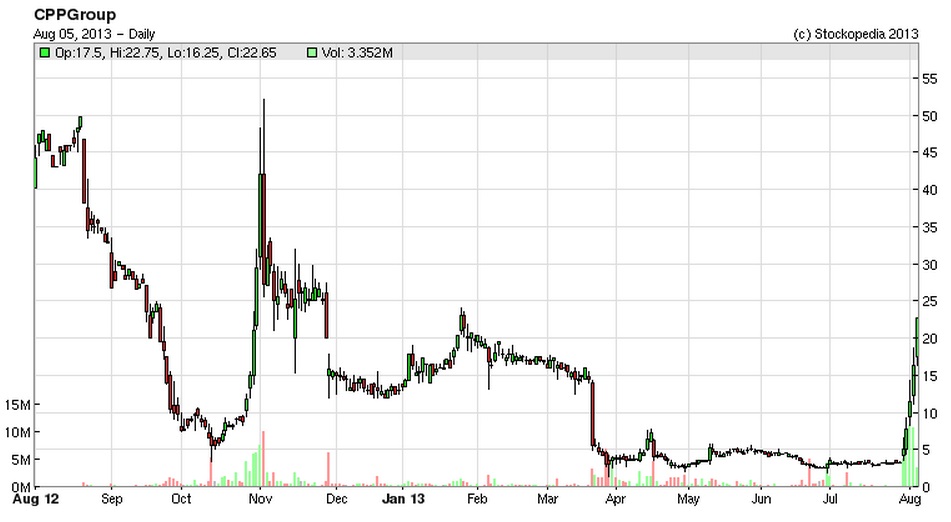
So there have been two massive short squeezes in the last year. The most recent one has seen the shares rocket from about 3p to 23p. This rise has happened because the company has been refinanced by its bank and other creditors. This is a very surprising outcome, as by any measure the company looked to be toast.
So anyone who had opened a short position of say £10k, thinking that it would bring them a risk-free profit when the company went bust, would now be sitting on a loss of almost £67k. Painful stuff. That's why I just don't risk shorting - as the losses are potentially unlimited. Whereas at least when you buy a share, you can only lose 100% of your money invested. With shorting you can lose many times your investment, as in the case of CPP.
I'll leave it there for today, as there's very little news in the small caps space today.
It will be interesting to see whether AIM stocks being allowed into ISAs from today will have much impact? Fresh money coming into AIM can only be positive for prices, so it's certainly a factor in supporting a bullish view for small caps.
Also, I see that the July services PMI data has been released today, and is very positive - the highest reading since 2006, so that reinforces my view that we are now firmly into an economic recovery, which should be good for earnings & hence share prices.
Regards, Paul.
(of the companies mentioned today, Paul has a long position in PEN, and no short positions)
Disclaimer
This is not financial advice. Our content is intended to be used and must be used for information and education purposes only. Please read our disclaimer and terms and conditions to understand our obligations.

13 comments
Hi Paul,
That's very useful, hopefully more people will take note.
Thanks very much for taking the time to write that.
Cheers
M
Hi MrM,
My pleasure, happy to help :-)
Regards, Paul.
Hi Paul,
For the people who aren't accountants, or are new to the site, could you give a quick summary of the problems at RSM (TNO), and how you'd spot them using the StockReport? (Or from the B/S)
Also, do you know any good books on the subject?
Thanks
Hi MrM,
You asked:
"For the people who aren't accountants, or are new to the site, could you give a quick summary of the problems at RSM (TNO), and how you'd spot them using the StockReport? (Or from the B/S)"
Sure. Companies only go bust when they run out of cash. So in an ideal world we would only invest in companies that have a significant net cash balance, and are generating more cashflow on an ongoing basis. Such companies should never go bust, as long as they remain cash generative.
Other companies borrow money from the Bank, to finance expansion, asset purchases, working capital, etc. That's fine as long as they don't borrow too much, and if they manage their finances well, then a certain amount of bank debt is good, because it should enhance shareholder returns.
The problem with £RSM is that they borrowed far too much from the Bank, and you can see that immediately from the Stockopedia Stock Report - just look at the top RHS, and you can see Mkt Cap of £5.6m, and Enterprise Value of £86.0m. The difference is net debt (since EV = MC + net debt).
For me, it's a warning sign if Enterprise Value is more than about 1.5 times Market Cap. In this case EV is over fifteen times Mkt Cap!
Next, you need to look at the most recent Balance Sheet. You can see that Net Assets are £40.5m. However, that includes £104.5m intangible assets, which should always be written down to nil (since they have no resale value). This takes us to a negative Net Tangible Asset Value (NTAV) of £64m, which is horrendous.
As a rule of thumb, I never usually buy any shares where the company has negative NTAV, which is a simple way of usually avoiding the worst investment situations.
Then look at the total net debt, which you can usually find in the narrative to the accounts, or calculate it manually, by adding up total interest-bearing Borrowings on the Bal Sheet, less Cash.
In this case, the narrative tells us that RSM Tenon has net debt of £80.4m. You have to consider whether that is a reasonable level of debt, for a company of this size and type? The key question is how will they repay the debt? So if the company was making say £40m p.a. in profits, then £80.4m in net debt shouldn't be a problem, as they would probably be able to repay it in several years, providing profits & cashflow are sustainable.
In this case, the company is trading around breakeven, it made EBITDA of £1.5m for the six months to 31 Dec 2012, and an underlying operating loss of £0.6m. Then there were £9.4m additional costs, taking them to a loss before tax of £10m for the 6 months. Clearly that's a disastrous performance, and if I were the Bank, I would be extremely worried that this company is not going to be able to repay its debt.
Remember that trading losses will generally increase the level of net debt, so a highly indebted company that is also trading at a loss, is the riskiest type of situation. Who is going to finance the losses? The Bank. So they are incentivised to take immediate action to shut down or sell the business.
Therefore we have already clearly seen that this company has dangerously high levels of debt, and that means the Bank will probably be looking for an exit. If the company has a credible turnaround plan, to return to decent profitability, then the Bank might go along with it. But in this case, the Bank must be worried that they are funding all the restructuring costs. In that scenario, they would be better off pulling the plug on it, it, and have the Administrator sell off the good parts of the business, and as the main secured creditor, the Bank will get the proceeds of the sale, and unsecured creditors & shareholders will get nothing.
So in terms of profitability, I tend to look at Net Debt of up to 1.5 times EBITDA as being acceptable. Anything above that, is in my view, getting a bit stretched.
You should also look at what Freehold Property a company has. Victoria (LON:VCP) was a good recent example of a company where I was initially worried about the level of net debt, but then discovered that it was more than covered by Freeholds. Banks like lending against readily saleable hard assets, like property, so will take a much more relaxed view if they have security like that, as it means the Bank should not lose any money whatever happens to the business, as they will get the proceeds from the sale of the freeholds.
That's not an exhaustive list, but it gives some ideas about how to assess whether a company has an acceptable level of net debt or not. I cannot understand why anyone would have bought shares in RSN Tenon, when its finances were so obviously a disaster. It's vital to do a proper Balance Sheet review for every company before buying it, as that will prevent any 100% losses in your portfolio.
Cheers, Paul.
Hi Paul,
Good response. :0)
Worth noting that those nice chaps at Stockopedia have conveniently provided a net debt line in the stock report. ;0)
Cheers,
Mark
Our local branch of Nationwide Accident Repair is a sweat-shop that goes all-out for throughput at the expense of quality. After a disastrous job they did for us, I would never use them again, still less invest. If they are now reaping the results of their attitudes to customers, I wouldn't be at all surprised.
Interesting thoughts on shorting Paul, and glad at least you don't dislike shorting for any misguided ethical reasons.
Good companies deserve to be bought up to value and bad companies shorted down to value in my opinion and thanks to the market for giving us the extremes and opportunity.
I never get why shorting is deemed as more risky than going long, apart from obviously the natural market tendency to drift upwards, and the unlimited losses thing.
Surely if you place the same thought, discipline and care when shorting as you do when buying value, i.e. large margin of safety, tight stop losses and money management there isn't a problem.
Just like you should never catch a falling knife when buying a share, surely you shouldn't catch a rising tide when shorting.
Yes some of the shorters at CPP have been caught with their pants down, but surely it's only the greedy or late coming ones who have got caught anyway? Just like when a share reaches it's peak and about to fall the best have usually long gone, or got in really early anyway.
Just my thoughts.
"Tight stop losses" don't really solve the unlimited losses problem with shorting, as they expose you to short term vol and temporary spikes (a new problem!) and don't save you from gaps (overnight or due to insufficient volume in session).
Borrowing costs are also a problem as they may spike when you don't want to or overwhelm the trade (borrowing cost > price decline).
Shorting is OK with options but that does limit the universe available as many stocks have no options available, or they are too expensive.
No.Call me a cynic but it seems to be a regular occurrence with TD whenever markets get busy.
Seriously thinking about moving my account.
On the first day of allowing AIM shares in ISA accounts, TD Waterhouse's website goes down.
Coincidence ?
Really enjoy reading the morning report, Paul. Would it be possible to have a quick glance at 'Powerflute Oyj' this morning?
Cheers,
Hi B2B,
I've had a quick look, but Powerflute Oyj appears to be a Finnish company.
I don't normally cover overseas companies which List in the UK, as to quote Mark Slater, "There is usually something wrong with them!".
Regards, Paul.
Powerflute has a sizable Smurfitt family interest, so I cannot see them pushing the company too far as it would impinge on the family business. It strikes me it may be somewhere the baby Smurfitts get sent to pick up the basics of the trade.