Small Cap Value Report (5 Nov 2014) - WIN, MNZS

Good morning! I am posting this early (the night before) because I want to give a quick last-minute update on;
Mello 2014 investor event in Derby, which is imminent, Thu-Sat (6-8 Nov). I'll be there for the whole three days, and I'll be doing my Small Cap Value Report live at 10:30 on Fri morning, in the lecture theatre at Mello 2014. So literally making it up as I go along, probably with a bit of a hangover, this could well be an embarrassing debacle, but what the hell, let's do it, it's only half an hour!!
Click here for the timetable of talks for the Derby event, which I am sure you will agree looks fantastic.
I understand that Thu & Fri are nearly full, but the Sat still has some places available. Therefore the organiser my good friend David Stredder has just emailed me to say that readers here can have a last minute special offer of Saturday only tickets for just a tenner. Use this discount code: MELLODAY-DISCOUNT on this link and select the 1-day ticket for Sat 8 Nov, which using this discount code will only be £10 instead of £49. Only for the Saturday mind.
The reason I am plugging this event is because it's going to be amazing - and as far as I know it's the first time a remarkably successful private investor has organised his own event of this scale, on a not-for-profit basis, designed from the ground up to bring together his most interesting contacts. The numbers are limited, so there will be great networking too, with numerous millionaire investors rubbing shoulders with fund managers & interesting small cap companies. So expect a somewhat smaller event than the London ones, but with great quality speakers & companies.
Of course, as with anything in life, there are always snipers, who want to throw mindless criticism and jealousy dressed up as cynicism, hiding safely behind false names on the internet. You just have to accept that, if you put your head up above the parapet and try to do something new & good, that the moaning minnies will snipe away. Well, who cares about that lot?! I certainly don't! You get a hide beyond rhinoceros thickness when you've been sniped at as much as I have, for various undeserved & irrational reasons, throughout life! Sod 'em!!! Let the good people prevail!
There is even superb quality evening music & entertainment organised at Derby by my brother! What more could one want?!
Derby is only 1hr 25m from London by train. I am so looking forward to this event, and hope to see many of you there. Would be good to see some midland & northerners there too, seeing as how they always complain investor events are usually in London!
I should have added that there is a date clash unfortunately, so Stockopedia won't be at Derby (although I will be flying the flag there!) as they were already booked to have a stand at the World Money Show in London this Fri & Sat. So for anyone who can't make Derby, then there's a good chance to meet the team in London.
Good morning! Ooh you can't beat a good rant! Talking of which, results from this company usually set me off, and today is no exception;
Wincanton (LON:WIN)
Share price: 140p
No. shares: 121.7m
Market Cap: £170.4m
I have no idea why anyone would hold this share. It has probably the worst Balance Sheet of any UK listed company, it's beyond bad, it's insolvent. Net assets are negative £268m, and once intangibles are written off that worsens to negative £369m! So it's clearly uninvestable with such a colossal deficit on the Balance Sheet.
Interim results - to 30 Sep 2014 are issued this morning. The headline figures look OK, with turnover up 1.6% to £550.9m for the six months, so a fairly substantial business. Underlying profit before tax is only £15.9m though, note that it's low margin, as you would expect for a logistics business. So if you ignore the Balance Sheet completely, then the shares look superficially cheap, on a forecast PER of 8.4.
Balance Sheet - this is where it unravels completely. Wincanton is clearly a zombie company - which is only able to continue trading because its creditors have given it extended credit.
Net debt has dropped from £87.2m to £66.9m, which doesn't look too bad, but I suspect that figure might be window-dressed for the year-end. Note 3 shows that interest expense was £13.9m last year, which if they are paying say 5%, means that average debt would have been £278m last year.
I've just spotted a note in today's accounts saying that average net debt for the six months ending 30 Sep 2014 was £141m. How is that debt going to be repaid? At some stage the bank will want that money back, yet Wincanton doesn't have the cashflow or assets to repay it. Freehold property is only £14.1m on the Balance Sheet, so there isn't really much asset backing here either.
Cashflow is summarised by a table from today's results, which reinforces the fact that the cashflows generated by the company are consumed by capex, debt interest & pension deficit repayments. These are six-month figures remember;
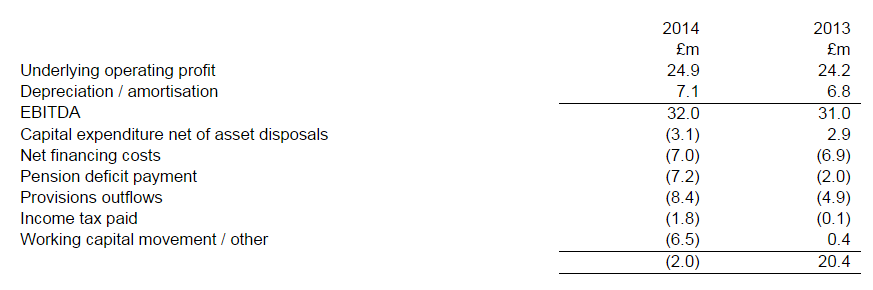
There is no scope to pay shareholders anything in dividends, so arguably the shares are really worth nothing.
Working capital - this is in very poor shape. Current assets (i.e. stock, debtors, and cash) total £232.1m. However, current liabilities (which I would have expected to be about £150-200m) are actually £339.6m. Therefore that is a very poor current ratio of 0.68 (where personally I consider anything below 1.2 to be weak, and certainly below 1.0 is getting into risky territory).
Trade & other payables - this is the figure which jumps out as being far too large, at £308.4m. Digging into the notes to the last Annual Report, it becomes clear in note 18, where the anomaly is £164.6m described as "Accruals and deferred income" (reproduced below).
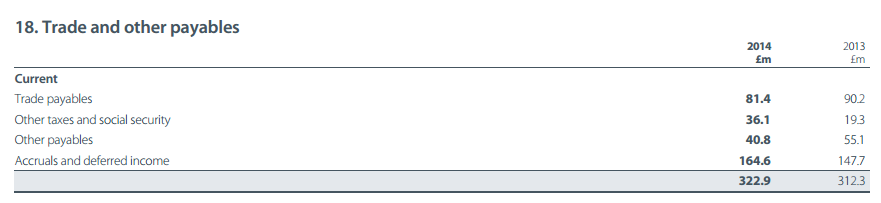
The double entry for this deferred income is therefore Debit: Cash, Credit: Deferred Income. Both are Balance Sheet entries, so cash is boosted by £164.6m, and the other side of the entry sits in creditors.
So in other words, the £164.6m represents the amount that its customers have paid up-front for services not yet provided. Wincanton is therefore financing its insolvent Balance Sheet through cash advances from its customers, combined with bank debt. That's an extremely risky proposition. What happens if those particular contracts where customers pay huge amounts up-front are lost to a competitor? The deferred income would unwind, and Wincanton would go bust, that's what! Or, its banks would have to take up the strain & extend very much greater loans to the company. It does have substantial bank facilities, which frankly makes me think that the bank have taken leave of their senses too. Bank facilities can be withdrawn at the drop of a hat if a company breaches its banking covenants remember.
Pension deficit - this is another nail in the coffin for the Balance Sheet. The deficit has risen to £143.6m, and requires £14.1m in annual cash over-payments.
My opinion - the only reason this company still exists, is to service its bank debt, and its pension fund. There are no dividends (they stopped in 2011), and the company has no scope to resume dividends, and is not likely to for the foreseeable future. A very large cash call to shareholders is inevitable, the only question is the timing.
I cannot over-emphasise just how bad this company's financial position is, it's one of the worst I've ever seen. Anyone buying these shares needs to think very carefully about the risk involved. It may be fine at the moment, with customers happy to pay huge amounts up-front, and the banks happy to lend against cashflow, but what happens if something goes wrong? All that financing could disappear, and if creditors pull out, then an insolvent Balance Sheet will implode, rendering the shares worthless. Why take that risk when you don't have to?
It's going on my bargepole list, which has established a very good record so far for correctly identifying problem companies, so my 35-point red flag warning system that I've been developing seems to be working well. It's particularly interesting that on 29 Jul 2014 I spotted the warning signs on the Balance Sheet of Synectics (LON:SNX) at 335p per share (they are now 155p per share).
John Menzies (LON:MNZS)
Share price: 364p
No. shares: 61.3m
Market Cap: £223.1m
Checking the archive here, I've never reported on this company before - possibly because it was a little too large in market cap, although a profit warning this morning, following a gradual decline in share price has brought it into my remit with a thud!
The company has two divisions, newspaper distribution (declining sector, doesn't sound very interesting), and aviation - which seems to be a range of services such as baggage handling, etc.
A quick review of the StockReport suggests that it's a mature, and low margin business. The generous divis are a stand-out feature, which has sparked my interest - if last year's divi is maintained, then the yield would be 7.3% - which is potentially good, but also worrying, as yields above about 6% often get cut, sooner or later.
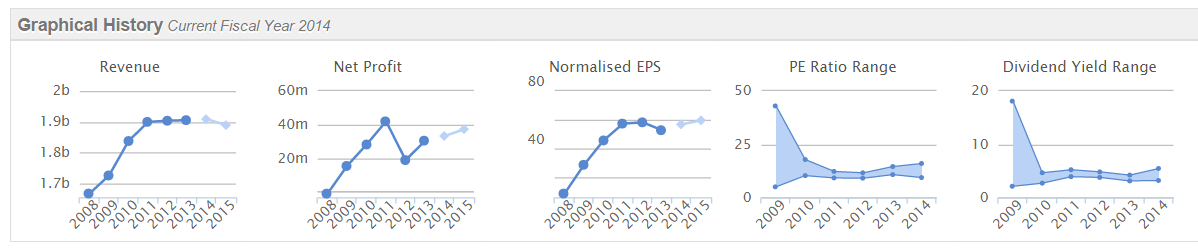
Here are the Stockopedia historic graphs;
Balance Sheet - oh dear, this isn't good. Looking at the last reported Bal Sheet on 30 Jun 2014, net assets were £83.8m, but strip out intangible assets and that turns negative by £37.9m. So weak, but nothing like as bad as Wincanton. What is it with logistics companies? Why do they have such ropey finances?
The current ratio is 1.04, not great, but not a disaster either.
Net debt - by my calculations it was £116.3m at 30 Jun 2014, which was about double last year's "underlying operating profit" - a bit higher than I am comfortable with, especially as the company has warned on profit today.
Pension deficit - a liability of £50m is shown on the Bal Sheet. It's a big scheme too, with £292.8m in assets, and £343.0m in liabilities. I'm trying to find out what the recovery payments are. Ouch, it's not good. In note 11 to the interim results overpayments of £13.1m were made into the pension fund last year. That's a big chunk of profits/cashflow being consumed by the pension fund - it was about a third of operating profit last year, not good at all, as that is real cash going out of the business.
Dividends - very generous in the past, but now trading is tougher, can they maintain the divis at such a high level, considering the pension fund is cash hungry, and the business has a fair bit of debt, plus ongoing capex requirements too. I think they are stretching themselves too thinly here, and would expect the divis to be cut at some stage if trading doesn't improve.
Profit warning - issued today, says that problems have arisen in their aviation division;
As previously communicated, in the UK we are managing a number of challenges. The significant changes at London Heathrow have substantially reduced margins which will continue into next year and to address this situation the UK leadership team has been changed.
It's amazing how many companies with weak Balance Sheets (like this one) claim to have a strong Balance Sheet! This worries me, as it suggests management are either deluded, or are being economical with the truth;
The Group continues to maintain a strong balance sheet, with positive cash generation which leaves it well placed to support medium term growth ambitions. However, contract wins in North America will raise our short term debt levels. Reduced earnings in lower tax rate jurisdictions will result in the Group tax rate exceeding 30%.
Memo from me to John Menzies: Having negative net tangible assets, and tons of debt means you have a WEAK Balance Sheet.
It's difficult to judge how overall group performance might be affected by this, as it's not very clear;
Overall, as a result of the above issues, the full year outturn for Aviation will be materially below Board expectations and they will also impact the following year. It has been decided that Craig Smyth, Managing Director of Menzies Aviation will leave the Board with immediate effect.
My opinion - Checking back to 2013 results, the aviation division made £37.8m underlying operating profit, so is the more important of the two divisions, since the distribution division made a smaller £24.3m underlying operating profit.
Therefore today's warning of poor trading in the aviation division for this year, and next year, looks fairly serious. I also dislike the comments about debt increasing, and the tax charge being unfavourable at >30%.
Overall therefore it looks a can of worms to me, so I expect there will be more bad news in 2015, with restructuring costs probably, and a likely cut in the dividend. For those reasons I'm going to watch this one from the sidelines, and am resisting the urge to chase the 7%+ dividend yield. The company's finances are not strong enough to maintain that sort of payout safely, in my opinion.
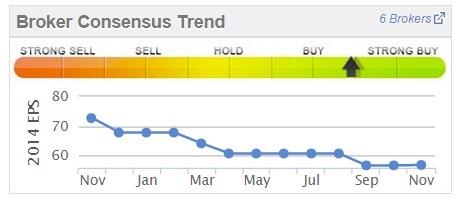
It's interesting to note that Stockopedia's great little broker consensus graph on the right, once again proved to be a good tell. After all, if the company is gradually guiding down analyst profit expectations, it means something is wrong! Hence the risk of a profit warning is greatly increased if you see this chart trending down - something to look out for.
All done for today, see you in the morning!
Regards, Paul.
(of the companies mentioned today, Paul has no long or short positions.
A fund management company with which Paul is associated may hold positions in companies mentioned)
Disclaimer
This is not financial advice. Our content is intended to be used and must be used for information and education purposes only. Please read our disclaimer and terms and conditions to understand our obligations.

38 comments
Hi everyone,
There is a really interesting article by S&P - here: http://bit.ly/11ggOYn
See the section on Financial Leverage (pg.5) which suggests that "lowly-geared companies beat highly- geared ones by about 1% per annum (p.a.), but this outperformance is unremarkable vis-a?-vis the reduction in return volatility (by about 3% p.a.), which may imply that lower indebtedness offers companies downside protection."
The article also notes that "further analyses suggest that low gearing is not always associated with higher-profit companies. In fact, in calmer markets, companies with less gearing often tend to lag behind those with high gearing, but they usually prevail in financial downturns, as their “safer” characteristics come to the foreground."
.....just food for thought
Alex
Morning Paul,
I think you underestimate the value to us punters of the rules you use. Things you may take for granted will be like gold for new investors.
For example all of my screens now have the rule
Net debt < 3 x operating profit
That rule was inspired by a comment in a scvr last year.
I understand that:
1) at present it might not be possible to implement all of your rules
2) that you might want to maximise the commercial opportunities by keeping them close to your chest for now. I understand and respect that. It could well be that you are having commercial discussions with Stocko or that the book is taking shape or that you have a researcher working with your ideas.
If 2 isn't an issue would you consider publishing the list and letting it develop over time as you do with your barge pole list (which I also considered as a potential list of short candidates)?
Whatever you choose to do I want to say thanks again for your efforts.
Warm regards
Phil
Paul,
I'm sure I'm not alone in being very interested in the 35-point red flag warning system that you mention you are developing.
Might you be able to publish that at some point?
cycle,
I keep finding more red flags, so by the time I'm ready to publish it, my red flag system could easily be up to 50! I'm going beyond just accounting ratios, and looking for things in the text, and behavioural patterns that conmen find irresistable.
I'm getting more & more cynical about AIM and small caps generally in the UK, in that I don't think you can rely on the accounts to anything like the extent people think you can. So basic management honesty is the number one prerequisite that I'm looking for. That is sadly, and disgustingly lacking in many cases.
More to follow. My ideas on this are gestating well. The Bargepole List is proving itself pretty well I think. So let's keep going with that, and see what happens!
Regards, Paul.
I am reluctant to challenge Paul as he is far more experienced and knowledge than me, but I feel compelled to do so. I agree the balance sheet is terrible but the company is trading well and it is cheap. A lot of their contracts are long standing arrangements and there is new business so the bankruptcy risk seems low.
I am not surprised at the high quality ranking. Stockopedia clearly state: "We heavily weight the F-Score given it's effectiveness, especially amongst small caps", Wincanton has a F-Score of 8 (out of 9) so this explains the high ranking. I guess the logic is that while a weak balance sheet is a risk factor this does not matter so much if financial health is.improving. This makes sense to me but obviously I'm in the minority here!
Out of curiosity, I've run a screen to see which other listed companies are in negative equity. There were 79 and I was quite surprised with some entries on the list, These include BT, Rightmove, Jimmy Choo. De La Rue, and Topps Tiles. Does anyone think these companies are on the verge of bankruptcy?
Disclosure: I am long on Wincanton
Hi Mechanical Bull,
Please do challenge me on anything - I very much welcome two-way discussion, and encourage bull and bear views in every stock.
The issue for me is risk. If something goes badly wrong at a company like Wincanton (LON:WIN) then its dire Balance Sheet could easily result in the company going bust. Why take that risk, when there are hundreds of other companies you can invest in which have far stronger finances, capable of withstanding significant problems?
Also, there is effectively zero chance of being paid a dividend on your WIN shares, for the foreseeable future. So why would you want to hold them, when you can get a 4-5% dividend from other companies. Or a 7.3% dividend (which might be cut) on John Menzies (LON:MNZS) the other (similar sector) stock that I covered today.
Each to their own, and it's your money, but I cannot see any attraction at all in WIN shares, once you consider how dire their financial position is.
Regards, Paul.
If one is using the Stockopedia ranks to select companies for a portfolio, perhaps one should add a screening rule that each company selected must pay a non-zero dividend, even if that dividend is very small. That would exclude companies such as Wincanton which are unable to pay a dividend due to their poor financial positions and which therefore have a greater than average risk of going bust (in Paul Scott's view), and would perhaps make the portfolio perform better in the long run.
Hi pka,
Good idea. The StockRanks are not designed to be a panacea, but have been back-tested to produce very impressive results for a whole portfolio whose components all have high StockRanks. Some will do badly, or even fail, but the whole portfolio should out-perform. That's the thinking behind it.
In my view (which chimes with what you said) more screening is needed to eradicate financially distressed companies such as Wincanton (LON:WIN) . Eliminating zero dividend companies is not a bad idea at all, although sometimes failing companies continue paying divis until a very late stage, as management don't want to upset shareholders until they have no choice.
You can screen on plenty of other criteria, such as net gearing, PTBV, etc, so the screening tools here give plenty of flexibility to take high StockRank shares as the starting point, and to then filter out ones that you don't like.
Regards, Paul.
Sigh. I dont see what the big deal is. The quality score is what it is and is formulated from the Stockopedia's team research into the financial research.
You have Altman, Beneish and Montier C Score to help you weed out the duffers. WIN and tons of the other dross just doesnt even appear in my screens so I save hours of pointless research and more importantly tons of money. In fact the three screens I use day in day out, typically only generate a handful of stocks and I go on to weed out those without good price momentum.
I would say that Stocko could and probably should look at aggregating as much of Paul's balance sheet checks into another ScottRank (TM) as that would be potentially be another useful tool.
My twopenneth
Phil
Paul, thanks for your regular in depth analysis of the financials; for me it's educational. The Stocko ratings have helped me identify stocks but I do tend to give them too much weight. For WIN even the 'Q' is 80 based on a reasonable ROCE & F score of 8 BUT with a low Op margin of 5%. Only the 'Z' score gives the game away. Presumably the Bal Sht detail is left out as all the Stocko calcs are done on std figures fed into a model each day & time is of the essence. Bit like looking at the EPS & ignoring cash flow & the expenditures , capex et al.
This has certainly been a 'wake up' for me to dig even further into a companies background.
Thank you , you will I am sure ,have saved me from some losses in the future.
Antony G.
How was Wincanton able to reduce borrowing costs by refinancing its debt at a lower rate if the company has such a weak balance sheet?
Surely a lower rate of borrowing reflects a lower rate of default?
Hi Paul,
Agree with pretty much all of comment on inconsistency between your analysis and the Stockopedia ranking. Personally not invested in Wincanton but in 2014 Annual report KPMG auditors appears to give it a clean audit report. How is that possible given that the business has negative net current liabilities of £95 m and Net liabilities of £250m (both of which increased in the interims!)? Should there have been some reference to 'going concern' in the audit report?
I think it is shocking that a company with such a weak balance sheet as Wincanton should be given a Quality Rank of 80. I will put some feedback in to request that Stockopedia review how the Quality Rank is calculated.
I think it can be argued that there is a fundamental flaw in the construction of the StockRank if a company which has an insolvent balance sheet is not picked up. Surely the fact that P/BV is negative should come up as a red-flag and impact the Value ranking.
Perhaps a negative Altman Z score should be more prominently highlighted.
On the face of it you can look at the StockReport for this company, see a whole set of green flags and read into this is a relatively safe investment.
Hi OldSchool - yes, I think there are a few glitches with the software engine. In the screening facility, there are two parameters available, P/B and P/TB. If you try and filter either for negative values, you get nothing. But I am happy to be corrected by the Stocko analysts.
Paul- Just come across the event in Derby am hoping to be there as I am 15mins down the road
Paul - Re. Wincanton (LON:WIN)
Stockopedia's assessments are fairly transparent (with some geeky background if you want it) but I am not sure the exact calculations for the rankings are given (Ed will doubtless put me right on this).
An interesting remark on QualityRank says "NB. It should be noted that the QualityRank is very specifically designed to be 'predictive' rather than 'descriptive' of future returns."
Re. WIN. Like many others, I was gobsmacked to read the disparity in analysis between Paul's and a StockRank of 99.
I think the main difference comes down to the balance sheet valuation. To Paul, a negative Book Value and negative Tangible Book Value are show-stoppers. Such a share is basically uninvestable, period. And I concur, especially in today's market which punishes any share that doesn't have a relatively strong b/s.
There are a couple of early warning signals in the StockReport. In the tabulation on the top right hand side titled Valuation, there are two entries, Price to Book Value and Price to Tangible Book. When both show no values and only 'n/a', then it invariably means that BV and TBV are negative.
Regards
Like dasv above... embarrassed... as I too saw things exactly the same way. I console myself by knowing that I have just exchanged a small loss in closing my position for an excellent lesson from Paul in how to really read a balance sheet! Now that's a good investment!
It's also interesting to compare Paul's view with the tips in the Investor's Chronicle. Guess what? Wincanton rated a Buy today. As was Earthport a week or so ago, both companies on a long bargepole list!
Yes I agree, I had some Wincanton but sold after reading this article. It has done OK for me up about 30p this year. I'm really going off IC tips, even ST has come a cropper this year.
I would echo other comments re: WIN's stock rank of 99
Do note the Altman Z score distress rating of -2.17 (distress).
I think the stock rank should perhaps include balance sheet (incorporate z score or something).
I had bought the stock recently but dumped on reading your analysis (embarrassingly - I had missed the extent of the balance sheet woes. - I just thought they were in debt, had reduced financing costs and that this would improve their margins, the debt being paid off quicker). When I realised the actual risk the company is operating under, I dumped the stock. Better to take a small loss now rather than take a large loss later.
Hi Paul - excellent write-up on Wincanton. I'd also be interested in Ed's views on the StockRank valuation. This should be a salutory lesson for anyone simply relying on the screen numbers without having a close look at the balance sheet.
Wincanton: Headline numbers are all positive. CEO quote ""These results represent another solid half of operational and financial performance...." so it all looks very good! However as you have ably demonstrated the company has serious issues. Your applied analysis is precisely the sort of story which should be included in your first investment book! I trust that you will consider the idea.
Hi Paul - have a smashing time at the Mello event. Those who criticise are like mosquitos, nothing to contribute but live off others life blood.
Best, Ramridge
Hi Paul
I think you make a very interesting point re the apparent inappropriateness of WIN having a high stock rank whilst its B/S is weak as reflected in an Altman Z-score of -2.17
As you will no doubt have noticed, most car dealers also have low Altman Z-scores, albeit nowhere near as low as WIN. For example, CAMB, who are presenting at Derby on Friday, has an Alman z-score of 1.20. AIUI any company with a Z-score less than 1.81 is viewed as being in distress, However, I don't really see too much sign that CAMB is in reality distressed. Thoughts welcome, perhaps after the presentation.
Regards, Martin
Thank you for a really interesting analysis of Wincanton (LON:WIN). Really educational. What an inappropriate EPIC code unless one is short the stock. Which leads me to two questions:
Why does Stockopediaa not allow you to comment on stocks you are short but it does on stocks you are long. Purists might say that being long is an investment but being short is a bet but if you have done your research then surely both are reasoned investment decisions which would be of interest to your readers?
Secondly if you had shorted all the stocks in your barge pole list when they joined would you have made money?
Enjoy Mello. Bought tickets but can not be there.
slightly off topic but related to the most recent webinar. Where do the estimated dividend numbers come from? The company or the broker? Looking at Finsbury Food (LON:FIF) the dividend shows 1p this year and 2.5p for 2015 (a massive increase) - I can't find any reference to the 2.5p in the company statements.
So you're undecided about Wincanton (LON:WIN) then Paul? :-)
See you in Derby. Just a shame that work pressure means I can only make the Friday afternoon and most of Saturday.
Steve
Shockingly Wincanton (LON:WIN) has a Stockpedia StockRank of 99! It also passes 5 buy screens.
Hi Webpax,
Indeed, I just cannot understand why Wincanton (LON:WIN) achieves such a high StockRank. I've queried this with Ed at Stockopedia. I think it emphasises that we need to do our own Bal Sheet testing, as only the Altman Z-score really looks at financial strength. In my view this issue is a gap in the Stockopedia system, and not enough emphasis is placed on the simple (but vital) issue of whether a company is solvent or not! There again, that creates a gap for me, since I focus very closely on that issue in my reports.
Regards, Paul.
Agreed Paul, I very much value your in depth analysis.
Looking forward to Derby - although i'm taking the bus!! It should be a great event.
Wish I was going, it's where the family and in-laws are from!
Enjoy the seminars, enjoy the many, many, good pubs and beers in Derby (the Alex by the train station will be a great start for many of you).
I look forward to (being one of many) buying you a drink on Thursday night - just to ease the thought processes on Friday, you understand!
David has done a great job.
Hi Paul, sounds like you've got the right attitude towards the trolls, you must know some of us appreciate what you do. Thanx for all the helpful advice. S
yes very informative reports and good educational value too. and humorous. whats not to like :)
audio casts work well too very interesting and informal approach.
Have a cracking time at the Mello event.
Sorry I can;t be there.
Cheers
Mike