Small Cap Value Report (6 Aug 2014) - IND, JPR

Good morning!
Indigovision (LON:IND)
Share price: 477.5p
No. shares: 7.6m
Market Cap: £36.3m
There's a trading update today covering the year to 31 Jul 2014 from this high-end CCTV over IP company. It's really a software & video compression company above all else, with the hardware (cameras, encoders, etc) being the devices on which their software is sold.
Note that the company has very sensibly changed its bizarre 31 July year end, to a 31 Dec year end, so the results to 31 Jul are actually a second set of interim results, and the full results will be for the 17 month period ending 31 Dec 2014. The problem with the old 31 July year end was that it was so difficult closing sales, as many clients would be relaxing on a beach somewhere, not signing off purchase orders. This led to erratic results which were highly dependent on whether individual orders happened to fall into the current, or the next financial year. So the new 31 Dec year end should give more predictability to results, and will tie in with most client year ends too.
Positives
- Revenue for the 12 months to 31 July 2014 exceeded £37m, more than 15% higher than the previous 12 months, and in constant currency over 20% higher.
- All major regions have reported year on year revenue growth.
- Gross margins were marginally ahead of the previous year (good, as some investors have questioned whether the company's high margins were sustainable)
- Before foreign exchange movements, operating profit will be around £2.7m, approximately 50% higher than last year
.
Negatives
- Profits were affected by sterling strength against the US dollar (in which the majority of the Group's sales are denominated)
- Overheads were increased by approximately 15% as IndigoVision continued to develop global sales and distribution.
- The share price has fallen 6% this morning, so clearly investors were expecting more.
.
Personally my take on things is that I was hoping for a slightly better profit figure. The operating profit result of £2.4m was blunted by currency movements to a greater extent than I anticipated. So in the back of my mind I was hoping for a £3m+ figure.
However, underlying sales growth of 20%, and underlying profit growth of 50% are not to be sniffed at, especially when you consider that this is entirely organic growth.
Valuation - at £36.3m this company is not aggressively valued at all, in my opinion. Especially now it has revamped its product ranges, and re-established a market position that had been suffering from strong competition. I meet with the CEO every six months, and he's improved the company on every front - new products, better processes (e.g. a much faster & better managed development process for new products), better marketing, selling on quality & features rather than price discounts, etc.
Cash - should be building up again on the Balance Sheet - remember that the company paid out its surplus cash to shareholders in a 70p special dividend a few years ago, so Directors certainly have a shareholder friendly outlook. So it's good to see the company's performance improving, with hopefully more to come.
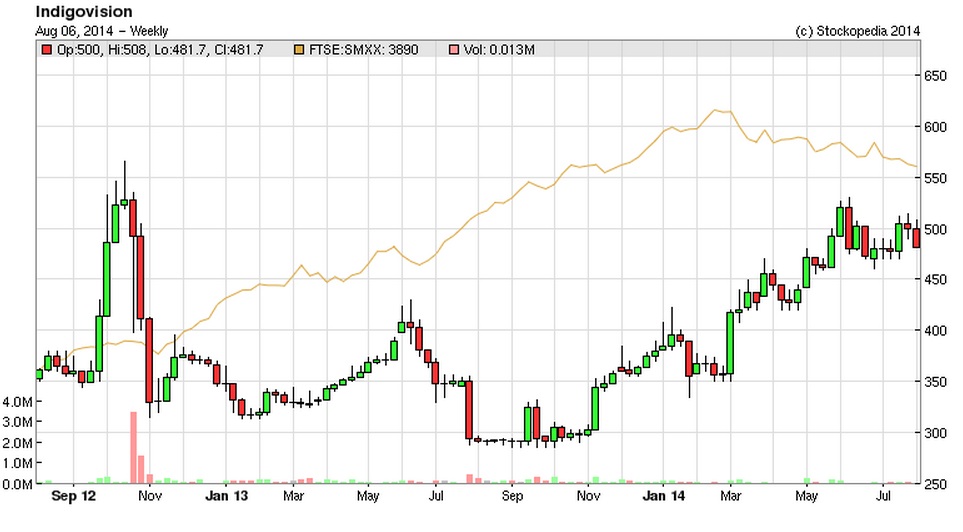
Share price - The shares are close to a 12-month high, as investors anticipated good performance from the news section of the company's website (it doesn't RNS contract wins) - which explains why the shares have slipped back a bit today. The currency impact was greater than I anticipated, but apart from that the figures look good to me. I'm not overly concerned about the impact of currency movements, as it's swings & roundabouts in the long term.
Still a good share price performance given how weak small caps have been in recent months - most small caps have been going down, this one has been going up;
Johnston Press (LON:JPR)
Share price: 4.14p
No. shares: 5,294m
Market Cap: £219.2m
I've been extremely bearish on this company for several years, maintaining that the shares were worth zero because the company was in decline (being a newspaper group), and that its cashflows were only enough to service its debt interest and pension fund deficit payments. No dividends were likely to ever be paid, hence the company would eventually just wither away to nothing.
However, it's become more interesting since they managed to get away a big refinancing in May-Jun of this year. So £140m in fresh equity was raised in a deeply discounted Placing & Rights Issue. Plus £220m was raised in a new bond, the monies being used to repay historic debt.
So it's now a question of trying to work out if they have a viable business or not? So looking at each piece of the puzzle in turn;
P&L - As with my previous coverage of Trinity Mirror, the operating profit margins on newspaper groups are remarkably high. In H1 of 2014 Johnston Press made £27.8m operating profit on £135.8m turnover, so that's a remarkable 20.5% profit margin. It's very unusual to find such a high profit margin in a sector that is arguably in terminal decline. Although margins are being maintained by stripping out costs - which inevitably means that the quality of newspaper content declines, which in turn won't help circulation stabilise in decline, let alone grow.
Business model - Profit is susceptible to changes in energy prices, and newsprint prices in particular, but for the time being there is a very nicely profitable & cash generative business here. How long will it last though, before circulation dries up to a point where there is no viable business left? 10 years maybe? Maybe a little longer, who knows? As the Evening Standard has shown, moving to a free distribution model can dramatically increase circulation, and hence advertising revenues, so my hunch is that newspapers in cities may survive much longer than people expect, but only if they move over to being given away at railway stations & other high footfall places.
Digital? - Newspaper groups are making a big fanfare about their digital content, but in my opinion it's difficult to see anything viable at either Johnston or Trinity Mirror on that side of things. Digital advertising revenue at Johnston rose 23% in H1, but that was not enough to offset even half the decline in print advertising. So the jury is out on whether this is a viable part of the business, or just staving off inevitable decline. Certainly at Trinity Mirror, their scatter-gun approach to digital under Sly Bailey was just throwing good money after bad, with no strategy or insights at all.
Cashflow - If we assume that Johnston can maintain the £27.8m H1 level of operating profit for a few years (which is being very ambitious, given that circulation & ad revenues are in structural decline), annualise that to say £55m p.a., then this will have to service tax, debt interest, debt repayments, and pension fund deficit recovery payments. Anything left over might be able to pay a dividend.
In today's statement it says that interest payments will now be about £20m p.a., so that uses up over a third of the operating profit of £55m, taking surplus profit to £35m p.a. Take off say 20% tax from that, and we get down to £28m p.a.. The pension deficit (of £86.9m) requires just over £6m in cash p.a., which reduces the surplus profit down to about £22m p.a.
Net Debt - The trouble is, after the recent big fundraising, the company still has £181.6m in net debt. So they will need to make serious inroads into that debt over the next 3 or 4 years, otherwise they're never going to be able to repay it once circulation & ad revenues have fallen further, as seems inevitable they will.
Dividends - Therefore I am struggling to see how this company will ever be able to pay any meaningful dividends. It seems to me that it will be a major uphill struggle just to reduce, let alone pay off the still enormous debt pile, and with the additional drag of the pension deficit recovery payments, I doubt there will be much, if anything left over for shareholders.
Property - this could be the wild card, with some valuable city centre property assets on the Balance Sheet, so to my mind you couldn't value these shares at anything above zero unless you have carefully valued the properties - if they are worth multiples of book value, then it might just about stack up?
Overall though - just look at the Balance Sheet - it's still terrible, even after the refinancing!
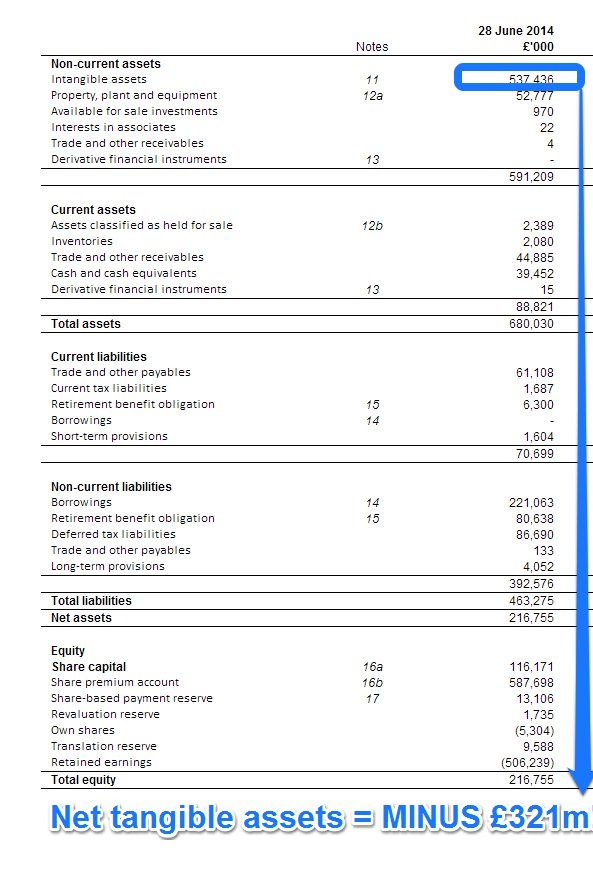
My opinion - Clearly the company is in a much better position now than it was before the refinancing, but it's only gone from a catastrophic situation to a very bad situation. All the cashflow is going to be needed to service the debt & the pension fund, for many years to come. By that time it's possible there won't be very much profit being made, when circulation has shrunk below a level where it might be viable.
So overall I think it's just a gamble on them managing to create something viable on the digital front? I can't see any meaningful signs of much happening on that front either, so for me this one remains on the bargepole list. I think the most likely outcome is a very slow, lingering death.
The market cap of £219m looks ridiculous to me, given the very weak financial position, absence of dividends, and structurally declining business model. It amazes me how so many investors just seem to blithely ignore terrible Balance Sheets at the moment. Certainly the investors who stumped up the new equity here seem to have some very strange ideas about risk/reward.
I shall sign off now. See you tomorrow morning, should be a bit earlier for the rest of this week as I'll be back home after a few days away.
Regards, Paul.
(of the companies mentioned today, Paul has a long position in IND, and no short positions)
Disclaimer
This is not financial advice. Our content is intended to be used and must be used for information and education purposes only. Please read our disclaimer and terms and conditions to understand our obligations.

8 comments
I agree with Boltonreddave, create your own space to publish this stuff, it looks valuable though.
Hey,
FWIW, I think JPR's was the 'first round'. A second round will be necessary and maybe even a third. If the company still exists at that stage, it may be investible.
Hi FreakNomad,
I agree with you. Johnston Press (LON:JPR) clearly still has a dire Balance Sheet, so will need to raise more equity at some point in the next few years.
Apparently management tell a wonderful story. It's astonishing that they have been able to refinance it, who on earth in their right mind would pour fresh money into that black hole of a Balance Sheet, for such an obviously declining business?
P.
AIM Prospector,
Nice to see your comments but i do think that you would be better off setting up your own page on Stockopedia rather than riding Piggy Back on Paul's page. The comments on here should be about what has been mentioned in the post. Set yourself up and I will look forward to reading both posts each lunchtime.
Dave
The news from Indigovision (LON:IND) this morning is further demonstration of how correct the board was in late 2011 to turn away a 265p bid from the company's founder and his private equity backers. Since then, the company has declared 17p of ordinary dividends and paid a special dividend of 70p per share. As above, the shares now trade at around 500p and the company is progressing very well.
Elsewhere, Avingtrans (LON:AVG) has purchased RMDG Aerospace Limited from Tricorn (LON:TCN).
http://www.investegate.co.uk/avingtrans-plc--avg-/...
Avingtrans (LON:AVG) says:
"for a cash consideration of £1.1 million... RMDG has a number of customers in common with Avingtrans, as well as several customers with whom the Company has no existing commercial relationship. The Board therefore believes that the Acquisition will both strengthen its current portfolio and also add valuable new sales channels.
RMDG generated revenues of £3.2 million and an adjusted operating loss of £0.14 million during the year ended 31 March 2014. However, the Board believes that its potential is materially higher, when combined with the Group's other aerospace assets"
Obviously this will be immediately earnings enhancing for Tricorn (LON:TCN), as RMDG was loss-making! At the end of March, Tricorn (LON:TCN) has net debt of £3.4m, so this money will come in handy.
AIM Prospector wrote about Tricorn (LON:TCN) in the June edition here:
http://issuu.com/aimprospector/docs/201407_issuu_a...
The bull case was based on the fact that the company had consistently enjoyed success before reporting a loss for FY 2014. Also, the company's acquisition of assets in the US presented the company with the opportunity to significantly increase sales capacity.
Finally, StatPro (LON:SOG). A bit of the sheen has come off this former darling stock, which spent all of 2010 trading over 100p. When a software company changes its revenue model from lumpy sales to SaaS/cloud rental model, it can be difficult to compare one year to previous. Again... currencies. Recurring revenues showed a small decline, or an advance at 30th June rates.
The dividend was held, which is probably the biggest signal of underlying progress in the business. It might be worth contrasting with Bond International Software (LON:BDI), who have seen quite some volatility in reported EPS at it made the transition from capital sales to SaaS. However, Bond did manage a rapid increase in dividends from 0.8p in 2010 to 2.20p in 2014.
David O'Hara, Editor
note: Blackthorn Focus, publishers of AIM Prospector, may have enjoyed past, or seek future, commercial relationships with companies referenced.
Morning Paul. Thanks for the write up on Indigovision (LON:IND). I like the company, the products and the progress they are making, however I sold out when they touched £5 a couple of months ago because I was raising cash as protection against the markets.. I will keep them on the watchlist. With regard to the markets - I would very much like to hear your take on the state of play at the moment. People everywhere are talking about us being overdue a correction of 10-15%, of low volatility, and the CAPE being high. However there seems to be a disconnect between the US and UK (the FTSE100 is slightly down for 2014) and European markets and also between large cap and small cap (aim has been in a bear market for the majority of the year) There is also a big disconnect between different sectors. For example, resource (O&G) and mining stocks have been under the cosh for the past few years.. What is your opinion of the markets at the moment, how do you position your portfolio accordingly and do you have any other advice for us who are relatively new to investing? Thanks again for the commentary each morning, which always gives me some new ideas to research.
Good morning Paul. IND has clearly overcome the issues causing the downturn in 2013. The heavy investment in new products and sales and distribution is paying off. In his report for the 2013 f/y he said " The
benefits of the substantial increase in headcount in the sales team made in the second half of last year are not
currently expected to show through in revenues until the latter part of 2014." The increase in overheads was expected. Bearing in mind the company's prudent approach to announcements it's reasonable to expect that the full year will show an appreciable increase in earnings.
Would be interested to hear your thoughts on JPR's results this morning Paul...