Small Cap Value Report (6 Jul 2016) - TPT, CAMB, VLK

Good morning!
There's an interesting article in the Telegraph this morning, saying that Persimmon shares (which I currently hold, currently 1302p) are worth a look, after the recent plunge which has affected the whole housebuilding sector. I agree. After all, people won't stop buying houses in the long run just because of Brexit. There might be some short term impact from people who panic, and cancel a reservation, but in my view that is likely to only be transitory.
Mortgages are extremely cheap right now, and banks are happy to lend on great deals, with e.g. a 5-year fix or cap. Both housebuilders and banks have very much stronger balance sheets now, than in 2008, so I really don't see why things should move into a recession - unless there's some big external shock, e.g. another Eurozone banking crisis - which is a concern. Italy's banks seem to be under strain - the EU has banned short selling on Banca Monte dei Paschi di Siena SpA, usually a bad sign.
A French Govt Minister arguably hasn't helped matters by declaring that the French state is "totally bankrupt" in a recent interview. So who knows, we might be regarding Brexit as a very smart move, if the Eurozone implodes at some point in the future?
Persimmon's update yesterday was positive, although they included the too early to say comment on the impact of Brexit, which seems to be becoming the norm at the moment. This to me implies that there probably has been some short term impact from Brexit, but that it's not a discernible downward trend. Personally, I think the housing market (outside London) is probably going to bounce back. There is so much demand for housing, and affordability based on low mortgage rates, is decent outside of the South East. It's difficult to overstate the yearning of generation rent to own their own home. So once they've got the deposit together, they'll go for it, in my view, regardless of Brexit.
Although there's always the risk of anchoring in this type of market. Most of us tend to make the assumption that stocks were correctly priced before Brexit. However, what if they were actually over-priced to begin with? Then prices might now simply be adjusting down to where they should be, given much more uncertain times. Or they could still be over-priced, who knows?
The trouble is, everything is so difficult to value right now. We cannot rely on broker notes, since if the economy does go into recession, then many forecasts out there at the moment are likely to be wildly over-optimistic. So forward PER is a valuation measure that needs to be treated with great caution at the moment - as it's probably based on forecasts that may now be unrealistically optimistic.
There again, where there's a lot of fairly indiscriminate selling, as we're seeing at the moment, then there can be some cracking bargains. So very much a stock-picker's market.
Also, I think it's worth considering that recessions are not necessarily disastrously bad, and drawn out. Perhaps our mindset is still burned by experiences in 2008? In my lifetime, recessions in the UK have been caused by the economy overheating, and inflation rising to c.10%+, with rising interest rates snuffing out growth. That's what happened twice in the 1970s, also at the end of the 1980s. 2008 was a bit different, in that the financial system blew up, triggering a dramatic withdrawal of credit.
Right now, we don't have inflation, although it is likely to begin creeping in later this year, and next year, as the impact of sterling's devaluation kicks in - making imports more expensive. Remember that a lot of imported (from Far East) consumer goods are invoiced in US dollars - hence why that is such a key rate, and just look how much sterling has depreciated since 2014. In particular the huge move from the mid 1.40s to now just under 1.30:
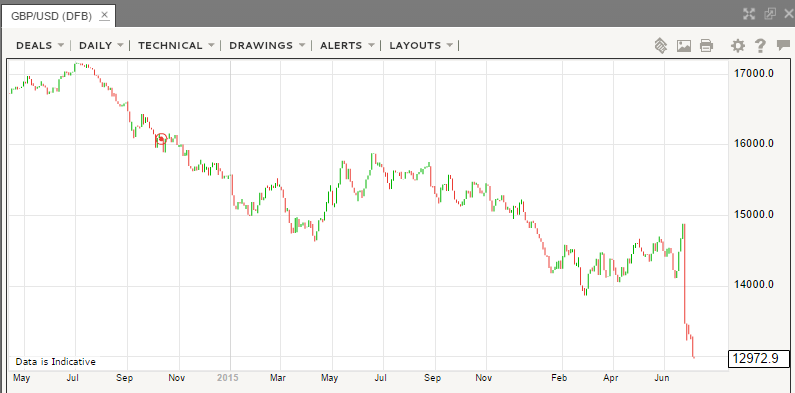
(chart courtesy of IG)
I think it's inevitable that retailers will need to absorb some of the impact of such a big drop in sterling, so expect to see their margins coming under pressure. This is at the same time as cumulative rises in Living Wage, so a double squeeze on their net profits. Hence why most retailer shares are down so heavily. I suspect that the Govt may well have to moderate, or defer, future rises in Living Wage, as the cost to jobs could otherwise be too great.
Labour now doesn't have the same ability to screw employers for pay rises, which was what fuelled inflation after the initial oil price shocks in the 1970s. Also, I think the Bank of England might just leave interest rates at rock bottom now, even if inflation creeps in. We've had negative real interest rates before, so why not again?
Anyway, it's interesting to bounce ideas around, about what scenario is most likely to play out now. Personally, I don't see a prolonged, or deep recession as being particularly likely because of Brexit. However, I'm watching the Eurozone closely, as that's probably the biggest worry right now. There are other worries too, e.g. China, the balance of payments deficit, etc. But there are always worries, and we always muddle through somehow.
Another bit of news has rattled property investors - that Standard Life, M&G, and Aviva have suspended redemptions in their UK property funds. In my view, the open-ended structure of these funds is the real problem. It's ridiculous to buy illiquid assets such as commercial property, within an open-ended fund structure. The FCA probably needs to ban, or heavily restrict open-ended funds of this kind, in my view. Property investments should always be in closed funds, I feel (e.g. an investment trust). That way, investors can withdraw any time they like, without forcing the fund into asset fire sales.
I'm not an economics expert, but I did study it up to & including degree level, so know the basics, and find it interesting to bounce ideas around. If you don't like my ramblings on this, then just skip the preamble, and go straight on to the individual company sections. That's why these reports are arranged in sections, so that people can easily skip the bits that don't interest you.
Enough thinking out loud, on to today's company news.
Topps Tiles (LON:TPT)
Share price: 102.1p (up 0.6% today)
No. shares: 192.9m
Market cap: £197.0m
(at the time of writing, I hold a long position in this share)
Q3 trading update - in normal markets, this positive announcement would have propelled the shares upwards nicely. We're not in normal markets now though. So good news now perhaps only persuades people not to sell.
TPT has a year end around end Sept. So today's update covers the quarter to end June, and YTD. It looks encouraging:
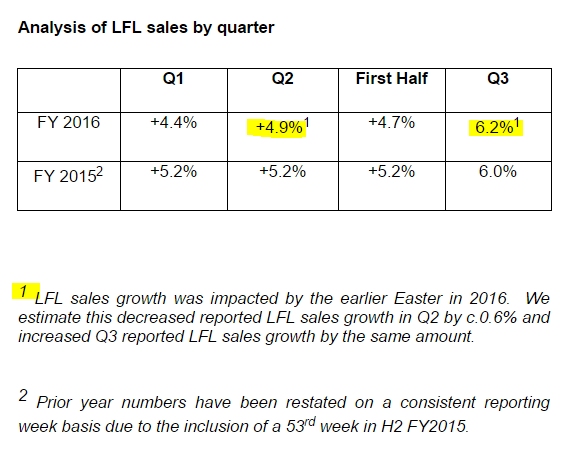
So like-for-like ("LFL") sales growth actually accelerated in Q3, to +6.2%. That's very impressive. It's always important to read the footnotes though. In this case footnote 1 points out that the timing of Easter boosted Q3 sales by c.0.6%, and a corresponding negative impact on Q2. So if we adjust those figures, Q2 goes from +4.9% to +5.5%, and Q3 goes from +6.2% to +5.5%. Therefore the adjusted LFL sales increase in Q3 was exactly the same as in Q2, at +5.5%.
There are not many retailers reporting LFL sales growth of +5.5% - this is a very strong performance. As you can see from the second row, this builds on a similarly strong LFL sales performance last year.
I like the strategic initiatives the company is taking, which is clearly helping to drive their strong sales growth;
- Personalised eBrochures for individual customers
- New product lines - which account for 8.8% of current sales
- New store format - of smaller, boutique stores (15 out of 348 stores)
On Brexit impact, the company has also gone for a too early to say comment;
...While it is currently too early to ascertain the implications of the result of the UK referendum, we remain confident in the longer term outlook for our business and in our ability to outperform the market."
I think that last bit is important - out-performing the market is what retail is all about. So in my view, buying good retailers in a bombed out market, is absolutely the way to go. The best companies tend to do OK, even in poor markets. The weaker competition goes bust in a downturn, leaving them with more market share, and ready to power ahead once the economy improves.
EDIT: Broker update - I see that one broker revised their forecasts yesterday, as part of a sector-wide reduction. Liberum is now forecasting 8.7p EPS this year (down from 9.1p), and 8.9p EPS next year (down from 10.0p). This is to reflect a reduction in demand, and changes to margins brought about by recent big forex moves.
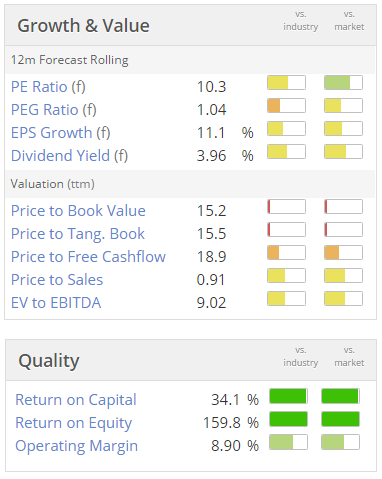
At 102p, the shares look reasonable value on the more prudent forecasts. The downgrades also move the bar a little lower for the company, which reduces the risk of a profit warning. So once the reduced forecasts filter through to Thomson Reuters, then the forward PER will rise from 10.3 to about 11.5 - still good value I would say, for a company that has been out-performing the sector.
My opinion - I like this company a lot, especially now it's almost a third cheaper than it was just a couple of weeks ago.
The danger is of course that there could be a Q4 profit warning, if demand slows down sharply, and the shares could lurch down another 20-30p. So there is a good argument for keeping at least some powder dry, until economic conditions become more clear.
On current broker forecasts the PER is looking reasonably good value, but bear in mind my comments above that we may not be able to rely on forecasts, due to economic uncertainty.
There again, most of us are not much good at timing the market, so in my view if a share represents excellent long term value, then personally I just like to buy some, and ride out any future share price volatility. Indeed, I would happily buy more if it dropped again in price significantly from here.
It's helped in this case by the fact that its well-covered dividend is now yielding almost 4%.
This company very much looks like a long-term out-performer in my view, reinforced by today's strong update.
Cambria Automobiles (LON:CAMB)
Share price: 65p (up 1.6% today)
No. shares: 100.0m
Market cap: £65.0m
Acquisition & trading update - Cambrian has bought a Jaguar/Land Rover dealership in N.London, for £2.1m. Its estimated profit is £0.7m p.a., so that looks a good deal. Although there is an additional £1m future cost from taking on an onerous (over-rented) lease.
Of more interest is the trading update. No sign of Brexit-related problems here;
The Group continues to trade well and the strong trading performance reported to March has continued through to the end of June which leaves the Group significantly ahead of the prior year and trading in line with current market expectations for the year to 31 August 2016.
There's no mention of Brexit, or any downturn in trade, which is encouraging. Although of course the post-Brexit period would only have been the last week in the period being reported on. However, I feel if there had been any material downturn in orders, then the company would have been obliged to say so today, but they didn't.
My opinion - personally, I'm very bullish on car dealer shares right now. Most have been brutally smashed in price, some have halved - e.g. my favourite pick from the sector on value grounds is Vertu Motors (LON:VTU) (in which I hold a long position).
The sector dynamics have radically changed in recent years. Most customers now buy on personal contract hire, which is highly affordable. The car manufacturers have to shift their production, so they subsidise prices to whatever extent is needed to move the cars. Cheap personal lease deals make it far more affordable to have a new car then it's ever been before. Hence why volumes are so high.
Dealers make very little margin on new cars. Where they do better, is on after-sales. People who are leasing new cars are often obliged by the contract to have the car serviced at the main dealer. So even if new car sales do slow, there will be a long tail of profitable after-sales work. Therefore, even in a downturn, I believe dealers should fare a lot better than in the past.
The market doesn't seem to have recognised the above factors, and is selling off dealer shares in a way which is revealing some smashing bargains, in my view. Also bear in mind that many of the smaller car dealerships own a lot of freeholds, and have little debt. So they should be well-placed to withstand any (hopefully temporary) downturn in business. Not that any downturn in business has actually been reported by any of them yet, that I've seen (correct me if I'm wrong on that, as I do sometimes miss RNSs).
I think Cambrian is well managed, and has a sensible growth strategy, and sound balance sheet. Therefore it looks good value to me, at the current level.
More new car sales in recent years also of course means more secondhand cars to shift, and dealers make money there too.
Overall then, I see this sector as being a good place to hunt for bargains which have been over-sold in the recent market sell-off.
Vislink (LON:VLK)
Share price: 16.75p (down 48.9% today)
No. shares: 122.6m
Market cap: £20.5m
Trading update (profit warning) - commiserations to any readers who still hold this one. Many private investors sold out in disgust at management's greed when they created a so-called Value Creation Plan ("VCP"). Such schemes are regarded as completely toxic by many private investors. It's an elaborate form of theft basically, in my view - targets are set which management think they can beat, then they basically are given c.15% of the company through the dubious practice of creating an intermediate holding company.
VCPs are morally wrong, and to any company or adviser thinking of implementing such a scheme I would simply say - don't! It will destroy reputations, private shareholders will mostly hate you forever more, and in the current national mood of revulsion at fat cat greed, and excessive remuneration for executives, it would be much more wise to be grateful for already being richly rewarded, and not try to create yet another method of screwing the companies you manage for even more (usually unjustified) personal gain.
This is even more the case, as we seem to be entering more uncertain economic times, where employees may lose their jobs. It's utterly disgusting to see executives drawing out big bonuses, and salaries, plus often lucrative LTIPs, etc, when they're slashing jobs in order to boost company profits. Something has to give - the whole system stinks right now, and Directors would do well to think carefully about the public mood, before lining their own pockets.
Anyway, back to Vislink. Today's statement is pretty awful;
...As the lower than expected trading performance of VCS in H1 is expected to continue into H2, the Board believes that the financial performance of the Group for the full year will be materially below previous estimates.
As if that isn't bad enough, there's potential trouble with the bank covenants too;
As trading has been lower than expected, the Company's bank has agreed to defer covenant tests until the end of July from the end of June and remains supportive of the Company.
That's only a one month deferral. Therefore, I read this as making the risk of a discounted placing now very likely. For that reason, personally, I would ditch my shares, if I still held them (which thankfully I don't).
Clearly this means that dividends are probably now a thing of the past, as the company alludes to today;
The Board intends to review the Company's dividend policy in light of the intended restructuring, with further information to be provided in relation to dividends in the Company's half year results.
There's more restructuring to come, which costs money of course. Plus a write-off of intangibles. People always say that's non-cash, which is true now. However, it was historically a cash outflow, so that needs to be borne in mind - it's shareholder value that has gone up in smoke;
This restructuring includes a non-cash write-off which could be between £6 - £9 million of increasingly inappropriate legacy technology. In addition, it will result in a more focused range of products that are appropriate for today's market, a further reduction in costs of £1 - 2 million annualised, and a clear focus on improving asset management and cash generation of the division.
I'm concerned by the phrase "increasingly inappropriate legacy technology".
My opinion - I don't rate management here. In my view the Exec Chairman is not an entrepreneur, but is a financial engineer - obsessed with doing acquisitions. The inevitable effect of that is that the balance sheet fills up with intangibles at the top, and debt at the bottom. Something then goes wrong, and the group is in trouble.
I recall a presentation by Vislink some time ago, when the Exec Chairman outlined his glittering business career. The gentleman sitting next to me leaned towards me and whispered, "He actually made a dog's breakfast of things at Anite!"
There have been various issues of outrageous remuneration for the Exec Chairman, which I've mentioned here before. The company even paid his tax bill, as was revealed in a small note to the Annual Report. Plus excessive remuneration, for only working part-time. It was quite clear to me that this individual was not someone to back, hence why I bailed out of this share some time ago.
Based on today's news, the group sounds as if it's in trouble, so I would have no hesitation in selling.
That's all I have time for today, as another investor lunch is looming. Hopefully I'll get the time & venue correct today, unlike yesterday, when I ended up dining alone because the event had been cancelled & I'd forgotten to update my calendar!
Regards, Paul.
(usual disclaimers apply - the above are my personal opinions only, not advice or recommendations)
Disclaimer
This is not financial advice. Our content is intended to be used and must be used for information and education purposes only. Please read our disclaimer and terms and conditions to understand our obligations.

71 comments
Firstly, a message to Paul to register my liking for the preamble in times of economic change. It's good to see if my personal views on current issues are at odds with others and what opportunities might arise. I recently read a tipster's recommendations to buy Sports Direct, Lloyds Bank and Barrats Housebuilder. All have fallen around 20 to 30% since the tips. I already held Sports Direct but have since bought the other two plus Telford Homes. Clearly I think the house builder sector has been oversold. A cautionary note though is the widespread belief that housing is expensive because it is short supply. There may be a shortage of good quality housing but not overall. I think house prices are high as a result of cheap credit and its ease of availability. There is a bubble which is further inflated by the Government's Help to Buy scheme. It seems that interest rates will remain low unless there is a sharp and chronic rise in inflation, which would inevitably be bad news for the property market.
With regard to the UK economy, Brexit has indeed seen the gbp weaken substantially. As this will mean dearer imports, some prices will rise, possibly causing some inflationary pressure. Back in the 1980's, there was a strong movement encouraging everyone to "buy British". I know it's not possible to buy everything needed but currently, wouldn't it be good to resurrect this policy. After all, the country's current account is in deficit to the tune of 7% of GDP. We rely on foreign investment to balance the books and that may not be forthcoming if our risk levels rise.
Casa.
I agree completely about the comment on property funds. Arguably every fund investing in illiquid assets should be a closed ended Investment Trust type company. So that might include property, micro caps etc.
Re VLK - Just a comment on excessive remuneration to executives. Society needs to do a reset on run away greed by some executives. shareholders need to be more challenging to management. If you perform well then you can earn it. The gap between rich and poor is becoming dangerously threatening to a civil society for all citizens. Unfortunately I hold some of Vislink in my SIPP and will be rid of these asap (executives too greedy for my liking) . Not too great a loss so far but there might be more carnage to come. Agree with Paul on housebuilders outside of London. A primary need is housing so I too am going to hold my Persimmon. We are not making any more land and the government will be implementing urgent changes to get more houses built in our crowded country.
Steady nerves needed on the tiller
be patient
anyone have any thoughts on Somero's price drop today?
I was surprised at this Somero (SOM) move, especially since it is a company that is primarily selling outside the UK and should have a clear benefit when translated into sterling.
My only conclusion is that this is caught in a larger expectation of a worldwide slowdown in construction. If people are winding themselves up for a worldwide recession it is going to be very hard for investors to find safe havens
Re: AHT
More news like this creeping out of late, worth keeping an eye on.....
https://www.bloomberg.com/news/articles/2016-07-06/as-growth-in-apartment-rents-slows-u-s-developers-press-pause
Just on the car dealers, I haven't seen it mentioned yet, but with Sterling weakening, surely the cost of all these imported new cars is going up by 10-15%? That, combined with a domestic economy that is really only in the first innings of a recession suggests to me that the profit warnings will start coming.
On a side note, if you were planning on buying a new car anyway, maybe now would be a good time to buy.
Yes, the same applies to a lot of imported goods. I'm thinking of replacing my iPad before prices go up. Apple try to maintain their pricing irrespective of currency fluctuations but even they have limits, and you can pretty much guarantee new models will be priced on the basis of the new exchange rate.
I would look at refurbished ones from the Apple store, they come with a full warranty. Saves about 20% on new price.
Another one worth looking at is Ashtead (LON:AHT) which seems to be suffering from the fear of a recession in UK. In fact, almost 90% of its EBITDA comes from its US operations and it is a very substantial beneficiary of the fall in sterling against the US dollar. Here's an article from a US holder of Ashtead (LON:AHT), as well as their last results presentation:
http://seekingalpha.com/article/3983114-british-coming-ashtead-group-aims-top-player-equipment-rental-industry?ifp=0
http://www.ashtead-group.com/lib/docs/213616-q4-15-16-results-presentation.pdf
Note as well that they have been buying in their own shares on a daily basis for several weeks now.
Note from their last results announcement:
"The Group's reporting currency is the pound sterling. However, a majority of our assets, liabilities, revenue and costs is denominated in US dollars. The Group has arranged its financing such that, at 30 April 2016, 91% of its debt was denominated in US (and Canadian) dollars so that there is a natural partial offset between its dollar-denominated net assets and earnings and its dollar-denominated debt and interest expense. At 30 April 2016, dollar denominated debt represented approximately 62% of the value of dollar-denominated net assets (other than debt). Based on the current currency mix of our profits and on dollar debt levels, interest and exchange rates at 30 April 2016, a 1% change in the US dollar exchange rate would impact pre-tax profit by £6m."
It is virtually a US play on sale in sterling. As I read that, the 10% depreciation of sterling would boost pre-tax profit by £60m.
I have also been buying.
I used to hold Ashtead (LON:AHT), sold out a while ago when the shares were nearly £12. I have not looked to buy again, there gearing is quite high now and the last I hearde the US housing market was declining in April it was down over 8%, so I'm a bit cautious on AHT. If its debts are 91% in US$s then that means they have just gone up about 15% in £ terms?
Dollar debt is only 62% of dollar assets, hence they are a major beneficiary of a higher dollar.
Re current trading, this is from their last results annnouncement three weeks ago:
"Particularly encouraging is the continued improvement in our margins, with Group EBITDA margins now a record 46%. These strong margins, together with the natural moderation of our replacement fleet expenditure, mean we are entering a phase where we anticipate both good earnings growth and significant free cash flow generation. We therefore have the flexibility to continue both to invest in our long-term structural growth opportunity and enhance returns to shareholders. As a consequence, we have announced today both a proposed 48% increase in our full year dividend to 22.5p and a share buyback of up to £200m. As always, we will continue to grow responsibly and will operate within our 1.5 to 2.0 times net debt to EBITDA range.
We have seen a good seasonal upward trend in fleet on rent throughout the Spring which has continued into the new financial year. Our end markets remain strong, the structural drivers are still in place and we have a strong balance sheet which allows us to execute our plans responsibly. As a consequence, the Board continues to look to the medium term with confidence."
But DYOR, as always.
You said 91% of debt was in US$s? Debt is 5x net profit so is that not a bad thing?
Sorry I don't understand your point about $ assets, please could you explain further.
It's all in the figures, extracts and links I referred to.
US dollar assets greatly exceed US dollar debts.
US dollar revenues greatly exceed US dollar outgoings,
About 90% of profit comes from the US (see slide 42).
Therefore they benefit from a higher US dollar.
I see. But debt is still rising, in a recession asset values will probably fall?
For me there is too much risk, signs are the US housing market is slowing.
Anyone know why Tesco (LON:TSCO) and WM Morrison Supermarkets (LON:MRW) have fallen so much today, would have thought they were safer sector to be in now.
ITV (LON:ITV) price has dropped way too far / fast... Any ad revenue drops should be covered by increase in production revenues, and in non-Sterling. Here is Enders Analysis latest insight...
"TV viewing has one reliable, long term trend: programme genres are watched by consumers at predictable life stages and ages.... WARC, the main UK industry source of advertising expenditure, was still forecasting 3.6% real growth in TV advertising spend in its quarterly report released in April.... Television NAR (Net Advertising Revenue) from spot advertising has so far suffered almost no discernible erosion at the expense of online, which we attribute to the very different roles of the two media; television being very much about mass market fame and branding, while online is more about addressable targeting and direct marketing."
Within today's news from Inland (INL) they say "In the two weeks since the Referendum vote, we have continued to see the same level of appetite from potential purchasers for our homes"
Facts speak louder than opinions
Flackwell
Also, as an Inland Homes (LON:INL) holder, I am very encouraged by the new 50/50 venture also announced, which as the CEO states is an "acquisition in Cheshunt which is a long term project in a strong location and benefits from local political support." Assuming things go to plan Inland Homes (LON:INL) expect to build 1,000 affordable houses on the site, which is close to M25 and new X-rail links. I'm encouraged to add to my holdings once the current price drops abate.
Regards
Howard
Howard - unfortunately the INL share price has done nothing but drop recently !!!!
but imo offers good value - hence I hold
It's gone up today, now 50p.
Herbie - 50p is technically a 1.6p odd drop from the close of play yesterday - but I take your point - it now seems to have bottomed and is reversing the previous trend
Yes but it was 47p earlier. I should have said, after I typed it I thought someone may say that.
Flackwell
I will hold as well.
In case you are interested here is a second data point. I just spotted a positive note from M J Gleeson (LON:GLE) (which I don't hold) who operate a bit like Inland Homes (LON:INL). Their CEO also stated they are experiencing strong demand for their low cost homes. Buyers are not being deterred, it seems.
The M J Gleeson (LON:GLE) CEO summarised the update "As a result of the strong performance in the financial year, the Board is confident that the results for the financial year will meet the top end of expectations."
I perceive, as Paul has commented (above), that the sector is possibly being hammered more severely than it ought to have been. Or perhaps, more specifically, the market is treating all houses builders in the same light, but they actually operate in quite different segments. Berkeley Group (LON:BKG) being top-end London, yet others are non-London and/or are low-end, such as M J Gleeson (LON:GLE). I'll watch with interest.
Regards
Howard
Thanks for the pointer - will look at as it's not one I'm not familiar with
Closely related, although not quite same I like both BBOX (industrial sheds) - which now yields of the order of 5% and BLND which yields even more, and is as blue chip as they come being a company with something like a £5- £6 billion captalisation.
These opportunties don't come up too often - albeit all of these may get pulled down by the market as you say
Flackwell
I hold British Land (LON:BLND), but not Tritax Big Box REIT (LON:BBOX), I'll look at it, thanks for the idea.
As further inputs to out discussion, since I have been writing, I have just seen that a fourth Real Estate unit trust has suspended redemptions. I am sure the profile of this activity will now ripple deeper into the UK property market irrespective of underlying asset types. I sense a further bit of capital flight is kicking in. Oh dear!!
Regards
Howard
It's now 6 property funds who've suspended redemptions, unless I've missed some more. Standard Life, Aviva, M&G, Henderson, Canada Life and Columbia Threadneedle.
If you are the sort of foreign investor who was tempted to invest in UK real estate then you're already staring down the barrel at huge losses just on the movement of the exchange rates. Now you're finding it impossible to get access to your money, just at the point when you would really like to get access to it. Do you really think anybody in this position is going to be tempted to come in and bottom fish? Especially when Mark Carney is hinting at rate cuts and more QE. That won't sort out their exchange rate woes.
It's a similar position in residential property (if you can call something nobody lives in "residential"). Huge exchange rate losses. How easy is it going to be to sell some of the rubbish that the house builders been stitching up foreign "investors" with?
Can the house builders, even those not exposed to London, really insulate themselves while a massive cash inflow into UK commercial and residential property turns into a massive cash outflow?
"But Cheshunt is nowhere near Crossrail" I thought. I looked it up and they said Crossrail 2, which is just a proposal. Still a good project.
JohnEustance
Thank you for the correction, my apologies for the inaccuracy.
Regards
Howard
"A French Govt Minister arguably hasn't helped matters by declaring that the French state is "totally bankrupt" in a recent interview.A French Govt Minister arguably hasn't helped matters by declaring that the French state is "totally bankrupt" in a recent interview."
This interview seems to be from January 2013 and is not a 'recent' interview.
Paul,
The Quote from Sapin is dated 2013.
Although France is still bankrupt.
Bryan
Paul
Could not agree more with your observations re open ended property funds with relatively illiquid assets and recognition that investment trusts or similar are the correct way to structure such investment portfolios. Unfortunately, in the present selling panic engulfing both commercial property companies and housebuilders (plus associated suppliers, estate agents etc) following the poor construction quarterly figures, everything is being irrationally written down. NewRiver Retail is a good example of a quality REIT with a well balanced property portfolio and high occupancy that has been dragged down along with everything else. No doubt there are bargains around but volatility presumably will remain until there is a clearer view of what is the real effect to the economy going forward.
Peter
Paul and others can I ask why you think Persimmon (LON:PSN) is a good housebuilder to buy? I've only begun my research into housebuilders but I noticed that a fellow reader suggests it is trading on a high price to net asset value compared with the rest of the sector. See: http://www.stockopedia.com/content/mccarthy-amp-stone-just-a-housebuilder-128342/?comment=13#13
That's a fair point Paraic.
The cleanest measure of asset value is net current assets (NCAV) i.e. current assets minus total liabilities.
For housebuilders the P/NCAV ratios are:
Bovis 0.99, Bellway, Redrow 1.25, Berkeley, Persimmon 2.1, Galliford Try 2.2.
Sounds like a LONG Bovis, SHORT Persimmon pairing is worth thinking about.
ITV (LON:ITV) is perhaps worth looking at. More that half its revenues are from the production, sale and licensing of programmes and series, online revenues, etc, etc, therefore it is actually much less exposed to a possible downturn in UK advertising spend than it used to be and that the market seems to be pricing in. About a quarter of revenues come from outside UK, presumably mainly in US dollars. The fast growth of ITV Studios is now building up a very valuable content asset (think how the US has gone gaga over Downton Abbey). Cash generation and FCF are excellent, management very good. Liberty Global owns 10% so a share price fall of close to 40% since the start of the year plus the recent fall in sterling against the US dollar puts it, in dollar terms, at about half-price, should a bid be in someone's mind.
PER now below 10, yield 5.60%, ROCE 31.7%.
I am buying on market falls.
Just been reading about ITV (LON:ITV), it could benefit from a change in law that currently allows Virgin Media free access to its main channel.
That is about to be challenged?
Hi Paul,
I hope you are right on the economy muddling through. My concern is that the current account deficit of 7% of GDP (£10bn a month I think) will no longer be financed by foreign investment. Who will want to invest in a factory / commercial property / residential property / companies in the UK now. Clearly a weaker £ makes all assets cheaper which helps, but the poorer long term economic prospects mitigate that. If we have a full blown currency crises, which I think is a reasonable possibility, then we could be in huge trouble . Our economy had substantial challenges before Brexit. It seems to me that the likely lack of inward investment, and potential disinvestment in certain sectors, makes a minor recession the very best we can hope for, and not the most likely scenario, in the event of Brexit actually happening. I am not a trained economist so my thoughts are very unscientific!
Hi Paul,
RE: Cambria Automobiles (LON:CAMB) whilst I take your point about new car sales being mostly contracts these days and the high margin of after sales I personally sold out recently because 1/3 of gross profit is from used car sales. Even a dealer approved user car is a large ticket purchase for any consumer and in such an uncertain environment, with consumer debt already high, I cannot see how this will not be hit. There's also the discretionary element to the after sales servicing which I do not like and if times get tough people will go elsewhere rather than pay full whack for a dealer service. I know I do!!
All the best, Si
Not an advert!
I have a proportion of my ISA funds in Fundsmith, who operate a basket of long hold shares, which include a fair number of stable overseas, dividend payers (Microsoft etc) rated in dollars. So not a bad hedge at the moment against the more uncertain smaller UK players. It appears to be ticking up, as compared to my other UK ISA portfolio constituents
Trident
I concur with taking a global/overseas view at this moment. I hold Fundsmith a basket of other 'global' trusts and ETFs, US ETFs and Japan trusts. In combination, these have all lifted from between 7 to 11% over the past few days, giving a gratefully received counterbalance to my falling UK small caps portfolio. Further, I hope that in the future dividends from some of these might be lifted from exchange rate benefits, if the trusts pass them on (he said hopefully).
Having experienced in such a short timeframe the possible benefits of factoring in an exchange rate theme (often commented on recently by Paul and other commentators) to stock buys at the moment, I am looking closely at my holdings to determine exactly where their revenues arise from, as well as where their major input costs are generated from.
From within the confines of my current portfolio I have spotted these which might obtain a lift (or achieve lowered volatility) from currency themes: Somero Enterprises Inc (LON:SOM) as it operates in dollars (Paul has mentioned several times); Total Produce (LON:TOT) as it operates across Europe-Eurozone, Europe non-Eurozone, North America and India, Novae (LON:NVA) operates Europe, UK and US, Zytronic (LON:ZYT) sells in US, China & Korea, and of course many of the FTSE 100 companies.
Regards
Howard
I agree, I've been topping up my Fundsmith holding. It's one fund that is clearly doing the job it set out to do.
Their holdings are a beneficiary of "bondification" - people valuing blue chips on their yield vs. investment grade bonds. If/when interest rates start to rise, that effect will go into reverse but there's no sign of that on the horizon.
Hi gekkoluvchuld
I think we must assume that most Govt's are relatively incompetent at achieving their desired aims. Yes, they want inflation (but haven't been very successful to date), and theoretically they do not control either the FED or the BOE regarding interest rates targeting inflation. There are too many moving parts, including currency movements, and other Govt actions (e.g China) to believe they can steer very accurately.
The best they can do is act in their own interests, and currently both are getting away with borrowing huge amounts while rates are low, funding their fiscal deficits. Ultimately both are hoping general growth will reduce their debt as a proportion of GDP, and the art, if any, is to trying not get in the way of general economic growth, whilst trying to close the fiscal gap.
The irony is that pension funds etc will buy Govt bonds even at zero rates because they are 'certain' to get their money back ( or most of it), rather than buying equities, with their inherent risk. Company Pension funds then go into further underfunding because of poor bond returns, creating a potential drag on the earnings of companies who have commitments to fund their continuing final pension schemes.
Paul - I'm big fan of the preamble and value your thoughts on the general economic landscape and topical issues. It keeps me coming back!
Hawkins will not be sitting on his laurels as Vislink (LON:VLK) deteriorates.
He will be working with his advisers on a rescue plan - for the directors' underwater VCP.
No doubt a re-priced scheme or new options are on their way.
No need for panic, but a recession, though possibly relatively mild, is almost certain. Brexit is not the underlying cause but may be the proximate trigger. It's mostly about a general lack of growth and confidence and uncertainty from Brexit with increasing fear (exacerbated by various politicians and central bankers) deferring decisions. Might only have had a small, possibly invisible, effect if growth were strong across the world but Japan and Europe have been struggling massively with little sign of real sustained improvement. Likely to have happened anyway, Brexit or not. I would like to think that increased flexibility from Brexit would allow us to navigate the choppy waters more successfully than would have been possible in the EU (and that the EU could also be more flexible without the UK), but this would require a higher degree of competence and vision than the politicians have demonstrated so far.
With regards to the economy, aren't the UK and U.S generally trying to create inflation and fear deflation due to the lack of real global growth and the fact that debt levels have got out of control and massively increased since the crisis? They are trying to inflate away the debt and create a ''wealth effect'' boost to the economy and the Brexit in some way proves that it hasn't worked.
Government bond yields in developed markets are near zero or below and yet people are worried about inflation??
Paul, be good to get your thoughts on the amount of stock the car dealers carry and the terms on which they carry it. Can they return stock to manufacturers if it is unsold? It looks like Vertu has a big balance sheet relative to its P&L and in a downturn if sales slow it could really have a working capital crunch. I'm not really familiar with the business model - is there something I'm missing? Many thanks.
Flybe (LON:FLYB) I have never liked this company and have written about it before. However there are new concerns IMO:
1) Fuel prices in Sterling terms are going through the roof
2) Flybe is a regional player and the feeling is there will be less people travelling overseas ex UK
3) The potential introduction of border controls will make it harder for Flybe to get passengers
4) Much of Flybe's business is conducted in US$ (aircraft purchases, leases, insurance and they have suddenly become more expensive
5) Consensus is that Sterling will continue to weaken
6) Flybe has dire load factors already so even a small decline from there will have serious repercussions
Carcosa, there is perhaps also the fear that the sizeable pension deficit of Flybe (LON:FLYB) (pension deficit about 18% of market cap) may widen further should UK government bond yields continue to fall. This is perhaps also a consideration for quite a few other companies. Some are mentioned in this article from Phil Oakley:
https://www.sharescope.co.uk/philoakley_article107_f.jsp
The last set of financials state that they are 90% hedged at $1.50 for the current financial year. I believe this covers them for their fuel costs, although not sure about the new aircraft they are supposed to be purchasing. They are also well hedged on fuel, especially compared with last year. Agreed on the load factors - room for improvement! Interesting times ahead...
re Flybe (LON:FLYB)
... but they also hedged 90% of fuel for 2016/17 at US$ 566 per tonne, and 50% for 2017/18 at US$ 473 and currently the price is $457/tonne. So any currency hedging savings have been undone.
But the real killer is likely to be further erosion of seat utilisation rates, add in unplanned maintenance cost increases and overseas operational costs against a background of a weaker currency and european overcapacity, and in all likelihood significant cost increases in 2017 then the outlook has to be negative.
Paul, some useful thoughts regarding things moving forward, thanks.
I run an import/wholesale business, you may remember me commenting on DX/Tuffnells/couriers etc a couple of months ago. We import about 85% of our stock from the Far East, which is a mix of stock that goes directly into customers in full containers, and stock that comes to us here and is distributed to smaller clients.
We have a few large customers who pay us in USD, and therefore take the currency risk on themselves, but the vast majority pay us in GBP (websales, smaller orders etc). We don't tend to 'try our luck' on currency too much, we'll just place forward contracts for the currency we need for orders we know we have, and historically have bought a smaller amount of currency at spot if needed for our general stock. We don't attempt a huge amount of hedging or options, because if we're quoting an item for a customer we know the rate at the time and the price is based on that. My thoughts are:
Prices will need to go up if the current environment becomes the norm, but there's no need for knee-jerk reactions. All of the stock we are currently holding here has been bought at a much better rate, so we have time to consider options. Because of the lead times involved, we've ordered and have the currency booked for this Christmas' stock already (pre-Brexit), which will likely be true for retail in general. Who knows what's going to be going on by next January?... We may have a new government... There may not even be an EU!
Everyone else in our industry will likely also need to raise their prices. Some are more flexible than others (one competitor releases an annual catalogue in June every year and the prices are fixed for 12 months, poor things).
It may lead us to explore other currency alternatives such as buying in RMB, using currency options, shorting something as a hedge etc.
Shipping costs are going to rise at some point - we are currently in an environment where shipping costs are crazily low, we can import a 40ft container and the road freight in the UK is higher than the shipping from China. This will compound any currency drop.
We're quoting all year for projects with 16-20 week lead times, so we are having to reassess prices where we perhaps quoted for a line for this Christmas in May or early June, and the customer is now coming back with design tweaks but haven't placed an order yet. For a business like ours, where we are in fact already discussing Christmas 2017 projects with clients, you just can't guess what's going to happen, and really need to wait until orders are ready to be placed before assessing the situation.
For us, it's keep calm and carry on, everyone else is in the same boat, no need to panic... yet...
Thanks Will. Here's hoping everyone is as sensible and level-headed as you!
When you are looking at your currency options, don't rule out buying from China in GBP. I've been able to do that in the past.
Anyone got any views/idea why FLYB is tanking post brexit?
There is pressure on Aviation shares in general, and Flybe (LON:FLYB) has one of the worst models going forward. They will have suffered from the Continental ATC strikes -= see £EZJ's post today. What it does have is loads of cash and some of that could be coming back to shareholders so that is a plus point.On the other hand, they could just continue to burn it! All in my very humble opinion.
Actually, Saad Hamad stated this time last month that they hadn't cancelled a single flight as a result of the ATC strikes. Not sure if this position has changed...
Paul
I think you are generally right on a forecast of a higher rate of inflation because of sterling influences. Also, because of the perceived economic weakness we may have a declined in our already pitiful interest rates.
This is generally good for Govt debt, but bad for savers. Therefore for a period equities should represent better value, though stock picking may remain the best way of getting value.
Like a fool I hopped out of Pan African Resources, at a profit, and left a rather bigger profit on the table.
Thinking that Persimmon had been marked down too much I used my PAF money to buy in, only to see it fall again. So if I look through one half-closed eye in a dark room, I am neutral(ish) on the transaction.
The problem with online share systems is that it makes changing so easy that it panders to ones instincts, rather than to your plan.
Whilst I agree on Persimmon, it is a solid company, quite how far the tide will go out on sentiment, it is difficult to say.
My bet is that when the Conservatives finally select the PM, the markets will steady (subject to any external factors) but the after shocks of Brexit will persist for a while.
Totally agree with this statement...
The problem with online share systems is that it makes changing so easy that it panders to ones instincts, rather than to your plan.
Sapin's "recent" interview is from 2013 (as is the article you quote), before his time as finance minister, and if you look up the background of that quote it turns out he was playing some verbal tennis with the opposition. It seems pretty insignificant.
Re: Topps Tiles (LON:TPT) if you look back to last recession they nearly went under, shares fell to under 20p so it does not follow that quality companies always do well, they also have a fair amount of debt. It will all depend on how bad the recession is, that is if there is one at all. The same goes for car dealers.
Fair point, though I am minded that in 2010, Small Company Sharewatch bought only 2 shares for their Portfolio - Topps Tiles (LON:TPT) and Photo-Me International (LON:PHTM). Both turned out to be 10-baggers if my memory serves me right; certainly Photo-Me International (LON:PHTM) did and perhaps Topps Tiles (LON:TPT) was a 6 or 7 bagger. So, they can fall as with general retail but DIY seemed to bounce back very quickly.
Yes I agree they can bounce back but they did fall by 90%, its the same with housebuilders they fall a lot and then bounced back after the recession, I just feel at the moment it's probably too early to buy them until we have a clearer picture about Brexit and the economy.
That assumes that Topps Tiles was a quality company back then in 2008. That's a long time ago.
Re Persimmon (LON:PSN) There is an equally strong case made by Tempus in The Times today.
" A yield of 8% means Persimmon, along with several other housebuilders, is now providing a better income than traditional high payers such as the two big oil companies. Another of those cases where, unless you think the world is coming to an end, the shares look like a steal."
"It is hard to imagine what cataclysm could occur in the housing market that could prevent the planned return of capital to investors."
Declaration. I hold a long position.
But please DYOR. Despite what pundits say, it is very difficult to read the property market right now. Too many political and economic moving parts.
I think we had an immediate Brexit reaction followed by some recovery on hope that we wouldn't really go through with it, but now we are in the "They're really going to do this" slump.
People thought they could rely on Boris to let his supporters down and not go through with it but he's no longer in contention.
I think you're right that in the long term there is a fundamental imbalance between supply and demand for housing and that the interest rate environment is supportive of the market.. My concern is that this market has been inflated by people investing, not nesting, and that lots of those investors are marginal holders or novice landlords fleeing low deposit rates. If the market starts to soften, I suspect there could be lots more properties put up for sale, leading to substantially lower prices in some areas. Nationwide it may not look like a slump, but I suspect in some areas and sectors it certainly will.
I personally don't have a clue about whether Brexit will cause a recession. The thing is, I am highly sceptical that anyone else does either.
Scm
Morning Paul, what are your thoughts on the stinker of an update from Vislink today? Worth a short term punt in the 50% off sales?
These huge knock downs are getting more and more frequent...
Mark
This Vislink announcement shows perfectly why Paul goes on about not capitalising software costs.
Vislink's software IP "asset" has (as so quickly happens with software) lost its value and a large write off is necessary.
Although there is nothing illegal about capitalising software, and in fact it is mandated for developed software that has sales it is clearly unwise if it lulls management into a false confidence in their numbers. It seems a good moment for the accounting authorities to review their advice on this.