Small Cap Value Report (6 Mar 2015) - AGA, CAMB, ATY, ZZZ

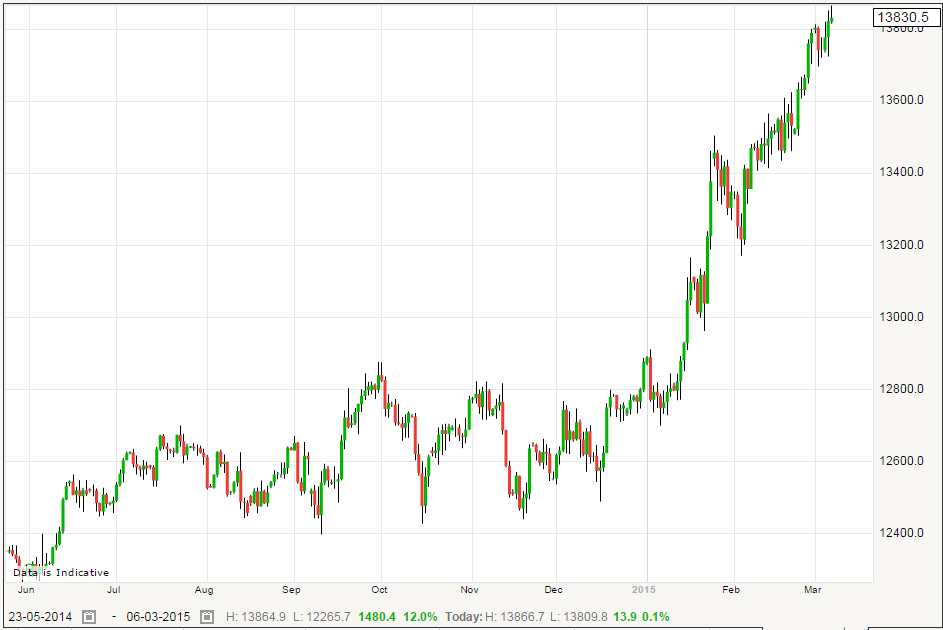
Good morning! I note the very large movement in the Euro against sterling this year, so am having a think about how this might affect the companies in my portfolio (chart courtesy of IG).
The impact of a weaker Euro on UK shares seems to mainly be a case of profits from European subsidiaries translating into a lower sterling profit. Also it makes life more difficult for UK exporters into Europe, as either their selling price in Euros has to go up, or the profit margin has to shrink (or a bit of both).
UK importers however will be able to buy cheaper products from Europe - so that maybe will help supermarkets' margins? If readers can think of any other particular beneficiaries or victims of recent, large currency fluctuations, then do please add your comments in the comments below.
AGA Rangemaster (LON:AGA)
Share price: 103.5p
No. shares: 69.3m
Market Cap: £71.7m
Full year results for calendar 2014.
The highlight bullet points look encouraging;
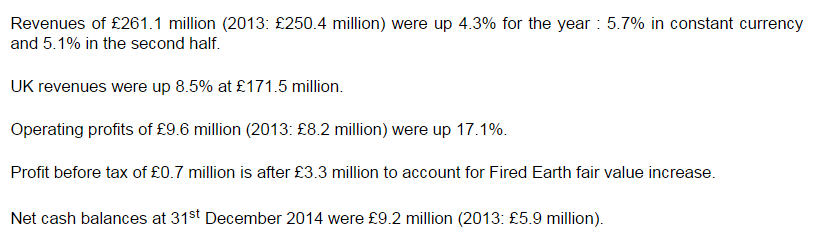
However, none of that really matters a great deal, because AGA is really a giant pension fund, with a small business struggling to service it.
Pension deficit - here is the whole section of today's report on AGA's pension fund issue. Note the sheer size of the pension fund, which dwarfs the company. Plus note that the existing recovery payments will likely consume ALL the company's profits from 2016 onwards:
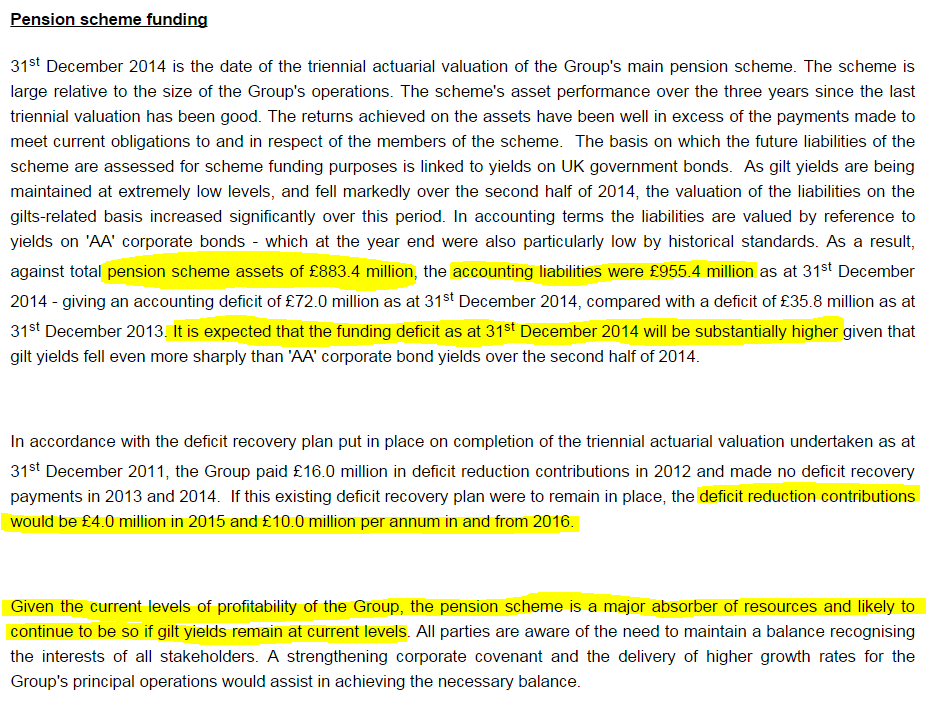
Remember that the accounting valuation of pension deficits produces much lower deficits than the actuarial method of valuation, so it's a tricky area for investors - the deficit showing on the company's balance sheet can just be the tip of a much larger iceberg.
Dividends - can't be paid, without the agreement of the pension fund trustees. Therefore that means there is no realistic prospect of shareholders receiving any divis for the foreseeable future.
My opinion - given the enormity of the pension scheme problem, and the knock-on impact of that meaning no divis are likely, then it makes me wonder what value (if any?) to put on the shares in this company? As things stand at the moment, the equity is worth very little I would say. So the only value is if you start making assumptions for what might happen when interest rates rise, and the pension deficit should then greatly reduce, or even swing into a surplus, who knows?
So any analysis that talks about the PER, and future EPS etc., is meaningless without considering what is likely to happen with the pension deficit. IF the deficit disappears over the next couple of years, then you could start to value the shares on a conventional basis.
Personally, I'm not an expert on pension deficits, so it would be little more than guesswork for me to forecast what's going to happen here. The shares are reasonable value if you totally ignore the pension deficit. So 9.4p adjusted EPS for 2014 puts the shares on a PER of 11.0 times. Trouble is, all the earnings are required to plug the gap in the pension fund.
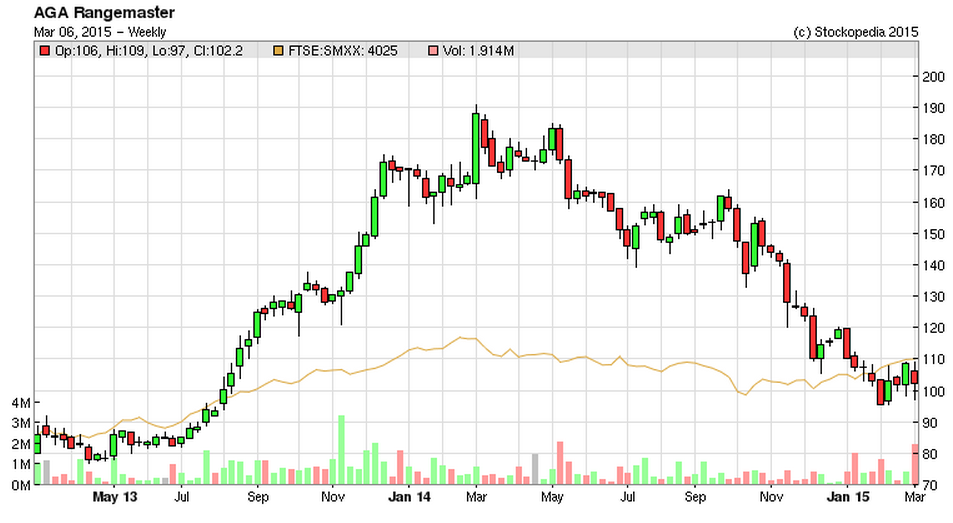
What happens if interest rates don't rise? What if we end up in a Japan-type scenario where interest rates stay low for 20 years? In that scenario Aga shares would effectively be worth nothing. I can't see the point in taking that risk, when you don't have to. Put it on a PER of say 4, and that might better reflect the current risk/reward re the pension fund - so I'd start to get interested if the shares fell to about 38p. At 103.5p the share price seems nowhere near to a sensible risk/reward level, in my opinion.
Cambria Automobiles (LON:CAMB)
Trading update - things are going well for this growing chain of car dealerships;
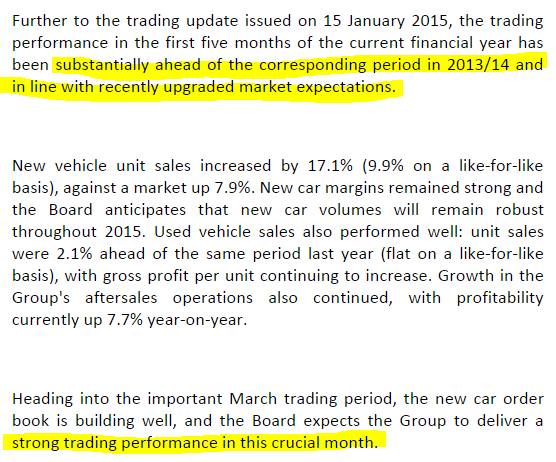
Thinking about exchange rates, the considerable weakening of the Euro versus sterling should be good for car dealerships which import European cars, as they should be getting cheaper, thus allowing car dealerships to pass on price drops, and improve special offers to entice customers.
Dealerships also benefit from after-sales servicing, and warranty work, since most buyers of new cars tend to have the vehicle serviced by the original dealer for the first 3-5 years of ownership.
My opinion - so why aren't shares in CAMB and other dealers going through the roof? Possibly because they are enjoying such favourable conditions, due to ultra-low interest rates, and now cheaper imports too, that some shareholders think they must be at or near the top of the cycle for earnings. For that reason I think it probably makes sense not to get too carried away with valuations in this sector. A PER of sub-10 makes sense if earnings growth is likely to be very difficult to achieve in future.
On the positive side, most people I talk to feel that management at CAMB is strong, and that the company can grow earnings through acquisitions. It also has a nice balance sheet, with lots of freeholds, which over time should give a competitive advantage & upside from properties rising in value.
CAMB seems to be on a forward PER of about 10, which taking into account the favourable cyclicality at the moment, is probably about right. The divi isn't much, at only 1.3% yield.
Athelney Trust Closed Fund (LON:ATY)
Final results - as usual this tiny investment trust's results statement is of interest and amusement purely for the outspoken views of its Chairman, Mr Hugo Deschampsneufs.
He is, as ever, clearly relishing his six-monthly soapbox moment, to ramble on about politics, short selling conspiracy theories, Tescos, and assorted other matters that have rattled his cage in 2014.
Still, all great fun! The fund seems to make steady returns from boring, value shares. Nothing wrong with boring of course, I use that word as a compliment when it comes to shares, as it usually means cheap! Although a lot of the shares he mentions this year are cheap for a reason.
Snoozebox Holdings (LON:ZZZ)
(at the time of writing I hold a long position in this share)
Update - a couple of interesting snippets in today's update from Snoozebox. It has been selected by Ealing Council to create some modular housing, in conjunction with Mears (LON:MER). That's quite interesting - maybe there is potential for JVs to help create affordable housing? ZZZ has lots of experience in this area, having pioneered portable accommodation for several years now. Semi-permanent sites appeal in that they are steady revenue earners, as opposed to events, which only generate a few days' income. Although the daily room rate on semi-permanent sites is very low compared with events.
Got to dash, yet another lunch in the City beckons (that's 4 this week!). I could get used to this - working in the morning, then lunching in the afternoons!
Regards, Paul.
(of the companies mentioned today, Paul has a long position in ZZZ, and no short positions. A fund management company with which Paul is associated may also hold positions in companies mentioned)
Disclaimer
This is not financial advice. Our content is intended to be used and must be used for information and education purposes only. Please read our disclaimer and terms and conditions to understand our obligations.

29 comments
Snoozebox Holdings (LON:ZZZ) seem to be following a successful strategy of working with JV partners to secure locations for semi-permanent facilites, for instance last Autumn they partnered with the YHA to provide the new hostel at the Eden Project. Anyone doubting the appeal of their accommodation offer should take a look at Tripadvisor for the Eden Project YHA. I think the company have been surprised by the level of interest they've had for their version 1 units (shipping containers) as a semi-permanent facility, which could lead to them building more of them. So far uses have included the aforementioned hostel, accomodation for oil exploration in an offshore territory, accommodation at a training establishment and now emergency social housing.
Weaker Euro (and low oil prices) should help travel companies in 2 ways, First they generate revenue in sterling but buy hotel accom etc in Euros so lower costs. Second travellers will see better value in visiting European countries and specifically Spain and Greece which are very important destinations for these companies, .
This Deschampneufs chap is great value. Thanks for highlighting it!
I understand that pension funds use gilt yields to calculate NPV of their liabilities but what I don't understand is why they use the current yield. I would have thought that using average yields over 10, 20 or even 30 years would make more sense? After all pension funds are very long term investments!
Secondly if you take the view that this company has no value because all the foreseeable profits belong to the pension fund why would anybody invest in it? Ha bro, Hargeave Hale and Standard Life all have large stakes; to what end? How can be good for their clients? To me it shows singularly poor judgement and just reinforces why I do it myself!!
Finally what would happen if the company was to go into liquidation for whatever reason. What would happen to the pension fund then?
I think many investors do not look at pension deficits, its only people like Paul who highlight these issues. I have seen many share tips, hardly any mention pension deficits. I think most think its a problem maybe in the future.
UK 10-year paper is yielding only 1.93% pa, which perhaps illustrates the problem for actuarial valuations. Mind you, it could be worse, in Germany the 10-year yield is only 0.35% pa!
http://www.pensionprotectionfund.org.uk may be the destination for orphan pension funds.
Is not right hand drive an issue for UK car dealers anymore?
UK franchise dealers are all supplied by manufacturer owned or tied UK sales operations, these take the currency risk/reward out of the dealers hands altogether. Only in the mid term to long term do currency issues impact on the relative price competitive position of individual Brands. Many manufacturers also hedge exposures in the short term so there is a lag effect as well , finally a sizeable portion of components are UK , US or RoW sourced even for European factories so that adds another layer of complexity.
CAMB does look cheap but I think Mark Lavery is more than fully remunerated
Yes but those cunning European car manufacturers also make RHD cars.
The top 3 selling foreign cars are Fiesta, Focus and Corsa.
Yes but at what price, I know years ago the same cars in Europe were much cheaper than here.
Bear in mind that even if you can identify a target with a European supply base, they will probably have hedged their purchases forward for a year to 18 months. So it may be some time before the effect of lower rates filters through to improved margins.
Re CAMB, I did hold them about 1 year ago but they were not doing anything so i sold them, They are almost back to the level they were last year so seem good value now. A few negatives: spread is quite wide and directors pay is excessive.
Compared to CFYN Camb may look expensive?
AGA Rangemaster (LON:AGA) Worsening pension fund deficits are indeed bad news not only for AGA but all companies currently showing pension fund holes. It is almost the case of a perfect storm. Gilts rates are lower than the previous assumption at the 2011 triennial actuarial valuation. Pensioners are living longer so a worsening longevity risk. Scheme assets are showing modest rises but nowhere near the damage caused on the liability side by the lower interest rates and higher longevity trend.
AGA's last triennial actuarial valuation, @ 31/12/2011, showed an actuarial deficit of £227.7m There are too many moving parts to say what it might be @ 31/12/2014. What we can say with reasonable confidence is that it will be worse than this figure.
The accounting deficit is a red herring. What really matters is what the triennial actuarial valuation carried out currently by consulting actuaries is likely to reveal later this year.
Regards, Ram
Ok, be gentle, I don't know much about bonds,
but they've had gilts for years, and now they're complaining that returns on gilts are low ? presumably the majority of the gilts were bought at much higher rates of return ? so surely their capital value has risen considerably and still they have a big deficit ? When interest rates go up, surely price of these glits will fall to set them at a suitable return ?? Shouldn't they then be getting out of gilts, that really can't go much higher and into either corporate bonds of blue chip companies or shares ? (shares are pretty high now so that's probably riskier) . These other assets will produce a higher return and shouldn't be so vunerable to falling in value if interests do go up ? and require a smaller base of capital to produce the returns they need to service the pension fund ?
Obviously there is something wrong with my logic, if someone could politely put me right, I'd appreciate it.
Are they legally obliged to hold the amount of gilts they currently own ?
K
Future cash flows (the pension payments) are discounted using various bond rates, but they hold other things, that are expected, but not guaranteed, to grow faster. The procedure is an attempt to tame the risk they don't grow enough. A deficit means that they're above what the regulator considers acceptable risk.
If they owned only index linked gilts there would be a perfect match between assets and liabilities (net of longevity risk) and therefore the pension fund would be insensitive to rates. But they'd need a much bigger fund.
Possibly a bit too large for Paul to report on but I was pleased with ITE Group's acquisition and placing announced this morning:
http://www.investegate.co.uk/ite-group-plc--ite-/rns/acquisition-and-placing/201503060700187188G/
New shares placed at a modest discount of 4.4% and a dilution for existing holders of just 2.9% to fund an interesting looking acquisition. An example of a 'good' placing I would suggest.
Gostevie
Disclosure: I hold shares in ITE.
Hi Gostevie, yep my thoughts too and it is a further diversification away from Russia - the Ukraine conflict unfortunately doesn't appear to be resolving itself any time soon. Regards, Maddox
Herbie, I think that actuarial valuations are normally done triennially.
I don't know when it was last done for AGA.
If you look back through their accounts, the info ought to be there.
herbie, are not most pensions invested in shares?
I think you will find far more are invested in bonds because pension funds need the certainty of an income stream rather than the possibility of capital gains (or losses). They typically try to match the liability to pay out £x by buying bonds that produce a similar income. As interest rates rise, bonds yields rise too but bond prices fall. What matters however is whether the pension fund can cover its outgoings and forecast liabilities longer term.
AGA. Is there anyway of getting hold of the actuarial valuation? My worry is that mortality rates are also improving , compounding the deficit issue.
Yes this has been happening for years plus Gordon Brown taking £5 billion out of pensions each year. Plus low investment returns.
Herbie, put simply, the NPV of forecast liabilities (the pensions expected to be paid to pensioners for their lifetimes) is calculated by discounting them back to today using the market interest rates. So, if interest rates are lower, the NPV is higher. Expressed another way, you need to set aside more money today if interest rates are low in order to produce an amount sufficient to pay the future pensions.
OK thanks I think I understand. But interest rates have been low for years. They are expected to rise next year? I would have thought its more about fund performance which was probably not great last year and how long pensioners live, 2013-4 winter was very mild.
Re selling Aga I doubt anyone would want to buy it with that pension deficit?
Re pensions, are not most pensions invested in shares? If so why are interest rates so important, rates have been low for some years now but it seems pension deficits have become a big issue lately?
But if we stay with low interest rates a case can be made that AGA's business, with its cyclical tie to construction and refurbishment, will be able to grow enough to afford its pension fund much better than an interest rate rise which damages its operations. Regrettably, I think the interest rate rise is a likely scenario long before the pension deficit is cleared.
AGA sounds like Telent, the very small rump of the old GEC/Marconi business (the Weinstock legacy so ably and rapidly destroyed by Simpson and Mayo) and which, I believe, still has the whole of the GEC Pension Scheme to manage, an impossible burden. Wouldn't AGA be better off by simply selling the business or the brand, with the pension scheme then going to some private provider?
Problem with that idea is that what an insurer will want to take over the liability is likely a multiple of the actuarial deficit -- they do take a real risk if they get it wrong. Actuarial valuations include relatively optimistic (if not as much as some years ago) estimates of risky investment returns.
In this case the business is probably worth much less than that, so the liquidation value is probably deeply negative, therefore it can't be done. The status quo doesn't have an immediate liquidity problem, so the rational thing to do is to keep going until it gets markedly better (or worse). They could perhaps issue new shares and put the proceeds into the pension fund, until they reach something like the PE of 4 Paul recommends, so as to tap the irrational exuberance of current shareholders.
I believe this was the "solution" to the Telent/GEC-Marconi situation:
http://www.ft.com/intl/cms/s/0/77829602-6b42-11dc-863b-0000779fd2ac.html#axzz3TblMPdpI
but it took, it seems, a couple of years to sort it all out:
http://www.ft.com/intl/cms/s/0/5ebc01da-d931-11de-b2d5-00144feabdc0.html#axzz3TblMPdpI
Would the AGA business and brand be worth a premium sufficient to make a similar kind of solution possible? That's the question, I guess.