Small Cap Value Report (7 Aug) - SSP, QED, CRX

Good morning! It's a quiet day for news again this morning, so a fairly short report today.
I met with managament of Solid State (LON:SSP 241p) recently, to be briefed about the business, and I like it - they are a small, niche maker/distributor of rugged computer equipment, high temperature batteries, antennae, and various other niche products. They have good barriers to entry, since they tend to supply bespoke products to many clients, in relatively small quantities. The market cap is only £17.4m at 241p per share.
So a nice business, and family owned/run, with a fairly small free float. That brings some disadvantages, e.g. illiquidity in the shares, and the risk of a de-Listing, but my view is that where dominant shareholders have behaved decently (e.g. not drawing excessive salaries/bonuses, and paying decent dividends) over a long period of time, then you should be reasonably safe as a minority shareholder.
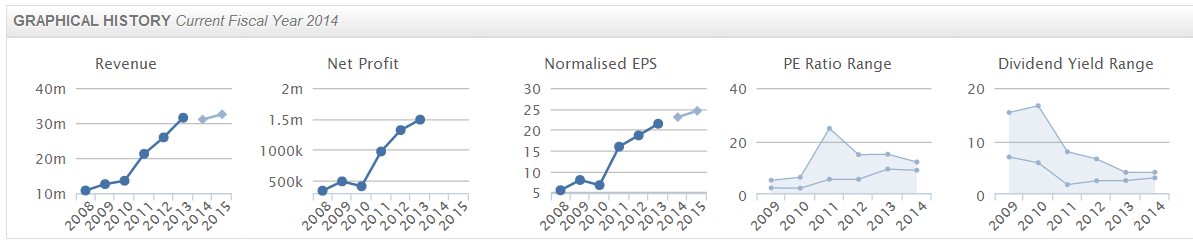
The Stockopedia graphical history shows a good progression over the last few years:
The reason I mention Solid State this morning is that they have issued an AGM statement. It has a 31 Mar year-end, so this covers just over 4 months of the current financial year ending 31 Mar 2014.
The key sentences in today's statement are (my bolding):
Solid State has made a reasonable start to the current financial year. Order intake remains strong and margins are holding well. We expect to see a repeat of the traditional second half weighting to our revenue, reflecting the buying patterns of our clients and their budgetary cycles...
...The Board believes that Solid State is demonstrating its resilience in markets that continue to reflect a cautious approach to capital expenditure. The niches that we service remain in demand with sentiment improving.
So that sounds OK, rather than exciting. It doesn't comment on the company's performance versus market expectations, which is a pity, as that is really the key point that a trading statement needs to convey.
Market expectations are for 23p EPS this year, so if we make a leap of faith and assume that the company will achieve those (which appears to be consistent with the overall tone of today's statement), then the shares are on a PER of 10.5, which looks reasonable value.
The dividend yield is reasonable too, at 3.5% forecast for this year, and 3.7% next year. Factor in some improvement in trading from a cyclical economic recovery, and there could be some good upside on this share price, if the company continues to perform well. They have also made a number of small, but successful acquisitions in recent years, at very low prices. So a good track record on that front too.
Quintain Estates And Development (LON:QED 88p) issue their Q1 Interim Management Statement (IMS). It gives general updates on their projects, but doesn't give the key NAV figure.
Their London Designer Outlet centre is now 70% let, ahead of opening in October, which is not great to be honest, it should be 100% let this close to opening, but it's being presented as if it were a positive.
There are updates on their two other key projects in Greenwich Peninsula, and Wembley.
Interestingly, they note that the London property market is strong, and characterised by an acute shortage of supply. Well that's hardly a surprise, considering property (especially new build) is being hoovered up by overseas buyers as investments, many of which are then left empty! What a ridiculous state of affairs. Also policy-makers have allowed the population to explode, without apparently giving any thought to where all these people are going to live.
So property prices in London & the S.East remain at dangerous bubble levels, with the Help to Buy scheme re-inflating the bubble even more. What we need is a massive new programme of affordable housing for rental by Councils, to meet demand, and to stop the lining of the pockets of Buy to Let landlords from the taxpayer subsidy known as Housing Benefit. Wouldn't it be better to divert that huge expenditure into building new Council Houses, and thereby create large numbers of badly-needed jobs in the construction sector? Sorry, I'll get off my soap box, but sometimes you really do despair at the lack of vision in our political class.
It is interesting to note that Quintain have supplemented their bank borrowings with a £115m 6.5% seven-year secured bond. This is a good example of how medium to large companies are getting round the shortage of bank lending, and making their own arrangements with investors, cutting out the middle man. This strikes me as a much healthier way to finance a property company, with a range of secure funding options, rather than relying on one huge source of finance from a bank or group of banks.
With the market cap now up to £457m, I'm inclined to drop update coverage of Quintain here from now on.
Cyprotex (LON:CRX 6.88p) results look good. I don't generally comment on the pharmaceuticals sector, as it's not an area I understand. This company issued a positive trading update on 20 June 2013. Their interim results to 30 Jun 2013, published today, show turnover up 22% to £4.55m, and an operating profit of £0.3m. The outlook statement indicates that they are on track to meet expectations for the full year.
Forecasts are for £10m turnover, £1m profit, and 0.3p EPS. So at just under 7p the shares are on a PER of about 20 times, and the market cap is around £15m. So it doesn't look cheap, but then growth companies never do. It's not my type of thing, as I have no way of knowing whether growth will continue or not.
Well, sorry this is such a short report, but I've looked at a couple of other things, but really nothing of interest today, so I'll sign off.
See you same time tomorrow!
Regards, Paul.
(of the companies mentioned today, Paul has no long or short positions)
Disclaimer
This is not financial advice. Our content is intended to be used and must be used for information and education purposes only. Please read our disclaimer and terms and conditions to understand our obligations.

8 comments
So, for example, here's a typical piece from the Daily Mail on the unfairness of Council Housing. They were commenting on George Osborne's decision to raise council rents and end lifetime tenancies.
"While many council tenants are indeed poor, a substantial minority are not. Last year's Family Spending report by the Office of National Statistics sampled the income of 104 households renting council homes across the UK.
Of these, 12 earned more than the median income for UK households as a whole. Three were in the top 30 per cent of earners, and one was in the top 20 per cent.
Given that there are 2.7 million council tenants in Britain, it suggests there are 310,000 households living in council homes, even though they enjoy above average earnings and so ought to be capable of buying or renting a home on the open market."
and.
"The changes announced last week will start to level the playing field between council tenants and those who have to rent on the open market-It will put an end to hereditary tenancies and of well-off people living in heavily subsidised housing.
In future, all tenants will be means-tested every five years to see if they still need subsidised housing. Even so, many thousands of well-off tenants living on existing tenancies will continue to enjoy their homes on the cheap - supported by you and me."
http://www.dailymail.co.uk/property/article-1323535/Social-housing-reform-Council-rent-74-week-private-rent-280.html
The Daily Mail would be leading the charge against any new plans to increase council housing.
It may be relevant that one of the Daily Mail's most famous headlines was 'Hurrah for the Blackshirts!' (Nice report today Paul, thank you).
Maybe a possible solution would be to introduce much higher taxes on properties bought by overseas buyers.
As Paul stated, much of the property in central London is purchased by non-UK residents, which drives up prices and makes property unaffordable for UK residents. Reduce the demand from outside the UK, prices drop and become more affordable, so UK residents can afford to buy.
Developers have no incentive to sell other than at (or above) market price, and currently overseas buyers are the ones that can afford it. Choke off that demand, and prices will stabilise.
A quick comparison of London properties v. the rest of the country, and the rate of growth of London prices, shows how ridiculously expensive has become.
You might be right in that there is plenty of evidence to suggest that wealthy overseas buyers are propping up the London market, but the problem remains as to whether there is the political will to introduce such a tax.
I don't think the idea of a tax on rich foreigners in itself would not find a degree of political support, but the knock on effect, reduced sales, the possibility of prices falling, etc, is what politicians don't want to hear. This has more or less been the case since the 1980's as home owners - important voters - have seen their wealth as being tied up to a large degree in property. Who would they blame for any fall in price? More likely the politicians in power rather than the free market if prices fell.
It's also the reason why the idea of building council housing has little support today. Council housing is seen as going to the low paid, unemployed or housing benefit stereotypes. It can be seen as unfair, in that the rents for council properties are significantly lower than the private market. Politicians like to play the fairness/unfairness card, especially if it's alongside the hard working families card. They especially like to play these cards if it looks like someone is getting something for nothing or has an advantage that middle earners don't have. The irony here is that council housing lived in by the unemployed, because it is usually rented out cheaper than market rents, would actually over time reduce the housing benefits bill. I'm not saying that council housing should specifically go to the unemployed or those seen as benefit scroungers, but currently they are mostly paying private landlords many of which know how to play the system. The rents they pay are generally much higher.
I don't think any UK political party or politician is brave enough to address the price/investment issue around property that I raised in my initial post because they would be afraid of losing the property owner vote. I suspect they also don't care that much about non property owners as most of them tend to be younger and they don't vote anyway!
If any Government seriously wanted to address the issue of affordable housing then the only real way to do it in the UK is probably via Council Housing as I doubt whether any relaxing of planning laws are likely to happen that would encourage the private sector to do it. However, I do feel that what the UK suffers from is the major disconnect between the price and rent that the free market property owners seem to expect as a return and what many people can really afford.
The whole debate is a fairly complex one. For example, the media like to focus on shortage of property supply, Government does the same, yet it is estimated that up to one million empty properties exist in the UK. Councils do actually have the power under the Empty Homes Acts 2004 to supposedly take such properties, do them up if necessary and rent them out. However, there is no political will at all to do this and I think only a few hundred properties have been taken in this way since 2004. Pretty pathetic given the one million empty property figure in a country with a housing shortage.
The conflict here is that Councils probably don't want to be seen as taking over private properties. Question also is whether they have the funding to do it on a massive scale and the inevitable bureaucracy that would build up as a result. But it also comes down to politics. A massive building program or even a takeover of empty properties should in theory effect both house prices and rising rents and here in a nutshell is the problem - the disconnect. We live in an financial system that seems to need these rising asset prices. Property owners, builders, Landlords, banks, the financial markets and Government all seem to see rising prices and rents as a naturally good and desirable thing. The disconnect is that for most people these prices and rent increase get ahead of what they can afford. A free market would suggest that any disconnect should then be corrected by falling prices, but as we have seen since 2008, the inflationary asset bubble nature that our financial system has become dictates that this cannot be allowed to happen.
I feel that when it comes to housing we are probably 15-20 years away from the first serious social issues that will arise from the disconnect mentioned above, in that if generations are priced out of ownership, then clearly when people come to retirement they will have no choice but to continue renting. Given that their income will be reduced, how exactly will they afford it, especially the relatively low paid. The housing benefit system is being cut back, private and public pensions are also under pressure and private Landlords hate to reduce their rents.
Council housing is one answer, but it would require an acceptance that not everyone can afford inflated free market rents and house prices that aren't allowed to fall, that subsidies in the form of cheaper rents are necessary and that Council properties shouldn't be sold off at a discount just because you happen to have been living in the place for a few years. I can't see it happening as the politicians brought up on the 1980's belief that your home is an investment simply don't have the desire to do it. I believe that Mrs Thatcher once said that buying a property is the biggest investment most people would make in their life as she sold off the cheap council stock and stopped councils from using the proceeds from the sales to build more. Hence we are where we are today. Every Government since has lied about wanting to create more affordable housing - anyone remember John Prescott's plan to build 100,000' of £50,000 affordable homes every year? Never got off the ground. All Governments do is prop up current prices with schemes like Help to Buy.
I for one can't see the affordable housing issue whether in house prices or rent being addressed until social issues force it on Government. By then it might be too late.
"What we need is a massive new programme of affordable housing for rental by Councils"
It has to be remembered that we do have affordable rental schemes - its just that many are ocuupied by people that do not need affordable rental. For instance, I believe that a well known union boss on a decent salary still lives in a council house.
Also many Councils have proved themesleves to be pretty inefficient at managing council housing stock, wasting a good deal of public money in the process, I am not sure that Britain could afford them to embatk on a new council housing program.
Great report as always Paul, and thanks for the gentle reminder about FWEB on twitter yesterday. They look a good solid business well diversified over several countries, and a great divi too. Bought in this morning.
It's Puricore's interims tomorrow and have mixed feelings. I know it's very speculative but was hoping with all the recent contract wins it may be a good one. Any thoughts?
Hi it_trader,
I like Puricore actually, and hold a few shares personally.
Given the positive newsflow, I'm perplexed as to why the shares have been in the doldrums?
It's a bit speculative, but who knows? Will have to see the figures tomorrow before commenting any further, as it's the numbers that drive things. I'll give it prominence in tomorrow's report though.
Cheers, Paul.