Small Cap Value Report (7 Feb 2014) - DSG, WTL, ACL, NBU, CAMK

Good morning! I've invested in a new computer for my London accommodation, so will be able to insert graphics into reports now, even when staying up in town. Am using it for the first time today, so will blame any typos today on the new keyboard!
Dillistone (LON:DSG)
This is a small software group, serving the niche for software specifically targeting head hunter employment agencies. I had a pleasant lunch with the Directors last year, who made a good impression as the type of people I like to back - i.e. straightforward people who are just getting on with the job of growing the business. Niche software businesses are intrinsically attractive as investments, since they usually provide mission-critical software, and have a very good stream of recurring revenues, as Dillistone does.
Also in this internet age, it's fairly easy to rummage through Google to find third party evidence of whether a software product is any good. Decent software should leave a pretty clear trail on the internet, from user groups discussing it, reviews, etc. If there is virtually no evidence of software even existing on the internet, then you need to question why.
Even though it's small, Dillistone software (which operates under several different brands) is highly regarded by its users, based on the discussions which I've monitored online via a user group. Decent software will also usually feed through into decent financial figures. That is the case here, with a positive trading update for the year ended 31 Dec 2013 issued this morning.
Various detail is given, but the key sentence is this;
... for the year ended 31 December 2013 it expects its performance to be in line with market expectations.
 Turning to valuation, the Stockopedia graphics show good value, with a modest PER, and a very good dividend yield.
Particularly of note are the high scoring green bars in the Quality section, with a strong operating profit margin, and strong return on equity and capital.
The downside factors are more short term considerations - that the share is illiquid, and has a rather wide bid/offer spread.
I don''t think this share will be a multibagger any time soon, but it does look like a nice quality small business, on a modest valuation.
Growth should continue through bolt on acquisitions (it's quite a fragmented space), and smaller competitors are being squeezed through software increasingly moving onto the Cloud. This is expensive to set up, but Dillistone have the resources to do it, whereas smaller rivals may not - thus also providing reasonably priced takeover targets, as well as limiting competition.
So this one gets a thumbs up from me at the current price of 105p. As always, that's just my personal opinion, so please form your own view, based on your own research.
WH Ireland has issued a positive comment this morning, upping their price target to 130p, which looks sensible to me. So there could be a fairly low risk 20% gain to be had here possibly?
Waterlogic (LON:WTL)
This group supplies water purification machines (instead of bottled water dispensers) for offices, gyms, etc. It grew by rapid acquisitions, and seems to have experienced some problems digesting them. The shares have drifted downwards, as you can see from the two year chart below;
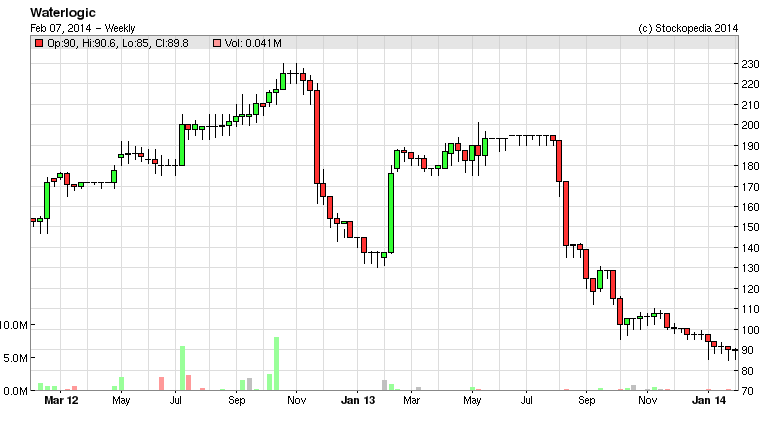
That in itself doesn't put me off, in fact I like shares that are out of favour and overlooked, as you can sometimes find a real bargain. However, far more often, the share is cheap because it's a crock. I've lost track of the number of times I've bought something that looked cheap, only to see it grind relentlessly down, then you end up in that most depressing of investing places - the forlorn hope of an eventual share price recovery, then eventually one day you lose patience & sell up. Within days, or even hours, Sod's Law will kick in, and some remarkable turnaround news will be published and the shares shoot up! We've all been there I'm sure - selling right at the exact bottom.
Anyway, back to Waterlogic. The company has issued a trading update today which sounds reasonable, as far as it goes, with the key parts saying;
The Board today announces that Waterlogic has delivered a solid financial performance for 2013. Revenues are expected to be approximately USD 124 million (2012: USD 101 million) for the full year and adjusted EBITDA in line with market expectations.
2013 was a year of significant progress for Waterlogic. Group revenues increased by approximately 23%, with organic revenue growth expected to be in the region of 4.2% (3.5% at constant currency). This is coupled with increased recurring rental and service income, which now represents over 40% of revenue on an annualised basis.
I'm not keen on adjusted EBITDA as a performance measure at the best of times, but especially not for a company that presumably is installing equipment at clients' premises on hire? So the depreciation on that equipment is very much a key component in their overall costs.
The market cap is currently about £70m, and I note from their most recent interim accounts to 30 Jun 2013 that they have taken on a lot of debt recently. That probably rules it out for me, although I'll be interested to read their 2013 accounts which are due out on 7 Apr 2014.
Interesting to note that Directors spent about £180k buying shares last autumn, which seems encouraging. Following Director trades is not foolproof by any means, but I'd rather have Directors buying than selling.
Acal (LON:ACL)
Shares in this electronics company have been doing well in the last year. Today the company reports strong growth in sales, although this has mainly come from acquisitions.
On profitability, it says;
Results for the year are expected to be in line with consensus.
This relates to the year ending 31 Mar 2014.
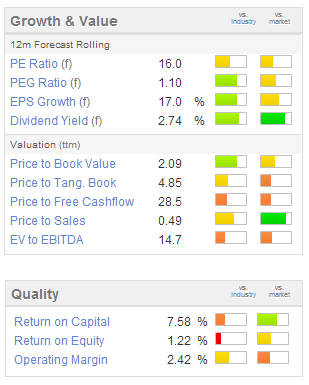
As you can see to the right, the Stockopedia valuation graphics look unexciting, so the only reason to take an interest in these shares is if you think that the company is likely to out-perform against broker forecasts.
I only do a superficial skim of the key numbers here, so have not looked into their business at all, so can't pass judgment on that.
I've just had a very quick skim of their last interims, and it looks like a low margin business, which I tend to dislike.
Their Balance Sheet is strong though, with a healthy working capital position.
Note that there is a pension deficit, which appears small, but accounting standards seem to badly understate some pension deficits, compared with much larger actuarial deficits (which is the figure that matters, as overpayments are determined by this usually larger actuarial deficit). So it's always worth having a quick look at the last Annual Report (available online for all Listed companies these days) and find the notes relating to pensions.
The Danger of Share Tips
There is a strange (and in my view very wrong) exemption in the financial services rules, that allows journalists to freely tip shares in newspapers and magazines, often on virtually no proper research, to a very often unsophisticated readership.
That is the complete opposite of what we do here on Stockopedia, which is all about doing proper research ourselves, using some excellent tools on this site, and making our own informed investment decisions. Learning from our investing successes and failures along the way.
In the last say six months, I've noticed an increasing trend for tips in certain newspapers and magazines in particular (especially the IC and Mail on Sunday) to trigger large spikes in share prices first thing. This is partly because Market Makers run for cover when they see shares tipped somewhere, and so the price will be marked up initially, and then hiked up dramatically if lots of buy orders come through after the opening bell at 8am.
My worry is that these short term spikes are costing people money. Hopefully readers here are sufficiently sophisticated to realise that these spikes are actually selling opportunities, not buying opportunities. Indeed I banked a £1,500 profit this morning courtesy of the IC's tipping Arden Partners (LON:ARDN) and triggering a 40% spike in price to 100p, where I was very happy to bank my gains about a year ahead of schedule. I shall be recycling a bit of that profit into an IC subscription, which seems only fair!
But what about the guy on the other side of the trade, who rushed in excitedly thinking he's found a bargain, and actually has just handed me a lump of his money on a plate, via the market? It raises serious questions about whether journalists should be allowed to recommend that unsophisticated readers buy or sell particular shares. Surely they should instead just offer a balanced opinion, and then invite people to do their own research, as we try to do here?
It's much better for everyone that way - as you don't get massive spikes in price, leaving some people out of pocket. Or maybe we all need to go through that learning process, and lose money on buying tips, in order to become better investors? What do you think, please feel free to comment below (it's free to register for commenting by the way).
So I shall continue to regard newspaper tips triggering big spikes in price as wonderful selling opportunities. The people who buy usually have the attention span of something very absent-minded, so you can usually be sure that the price will spike up, then gradually drift down again within just a few days. Occasionally though, they do identify something really cheap, and the price can carry on rising.
That brings me onto Chinese stocks. As regulars know, I don't touch any of them, because their accounts cannot be relied on as being accurate, in my opinion. Same with Indian companies, and indeed most overseas companies Listed on AIM have something wrong with them, to quote Mark Slater, and he's very obviously correct!
So why on earth have the IC today tipped two very questionable Chinese companies on AIM, which most serious investors wouldn't touch with a bargepole? Most people agree that Naibu Global International (LON:NBU) and Camkids (LON:CAMK) are cheap for very good reasons! It really concerns me to see those spiking up in price this morning, on obviously uninformed buying from readers of IC, who are effectively lambs to the slaughter the way I see it.
If people are going to tip shares (which they shouldn't, in my view), then at least apply some sort of quality filters to ensure you're not pushing people into things that have a very high risk or likelihood of not being what they purport to be. I think everyone who writes about shares has a duty of care towards their readers, to not direct them into things that are likely to lose them money. Or at least, to cover them with risk warnings, if they are high risk situations, so that people know what they are getting into.
OK, that's it for now. Have a smashing weekend, and see you bright and early on Monday morning.
Regards, Paul.
Disclaimer
This is not financial advice. Our content is intended to be used and must be used for information and education purposes only. Please read our disclaimer and terms and conditions to understand our obligations.

53 comments
Paul
Could you specify what you mean by "Chinese stocks"? I know it sounds like a silly question, but there are a lot of variables - for example Edward Croft in earlier comments mentions as Chinese RCG Holdings (LON:RCG), a Hong Kong-based company incorporated in Bermuda with (last time I checked) HK and Malaysian management and business in a range of countries, one of which is China. Now, is every company listed or based in Hong Kong to be considered a Chinese stock in the context of your comments above? Presumably not, as there are many large and venerable companies there. Then there are more borderline cases like Asian Citrus Holdings (LON:ACHL), again a Hong Kong company with a predominantly HK board, but unlike RCG its business is entirely in China. Clearly its connection with the PRC is strong, but does it fall in the same category as Naibu Global International (LON:NBU), based in China, run by Chinese nationals, with no business outside the PRC?
I don't think it matters particularly how Chinese it is! To my mind, anything Chinese (or Indian) that Lists on AIM is not something I would touch. A simple rule that means I'm not exposing myself to perfectly avoidable levels of high risk. Other people can do what they want with their money, this is just how I like to protect mine!
P.
But you do say
That's pretty categorical. I just wondered how you define the term - do you include Hong Kong-based companies, for example?
Everyone gets so excited about Simon Thompson's bargain shares but he just uses Ben Graham style filters that are readily available on Stockopedia. You can find most of the stocks he mentions each year on our bargain screens.
For an indication of the disgust in which the market treats Chinese Aim Shares just take a look at the likely lads on this - Ben Graham's Net Net Deep Bargain list - Naibu, RCG, Taihua, Asian Citrus - all the likely lads are there selling for less than liquidation value :-)
http://www.stockopedia.com/screens/benjamin-graham-net-nets-screen-30/
I haven't read the full thread here, but I do remember West China Cement had an awesome run. It did though, from memory, have a very good corporate governance structure including a Brit as either Chairman or CEO. Some of the others I've mentioned had nothing more than a puppet NED on the board.
I've lost money on Chaoda Modern Agriculture,I'm showing losses on Asian Citrus and some Chinese stocks listed on the US market.If the figures from Naibu and Camkids are correct,then the shares are bargains but I have no way of telling.
The short sellers who expose Chinese mid-cap scams listed in the USA don't seem to care about Asian stocks listed on AIM,because the market caps are small,the markets are thin and the spreads are wide.So there is less scope for exposing any falsehoods.
One day, a friend saw Nasrudin the Mullah eating a bowl of red hot chillies. Nasrudin was panting, his face was red, and tears were streaming down his face. His friend asked, "Why are you eating all those hot chillies?". Nasrudin replied, "I'm looking for the sweet one"
And the point is? CAMK, NBU. Chinese companies, Less than 2 years flotation apiece. 'nuff said.
That is what they all said about West China Cement. Ended up rising over 10 fold from 50p to 700p within just 2 years and just 2 years after listing . Aided by getting an HSE listing. There are too many similarities to point out!
Very high risk but can be very very high reward.
Hi Investor2015,
You've made some very interesting points, and made them well - a fascinating debate for sure.
Marlborough fund management buying in is encouraging, and the payment of the dividends more so. I'm coming round to the possibility of maybe making a very small punt on this - treating it as gambling, i.e. factoring in a strong possibility of it being a 100% loss, and sizing the position so that it wouldn't hurt, but giving potentially big upside.
The thing that's making me hold back is that literally EVERY time I've taken this approach in the past, it's turned out to be a 100% loss!
Cheers, Paul.
Hi Paul,
For what its worth, I certainly would steer clear of CAMK and CTEK. As I say, they are in the dumping phase which is the worst part!
Factoring in the chance of a 100% loss is the right mindset to have. The upside could be several hundred percent, the downside is 100% but I probably think that the company has some book value in the brand and inventory so in practice the downside is if they delist. Rest assured I have taken steps to get the board to reassure me that wont happen and they seem to be keen to make this a success. When they listed a couple of years back they were a much smaller company than now so with sense they will get an HSE listing down the line
They will be paying a dividend this year unless it is a total fraud so you should be able to bank 8% straight off. I wont be reinvesting that but pocketing it.
A meaningful but modest stake for me in the morning. If it does turn out to be something its not, i'd expect maybe a maximum of a 75% hit as i dont think they will delist and they wouldnt straight away meaning that I can sell up. If it is real, then it could genuinely go up to 400p in time but im keeping it real with a first target of 150p to see how it fares. if it doesnt move for the next 2 months then im out but i suspect that the momentum from friday will carry it far and that it could continue the rise tomorrow. We all know that positivity springs positivity after all. Seeing the shops and product first hand helped me to understand the business model and that is what is attracting me. £4-£6 per pair of shoes is a really big undercut compared to competitors.
Keep up the excellent morning posts.
Investor2015
Hi,
I don't accept that Naibu Global International (LON:NBU) are likely to have any competitive advantage on cost. Trainers are just a commodity product that can be made in any factory in China for about the same cost. So Naibu's product offering will be the same cost as any other low-medium quality trainer manufacturer in China, surely? Of which there must be thousands of similar competing factories. So I'm suspicious of their very high operating profit margin of 21.2% - just seems too high for what must be a competitive market, with no barriers to entry. Unless the Naibu brand has strength in China? That might make sense - i.e. commanding a higher gross margin due to brand strength, but cost savings over other Chinese trainer manufacturers doesn't make sense to me.
Also I disagree with you over Friday's spike being the start of a bigger move. Newspaper/magazine tips are generating increasingly short-lived spikes in price at the moment, and often evaporate completely within two weeks. Especially here, as insiders sell into the spikes, as do people who bought that stock and want to flip it at a profit.
You might get chartists buying in once it breaks out of the current down/sideways trend.
Will certainly be fascinating to see how it pans out, but my safety-first investing approach means that I'm not prepared to risk potential 100% losses. Since I adopted that approach about 2 years ago, it's definitely helped me out-perform small caps generally, as I've not had any big losses. Whereas previously, I was always trying to catch falling knives, and convince myself that there was upside in high risk situations, and it nearly always seemed to go badly wrong.
Maybe that's made me too cautious now?
Regards, Paul.
Hi Paul,
Even though I disagree I respect your position and stance on the company. It is completely fathomable when you look at the share price.
The best thing about the stock market is that time will answer all questions! I look forward to tomorrows session after a good robust finish on the US markets on Friday.
Investor2015
Hi Investor2015,
Likewise, I respect your position too - you've made some excellent points very well.
On balance I've decided not to buy any Naibu Global International (LON:NBU), but can see the argument for having a small punt on it with money you're prepared to lose, as if you're right then the upside % could be a lot greater than the 100% loss potential.
It will be fascinating to see how it pans out!
Also this thread is a great example of how bulls & bears should discuss shares - politely and rationally - please take note posters on other, lower quality bulletin boards, who descend to ad hominem attacks at the drop of a hat.
Regards, Paul.
I thought the investors chronicle article was balanced. The seed / venture shareholders selling, is I think misleading. It is quoted now, they have probably made multiples on their investment and are what they do is seed pre ipo companies. The question is cash and is it real. The dividend clearly gives support. Am lost - has Paul been to China to see the operation? This is not a great business but it is not a conceptual tech play and although I do not know this for sure, I somehow doubt all the other names mentioned as China plays had net cash equal to their market cap.
Interesting debate on Naibu Global International (LON:NBU), thanks to all who have posted. It will be fascinating to see how it pans out.
My view, for what it's worth, is this. I base everything on weighing up risk/reward;
1. There have been numerous Chinese companies which have Listed (especially in America) which have turned out to be frauds. Therefore as with anything in life, if an area is very high risk, it's best to just completely avoid it.
2. The Chinese economy is not capitalism. It's a strange hybrid of a command economy, and their version of capitalism, with the State involved in everything. Therefore no transactions are really arms length, things are often not what they seem, and you simply cannot rely on their accounts in the way you would with companies in most Western countries. To apply Western judgements to Chinese accounts is just fundamentally wrong.
3. Naibu did not need to List - it didn't need to raise any money, so you have to question the motivation for acquiring a Listing. The only rational explanation is that the owners wanted a vehicle to raise cash in Britain from British investors, by selling them shares which may or may not relate to a sportswear business in China.
4. The fact that there have been repeated, large Placings of existing shares by founder shareholders, at significant discounts to the prevailing market price, indicates to me that the figures as presented are obviously not correct. No rational person would sell shares in a cash-rich business on a PER of 1, if that valuation was real. So the valuation is obviously wrong, there can't be any doubt about that, it's obvious! So to be on the other side of that trade, and buying shares from the founders, suggests to me that you're being fleeced in some way.
The one fly in the ointment, and it's quite a big fly, is the fact that (amazingly) the dividends were recently paid.
That certainly stops the bear argument in its tracks. If the whole thing is suspect, why would they pay dividends? One explanation is that it was anticipated that the share price would surge on payment of the dividends, thus enabling another large tranche of shares to be disposed of at a higher price (thus perhaps a net overall profit was anticipated - i.e. higher value of shares sold post-dividend, exceeding the cash cost of the dividends paid to minorities?).
So overall, for me, the whole thing completely fails common sense testing. So for that reason, I'm not really interested in digging into the supposed activities of the company. Also, if the shares are essentially designed as a vehicle to raise cash for the founders outside of China, then they're not likely to want to retain a UK Listing once they've achieved the desired result. It costs money to pay NOMADs, etc, so I would imagine the chances of a de-Listing are pretty high, and if that is announced, then you're looking at an instant loss of 50-75% at a guess. Again, why take the risk?
Probably like most (maybe all?) of us, I don't yet know what the truth is, but looking at risk/reward, in my estimation the risk factors are probably 90% likely to be true, with the upside case maybe having a 10% chance of being true, so to me that's just not an attractive bet.
Regards, Paul.
Hi Paul,
I just want to resay my point about why they listed
China has very strict currency controls meaning that it is very difficult for people to get money out of china efficiently. That is why so many chinese companies list on AIM, even though they know the horrible past that most have had (not all though, West China Cement was a beautiful company!).
When I spoke to the fund manager in question, he concurred that this was the reason why they listed. It allows these companies (or seed investors) who nobody has ever heard of to get cash out of china without taking a haircut. It fits in with what Brian was saying about these companies literally being given shares. Give them shares, use the foreign listing, and get cash out. That is why so many list on AIM
That is also why they took the seemingly massive discount! They got the shares at that level, they sell them as soon as possible and they don't lose anything. I am 75% sure this is what is really going on. What that really means is that the company is actually sound underneath, or at least it should be. Now those investors have buggered off, proper, respected investors such as Close Brothers, Montoya, and Marlborough have stepped in to take up this 'discount'.
It is NO COINCIDENCE that these placings were done at 60p and pre-arranged. The funds know what they are doing and wouldn't risk a penny if there was any sense of fraud. As you say, it's not worth it from their perspective.
So what has happened IMHO is that the seed investors are gone with their non-Chinese cash and a company with a solid cash shell and strong financial figures is left in it's wake. Not one to bet the house on but a meaningful position now should pay off adequately if it's not a fraud
if you want further proof that this is the case, look at CTEK and CAMK. They're further back up the curve as the seed investors are in the dumping phase now that the lock ins have expired. It's all very weird, but once the dumping is done, a bargain basement opportunity is left. I suspect that is what Simon saw. I am interested in your thoughts on this, but as above I'm very confident this is the truth and I am very happy to jump on the bandwagon now that the dumping is done
PER of 1 and a fat dividend yield. All because of the Chinese currency controls!
Chinese,eh :-]
Investor2015
ammendment. The chances of Naibu delisting are very low in my opinion. There is no reason for them to as a listing has its merits anyway. The finance director seemed determined to make the AIM listing a success through progressive dividend payments first, and then a buy back if needed
Hi Investor2015,
It's a nice theory, and if you're right, then it could be a profitable trade.
I'm not convinced though. If those dividends were sustainable, then surely as a seed investor, you would just collect your dividends in sterling in the UK?
If the Chinese currency controls are the big issue, then it suggests that the dividends paid recently are not likely to be repeated?
The bottom line for me is this - irrespective of other factors, if the people who know most about the company (the insiders) are selling out as fast as they can, and at a PER of 1, then something's not right.
Good luck with it! It's just too high risk & uncertain for me.
Regards, Paul.
Investor2015,
We all have to form our view on the different potential investments. You appear to have done some initial research. As time passes, if you feel motivated to look further and make reasonable demands of management, so you may upgrade your view.
Good luck with your investment. I'll run through your responses quickly, but am not going to spend too long on a company in which I no longer have a financial or other interest more than passing curiosity.
Firstly, you say you've visited Fujian province and seen a few shops, That's clearly a good start, but I don't think anyone would dispute that Naibu exist and have quite a few shops. I have used Google and Baidu extensively with Chinese characters, and in general found Google to produce better results. If there's anything you found with Baidu that substantially proves the scale and authenticity of Naibu (and I don't mean pictures of twenty or so shops, or a couple of trade shows), then please draw our attention to it. I guess you've already asked Daniel Stewart to look at their pre-IPO portfolio package sent to them by Naibu, with lots of photos.
It seems strange that you would visit some Naibu shops in China, but wait for a Simon Thompson tip in Investor's Chronicle to trigger you to buy some shares tomorrow. Why would you do that?
1. The AIM Admission document is a vital starting point for research. It makes it clear that there were NO early stage investors in Naibu HK, or its 100% owned subsidiary Naibu China. This whole business about early stage investors seems a recent invention to answer my repeated questions to the company about why these entities were GIFTED large parts of the company on Jersey incorporation. The answers just don't stack up in my opinion.
3. You really need to do your own research on issues like this. In several accounts from last July, the figure of RMB 1.27b was mentioned as Naibu's investment, prior to subsidies. Anyway, here are a couple of links to help. There are others.
HTTP://news.dz169.net/dzyw/2013/0716/76812.html
HTTP://dz.dzrbs.com/2013/0716/347100.html
You may also be aware of the proposed RMB 800m investment by Naibu that didn't happen a couple of years ago.
4. What you have to do is to comb through the other Sportswear market study to identify the say top 20 sportswear companies, and then look for their presence and the markets they cover - not just the top 5 big names. Naibu doesn't appear, and the others have significant web presence. This was a very time consuming exercise, and unfortunately I didn't keep detailed records, and am not going to repeat it. Also look also at all the websites trying to recruit distributors. They don't stack up with the fixed 20+ large distributors.
5. A starter for you, but there are many on this topic http://big5.chinairn.com/doc/70290/264776.html
6. Again, there are several bits in different detail, but here's an example
http://www.jjjjb.com.cn/images/2008-09/11/12210648938594b.pdf
7. Debtor days have mushroomed. Look at the profile since they listed. Compare it with creditor days. Speaking to the CEO and FD, they say it's necessary to maintain good relations. Well frankly they have to answer the question somehow, and that's probably as good a thing to say as anything, but as an investor, I don't find it convincing.
8. The UK auditor says they take responsibility for Group Audit. Regarding Naibu China, I quote their senior auditor: "We undertake the work through an entity as part of our international association". Separately, "We were involved at the primary and the completion stage". He later clarified this as meaning that they set the requirements, and reviewed the results. You can see from the Crowe Horwath International website that they are a NETWORK of 171 INDEPENDENT member firms. That means just what it says; they are independent firm who pass work to each other.
You also say Naibu is a franchise. If you'd read the Admission document, you'd know it isn't a franchise, because to run an unauthorised franchise is unlawful in China. If their business is legitimate, being considered a franchise, is one of the largest risks, because their business would potentially be no more.
Hope that helps, but as I say I have no financial interest, so am not going to spend more time.
Brian.
@Brian, thanks for these interesting comments. Like you I am not a holder because I am just not in a position to do my own research - I cannot travel to China or read Chinese characters. The risks that you mention are enough to put me off.
However just a comment on " You can see from the Crowe Horwath International website that they are a NETWORK of 171 INDEPENDENT member firms. That means just what it says; they are independent firm who pass work to each other."
This is not entirely straightforward. Auditors are typically partnerships, or LLPs these days. Not being companies, they cannot have subsidiaries. So you will find similar statements on the websites of several auditing firms. For many of them though, the importance of their brand means that they take active steps to share knowledge, exchange personnel and ensure that the members of the network meet certain standards.
I don't know Crowe Horwath and cannot form a judgement on the rigour of the audit. All I'm saying is, don't read too much into that statement.
regards,
Brian,
Thumbed up your post as you raise decent points, but I am happy to answer
My 'initial' research on naibu has been extremely extensive. Becuase the company is Chinese, I have spent an extreme amount of time compiling research, and it is way more time than I would ever do on another company. I am more than satisfied with my findings.
"If there's anything you found with Baidu that substantially proves the scale and authenticity of Naibu (and I don't mean pictures of twenty or so shops, or a couple of trade shows), then please draw our attention to it."
I cannot aid you in the above, but that is the same as a lot of NON-CHINESE companies. Try finding stuff on Globo for example. It's a needle in a haystack job. There is a lot more presence because Naibu creates a consumer product. At the end of the day, I visited some of their shops without notice, and saw evidence that the brand does exist. The shops were not very full but i imagine that shoe shops rarely are during the morning hours of a work day.
I am choosing to buy in on Monday as the opinion of the market has now changed. It had not bottomed before Friday but it now has. I was actually in Newcastle on Friday and I was not able to see the share price or Simons piece. I expect the share price will continue higher as it closed near friday's highs.
1. I have already explained the reasoning of me and a fund manager. The IPO was a way to get cash out of china. Now that is done, the focus goes back to shareholders and that is why respected funds have taken stakes. If it was a true basket case, they would not have. You can bet a farm that they have done their due diligence.
4. I have found a substantial amount of internet presence. Ironically, as part of my trip I visited an internet cafe (rubbish computers) and asked for a chinese national who accompanied me on the trip to show me via the internet. I don't speak very good chinese at all, and found the google translations to be fragmented. He spent possibily 20 mins showing me all the search results, product reviews on various chinese blogs, and many other naibu links that I had never seen before. Prior to the trip, I had done weeks of research.
for ecommerce, There is no point selling on the internet if you aren't going to drive sales that way. Distributing via the internet requires transport for that. Its a very costly exercise.
3. Naibu had a list of options where they could build their new factory. That was only finalised last year. It is very reasonable to expect governmental and provincial issues to get in the way of progress. China's provincial regulation and governance can be extremely difficult to work with.
5 and 6. Thank you. I shall read but the equity investment was only for Memorial Production Partners LP (FRA:10M) so not much really.
7. debtor days have FALLEN off over the last year, not mushroomed.
June 2012 was 124. December 2012 was 121. June 2013 was 116
"None of the trade debtors were considered as impaired, and 93.0% of the trade debts were within 90 days". I don't know why you are trying to make it out to be different.
8. I will contact the auditor
9. Naibu ARE a franchise in all but name. They call themselves a monopoly but anyone can join if they meet the conditions. It is not a risk if it is working.
Thank you for your responses any way. I don't want to spend all my time defending Naibu so we can draw the line here. INVESTORS SHOULD DYOR
Investor2015
In case it's of interest, we discuss the research on tipping here: http://www.stockopedia.com/content/is-it-worth-listening-to-newspaper-tips-or-investment-newsletters-77001/
In short, a temporary price effect or 'pop' (which does happen with tips) is reflective of herd behaviour and is not the same thing as sustained outperformance, i.e. the effect usually reverses quite quickly.
Further to my previous post re Naibu, there is another point which may be of interest, particularly in view of Stockopedia's current home page concerning piggy backing on the best ideas of fund managers.
There was a TR-1: Notification of a Major Interest in Shares re Naibu by Hargreave Hale Limited on 19 September 2013 because it had crossed the 5% threshold and held over 6.5% of voting right shares. Almost all of these shares are held in Marlborough unit trusts. In practice, they will have been largely held in Marlborough smaller company unit trusts and these are lead-managed / co-managed by Giles Hargreaves. This is relevant because Giles Hargreaves is one of the best (arguably the best, most intelligent and most experienced) smaller company fund managers in the UK, with an outstanding past investment record over many years, whilst generally investing conservatively.
DYOR.
Paul
I understand your scepticism regarding Chinese shares. However to add to the balance of Naibu, nobody has yet proved it is a fraud, it has UK auditors and has paid 6p in dividends already. The money to pay the cash dividend must come from somewhere.
I am a holder and I am aware of the risk I am taking. And yes it could all come crashing down. However, based on my current experience it does appear to be a bona fide company.
Many thanks
Some people take the dividend in shares (does anybody know the ratio?), and given the rating the dividend is small relative to alleged earnings (<1%) so the net cash outlay is not that much, if the accounts are truthful. If that helped taking the rating to a PE of 5 or 10 and allow insiders to exit at the corresponding price, it would pay off many times to pay that token dividend.
Cig,
EPS are expected to be around 55p so the annual dividend is about 10% not 1%. But yes they could pay more away in a dividend but I guess they have their reasons e.g. building new factories.
I do not know what proportion take the scrip dividend but it has been beneficial for those who have to date.
This should, in my view, be on a higher PE rating but I suppose the Chinese fraud risk weighs heavy on many plus there are many Bulletin Board posters who allege fraud with no actual proof. I will remain a happy holder whilst the dividend keeps getting paid.
loudenr,
With some of these Chinese stocks such as Naibu, it pays to do some research on the internet, especially looking at Chinese language websites. Here's a list of things you could look at relating to Naibu:
1. The admission document describes the capital history of the company. At the time of the Jersey incorporation, large parts of the company were given away for no compensation. When questioned, the company said that these people were early stage backers. However (according the admission document) they had NO financial interest in the company prior to being given shares.
2. The founder holds his shares in a BVI account, as do a number of these mystery beneficiaries of the owner's largesse. Prior to payment of both final and interim dividend, large sales of shares occurred from these cloudy figures. A coincidence? Perhaps.
3. The company plans to build a very large new factory in central to western China. Why do the broker estimates of the cost of this facility differ hugely from those values mentioned in the local press as Naibu's share?
4. The company claims to be the 10th largest sportswear manufacturer and distributor in China - a claim arising from a Frost & Sullivan report. The rivals, many of which sell to a significant extend into Tier 3&4 cities, have substantial web presence in China. Naibu's web presence, even in Chinese, relates mainly to its London floatation, and a couple of stage trade shows. Note Muddy Water's comments about Frost & Sullivan's reports in its NQ Mobile investigation.
5. Around the time of the 2008 Olympics, look in the Chinese press to see information about rescue equity re-financing. Nothing like that in the admission document.
6. Look for stories of baliffs turning up at the Naibu offices and confiscating property.
7. Wonder about the mushrooming debtor days.
8. Wonder why the trading updates and financial reports are otherwise perfect, when all other sports goods manufacturers have struggled. Perhaps it's top quality management? I've met the CEO Mr Lin, and I wasn't left with that impression.
I believe the auditors are the Chinese associate of a UK company.
BrianG,
I am not yet an investor in Naibu but I have been researching the company for 9 weeks now, and that included a trip to the lively province of Fujian, the city being Fuzhou. It was only a business trip but I set aside a day to do real trawling of Naibu's stores, which is far better than any internet search. Rest assured, I found a total of 4 Naibu branded stores in the city with one additional very small shop having a Naibu section within it. I also spoke in person to Li Zhen, their financial controller, and was reassured. After Simon Thompsons tip, I intend to take a modest but meaningful stake first thing on Monday
There is a mass of photos of Naibu shops and products on the internet that can be found via Baidu, not google. You must search with the Chinese characters not in english.
1. Many investors have said that Naibu listed overseaas so that Chinese companies can get funds from within China, and realise them overseas. That is why the early stage investors have sold out and why they were all based offshore in places like Jersey and Alderney. That is also why institutions were not interested in naibu upon listing. A fund manager I spoke to said that they had guessed that this is why so many chinese companies listed overseas, and that the fund would ONLY be interested after all of them have sold out. As of now, they all have but I have not spoken to the fund manager since so cannot comment. However, it should now mean that Naibu can make progress focusing upon rewarding shareholders. I believe this also answers question 2.
The comment that a scrip dividend is used is flawed as well. The scrip is optional and cash can be taken. The early stage investors took the scrip so that they could realise funds outside of China. Now that those investors are gone, expect that the new institutions will request the cash dividend and that should prove that it is real. The chairman taking a scrip is a sign of confidence
3. The local press have not said this. If you are going to provide such comments, back them up with links
4. Naibus rivals do NOT significantly extend into tier 3 and 4 cities. In fact, I saw none of Anta, Peak, 360 or any other recognisable brands in Fuzhou. You have assumed and guessed this, incorrectly. They mainly focus on Tier 1 and 2 cities with minimal focus on Tier 3 and 4. The reason for this is the price points. From first hand, I can tell you that the average Anta shoe that I saw cost £15-£20. They did look very high quality but also very sporty. Compare that with Naibu. The average price I saw was £4-£8 which is massively undercutting. The quality of Naibu's shoes were slightly lower but they were very decent. You'd probably end up paying £20-£30 for the Naibu shoe in the UK if it had a Nike tag slapped on, and maybe £25-£35 for the Anta shoe. From what I saw, the price point is Naibu's overwhelming USP. In these low tier provinces, wages are low, there were people living on the streets from what I saw. That is why Anta, 360 and Peak don't focus on tier 3/4 countries, their price points are too high. Bear in mind that Naibu still does sell third part shoes such as Adidas, and that is a component of their revenue
To conclude, I'm afraid you fabricated that point. The rivals do not 'SIGNIFICANT'LY extend into tier 3 and 4 cities.
5. Link. It's impossible to know what you talk about, or whether it is true, unless you link it
6. Same here. Could be complete nonsense unless you provide proof
7. Debtor values have mushroomed, but debtor days have NOT. Debtor days did actually fall over the last set of results. Yes they do remain stubbornly high but that is the case with Chinese business, you don't get low debtor days! That is something that just has to be accepted. Creditor values also rose in the last set of results which is common when a business is growing fast, both creditor and debtor values rise.
8. Naibu is a franchise! They are not a retailer themselves unlike other rivals. That means they have a different growth profile. Speaking to one of the shop owners who I visited (in very fractured english!) they told me how it works. The shop owner must be able to demonstrate a good financial state before they can become part of the Naibu franchise. When they have, they are given a small amount of money for the sole purpose of re-doing their store so that it fits a generic design. That includes having a giant naibu sign outside the shop, having a set internal layout, and having a design that is meant to help sell naibus product. They cannot sell rival products therein. It works well I have to say, and looked professional for 3 of the 4 shops I saw. The one that didn't look great had an orange naibu sign which I was told was the older design.
The tier 3 and 4 cities have different growth profiles. They have been expanding far quicker than tier 1 and 2 and that has helped.
The prime reason I concluded was that it was the stunningly low prices that has helped naibu maintain a good financial state. £4 for a pair of shoes looked exceptional value when I examined the decent quality. Ergo, they haven't had to cut prices much as their price points are still far lower than that of their rivals.
8. I hanve't met Mr Lin so can't comment. The auditors are the chinese DIVISION of a UK company which is commonplace.
This should help dispel some of the rumours about Naibu. I am by no means going in all guns blazing on Monday, but the ignorance shown by some investors (not you) is worrying. A modest stake is sensible for me at this stage, and I plan to add if the final results confirm my thoughts.
Investor2015
Other positives,
1. Huoyan Lin and British director Giles Elliott have bought almost 2 million shares since the IPO. That is a massive amount of money
2. Sturdy dividend yield of over 8%
3. Hargreave hale (Marlborough. over 5%), Close Brothers (less than 3%) and Montoya Investments have taken shares
Hi Investor2015
Interesting thoughts. You write a bit like bohemianI3 on TMF that Marben100 alluded to earlier on in this thread. Is that just a coincidence!
http://boards.fool.co.uk/hi-bohemien13-and-welcome-to-the-fool-youll-like-12969501.aspx
passinthru
I am not bohemien13, passingthru. It is very rare for me to comment on any public forum I have to say, but I wanted to clear up some points.
Investor2015
Waiting for the seller to be clear would seem sensible. I somehow doubt the institutional blocks on Friday were buying in the basis do the investors chronicle....
S Guiness I believe from previous columns by Simon T in the IC that he is not allowed to invest in shares. Some columnists such as the investment trust columnist do of course but they always clearly say that they own the shares, at least in the IC.
Thanks for the feedback on deferred income guys. It's interesting as on the current assets side of things the only assets other than cash (in the 2012 AR) are "Trade and other receivables" of 1,483 plus "Prepayments and accrued income" of 196 and "Other current assets" of 36.
So maybe the deferred income is being offset by something in the "other receivables" bucket and maybe it's being offset by the "prepayments" bucket - although the latter is pretty small.
As a result I'm still not entirely sure how the deferred income is being balanced out but perhaps this is by a combination of cash (where customers have paid) and receivables (where they haven't)?
I take your point about this not being like bank debt though. Would you feel comfortable in removing the deferred income from the current liabilities when comparing to the current assets though - in order to judge the strength of the balance sheet though?
Ta,
Damian
Why didn't TW. and BDEV (also tipped by IC) go up by 40%? TUT!
Well, the deferred income is a real liability, but of course the company should be setting its prices to make a profit. So for example if the profit margin is 50% on sales then the liability in cash terms is half of £2,483K. It would be normal accounting practice for a software business to defer revenue since maintenance contracts are their bread and butter. Much better that they recognise the income initially as deferred than take it prematurely to the profit and loss account.
An immediate thought that crossed my mind re Dillistone ( £DSG) is that with SaaS providers you need to have a global outlook - and so in this case, for recruitment software, the US tends to be the leader in my experience, so I would say that Bullhorn, HRSmart, etc are the software of choice within many countries. An example would be the SME accounting software, xero (www.xero.com) which is probably completely unknown in the UK, but is out there in Oceanasia and wiping the board clean. I'm sure Dillistone have a great product but I'd want to know what their real global reach or potential reach is.
(First post to this column, but thank you for your insight, Paul)
Hi Paul,
Regarding DSG, from Stockopedia the Current Ratio is 0.9, well below your usual 1.3-1.5 safety level.
Looking at the balance sheet, current assets are 3,420k against 3,760k in current liabilities, but they're not very well laid out in the accounts. They also carry 5,538k intangible assets.
Why are you still comfortable with this?
Paul,
A comment about your thoughts on the dangers of share tips.
I am sure that many people made money on IC tips this morning, experienced and unsophisticated investors alike. However, I don’t know by how much offer quotes are increased by brokers at times like these, and so don’t know what part of the share price gain is kept by investors.
IC presented pretty compelling arguments for each of the 12 companies in the new bargain 2014 shares portfolio. Therefore, I feel that any duty to readers is covered, at least in this case. (Perhaps not so of the case of Blinkx last week - apparently a respected commentator was paid to slag off Blinkx to support the short position taken by some investors).
Rather than duty to investors being a cause for concern - we are warned every step of the way of the dangers of historical performance, losses, risk, DYOR etc, and IC warned precisely in their article about market makers raising prices in the short term - what about the advantage gained by being a journalist whose tips often move prices? What are the rules about share ownership by journalists, and how may they use information that is about to go to press? Do the writers and their staff, family and friends all get to buy / sell prior to publication the shares being tipped? While a journalist is not party to insider information, could one argue that their tips provide an edge similar to having inside information?
Or are journalists’ tips to be treated in the same way as broker upgrades / analyses? After all, brokers and well-informed journalists have gone through the same set of books.
Thank you for your articles.
Sguinness you may recall this?
http://www.telegraph.co.uk/finance/2930512/City-Slicker-sentenced.html
It’s an interesting one re IC share tips. I had been watching Pennant International (LON:PEN) for a couple of weeks but the wide spread and total lack of volume (a few trades per day) put me off massively. Then all of a sudden last week the volume was ridiculously high and the SP has since gone up over 25% from the entry point I was looking at. It was brought to my attention that it was tipped that morning by IC. Very frustrating and it puts me off investing in a share tipped as it can too easily go the other way once the herd are told to move on. The difference is Pennant International (LON:PEN) is a good solid company.
I seem to remember you holding some of these so in this case I’m sure you’re very pleased about the attention to the share?
Like Paul I too gained from the IC Naps selling 1PM for a handsome gain. Back in again after the spike no doubt
Hi Paul
Firstly, may I say how much I enjoy your column, find it very useful and generally agree with your views.
However, as one who would touch Naibu "with a bargepole" I believe you can miss good, higher risk, investment opportunities by your blanket refusal to look at any Chinese based companies.
All the figures suggest Naibu is an excellent investment opportunity. Assuming the figures are not massively fraudulent, then Naibu certainly appears worth a serious look. Not an investment for "widows and orphans" but, as serious investor, I am happy to have 2% my investment portfolio with Naibu, recognising it is to be a more risky part of my portfolio.
Although some of the past actions of the Chairman in the early days of Naibu have been slightly questionable, I regard that is more than in the price and, having looked at the company in detail, it appears to be a reasonably sound business with a reasonably sound business model. I am also reassured that Naibu's auditors are UK based and have an excellent reputation.
DYOR but certainly, in my view, Naibu is worth a look.
For anyone interested in Naibu, worth studying this excellent analysis (and the rest of the thread): http://boards.fool.co.uk/hi-bohemien13-and-welcome-to-the-fool-youll-like-12969501.aspx
Cheers,
Mark
I invested heavily in some great (looking) Chinese AIM shares back in the 2004-2007 bull run. Notably RCG and Renesola. RCG appeared to have a perfect GARP profile. Low PEG, profitable, fast growing, exciting new products. I bought soon after float at around 35p-40p, rode it up to 145p then saw it start to drop like a stone. I eventually was forced out of my position due to a house purchase at 65p. It's now trading at 1.5p.
I had a mighty position in the stock so I count myself quite lucky with hindsight that I was forced to sell, I was so attached to the story around the company's technology - that I couldn't see the wood for the trees. A huge front page news drama unfolded around the company which proved the share register and management to be highly dodgy. The whole lesson was really what motivated me to start Stockopedia - to ensure I had the tools to try to uncover potential accounting risks and fight my own biases.
What I most learned from that episode is that companies that list in the UK from far away abroad need to be treated with the utmost care. There are a litany of Chinese AIM shares that have failed investors... like Renesola, RCG, Geong etc... the question to always ask is 'why would a Chinese share float in the UK when they've got the Hong Kong or Shanghai stock exchanges nearer to home ?'
Now of course, the contrarian will say that if every Chinese stock is treated disdainfully by previously burned and skeptical investors, then there will be some that are sold down way, way too cheaply that don't deserve it - and Value investors may be able to profit over-reaction. That may well be the case with Naibu or others in the market today. All I'd say to anyone investing in Chinese AIM shares is don't bet the house on it and be sure to heavily diversify !
On newspaper tips, it's best if investors learn by their mistakes, as we all have, I certainly have. Your advice as to how to look at value companies as explained in your columns has brought a new discipline to my investing. I also write down as a log, the reason for buying and selling a share, which I recommend to all.
At a quick glance the performance of Simon Thompson's 2013 Bargain Shares Portfolio in the Investors Chronicle suggests a very respectable performance. His tips were up 36.4% compared to 10.4% for the All-Share Index, 23.9% for the Small Cap Index and 16.2% for the Aim Index. My feeling is the best benchmark to use is the Small Cap Index but he has used this one including Investment Trusts, not the rather more appropriate Small Cap Index excluding IT's (which Paul uses here). The performance of that index was 34% for the same period. So perhaps rather a less respectable performance.
I also note that the final price for Terrace Hill (LON:THG) is 31.5p being the price he advised selling them at on 13 December 2013. Now looking at the graph I very much doubt there were many people who were able to sell at that as the price fell like a stone. The shares now trade at under 23p.
Interesting that when assessing the performance for the 2012 Bargain Shares portfolio they took the closing prices from two days before publication date and for 2013 they have taken the prices from six days before the publication date.
Funny what you find when you look under the bonnet!
Paul
Much of what you have said re Chinese stocks also applies to Russian stocks (eg why is Gazprom perennially cheap?). So a warning shot across the bows of anyone caught up in IPO fever - don't touch Lenta, the Russian retailer that is mulling an IPO. IMHO it's just not worth getting involved in companies in countries with dodgy corporate governance when there are still some opportunities around in more trustworthy countries....
I have just purchased today's IC and having had a quick glance at Simon Thompson's 2014 bargain portfolio note that all his recommendations are up 10-25% ! I wish I had that amount of power! I see that he has recommended 2 Chinese clothing manufacturers Naibu and Camkids which I have been following for a while. They look VERY cheap but how much can you believe when it comes to Chinese company accounts.....
$DSG look interesting thanks Paul and with the directors holding 43.58% of the shares they've certainly got plenty of skin in the game. The only thing that puts me off (apart from them being fairly valued at the moment) is the the current liabilities outweigh the current assets materially:
Last Interim:
CA: 3901
CL: 4372
Last Final:
CA: 3420
CL: 4608
However the company do cover this:
"As with previous years, the liability includes income which has been billed in advance but is not recognised as income at that time. This principally relates to support renewals which are billed in December 2012 but that are in respect of services to be delivered in 2013. Support income is recognised monthly over the period to which it relates. It also includes deposits taken for work which has not yet been completed as such income is only recognised when the work is complete or the client software goes "live". Also included in trade and other payables is £0.360m (2011: £0.499m) relating to consideration and contingent consideration due to Voyager shareholders. The contingent consideration is dependent on the level of revenue achieved by the Voyager Software division in the periods up to 31 December 2013."
This sounds reasonable but what I don't quite understand is that if the company has billed for renewals (and been paid which is why they're a liability) then wouldn't this show up in the cash balance or somewhere else in the current assets section? Or is this liability offset in some other way? Also when the income is recognised then does this mean that it disappears from the current liabilities and becomes part of the turnover?
Thanks!
Damian
RandomAmbler
If the customer is paying for services in advance then the transaction will initially be recorded as an increase in cash and an increase in deferred income (i.e. a liability to perform the service in the future). Under the principles of double entry book-keeping each transaction has two sides to it - the debit and the credit. The liability will then be released into the profit and loss account over the life of the contract. The accounting principle is that earnings are matched with costs. This is perfectly normal accounting - but a reader of the accounts needs to treat deferred income as a real liability because the company will have to incur costs performing the service in the future.
Hope that helps.
Hi Reynart,
Thanks for the reply. You've hit the nail on the head in there being two sides to the transaction since I don't see the sides as balancing. For example if I look at the 2012 Annual Report then in the breakdown of assets and liabilities we have:
Deferred Income = 2,483 (out of 3,609 current liabilities)
Cash = 1,643 (out of 3,420 current assets)
So there is much less cash then deferred income on the books. Does this mean that while the company appears to be debt free this is just an illusion? Is this normal for a software, or other 'intangible asset' business?
Cheers,
Damian
The other place the asset side of a pre-billed service contract can end up, is accounts receivable (or debtors), if it has been invoiced but not yet paid.
I do regard the deferred income as rather different to bank debt. The latter can potentially be called in (and may be subject to covenants), leading to major problems for the business, whereas the former only becomes relevant in an insolvency situation.
Cheers,
Mark
Good spot Paul, thanks
Just to say that Dillistone (LON:DSG) is already working on Cloud projects, so is very well placed in this area. The company is also expanding its geographic range, with recent new launches in Australia and Brazil. It is already the leader in its small field, and the reviews of its products and support are universally positive. I hold a few of these and have done for a while. The dividend makes it worth holding while waiting for the growth.
In another vein I hear that some of the staff at Amplifier Technology, recently acquired by Vislink (LON:VLK) , are working overtime. A good sign perhaps?
(As usual, thank you for your continued labours Paul).