Small Cap Value Report (7 Jul 2015) - CHH, SOM, GBO, CMS, CNCT, SOLI, MCB

Good morning!
A couple of things to note. Firstly, the market crash in China is continuing apace - I'm not sure which Index is the main one, but currently the China 300 Index is at 3,660, which is down c.32% from the peak less than a month ago. It doesn't seem to be having any impact on our markets though, thankfully.
The second striking thing was the big drop in the price of oil yesterday. Looking at the chart of US Light Crude, it was trading in a range of $58-62 in May-Jun 2015, but suddenly lurched down to $53.18 over the last week. I don't know why, just the forces of supply and demand I suppose. It's making me wonder whether I should defer any further attempts at bargain hunting in the oil, and oil services sectors?
Right, quite a few interesting trading updates this morning, so let's get cracking!
Churchill China (LON:CHH)
Share price: 554p (price unchanged today)
No. shares: 11.0m
Market cap: £60.9m
Trading update - today's update is reassuring:
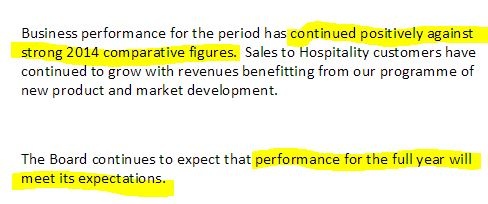
Valuation - I last looked at this company at 595p per share in Jan 2015, and concluded that it was rather too pricey. It's drifted down about 7% in share price since then, combined with broker estimates having edged up, so a double positive there.
The fwd PER is now 16.2, and the dividend yield is 3.2%.
Combined with a strong balance sheet, I think the shares look fairly priced.
My opinion - I like this company, its sound finances, and the valuation has come down from a touch expensive, to reasonable now, in my view.
There seem to be new restaurants and cafes popping up all over the place (in the South anyway), so I expect CHH will continue to enjoy buoyant trading for some time to come. Although it's important to remember that demand is cyclical, so profits are likely to drop when the next recession comes along.
I wonder if they are likely to be impacted by the strength of sterling? I've just checked the last Annual Report (page 57), and 60% of turnover is UK, with Europe being the next largest region, at 23%, N.America 8%, and RoW 9%. No mention is made about currency in today's update, so presumably the company must have either hedged, or absorbed the impact itself.
Somero Enterprises Inc (LON:SOM)
Share price: 146.5p (price unchanged today)
No. shares: 56.1m
Market cap: £82.8m
(at the time of writing, I hold shares in this company)
Trading update - this maker of laser-guided concrete screeding machines reported positively on trading at its AGM on 18 May 2015, and says today that it is "slightly above current market expectations".
More detail is given, and I'm particularly reassured that demand in China has picked up, as that was a worry previously:
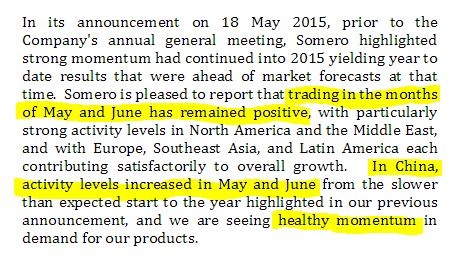
Valuation - the shares still look cheap to me, on a PER of about 11, with a strong balance sheet (containing net cash), and a StockRank of 98. There's a 2.7% divi yield too. Note the very high quality scores on Stockopedia too.
Set against that is the high cyclicality of the business historically - so demand considerably reduced in the last recession. There again, that's true of many cyclical industries, and arguably the 2008 financial crisis was such an extreme event, that future recessions may not be quite so bad?
My opinion - overall I really like this share, and hold it personally.
To my mind it's the ideal scenario really, of a high quality business, with sound finances, at a reasonable (cheap, even) valuation. So it's perplexing that the shares have slipped back down to level for the day, after an inital 5p mark-up. Quite why anyone would sell at this valuation, is beyond me! But that's what makes a market I suppose - buyers and sellers with different perspectives.
Globo (LON:GBO)
Share price: 46.3p (up 3% today)
No. shares: 373.7m
Market cap: £173.0m
Situation in Greece - Globo tries to reassure the faithful that the crisis in Greece is not really affecting it very much. Key points are;
- Greek Euro exit would lower their cost base
- in 2014 only 12% of Group revenue came from Greece
- All receivables relating to 2014 Greek sales have been received
- 2015 Greek turnover will only be 6-7% of the group total
- 42% of total group headcount are based in Athens
- Computer systems are cloud-based, and they have backup power generators, and satellite connections
- Cash reserves are outside of Greece, with only E100k in Greek bank accounts
- Capital controls should cause no interrruption to their financing, as their purpose is mainly to control/stop the export of currency from Greece
- They reassure that the Greek 49% Associate is trading alright, and paying the instalments due to the group on time
- The situation in Greece "has not arisen overnight", hence they have had time to prepare
My opinion - overall, the above sounds reassuring. However, the bigger question is whether Globo's accounts can be relied upon - in particular, where is the cash, and why do they borrow extensively (incurring E4m interest cost last year) whilst simultaneously holding greater cash balances?
I remain of the view that the accounts for this company don't look right at all, and explained specifically why here.
Communisis (LON:CMS)
Share price: 49p
No. shares: 207.5m
Market cap: £101.7m
Trading update - this direct marketing group (junk mail, presumably?!) updates positively today;
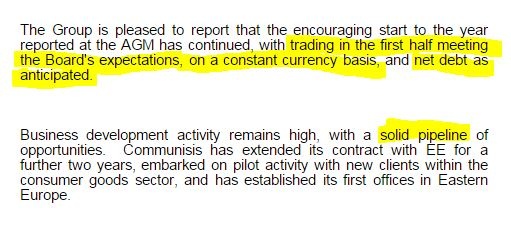
That sounds fine, but note the "on a constant currency basis" caveat - which possibly implies that they could be below expectations in sterling terms? That depends whether or not expectations factored in adverse currency movements, which it sounds like possibly they didn't?
"Net debt as anticipated" - fair enough, but it would have made more sense to actually give the figure! They're probably coy about this because the company has a ropey balance sheet, so it's easier to gloss over the negatives I suppose.
Outlook comments sound encouraging.
Valuation - looks tempting at first sight, with a PER of only 7.4, and a good dividend yield of 4.8%. However...
Balance sheet - this is where, for me, the investing case falls apart. Checking back to the last reported balance sheet, on 31 Dec 2014, note the following;
1. Net tangible assets are negative, at -£59.8m. So effectively the balance sheet has a big hole in it, caused by bank debt, and a pension deficit.
2. Bank debt - gross bank debt was £60.4m on 31 Dec 2014, which looks a hefty level of borrowings for a company that made an adjusted operating profit of £16.0m last year. On the year end date the company also held £24.5m of cash, so net debt is a more reasonable £35.9m. However, I like to focus on gross debt, as the cash figure is usually window-dressed at most companies in my experience.
The £2.4m interest cost for bank debt implies a fairly hefty average balance, of say £48m if we guesstimate 5% interest cost.
Overall then bank debt looks a tad too high to me.
3. Pension deficit - I'm more relaxed about pension deficits than bank debt, but it's still a liability, and sits on the balance sheet at a hefty £39.1m.
My opinion - the reason Communisis looks cheap is because it has a weak balance sheet. I feel they should properly tackle this issue by cancelling the dividends for say 3-5 years, to put the company on a more secure financial footing. However that's a call for management and shareholders.
Connect (LON:CNCT)
Share price: 144.5p (up 0.3% today)
No. shares: 243.7m
Market cap: £352.1m
Trading update - there's a good update from this group today, with the key part saying that "overall performance marginally ahead of management expectations", covering 44 weeks, so they should be more-or-less home and dry for the full year.
Details on divisional performance are also given, which I haven't looked at. The statement concludes that "There has been no change in the underlying financial condition of the Group".
This is a similar situation to Communisis above, in that Connect looks cheap on a low PER of 7.7, and a fantastic dividend yield of 6.5%. However, once you dig into the balance sheet, it's far from rosy, in fact it's bad.
Balance sheet - as usual my main three tests are as follows:
1. Net tangible assets should be positive - FAIL. Once you write off intangible assets of £172.9m, net assets of £2.8m becomes net tangible assets of -£170.1m - so again, a company with a massive hole in its balance sheet.
2. The current ratio should be at least 1.2 - FAIL. I'ts only 0.67 here, which is very weak. Trade payables looks very stretched to me, so they're probably getting money up-front from customers (which shows up as deferred income within creditors), and/or stretching their trade creditors.
3. Bank debt should be reasonable - this is an area of personal judgment, but for me the bank debt looks excessive, and had risen to £157.9m at Feb 2015, due to £53.0m spent on the acquisition of Tuffnells.
However, as the company points out, its net debt was 1.94x EBITDA, which is well within their main bank covenant of 2.75x. It also says that it is "committed to continue to paydown this debt towards our historic leverage ratio".
My opinion - the bull case here is that the group is a cash cow, which can handle the high level of debt, and still pay a bumper dividend yield. Personally I don't agree with that. It's all very well quoting EBITDA, but when you take into account the reality of cashflow, where tax, interest, and capex have to be funded, I don't see any evidence that this company can afford to pay such large dividends as well as reduce debt.
So one could argue that the big divis are being funded, at least in part, by bank debt, which isn't a good idea in the long run. So I suspect there might come a point where the divi here needs to be scaled down to a more sustainable level of say 2-3%.
Bottom line, it's cheap on a PER basis for a reason - the core activities are arguably in structural decline (newspapers, books - although they are supplementing this with other distribution activities), and the balance sheet is weak. Overall then, it's not for me.
Solid State (LON:SOLI)
Share price: 855p (down 4.7% today)
No. shares: 8.3m
Market cap: £71.0m
Results y/e 31 Mar 2015 - shares of this niche electronics maker & distributor have had a terrific run, more than tripling in price over the last two years, driven at least in part by a large order from the UK Govt for offender electronic tags. So the big question here is over sustainability of earnings, and whether the group is too reliant on one product/customer?
Looking first at the numbers reported today, turnover is up 14% to £36.6m, profit before tax is up 40% to £3.0m, and basic EPS is up 38% to 34.9p. So my immediate reaction is that the shares look expensive - that's a PER of 24.5 - very high for a business that has historically been quite modestly valued, on a PER of about half that.
Although Stockopedia shows broker consensus at 31.6p EPS for the year ending 31 Mar 2015, so today's results seem to be ahead of forecast by about 10%, so it's surprising to see the share price actually down today.
The order book is up, at £19.4m (vs £15.1m a year earlier).
Balance sheet - this looks OK to me, with a solid working capital position (current ratio of 1.61), positive net tangible assets (of £7.0m), and net debt at a reasonable level of £2.5m.
Valuation - I've mentioned above that the historic PER looks high, but it's really all about the future when valuing companies of course. The current year forecasts show a big increase in turnover and profits, so EPS is forecast to rise to 55.5p this year (ending 31 Mar 2016), which would bring the PER down to a much more reasonable 15.4.
That's fine, but a PER is only relevant if that level of profitability can be sustained.
My opinion - sustainability of profits is the only issue that really matters here. There's interesting commentary with the results, suggesting that there are new products in development with potential to further boost sales and profits perhaps.
That's as far as I can go with analysing this share - to form an opinion one would really need to dig into the detail about the company's products, competitive position, potential for new products, and repeatability of big orders (like the MoJ tagging contract). If this is the start of a period of big orders then the shares could be cheap. However, if it's a one-off bumper period which won't last, then the shares could be expensive.
I don't have a view on this, as I've not done enough research on the company to form a considered opinion.
McBride (LON:MCB)
Share price: 103p (up 1% today)
No. shares: 182.2m
Market cap: £187.7m
Trading update - this relates to the year ended 30 Jun 2015 - the company says that "adjusted operating profit for the full year will be in line with expectations".
Germany saw "strong growth", offset by lower revenues in other key markets.
Cost-cutting seems to be of key importance here, with £5m savings achieved for y/e 30 Jun 2015, and a further £7m savings targeted for 2016.
Broker expectations are for 7.84p, so the PER is 13.1, dropping to 10.4 times forecast EPS for the current year. That sounds a sensible rating for a very low margin business which is struggling to deliver growth.
Balance sheet - unfortunately, this is yet another company with a weak, over-geared balance sheet, that also has a pension deficit. So the 5p divis (yielding 4.9%) don't look safe to me. Again, as with other companies reporting today, McBride should really be getting their debt down, rather than stretching the balance sheet to reward shareholders, in my opinion.
The trouble is, if companies stretch their balance sheets in the good times, then they have nothing to fall back on when recessions hit.
My opinion - the shares here have had a good run, but don't appeal to me at the current valuation.
I'll leave it there for today. See you tomorrow!
Regards, Paul.
(of the companies mentioned today, Paul has a long position in SOM, and no short positions. A fund management company with which Paul is associated may hold positions in companies mentioned.
NB. There reports are Paul's opinions only, and are NEVER financial advice, nor recommendations. We encourage readers to do your own research, and make your own decisions).
Disclaimer
This is not financial advice. Our content is intended to be used and must be used for information and education purposes only. Please read our disclaimer and terms and conditions to understand our obligations.

29 comments
You do have to be a member of ShareSoc to read our AGM reports. We don't generally publish them and they are copyright material. But membership is only £45 per year.
Only some of the debt is likely to be used for acquisitions - that was made clear in my report. And I suggest we all wait and see what actually transpires in due course.
Roger
The whole point of discussing these topics is to try and get ahead of events!
As to your report I don't see a way of accessing it without joining sharesoc , do you have a link?
Anyhow an example or two of something similar would speak volumes!
There is more than one way to do it and it depends on the circumstances. You are jumping to conclusions about the future while having even less knowledge of the company than me. It was not practical to delve further into their future plans for obvious reasons.
Good Evening Roger
You're right many companies do put in place debt finance to support potential acquisitions even if they are holding sizeable cash balances.
However they pay a facility fee only and drawdown the funds when a deal is done. Only then is interest payable.
I'd be fascinated if you can find an example to the contrary.
Sometimes one takes on debt even when it is not immediately needed. From my experience of the funding tactics of many US software companies, they often way over-capitalise themselves in their growth phases and debt is of course now relatively cheap. But it was also obvious from the AGM that they are taking on more debt to finance some very specific acquisitions that they have already lined up. Read the report!
Incidentally a lot of the information re their exposure to Greece in the announcement today was also given in the AGM. It is always good to attend AGMs as you will learn things others do not know until later.
It still sounds very far-fetched to me Roger, but you're the expert at analysing software companies, so you keep telling us!
In my experience companies line up financing facilities, then draw them down when an acquisition is done. To draw the money down, start paying interest on it, then not use it, is clearly not logical, nor in shareholders' interests, due to all the wasted interest payments.
P.
Those who attended the Globo AGM, or read my report on it (available from the ShareSoc Members Network), will know why Globo is running with high levels of debt, and even trying to increase it. They are taking a very aggressive approach to capturing the US mid-market for their GO-Enterprise product - spending cash to increase their sales and marketing efforts and investing in R&D in effect. Now that might be a risky strategy, and some might not like it, but it is very much the strategy that many California based software companies would take. You either grab a major share of the market while it is still in its early phases (and compete head-on with your competitors in terms of investment in R&D), or you get left as a tertiary or worse player. They are using debt rather than equity to fund this expansion because their equity is so lowly rated (for a number of reasons) that it makes more sense to use debt. That was the explanation given. The strategy is perfectly understandable and makes sense in many ways to me but the bean counters won't like it no doubt. You can decide for yourselves whether you want to bet on the strategy working and whether you like debt in companies.
Roger,
Thanks for that explanation, but I think it rather misses the point.
I can understand why a company might want to borrow to expand, in the way you explain. However, that's not the issue with Globo. The issue is rather that they already held large cash reserves, but then inexplicably took out large (and apparently unnecessary) bank loans too.
I can't remember ever seeing any other company do this, because it's completely illogical, and involves wasting millions of pounds in unnecessary interest payments - because they are earning next to nothing on their credit balances, whilst paying E4m in interest on their unnecessary borrowings.
That is the specific point that I was querying, and to date I've not heard any credible explanation for why the company has gone down this bizarre route. It therefore remains a major red flag unless & until a logical explanation can be provided.
Regards, Paul.
Paul, any thoughts on the SUS disposal today?
Yes many people in China trade on the stock market but they seem to treat like gambling. It seems with the rise in market in the last year, it has sucked in a lot of new traders. Don't they say when everyone is talking about a share its time to sell.
Paul, keep on flagging please! As for Globo, don't know that company well, but if it has followers like Quindell has / had, then it's not for me.
As for the Chinese market, I read somewhere about how often people were refinancing mortgages / borrowing to invest in the market! And these weren't 'pros' either. So it's no wonder it's a huge bubble that's bursting right now.
Hi Paul, Interested in any comment you may have on ASOS and any read acress to BOOHOO. Cheers
hi jraitt,
I think Paul was short ASC.L so wont comment here, try his twitter feed for possible feedback.
regards
Yes I believe that is so, so he can't comment on here. Had a quick look at the trading statement, looks ok but the slowdown continues, down from 40% sales growth in 2013 to about 16% now, some due to currency. I think the problem is the valuation, PE is about 74, PEG is 4.1
Boohoo in comparison looks much better value, PE 23 and PEG 1.05. Operating margin about 2x ASC's. BOO last trading sales were up 35%.
I should declare I sold out of ASOS (LON:ASC) and hold Boohoo.Com (LON:BOO) long. Believe Paul is short in ASC and long in BOO.
Globo is has also held meetings last month about issuing senior secured high yield notes. Maybe someone can shed some light on those?
Hello Herbie
Ref the senior secured loan notes - that's a whole new "War Chest" of cash(via debt) for possible acquisitions - the consensus on ADV.. was that it was probably the best route of raising the additional War Chest that Costis felt was needed again for future expansion.
The Danger here is that they will spend this all on businesses that has good potential but haven't proven themselves profit wise - so there may be diluting the cheap p/e somewhat - but as its all done via borrowings it shouldn't really be dilutive in that no extra shares need to be issues.
Presumably it should be taken as a positive in that they were able to go down this route at all, as presumably there are some reasonable (non foolproof) checks that go on before the notes are agreed and the appropriate credit rating issued. Bods lending cash are much more likely to ask questions than those buying shares in a company i would guess ????
The ultimate would be a largeish proven US company with Blue Chip clients where the there is cross selling opportunities - the more the company morphs into a US based business the more likely it it that they can list fully in US and have a stock price similar to what would be expected from a similar business that had always been US listed.
So bad news is that its more costs, more risks , more unknowns - less clarity - but the potential is also much higher in that they may be able to increase earnings by 30-50%+ simply by using the warchest - taking on net debt and not diluting shareholders.
Thanks I understand that but do you know if they have managed to issue any? Its seems to be for US acquisitions, which is maybe not the best time to do this, due to current high market values? It does seem strange to keep raising money when you have money already.
Oil drop is due to Iran. If they do a deal then they plan to double oil output, which means a glut.
Paul - Ref Globo £4 Million finance costs
Seems logical to me that this is not simply interest but also includes bank charges and finance leases (the Annual report confirms that is what is contained in the 4.1 mill figure)
Bearing in mind that they borrowed £30 mill during the year for a "Warchest ref possible acquisitions" and the fact that this borrowings appear to be at Euribor +3.5% it would make complete sense that they would have chunky finance fees to secure this presumably "cheapish" borrowing.
Compared to the costs of a rights issue nothing seems particularly wrong here other than the fact that the company didn't explicitly state the full details in the accounts when released to add some clarity other than its an obvious chain of events with the 30 mill being borrowed.
This is all my presumptions as to the reason for the figures but the company is there to be asked the question for anyone who has a question mark. I would say that last year Globo probably where beggars rather than choosers when it comes to options available to get their hands on ready cash for future use.
Note the company also had £800k of finance income so at least they are getting some return on the cash sat on the balance sheet for future use - if everything was dodgy would we not expect this figure to be much lower?
I have to admit it doesn't seem that logical to be spending millions without a specific reason, but if the company knows where it wants to be and acquisition opportunities are limited having maximum flexibility to pounce when needs be does have a decent logic behind it even if this does have a cash hit to profits attached.
Thanks for this review.
However, there is something wrong when Globo is so highly rated by Stockopedia stock profile but has your comments on the figures. Please look into this and come to an overall balanced view.
Peter,
When I find companies whose accounts are full of red flags, I absolutely do NOT present a balanced view, I shout from the rooftops about what I think is wrong, to warn readers about potential issues.
A lot of readers here are very pleased that I adopted this approach about Chinese AIM stocks for example, as it saved people from losing money on them.
I put Globo in the same category - an overseas stock on AIM with accounts which contain numerous red flags, just like the Chinese AIM stocks did.
The jury is still out on Globo, but as with Quindell (another stock I repeatedly warned about), sometimes these things can take several years to unravel.
Screening systems are great as far as they go, but of course dodgy accounts can & do drive a coach & horses through screening systems, without the screening system noticing! That's why you need an experienced human being to pore over the figures too, to spot the things that have slipped through the net.
I think by combining the two approaches here on Stockopedia, we've got things covered.
Paul.
Paul,
Re: Globo and many others......Keep shouting from the rooftops! I'm one who appreciates your unbalanced but in depth personal view.
Hi fifthcolumn,
You're not the first person to describe me as unbalanced lol!
Cheers, Paul.
Peter -
I can attest that Paul's forensic share analysis and red flagging has saved me from my own stupidity a number of times and in the process saved me a bundle. More power to his elbow.
Thanks Paul for Solid State (LON:SOLI) review. Yes the MOJ contract is £34 over 3 years, so about 1/3 of revenue. It still has 2 years to run so I don't think that is a problem for a while. They say " Beyond the initial MoJ contract, this new team is developing a range of devices for applications in the medical and home care sectors as well as enhanced justice platforms which we expect to lead to opportunities in new market sectors both in the UK and abroad."
Which sounds promising.
Herbie - the revenues from the MoJ contract are yet to kick in - extract from the August 2014 RNS - "The contract is not expected to have a significant impact in the current financial year as most deliveries are expected to take place in financial years ending 31 March 2016 and 2017. The final deliveries will fall in the first half of financial year ending 31 March 2018."
I see thanks, that is interesting news, so there is more revenue/profits to come.
Paul, I see Solid State (LON:SOLI) has releashed results today which look pretty good. SP is down 6% though.