Small Cap Value Report (8 Oct 2014) - EZH, CTO, SIV

Good morning! It's ugly out there in small caps right now - many investors feeling a lot of pain, one friend described the market as "pretty dire" right now. The three small cap indices which I follow are hitting new lows for the year today, here is a table of the falls we have seen since this year's high points in Feb-Mar - some severe falls here, so this is very much a bear market in small caps now. Which of course is when you find the bargains, so as value investors we should be getting excited rather than fearful!

Here are the same indices over a one year period, which as you can see is grim. So if you invest entirely in small caps as I do, then you're almost certainly having a bad year so far;

Unpleasant though it may be, this market is creating opportunities - it's in bear markets when we can buy stocks at irrationally low prices, as the market throws out the baby with the bathwater. Plenty of stocks needed to come down, as they were over-priced. However, I'm increasingly seeing good value appear, and often sellers snuffing out price rises on good news - e.g. with Norcros (LON:NXR) yesterday (and Synety (LON:SNTY) ), where in both cases a selling overhang prevented the share price rise getting very far after positive announcements. That's a buying opportunity in my opinion, as sellers only last so long - once they are gone, then the price is free to move up.
There's not much news today, so I will recap on a couple of results that I didn't have time for yesterday too.
easyHotel (LON:EZH)
Share price: 92.4p
No. shares: 62.5m
Market Cap: £57.8m
This was a recent IPO, at the end of Jun 2014. I looked at the listing particulars at the time, and was unimpressed. It's too small to have floated, and it's not clear that they have a particularly viable business model. Taking over cheap hotels & splashing a bit of orange paint around pretty much sums it up!
Trading update - for the year ended 30 Sep 2014 gives various details, but the key part says;
Trading for the year ended 30 September 2014 was in line with management's expectations in both its owned and franchised hotels.
My opinion - I'll be interested to read the next set of accounts, due for release on 9 Dec 2014, but I remain sceptical about the valuation for now, which looks toppy. Forecasts are only for £0.8m profit for the year just ended, on just £3.7m turnover. That's a long way from being a serious business.
The shares are likely to be overvalued, because small investors might have a tendency to over-value the Easy brand name, and not do their research properly, assuming that it's a much bigger business than it actually is, perhaps? The IPO almost didn't happen - I can't remember the details, but seem to recall that the terms had to be amended to get it away, due to lack of demand.
T Clarke (LON:CTO)
Share price: 45p
No. shares: 41.4m
Market Cap: £18.6m
There is an Interim Management Statement (IMS) today, covering the period 1 Jul 2014 to 7 Oct 2014. Updates are given on several problems, including an insurance claim (now settled), resulting in a £0.2m exceptional charge. Also, the bank has agreed a formal waiver of the breach in the company's banking facilities, and is maintaining borrowing facilities of £13m. A "sizeable loss" has been incurred on a major account, in order to settle a dispute without litigation.
This whole thing just looks a complete can of worms! So today's RNS reinforces why I avoid building contracting firms. They are low margin, and very susceptible to significant problems emerging with disputed or badly costed contracts.
On the positive side, the order book is at a record high, with further "high value projects" in the pipeline.
On trading the company says;
... we expect a significant reduction in profits in the current year. We now expect to report underlying profits before tax of between £0.5m and £1.0m.
My opinion - it doesn't attract me at all. Note also there is a pension deficit with sizeable recovery payments. With a weak balance sheet, and an unsustainably high dividend yield, I think it's only a matter of time before divis are cut. It's a high risk share, with a much higher than usual risk of insolvency, in my opinion. So personally I wouldn't touch this share. However, it's not bad enough to go on my bargepole list.
For more detail on the figures, please see my report on the last set of interim accounts.
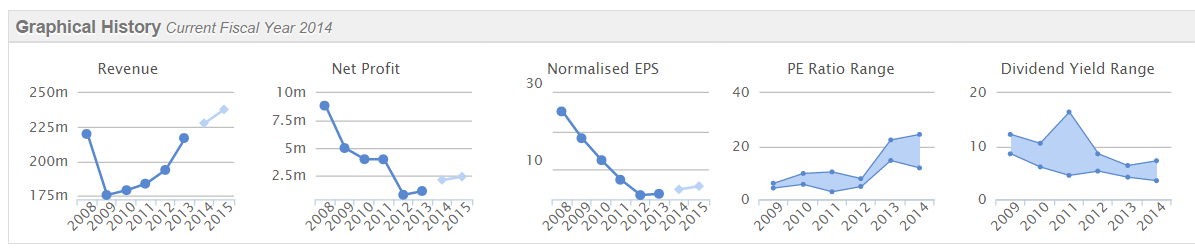
Mind you, looking at the historic graphs below, if this company manages to get back to previous levels of profitability, then it could be in for a big re-rating? So it looks a risky, cyclical share, but with potential upside, if you're prepared to take on the risk of a 100% loss if something goes badly wrong.
ST Ives (LON:SIV)
Share price: 195p
No. shares: 124.9m
Market Cap: £243.6m
This is a printing & marketing group, which issued results yesterday.
Preliminary results for the 52 weeks ended 1 Aug 2014 look impressive at first glance - revenue up 3% to £327.6m, and underlying profit before tax up 17% to £29.4m. That's a reasonable profit margin of 9% of sales, indicating that the company has a product/service that its customers want.
Underlying EPS is up 15% to 18.3p, although I note that there's a big difference between this figure and basic (i.e. unadjusted EPS) of 8.6p, so I would need to carefully check the adjustments to ensure they are sensible, and not getting into the creative accounting space that so many companies seem to seek out.
This 18.3p EPS result is a little ahead of broker consensus forecast of 17.5p, so this might lead to upgrades for the current year (ending 2 Aug 2015) possibly?
Net debt has risen considerably, from £15.2m to £42.7m, due to acquisitions, so it's important to also check how much of the profit growth is organic (thus justifying a higher rating) or from acquisitions (deserving a lower rating).
Balance Sheet - this fails my testing, since net assets of £144.3m reduces to -£22.9m after the substantial goodwill & other intangible assets are written off. I just don't like investing in companies with negative net tangible assets, as they don't have enough financial strength to fall back on when times get hard.
Outlook - this sounds reasonably positive;
The current year has started well and in line with our expectations, with our Marketing Services segment benefiting from the UK economic recovery, from increasing marketing spend by our UK and international clients, and from our own organic growth initiatives.
Overall we are confident that St Ives will make further strategic and financial progress this year.
Valuation - I reckon it might do about 20p adjusted EPS this year, so the shares are on a PER of 9.75, which looks undemanding. Once you factor in the net debt, which is another 34p per share, then the Enterprise Value is 229p per share, so being lazy and not adjusting earnings for interest cost, that increases the PER to 11.5 for the current year, which looks fairly reasonable. That's probably about the right price, given that it's not a terribly exciting business, and may be facing long-term structural decline on the print side of things.
Dividends - these were deeply slashed in 2009, but have been building up again nicely since. The yield is now a reasonably attractive 3.8% forecast for the current year.
My opinion - it looks reasonably priced, probably about right. Bear in mind though that this is a cyclical business, which could lurch back into losses once the next recession happens, as some customers turn off marketing spend when times are hard.
I'm also a bit concerned that management describe their Balance Sheet as strong, when it obviously is not strong! That is either PR flannel, or more worryingly it might show naivety about the appropriate levels of debt to take on when times are good - which could lead to a car crash in future when things go wrong. All just things to consider. Overall I don't have a strong view either way. I can see the attractions, but it's probably not one for me.
Regards, Paul.
(of the companies mentioned today, Paul has no long or short positions
a fund management company with which Paul is associated may hold positions in companies mentioned)
Disclaimer
This is not financial advice. Our content is intended to be used and must be used for information and education purposes only. Please read our disclaimer and terms and conditions to understand our obligations.

13 comments
Hi Paul + anyone else interested in ST Ives (LON:SIV)
I looked at these results yesterday and I'm becoming less impressed as they sink in. Whilst they paint a happy future picture, I have a few concerns...
So overall, not overly impressed, although, if things stay strong, I would hope for a price of around 250p....we'll see, I'm sure.
Regards,
Sully.
Thanks for another excellent report.
I thought small caps were on a higher PE than large caps & may well still be, however of course the pricing is becoming more attractive.
My 27th Sept FT copy shows the following PEs
FTSE100: 13.41
FTSE350: 13.93
FTSE small cap: 20.89
FTSE fledgling 164.16
FTSE Aim all share 45.17
As for the "Easy" brands, well as far as I know, only Easy Jet has properly taken off. I don't see the multiple successes of (say) Richard Branson.
Then if easy hotels were a good idea, wouldn't Stelios do better to build a bigger business using his millions, then float it? Last time I looked, he owned about 2 and the rest were franchises. That's hardly a big commitment to making the concept work.
Re. SIV. The adoption of IAS19 has caused a few swings to the accounting of the company's defined benefits pension scheme. The scheme has gone from a YE2013 nil surplus/ deficit to a YE2014 £9.8m deficit.
This partially explains the drop in the balance sheet's net assets.
The company states that it will continue with a funding contribution of £2,2m. Note that this is not reflected as a charge in the profit/ loss account or eps calculations. Generally, the average deficit recovery period is around 8 - 10 years, so their funding contribution is OK, on the conservative side.
Not sure if this scheme is still open to new entrants. The sooner they close it and replace it with a defined contributions one the better. Defined benefits pensions are IOU's over which they have little if any control.
Just a quick word on T Clarke (LON:CTO) who I have had dealings with in the past. The company had some bad luck in taking over another contractor who had made an inadvertant bodge on a job. Result: goodbye £2m!!! More generally the company has had to underbid to get work in the bad times, so margins have been shaved to within an inch of their lives. Those contracts will soon all be completed. Finally there is a bit too much debt here, even if you don't include the pension fund, but the banks are onside!
BUT potential investors should also be aware that some builders will use ONLY T Clarke (LON:CTO) for their electrical work, becuase they know the job will be done PROPERLY! This is especially true for complex installations. Also there are certain jobs that ONLY T Clarke (LON:CTO) can do, notably some photosensitive installations. Only they have the experience and expertise to complete these. If you want a decent job done, send for Tommy Clarke! (This company probably produces the best trained sparks in the country! Guys who they did not train but who work for them have to undergo up to six months induction to make sure they are up to T Clarke (LON:CTO) standards!!)
It says a lot that the litigants in the insurance case have now placed other work with the company. I also think it is very telling that this morning the price has risen, despite the decline in profits. I was hoping for a fall so I could get back in again! Gone on Paul, have a tickle here!
Regarding St Ives, the difference between underlying and reported seems to be about 50% legitimate, 50% ongoing costs (amortisation of acquired intangibles). The other adjustments to underlying do seem legitimate as they exclude both sold businesses and acquired businesses. As to the balance sheet, the business looks to generate about £14mn after capex but before acquisitions and disposals, which would equate to a free cash-flow yield of about 7%. Good not great.
But such accounting nitty gritty is where I go wrong, and did so in 2008-09. My problem is that it is too easy to get hung up on the detail and miss the key which is the sustainability of the earnings. And this is where I struggle with St Ives. I don't understand what on earth is marketing services. Are the revenues sustainable or is this highly cyclical? If the marketing services business has solid growth, then this is a cheap, dividend growth stock. If not, it is not that interesting.
SIV: I'm a holder and very happy with these results. The transformation from print to marketing services is a major reorientation of the business and not without risk. So, against this backdrop I judge the progress to be very good. A major consideration for me is the firm's management team and a well handled challenge such as this can only reflect well on their capabilities. I will thus be backing them to push on from here and deliver further improved results. Nevertheless, great to have your valuable insights and independent view Paul - to prompt reflection and temper my tendancy towards confirmation bias.
Cheers Maddox
Camtab: this is what markets do. The same is happening in the States where the Russell 2000 (i.e. small caps) has officially fallen into bear market territory too. Small caps are essentially the "weather vane" for investor sentiment - the lack of liquidity exacerbates the ups and the downs.
Paul, my question is why is the year being so hard on small caps. Normally this is the harbinger of doom and yet the signs in the economy seem fairly robust. I accept the valuations got crazy in last years run up but if so why weren't we just selling the beta? Accepting trying to call a market is for fools there has to be a point at which you close the downside, which is why we use stop losses. The long term hold is fine but at some point you have to take your gains/losses, otherwise you are just oscillating between a loss and a profit as market demand wavers accepting the fundamentals tell us we are in a company not going bust. Just some thoughts. Guy
For what it's worth, I think much of the recent sell-off has simply been down to the US Fed planning to end QE in October (i.e. end of tapering). The same very much happened at the time QE1 and QE2 both ended.
I guess though Paul it's a good market for your short positions?
Morning Paul. As you say it has been an ugly market for small cap investors since the early spring - my question (and perhaps Ed can provide some data?) is simply: how long do bear markets tend to run for and do bear markets in major indexes follow bear markets in small caps - i.e. is there a lag between a bear market in small caps and a bear market in large caps? What I can't understand is that mid/small cap indexes are more a reflection of the UK economy than the FTSE 100, which reflects the global situation. The UK economy is doing really well currently and is set to be the 'bright spot' in the global economy according to the IMF. The markets also look 6-12 months into the future and are therefore discounting a rise in interest rates and a possible slowdown? I would guess that a rise in interest rates would adversely effect smaller companies with debt rather than larger companies who would be able to borrow at better rates. All in all it's a very mixed picture and the global economy is at best, very patchy, with a slowdown/or hard landing in China very possible, Ukraine, Ebola, Syria/Iraq, Hong Kong etc etc.. I have found that lots of companies are warning on profits and are being hit very hard by the market and I have been concerned by the length of the bull market (over five years). Most businesses have been stripping out costs since the economic crisis of 2008/9 but there is a limit to how many costs can be taken out of a business and therefore they need demonstrate sales growth, which in turn should lead to improvements in profitability. Interested to hear the thoughts and opinions of other readers.
Cheers,
Ben
TUNG has had a pretty big drop in the last week .. anybody know why?
It is amazing what a bit of orange paint can do :-)
Hi Paul, surely there must be a mistake on stockopeidia's numbers? How can a a company with £4m of turnover, £2m cash on b/s, fixed assets of £20m have a market cap of £60m???