Small Cap Value Report (Fri 1 Nov 2024) - STB Briefs: SRT, SAAS, BOO, RKT

Good morning from Paul!
That's it for today, sorry SEE is only half-done, but I've run out of time, so that should appear on Monday. Have a lovely weekend! Podcast should be on Saturday.
Phew, am I glad it's Friday, this has been an exhausting time in recent weeks, with very volatile small caps markets, all the budget uncertainty, etc. We all deserve a thoroughly good rest this weekend!
I must thank everyone for the lovely reader comments yesterday - it's very much appreciated, and quite a thing to have retired fund managers patting us on the back. I was chuckling away, as everyone seemed to know each other! Maybe someone could organise an informal drinks evening at some point!? It would be great to put some names to faces and have a natter over a few pints. Although we have Mello Derby coming up shortly, where I shall be floating around both days & happy to talk shares with anyone & everyone :-)
I noticed that Evoke (LON:EVOK) has bounced strongly post budget, which reminded me that the media warnings of punitive budget measures targeting gambling companies didn't happen. I wonder if work is being done behind the scenes on more tax raising measures? After all, the Govt & civil service would only have had enough bandwidth to focus on a few key areas in this budget. So I suspect they might return to some issues next time.
I'll be writing to Rachel Reeves to urge her to give everyone some certainty - the big lesson she needs to learn is how negative messaging followed by a long delay causes actual, measurable economic damage - as we saw with consumer and business confidence surveys plunging in recent months. Confirming that corporation tax will not be changed in this parliament was an excellent move. We need the same thing on key issues for investors - eg assurances that they won't meddle with ISAs, or pensions tax relief, etc. Then people can plan ahead.
The IHT change, if implemented (it's only a consultation at present, I'm told) is a huge issue. Imagine how many billions there must be in defined contribution pensions? If that's all now going to be newly subject to Inheritance Tax, then I think we'll see a lot of people changing their behaviour - eg one friend has already told me that he's intending to move into drawdown, and just pay the income tax on it (up to the limit of the 20% band), then put £20k into an ISA every year, and gift the rest to his children (to avoid IHT under the 7-year rule), putting it into ISAs for them and managing the accounts for them. People are coming up with all sorts of ideas for how to avoid IHT in new ways, which is why I suspect these proposed tax changes may not raise anything like the amount budgeted. As mentioned yesterday, it is vital to take professional advice from authorised experts before doing anything that could potentially cause big problems down the line.
I'm curious to hear what the IHT portfolio fund managers think about the budget. Will bringing in effectively 20% IHT on most AIM shares (previously zero) kill their golden goose? I got an email from one yesterday, giving an initial response, which sounded quite positive - saying it could have been a lot worse, and well-chosen AIM shares still have considerable attractions - half the normal rate of IHT is still an attractive tax break. Naturally they have to sound positive to avoid redemptions! Although it's another area where Reeves should have given a commitment not to change the rate again this parliament. If it's just a stepping stone to full IHT on AIM shares, then it might cause people to move their money elsewhere possibly? Although this fund manager also commented that making pensions IHT liable could be a net positive for AIM, as people who thought their money was in an IHT shelter now realise that's ending, and they might move money into AIM shares. All interesting, and I enjoy reader discussions on these points, so keep them coming if you have any interesting insights.
Many eyes are now on UK gilt yields, which have risen to not far off the highs at Liz Truss's disastrous mini budget, and sterling has weakened a little. Let's hope things settle down. Ed Conway of Sky commented that things are "halfway to the danger zone" as defined by the OBR apparently. Although he mentioned that bond yields in other countries are also rising, but not as fast. Anyway there's nothing I can do about that, but it does raise the question of whether the increased borrowing Reeves has planned might end up keeping UK interest rates higher, who knows?
I'm keen to hear more from listed companies about how much the NIC increases will harm their profits, and how much can be saved with mitigating measures. To flag this article again from Sky, it sounds really bad actually - in particular the lowering of the threshold, plus the increased rate, combines to make costs much higher than expected for the many retail & hospitality companies which employ part-time workers in particular. This quote from one of the major supermarkets sounds as if the impact could be dreadful, and I think we could see widespread profit warnings (let's hope I'm wrong, but why take the risk - hence why I'm completely out of the retail & hospitality sectors until the dust settles) -
"An executive at one of the quartet said their immediate calculation was that they would have to pay "between double and treble" the additional sums they had modelled following pre-Budget reports in the media that the chancellor was preparing to increase the employer NICs rate by two percentage points."
I see that retail & hospitality shares are taking a battering, as this issue sinks in with investors.
Explanatory notes -
A quick reminder that we don’t recommend any shares. We aim to review trading updates & results of the day and offer our opinions on them as possible candidates for further research if they interest you. Our opinions will sometimes turn out to be right, and sometimes wrong, because it's anybody's guess what direction market sentiment will take & nobody can predict the future with certainty. We are analysing the company fundamentals, not trying to predict market sentiment.
We stick to companies that have issued news on the day, with market caps (usually) between £10m and £1bn. We usually avoid the smallest, and most speculative companies, and also avoid a few specialist sectors (e.g. natural resources, pharma/biotech, investment cos). Although if something is newsworthy and interesting, we'll try to comment on it. Please bear in mind the "list of companies reporting" is precisely that - it's not a to do list. We typically cover c.5 companies per day, with a particular emphasis on under/over expectations updates, and we follow the "most viewed" list of readers, so if you're collectively interested in a company, we'll try to cover it. Obviously with the resources available, we can't cover everything! Add you own comments if you see something interesting, and feel free to discuss anything shares-related in the comments.
A key assumption is that readers DYOR (do your own research), and make your own investment decisions. Reader comments are welcomed - please be civil, rational, and include the company name/ticker, otherwise people won't necessarily know what company you are referring to, if they are using unthreaded viewing of comments.
What does our colour-coding mean? Will it guarantee instant, easy riches? Sadly not! Share prices move up or down for many reasons, and can often detach from the company fundamentals. So we're not making any predictions about what share prices will do.
Green (thumbs up) - means in our opinion, a company is well-financed (so low risk of dilution/insolvency), is trading well, and has a reasonably good outlook, with the shares reasonably priced. And/or it's such deep value that we see a good chance of a turnaround, and think that the share price might have overshot on the downside.
Amber - means we don't have a strong view either way, and can see some positives, and some negatives. Often companies like this are good, but expensive.
Red (thumbs down) - means we see significant, or serious problems, so anyone looking at the share needs to be aware of the high risk. Sometimes risky shares can produce high returns, if they survive/recover. So again, we're not saying the share price will necessarily under-perform, we're just flagging the high risk.
Others: PINK = takeover approach, BLACK = profit warning, GREY = possible de-listing.
Links:
Paul & Graham's 2024 share ideas - live price-tracking spreadsheet (2 separate tabs at bottom), Video update of results so far, June 2024.
** New SCVR summary spreadsheet for calendar 2024 ** This is the live one! (updated 6/9/2024)
Archive - SCVR summary spreadsheet for calendar 2023.
Paul's podcasts (weekly summary of SCVRs & macro views) - or search on any podcast provider for "Paul Scott small caps" - eg Apple, Spotify.
Phil Hanson's data analysis measuring performance of our colour-coding system in the SCVRs, from July 2023- Mar 2024 (with live prices). My video explaining/reviewing it.
My other video (June 2024) - How to screen for broker upgrades on Stockopedia. More stock screening strategies here (possible bargains?) - 21/9/2024.
Companies Reporting
Hardly any news today, which is handy as I've got some backlog items I want to look at. Then it's a hard stop at 1pm for me, as Mum wants to go on a jaunt to buy a new vase, so chauffer duties beckon for me!
Summaries
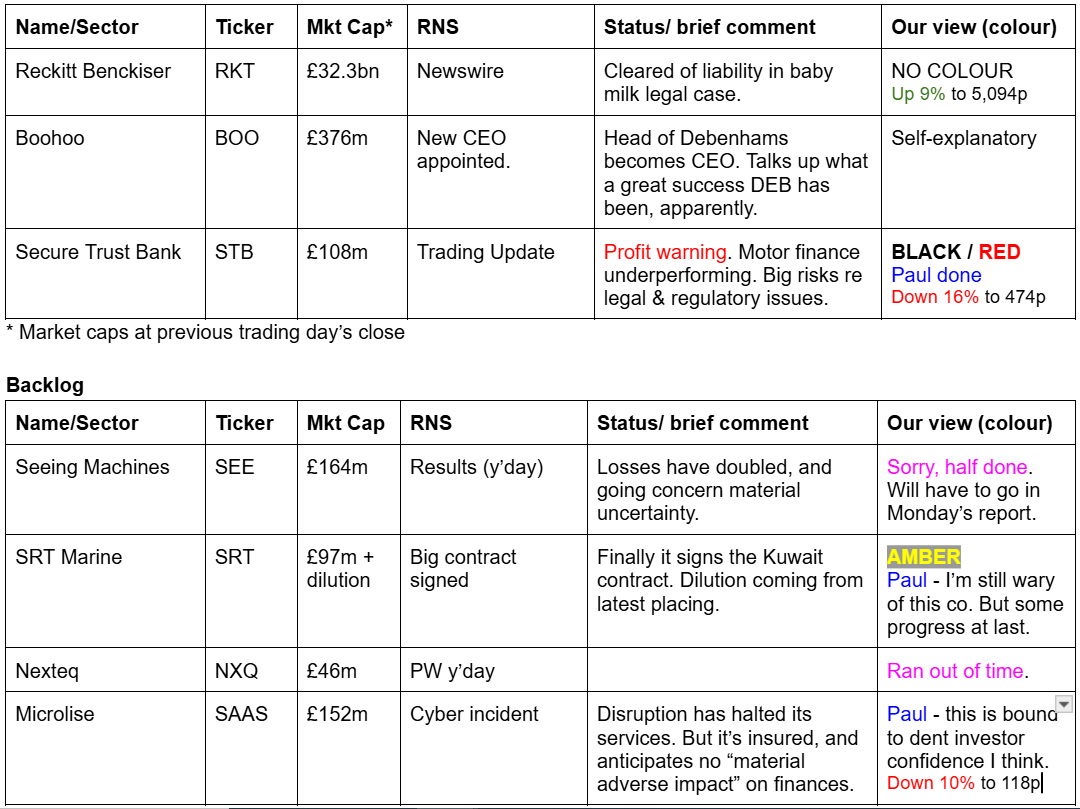
Secure Trust Bank (LON:STB) - down 12% to 500p (£95m) - Trading Update [Profit Warning] - Paul - BLACK / RED
Profit warning from this specialist lender sees broker forecast for FY 12/2024 slashed by 29%. The problem (putting it mildly!) division is the motor finance division. Elephant in the room are potential legal & redress costs, which could be huge, but are currently unknown. Therefore I see this share as GREEN for value, but RED for risk, so for me the high risk has to be prioritised in our overall view, so I'm reversing it from Graham's GREEN, to my RED. We'll have to have a negotiation over this next week!
Paul’s Section:
Secure Trust Bank (LON:STB)
Down 12% to 500p (£95m) - Trading Update [Profit Warning] - Paul - BLACK / RED
“Secure Trust Bank PLC ("STB" or the "Group"), a leading specialist lender, announces a trading update for the financial year ending 31 December 2024 (FY24) and details for the third quarter ended 30 September 2024 (Q3).”
This is one of Graham’s so don’t expect any particular insights from me, I’m just reporting on the news.
On 14/8/2024 Graham reviewed STB’s interim results, concluding GREEN at 836p, due to an extremely low PER of 3x supposedly pricing in the risks. He says it was a mild profit warning for 2024, combined with increased guidance for 2025.
Unfortunately, the 1-year chart below shows it making new all time lows today, and it’s obvious something has gone badly wrong here in the last week - STB shares began a big move down on 28/10/2024 - 2 days before the budget, so it doesn’t seem to be specifically related to that -
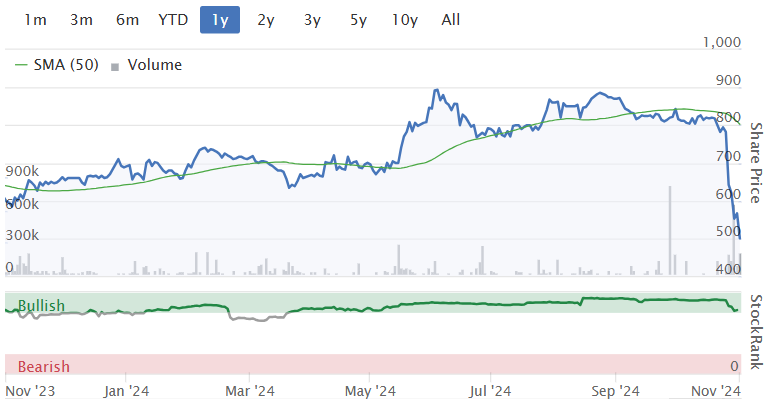
Ah yes, I remember now, it’s connected to the issue of motor finance, which hit several shares on the same day. STB issued this RNS, Vehicle Finance Update on 28/10/2024. Graham covered this issue here on 28/10/2024 in respect of Close Brothers (LON:CBG) which fell heavily too on a legal case called the Hopcraft case.
This is the second time motor finance companies have been hit with legal/regulatory problems, as the FCA had produced an adverse verdict in Feb 2024 - although looking at STB’s chart above, that didn’t seem to do much damage at the time.
Graham took the view earlier this week that motor finance looks as if it might become another PPI-style fiasco of unknown size and duration. He concluded that CBG looked a "bargain, but with the Sword of Damocles hanging over it".
On 28/10/2024, STB said that it noted the adverse verdict in Hopcroft, but that CBG intended to appeal the decision to the Supreme Court, concluding -
“This sets a higher bar in relation to commissions than had been understood to be required across the vehicle finance industry, before the Court of Appeal's decisions. These decisions relate to commission disclosure and consent obligations, which go beyond the scope of the current FCA discretionary motor commissions review.
STB is assessing the potential impact of the decisions, as well as any broader implications, pending the outcome of the appeal applications. The Company will update the market, if and as appropriate.”
Today’s update from STB -
Good news on arrears -
“As indicated in the Group's interim results announcement on 14 August 2024, the pausing of collections activity following the FCA's Borrowers in Financial Difficulty ('BIFD') review led to a higher volume of Vehicle Finance loans reaching default status. The Group has restored collections activity to normal levels and early arrears in Vehicle Finance are at the lowest level for three years.”
Although it says recoveries are taking longer than expected, which I’m struggling to reconcile with the quote above.
Overall though, it’s a profit warning, with a very helpful indication of the amount involved (why can’t all companies do this when they warn?) -
“As a result, the Board now expects the Group's underlying, continuing profit before tax for FY24 to fall materially below market expectations by between £10m and £15m. The reduced level of profit before tax is due to the performance of the Vehicle Finance business. The Group's other businesses are performing in line with management's expectations.”
Broker update - with thanks to Shore Capital, which downgrades EPS estimate for FY 12/2024 by 29% to 145p. That’s a PER of 3.4x.
Estimated EPS for FY 12/2025 comes down from 271p to 235p - a PER of 2.1x (based on 500p share price)!
So we have a staggeringly low PER (almost always a sign of big problems).
Very well covered dividends are forecast too, at 33.8p in 2024 (6.8% yield), and 35.5p in 2025 (7.1% yield).
Balance sheet - H1 results showed NTAV of 1836p, so at 500p in the market today you’re getting a huge discount. That’s a P/TBV of only 0.27x.
With 19.07m shares in issue, the discount to NTAV is £255m (£350m book value, less £95m market cap). So the key thing investors need to estimate, is the likely (or maybe a prudent) estimate for the legal costs & compensation to customers. If you think that total cost is more than £350m then these shares are probably worth little to nothing. If you think the cost is likely to be less than £255m, then the shares are worth more than the current 500p share price. How on earth are we meant to calculate if & how much compensation & legal costs might be? That's quite a narrow band as well between success and failure of this share.
The risk looks high that this could be another compensation gravy train, with TV ads cropping up for no win no fee type ambulance chasers, and often spurious claims. That could drag on for years and be hugely expensive for STB and others.
Overall though STB’s balance sheet looks quite simple -
Assets of £3.9bn are mainly loans to customers (£3.4bn), plus £0.4bn cash. £0.1bn other.
Liabilities of £3.5bn are mostly customer deposits of £3.04bn, and debt owed to banks £0.36bn. £0.1bn other.
Equity is £356m - just over 10% of the loan book.
However, Shore cautions on the unknown extent of the potential costs of redress over the legal/regulatory issues -
“However, this does not current include any potential legacy redress impact from the ongoing issues in the motor finance industry, which are currently too uncertain to quantify with any degree of confidence but could be significant. “
Paul’s opinion - this share is impossible to value. I would give it GREEN for value. But RED for risk! It’s totally unknowable for me to assess risk:reward here. But if there’s a significant risk of massive costs & compensation, I think it has to be properly flagged with our colour-coding, so overall I’m going RED.
Readers can now decide for yourselves if you think the high risk is worth taking or not. Remember that our colour-coding is not making predictions of future outcomes, it’s just flagging risk:reward as of today.
Disclaimer
This is not financial advice. Our content is intended to be used and must be used for information and education purposes only. Please read our disclaimer and terms and conditions to understand our obligations.

144 comments
Time to rethink IHT strategy. Currently I have £350k in a HL SIPP that I have no need to drawdown from. With SIPPs now coming into the IHT net as a result of the Budget, I now will consider drawing down £22k (the amount that would be subject to 20% tax) and invest the monies in BPR shares within a Stocks/Shares ISA. Obviously these shares will be subject to to 50% relief from the 40% IHT rate which is better than the SIPP being subject to 40% then a further minimum of 20% in the hands of the recipients . Specific IHT BPR plans on the market are very expensive on charges etc (no offence to Megan Boxall’s family) and there is no reason why you cannot construct your own BPR shares in an ISA. It would be good Paul and Graham , if you could state if shares especially on AIM in your report qualify for BPR ! Even better if a screen could be added. This would certainly give added value to the Stockopedia subscription.
Hi Spancan
The problem is the risk lies with the holder of the AIM shares - and they must make a claim for relief for their holdings and show that they satisfy the eligibility criteria (for BPR) applicable at the time of death not when the shares were originally bought.
HMRC do not publish a list but they are the arbiter.
Most AIM manager constantly speak to the issuer companies to ensure they believe they continue to meet these criteria.
You might want to look at readers’ comments in the week running up to the budget and the top 10 or so holdings for the portfolios of many leading IHT collective funds were reproduced.
All this jumping through hoops to avoid 20% tax...
I get it makes sense if you're about to die within the next 12 months, or 24 months. As generating that sort of investment return is a decently high hurdle.
But if you think you might live another, say, 5 years... then is it worth limiting yourself to BPR-qualifying shares, rather than being able to invest in anything you want? Surely with some effort, you can generate 4% more per annum than the forced-BPR investments?
I agree Boon, one shouldn’t let the tail wag the dog.
Am I right in think that the companies now to avoid are those that will be greatest affected by the triple whammy...
So the likes of retail outlets, fast food, quick casual restaurants?
I'm thinking like Tortilla Mexican Grill (LON:MEX) , Comptoir (LON:COM), Everyman Media (LON:EMAN), XP Factory (LON:XPF), the supermarkets, even like SSP (LON:SSPG). Someone else mentioned Card Factory (LON:CARD) as well? I've recently disposed as Safestay (LON:SSTY) for other reasons, but think they will be impacted too.
(I hold Comptoir in the Boon Fund)
On this theme, what do you think the ulterior motive for introducing Pensions Freedoms was?
If £100k pension pot gives an annuity income of £5k per annum wouldn't the Treasury prefer to tax accelerate the taxation of the potential income stream liekly to occur when people incautiously draw down too much, and earlier etc?
Warpaint London (LON:W7L) talked up by RBC Capital Markets when they initiated coverage today (Friday Nov1st)with a strong 'outperform' rating and 685.0p price target.
It said the company presents a strong value proposition to customers by leveraging its dupe strategy to drive sales across its own-brand cosmetics lines, W7 and Technic.
"With many households facing tighter budget constraints, the popularity of quality dupe brands has been on the rise, supporting it's rapid sales growth of 20% CAGR to 2023," it said.
RBC noted that Warpaint London (LON:W7L) has grown 17% more than the weighted mass colour cosmetics market since 2014.
"With strong retail partners on board in the UK/US/EU, we believe it can continue growing at circa 13% compound annual growth rate through 2026E, ahead of the market at circa 6% CAGR," RBC said.
"As a debt-free, cashflow positive business with superior operating margins (more than 20%), we initiate at outperform with a 685p price target, which reflects around 17x 2025E EV/EBITDA."
Could they be impacted by tariffs should Trump be elected President and materially increases tariffs on Chinese good (where W7L's products are sourced from)?
I am a holder and see this as the only cloud in the sky, but will take some profits if we get to 650p again. I bought around 130p, my father at half that, and we wish we had more like this.
Clever man your Dad.
And not for the first time for him . . . . . . .
I think Warpaint London (LON:W7L) will get crucified if Trump gets in and implements his crazy tariff plan, but then so will many other UK and European stocks, even those without Chinese sourcing. I am increasingly of the view that Harris will win, so keep my over-sized position in lipstick, but I will be watching events with some nervousness. I am a great fan of the art of doing nothing very much.
Thanks for your thoughts on this jamesalastair
I prefer referring to a deliberate strategy of “masterly inactivity”
It's really strange: CNN - which is normally Dem/Harris-leaning, was showing internal calculations this morning showing a Trump victory slightly more likely, and the Daily Telegraph - which is normally Trump/GO- leaning, was reporting Harris as the more likely winner. Feels like it really is on a knife-edge.
Its like a patient was in fragile health but making a steady recovery, and the Govt as economic doctor has decided they to pay an increased medical bill and running costs, (which it offloaded to a loan shark) , whilst telling the family the prognosis isn't looking good, and that it has ordered them to work on increased hours on no wages to pay it back to cure the problem.
Secure Trust Bank (LON:STB) I don't have anything in this, but on a cursory glance, was he required to buy that number of shares as a condition of his employment?
Is tiddler Westminster (LON:WSG) about to deliver after years of shareholder value destruction? £500k raised at mkt price + warrants at 10p.
Commenting on the Subscription, Peter Fowler, Chief Executive of Westminster, said:
"I am delighted that our strategic investor, Pantheon A Family Office, has increased their holding in the Company. They have invested without discount and have agreed to be issued warrants with a 10p exercise price, being over four times the current market price, which indicates their belief and confidence in the future growth of the business."
https://newsfile.refinitiv.com...
Best part of Westminster (LON:WSG) is the AGM where disgruntled shareholders grill the board. The CEO cant hide the fact he thinks he's above such things, don't think he even turned up last year. Very entertaining, they even had to cut the sound a couple of years ago as it descended into shouting.
Positive trading statement issued by Mears (MER) at 11.02AM today if you missed it. Another profits upgrade. Fall overdone?
Possibly. Would have preferred some rebuttal to FT headline though. Tempting
Mears (LON:MER) 11am update doesn't look bad. Upgrade to FY expectations, but obviously overhang of the FT article on acting on the break clauses impacting them potentially in 2026..
Also - great to see them add in what their consensus expectations ACTUALLY is! Looks like a very nice PBT upgrade, minor revenue upgrade.
Just found this link on twitter if there are any small farmers out there worried about the IHT implications of the budget...
https://twitter.com/DanNeidle/...
interesting point/take, and he is a tax specialist...
have a good weekend all
Apologies for the late reply and I appreciate this subject probably isn't relevant to most readers of the SCVR. As a longstanding tax adviser to farmers and landowners, I partially agree with Mr Neidle, but some of his comments seem naive. He says that a farm making 20K wouldn't be worth more than £2M. I find that quite amusing as I could take him to meet several farmers with farms worth more then £2M that make less than 20K, or even make losses.
He also says that farmers can insure the potential IHT liability away. I know of several elderly widowers/widows who will have a maximum of £1.65M relief available to set against the potential estate, as the residence nil-rate band is tapered away above £2M net estate (importantly, this is before any reliefs are applied). IHT liability insurance would be exorbitant for them so their only option is to make gifts, claim holdover relief, and hope they survive for 7 years. However, that path is often fraught with risk due to various family issues.
I do, however, agree with him that many farms owned by husband and wife will have relief up to £2.65M in value. Even in these cases, there will often need to be changes made to wills (in many cases, mirror wills leaving assets to each other on first death) to enable them to make use of both £1M APR exemptions, as the allowance isn't transferable, unlike the standard IHT exempt amounts.
Thanks Northender
It’s always fantastic when someone with detailed knowledge steps up & shares their perspective on a complex issue..bravo
Lifted this from the BBC verify website (hope thats ok ) -
“Paul Johnson, the director of the Institute for Fiscal Studies (IFS), an independent economy think-tank, told Sky News: "The changes will affect a remarkably small number of some of the most valuable farms."
He added: "[Farms are] still more generously treated, actually, than farms used to be in decades past."
Not a sector I am familiar with but its interesting to hear the views of respected and independant experts like Johnson and Niedle, who have no axe to grind and have no vested interests.
Hi Northender
I live in a rural area and know (and am related to 1) farmers it's true that low returns on assets employed and very low incomes versus the work/hours involved are common, particularly among smaller livestock farms.
You are also correct in instancing family dynamics as a complication.
It's also a truism that its rare to meet a farmer who admits to having had a good year.
I think the piece missing is subsidy payments on the one hand, food security on another, and stewardship of the environment.
Personally, I think if there is to be "reform" (not explained at all in the context of CGT or IHT) then they should look towards much larger farming units which can plan for the tax.
Personally, I think the only true "loophole" is farmer being able to claim IHT APR and also rebasing their costs at death for CGT purposes.
Thank you Paul for your views on Secure Trust Bank (LON:STB)
I hold this and am now 35% down from a roughly even position at the start of the week - such a shame - hammered once this week by the court rulings and then again by the trading update.
It's difficult to assess the exposure to the potential commission issue. However, I think the market has overreacted based on the proportion of their lending that is in the motor space. I wrote to them in February this year, asking for some comment on their exposure and their reply was: We operated some discretionary commission arrangements until 2017. From 2014 to 2017, a mid-single digit proportion of our new vehicle finance loans included such arrangements.
What's "mid-single promotion" mean? 8% perhaps? So that's 8% of a vehicle finance book that is perhaps 20% of the total book (last reported as c£500m lending vs total lending of £3bn = 17%)? So <2% overall? On this basis, you'd say that the market has overreacted. And of course, the whole issue might go away on the court appeal - no actual laws have been broken at this point.
So, as tempting as it is to take the hit and get out now, there is also a counter-case:
It's one of Lord Lee's portfolio too, which might count as a plus for some.
I think I'll just hold, wait for the Capital Markets presentation on 13th Nov and hope that there's not more bad news in the next 2 weeks.
Something to distract me from the misery of the budget at least!
Secure Trust Bank (LON:STB) I think your numbers are interesting - looking at the direct potential hit. However there is also the indirect potential hits - which are unquantifiable. ie. Will there be further fines dished out (as I believe there were with ppi). Also the admin costs of sorting this mess out could be eye watering. Then you have the reputational damage etc. I think this is impossible to judge and I agree with Paul's assessment. So I think this could be very bad for quite a while, I also see this as now becoming a real distraction for the business.
Don't forget you also have to model out the operational costs for processing the deluge of ambulance chasing claims that will be submitted to Secure Trust Bank (LON:STB)
That is the lesson from PPI - it is not only the actual payouts that you have to model, but the huge operational cost of processing all those claims, many of which are bogus.
Agreed - the cost of responding to claims, or undertaking a remedial project at the behest of the FCA, will often exceed any underlying redress/compensation.
Thank you for the prompt to start withdrawing the balance of my savings account with £STB. Obviously it was within the £85k limit, but I can do without the potential excitement of it going out of business
Oh cripes, I don't want to get the blame for starting a bank run!
I don’t think anyone is yet suggesting Secure Trust Bank (LON:STB) is going out of business, but quite clearly they are not sharing how bad the situation might become. I don’t need the excitement.
Secure Trust Bank (LON:STB) Personally I am not sure I would trust managements assessment anyway. 9 weeks prior to this profit warning, Jim Brown bought 250k of shares in August at an average of about 840 a share (potential motor finance fallout was known from about January). Seems to me the management team are inept at understanding how the business is actually performing. I wonder how many people took that as a sign of confidence and followed him in.
Or alternatively Mr Brown does not think it is that bad.
Well clearly Mr Brown didn't think it was that bad, and has lost half his investment in 9 weeks. His judgement and forecasting abilities are perhaps bought into question. I am sure he can afford it, probably beer money to him. But I'm sure many small investors took it as a bullish signal and would have believed the business would be performing well and then you get this poor update and the potential motor finance fallout, which btw the company have not communicated properly over (head in the sand for months), and now it shows they / or their shareholders are way behind the curve on the potential risks. This is evident imo by his buys in August, and perhaps shows he doesn't have a good understanding of the real situation this business finds itself in.
On the whole I agree with Charles Mitchell, but with a different conclusion. I think Mr. Brown was encouraged by the conclusion of the FCA embargo on chasing arrears. I think he was completely blindsided by last Friday's Appeals Court decision. I feel sorry for him. He has lost a lot of money and I doubt' he'll get it back.
We too have a chunky deposit at Secure Trust Bank (LON:STB) as mentioned previously and my wife has instructed me to act now. She is somewhat risk averse having had a very difficult start in life. When I was a kid the idea of a UK bank going bust was pretty much unthinkable. I remember the odd tiny building society failing but they were always baled out by the Building Societies Association. I don't 100% trust the FSCS and i worry about the bail-in law.
My conclusion is not to buy back in-yet. I also have a reasonable deposit with STB but will leave it there. My feeling is STB will be OK financially but this overhang could drag on. I am not convinced it will be come anything like the PPI scandal. It is entirely possible the Close Bros appeal will win and sense will prevail. PPI was the mis-selling of a product, this as I understand it is lack of transparency about fees and not a suggestion customers paid more for a car. I do not really understand how if I agree to take a loan out at say 7% the fact a bank pays the dealer a commission altered my decision to buy. But I might well be not fully understanding the legal arguement.
Osb (LON:OSB)
Looks attractive now and have added post the budget. Fcst p/e 4.2, yielding 9.25%, p/tb 0.62
Passes 7 long stocko screens and buybacks continuing. Could a predator pounce?
I can see that Osb (LON:OSB) is still dipping down but have added from dividends paid today so no pain involved (as yet). I like the idea of a takeover of course but prefer the nice dividend.
They have a Q3 update coming up on the 6th Nov. I bought after their last update which was a profit warning. Now underwater so nervous about next week's update. Hard to guess what the outlook is for their buy to let mortgage business - negative with the additional SDLT and positive with generally falling interest rates.
Paul
eg one friend has already told me that he's intending to move into drawdown, and just pay the income tax on it (up to the limit of the 20% band), then put £20k into an ISA every year, and gift the rest to his children (to avoid IHT under the 7-year rule), putting it into ISAs for them and managing the accounts for them. People are coming up with all sorts of ideas for how to avoid IHT in new ways, which is why I suspect these proposed tax changes may not raise anything like the amount budgeted
There is always a danger that the amount of taxes raised might not be as expected - but if you think of the logic of this specific example - someone going into drawdown now is actually handing over the tax immediately to hmrc. so on this specific point these changes should raise some great amounts of tax NOW taht woudl not have been raised - and in many respects if they havent factored in changes in behaviour there is very decent chance that the near term tax revenues hould be better than expected as people pay the tax now - rather than in 15-20 years time when they pop their clogs.
It also gives us the possibility too that once these funds are outside of the security of the SIPP where they know they cant touch it if they want to be tax efficient - as the tax has been paid i would like to think that some of these people might actually treat themselves to some nice things with some of this cash - so hopefully some potential that rather than sitting there doing nothing this money may be spent on stuff that raises extra taxes too or aids teh economy. The only thing that surprises me here is how the old position was allowed to remain as it was for so long - with working people funding 25% extra into rich peoples pots for the possibility that nothing would be paid back later - or that it might be 30-50 year wait by the time some of the tax is clawed back - ohhh lets think here what % of politicians have friends and family who will have benefited - probably themselves too to a certain degree from the how it was situation. I for one applaud labour for ending this ridiculous freebie for the rich - albeit i am against the taxing via iht and taxing again on recipient later - perhaps though this extra tax is a suitable incentive to get people to do what pensions were designed for in the first place and simply use the funds to support them in old age - rather than gain freebies from others. anyone who will lose out here should have known there was a decent chance rules would be changed before they got the benefit - anyone moaning about being robbed here is ridiculously niave for not having seen this coming (and had backup plan) or simply moaning due to sour grapes.
There's also the possibility of paying a regular sum to children out of excess income, thereby avoiding the 7 year rule.
and to be sure the children will likely spend that wonga - the more i think about this new rule the more i like it !!
rmillaree-I agree. I always thought my pension was to provide an income post retirement- not shelter assets from tax. Assuming you like/get on with your children there are simple ways of passing on assets without risking hardship in later life.
Totally agree. It is good that they have restored the principle that pensions should not be a vehicle for the accumulation of capital sums for the purpose of inheritance.
Regarding Aim stocks and inheritance tax. My understanding was that if your estate is above £2M then IHT was 40% on the total (£800k tax bill). One of the main advantages of holding AIM stocks in your estate was that it could reduce your estate value to below £2M then your IHT would be £400k, It appears that the planned changes of reducing IHT on AIM stocks from 40 to 20% doesn’t help you in reducing your estate value anymore.
I'm not sure where the £2M comes from?
A couple have a combined £1M between them (£325 nil rate band each and £175 residential nil rate band for a property left to lineal descendants but the latter relief is subject to taper reduction when the estate exceeds £2M).
AIM shares were never deducted from your estate value rather you were able to claim BPR in respect of them when calculating the IHT due on the estate, and that relief has now halved from 40% to 20%.
Paul. I just read your observation that IHT on pensions is only a consultation. I don't think that is right, I think what is being consulted on is the best way to implement the changes. The 40% charge is a done deal I believe. Maybe some concession might be introduced, as to pay 40% IHT and then income tax at marginal rates is draconian. It's an important point to be clear on though before taking any action.
Got to chuckle at certain businesses so enthusiastic about the new government before the election. The little celebrity bloke from Iceland Foods seems to have gone very quiet, spending more time with his moisturiser?
yes - so much for business friendly!!
more like a Wolf in sheets clothing ;-)
Surely you mean a Wolf in Lord Alli's clothing?
Paul as always has been all over the NI rise in terms of impact on business, but I'd missed the impact of the reduction in the rate it is applied.
'The rate of employer’s NI contributions (NICs) will increase by 1.2 percentage points to 15% from April 2025. The second hit to employers comes with the lowering of the secondary threshold (ST) which means employers will start to pay NICs on employees earnings from £5,000 instead of the current £9,100 threshold.'
The impact of this on lower paid employees has the risk of being devastating, if the business operates on a low net margin. This threshold change alone, if I'm correct, is a per employee cost increase of £615.
Here was my calculation
Example Calculation for an Employee
For an employee earning £25,000 annually:
• Under the current 13.8% NIC rate and £9,100 threshold, the NIC cost is:
• 13.8% on £15,900 = £2,194.20
• Under the new 15% NIC rate and £5,000 threshold:
• 15% on £20,000 = £3,000
• Difference: £805.80 more per year per employee
In in the executive team with a company with 73 staff in the UK, and 4 in the USA, our average wage will be way above that level and we operate on a net margin of 14-20% on our year ends (lower for high investment years, higher when that investment takes effect). A quick estimate gets our additional costs per year to be £74,000 going from £341k to £416k in employers NI. That's a 21.83% increase in employers NI costs.
We turn over approx £5 million, taking an average of our expected profits at 17% = £850k profit. So the 1.2% and threshold change is going to take 8.71% of our annual retained profits before corp tax.
My math there could be out, the threshold change is outside of my day to day financial experience, as is the exact internals of how employers NI works, so I would value others views.
Considering that impact on a business with high gross margins and reasonable net margins, its going to be real kick in the teeth for retailers in the hospitality, construction and leisure sectors where net margins can be paper thin and they have a higher proportion of lower paid staff, therefore the £615 increase will be a bigger percentage of staff costs. If a company has 125 staff on £25k per year (the same total staff cost as my rough estimates above) the cost is an additional £100k, rather than the £74k for the same wage bill but a higher average salary.
Which is all a long way of saying, Paul was absolutely correct, estimates are likely to trashed for those sectors.
Again I'm happy for this to be picked apart if my estimates are wrong. I must be wrong, as this looks like an attack on the low paid...
Paul, thank you for bringing area to my attention over the past few days.
As a side note to that (I realise not of much benefit to your company): ”The new Employment Allowance for National Insurance contributions (NICs) will be £10,500 starting from 6 April 2025. This represents a significant increase from the previous allowance of £5,000. Additionally, the £100,000 eligibility threshold will be removed, meaning all eligible employers will now benefit from the Employment Allowance. " When I first heard the budget I thought it was the end for thousands of smaller businesses. Obviously if a small business has mainly a student workforce then it also has the minimum wage going up by 16.3% (interestingly when I was searching the document for this figure I also came up with this: output in the health sector remains nearly 16.3% below its pre-pandemic level.
Thanks for the input Neil and your calculations on your business. They match the analysis I've done.
However, you seem to be saying your business is now simply going absorb all of those extra costs with zero price rises.
Is your business a complete price taker in which case I sympathise but for most businesses they will all be offsetting that with corresponding price increase?
You need to increase prices by £74k on a £5m turnover - thats an average price rise of 1.5% to cover it completely.
The reason bond markets have repriced the UK 10Y is because this is seen as inflationary. Every company is going to raise prices. The fact that everyone will be doing it means there is little resistance (coupled with the very large wage increases for the population that tend to spend rather than save).
Fanatastic analysis. And all of the above is before you factor in energy costs, which will continue to rise further from their position as already the highest in Europe as we pursue the ‘net zero’ panacea. As an aisde I can’t help but notice that London Underground just confirmed that they will be on strike pretty much all of next week. Wonderful present to the hard put upon retail and hospitality sector. And you thought the public sector Unions might be a tad grateful. That’s a negative. Welcome to the 1970s redux. On a more serious investing note in my mind it makes large parts of the UK market completely uninvestable. Basically the only protection is in very high margin service orientated companies with a very large percentage of international sales e.g. Relx (LON:REL) , Experian (LON:EXPN) . Would include exceptional ultra high margin tangible businesses like Games Workshop (LON:GAW) . Poor Chris Martin et al. You are utterly stuffed I’m afraid. And so are most UK companies
The rise in the minimum wage and NI hits businesses in a number ways.
It tends to push up wages for those employees earning above the minimum wage,
Thus pushing up employers NI contributions further.
Employer pension contributions are therefore also increased
Thank you for the input, its making me think about increasing our new business prices, a helpful thought.
A lot of our software contracts are three years, and they have annual increases at the rate of inflation, so if inflation does rise, we're good. If this causes economic activity to slow it will mean we have to work harder for less. We don't have a lot of debt and what we do is largely on low fixed rates, so we would not benefit from a corresponding fall in interest rates.
We service the retail sector with software, so I suspect we might struggle to increase our new business pricing as much as we might like. Overall however our business is adding new services and growing outside of the UK at a much faster rate than our UK growth, so its a setback not a disaster.
It would be businesses in sectors which are not price setters like retail who I suspect will feel the pain. There is still a lot of overstock floating around holding down margins due to discounting.
I think this will have, when combined with the new labour laws (the removal of two years no fault contract termination) three impacts.
1. It will make employers much more reluctant to take risks on employees, for example those who have been out of work for a period of time, as there is higher NI costs and it is hard to terminate contracts if it's not working out for both parties. This will ensure the wellfare bill stays high;
2. In sectors with low margins due to a lack of a 'moat', redundancies, less investment due to less retained profit
3. Low wage rises in 2025, particularly for the lowest paid workers where the increase as a percentage of salary is highest.
Hi Neil,
I see the impact slightly differently
1) Direct to consumer : Retail and hospitality can increase prices easily by 2% at no notice and mitigate the effect almost fully. If everyone does the same it won't be a problem on demand. 2p on a card or 8p on a pint for example
2) Fixed contracts - ouch. Could have an impact on the likes of construction, particularly large projects etc. as those companies will need to absorb costs possibly on a multi-year basis and are people heavy so could be quite a lag passing increases through
3) Professional services : will quickly get built into hourly rates : some lag but less of a problem
4) Housebuilders - little chance of passing the costs through. will impact margins. Could be a double whammy if this becomes a bond market problem and house prices fall due to high interest rates
5) B to B Software type services : difficult - should be able to pass through on an annualised basis but quite possibly a lag effect as it won't show up in inflation immediately. Will require some negotiation / re-pricing.
6) Manufacturing / Engineering : should be able to pass through but probably a lag depending on supply chain length
Of course international presence has no impact : so businesses operating more globally will see much less impact but could see further moves to offshore.
Medium to longer term will continue to drive automation and self service, the latter being something that customers have been pushing back on more lately (think supermarkets)
A lot of commentary is focussing on the retail / hospitality effects but these businesses have the ability to immediately raise prices in store. Some of the other sectors have much less opportunity to pass through costs or suffer a lag effect. This is why the OBR thinks only 60% of the tax raid can be passed through in price.
I just wonder if it is really correct that a low margin retailer or hospitality business can really increase their sales price by 2%- and recoup the excess employer NICs? I dont know, it's a genuine question.
My reason for doubt is how elastic demand is for their services. For example if a small increase in menu prices means a typical chain restaurant branch has just one less table occupied per evening, that would more than wipe out the menu price increase.
That said, I can see one small upside from lowering the employer NIC threshold.
That would be to create an incentive to employ a few more staff on fuller time contracts, and less incentive for temporary, part time contracts. It might just resullt in better trained, more efficient staff. If so that would raise the UK's productivity. It is widely acknowledged that Britain's poor labour productivity growth has been a blight on our economic performance.
Add in the 6.7% increase in minimum wage and proposed changes to workers rights, the threshold for hiring has moved in the wrong direction. This is not going to support the government's aims to cut the number of non-working and long-term unemployed, needed to reduce the benefits bill.
I doubt there are many long term unemployed who have suitable skills that cant get a job - everything i am being told by employers and have been told by employers for the last 10 years is that its hard sometimes impossible to get good competent reliable staff. ok some people with niche skills or in isolated areas may find it tough - but i simply dont agree that there should necessarily be issues with long term unemployed. My opinion is that the long term unemployed mostly have issues that put the in that situation - if we want to reduce the long term unemployed we actively need to get down to the detail of why they are unemployable or why there are no jobs in that specific area if its area of very high unemploymet- if needs be simply pay business to take on some of these people who are less lucky. That then simply leaves the hardcore who dont want toi work and activelky make themseles unemployable - i am not sure whats best for that lot. Would be interested to see detailed analysis of long term unemployed as to what the reasons are - i doubt in most areas many are good quality workers that cant get hired.
I have a close friend who works for a partner company to DWP that specialises in getting benefit reciepents back to work.
The lenghts they go to are quite astonishing - providing training course for bar and barista work, safety certificates for construction work, even laptops for work form home jobs. On occasion, buying suitable cloths for an interview.
As you can imagine lots of mental health issues come up but one of the largest barriers is transport. Many do not drive / cannot afford to run a car and many of the job opportunities are edge of town factories and warehouses that just arent served well enough by public transport.
To your last point: Ride Tandem are a start-up trying to address this market - doing ok so far, one of their KPIs is "wages enabled" - i.e. the wages received by the people they take to work that would otherwise not be able to work.
Hi Paul
May I suggest that if you want to write to a Government Minister you do it via your MP otherwise only a civil servant will read it and reply and not a Minister. Thank you for all your hard work
Even that often doesn't work.
A few years ago I wrote to my MP about the negative impact that nominee accounts have on the governance of UK listed companies. Nominee accounts break the link between companies and their investors making it much more difficult for investors to have their say on the ways in which companies are run, including of course excessive executive rewards.
My MP sent me a reply clearly drafted by a civil servant that:
1. restated the current position. I know that position. I had stated it myself in my letter
2. Completely failed to address my concerns about the ways in which the current position damages UK industry
This was due to the way that the letter was forwarded to the Minister by your MP. You should ask your MP to ask for a reply from the Minister to him and not you directly.
Ministers are obliged to see and respond to MP's letters and queries.
MPs are usually so ignorant of investment matters because they don't own shares so they don't even begin to understand the issues.
Card Factory (LON:CARD) bearing the brunt of everyone's irritation at a very dispiriting budget. But representing good value now surely? Irrespective of whether it actually hits expectations the H2 weighting means it is likely to be running at a PE of 6 or thereabouts. Extraordinary turnaround in investor sentiment.
There's been a lot of debate around how retailers like Card Factory (LON:CARD) will respond to the NI raid on other chat sites. Obviously a lot of "armchair CEO's" like to express their opinion and think they know more than the Board but hey ho!
However, the obvious economic response for all retailers impacted by this NI madness (particularly by lowering the threshold to £5k) is to increase prices. Given the NI raid will impact all retailers then the collective response of increased prices will not impact their competitiveness on the high street (I do acknowledge online competitors remain a risk but in the case of Card its main online competitor Moonpig ain't exactly cheap for a card - I paid £8 last time I used them).
Card Factory (LON:CARD) were also very clear in the H1 report about how they were responding to improving internal efficiencies - and key to this was their new staffing system.
So in terms of response I see price rises being critical to defend margins, whilst internal efficiency drives hopefully enhance margins.
Businesses will always respond in kind to defend their interests and adapt to a changing landscape.
One final point no one seems to have asked - Given the raise in the NMW and the typical demographic of a shopper at Card Factory (LON:CARD) , do we actually think sales will decrease? Methinks not.
Quick edit - useful article on Sky about impact to UK grocers of the NI raid - https://news.sky.com/story/gro...
Agreed Gimmers
I think anyone who is not a low margin price taker will raise prices. Will an extra 2p on a card damage sales - I also expect not.
The bond market is saying the same thing - this is inflationary.
That doesn't mean there will be no impact, nor that companies won't have a headache to manage but so many people seem to be assuming employers costs cannot be passed through and will just hit the bottom line with no mitigating action and I find that rather incredible. Even the OBR (who I think are generally too cautious reckon a 60%+ pass through)
Every company will be unique and every board should understand their business better than any of us (not all in all cases sadly) so there is no magic formula and markets hate uncertainty but the answer is far from simply taking a scythe to profit expectations in my view.
I agree with this analysis to a considerable degree, the effect, as Reeves has herself confirmed will be somewhat inflationary particularly where low paid labour is involved. I would imagine, at least in part, this increasing cost of cheap labour will encourage labour productivity, driving labour demand away from low skill, often immigrant jobs, and from low paid self employed jobs into areas of more value adding employment. Efficiency in the use of labour should not threaten, but reward the better managed companies within any given sector.
Re Card Factory (LON:CARD) - I also think the budget may actually be positive for them in the medium term. It still has scope to raise prices on products with a >70% GM and a wide range of price points and is perceived as offering good value (according to the research they put out to analysts).
At the bottom end of the market, it's customers are getting good wage rises (NLW, public sector workers) and I suspect cards are less likely to be cut back on, more traded down if money is tight. Card giving is deeply embedded in UK culture and is adapting to modern trends well - cards for dog, new celebrations like Halloween, new relationships and religions). CARD are also adding higher margin additional lines as it gets going on integrating gifts better in the same floor space.
Its competitors in the physical retail channel are less well placed to respond (will Clintons go under again!) whilst online is more costly and must be facing challenges from rising postage and delivery costs). I'd expect CARD share to rise again.
Only a full on UK recession (or a return of Covid!)) that triggered far less footfall would worry me on a >12month basis.
Finally, CARD are trying to diversify internationally (owned business in SA/Eire, deals in Gulf, US, Australia). I think they have a good chance to add usefully over time. (They have so missed out online even this is a potential upside as they at least go omnichannel and exploit their physical store advantage over the likes of Moonpig)
Since CARD finances are now in good order, I think I will get a divi whilst waiting for recovery. From <90p, a 50% rise back to >135p looks very possible when the national mood eventually lifts.
NIC back of envelope calc for the threshold increase:
C.10,000 employees x £4,100 (£9,100-£5,000) for earnings now above threshold = £41m 41m x15% =
£6.15m ( this could be 50% out either way)
I believe the 1.2% won’t be a massive headwind on top of this.
Seems a nasty enough hit and I’m not entirely confident they’ll be able to offset this along with the other pressures they’re experiencing.
Jobe
Card Factory (LON:CARD)
NIC REs effect will be c. £5m (they have lots of seasonal workers below £9k)
but 6.7% minimum wage inflation is actually a worse headache - about £7m
So for the company I expect a £12m headwind for wage and tax amends next year.
Revenue is £500m so to offset that you need a 2% rise in prices. An average card is £1 to £1.50 so it requires a 2 or 3p increase per card.
Interesting. In the context of revenue it does seem small but when you express these as a percentage of last years net profit c£50m it manifests at 24%.
This makes it feel like a tall order to me.
Yes it hasn’t happened in a vacuum, other competitors will need to raise prices for the reasons mentioned above so everything may be fine. I do recall card aren’t the lowest priced cards out there are these cards at a lower price point exposed to the same headwinds? They could be shielded due to being international etc?
Speculation on my part but I’m cautious given Cards previous reluctance to increase prices. It very much feels like a last resort to me, why is this? As you can see I’m mulling over this one.
every business is different but my point here is that all businesses are expecting to raise prices Jobe
You are extrapolating from normal business where companies are reluctant to raise prices in a vacuum in case competitors don't and it erodes price advantage. In a macro event like this ALL the competitors need to do the same - thus I expect a blanket rise by them all.
In an environment where real wages are flat to down that could be more of problem but in this case our esteemed chancellor has given a way above inflation wage rise to all the public sector and lower paid workers. In general these are spend rather than save earners.
So large real wage growth can absorb those extra prices without much consideration and fundamentally that is what the bond market is telling you at 4.5% - it is saying this all needs to be passed through to the consumer who can afford it due to salary increases and tend to spend - thats inflationary and therefore interest rates will be higher for longer
Hi Jobe - Card's gross margin before staff costs is 70% which is exceptionally high for any retailer. Ergo small price increases will absorb increased NI costs - example:
5% price increases on annualised £530m sales = £26.5m additional contribution to GM. So David's comments above completely stack up.
I also commented I expect sales to rise given their customer demographic will have more cash in their pockets.
This, supported by new gifting product ranges (I stress the word new - offers a good opportunity to increase prices behind the scenes), should further support margins.
Also don't forget the increased NI is an operating cost and tax deductible - so post tax adjustment is 75% of the increased cost (assuming Card pay 25% CT across the board), and that assumes Card do nothing.
Finally, NI increases aren't coming in until April 25 which gives the company 6 months to get ready. I know they didn't respond in time for the previous NMW increase (at least that's how the market perceives it) but I bet they will for this.
I think this is all very rational and agree with many of your points & thanks for the correction.
I remain sceptical, I think I would be less so if they’d have front run the recent issues in H1, let’s not forget net margin has taken a pounding to date (they still haven’t recovered this- let alone next years). This shakes my confidence. Though primark (ABF) who I’ve held on and off for years held prices firm for longer than they could have through the energy crisis etc the rationale was that they’d take market share I believe and possibly hoped for a reduction in input costs. The lower input costs came to fruition, moderating price action and they’ve recovered a fairly decent margin. There was a strategy, they voiced it and it made sense, I continued to hold. I’m just not as comforted by Card.
I’ll do a bit of digging into their margin recovery strategy as I do recall a fairly detailed slide presentation in the interim results. Maybe I’ll find comfort there.
The other thing I’m not entirely convinced by is the margin of these ancillary items they are selling, I mean there’s not much a vertically integrated card producer can add to their offering that won’t erode margins.
Hi Jobe,
You are right. Building on your previous post and lookiing at one of the largest employers in the country that isnt a public service so wont be shielded from the rise - Royal Mail (the UK company not the IDS group).
Circa 140K employees on contracts from 20 - 40 hours a week, so salary of circa £13K per annum up.
The threashold change alone will cost around £90m per annum so with the added 1.2% easily towards £100m per annum additional NIC.
This represents around 15% of an excellent years profits (£600m) and 30% of a typical years profit (£300m). These profit numbers are group and not just the UK business.
Price rises will impact online sole traders, putting many of these out of business I suspect.
I’ve been browsing through the budget documentation, wondering where the investment opportunities lie. After all, there are always opportunities, this government is about to launch one of the largest ever peacetime investment programs. Like most here I suspect that won't end as well as they hope, but all I can do is aim to maximise my wealth, I’m not going to change the government’s priorities no matter how many strident comments I make about it on the SCVR.
Rationally, increasing employee tax on employers should push the latter into more automation. UK productivity is pretty poor by advanced nation standards so that would be positive both for the country and businesses. As usual most of the best opportunities lie outside the UK, but Bytes Technology (LON:BYIT) and Softcat (LON:SCT) offer a route in, although neither are really small cap. MPAC’s (LON:MPAC) automated packaging might be another option. Surely there must be other UK companies for whom this is an opportunity?
The departmental spending breakdown is interesting as it shows where all those taxes and borrowings will go, relatively speaking:
https://ifs.org.uk/data-items/...
The DESNZ (The Department for Energy Security and Net Zero) saw an increase in its budget from £6.4 billion to £14.1 billion. Lots of different areas, but including carbon capture and storage, nuclear and green hydrogen - ITM Power (LON:ITM), maybe? Otherwise, it looks like the renewable trusts are the only way into this in the UK. Surely battery storage has got to benefit from this? Surely? (I've said that before). Beyond that the likes of Alumasc (LON:ALU), Volex (LON:VLX), Volution (LON:FAN) ought to pick up business. There must be others who stand to gain overall.
The investment in the NHS is largely targeted at capital spending, so a lot of money going on surgical scanners and diagnostic hubs, plus all the associated testing. EKF Diagnostics Holdings (LON:EKF) are probably the largest quoted UK diagnostics company, but I'm not sure they have any UK business now. Most software suppliers seem to be US based, I’m still sore about EMIS being taken over. Anyone have any bright ideas?
Overall, there's going be a lot of construction, across sectors and the country. Other than attempts to stimulate housebuilding there's that needed for the NHS and schools (wracked by RAAC), prisons and all of the electricity infrastructure required. Pick your builders and infrastructure providers - Galliford Try Holdings (LON:GFRD) and VP (LON:VP.) among the smaller ones, maybe? James Halstead's (LON:JHD) flooring likely to be in demand for many of the new facilities.
Obviously lots of the usual suspects will be hovering around, hoovering up government money, but maybe smaller companies like Elixirr International (LON:ELIX) or Wilmington (LON:WIL) may pick up some of this?
Ill winds and all that: somewhere out there will be some big winners.
timarr
I've added to Made Tech (LON:MTEC). Should be in a sweet spot as more spending on digitisation in the public sector comes through. Mkt cap £26m with cash balance of £7.65m.
I was thinking about this as well. And it has plenty of room to grow and for self-help measures.
A friend told me yesterday that HMRC are hiring massively to boost their investigations. I asked why they needed to go down this route, as investing in AI should provide a better initial drill-down which could then be manually verified. Clearly, RR and HMRC are not ready to find their inner Harrold Wilson and apply the white heat of this technology.
I see (and hold) Ceres Power Holdings (LON:CWR) which offers an asset and staff light alternative to both hydrogen extraction and power generation.
HMRC get a bee in their bonnet about lost tax but practicably speaking from top down they do almost nothing to tackle the main important areas that ned to be tackled - ref protecting taxpayers funds they are clearly not fit for purpose from top down. We have new powers that be lets se if that will change - i doubt whilst the completely incompetent Jim Harra is in chare owt will change. IMHO if anyone is claiming means tested benefits then they should be happy to sign on the dotted line to give hmrc unrestricted access to all their financials as part of the deal - the fcat we dont do that at present is like handing over ablank cheque to fraudsters who have a 90% chance of not being caught when it should a be a90% chance they are caught. Oh and get each claimant to list their main assets - or anything they have connection too once a year - if they miss stuff of the list - give hmrc powers to take it of them.
I imagine AI's place will come in time but too much uncertainty re: hallucinations etc. and the reputational implications of a wrong judgement / assessment could be large. i.e. they're not going to go down that route until there's a proven, reliable product and Gov has developed a clear policy on its use (which for now is don't trust it.)
On Made Tech (LON:MTEC) - could well be a beneficiary. A good data point is an increase in government outsourcing/consultancy rather than just net spend. A big issue with the civil service is digital products not being connected. A lot of the civil service has been 'modernised' but they all use different systems, which creates a huge drag on productivity (a simple example is one department will use MacBooks, Google Drive and Google Meet whereas another will have windows computers, use Sharepoint for storage and Microsoft Teams for meetings.) I suppose an issue with the civil service all using the same system is too much reliance on one provider... so who knows if they'll ever get there.
In the construction sector, Costain (LON:COST) is also a winner, not the least for the belated approval for the HS2 Burnt Oak to Euston link. (Why the Tories did not sanction it is a mystery).
Hercules Site Services (LON:HERC) could also continue to do well as they are involved in providing additional labour skills due to lack of available skilled labour at the big companies to hs2 amongst other projects and the construction sector.Not on a cheap multiple currently though.
Good piece Timarr. I have started researching Watkin Jones early insights they are pretty bombed out following delay in being able to book revenues. But according to Stocko book to price is about 0.5. Given the Governments focus on building accommodation it seems to me they are probably too cheap. Next stage I have to work out if you can get any size in the market without paying an exorbitant spread!!
Also Idox (LON:IDOX) turnaround continues and a good spike up the last few days.Should be in a sweet spot with local Goverment, NHS, infrastructure, efficiency drives etc Should be rubbing their hands with glee! The moat is a hard to crack sector but once you’re in, you’re in with a sticky product.
Stocko summary :
Profile Summary
Idox plc is a United Kingdom-based supplier of specialist information management software and geospatial data solutions to the public and asset-intensive sectors. The Company's segments include Land, Property & Public Protection (LPPP), Assets, and Communities (COMM). The LPPP segment delivers specialist information management solutions and services to the public sector. The Assets segment delivers engineering document management and control solutions to asset intensive industry sectors. The COMM segment delivers software solutions to clients with social value running through their core. The Company's solutions include regulatory services, engineering information management, public protection, electoral services, sexual health management, funding and information services, and hospital asset tracking and records management. The Company serves various industries, including government, health, transport, engineering and construction, land and property, emergency services, and utilities.
I hold.
Great piece Timaar as usual and one sure to generate much discussion, stock ideas for further research and maybe some positivity after the budget and the ongoing assessment of it's implications.
In the Energy transition/construction sectors I'm interested in (and hold) Van Elle Holdings (LON:VANL) who recently purchase the Scottish company Albion to improve their chance of getting on-board with works coming from the huge planned investment in transmission network expansion and upgrade in Scotland and down the east side of England (discussed in the attached IMC presentation between 9m45s and 12m44s)
Multiple delivery programmes being mobilised by NG, SSE and SPEN and due to take place over several years starting in earnest in 2025
This will also include the construction of a couple of hydro-schemes to act as battery storage.
VANL also have close links with Galliford Try Holdings (LON:GFRD) (I hold) so I'm hoping both benefit from this relationship.
As previously posted, Springfield Properties (LON:SPR) are also looking to benefit (I hold)
I think you could add Morgan Sindall (LON:MGNS) to your list. A quality business operating in many of the areas targeted for government spending increases.
Whilst an increase in NHS spending was announced to increase a ‘chronic underinvestment in technology’ (Lord Darzi report) also stated is that central to improving healthcare will be efficiency / productivity improvements and use of the private sector to reduce wait times.
The following was published on the 31/10.
Government takes first steps to fix the foundations and save the NHS - GOV.UK
I expect NHS office / support / health record functions will be focused on to improve outdated systems and processes, and more private sector use may possibly increase the need for compliance and oversight. One possible beneficiary may be AdvancedAdvT (LON:ADVT) (I hold).
Yes, this is still a newish venture but already has a foothold across NHS trusts, private healthcare and local government (where I can see a similar expectation re: productivity) with high recurring revenue indicating that the products on offer may be ‘sticky’ for the end users.
After acquiring the various parts that now make ADVT they have started to move their software to the cloud in order to drive cross selling of their products whilst implementing AI tools.
A plus is it is actually making a profit with an ok balance sheet, so not a 'jam tomorrow' business.
ADVT
(hopefully a link to their final results slide deck)
Hi Paul2148
An interesting posting about the NHS, many thanks.
I have quite an interest in the digitisation of the NHS. But I address it from a rather different direction to your examination.
WARNING ... this is not a post about UK small caps, my apologies upfront.
But, it is about NHS digitisation which you highlighted.
An important strategy of the NHS data digitisation is the NHS Federated Data Platform (FDP). Interesting research area (IMO).Link here .....
https://www.england.nhs.uk/dig...
My interest in this NHS/FDP is that my biggest holding is the US data analytics software company Palantir Technologies (NYQ:PLTR) .
If you dig into the FDP you will find that Palantir Technologies (NYQ:PLTR) is the strategic and major platform supporting the FDP. Thus Palantir Foundry (their platform) is the key pillar of support behind some of the quotes from the government paper you have quoted.
I raise this point as it might be useful for anyone researching NHS opportunities.
Clearly there are multiple other areas for suppliers to be involved in the NHS as it is a vast and complex entity. But areas of data, process flows, analytics, decision making, resource allocation and so on are probably going to become folded into the FDP platform. (there are several write ups on the internet elaborating on where the NHS id deploying the FDP).
(Disclosure I have no involvement with the NHS other than being a patient. My remarks are purely from my investment viewpoint. And a real hope that the Palantir Foundry platform will improve efficiencies and effectiveness. As it has done in many US Healthcare based contexts.)
Regards
Howard
Great post Timarr, there are many different opinions and points of view about the Budget and worries for some which I would not down play for any individual. I admire your post for its forward thinking and “this is the cards we have been dealt” attitude and what planning can be put in place.
From comments I read elsewhere, 50% of the increased NHS funding will go towards staffing, including pay rises - not infrastructure and equipment.
On the productivity, aside from the names you mentioned, I would look to software. Government IT is a key growth area and that means Netcall (LON:NET) which is doing well now and Kainos (LON:KNOS) and Made Tech (LON:MTEC) when they eventually turn around. 1Spatial (LON:SPA) is doing well, expensively!
Where productivity could really takeoff is in the use of generative AI and, Netcall aside, the UK shows slim pickings, which does not stop the term being shoehorned into everybody’s TU. It might pay off to think about the organisations that could particularly benefit from its implementation, those with large admin functions like insurers perhaps - or am I so out of touch that these savings have already been made without my realising?
Hi BnB
It might pay off to think about the organisations that could particularly benefit from its implementation, those with large admin functions like insurers perhaps - or am I so out of touch that these savings have already been made without my realising?
Insurers and banks are already using AI, but generally in quite a limited fashion. Central banks and regulators are concerned that they understand the limitations, and want to make sure there are appropriate protections in place. You can't talk to any of these people without them raising concerns over AI hallucinating.
That said, I agree - organisations with large backroom functions, particularly in the area of regulatory compliance, are obvious beneficiaries of the technology. I know, for example, that Experian (LON:EXPN) are using AI to sift through data overnight and then presenting reports to their staff in the morning, highlighting areas that need to be looked at, reducing the grunt work associated with the basic analysis.
Sadly I can't take any more advantage of this than I already have. I'm sure my large insurance holdings will rerate one day :-)
timarr
Thanks for the prompt reply. I avoid banks and insurers as too risky and too complicated for my simple accounting skills, but good to hear you perceive the same opportunity- if regulation will permit. Good call on Experian and its use of AI to sift those vast banks of data and I would add RELX (expensive) and GlobalData (LON:DATA), which is not only reasonably priced but also well advanced in its ability to make good use of new data streams though AI. I owe thanks to you for mentioning DATA on my UK fund thread. I rejected it at the time on account of my established exposures to data providers. But it got me thinking on the name and when I top-sliced a larger holding of a similar nature that had run too hot, I had the bandwidth for another name under the theme. The recent sell-off completed my motivation. So thank you.
I agree that Netcall (LON:NET) should be one of the main UK beneficiaries. Their cloud business is providing automation in the CX space (so any enterprise dealing with large numbers of customers). 30% revenues are NHS and 38% are Public Sector. They provide their low code Liberty platform which sits over the legacy systems and allows the enterprise to automate their processes themselves without the need for IT consultants or prepackaged software. They provide pre tenanted hubs so their clients don't have to start from scratch - Patient Hub (my NHS sussex trust just launched this), Citizen Hub (councils) and Tenant Hub (housing associations) and because their clients don't compete with each other, they can share apps/processes through a library. New clients tend to start small (one process) and then increase usage over time which gives them an NRR of 117% (one of the highest of the listed UK software companies).
They are very cash generative (12mm FCF last year) and are now recycling this into bolt on acquisitions which can be integrated into the Liberty Platform. So they've added process improvement (clarifies work processes and shows how you can add automation), revenues/benefits automation and AI document processing.
They are adding GenAI which will move it from low code to no code, and have recently launched their Cloud contact centre as a service to replace their legacy on prem contact centre software (75% NHS use this).
I'm biased as they're my largest holding but they seem to be in the right place at the right time.
Just a quick note to thank you for the back and forth we’ve engaged in on the subject of Netcall (LON:NET. Prompted by you, I did my research and came to a very positive conclusion on the name that was compounded when shares fell into the low 80s having hit the 90s on a strong print. I completed a position in the sell-off and am surprised and delighted to have seen it rebound so positively. Thank you and I hope some of my ideas work in your favour. ServiceNow (NYQ:NOW) which I championed in that same discussion continues to fire on all cylinders and has grown in the last month to become the largest position in the BnB fund, while (really) big tech takes pause, much of recent gains being based on NOW’s monetisation of gen AI.
Thanks BnB. Glad you came to the same conclusion I did about Netcall (LON:NET) - it's nice to know my research isn't totally about confirmation bias.
Yes I looked at ServiceNow (NYQ:NOW) . An amazing company. The main question I had was that most of the business seems to be the IT management side rather than the RPA side but, to be fair, I didn't spend that long looking at it as my focus (rightly or wrongly) is UK small to midcaps.
Assura (LON:AGR) I hold
Could be another stock to benefit from increased NHS spending. AGR aims to design and build GP surgeries, primary health and community health centres to relieve the load on hospitals by providing medical services in the community. It provides investors with a yield in excess of 8% and has a blue chip customer in the NHS which is unlikely to default on paying the rent which is inflation linked. The company describes itself thus:
"Assura plc is a United Kingdom-based diversified healthcare real estate investment trust. The Company is a specialist healthcare property investor and developer. The Company owns and procures primary care properties across the United Kingdom. It develops new buildings, invests in existing buildings, manages portfolios, and ultimately, owns them for the long term. It also designs, builds, invests in, and manages GP surgery, primary care, and community healthcare buildings, so the NHS has the places and spaces it needs to deliver more services, tests, and treatments in the community. It provides customers with spaces to deliver diagnostic, specialist treatment and mental health services. The Company owns and manages a portfolio of about 600 properties."
Assura (LON:AGR)
not looked at this company before but on a quick glance if all the debt is real (???) it does look slightly on the risky side to say the least . Expected net profit £118 million and net debt £1.2 billion. If this is real debt (ie no future lease costs) i can see why the shareprice trend is down as i would be expecting them to be using more of profits to pay down debt rather than divis. Hey ho they may feel that rent income will never not turn up and that they can out all the profits (plus some?) as dividend income.
Have a look at Spectral AI (NAQ:MDAI). Used to be AIM listed as Spectral MD:
https://www.newcastle-hospital...
They have devices in 5 UK hospitals and approval for commercial sales. Funded by BARDA in the US through to commercialisation, and are submitting FDA approval in the coming weeks:
https://investors.spectral-ai....
This broker note from March gives a decent overview:
https://investors.spectral-ai....
Highly speculative of course.
Microlise (LON:SAAS) down sharply after reporting a Cyber Security incident after mkt hrs yesterday
https://newsfile.refinitiv.com...
Microlise (LON:SAAS) have insurance so they say little financial impact (shouldn’t impact their revenues anyway as mainly subscription based). It’s more a question of how long it goes on and whether that impacts customer confidence going forward.
Morning Paul - Re your comments about taking tax free cash from SIPP's. I opted to do exactly this ie switch what I can to ISA's. I no longer have a salary so ISA's are an option. A J Bell paid in around 10 days after I sold stock. Hargreaves Lansdown uttrely hopeless, stocks sold on 2 October and I'm still waiting due to internal backlog, poor show HL. I opted against taking more or you end up selling/buying just too many times getting it in and out or normal dealing accounts and then out in to ISA's in following years. My hunch is zillions have been taken out and will hopefully go back in but yesterdays gyrations are unsettling. It brings back nasty memories of the sell off through 2022.
HL took 5 weeks to pay my 25% tax free lump sum. As you say, they are utterly hopeless. The highest fees and the worst service. I've been with them over 15 years. They used to be good but have steadily gone down hill. Now looking around to move away from them but worried about 'out of the frying pan and into the fire'. Anyone have any recommendations?
I moved from HL to Interactive Investors a couple of years ago. I've had no problems and it only usually takes about 5 days to withdraw from my SIPP.
I'm still feeling physically sick over the change to IHT. Tax free cash on death before 75 when undrawn was always mad. I think that kids should be allowed to inherit your DB pension, but be taxed on drawings. In my case my DC pension pot is the largest part of my worldly wealth. The government is going to steal 40% and force my kids to cash in prematurely. So I'm changing strategy to sell some shares and give my kids more cash now; risky for me but the only route other than migration to Portugal, NZ, or Barbados (negligible inheritance tax). And I believe in paying more tax, just on my earnings.
Profit warning out of Secure Trust Bank (LON:STB) . I no longer hold. Pay as you go credit strikes me as an accident waiting to happen. The regulators could easily thump it.
The whole market feels wobbly to me. Lots of uncertainty out there. Sorry, glass half empty for me just now...
Hi GreyInvestor
The IHT would only apply to DC pensions.
Speaking objectively and from first principles you should get tax relief paying into a pension and pay tax on its way out, whether its income tax on drawdowns or IHT.
While this isn't unreasonable people need confidence that there won't be sudden changes when planning for their retirement.
Bit of a disaster with Secure Trust Bank (LON:STB) with the profit warning not relating to the recent unhelpful Court ruling which merely adds more uncertainty.
The market is wobbly and the brief buyers stampede on Wednesday may unwind as reality dawns.
Although we need confidence there won’t be sudden changes generally I think anyone who knew they could pass on pension without paying a penny of iht - on top of the generous limits - must have known this was a semi loophole and would likely to be targeted at some stage - I can’t think of any logical reason for it to be that way frankly seeing as taxpayers have directly added into that persons cash pot many years previously - being frank I think it should simply be fully taxed as income on death even if one has exemptions - I don’t agree with double taxing it tho via iht then later drawdown that does seem unfair
I agree, there are generous pension tax breaks already.
Also giving it an IHT tax break is over the top and creates distortions.
Agree the "exit" tax should be applied but it shouldn't be double taxed.
So if IHT is applied there should be no further income tax.
There is a consultation on how this will work and this sounds like a point to be objected to etc.
Apologies, I meant DC and typed DB
I bought an F TYpe Jag, why not the kids can have the rest !
Outstanding car. I miss mine!
Agreed. Outstanding car. Never had one but been in many,
At least RR left fuel duty alone and no CGT if it goes up in value.
I'm planning to reverse my SIPP drawdown which happened a couple of days ago. The IHT hit doesn't come into effect until 2027 and Reeves didn't tinker with the £268k max cash withdrawal, so no point having the new cash outside the pension for now. Hargreaves allow a 30 day change of mind to return the cash back into the SIPP.
Interesting that historically the advice was not to take the lump sum out of the SIPP IHT and income tax wrapper, while many may now chose to do that to gift it to family getting the 7-year clock ticking . . . . .
Haha some of these comments in the video after 1949 budget would get you 6 months in prison now.
Nothing much ever changes, even the 1p off beer tradition.
https://youtube.com/shorts/5q8...
Love the You Tube video.
Always think people from the 1950s look slim and healthy. Personally, i wish the budget would address the obesity epidemic, this would help the NHS much more than just bunging it another £20 billion to blow.
Classic and I would be very happy to buy the young lady a pair of curtains. Thx for sharing. It made me chuckle before we go off to chat to Saffrey Champness about our options for the farm. If we were younger, my wife and I decided last night we would depart for farming in South America. This country is finished for the family farm.
Sadly I agree. There can be no doubt about it. I watch from the sidelines because although we have 22 acres, and a "Farm" address, and I collected this year's lamb crop from the abattoir today, we don't earn a penny from agriculture. Our proper family farm was sold a long time ago. At the abattoir they think the corporate and hobby farms will continue, and they might just possibly have enough throughput to keep the slaughter side going, the majority of family farms will not survive the next generational handover. Their biggest concern is the amount of land they are aware is going to be planted for carbon credits or covered with solar panels. Bad news for Wynnstay (LON:WYN) and NWF (LON:NWF)
Fancy a JV beef enterprise in Uruguay?
When I left the City many moons ago, I applied for a job as a ranch manager in Venezuela. The advert said "ability to ride a horse an advantage". It turned out to be with the Vestey beef operation and I was interviewed by Tim Vestey. The poor man could not understand why the young man sitting in front of him, who had been working in accountancy for one of the top corporate brokers in the City, wanted to take a 95% salary cut to work for him on the pampas and I did not get the job.
Secure Trust Bank (LON:STB) another profit warning
Hi Paul and Graham
Well done on surviving an exhausting week - ongoing BAU analysis and anticipating and covering the budget announcements, all much appreciate by us all!
I've read the entire budget text and reflected on it as a whole rather than the efficacy of specific measures.
This made me think about the work of Dan Neidle, a retired Magic Circle tax partner who produces research through his Tax Policy Associate organisation (Click Here). Many SCVR readers will be aware of Dan, and also appreciate that while he is very active in the hierarchy of the Labour party organisation, his output seeks to be objective and is quality and well-researched/referenced.
One of Dan's key beliefs is the urgent need for tax reform/simplification which he argues convincingly will produce a more coherent, efficient and fairer tax framework which raises more revenues, more efficiently, with fewer distortions. Who would disagree?
Troubling that Rachel Thieves only mentions the word "reform" 11 times in her speech, 5 of which don't relate to taxation or any of the changes she was announcing. Of the other 6 that are relevant she fails to explain why the reform is desirable and the benefits it is intended to bring (aside from more tax revenue). This is particularly true of changes made to IHT BPR/APR and AIM shares which is of specific relevance to us.
Of great interest is the largest change Ms Thieves chose to make (employers' NI) is completely at odds with Dan's longstanding position on reforming that tax - see his report via the link . . . . . . How to reform employer national insurance - don’t increase it, abolish it
Food for thought.
The Jayman - I would agree on desirability of tax simplification. The majority of comments in the last two weeks has seemed to be of the 'how do I best hide my income/wealth' from the taxman. Understandable for the individual point of view but a fairness issue for the country that still needs to raise taxes for education, defence, the NHS etc
Tax shielding is most easily achieved by the well educated and better off (over represented on this board!) who can act as or employ 'smart accountants'. Complexity also helps white collar criminals. (BTW anyone who understates their tax liability is a white collar criminal and is demonstrating thefy and anti-social behaviour just the same as a mugger, except the mugger adds a second offence of violence. How many businesses have been 'creative' in their accounting at some time).
Radical simplification would also reduce the frustration and cost of compliance/enforcement for the law abiding and re-direct entrepreneurial thought towards wealth creation not tax avoidance (and evasion).
So merge NI and income tax, abolish the millions of exemptions and boondoggles lobbyists have inserted, tax unearned and unproductive wealth like housing and not income - and accept that the remaining visible levels of say income tax goes up or the quality of public services continues to go down.
Your political and childish "Ms Thieves" at end of your note possibly probably shows where you sit on that choice. I am no friend of Labour but I might differ.
That's what makes a (political) market.
Anyway, let's hope we move back to more of a focus on investing ideas and less on tax and the budget from next week.
Thanks ZipmanPeter.
When I say "fairness" I am talking about distortions which arise from the tax framework which create unfair outcomes, for example the removal of the personal allowance through tapering for those with incomes from 100-125k creates a marginal rate of above 60% before it drops after 125k. This is clearly unfair and not rational.
But many reliefs/exemptions/allowances are there for very good reasons and aren't "loopholes". Darren Jones should consult a dictionary before using that word - it has specific meaning.
While all people should pay the tax that falls due on them, all taxpayers can legitimately and honestly arrange their financial affairs so as to minimize that tax exposure. However, I know from direct insight that those seeking to shelter assets from IHT via AIM will now be actively considering alternatives (farmland, forestry or just direct gifts to start the 7-year clock ticking). None of this is aggressive tax planning and is entirely legitimate.
BTW those who unlawfully and dishonestly evade taxation by concealing assets and income should be jailed! This isn't foreign billionaires rather trades people and historically a lot of people who had rental properties but didn't declare the income or who sold them and failed to account for CGT.
P.S. all commentary on the budget will inevitably have a political dimension. As for the mention of Rachel Thieves - whether or not it's a tad "'childish" it's quite a funny deployment of alliteration, has more than a ring of truth, and avoids repeating unkind references made by others to the muppets or that dreadful, moany voice. Q.E.D.
BTW those who unlawfully and dishonestly evade taxation by concealing assets and income should be jailed! This isn't foreign billionaires rather trades people
Seems a tad harsh on tradesmen to jail them for cash in hand work, when no bankers went to jail for getting us in this position in the first place.
I'm speaking specifically to the criminal offence of tax evasion - serial, material evasion not errors or oversights.
You only impose a custodial sentence on those found guilty in a criminal court - irrespective of their trade or profession.
Thx for a good and measured response and I apologise for being a bit snarky! Out of place here. Consider it the triggered response to a cumulative drip of commentary about first world problems.
Governments should expect people to do what is best for them and devise policy accordingly, including planning and paying for enforcement. That's human nature. I just get depressed at the immediate negative reaction to any mention of government and taxation. This is what makes it so hard for politicians to be straightforward. Having lived in countries where these things barely exist, been both rich and poor in my lifetime, and also been a politician, I see the value of good government and how hard it is to deliver. Working in the private sector was so much easier!
Anyway, I will keep my head down for a bit and get back to individual stocks!
Zipmanpeter
You're quite alright - we need to have plenty of exchanges with differing views in this forum.
Perhaps it's easier and less political when it's discussing the impacts of budget changes on a specific company like Card Factory (LON:CARD?
My point was that budgets are overtly political events which impact all of us as individual taxpayers as well as being investors. We need robust debate, its healthy, and can expose some of the defective thinking and dubious claims from politicians across the spectrum.
Enjoy the evening - I'm 3 hours a head here in Saudi so it's already dark.
I don't think the general feeling is that everyone wants to hide their income from the tax man.
We've got to a point where we're collectively paying the highest taxes ever, whilst receiving third rate services in return. In that situation it's natural that people would rather do what they can to minimize the taxes they are paying.
I recently spent a weekend in Budapest where the public services/facilities were amazing and the place was spotlessly clean. Compare their tax rates to ours...
It's only when you see places like that first hand you realize how far standards have fallen here.
Perhaps the long term unemployed should sweep the streets to get their benefits ?
hi Jayman, i've just posted a tweet from Dan Niedle, about IHT and then read your link..
definitely a "food for thought" poster.
have a good weekend
Thanks Patrickmylnetrade
For memory your post was about the composition of claimants for APR?
I do think that IHT reliefs for privately held businesses (whether farms or trading businesses) should be allowing continuity and ongoing viability of a business after death, so it or its assets don't need to be sold. Clearly at some point they are of sufficient size to mean they are able to plan for/pay for the IHT, but it's debatable when that point is reached and I would argue that it's a higher point than the new limit.
Are you a gambler, investor or both?
Indeed, how can you really tell whether you’re actually investing in the capital markets, as opposed to simply betting down the City's dog track?
The distinction is not always obvious, and often blurred.
Anyway today at 10.50am, I'll try to answer that important question at the @MelloEventsUK investor conference in London. Alongside explaining:
1) The skills & mentality required to invest successfully
2) How to value businesses, &
3) Two potential stock ideas for 2025
Ahead of the presentation, please find below a download link if you'd like a copy of the slides.
Happy investing everyone.
https://www.linkedin.com/posts...
https://pmhcapital.com/
That's a great slide deck, Paul H - full of common sense & reminders (constantly needed in my case!)
Fabulous long-term returns too, so your approach has clearly worked brilliantly. Kudos!
Many thanks Paul for the very kind words.
Great presentation today Paul at the Mello @ London Investor conference! First time I've watched you live!
Many thanks Boon - & apologies I missed you. It would have been great to have put a face to a name afterwards.
BTW, if you're coming to Mello in Derby on Wedn 20th Nov, then Dave Stredder usually puts me on the 8.30am 'hangover slot'.
CMC Markets (LON:CMCX) goes into the land of the long white cloud with a tie up with ASB Bank.