Small Cap Value Report (Fri 10 June 2022) - AO. DFS, NXR, NET, PROC

Good morning! It's Paul & Jack here with the last SCVR for this week.
Agenda -
Paul's Section:
Backlog items from yesterday -
AO World (LON:AO.) - closure of German business makes sense, due to continuing losses. I remain sceptical about AO's business model and ultimate viability even. One to avoid, I reckon.
DFS Furniture (LON:DFS) - profit warning. Just as I was warming to this share, recent conditions have deteriorated, as consumers cut back a bit. Maybe we've seen peak earnings for now? Guidance reduced to just below original "low scenario" profit for FY 6/2022. Customers cash deposits have been spent on divis & buybacks, which I find reckless.
Norcros (LON:NXR) - strong results beat expectations. Pension deficit only a minor issue now. Balance sheet sound. Big recent acquisition post year end has raised debt though. Looks one of the cheapest, decent companies on the market. Solid current trading too. An attractively cheap, well run, growing (by acquisition) group.
On to today's news -
Netcall (LON:NET) - a really impressive, big contract win. Shares are expensive, but could it now have reached an inflexion point that justifies the premium rating?
PROCOOK (LON:PROC) - a nasty profit warning today, with profit guidance roughly halved for FY 3/2023 - the perils of operational gearing being once again demonstrated. It's starting to look interesting now, and seems a fundamentally sound business. It's going on my watch list.
Explanatory notes -
A quick reminder that we don’t recommend any stocks. We aim to review trading updates & results of the day and offer our opinions on them as possible candidates for further research if they interest you. Our opinions will sometimes turn out to be right, and sometimes wrong, because it's anybody's guess what direction market sentiment will take & nobody can predict the future with certainty. We are analysing the company fundamentals, not trying to predict market sentiment.
We stick to companies that have issued news on the day, with market caps up to about £700m. We avoid the smallest, and most speculative companies, and also avoid a few specialist sectors (e.g. natural resources, pharma/biotech).
A key assumption is that readers DYOR (do your own research), and make your own investment decisions. Reader comments are welcomed - please be civil, rational, and include the company name/ticker, otherwise people won't necessarily know what company you are referring to.
Paul’s Section:
AO World (LON:AO.)
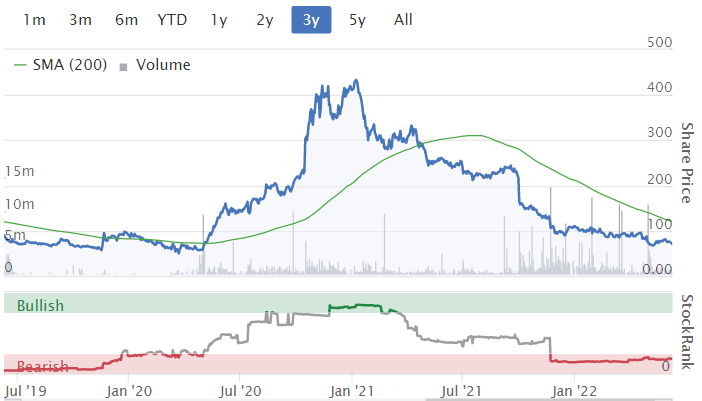
71p (down 3% yesterday)
Market cap £341m
The strategic review has decided to close AO’s German operations, which it says is currently about 10% of group revenue. That’s shrunk, because it was 13.6% of group revenues for FY 3/2021, and more recently 13.0% of group revenues in H1 to Mar 2022.
Germany was loss-making previously, so with shrinking revenues, and higher costs, the losses must have got to a point where management had no option than to pull the plug. Clearly nobody wanted to buy it.
The last reported (H1) gross margin in Germany was only 7.6%, so they’re selling at barely more than cost price - absolutely hopeless.
There are well documented problems in this sector, with supply chain constraints, higher distribution and digital marketing costs, and intensifying competition.
As I’ve mentioned lots of times before, AO has a lousy business model, and operates in a fiercely competitive market.
UK operations are doing OK though -
... the Group's UK business continues to trade in line with the Board's expectations for FY23.
My opinion - this share price still looks irrationally high, for a not very good business, that might not even survive a recession.
Exiting Germany seems a sensible, and inevitable decision, and stops the losses.
I really don’t like AO’s reliance on selling extended warranties, which have big balance sheet entries for this. So there’s a risk of mis-selling type claims & compensation, maybe? Some people argue that AO’s business model is to sell appliances cheaply, and then try to sell customers high profit warranties. I don’t like that.
For me, I just wouldn’t go near this share. Although exiting from the problem German division seems an improvement. Cash costs of £0-15m is a perplexing range! Why so wide? The pandemic brought a short-lived boom in business, now we have the hangover.
.
.
Webinar - there's a webinar for competitor £MRK today starting at 10:30 - login details here. I'll watch that, and report back if anything interesting is said.
DFS Furniture (LON:DFS)
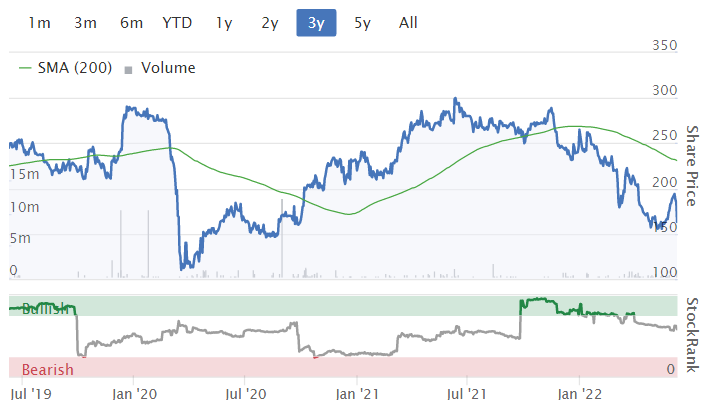
163p (down 12% yesterday)
Market cap £421m
Trading Update (profit warning)
Ahead of its financial year end on 26 June 2022, DFS Furniture plc ("DFS" or "the Group"), the UK's leading retailer of living room furniture, provides the following update on recent trading through to 5 June 2022.
Share in furniture retailers have been poor performers in the last year, peaking last summer, as households splurged pandemic savings on home improvements. Now we’re experiencing the hangover, with consumer spending data already having flagged that people are responding to higher inflation by cutting back on buying furniture, and some other items of discretionary spending.
Brokers seem to be very slow to reduce forecasts, which is a problem we always seem to see when the economy changes direction either way.
It’s encouraging that we’re seeing more muted market reactions to profit warnings at the moment - DFS down 12% yesterday is not bad at all, suggesting to me that we might be getting close to a market low in cyclical shares, where the downside on earnings has been anticipated by much lower share prices. Also, with so much market doom, if people haven’t sold their shares by now, then how many more sellers are left? Not many, I imagine.
It’s only a matter of time before investors start looking ahead to recovering earnings maybe in 2023 and beyond, but it doesn’t feel like we’re quite there yet.
Yesterday’s update from DFS - key points -
Q3 (Jan-Mar) - good order intake, double digit up on pre-pandemic level.
Q3 - significant cost inflation, which has been mitigated by selling price rises.
Q4 (Apr-Jun) - fall in demand reported by Barclaycard data (down 2.1% in transaction volumes) - DFS has seen a similar fall, but has maintained market share.
This seems garbled to me, and seems to contradict itself - but it sounds negative -
While we have increased our weekly production and delivered revenues progressively over Half 2, to record levels in the fourth quarter, the ongoing Covid linked supply-chain disruption, combined with lower order intake since April has led to lower levels of production and deliveries relative to our previous expectations.
Revised guidance - it would have been helpful to include a table of new vs old guidance, but instead we just get revised guidance with no indication of how much it has changed -
Subject to any variations in the rate of deliveries of the final weeks, we now expect UK & ROI full year revenues of approximately £1,150-1,160m and underlying profit before tax and brand amortisation of £57-£62m, which compares to pre-pandemic FY19 pro forma 52 week revenues of £996.2m and profit before tax of £50.2m.
Looking back to my report here on 23 Sept 2021, I was impressed with strong results for FY 6/2021, and initial guidance for FY 6/2022 from the company was PBT between £66-96m (low, medium to high scenarios).
Therefore the latest guidance of £57-62m, is a little below the original “Low Scenario” for this year. Hardly surprising, given that a cost of living crisis has emerged, when last autumn most people assumed that higher inflation would only be transitory, when it now looks like it’ll be around for some time.
Guidance on debt - I feel DFS operates on a reckless basis, having spent all the customer deposits, and paying out special divis & buybacks, funded by debt. The contrast between DFS (reckless, weak balance sheet), and SCS (which hoards cash) couldn’t be starker. I did a video explaining this & comparing SCS vs DFS last year, but can't find the link.
DFS is clearly a better business, but if the economy does fall off a cliff, then DFS might have to come back to the market for fresh equity, which is what happened during the pandemic, whereas SCS didn’t & won’t need an equity raise, due to its huge cash pile.
Outlook - doesn’t sound alarming -
We now expect to close the financial year with an order bank that is elevated by c. £30m or c. 2.5% of annual revenues relative to pre-pandemic levels, which will provide some resilience going into our 2023 Financial Year ("FY23").
It is difficult to forecast consumer behaviour over the next twelve months, but should the trends observed in April and May continue across FY23, this would broadly balance the volume benefit from the elevated opening order bank. Following the growth of the Group in volume terms relative to pre-pandemic levels, we also believe that we have the opportunity to drive further cost efficiencies from our scale.
However, our trading history shows that the Group has gained market share during periods of furniture market decline, and we believe that we will remain well-positioned against the market, given our scale, brand strength and our integrated retail strategy.
My opinion - this seems a fairly mild profit warning, and anyone surprised that orders have slowed in recent months just wasn’t paying attention to macro factors!
Although DFS has an attractive yield, it really shouldn’t be paying out divis & doing buybacks at the moment, given its weak balance sheet. So I wouldn’t rely on the divis continuing, if the economic situation gets worse.
How much did furniture retailers benefit from pandemic surplus cash spending?
It’s so difficult to anticipate where the future is heading. I thought the fundamentals were improving nicely at DFS, last autumn, but am not so sure now.
Tricky one, so I’d say with forecasts likely to come down, it might be best to watch from the sidelines for now.
.
.
Norcros (LON:NXR)
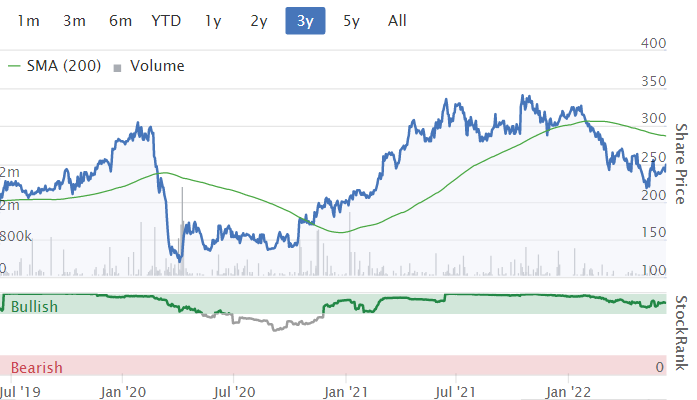
249p (up 4% yesterday)
Market cap £222m
Norcros, a market leading supplier of high quality and innovative bathroom and kitchen products, today announces its results for the year ended 31 March 2022.
PR headline -
Record underlying operating profit and strong financial position
Key figures -
Revenue £396.3m (up 22% on LY, and up 16% on pre-pandemic)
Underlying profit before tax £39.3m (up 28% on LY, and up 36.5% on pre-pandemic) - an impressive performance.
Diluted u/l EPS 38.2p - a PER of just 6.5 times - very cheap, providing this level of earnings is sustainable.
Looks like an earnings beat, with 38.2p actual EPS ahead of broker consensus of 35.9p
Dividend 10.0p yielding 4.0%, and covered almost 4 times.
Pension scheme - this has previously been a big drag on the share price, as it’s a large scheme, which means movements in assumptions can change the deficit considerably. Norcros’s strategy has been to grow the business through acquisitions, which in turn dilutes the pension deficit’s overall significance to a larger group. That seems to be working a treat. The latest figures are an accounting surplus of £19.6m, compared with a deficit of £18.3m a year earlier. Excellent news, and driven by higher bond yields, which reduces the valuation of future liabilities.
The more important actuarial calculations result in the latest pension deficit being £35.8m. An agreed payment plan for the deficit is £3.8m p.a. from 2022 to 2027. That’s now only a small amount relative to profits & cashflow, so the pension scheme now seems only a minor issue. Although there’s always the risk that in future assumptions could change adversely, so it’s worth keeping an eye on.
South Africa - Norcros has significant operations in S. Africa, which have performed well in FY 3/2022. Revenue of £139.6m is 35% of the group total.
Underlying operating profit was £10.9m, up £4m on last year, and 26% of the group total profit.
We always mention political & economic risk with S.Africa, which might lead some investors to apply a discount to these earnings
Outlook - I was worried that companies supplying building & home improvement goods might have benefited from a spike up in demand during the pandemic - when a lot of people who couldn’t go on holiday or eat out, opted instead for home improvements.
No sign of that here though, it sounds like demand remains robust, for now anyway -
Group revenue in the two months to the end of May 2022 was marginally ahead of the strong prior year comparator by approximately 1% and significantly ahead of the pre-pandemic comparator of the two months ended May 2019 by approximately 25%.
Whilst market conditions are likely to remain uncertain, the Board believes that the Group's proven business model and leading customer service proposition will continue to drive outperformance leading to further progress and market share gains, in line with its expectations, for the year to 31 March 2023.
Big acquisition made post year end, of Grant Westfield - at a reasonable price of 7.9x adj EBITDA. Broker consensus forecast does not yet seem to have included an >10% uplift in earnings from this acquisition.
An equity placing of just under 8.1m shares were issued at 230p.
Balance sheet - NAV is £200.3m. I would adjust that to remove intangible assets (goodwill,etc) of £90.3m. Also I would remove the pension surplus of £19.6m, and replace it with the real world deficit of £35.8m, so an adjustment of -£55.4m there. Also I would remove the deferred tax liability of £9.4m.
That arrives at my adjusted NTAV of £64m - which looks fine. Although the latest acquisition is big, and will greatly reduce NTAV to not much above zero, I reckon.
Working capital is healthy, with current assets (including cash of £27.4m) totaling £200.7m, versus current liabilities of £110.8m, a very healthy current ratio of 1.81
There is £18.8m in long term bank borrowings, which is more than offset by cash of £27.4m, so a net cash position of £8.6m - more than satisfactory.
However, note that bank borrowings have shot up since the year end, with the big acquisition (£80-92m, dependent on earn-out) being funded mostly by debt, plus a 10% expansion of the share count from 81.0m to 89.2m recently.
Cashflow statement - not so good this year, because adverse working capital changes have sucked in a fair bit of cash - mostly into higher inventories, although that doesn’t worry me, because many companies have raised inventories in order to mitigate supply chain problems, which NXR says it has done in the commentary. Hence it’s not a worry, and could unwind next year, if supply chain pressures have eased.
Inflation - the main issue of the day. NXR seems to be coping OK -
Whilst overheads were carefully managed as we emerged from the disruption of the previous year, we experienced unprecedented raw material, freight, and energy cost increases. These cost increases were largely recovered through price increases to our customers and margins continue to be closely monitored.
My opinion - this share looks excellent value, with a very low PER of 6.5, and decent divi yield of c.4%, covered almost 4 times.
The pension deficit is now only a small issue, so there’s a chance this share could re-rate maybe to a PER of 9-10, as investors realise they no longer need to apply a deep discount for the pension deficit - they key point being that pension deficit payments do not go through the P&L as a cost, so this has to be adjusted for, with a lower PER. It’s surprising how many investors don’t realise this.
Another positive thing is that the stock market has not given NXR any credit for management expertise at making a string of successful, sensibly priced acquisitions. Although this has seen the share count rise from 63m to 89.2m in the last 6 years - not ideal, given that NXR shares are lowly rated, so it could end up making acquisitions at a higher rating than its own shares’ rating, which is the wrong way around! Acquisitive groups need to get onto a high PER, then issuing more equity to fund acquisitions adds value. NXR looks to me a successful consolidator in a fragmented sector, so the business model looks good to me.
The big question is where the economy is likely to go next? If you think that the economy is likely to tank, then we could have already seen peak earnings, and EPS might drop to say half the current level (remember operational gearing). But that’s already priced in! If EPS were to almost halve to c.20p, then the 249p current share price looks about right, at a PER of 12.5
Therefore, the downside risk looks priced-in already, and if earnings can be sustained at or around the current level, then the share price seems attractively low.
Overall, I think risk:reward looks good, and with patience, this share should do well.
Or, if the economy does badly, then we could revisit the c.150p pandemic lows, who can say which it will be? Longer term though, NXR shareholders should do well, and receive nice divis along the way.
High StockRank of 88 -

.
.
Netcall (LON:NET)
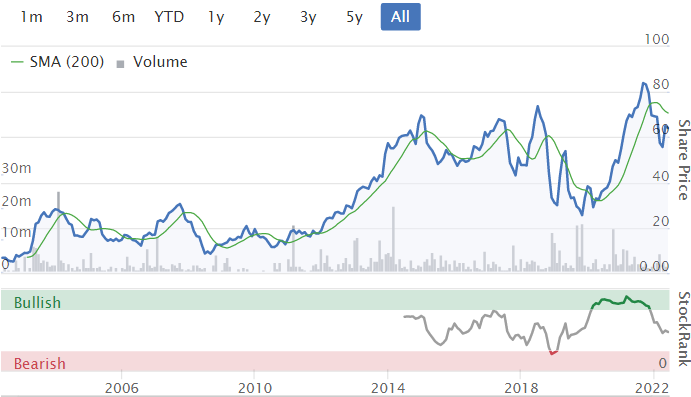
65p (pre market open) - now (at 08:17) up 28% to 83p in early trades
Market cap £97m (EDIT: up to £124m by 08:17)
This looks a big contract win, as the $19m (£15.2m at £:$ of 1:1.25) revenue is spread over 3 years. Hence about £5.2m extra revenues p.a. for NET, which is 19% extra on FY 6/2021 revenues - so a big contract indeed.
Dollar earnings are useful at the moment, given that sterling has weakened.
Profit from this contract is “...expected to generate similar margins to Netcall’s overall group margin…”
EBITDA will be “significantly ahead of its previous expectations” for FY 6/2023 (no footnote included, annoyingly).
The client is a global financial services group, and initially trialled NET software in N.America & Europe, now expanding it globally. That’s a very impressive contract win & reference for possible future contracts.
My opinion - I’ve followed Netcall for years, and never been madly impressed with it. Growth was steady, rather than exciting, and profitability bumped around between breakeven and just over £1m p.a. - performance which never seemed to justify its lofty valuation.
That could be changing now, as this “landmark contract” should boost forecast profit considerably, coming on top of strong H1, and forecasts raised earlier this year.
Looks interesting - if the company has reached an inflexion point, then earnings could now be on a strong upward trajectory. Taking a previous forecast of 1.7p EPS for FY 6/2022, and adding 20% to it, would be 2.05p EPS - so a PER of 32 times (EDIT: more like 40 times, after the 27% share price rise today, at 08:19) - not cheap by any means, especially now tech valuations generally have plunged. However, if NET is now on a roll, and more big contracts are won, then the valuation could be justified, and even increase further, who knows? Could it be a takeover target too? Growing software companies are often taken out at perplexingly high valuations.
Bear in mind also that the lighter blobs below are forecasts, which will be raised considerably after today's news, creating revenue & EPS trends that look to be going parabolic!

.
Long-term shareholders have been very patient - and only received small divis along the way -
.
.
PROCOOK (LON:PROC)
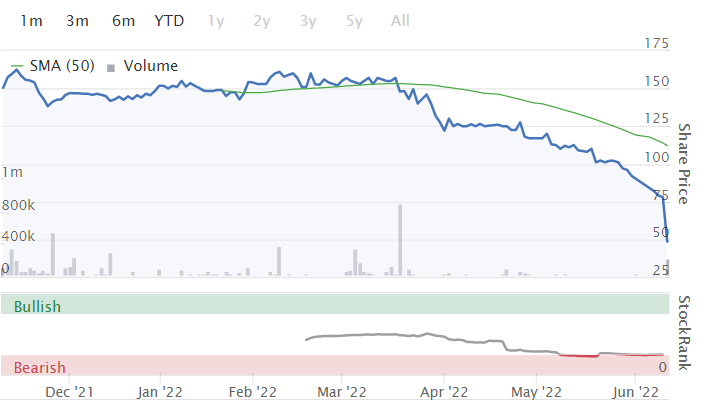
46.7p (down c.40% at 08:20)
Market cap £51m
Down 40%, that’s a harsh market reaction, so must be a pretty bad profit warning at a guess, let’s find out.
Background - I’ve only looked once at this retail/ecommerce business selling kitchenware, here on 22 April 2022. I liked the business, but concluded the valuation was too high.
It floated on the main market in Nov 2021, at 145p. It’s now 47p. Family shareholders cashed out £40m at the IPO - nice timing for them. Although to be fair, the founding family are still by far the largest shareholders, collectively. The free float is tiny.
H1 revenues rose strongly, but the operating profit margin dropped heavily, from 19.0% to 10.4%, so there were already some warning signs that things were not going well.
Guidance for FY 3/2022 was £10.0m PBT, in the Q4 trading update published on 22 April 2022.
On to today’s update -
Trading Update (profit warning)
ProCook Group plc ("ProCook" or "the Group"), the UK's leading direct-to-consumer specialist kitchenware brand, today updates on trading in the financial year to date ("FY23") and its outlook for the full year.
It’s early in the financial year, which ends 3/2023.
Key points -
Recent trading impacted by “increasingly challenging market conditions”, and consumer caution.
Q1 (Apr-Jun) - up against “exceptionally strong” prior year comparatives. Like-for-like sales have weakened in all sales channels (no figures provided).
Revenues still “significantly higher” than pre-pandemic.
Outlook/Guidance - this is useful, being detailed & specific - for FY 3/2023 -
- Revenue - c.flat vs LY (£69.2m)
- Gross margins c.flat vs LY too.
- Costs to be “managed carefully” - rather vague.
- Adj profit before tax (PBT) expected to be £4-6m - that’s way down on previous guidance from April, of £10.0m PBT - another reminder of how nasty operational gearing is being right now, when demand softens at lots of companies.
Valuation - I can’t find any broker notes, but see the consensus figures on the StockReport are for £81.9m revenues for FY 3/2023. That’s now revised down to c.£69m, a drop of 16% in expected revenues. That seems a big forecast drop. But I suppose it makes sense, given that new kitchen utensils are not even remotely a necessity, hence consumers cutting back on discretionary spending.
Crunching the numbers myself, £4-6m PBT would turn into c. £3-4.5m profit after tax (PAT) if we assume the now higher corporation tax rate of 25%.
Divide that range by 109.0m shares in issue, arrives at EPS of 2.75p to 4.1p
The share price is moving around, but currently (09:05) is 49p mid-price.
This gives a PER range for FY 3/2023 of 12.0 to 17.8 - hardly a bargain, despite the share price having crashed from 145p IPO price, to just 49p now, a drop of 66%.
There's not a lot of asset backing, with NTAV last reported at £10.6m - adequate only.
My opinion - the big question is what level of earnings is the business likely to achieve longer term? At the moment, the stock market is being incredibly short-sighted, and only looking at current earnings. Yet future earnings could recover considerably, and this year might turn out to be an unusually poor year. So if you believe in the long-term prospects of a company, then buying shares cheaply this year could turn out to be a very good decision long-term.
OR, the other way of looking at it, is that particularly companies which floated on the stock market on the back of strong growth from the pandemic, were over-priced, on the back of unsustainably high earnings. That’s definitely the case now, for many companies which floated in the last 2 years. Everyone seemed to assume that growth was permanent & structural, whereas a lot of it now seems to have been a one-off boost from the pandemic.
Hence it’s almost impossible to value some companies right now, buying is a leap in the dark.
The market cap here of £51m, is looking quite attractive to me, for a business with a long track record, under family ownership mainly still, that has a very high gross margin (67.8% last reported). I imagine the returns rate from online sales is probably low, as products are not fashion items which need to fit different body shapes!
I don’t know what level the shares bottom out at. There’s always the risk of another profit warning too. Hence it feels too early to be buying. Although I’ve added it to my watchlist. Maybe it makes sense to wait a while, to see a bottoming-out pattern emerge? I don’t yet see it as crushingly cheap, where it’s just worth throwing caution to the wind and buying regardless. Some decent sized Director buying might be needed to calm the market's ruffled feathers?
.
.
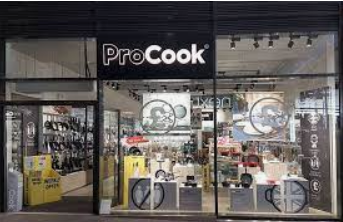
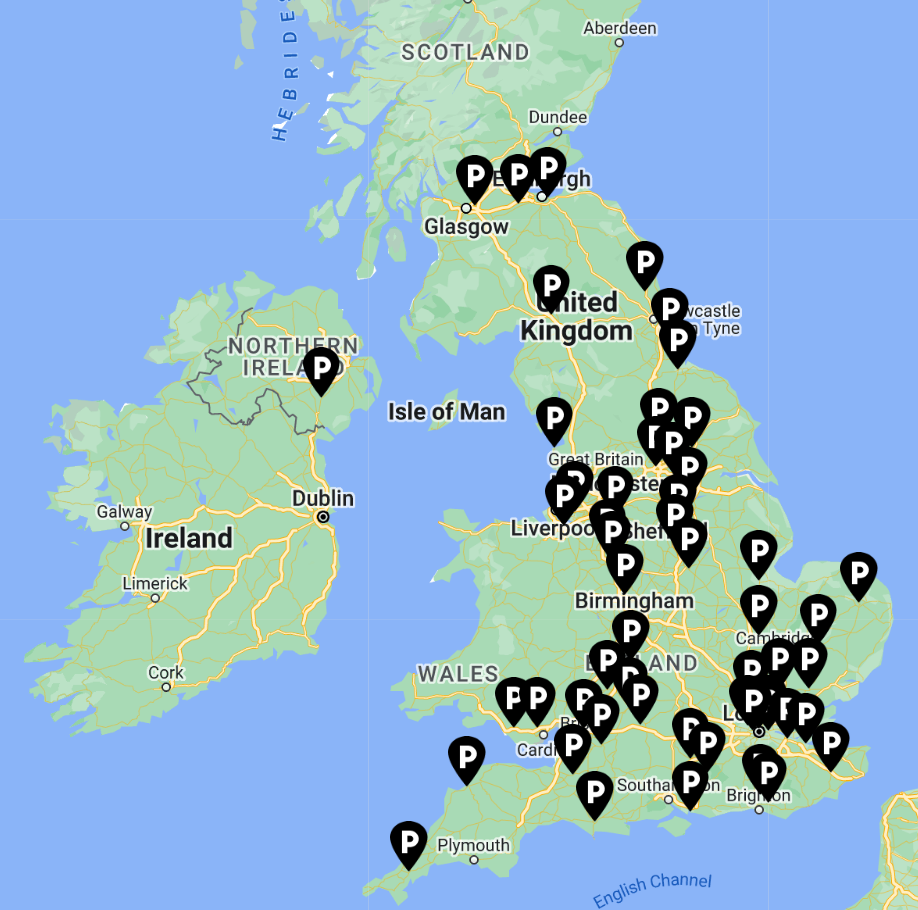
Googling some pictures of its c.55 UK stores, I recognise a lot of the names as being factory outlet villages. Also, the UK market could clearly have capacity for many more sites, if the site economics are good, and favourable deals available currently.
The store design looks unappealing to me. Competitors might include Robert Dyas.
.
.
Disclaimer
This is not financial advice. Our content is intended to be used and must be used for information and education purposes only. Please read our disclaimer and terms and conditions to understand our obligations.

39 comments
Read through the latest Barclaycard monthly consumer spend report for month of May.
Some interesting points. My comments are in italics:
Off the top of my head, this bodes well for Saga (LON:SAGA) in terms of Cruise, Travel Agency, and FX sales. Also for Quiz (LON:QUIZ) as they specialise in dresses, which will be in demand for summer travel given people need to update travel wardrobes. Bodes well for £SSP recovery at train stations and airports.
I would be avoiding the likes of DFS Furniture (LON:DFS) and Made.Com (LON:MADE) with the spend trends going quite negative now. And keeping an eye on hospitality without a strong loyal customer and/or affluent customer base with discretionary income. Revolution Bars (LON:RBG) and £HOST and £CBOX and Restaurant (LON:RTN) come to mind. Although perhaps very value-focused like Fulham Shore (LON:FUL) might continue to do well as people trade down.
(I hold SAGA in The Boon Fund)
Paul Scott- did you join the webcast for Marks Electrical (LON:MRK) yesterday? If so, what were your thoughts after it?
My concerns are:
Poor liquidity
The general economy affecting the company. This can be split into two parts.
1. as money gets tighter for the general public less will be spent which would affect revenues. On the plus side of this is the business is growing primarily through getting the company known to the public via advertising. Marks Electrical (LON:MRK) has only 1.6% of the sector sales and aims to grow this. They have no dates or targets as such but they would like to eventually hit 10% of the market.
2. Expenses will increase with everything going up in price. Wages, fuel and costs of vehicles all increasing will affect the bottom line.
On the plus side, it’s business model is nothing like AO World (LON:AO.) having just one depot to work out of they do not have trunking between depots.
They have a smaller team to pay wages too.
PE of around 18 is not the best but imo an acceptable level for a growing business that is profit making, cash in the bank and running on an EBITDA of 9%.
Regarding the EBITDA, 8% is very good for this sector. The previous figure of over 12% was before the ipo and is unrealistic as a listed company. They have done well to maintain the 9% level and are very confident to continue at that level.
It is worth noting that it is in these hard times it is the perfect time to find those companies that are coping and even growing as these are the companies that will likely survive a recession and then do well after.
If a serious crash of the markets happens or just a sector crash, then all companies will drop in price. Not a lot an investor can do about that. Either go all cash or take advantage of the drops.
I do think Marks Electrical (LON:MRK) will do well in time but for now it is in a sector that has been hammered. It is proving itself to be resilient in these hard times and still growing. Whether the sp drops further I’ve no idea but I do see this as a topping up situation on drops in the sp.
Anyway, just my view and I appreciate reading your reviews on a daily bases. (Any chance you can tie up Jack to stop him from leaving?)
Marks Electrical (LON:MRK) webcast
https://www.equitydevelopment....
Worth a watch. Paul Hill and Justin from VOX talk. Marks Electrical (LON:MRK) are part of the talk. (Sorry if the link doesn’t work).
Hi gmtrader,
Yes, I watched & took notes through the Marks Electrical (LON:MRK) webinar. I though it was excellent, and management come across really well. I particularly like their common sense, no frills business model & attitude.
My opinion is now a lot more favourable, and I've added it to my watch list. This share could do well long term.
For now though, I think the valuation is too high, given macro conditions & bombed out valuations for most small caps. Hence I wouldn't want to pay the current, c.90p share price. 50-60p is where I'm at, in terms of valuation in difficult conditions now.
I'm aiming to type up my notes from this, and 3 other webinars, so watch this space in next week's reports.
Best wishes, Paul.
Cheers Paul.
Totally agree with you regarding the management. I’ve had several contacts with the cfo, Josh, and been very impressed.
As for price, I’ve no idea how low it may go but as with all my holdings, I only buy a small amount to start with and add at key support levels to build a bigger holding providing I am still happy with the company.
I am looking to double down at this level which will still be a small holding of just 2k then. With being a new listed company there are no support levels to work off so I suppose working off the PE is probably the best way. Will probably double down again if 70p is hit and a final double down purchase in the 50’s which currently I would be very happy to see.
All the best.
Hostmore long term incentive update -
Don’t worry though it’s only a token 496000 shares .
Nil cost
Wonder why this is released Friday evening 6pm !
Robbers - thieves .
Hostmore rewarding its directors under their long term incentive plan with some seemingly nil cost options .
What is this rewarding ?
Afternoon. It would be great to get your thoughts on Peel Hunt who announced their first results yesterday since the IPOd last year….
Hi Purbow,
Sorry we didn't get round to looking at Peel Hunt.
I don't like their ethos of favouring rich clients, and keeping their excellent research (which relies on close contact with company managements) away from ordinary private investors.
I hadn't realised its shares had crapped out considerably since floating.
Very cyclical, people businesses, so I suppose this sector is going to be under pressure right now.
I'd like to hear what readers think, we want your views too, as well as publishing ours! :-)
Regards, Paul.
Avation (LON:AVAP) (I hold) has been on a bit of a roll over the last fortnight. Richard Wolanski, the FD spoke at the recent Mello conference and I had a good chat with him. Talked a good recovery story I thought. It looks too as if a div is to be reintroduced albeit the rns is slightly confusing.
Views of anyone with greater knowledge of this sector (aviation leasing) would be gratefully welcomed. Thanks.
I was a huge fan of these prior to COVID and thought I would keep them forever. Thankfully I changed my mind a sold out just before the real crash and so minimized my losses. I think they have a strong management team with a lot of skin in the games and they should re-rate over time when they straighten out their finances. I honestly haven't looked at them too much in the last 18 months but would consider going back in when things normalize (Russia, COVID etc)
I've met Richard many times & one of my kids has an ATR in Avation livery taking off from a wardrobe...
I like the company and they have consistently put a lot of effort into making themselves available to private investors - but that is different to saying they are a great investment. Aircraft leasing is a specialist area that can be much more risky than it looks.
It is a leasing business, so to oversimplify their cashflow is what they lease the planes for minus their blended cost of debt/equity. Excluding minor wrinkles, like Russia invading its neighbour and confiscating 500 planes, the risk is usually in whether they get their depreciation estimate right and are able to dispose of aircraft at book value or above. This is much more difficult than it sounds - the double-decker Airbus A380 did a lot of damage in some of the Doric Nimrod and Dr Peters funds. When jet fuel is expensive the thirstier planes get parked up, when it gets cheaper they sometimes resurrect them...
With Avation they are much smaller player and the upside was the scale gain as they transitioned from small turbo props to bigger ticket jets, as well as a reducing cost of debt as their credit rating improved.
COVID did indeed put the company under a lot of stress as they gave their airline customers breathing space and they had to extend their debt which whacked up the coupon. They've managed to shift most of the ATRs Virgin Australia handed back & it got a little too interesting for a whilewith a big 777 leased to Phillipines Air which went into restrcturing.
The management are often buyers of their own bonds, rather than the equity. Problem is that they are US market and extremely difficult to deal in from the UK.
There are less risky ways of playing the airline recovery if you are averse to investing too much time or money in a small cap (and it is a case of modelling the fleet) - AerCap is a much bigger, more liquid player that did have a bunch of planes in Russia, whereas Avation has larged ducked the Ukraine pain so far (although I think they have some Baltic customers who will be feeling nervous).
The company has announced a livestream of the results presentation that can be attended by investors, and not just analysts
09:00 Monday 27 June 2022.
Link below
https://webcast.openbriefing.c...
Tommy (I hold)
PROCOOK (LON:PROC) looks like a good business to me but just seven months after a 145p IPO last November the share price is just about 48p. This is becoming far too frequent recently.
I can’t see the appeal of any consumer retailer stock right now. Manufacturer inflation, payroll inflation, fuel/energy inflation, increasing taxes, squeezed disposable incomes, monetary & credit tightening. Valuation doesn’t matter unless the company is sitting on mountains of cash cos they could go to zero. Electrical/electronic goods are completely commoditised due to total price transparency so margins are virtually non existent. The extended warranties are a scam because consumer laws already cover repair or replacement of goods that are “not of satisfactory quality” when sold. The retailer is liable for several years after sale. I got a few hundred pounds back from Currys for a camera bought 5 yrs previously. Takes a bit of persistence but once the company realises that the customer knows their legal rights they offer a settlement.
A small bounce back on CMC Markets (LON:CMCX) after yesterday's big fall. I notice the company managed to buy back some of the shares at the lower price yesterday so hopefully that is a positive going forward. The guidance was at the top end of expectations, but probably the cut in dividend and the lack of news about dividing part of the company pushed it down. Hopefully the growth plans for the future will start moving it back towards the 300p mark.
Camtab, I am an over 50 (well over!) and expect my shoes to last for 20 years. I may never need to buy any more!
Seems like the fear is back last few days, with shares coming into range of buying.
I also get the feeling that some of the decent bombed out small caps SP prices are holding up/increasing against the market fear/trend.
Its just a gut feeling and I have no evidence to back this up.
Paul.S
The CNN Fear & Greed index is a useful objective measure of investor risk appetite & is updated daily.
Fear is easing with a current score of 32 vs a score of 10 a month ago.
(0 = Extreme Fear, 100 = Extreme Greed)
https://edition.cnn.com/market...
It feels like the small cap sellers are out. Just need some conviction buying to return....
Agree Revs..it feels like that to me
Hi Paul,
Thank you for your very interesting post on Wednesday in response to my post on £RBG. I am tempted to invest and I intend to visit the new Exeter Branch next month plus. I believe they have one in Torquay also.
In the past I made a point of visiting Dunelm (LON:DNLM) and Pets at Home (LON:PETS) and but for my impatience I would have made big profits.Both are very good businesses and the amount of Dog owners in my locality has mushroomed since Covid.
Talking of patience I have just sold an investment property for £300 k which I bought in 2002 for £45k. I think it illustrates the Warren Buffett strategy of buy and hold forever.
I remember being told when a young man patience is a virtue sought my many but possessed by few. I think I am going to have to be very patient with some of my holdings including Boohoo (LON:BOO) and
Hostmore (LON:MORE) to name but two.
Regards
Portugull.
Just to pick up on an excellent point you have made there, Portugull,
In the past I made a point of visiting Dunelm (LON:DNLM) and Pets at Home (LON:PETS) and but for my impatience I would have made big profits. Both are very good businesses and the amount of Dog owners in my locality has mushroomed since Covid.
Something I have been mulling over for a while is an unused resource we have here on Stockopedia - simply our own experiences. Take for example Unbound (LON:UBG) (I Hold). They have a branch of Hotter hoes here in Norwich - it is just around the corner from my own retail business (Oriental Rugs of Norwich - other rugs are available!)
I make a point of walking past this outlet regularly and it is only ever busy or very busy. Last week I wandered in and spoke with the lady behind the counter and asked her a few questions. Basically they are doing very well and are constantly busy - in fact it would be nice to get a break once in a while, was one of the replies(!!).
Clearly it is difficult and indeed dangerous to extrapolate the results of one 5 minute conversation and compare to the rest of the country but that is where the readers of this column have an advantage. We can literally share our own experiences of trade in our local area, businesses that are popular and followed in this column e.g. SCS (LON:SCS) Revolution Bars (LON:RBG) Shoe Zone (LON:SHOE) Saga (LON:SAGA) Vertu Motors (LON:VTU) Quiz (LON:QUIZ) to name but a few.
Anyway, just a thought, as I say, but often I feel private investors can be left a little in the dark when it comes to what is really happening within a business and certainly one area we can do our own on foot research is the retail arena. Put it another way, I have been so encouraged by what I have seen in the Norwich branch of Hotter that I have increased my stake in the company.
That should be Hotter Shoes here in Norwich - although I could have accidentally stumbled on an idea.....!!!!
Thanks for this comment Norfolk.
I too hold Unbound (LON:UBG) . Aside from the bombed out share price my logic is that shoes are less discretionary than other consumables and Unbound (LON:UBG) have better control of their supply chain than others and don't rely on China. However I didn't have any direct observational data until your comment. Thanks again.
Thankyou for posting your conversation very useful. I also hold Unbound. I agree with Revs8 but would add in a difficult climate targetting the over 50s is probably a good idea in retail as they should have the most disposable income and as said shoes are quite important in the overall mix.
Hi Norfolk,
Yes it's useful to see a business for yourself. However, I would be very careful about extrapolating out from one site, to a whole business. That's because many small to medium retailers/hospitality often tend to have a small number of monster performing sites, that generate a lot of the total profit. Then a typical mid range of sites that do OK, nothing special. Then a tail of horrible loss-making sites, usually over-rented, that they're desperate to exit.
Hence when you mystery shop a site, you don't know which of this category the site fits into. If it's a rubbish site, then it will look empty all the time, demotivated staff, poor service, etc. Whereas a monster site will be the opposite - super busy all the time.
Another point is that retailers/hospitality always depend on having a great store manager, then everything else flows positively from that. The best store managers come & go, and get poached by area managers from competitors, who can see instantly from mystery shopping whether a manager is any good.
Hence at any point in time, the store that you're mystery shopping could be lacking a good manager, and might be spiralling downhill. But it won't be typical of other sites in the business.
All that is worth bearing in mind.
Ultimately though, if the product surprises & delights you, for quality and value, then that's the biggest sign of a good business, irrespective of any other factors, because it drives repeat business & customer loyalty.
Regards, Paul.
Thanks for the reply Paul and yes, I agree, one swallow doesn't make a summer and all of that, indeed I have said,
Clearly it is difficult and indeed dangerous to extrapolate the results of one 5 minute conversation and compare to the rest of the country
But that isn't the only point I am making. By everyone chipping in we probably have a good deal of the country covered - put simply, if everyone were to find that there local Hotter Shoes branch was busy, for example, then we would be better informed to make a judgement, especially as in this case the share price seems wrong - simply too cheap.?
Do other readers of this column use or have any experience of shopping in Hotter Shoes?
Norfolk
I understand the High St data gathering point that you're making, but maybe Unbound (LON:UBG) isnt the best example to choose - after all, only 12% sales come from the UK High St.
These 23 UK stores may be unrepresentative of the overall group given that they offer '3D foot scanning' to allow the selection of shoes that fit 'perfectly'. Clearly this same technology isnt available via the digital app.
Thanks for adding further useful info Epsilon - in a way further endorsing my point, which is if we all share our individual findings for any given company, added together we will have a much bigger and much better and much clearer picture. I guess this does happen to an extent here naturally but I feel it needs to be encouraged - we can all learn from each other?
Remember - not everything recovers in value.
Cisco for example has never returned to the high-water mark set in 1999, even 20+ years on, and having proven itself to be a successful and dominant company in its sector, which was the bull investment case back in 1999. It has more or less succeeded in fulfilling its promises; yet because the price paid at the high was so ludicrous, it has never returned to that value.
Same could be said for many investments in Japan just before 1991.
Just because a company is quality and will fulfill its promises doesn't mean that the price will set an all time high when it does.
I wonder if there are any investments that Warren Buffett has bought 10+ years ago and still holds that have never fully recovered their value. It would be interesting to see. Or has he always disposed of lossmaking companies before they get to that tenure in the portfolio?
Now do it with dividends reinvested :) And have you factored in the stock splits for Cisco? They've split the shares by half twice (so 4 for 1) since June 1999
There's more to buy and hold than absolute price.
The inability to chart total returns is a major problem here on Stockopedia and all the long-term charts are tainted by it.
If you load a portfolio up properly in Folios and add the dividends you do get a reasonable performance proxy, but even then the total return versions of the benchmarks are unavailable (for "business reasons" i.e. they cost too much) so the chart displays apples vs pears. This could be partly overcome by permitting us to load a total return ETF as a benchmark proxy, which I have suggested.
You would hope that simple corporate actions like share splits are in there and we are seeing the factored prices (taking 2 examples: we certainly are for AMZN post-split, and the capital returns for ICG Longbow Senior Secured UK Property Debt Investments (LON:LBOW) are being adjusted for), but there is no way of verifying the underlying data.
I do know that the dividend histories here on Stocko can be a bit haphazard, with special divis sometimes omitted from the chart even though they are in the table (look at Somero Enterprises (LON:SOM) for instance) - it appears that Stocko struggles with special divis paid on the same date as a regular divi.
Maintaining a clean dividend history and the full corporate action log is, however, quite a demanding exercise, and I can see the business case struggling....
Hi portugull,
There's an excellent interview on a trade website with Rob Pitcher, the CEO of £RBG (I hold).
H'e s a superb operator I think, and this share is significantly undervalued, yes I know about macro factors, so am taking those into account.
If you have the time, this is well worth tuning in to: https://www.propelhospitality....
If not, it's on my list of things to do (writing up my notes), but given that it's my birthday weekend, and I've got a fridge full of English wines to taste test them, and friends/family coming round, then there's a chance it might have to be deferred into next week.
Incidentally, Nyetimber (English wine) has not impressed me. Just opened a bottle of their Classic Cuvee sparkling wine, and it's no better than a £7 Cava, But it costs £30. Hmmm. I bought 3 bottles, just to be sure.
Here's part 1 of my mystery English wine shopping.
Morning all
Very little news from my portfolio today. Thought I’d highlight comments from Mohamed El Erian (very well respected economist) on US inflation (there is obviously a read across to the UK).
Last year he (correctly) warned that inflation would not be transitory. Now he is warning that YoY inflation may not peak until later this year so don’t expect a flip flop on rate rises.
He’s very critical of The Fed pumping money into the system for far too long (same happened in UK).
From my point of view it makes me think that I need to avoid thinking about a “return to normal” but instead think which companies can grow in a changed economic environment.
https://www.bloomberg.com/news...
El-Erian is probably right to criticise the Fed for not tightening monetary policy sooner, but he doesn't talk about them "pumping money into the system", which can only be done by the government, not the Fed. The Fed can only pump money in to asset markets. He does criticise the continuation of QE in to this year, but if he or anyone else thinks that QE, as opposed to rate rises would make much difference to inflation, then they are making a mistake. There is little evidence that QE, has any significant impact on consumer inflation and plenty of evidence that it doesn't.
The latest evidence comes from Switzerland where the central bank has been printing money along with the rest of them. In their case they even sell out of Swiss francs entirely, buying foreign currency rather than domestic bonds, which is theoretically even more inflationary because it directly drives down the value of the currency. Yet their inflation rate has only just crept up to 2.9% mainly due to the same food inflation as everyone else. The reason they don't have the same overall inflation as the rest of Europe is because the vast majority of their energy is not derived from fossil fuels. It comes from hydroelectric, other renewables and nuclear. They have 10% inflation in transport because that's one area where they do use fossil fuels.
The evidence is clear and has been since 2008. QE moves asset markets and investment levels but the transmission through to consumer inflation is tiny. Bringing down global inflation will require demand to be squeezed down to match reduced supply, with consequent impact on GDP. I believe that will happen with the schedules of rate rises that central banks are now engaged in, alongside fiscal tightening. I don't think the results will be pretty. Stand clear.