Small Cap Value Report (Fri 14 Oct 2022) - BKS, LGRS, REVB, WAND

Today's report is now finished. Don't forget to check out tomorrow's podcast!
Good morning from Paul! It's catch-up Friday today. For those of a nervous disposition, and reading this on Thursday, no you haven't accidentally fallen through a worm hole in the space-time continuum, I'm publishing this early, partly so that I can have a bit more time in bed on Friday morning, and not get so stressed at 7am, but also so that everyone gets to see my notes on yesterday afternoon's interview with Beeks Financial Cloud (LON:BKS) (I hold), which might have otherwise been overlooked, if it had been added late to Thursday's SCVR.
Forthcoming CEO interviews - I'm really enjoying doing these CEO interviews, although it is quite a lot of additional work & stress, but if we can't flag up decent companies at attractive valuations, and quiz management, then there's little point in us being here!
So I've lined up some more. NB I only approach companies where they've issued a recent trading update or results which look good, and where I think there might be a long-term opportunity because the shares seem cheap, either as value, GARP, special situation, etc. So it's really my best ideas from these reports, and then I contact the company and ask for an interview (no fee, as I want to be independent). So far, every company I've approached has been delighted to engage, so that's encouraging. The next companies lined up for my interviews over the following fortnight are -
Sanderson Design (LON:SDG) - good recent results, and looks cheap. Lovely balance sheet.
Zotefoams (LON:ZTF) - we flagged it looked good in August, but yesterday's update sparkled.
As always, these are never recommendations or advice. DYOR please, and it's up to you to decide if or when to invest.
So if you have any particularly insightful questions, pop them in the comments section below, and I'll pick up the best ones, as I did with BKS yesterday. If you're finding them useful, then leave a comment, as otherwise I don't know if these interviews are useful or not.
Agenda
Paul's Section only as it's Friday:
Beeks Financial Cloud (LON:BKS) (I hold) - I've typed up a summary (below) of my interview with CEO & CFO yesterday, also available on podcast, or here in audio version. It's worth viewing the InvestorMeetCompany recording from yesterday first, as I did my interview immediately afterwards, and tried not to have too much overlap. I got to the bottom of the kerfuffle over share options, and it's not executive greed at all. I'm bullish on this share overall, due to the rapid & high quality recurring revenue growth, plus an obviously exciting pipeline. Over £20m of the £25m forecast revenues for FY 6/2023 are already in the bag, so I suspect upgrades are likely to continue (there were 3 last year). Not for everyone, and not a value share, and I think it's probably priced about right for the time being. Long-term, I think this could be a significant winner. Time will tell, as always!
Loungers (LON:LGRS) - a reassuring-sounding scheduled trading update, but it glosses over the fact that whilst sales are up strongly on a 3-year pre-pandemic view, there's been a significant drop from last year. It's a quality operator, and a self-funding roll-out, but the profit margins are slim, and valuation looks way too high, given macro uncertainty. Although it's not seen any downturn so far, and benefits from having local bars, so work from home helps. Overall, this share looks far too expensive for me, in current conditions.
Revolution Beauty (LON:REVB) - shares are suspended - the CEO & Chairman are both stepping down from day-to-day operations, in order to focus on the forensic accounting investigation. Well-known turnaround specialist, Bob Holt, is coming in to run the business on an interim basis. I'm keeping an eye on this situation, but have no opinion on the shares, because we don't have the full facts & figures to work out if it's worth anything, and how much. We'll keep a watching brief. More detail below.
WANdisco (LON:WAND) [no section below] - I’ve flagged this share several times recently, because something significant seems to be happening with order intake. In the past, WAND has limped along, making massive losses every year, with little growth, repeated fundraisings, and it all looked totally dismal. Whilst all along, making expansive claims about how brilliant its data-handling software is supposed to be. The market cap is now a huge £315m, and it’s still forecast to make continuing heavy (albeit reducing) losses. What’s interesting though, is the pace of, and size of recent contract wins. A lot are repeat contracts wins with 1 big customer, but others are also flowing through. The Q3 update this week says bookings are ahead of expectations. Sector experts might want to look at this share, and maybe report back if you like? I’m just flagging the big surge in contract wins, I have no idea how to value the company. It intrigues me though, because if the software is unique, and it's now selling, then upside in a global market could be very exciting. For experts & gamblers only! [no section below]
SCS (LON:SCS) - I have a look at the ahead of expectations FY 7/2022 numbers, which are surprisingly good. But order intake has fallen heavily in the new year, so broker forecast is for halving of profits. The balance sheet is rock solid, with a net cash pile much bigger than the market cap, and it permanently rotates of course, but there are two equally valid ways of seeing the cash, both are correct in different ways. Shares look extremely good value, if you look through what's likely to be a tough year FY 7/2023. Little to no solvency risk, so it's a sleep soundly share, with a good case for buying & forgetting about it.
Paul’s Section
Beeks Financial Cloud (LON:BKS) (I hold)
140p
Market cap £92m
CEO & CFO Interview - audio recording is here
Summary of key points only (lots more detail in the audio)
- Disclaimers - no fee being charged, I do hold shares personally, not financial advice nor a recommendation. Please do your own research.
- Please describe the business in layman’s terms! It’s cloud computing to connect banks, brokers to financial exchanges, for trading purposes. Public cloud is small part of Beeks now. Private cloud is dedicated services for client’s own use. Deals typically $0.5m-$2.0m deals, over contract life (4-5 years). Proximity cloud - latest product entirely dedicated to one end client, $2-5m total contract value. Driven by client requests for better security where they control access to the servers & manage it themselves through Beeks user interface. Unique in sector, quick to implement, clients pay monthly. Exchange cloud - big deals in pipeline, with potential $5-20m total contract size, but complex & take time to negotiate & get through security/compliance.
- Exchange cloud - ICE Group - biggest financial exchange group in the world, owns New York Stock Exchange. Built this for them, they then white label sell it to clients. Major endorsement of Beeks, and took 2 years to set up this deal. Rigorous testing, great reference site, they sell it for BKS. We’ve got dialogue with some of the next 10 biggest exchanges, at various stages of discussion. Big opportunity. New income stream for the exchanges, so they sell it. Can be switched on in an hour for ICE’s clients, as opposed to months to build their own connections. Don’t expect frequent big deals, it’s new business, longer sales cycle, but higher ticket size.
- FY 6/2023 revenues - over £20m recurring revenues already committed. Forecast is £25m revenues. Big pipeline, nicely spread across each product. Sales processes are involved, lots of resource needed from the clients, but it’s a real quality pipeline that takes time to convert.
- How sticky are customers? They’re “incredibly sticky” - getting into a big organisation is difficult, so once you’re in, and it works, customers don’t make changes. So if you become incumbent supplier, then inertia works on our side. Some churn for smaller clients, 1% churn per month is acceptable, as cloud services are meant to be flexible. Anything over 1% per month churn is flagged at Board meetings. Very sticky business.
- Capex - I identified that half the £10m capex was one-offs (freehold & leases), regular capex is c.£5m p.a.. Bought stock (of IT kit) due to supply chain delays. That should be reduced as supply chains ease. Capex this year should be c.£5m too. Inventories could be sold to customers.
- Reader question - most IT companies bill up-front, whereas Beeks seems to spend (capex) up-front. Couldn’t you change contracts? Yes, we’re looking at getting more cash up-front with new contracts. Also looking at debt & lease facilities. Looking at doubling RCF (undrawn currently). Want to preserve the cash on the balance sheet. Don’t want any more dilution. Large organisations look at our balance sheet, to make sure we show healthy cash balance. So we’re “very protective” of the cash balance. If mega deals happen, then we’ll try to work with customer to protect our cash pile.
- Dilution - Gordon: I hardly take any salary (am lowest paid member of staff!), and I’ve never taken any share options. I’m heavily personally invested.
- Share options - used up 80% of underlying profit, how can you justify this? This is not for management. CEO has never taken any options, and “never will”. Everyone at Beeks could walk out and get double their BKS salary, at big name banks in Glasgow. Average salary at Beeks is incredibly low (incl. Directors) is only £65k. Bulk of the options pot goes to the staff. Usually we do 2% p.a. In new share options to staff. Did a one-off 4% this year, as a thank you to staff for an exceptional year (i.e. as dilution of existing total shares). LTIPs come with 2-3 year lock-in. This is not executive greed. It’s to attract & retain talent. They’re locked in for several years, before share options vest. Will normalise to 2% p.a. Going forwards. We’re glad you’ve raised this point, so we can explain.
- Conclusion - exciting time for the group, opportunity in front of us. Most product development done, headcount doesn’t need to rise much more, it’s all about sales execution.
My opinion - I hold this share as a long-term investment, and I remain of the view that it's a credible, exciting growth stock. Which, to be fair, is reflected in the valuation of £92m, which does factor in a fair bit of future growth I think. The 57% organic growth rate in revenues was super-impressive for FY 6/2022. It's clear that growth for FY 6/2023 should continue at a fair clip, although forecasts are for a slower % growth rate. Given that over £20m revenues are already in the bag for the current year, due to contracted monthly revenues, then it's clear management don't see the c.£25m forecast as challenging for this year, it's likely to beat that. As they pointed out, last year saw 3 forecast upgrades, and with such a big pipeline (some are "mega deals" at a fairly advanced stage of negotiation), my money is on the company being well set up to beat forecasts. Plus, at some stage, we could get a big announcement or two about larger deals. So surprises look set up to be on the upside, rather than a profit warning, but of course we can't guarantee that.
The CEO said this year is all about sales execution, with most of the product development now done. Headcount will continue to rise, but at a slower rate. This should mean that profitability now begins to significantly rise, as the operational gearing from rapid sales growth kicks in, on a cost base that won't be rising as rapidly as in recent years.
Turning to share options, I got to the bottom of this. It's not executive greed at all, and I think some subscribers here jumped to an incorrect conclusion, so I was happy to help clear up that misunderstanding. The bulk of the options go to staff, who are on lowish salaries (circa £65k average, incl. Directors), and the share options top them up by about £25k each. Double the usual share options were awarded in FY 6/2022 as a thank you to staff for their dedication and delivering an exceptional year of growth. That's all great, and a wonderful example of how companies should be using share options. Sadly, at most other companies, executive keep the share options for themselves. Gordon McArthur is refreshingly different, saying "I'm the lowest paid person in the company.... I've never taken any share options, and never will, I've got enough shares already!" Isn't that terrific?! I wish there were more entrepreneurs like Gordon on the UK market.
However, what this does mean is that the share options charge of £1.6m last year, should not be adjusted out. It's core remuneration for staff. It's set to drop from 4% dilution, back to the normal 2% dilution this year, so £0.8m p.a. ongoing. Therefore I think this number should be deducted from the £2.0m underlying profit, to give an adjusted figure of £1.2m profit. That's the real number, in my view.
I watched the InvestorMeetCompany webinar for Beeks, also yesterday, and tweaked my questions, so that my interview immediately after the IMC webinar did not duplicate too much. Therefore, I recommend subscribers here interested in BKS watch the IMC webinar first (it's about 45 mins, and very interesting, with slides), then listen to my interview afterwards, as they fit together quite well I hope.
Loungers (LON:LGRS)
206p (up 1% at 08:27)
Market cap £213m
Preamble - We didn’t cover the results for FY 4/2022 here, so I’m looking at them now, and the figures are really good - helped by Govt support measures of course, and hindered somewhat by the later stages of the pandemic (e.g. omicron caution either side of new year 2021/2).
LGRS is a successful roll-out, self-funding, of cafe/bars. Management are highly regarded by sector experts I’ve spoken to, seen as best in class.
We’ve also reported generally positively on LGRS here in the SCVRs since it listed in 2019, although at times the valuation has seemed a bit warm - but that’s because it’s well managed, and a good format, with a self-funding roll-out of new sites.
LGRS also seemed to cope well during the pandemic, and there’s only been modest dilution since it listed in 2019, and the share price is now similar to when it floated. Not bad overall, considering that period covered the pandemic, which obviously did tremendous damage to many companies in the hospitality sector.
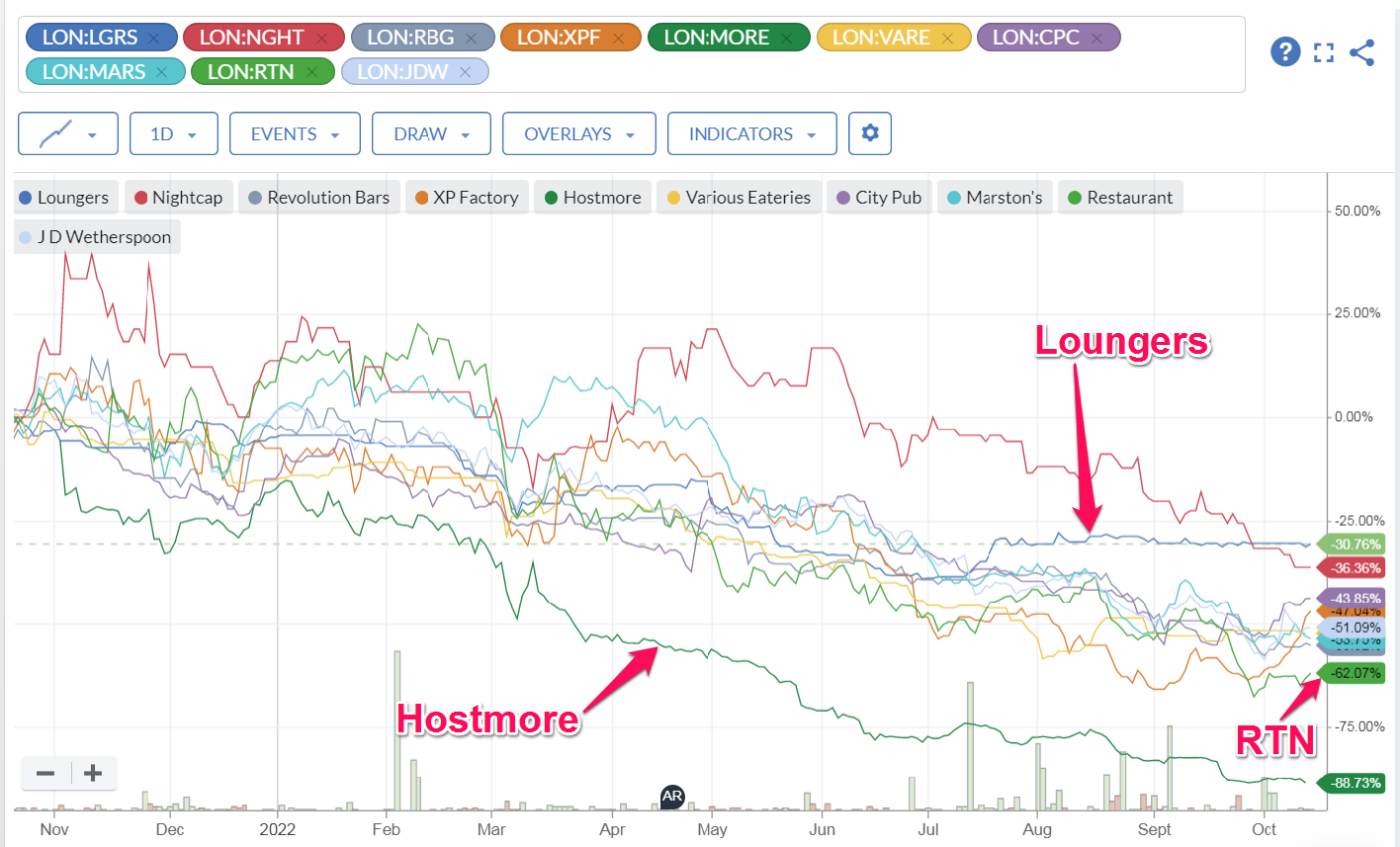
I’ve done a sector comparison chart below, easy to do on the “CHARTS” tab from any company’s StockReport. Then you put in the tickers of the companies you want to compare it to, and can play around with the timescale (which often shows remarkably different stories, when you zoom in & out).
I’ve chosen some small cap competitors in the bar/restaurant space below, and chosen a 1-year timeframe -
.
As you can see, the whole sector has sold off in the last year, like so many other cyclical shares in this bear market. You can pick the comparison shares from the “Sectors” tab under “BROWSE” on the left menu. I normally sort the sector list by market cap first, to chose relevant comparison shares.
The stand-out ones are that Loungers’ share price has done the least badly, down 31% in the last 12 months. Note that its relative out-performance has all happened since July 2022, when it traded strangely sideways, whilst the rest of the pack continued falling. Suggesting maybe there has been a buyer in the market, accumulating shares, and supporting the price?
The bottom two are Hostmore (LON:MORE) which has been a disaster unfortunately, down 89%, and Restaurant (LON:RTN) isn’t a lot better at -62%.
Everything else is bunched in a pack, between about -36% to -56% in the last year.
If I widen the timescale out to about 3 years, starting pre-pandemic, then they’re all down about 65-85%, apart from NGHT (not relevant as it floated midway through this period), and actually LGRS is the stand-out relative success, being only down 2.6% since it floated.
So there we are, this has been a lousy sector (hardly surprising, due to the pandemic), but the stand-out relative success has indeed been Loungers.
On to today’s trading update, which is a scheduled update coinciding with the AGM, and the same reporting as last year.
Trading Update -
Loungers, a leading operator of all-day café/bar/restaurants across the UK under the Lounge and Cosy Club brands, today announces a trading update for the 24 weeks ended 2 October 2022.
Continued industry-leading like for like sales growth with 11 new sites opened during the period
Strong sales growth against pre-pandemic comparatives, but this is now 3 years ago, so the numbers need to be strongly positive, in order to absorb substantially higher costs (especially wages, which have risen a lot in the last 3 years) -
The Group has continued to significantly outperform the market. Over the 24 weeks to 2 October 2022, the Group delivered like for like sales growth of 17.0%, using the period 22 April to 6 October 2019 as the comparator...
LGRS doesn’t provide any comparison with last year’s sales, which I think is necessary. Although last year was distorted by the reduced 5% VAT rate (on food & non-alcoholic drinks) until end Sept 2021, then it moved to 12.5% until end March 2022.
I’ve looked back to what was said this time last year, in an update on 15 Oct 2021. That said LFL sales were up 26.6% vs pre-pandemic. That has now fallen to +17.0% against the same 2019 comparator, quite a big drop.
Therefore, today’s update omits the important information that LFL sales this year are actually down significantly vs last year. I don’t like that they’ve tried to hide this. I would have preferred it to have been disclosed, and then an explanation given - quantifying the VAT benefit to last year, which is probably a fair chunk of the shortfall this year, as that boost last year has now ended this year.
Net bank debt is £9.5m as at 2 Oct 2022, which looks fine I think, it’s quite modest for the size of business.
Site roll-out - is continuing, with 30 new sites expected for this full year FY 4/2023. 11 have already been done. Current portfolio is 206 sites, so it’s a decent-sized business.
Diary date - 30 Nov 2022 for interim results.
CEO comments are useful -
Out-performing the market.
New openings performing well.
Inflation - a bit vague -
We are operating in a particularly inflationary environment and we are working hard to mitigate inbound cost pressures
This below looks an important competitive advantage, and note they’re not seeing any downturn in trade currently (encouraging) -
As our strong sales performance demonstrates, neither uncertainty in respect of the wider UK economy nor consumer attitudes towards discretionary spending have to date impacted our sales. We are continuing to benefit from more people staying local, working from home, and supporting their community and high street, which are trends that we believe are here to stay.
My opinion - this trading update looks like an edited copy/paste from last year, following the same format. The trouble is, in both years, it doesn’t actually tell us the most important thing trading updates are meant to say - namely is the company trading in line with, above, or below, market expectations? That’s the point of trading updates, so to miss it out, is ridiculous I think.
We’re meant to deduce that it’s probably trading fairly close to market expectations, otherwise they would have been forced to say that it’s ahead or below.
We have to check broker notes too, in case any bad news is being quietly slipped out, in reduced forecasts. Although as mentioned the other day, I actually want to see forecasts coming down, to reflect worsening macro conditions. Otherwise we end up with profit warnings, and the obligatory 30% plunge in share price, that can be avoided if forecasts are steered downwards gradually beforehand.
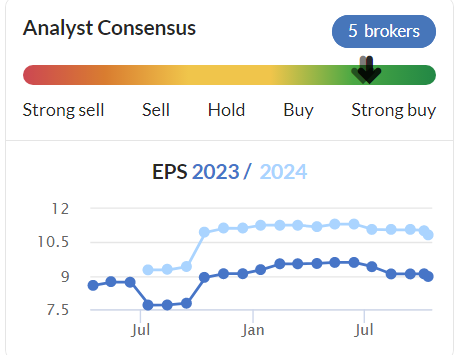
As we can see from the Stockopedia graph (vitally important to check this for every share), forecasts have so far been slightly trimmed, which makes sense. I wouldn't be surprised to see further cuts to forecasts, this doesn't look enough, given how bad the macro picture seems to be getting -
.
Many thanks to Liberum for an update today, which makes an important point that energy costs are hedged into 2025. Its forecasts are unchanged today.
Forecast EPS is 8.6p for FY 4/2023, down almost half on last year’s exceptional profits. This is forecast to grow to 10.6p, and 13.2p in the following 2 years, but of course we can’t rely on any forecasts more than a few months out, in current uncertain times.
This puts LGRS shares on a PER of 24 times this year’s earnings, which I think is way too high.
So, it’s quite a nice expanding business, but the profit margin is thin, £11.4m adj PBT on £276m forecast revenue this year, is only a 4.1% profit margin.
The whole sector looks pretty horrible at the moment, and I understand why some subscribers won’t invest in the hospitality sector at all.
I’ll buy shares if they’re dirt cheap & improving their performance (e.g. Revolution Bars (LON:RBG) - no current position, but want to buy back), or XP Factory (LON:XPF) (I hold) which is a very rapid roll-out of a distinctive format, that is trading well (but we have to take that on trust from management, as there’s little track record in the numbers).
Whereas LGRS shares look very expensive, and why would anyone want to buy at this stage in the cycle, as conditions are worsening, unless you’re getting a stunning bargain, which we're not?
So it’s not for me. I’d be interested if the share price halved from the current level.
.
Revolution Beauty (LON:REVB)
19p (suspended)
Market cap £59m
Update on Independent Investigation
I’m keeping an eye on this share, which is currently suspended as an investigation takes place of all its accounting issues. If we keep abreast of developments, then it could be an opportunity to move quickly if a future opportunity arises, or to steer well clear!
Tom Allsworth (Executive Chairman) and Adam Minto (CEO) have voluntarily agreed to step away from the day-to-day management of the business for the time being, in order to allow them to support the independent investigation being carried out by Forensic Risk Alliance and Macfarlanes.
This decision to step away is not a result of any matter arising from the independent investigation to date. The Board, including Tom and Adam, considers that at the current time, the Group requires an operational leader that can devote their full time and attention to managing the Group's business and lead the ongoing discussions with the Group's stakeholders, including customers, suppliers and banking partners. Tom and Adam will remain Directors of the Group but will not take part in any day-to-day decisions concerning the Group until completion of the independent investigation.
An interim COO has been appointed, the well-known Bob Holt - that name has cropped up a lot in my investing career, but I can’t recall whether he did good things or not at previous companies. If any subscribers here have any recollections about him, please do share them below in the comments.
My opinion - nothing earth-shattering there really. I can see why it would make sense to bring in new operational management to focus on the turnaround. It strikes me that it probably needs 2 new leaders - one to actually run the business, and the other one to refinance it with the banks, shareholders, etc, as necessary, or maybe sell the business to a third party.
We’re completely in the dark as to how this might pan out. It’s not at all clear if the shares are worth anything now, and if so, how much? So no opinion from me, due to lack of facts & figures, but I’ll keep monitoring it.
SCS (LON:SCS)
142p
Market cap £51m
ScS, one of the UK's largest retailers of upholstered furniture and floorings, is pleased to announce its audited preliminary results for the 52 weeks ended 30 July 2022.
STRONG FY22 RESULTS AND STRATEGIC PROGRESS; RESILIENT BALANCE SHEET MAINTAINED
Given how the share price has been in freefall this year, I was expecting terrible results, but these numbers look good, and the commentary says ahead of expectations.
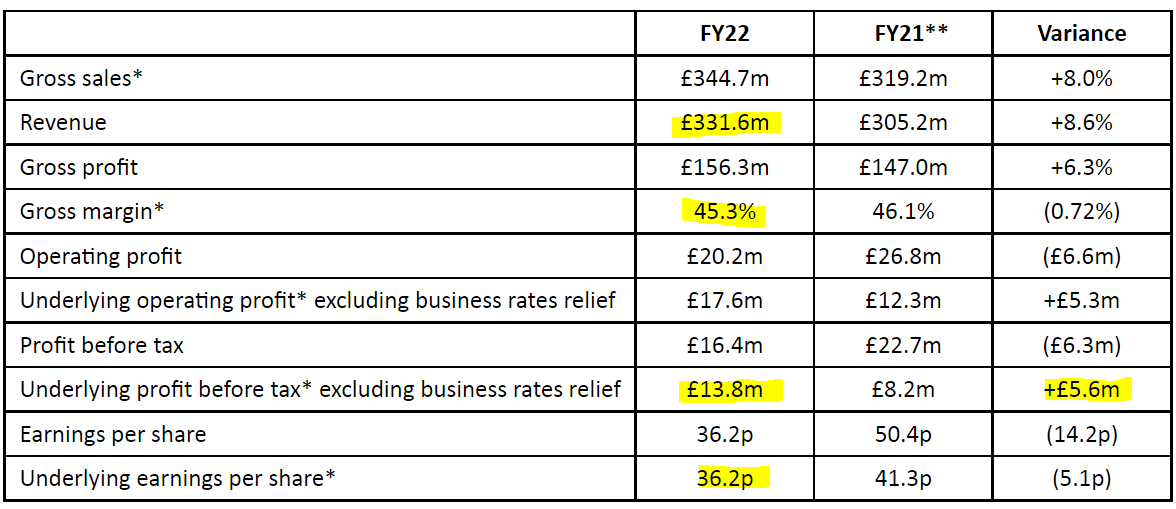
I’ve highlighted the most important figures for me -
.
This is particularly impressive, given that there’s been severe supply chain disruption, and greatly increased freight costs (in, and out) during this period, which has all but bankrupted online competitor Made.Com (LON:MADE) for example.
It’s admirable that SCS has stripped out the benefit of business rates relief in the table above, I don’t recall other companies reporting this transparently, so that inspires confidence.
Supply chain - this is good news, as the backlog of orders had got out of hand previously, with lead times too long. It’s now improving -
Supply chain improvements reduced closing order book (including VAT) to £71.7m (2021: £103.5m) albeit still £28.8m higher than at the same point in 2019
SCS shares look remarkably cheap, based on the FY 7/2022 numbers. So clearly the market is anticipating a drop in demand, due to consumers cutting back on big ticket items. Let’s see what the all-important outlook comments say -
Current trading - looks poor on both measures given -
Order intake down 7.8% (LFL basis) on pre-pandemic - that’s no good at all, as costs will have risen a lot on a comparison that is in this case from 2018, so four years old!
Versus last year it’s also bad -
One year like-for-like* order intake is down 14.4% on the prior year, with FY22 having benefitted from pent up demand as the UK recovered from the impact of the COVID-19 pandemic
Current cash position is more than the £51m market cap, at £76.7m (as at 8 Oct 2022). We’ve been over this lots of times before. There are 2 ways of looking at it, and both are factually correct -
- A lot of the cash is customer deposits, so isn’t really the company’s money.
- The cash pile permanently rotates, so the company can do what it wants with the money - as proven by DFS Furniture (LON:DFS) which has spent the lot, and also run up a load of bank borrowings.
Dividends - raised 35% to 13.5p total, giving a cracking yield of 9.5%, providing that can be maintained. It’s easily affordable, given the cash pile. A £7m buyback has also been underway, £3.3m done so far.
Outlook - trying to draw some positives out of a negative situation, I’d say! -
We are mindful of the challenges of the current economic climate, but believe our flexible operating model, refreshed strategy and robust balance sheet places the Group in an excellent position to deal with the headwinds our industry is facing. The tightening economy, coupled with the execution of the next phase of our strategy, will provide opportunities to take market share
Trading since the start of the new financial year has been subdued, with the challenges of high inflation impacting consumers' disposable income. As previously reported, the sector is seeing softening demand as consumers defer spend on big ticket discretionary purchases.
Whilst we expect the coming months to be challenging, we are confident in the longer term growth prospects of the business."
Forecasts - clearly, a sharp fall in current trading, means that FY 7/2023 is likely to be a lean year. Many thanks to Shore Capital for updating the figures, it’s pencilled in profits roughly halving, to £8.0m this year, or 17.3p - a PER of 8.2 - still cheap.
If this year gets worse, then personally I would prepare for the possibility of a result worse than that, maybe even as low as breakeven. But recessions pass, and then earnings recover, so I wouldn’t value companies on the low point of the cycle. Divis & buybacks might have to stop or be curtailed, if trading worsens.
Balance sheet is excellent, especially when you reverse out the lease entries, so NTAV that way is £58m. There’s net cash of £70.9m.
My opinion - SCS is at the value end of the market, so they’re not really big ticket items, and can be bought on interest-free credit. So I’d be more inclined to focus on this end of the market, than mid-market, which might see more of a slowdown.
SCS shares are so cheap now, and so well cash & asset backed, that even if it does trade badly for a while, it really doesn’t matter.
I think people who buy, or sit tight from this level, should do fine medium term, and with little risk in the meantime.
Remember that there’s flexibility in the business model, with a lot of staff paid on commissions, and because things are made to order, there’s little stock loss, and a favourable working capital cycle.
It’s heading for a poor year of trading this year, no doubt about that, but I think that’s fully in the share price already, and people could double their money with a say 2-3 year view, which looks good to me, if you can think beyond the current macro picture.
Note also that the share count has fallen in the last 6 years, from 41m, to 35.7m - interesting, and very positive.
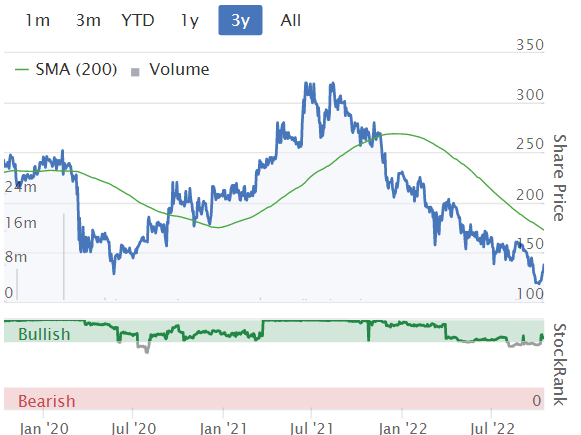
I think the price is oversold now -
Disclaimer
This is not financial advice. Our content is intended to be used and must be used for information and education purposes only. Please read our disclaimer and terms and conditions to understand our obligations.

105 comments
Hi Dodge, thanks for the comment but I'd like to make a couple of points:
1) the CUKS ETF tracks the MSCI UK Small Cap Index.
This index (as of the Sep 2022 factsheet) consists of 269 constituents, having a median market cap of £733m. In other words, half of the companies in this index are not within the traditional SCVR market cap limit.
Here are the ten largest components of this index (disclosure: I own RMV and IGG):
To put it simply, this index has a definition of "small cap" that includes many non-SCVR companies. It's a great index to invest in, but it's not a good index to compare with SCVR companies.
2) The AIM All-Share Index also includes companies worth over £1 billion, but it's likely to be a better representative of the type of companies that we cover. For example, the largest companies in AIM include the likes of Burford, Keyword Studios, Fever-Tree and YouGov, all of which we have covered in the past on multiple occasions.
The AIM All-Share Index is down 36.6% over the past year (before dividends), which is much closer to the result you calculated when looking at SCVR companies.
3) Not that Paul needs or has asked for me to defend his record, but I think it's fair to say that his specialism happens to be in retailing, to include both physical retailing and e-commerce companies.
Like other sectors, retailing is sometimes wonderful and it's sometimes awful.
It has been butchered over the past 18 months.
The FTSE AIM - Retail Sector index is down by 83% since its peak in February 2021. It's down by 70% since this day a year ago. What this means is that if your specialism happens to be retail shares listed on the AIM index, then you have just experienced the investing equivalent of the apocalypse.
Best regards
Graham
Thanks for the lovely message Jonno! G
Friday afternoon question...
Is there a way to invest cash sat in an ISA or SIPP in the equivalent of a high interest deposit account without withdrawing it from the ISA/SIPP? Normally gilts and bonds would be the the obvious option, but obviously things aren't normal. If the money was sat outside an ISA or SIPP you could invest it in a high interest savings account while you wait for equity markets to stabilise. If you were to withdraw the money from the ISA, to put into a savings account, you'd lose the tax-free status.
With money starting to have some value again (and inflation eroding its real value) it's becoming important not to have idle cash sat earning bugger all interest in a SIPP or ISA.
Any suggestions or ideas welcomed.
If your broker does a "flexible" isa you can now withdraw your isa cash but it needs to be returned before the new tax year. Perhaps google "flexible isas" - some do them some don't. The Investors Chronicle did a feature recently with a list of brokers that do and don't and more info - so I guess it depends who your broker is.
The IC article on flexible isas was very comprehensive, published March 11th under the headline "What are flexible isas and which platforms offer them?"
Thanks Robbie - will take a look at it...
Mmmm, one broker I use does offer this, the other doesn't. Guess which account has most of the idle cash sitting in it...
Well I've leant something new regarding flexible ISAs. Great to have this flexibility, though of course any interest you earn on the money when it's outside the ISA is subject to income tax. Was hoping to find something more tax efficient and without the hassle of having to withdraw (and later pay back in) funds from the ISA.
What is everybody else doing with ISA/SIPP funds that aren't invested in equities?
The only times I have transferred money from my ISA, both took around 3 months, both were in cash, so it sounds good in theory but they need to spend up the process.
It was also a lot of hassle, I got the impression, they wanted to hold onto my money, as long as possible.
Cash in ISA is a real issue now. You should be able to switch money between share and cash ISAs quickly.
Takes me about a hour to transfer between my Shares ISA and my current account; I bank and trade with Barclays. They also allow withdrawals as long as it's returned within the tax year as Robbie has discussed above. As for not paying tax on money outside ISA, well you can't have your cake and eat it: taxes and death....
My plan is to short the DOW and to buy oil and gas stocks and when the macro outlook looks better start looking at other sectors.
However, with Armageddon Joe in power may need to start looking at nuclear bunkers as none of the above will matter.
You can't do that with most brokers. Also can you only move this years amount, ie £20,000 or more than that?
Hi Rusty,
I believe you should be able to withdraw the full amount of your ISA and return it regardless of amount but I've not tried this myself except for small amounts only.
I found this on Google:
https://www.bestinvest.co.uk/i...
A while ago, Barclays trading services used to be called "Barclays Stockbrokers" and it was a totally separate account to its banking services with a separate login, but it relaunched as "Barclays Smartinvestors" and is now integrated with its online banking services(same login), so transfers between them appear like internal accounts. That's the bonus of banking and trading with the same business.
Whilst I am no longer with Halifax, my current account, ISA and Share Dealing Accounts all showed up on the front page of my log in system.
Though typically deposits were there instantly, withdrawals up to 3 business days
Gold Bullion and BH Macro.
Instead of cash another option is a short dated government bond ETF such as £IGLS I think this has an average maturity of around 2.5y so should be pretty steady, and has a yield to maturity of around 4%. A fairly good proxy for cash but with a slight pick up in yield. Obviously the price can move around a bit as yields move, but it's short maturity so shouldn't be too volatile.
Another possible option is to invest directly in short-dated gilts e.g. Treasury 0.125% 31/01/2024 £TN24. This was trading around £96 today and will be repaid at par on 31/1/24, giving a yield to maturity of around 4% over 15 months or so. Something to bear in mind is the cost of dealing, particularly on lower amounts, and the management charges with some ISA providers.
Are there money market funds available to SIPP as there are to DC Pensions?
With Vanguard SIPP I can leave my money in cash, not sure if they pay interest like they do on my standard dealing account or not as only just transferred in my previous company share scheme.
I have to say hats off to Vanguard and Aviva, took less than a week to transfer the SIPP though turned out the company had not made the last pension payment so now I have to wait until they reopen another Aviva account and then close that one too!
I have to say that there were not a lot of options in the Aviva account when I was trying to find something like cash or cash equivalents, and not the best range of funds either, but then company's choice not mine, though they went through People's Pension, Aegon and Aviva in under 18 months!
LON:WAND I am a bit embarrassed to say that this is my territory (you think your job is boring!) having spent the bulk of my career in the data/analytics space. The Product meets a number of important needs for clients with large amounts of data. I've worked for a similar company in the recent past and can say that, in my experinece, there is much more hype than there is real cash in the space. The new orders, whilst welcome, still amount to a fraction of the market cap. The sales process can also be tortuous as the subject matter is deeply technical and few senior execs can get engaged with the narrative.
I note that there is extensive VC involvement and the major individual investors are ex-VCs.
Where this may have legs is if a large tech player, e.g. a Cisco, SAP, IBM, or a major Cloud Provider, see it as an important fit for their portfolios. If that's the case there may be a large upside. I also wonder if there hasn't been a conversation of the nature - "build the product, get it across the chasm*, and we will buy it" - having occurred at some west coast party.
I'm not buying it - too many other good opps around.
* Charles Handy
Truss has announced that the corporation tax cut will not now go ahead. Jeremy Hunt will now produce the Haloween budget. Public spending will not now go ahead as planned.
An interim COO has been appointed, the well-known Bob Holt -.... If any subscribers here have any recollections about him, please do share them below in the comments.
Bob Holt OBE - possibly
Thanks but we know who he is! I just wondered if anyone could remember anything about his performance at other listed companies?
Hi Paul ,
I believe he was the CEO and behind the success of Mears Group ; and that was about 2000-2001. I remember I first bought at 26p sold all at 80p and then went to £5 ( in 18 months ) and paying a dividend of 20p a year!!
However he loaded the company with a lot of debt and he was basically kicked out ( can’t remember exact year).
Then he was involved in a company similar to Mears Group , again I am not 100% but I think the company changed its name (twice!) to the current Sureserve Group plc after a big dilution of the previous shareholders.
Thanks yiannos!
I thought of Mears when I saw the name Bob Holt, so good you confirmed that.
I think Sureserve was previously Lakehouse. I remember meeting the original mgt there, and thinking it seemed a bit odd. It looks a lot better now though.
Have a great weekend!
Regards, Paul.
Thats it Lakehouse , and before that was something else ; the business had something to do with pest control and the shareholders ended losing everything.
Thanks
He lead the turnaround of Lakehouse . he was appointed after the founder stepped back in and kicked out the mgmt that took it public and nearly bankrupted it. He also is (was?) Chairman at Totally . For both of these he stepped in and stopped the bleeding / stopped them going broke. Neither have seen huge returns though but havent gone to zero.
Press conference is now at 14.30. Jeremy Hunt is Chancellor - what is that likely to mean for economic policy? Possibly that growth is postponed and beating inflation becomes top priority? Or will support be focused on the poorest now rather than on the richer?
Hopefully your last sentence FREng but Truss has given Hunt terms of reference.
Jeremy Hunt's wikipedia page says he favoured low corporation tax in the past. So that's encouraging for business & investors.
Ah new Chancellor on the way !
The issue of directors stock options seems to be very much flavour of the month. I have seen notices from Michelmersh Brick Holdings (LON:MBH) , Litigation Capital Management (LON:LIT) and Alliance Pharma (LON:APH) in the last couple of weeks where directors have been awarded large numbers of nil-cost options. In the case of APH even while the CMA is looking to disqualify the director.
This is a good time to be awarding options from the directors point of view, because current low share prices reduce the theoretical value of the grant for tax purposes. Shareholders on the other hand face significant dilution, in the case of LIT about 5.5%.
Truss to hold a press conference [EDIT at 2PM today ]- without the Chancellor, BBC says, no-one will deny that he is to be sacked, and he's not answering his phone.
bit naff to do it whilst he was still on the plane...
His sacking was his reason to step on his plane, cutting his visit short. No point in him staying as his work was finished for him.
It was only said in jest, I had visions of Alan Partridge explaining that there wasn't going to be a second series :o) ..'it started with a kiss'
Superdry (LON:SDRY) - Dunkerton still keen:
On 13 October 2022, Julian Dunkerton, Chief Executive Officer, purchased 1,815,500 Ordinary shares of 5 pence each in the capital of the Company at an average price of £1.11 per share.
Hi eParo, Thanks for flagging that big Director buy at Superdry (LON:SDRY) by the founder.
I think this is very significant, because the company is in the process of renewing its (vital) bank facilities (exp Jan 2023). I concluded recently that the bank would probably play ball, because it has security (the large wholesale debtor book), and the business is actually trading OK in the circumstances. But it remains an unknown risk. Also, SDRY's borrowings are only seasonal, so much lower risk for the bank than if it's ongoing lending, because the bank could just decline to renew, and walk away without losing a penny, at the seasonal high point for cash (usually January, after Xmas).
Therefore, to see Dunkerton buy £2m of shares at this point, gives considerable comfort that the bank facility is very likely to be renewed, I would guess.
Regards, Paul.
Morning Paul
Would be interested in your view of Comptoir (LON:COM)
Market cap looks to be £5.6m, Net Cash £8.2m. Appears to be a perennial loss maker but a new board has come in and new CEO announced this morning is Nick Ayerst, who has a decent history in the sector? FinnCap are the broker since August so likely get some broker numbers soon.
Its at punt level valuation and I know nothing of the company or the sector but looks an interesting move
Hi gringo,
I recall looking at Comptoir (LON:COM) pre-pandemic, and thinking it was poor. So probably is still poor!
£6m mkt cap rules it out for the SCVRs now.
Regards, Paul.
Beeks Financial Cloud (LON:BKS) A word of caution. The return on equity is roughly 3.7%, for a risky asset the cost of capital is well above 10%. Therefore, Beeks are destroying shareholder value at present, further expansion means greater destruction. A nominal profit is being made but it does not compensate shareholders for the amount of capital they have tied up. The company need to develop a decent business before they expand. I don't think economies of scale make much difference here.
Hi Epitychia,
"The company need to develop a decent business before they expand."
I am a bit perplexed by this statement and was wondering if you could explain a bit more?
My own perspective: I started investing in Beeks Financial Cloud (LON:BKS) a few years ago after a Mello presentation by Gordon Mc Arthur. One of the questions at the time was "How is this financed?" and if I recall correctly, his reply was along the lines of "I took out a huge mortgage against my house and the rest is on credit cards". From that beginning they have gone to a footprint in 20+ datacenters globally and top-tier international financial institutions trusting them with their critical infrastructure. At the same time, they have been able to adapt their product offering as corporate IT architectures are rapidly evolving and new opportunities presented themselves. To me this is a remarkably impressive achievement, all the more so because I work with many of these same institutions and know the very real hurdles around new technology/vendor adoption.
The strategy clearly is one of maximising the land grab now with the eventual "prize" to flow from that in the future. I am invested on that basis.
Always good to temper one's enthusiasm with a differing view though :-) so again, would be very interested in what you would need to see to consider Beeks Financial Cloud (LON:BKS) having developed a "decent business"?
Thanks for your thoughtful comment. Certainly, this could be a highly profitable business in the future. But on the other side, if this industry is highly profitable why over the last 5 years have profits been low. I am sure they have wanted to make a high profit over this time. What will change over the next few years? Secondly, there are other companies out there that are currently making good profits, selling at low prices. A lower risk strategy would be to buy them instead of jam tomorrow.
I think a lot of it is just the nature of the beast. Big software development projects are risky, complex and most of all: expensive. So there are big upfront costs. But the payoff is that the same software, once developed, can then be sold over and over again. In addition, Beeks Financial Cloud (LON:BKS) obviously has considerable hardware costs which they highlight in their reports.
I am not sure this area has necessarily been very profitable for anyone in the last 5 yrs ... unlike other sectors, the big financial institutions have been some of the last corporations to adopt Cloud architectures. This is partly because they are naturally conservative and cautious given the impact if something goes wrong, but also because of constraints around compliance etc. However, this is now changing rapidly I think and will only build momentum from here.
The other point to highlight would be how these procurement cycles work - typically a bank would start with a minimal/low risk proof-of-concept type commitment and only scale up to more critical infrastructure as trust is gained in both the solution and the vendor. I think this aspect is what Gordon means when he refers to long and slow sales cycles. The flip side is, once a particular solution becomes embedded it can develop into the de-facto standard way of doing things across the whole industry.
Finally, why don't they just buy an existing business? I really am not aware of anybody else offering anything like Beeks Financial Cloud (LON:BKS) . This is not a simple managed services type IT business. Did you have any particular company in mind?
The above is just my understanding having a small personal window into this world. As with everything, there will be competing perspectives!
You are right of course - it is very much a case of "jam tomorrow". In this case - on balance - I am willing to accept the risks. I see Gordon McArthur as an impressive entrepreneur ... if the commercial opportunity here is correctly identified, he certainly strikes me as the right person to pull it off successfully.
Yes, as the late Queen said:
'Recollections may vary'.
Good Morning Paul, if you have time I would be interested in your thoughts on £SCS results that were published earlier this week
SCS (LON:SCS)
Caps make all the difference;-)
Morning Atomic Investor,
OK, sure, I'll look at SCS (LON:SCS) next - have been meaning to check it out.
Regards, Paul.
Good ish to hear from Beeks.
I’m not sure I buy all of it though based purely on my gut instinct and real world experience .
If employees can earn 100% more salary at companies close by, well I just don’t believe that and maybe if someone really wants to dig a shareholder could write and ask for some support evidence to back that up. Feels like hot air to me .
The “story” as presented sounds credible but a founder / major shareholder doesn’t need a big salary as their equity stake is their value . As highlighted below it looks like CEO is making his money by selling his shares along the journey , which is exactly the way it should be .
I had a good advisor once from Grant Thornton who had also advised Dean Hoyle founder of card fsctory, and the sage advice was a founder de-risks in stages by selling parcels along the way.
As an example of this taken to the extreme the amazing Rudi Weinrech chairman and founder of Holders technology and still 40 odd percent shareholder has a remuneration package of £10k.
Makes sense and good answers from Beeks CEO but doesn’t quite pass my own bullshit detector test based on my own experiences .
This is for a Java Full Stack Developer taken from their linkedin job ad...
None of this seems out of the ordinary for what the role is but I can't believe "A competitive salary" is 50% of what they can get elsewhere.
What we offer:
Financial:
• A competitive salary
• Share option scheme – an opportunity to have a tangible financial stake in the work that you do.
• Pension
• Flexible Work Hours (3 days on site per week)
• Life cover (4 x salary)
• Training Allowance
• Enhanced Maternity Leave
Lifestyle:
• A casual work environment.
• 25 days annual leave (plus 8 days floating public holiday allowance).
• Hybrid working pattern home/office (an average of 3 days a week in the office for local candidates).
Health:
• Private Health Insurance including dental.
• On-site gym and PT Sessions
• On-site massage therapist
• Free fruit throughout the office
I’m getting my application in, that does look a good place to work, Gym , massage therapist , free fruit probably needs a table tennis table and yoga sessions for me to consider it fully .
My first job was working at British steel factory n an underground tunnel descaling pipes and my gaffer introduced himself as “My names Harry and I’m a bastard . You can call me Harry the bastard . Now get down that hole and descale them pipes and see thee in 8 hours”
Reminds me of a good friend of mine who thankfully didn't really need to work going for a job as mortgage adviser the interviewer said "Monday to Friday we own you", my mates reply "I thought slavery had been abolished !" needless to say he didn't take the job.
Sounds like Harry was from Yorkshire. Sounds like my old boss!
Old boss sounds about right.
You're probably right, Dulciemo, but traditionally men called Harry were from Lancashire.....
Great!
Ah lad and tha's lucky! I used to drream of descaling pipes.
Employees can be happy to work for a low salary because they believe that their shares and share options will make it all worthwhile in due course.
Can’t say I ever found that, think that’s a bit of much peddled myth . Market salary and options yes . Not below market salary and certainly not 50%.
This is the millennial generation .
To be fair to the CEO I like the sound of him I think he’s over egged this and we are picking up on poor wording .
But having a founder CEO who started a business by remortgaging his house and loading the credit cards still sat on a big holding is a big plus .
And he is well advised to de-risk along the journey so I see his GRADUAL selling of shares along a riding trend as a very positive thing .
Once he has trousered circa 5 million would not like to see it continue .
So sort of a thumbs up but I genuinely feel he made a lazy comment to Paul saying his staff can get double the salary round the corner . Though maybe the massages and free fruit are important to the Glaswegian IT crowd
Maybe with yoga and table tennis they might stop to 30% of the market rate ?
High salary isn't everything to everyone. I recently heard a founder director of Smallsparks (I hold) say that he can pay new Phd grads 30% less than market rate because they get to launch rockets. (Yes it is rocket science)
Free fruit to a weegie , is like tofu to a tiger….
I imagine that experienced staff are much more difficult to retain however (and that most of the Phd grads are hoping to prove their worth - at least the good ones, and will move on if the salary isn't reviewed after a few years).
Actually cheeky minnows, the comment was made in response to a question about how the company retains their employees. Apparently It isn't a problem as, in their field, they have the pick of the crop. Everyone apparently wants to work for them.
Ok Roger, understood.
I used to manage a R&D department, a good proportion of which had PhDs (which is more common on the continent than in the UK). I have found that the commitment, skill and motivation of the development team is more important than any savings that could have been made on their salaries.
I once had a young engineer state that he wasn’t doing his job if he couldn’t make 10x his salary for the business. Obviously youthful exuberance aside (and this is a metric that is almost impossible to quantify), the point is an interesting one – get the most out of very good people, and it can be transformative to a business. Trundle along with mediocre people watching the clock .. and well you know how that ends.
I can’t say how my experience translates to the IT world, but I guess it is similar. The CEO is counting on his staff to be dynamic, motivated and skilled. It is good news for the business if people want to work there – it means that the culture is at least right. You are correct that people that work in the overlap between technical and creative roles often have job satisfaction higher on their list than salary, but a word of warning to the CEO – lose a couple of the best people and things can go wrong quite quickly. I certainly wouldn’t be boasting about how little I could pay them.
Premier Miton (LON:PMI) Q4 AuM update today. Truss and co. having a big impact:
The recent fiscal event in the UK combined with the ongoing geopolitical environment have created a challenging and uncertain period for markets both in the UK and globally. Investors understandably have remained cautious about committing new investments during this period and we have also seen outflows across the industry from open-ended funds.
It is clear that the current market conditions are particularly challenging for the asset management sector and this was reflected in the Group's AuM ending the Quarter at £10.6 billion.
Premier Miton (LON:PMI) They are heavily focused on UK equities so not surprised they are struggling a bit. Polar Capital Holdings (LON:POLR) might be a better option as most of their funds are global, and a bit more niche (technology, healthcare and insurance are the main areas of focus).
I’ve just been reading the Telegraph article on how LDI’s work. As far as I can make out, it is simply leveraged buying of gilts, and has similar risks to the buying of stocks with leverage (except gilts are not supposed to swing wildly in value (until now)).
I now understand why commentators are comparing this problem to 2008 and collateralised debt obligations. Is it all going to kick off this weekend or will the BoE cave in and keep providing support?
That’s my belief too
And it’s sad to see that the leopards haven’t changed the spots .
Leveraged trading by an institution causing financial upheaval then bailed out by the Government all under the watchful eye of the FSA.
That’s the real scandal in my eyes the fact that instituting etc have run the gauntlet, lost , and nothing will change .
If you or I do leveraged trading and lose out we pay the consequences
This is of course truly OPM , in fact it’s OPP (other peoples pensions) which is why the government has to step in .
This happened under the FCA regs and smart arse pension fund managers who used leveraged trading and just got caught pants down whilst being a naughty boy, whilst all the time the headmaster looked the other way because there is no actual consequence other than looking like a set of tits .
I've just read "The Price of Time" by Edward Chancellor in which the major theme is that eras of low interest lead to financial crises. One reason is that fund managers desperate for return take risks. The finance boys have over the last twenty years been expert at wrapping up risk into innocuous sounding "products". This time we have LDIs. Last time (2008) we had CDOs.
The odd thing about the book is that clearly Central Bankers don't buy the thesis that keeping interest rates low is dangerous. I came away wondering if economists actually understand the economy. Us non-economists don't stand a chance.
Did you gain much from Edward Chancellor's book beyond your brief summary. AIUI, the main thrust of the book, with lots of examples, is that he views interest rates under 3% as leading to ridiculous risk taking, which tend to lead to huge losses for the risk seeking idiots but can also cause major systemic problems. On the LDI front, the regulators and financial institutions must have been stupid/greedy and stupid respectively, to have had this happen.
I had mixed feelings about the book. It was very polemical, and I would have liked to have heard alternative views. But I agree regulators have been stupid/greedy. Even if they disagreed with Chancellor's views, they should have known that low interest rates increase the likelihood of risky behaviour.
This happened under the FCA regs and smart arse pension fund managers who used leveraged trading and just got caught pants down whilst being a naughty boy, whilst all the time the headmaster looked the other way because there is no actual consequence other than looking like a set of tits .
And we all know who used to be the CEO of the FCA until very recently! :-)
That is a non-trivial point. It is why the sacking of KK does NOT mean the crisis is over.
That is a non-trivial point. It is why the sacking of KK does NOT mean the crisis is over.
The BoE may not have covered itself in glory of late, but we need to recognise the unique issues they're dealing with. It's not as simple as rapidly raising interest rates to get inflation under control because the UK has a unique concentration of home ownership. Once fixed rate mortgage periods are out of the way interest rate rises impact people directly and quickly.
So the BoE is proceeding cautiously in order to try and avoid crashing the housing market, which would send the UK into a deep recession. It's a desperate tightrope which neither the Prime Minister or the (ex-)Chancellor seemed to have any appreciation of.
As events transpire it appears that by luck or judgement Andrew Bailey has got away with this. In refusing to bail out the pension funds further he also refused to bail out the government and pushed the markets to a point where the Prime Minister has been forced into a U-turn, thus easing the immediate problem with gilt prices. She's not the first politician to learn to her cost that you can't fight the bond markets.
The spike in gilts may help the BoE's inflation fight as well, as it will have no doubt concentrated home owners' minds wonderfully, without the Bank needing to raise interest rates. But basically this is all government policy - if you drive home ownership without building affordable housing and then try to promote unfunded growth in the middle of deep inflation then bad things happen.
timarr
Hi Tim
Is it not the case though that although the B of E won't buy anymore gilts from pension funds they are now willing to lend pension funds cash against the gilts the funds hold so all sounds a bit smoke and mirrors to me.
Regards Andy
Hi Andy
Is it nt the case though that although the B of E won't buy anymore gilts from pension funds they are now willing to lend pension funds cash against the gilts the funds hold so all sounds a bit smoke and mirrors to me
Sort of. The BoE has devised a scheme whereby they will lend against collateral via commercial banks. This supposedly comes at a higher price than if the pension funds had taken the straightforward bailout.
The whiplash u-turning of the last few days hasn't made much difference to gilts overall, and it looks like Hunt wants to hang on till Halloween before providing the certainty that the markets want (well, hopefully) so there'll be some nervous fund managers out there at the moment.
The whole situation is ridiculous, though. Truss and Kwarteng have been acting like Britain still has an empire and sterling is the world's reserve currency. We don't and it's not. As Mark Carney memorably said, the UK is dependent on the kindness of strangers to fund our debt addiction. This week we found out what the price of that dependence is.
timarr
Thanks Tim
Hopefully given virtually all the tax breaks have now been rolled with the exception of the stamp duty cut Hunt won't have to come up with two much to calm markets down although I think it will take a combination of fiscal responsibility and Truss given the boot to try and get gilt rates back down.
It really is incredible what an own goal bomb, Truss and Kwasi came up with plus throw in the usual derivatives working until they don't story again.
I think we have to be careful though. I was working with large pensions back in the 90s and the idea of LDI came in to try and stabilise things. Early 90s and naughties some some big swings in asset values and interest rates. Consultants said "well look we can simply match the liabilities you have in the future." They did and reduced the risk in pension schemes massively. Remember a lot of DB schemes were already too expensive for companies and they were moving to DC. At that point all was well. But then presumably the next generation came in and saw these long term investments and "being ever so clever" saw they could lend them out for return. In my view that is what happened and they like us all have been identified as not as clever as they think they are. I think my point is the long term is a series of short terms and things change.
Hi Camtab
Isn't that pretty much how CDO's became so toxic. Started off as a good idea (all triple A rated and as safe as house) then slowly but surely greed took over until they were dangerous junk being marketed under the original guise.
Paul, I just wish to say thank you to you and Graham for your hard work on behalf of private/retail investors. I may not always agree with your view on individual shares, but listening to the 'counter argument' is an essential part of the investment process, in my opinion.
During your time at Stockopedia you have unearthed some real gems. It was thanks to you that I was early into Avesco and benefited from its blockbuster takeover.
Looking forward to the interview with Lisa Montague, CEO of £SDG.
Best wishes
That's very kind, thanks Jonno.
For newer subscribers, I think it's important that I reiterate that Graham & I are not tipsters. Instead we're trying to provide analysis here, with our opinions on each share we cover, but then hand the ideas over to readers to do your own much more detailed research.
Yes, over the years we've found loads of fantastic investment ideas here, and we continue to do so on a daily basis! But obviously in a dire bear market, that doesn't necessarily translate into instant profits. Plus a lot of my higher conviction ideas have been awful in the last year, because the consumer sector has been slammed so hard. But in the wreckage, there will be future multibaggers, and we'll relentlessly try to identify them!
It's a marathon, not a sprint, and very much a team sport too, so we love sharing & discussing our ideas here with the members. I'm so impressed that so many people have stuck around, and the community here is just getting better & better. Which helps me keep motivated, and not sink into despair, as we're all human, and keeping busy is the best way to dispel gloomy thoughts.
Right, I'd better look at the RNS, as it's 7:30 already and I've not looked yet.
Best wishes! Paul.
Jonno,
Being dispassionate about the whole thing, I think a whole lot of dogs have also been unearthed by pundits. I recommend treating pundits as little better or worst than darts thrown at a dart board and time doing your own research is better than reading the writings of pundits.
BSV
I have tracked the performance of shares given a positive SVCR write up over the last year, and compared with what would have happened if you had just bought the CUKS ETF instead. A portfolio based on Paul's reports would have returned about -39%. If you had bought the ETF instead you would have about -28%. I see no evidence that reading the SVCR would have provided readers with an edge over the past year.
Its all very well telling people to DYOR, but that doesn't remove the need to track performance. The question I need an answer to is: "Does reading the SVCR give me an edge?" I see no evidence that it does.
How many times do people need to be told this is not a tip sheet service? I despair. Blindly following shares that happen to have got a thumbs up from one of the SCVR writers is not claimed to offer anything - this is not what this forum is all about. The question is not "can I get an edge by following what they say is good". The real question is "did I learn something new that I might remember to look out for when I'm doing my own research on another company." I for one have picked up a great deal of useful knowledge in amongst the four walls of this forum. None of them were share tips. All of them were things I would not necessarily have spotted without the information here. I actually find the biggest benefit of this service is more in loss avoidance than finding winners - i.e. helping me to avoid buying things that have problematic issues that need a keen eye to spot.
Exactly! People don't have to take any notice of the "My opinion" section. The purpose of the SCVRs is to plough through the announcements, unpick them, and give you some interesting & independent analysis (e.g. on balance sheets, cashflows, etc) that you can't get anywhere else. Covering a large number of companies (500+)
That's intended to be one of the tools available to you, in addition to the data tools such as the StockRanks & Styles.
There's an archive too, where you can quickly get up to speed on previous announcements & reviews of the results, which saves a huge amount of time to find the key information.
Put all that together and use it as part of your further research process, and then make up your own mind on if, and when to buy or sell.
I know a lot subscribers use the SCVRs as an initial filter, and if we flag a good trading update, strong balance sheet, and low valuation for example, that's a good starting point for something you can research in more depth, if you want to.
Maybe some newer subscribers think I'm meant to be a guru that you can blindly follow? That's never been the case, and isn't what we do here.
Happy to clarify that!
Have a relaxing weekend everyone :-)
Paul.
That is over one year, but when things turn, those down 39% could come back a lot stronger over a longer time frame.
what are your results during a bull year and how does it compare?
It looks like you are simply wasting your money paying for this service then Dodge1664!
Any tool in any trade can only be as good as the user....
The CUKS ETF is market cap weighted with the top 10% shares all being £2 million + market cap shares so is no way comparable to the universe of sub £400k shares reviewed and not tipped by SVCR. Of course, in a market downturn smaller cap shares are likely to be punished more by Mr Market. Many of us have benefited from the SVCR’s useful comments on shares - particularly to exclude dogs. Of course, shares that Paul is enthusiastic about can face adverse events that negatively affects their price but that is bound to happen in the absence of a reliable Chrystal Ball.
I see no evidence that reading the SVCR would have provided readers with an edge over the past year.
We've never claimed to give you an edge over 1 year.
It’s encouraging to hear that Gordon M is the lowest paid employee. The policy sends a message to staff that he’s there for the long term and has his eyes on building a much bigger, profitable and valuable company. One where careers can be built and where shareholders (in the form of the staff) can look forward to a big payday. The fact that he is not a beneficiary of new options reinforces that perspective.
On the negative side, the absence of “real world” director remuneration further flatters the profit numbers and any buyer would add back in an estimate for those numbers in order to derive an enterprise value.
Amazon and others have done this for years. Not sure its changed recently but in the past no US employee ever got more than $150k and the rest was paid in shares
Gordon M sounds like a shyster to me. No salary eh!!?? Look at how many shares and $$$ he extracted from the company by selling shares if this is the same person. Don't believe everything you hear more like it!?
Gordon M sounds like a shyster to me
But share disposals are not salary are they? He’s compromising his eventual windfall by selling earlier at a lower price. Have you ever built a business? You have to feed the family somehow.
And, if no salary, what did GM live off before the IPO? Having taken this journey myself several times, where you start a business from scratch, it’s normal not to have any income of any type for about two years. You live off your savings from previous employment or ventures until the business generates cash flows from profits and then you choose to pay a salary or take dividends. Or the business fails and you end up with nothing but debt.
Your emotionally charged response ignores this struggle and does not take account of the process of entrepreneurship.
Share disposals are part of 'salary compensation' as far as I'm concerned. Just don't try to tell us he's not extracting money from this business! Taking out GBP1175000 in less than 2 years is not living expenses. I see this regularly and its much more outrageous with USA companies. I recall Carvana for instance where a director extracted billions before the stock price collapsed by selling shares. Here's a case in point https://www.youtube.com/c/uksp...
Sure, you can make the statement that share disposals are salary, you might even get some sympathy from others. But comparing that to Carvana? I think that's stretching the comparison beyond breaking point:
Ernie Garcia II Has Made Billions Off Carvana, Has History of Fraud (marketrealist.com)
I really disagree with this. He's plainly not extracting anything from the business. He already owns these shares from founding the business. These aren't additional share options that he awards himself and then flips. Put another way, the business has exactly the same number of shares in issue whether he sells them or keeps them. Him selling the shares does not deprive the company of any capital. I realise I've said the same thing in a number of different ways, but I find your position on this to be quite confusing.
I wonder if your position comes from a place of not wishing to see directors sell because it can depress the share price?
As with wellwichia (post above) I started investing in Beeks after seeing the Mello presentation a few years ago. A lot of the initial funding came via GM's "massive mortgage and credit cards" so it's not surprising he has needed to sell a few shares to repay the debt.
Super Paul and thankyou for this. I have been and continue to be excited about Beeks Financial Cloud (LON:BKS) having bought in 4 years ago at just below 100p. Everything above continues to sound very positive and exciting and my biggest concern at the moment is that they get taken over before they are able to reach their potential. Did you get any feeling from the discussion that this was their goal in the next few years?
Thank you Paul. Much appreciated. Gordon McPherson seems to be a real 'mensch' ( I guess the FD is the company's highest paid employee). GP's own interests seem very well aligned with shareholders'.
I was pleased to hear the explanation of the stock options issue ... I am happy with that ... staff are committed to the company's success because they have a strong direct interest in it ... not working just for wages.