Small Cap Value Report (Fri 16 Aug 2024) - OSB, CAPD, GHH, GATC

Good morning, it's Paul here!
OK that's me done for the day and the week! Have a lovely weekend :-)
There's hardly any news today, so I'll do some backlog items.
Let's have a reader poll!
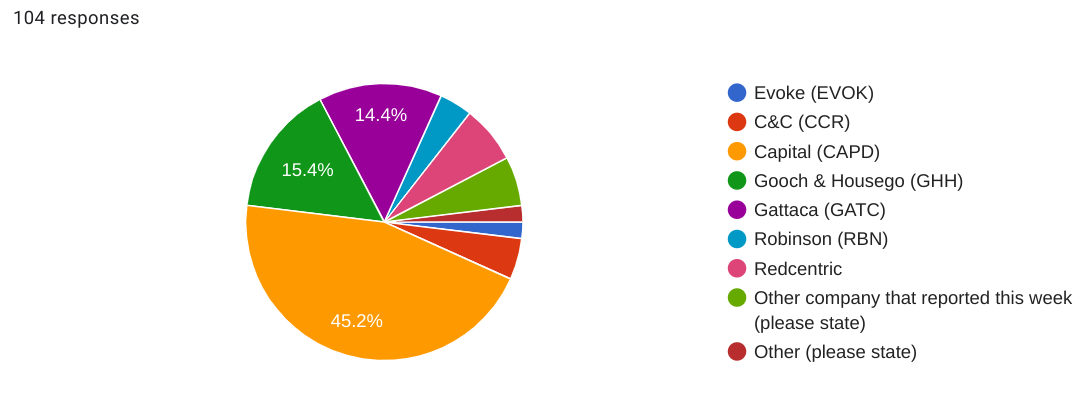
Vote for your favourite backlog item (companies which have reported this week) - and I'll cover at least the top two chosen by you collectively -
VOTE HERE Poll now closed, thank you for your votes!
Results so far at 09:11 - a very clear preference for me to look at Capital (LON:CAPD). Done.
Update at 12:36 - there's clear appetite for Gooch & Housego (LON:GHH) and Gattaca (LON:GATC) so I'll do shorter sections on both of them next (finish time will be a bit later, est. 2-3pm). Done.
Explanatory notes -
A quick reminder that we don’t recommend any shares. We aim to review trading updates & results of the day and offer our opinions on them as possible candidates for further research if they interest you. Our opinions will sometimes turn out to be right, and sometimes wrong, because it's anybody's guess what direction market sentiment will take & nobody can predict the future with certainty. We are analysing the company fundamentals, not trying to predict market sentiment.
We stick to companies that have issued news on the day, with market caps (usually) between £10m and £1bn. We usually avoid the smallest, and most speculative companies, and also avoid a few specialist sectors (e.g. natural resources, pharma/biotech, investment cos). Although if something is newsworthy and interesting, we'll try to comment on it. Please bear in mind the "list of companies reporting" is precisely that - it's not a to do list. We typically cover c.5 companies per day, with a particular emphasis on under/over expectations updates, and we follow the "most viewed" list of readers, so if you're collectively interested in a company, we'll try to cover it. Obviously with the resources available, we can't cover everything! Add you own comments if you see something interesting, and feel free to discuss anything shares-related in the comments.
A key assumption is that readers DYOR (do your own research), and make your own investment decisions. Reader comments are welcomed - please be civil, rational, and include the company name/ticker, otherwise people won't necessarily know what company you are referring to, if they are using unthreaded viewing of comments.
What does our colour-coding mean? Will it guarantee instant, easy riches? Sadly not! Share prices move up or down for many reasons, and can often detach from the company fundamentals. So we're not making any predictions about what share prices will do.
Green (thumbs up) - means in our opinion, a company is well-financed (so low risk of dilution/insolvency), is trading well, and has a reasonably good outlook, with the shares reasonably priced. And/or it's such deep value that we see a good chance of a turnaround, and think that the share price might have overshot on the downside.
Amber - means we don't have a strong view either way, and can see some positives, and some negatives. Often companies like this are good, but expensive.
Red (thumbs down) - means we see significant, or serious problems, so anyone looking at the share needs to be aware of the high risk. Sometimes risky shares can produce high returns, if they survive/recover. So again, we're not saying the share price will necessarily under-perform, we're just flagging the high risk.
Others: PINK = takeover approach, BLACK = profit warning, GREY = possible de-listing.
Links:
Paul & Graham's 2024 share ideas - live price-tracking spreadsheet (2 separate tabs at bottom), Video update of results so far, June 2024.
Frozen SCVR summary spreadsheet for calendar 2023.
New SCVR summary spreadsheet from July 2023 onwards.
Paul's podcasts (weekly summary of SCVRs & macro views) - or search on any podcast provider for "Paul Scott small caps" - eg Apple, Spotify.
Phil Hanson's data analysis measuring performance of our colour-coding system in the SCVRs, from July 2023- Mar 2024 (with live prices). My video explaining/reviewing it.
My other video (June 2024) - How to screen for broker upgrades on Stockopedia.
Companies Reporting
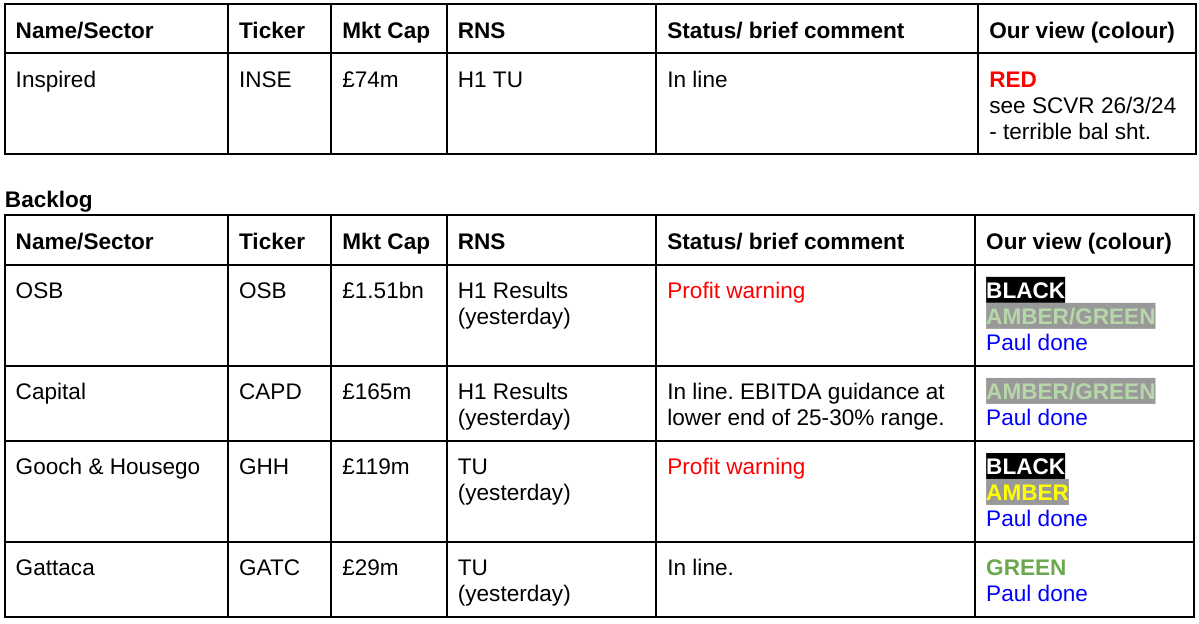
Summaries
Osb (LON:OSB) - down 19% y’day to 392p (£1.51bn) - Interim Results & £50m Buyback - Paul - BLACK / on fundamentals: AMBER/GREEN
It trimmed guidance yesterday, met with a hefty 19% down move in share price. Not my sector, but on a superficial review I see a lot to like here. Accounts are quite simple, and it's paying an 8.8% yield with hefty share buybacks on top. Solid balance sheet, and a good discount to NTAV. This looks interesting to me.
Capital (LON:CAPD) - 83p (£164m) - H1 Results - Paul - AMBER/GREEN
A few problems in H1 see it deliver unexciting results. Most of the cashflows are absorbed by heavy capex on its heavy machinery rental fleet. Higher debt looks fine to me, nothing to worry about, and is coming down rapidly from disposals. I like the low fwd PER, and discount to NTAV. The company seems too busy, with too many moving parts.
Gooch & Housego (LON:GHH) - 453p (£119m) - Trading Update [profit warning] - Paul - BLACK/ AMBER
Another profit warning, with FY 9/2024 estimate reduced by 16% as orders slip past the year end. There's talk of a turnaround, and raising margins significantly, but no sign of that as yet in the numbers. I think the shares have got off lightly, considering this latest disappointment.
Gattaca (LON:GATC) - 90p (£29m) - Trading Update [in line] - Paul - GREEN
In line performance, in a very tough sector. The stand-out feature is its strong balance sheet, with about two thirds of the market cap sitting there in net cash! Performance seems to be stabilising, and the outlook comments seem reasonably good. So we have cyclical recovery potential, and the enterprise value is only about £7m - rather interesting I'd say!
Paul’s Section:
Gattaca (LON:GATC)
90p (£29m) - Trading Update [in line] - Paul - GREEN
We’re overdue a look at this, having last covered it a year ago.
Gattaca plc, the specialist staffing business, today provides the following trading update for the year ended 31 July 2024 ("FY24").
No surprises - which is good news in a tough sector -
“Resilient performance in line with market expectations”
Net fee income down 5% vs LY, to £40m, “as anticipated”.
Profit guidance is very clear -
“FY24 Group underlying Profit before Tax expected to be in line with the Group's previously announced guidance of £2.4m to £2.7m. “
It claims to have almost two thirds of the market cap in net cash! That sounds distinctly fishy to me, so I’m going to investigate this bit -
“Statutory net cash at 31 July 2024 of £21m (31 July 2023: net cash of £21.6m).”
Well, as it turns out, there’s nothing fishy here at all. GATC does indeed have the bulk of its market cap sitting on the balance sheet in genuine net cash. NTAV was £27m at the last balance sheet date of 31/1/2024. Which begs the question, why isn’t it doing more aggressive share buybacks? It did a paltry £0.5m last year, but has ample firepower to do many multiples of that size in further buybacks.
The only point I would make is that with almost £400m pa in gross revenues (mainly contractors pass-through wages), the working capital swings could be very large intra-month, depending on when customers pay their invoices, and when GATC itself does its payroll runs.
Sense-checking this, the finance income line on the P&L was about £1.3m annualised (doubling the H1 figure of £671k), which assuming credit interest received of about say 4% pa, suggests an average daily net cash position of c.£33m, which is a good bit larger than the year end net cash figure of £21m.
Amazing though it is, this large net cash position looks real.
Outlook - it confirms FY 7/2025 expectations too -
“With our growing momentum we expect to increase market share in our target sectors and are well positioned for both investment and further growth as market conditions improve. Whilst mindful of the macro-economic headwinds affecting the recruitment sector, the Board believes it will meet market expectations for FY25.”
Paul’s opinion - this looks quite interesting, I’m glad readers flagged it for me to look at.
GATC may not be the best in the sector, but its shares are amazingly well cash-backed, meaning the EV is trifling. That gives lovely downside protection, and the upside almost thrown in for free, very much up my alley.
I see the major shareholder list includes 25.6% owned by George Materna, who seems to have founded the business in 1984. Could there be a retirement sale of the group in due course? In the past we’ve done well on companies where a founder wants to polish things up for a sale to maximise their retirement funds.
A further 22.6% of GATC is owned by MMGG Acquisition, which seems to be involved in the staffing sector, from doing a bit of googling.
So my hunch is that there’s a chance of a takeover/sale here, which could be done using GATC’s own cash pile, plus a bit of debt.
Overall, I think this looks quite interesting, both for a cyclical recovery in staffing, plus the self-help measures already taken, and it remaining profitable. Then there’s all that cash piled up on the balance sheet too.
I think it has to be GREEN, as risk:reward looks good.
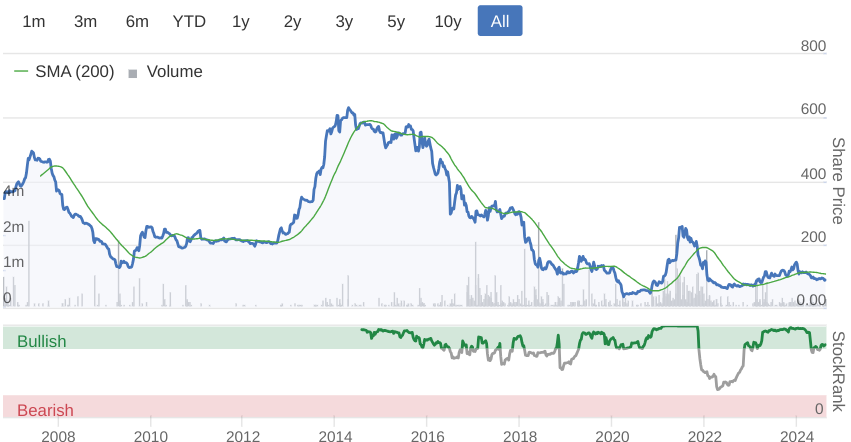
A poor long-term track record though -
Gooch & Housego (LON:GHH)
453p (£119m) - Trading Update [profit warning] - Paul - BLACK/ AMBER
Gooch & Housego PLC (AIM: GHH), the specialist manufacturer of photonic components and systems, provides an update on trading.
I had to google photonics. It’s things to do with light, so lasers primarily here I understand.
The story so far this year through the lens of the SCVR -
21/2/2024 - 610p - BLACK/AMBER - Paul - profit warning. Forecasts lowered c.24%, blamed on customer destocking.
4/4/2024 - 529p - AMBER - Graham - H1 TU in line.
4/6/2024 - 550p - AMBER - Graham - H1 results lacklustre, but more confident outlook.
I think it’s fair to say that we just haven’t found anything to get excited about in GHH shares this year to date.
Stockopedia agrees, with a middling StockRank of 48.
This looks a bit like a former growth share that has since gone flat, with the shares having peaked in 2018.

Trading update - from yesterday.
FY 9/2024.
Oh dear, this sounds like another profit warning -
"Some delay of revenue from the second half but continued progress with the execution of our strategic plan"
Yes it is a profit warning -
“Whilst the Group still expects to deliver an increase in output in the second half of the financial year, we now expect some revenues to be delayed out of the current reporting period, principally as a result of both supplier and customer delivery delays. As a result, the Group's full year adjusted PBT may be c.£1.5m lower than previously expected. “
Order book - is up very slightly from H1 end -
“The Group's order book has continued to grow in the second half of the financial year and at the end of July 2024 stood at £116.8m (31 March 2024: £115.8m).”
Net debt is down a bit -
“the Group's bank borrowings have reduced to £18.0m at the end of July (31 March 2024: £22.2m).”
This rings alarm bells -
“We are also mindful of growing low-cost competition for the Group's components sold into the medical laser market and are taking steps to address our cost base in this area of our business.”
One of its turnaround actions is to outsource production of some products to low cost contract manufacturers.
Outlook - sounds confident, but they said this kind of stuff last time too, but missed those numbers -
“Despite the macro-economic and geopolitical outlook remaining uncertain we continue to prepare for the sustained recovery in our industrial laser and semi-conductor markets in the early part of the coming calendar year. The Group's healthy order book along with a large high-quality pipeline of new business opportunities provides good visibility and confidence for next year. The Group's expectations for FY2025 trading remain unchanged.”
The Group continues to deliver on its strategic growth plan that sets a path to mid-teens profitability.
Broker update - thanks to Zeus for updating its estimates, with a 16% drop to 24.5p (FY 9/2024). At 453p/share that’s a PER of 18.5x - hardly a bargain I would suggest. The valuation only stacks up if you rely on the FY 9/2025 estimate, now trimmed slightly to 35.1p (PER 12.9x).
Paul’s opinion - GHH is becoming a serial disappointer. Talk of low cost competition, and the need to become more efficient worries me, and as an outsider I have no way of determining the likelihood of its mid-teens profit margin target being achieved. Maybe it's just become uncompetitive against stiffer competition?
The last balance sheet looks adequate with NTAV of £53m. Although I note inventories & receivables both look high, so it needs a tighter focus on working capital to reduce debt I think - it looks like customers might be taking advantage of it, and using GHH like an interest-free bank, moving the finance costs onto GHH's P&L instead!
I wish them well with the turnaround, but I need to see some evidence that performance is improving, rather than just an aspiration to improve margins. I think it’s too early for me to want to get involved here, but am happy to keep monitoring it. Let’s stick with AMBER on fundamentals.
Capital (LON:CAPD)
83p (£164m) - H1 Results - Paul - AMBER/GREEN
Clearly the top result in our reader poll today, and you’re a shrewd lot, so there must be something interesting here!
I last looked at CAPD on 15/3/2024, with a GREEN view - summarised as -
“Capital (LON:CAPD) - 91p (£176m) - FY 12/2023 Results - Paul - GREEN - Low PER, strong balance sheet, and upbeat outlook make this seem interesting at a first glance. Although profit/cashflow seems to end up being spent on heavy capex, with only modest shareholder returns.”
Capital Limited (LSE: CAPD), a leading mining services company, today provides its results (unaudited) for the half-year period 1 January to 30 June 2024 (the "Period").
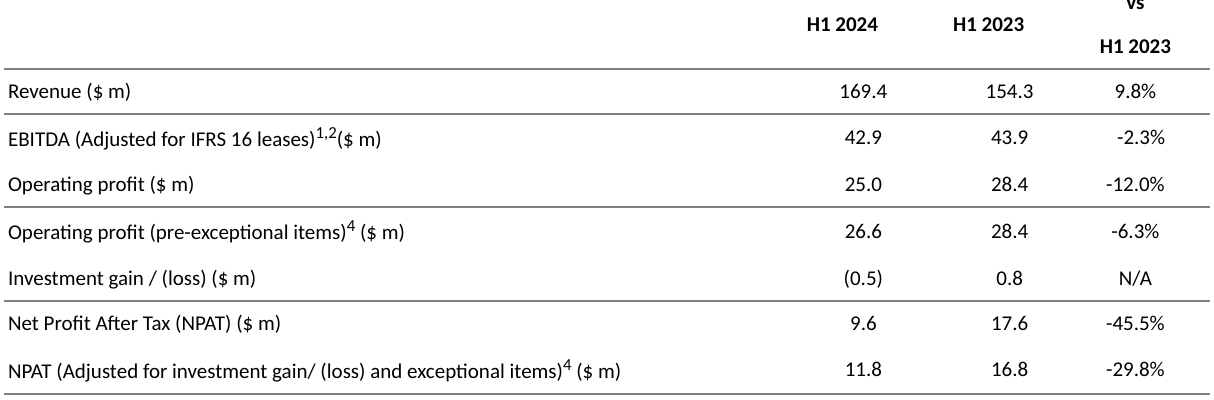
H1 results overall don’t look madly exciting - and note that the big EBITDA turns into very little PAT at the bottom of the table -
The core business buys & rents out mining equipment. A look through its website shows that this includes drilling rigs, and heavy duty diggers, etc.
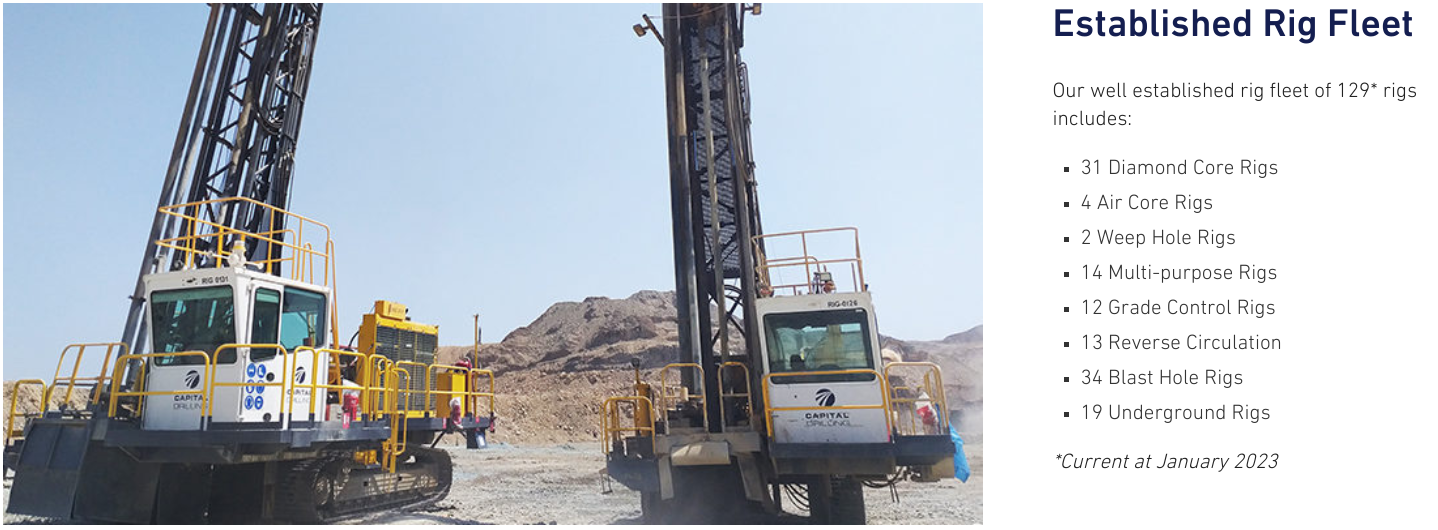
Key information is utilisation rate, which wasn’t great in H1, as explained here -
“H1 2024 average rig utilisation was 69%, a decrease of 8.0% on H1 2023 (75%). The decrease was primarily driven by lower utilisation in Q1 2024, which rebounded into Q2 2024 (72%) driven by increased rig counts at Belinga and the beginning of the ramp-up at Nevada Gold Mines. The Group's target average utilisation is ~75%;”
Another key metric is revenue per day/week/month, which has shown a useful improvement -
“Average monthly revenue per operating rig ("ARPOR") was $204,000 in H1 2024, up 8.5% on H1 2023 ($188,000). This strengthening in ARPOR is primarily the result of the ramp-up of high-quality contracts, as well as a continued focus on efficiency at our more established sites.”
Sukari contract has been extended into Q3, but is then scheduled to come to an end. It says this was the largest contract ever won in 2020, so it sounds financially significant. Does anyone know the financial impact of this dropping out of the numbers soon? How lucrative has this contract been, and how much of a drop in 2025 profits is it likely to cause? If anyone knows, please do post a comment. CAPD says it is actively selling the equipment, which should further reduce debt.
Net debt rose to $86.4m, but post period end it sold an investment for $31.2m, with more disposals to reduce debt further, so I don’t see debt as a problem here. That’s good because in H1, finance costs consumed a third of operating profit.
Remember that it owns a whacking great load of heavy equipment, with fixed assets being $229m. Therefore with net debt down to c.$55m post disposal above, this looks a very modest level of gearing.
NTAV looks very robust for an equipment hire business at $276m, about £214m, which is greater than the market cap of £164m.
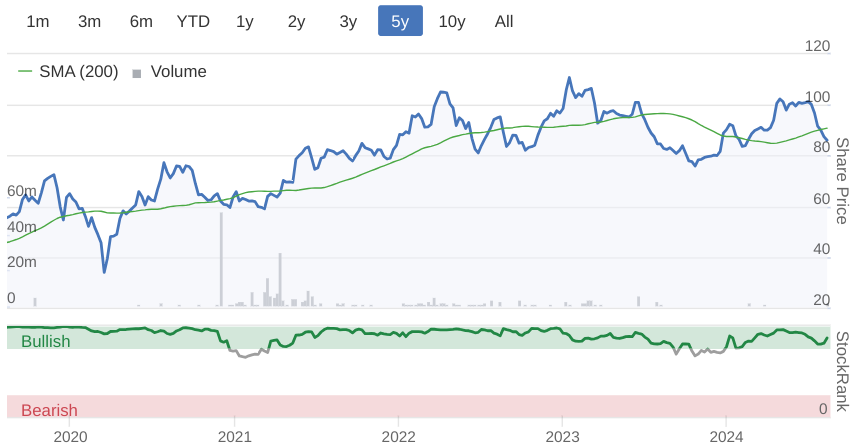
Dividends are OK, at c.3.5% yield, but that’s very well covered by earnings. Management strategy seems to be focusing on expansion ahead of divis, but there hasn’t really been much to show for it in the last 5 years, either in EPS or in share price appreciation -

Paul’s opinion - readers here will know far more than me about CAPD, so I’ve only done a quick overview, rather than delving into all the various projects, and trying to assess their prospects - that’s your job!
Bull points -
Low forward PER of 5.7x
Good discount to NTAV
Strong balance sheet with modest debt.
Bear points -
H1 seems to have encountered some setbacks, and the commentary is a bit mixed (better H2 expected).
Are they trying to do too much? Generally I prefer more focus, in a profitable niche.
Unexciting dividends, as heavy capex absorbs most of the cashflows.
Higher tax.
Capital-intensive business.
I can’t help compare CAPD with GMS (I hold). It seems to me that GMS is a much more compelling investment story, generating prodigious cashflows and enabling rapid debt reduction. Whereas CAPD looks to have some attractive features, but lacks the jaw-dropping free cash generation of GMS.
Think I’ll moderate to AMBER/GREEN with CAPD, but you guys know a lot more than me about it, so feel free to ignore me!
Osb (LON:OSB)
Down 19% y’day to 392p (£1.51bn) - Interim Results & £50m Buyback - Paul - BLACK / on fundamentals: AMBER/GREEN
I last looked at this specialist (buy to let) mortgage lender here on 14/3/2024 (at 386p, down 16% on a profit warning), and quite liked the look of it - low PER, generous divis, and a discount to NTAV. Although the same could be said of many lenders.
Shares had been recovering nicely, but it’s back to square one again with another profit warning yesterday.
Last time it reported the net interest margin (NIM) down from 303bps to 251bps in FY 12/2023.
Today’s guidance shows it’s reduced a bit more -
“Underlying net interest margin is expected to be in a range of 230 - 240bps for the full year as increased competition in the subdued mortgage market leads to maturing fixed term mortgages redeeming or switching onto lower prevailing spreads more quickly…”
Interim Results (6 months to 30 June 2024)
The headline profit number is very impressive, given this is only 6 months, and the market cap is £1.5bn -
“Underlying profit before tax1 increased to £249.9m (H1 2023: £116.6m) and statutory profit before tax was £241.3m (H1 2023: £76.7m) primarily due to non-recurrence of the H1 2023 adverse EIR adjustment partially offset by lower prevailing spreads from mortgages and deposits and an impairment credit compared to a loss in the prior period”
What is EIR? It looks like an accounting entry to estimate the Effective Interest Rate, and seems to have been mostly a one-off hit to last year’s profit -
“In the prior period, the adverse EIR adjustment related to the expectation that Precise borrowers would spend less time on the higher reversionary rate before refinancing, based on observed customer behavioural trends.
Balance sheet - as mentioned last time, this is fairly simple. OSB is mostly financed by taking in retail deposits totalling £24.3bn. Total liabilities are £28.56bn.
Assets total £30.75bn, with the largest item being £26.12bn of loans to customers (ie mortgages).
Total equity is £2,187m, less intangible assets of £38m, giving NTAV of £2.15m.
The market cap is usefully lower at £1.51bn. So I make that £639m of NTAV thrown in for free, not bad! Is there any reason to doubt that NTAV is real? Not that I’m aware of.
Although having a look through the financials sector, there are plenty of other smaller banks valued at discounts to NTAV - eg. Metro Bank 0.4x NTAV, Georgia Capital 0.46x, Secure Trust Bank 0.46x, even Barclays at 0.53x, Standard Chartered 0.57x. NatWest is near par at 0.96x - those are just some that caught my eye.
What I like about OSB is that it’s simple. Whereas something like Barclays has a balance sheet that is totally incomprehensible. In particular, the vast figures for derivatives could contain all manner of horrors, it’s impossible to know what risks are lurking under the surface at Barclays. Whereas with OSB the main risk would be a run of depositors, or customers defaulting on their mortgages (very unlikely for BTL investors, and in any case the lending is secured), or fraud.
Outlook - this clearly disappointed the market yesterday, causing a 19% drop in share price -
“We have seen an improvement in the macroeconomic outlook recently which supports our cautious re-entry into more cyclical, higher margin sub-segments, which will contribute to returns in the medium term. We are now past peak interest rates, which will also provide a much-needed stimulus to the mortgage market.
Based on current market activity and our disciplined approach to lending and retention, the Group now expects to deliver underlying net loan book growth of c.3% for 2024.
Underlying net interest margin is expected to be in a range of 230 - 240bps for the full year as increased competition in the subdued mortgage market leads to maturing fixed term mortgages redeeming or switching onto lower prevailing spreads more quickly, and as we continue to monitor customer behaviour in reversion on the Precise book for any potential impact on the measurement of the EIR.
The underlying cost to income ratio is expected to be c.36%, commensurate with the NIM guidance and as we continue to maintain our cost discipline while we invest in the business.
The Group is well-capitalised and well-positioned to successfully leverage our unique multi-brand structure and benefit from the opportunities as they arise. I remain confident in the outlook for the Group and our ability to deliver sustainable and attractive returns for our shareholders.”
The newswire service on Stockopedia not only contains the RNSs, but also very useful quick summaries, such as this one yesterday morning for OSB -

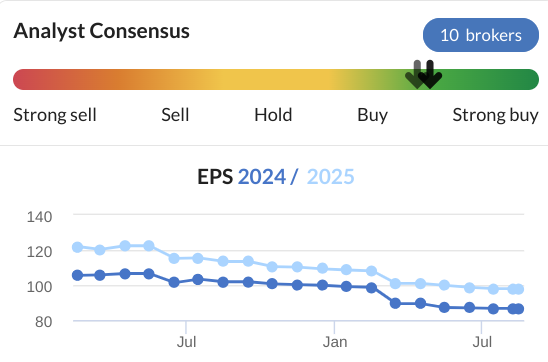
Broker notes - nothing available I’m afraid, so all we can do is monitor the broker consensus number on the StockReport, and see if it drops in the coming days/weeks. Hence I’m in the dark. On the existing forecasts, the forward PER is only 4.2x, although broker consensus has been drifting down, and I assume another drop is in the pipeline after yesterday's news -
Dividends - the best bit is the dividend yield, of a thumping 8.8%, which amazingly is 2.6x covered by earnings. The balance sheet strength also supports the idea that this level of yield looks sustainable.
Paul’s opinion - as you know, I don’t usually look at financials, because it’s a specialist area, fraught with hidden risks. However, if I had to buy something in this sector, OSB would be high on my wishlist, because the business model and the numbers are relatively simple.
Who wouldn’t want an 8.8% dividend yield too!? The outlook for mortgages is improving, now that interest rates have peaked, although it sounds as if there’s also more competition from other lenders, so it’s possible OSB might see its margins squeezed further maybe? That could be offset by greater volumes though?
I’d be interested to look into the terms it offers to depositors - are deposits locked in for fixed periods, or capable of being withdrawn on demand (making it potentially vulnerable to a run on deposits in an extreme macro scenario)? Let me know if you’ve looked into that.
Overall, I think this week’s sell-off might be presenting a reasonable entry point, so I’d be happy to go AMBER/GREEN - but please do bear in mind that’s on a fairly superficial review, in a sector I’m not particularly familiar with.
Share buybacks - I almost forgot, on top of your 8.8% dividend yield, OSB has also been shrinking its share count through buybacks, and announced another new £50m buyback yesterday.
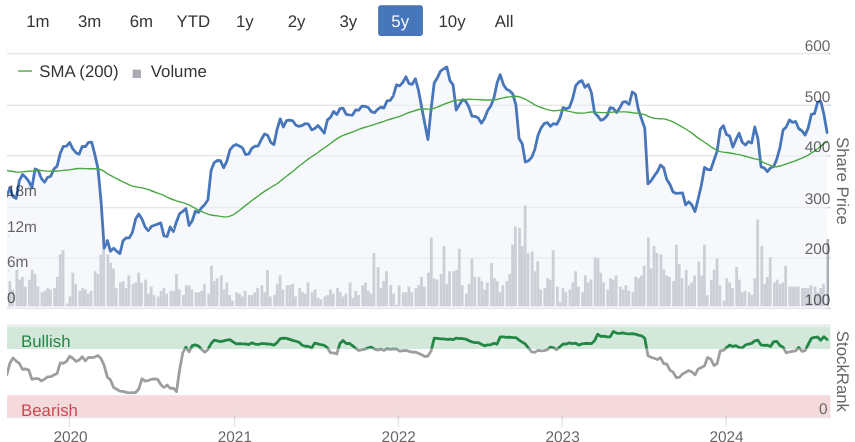
If you add up the generous divis over the last 5 years, the total shareholder return has been better than the chart suggests -
Disclaimer
This is not financial advice. Our content is intended to be used and must be used for information and education purposes only. Please read our disclaimer and terms and conditions to understand our obligations.

51 comments
Hi Paul, I very much enjoy your podcasts - hope you keep going with them! On your last one you mentioned that you had bought some shares and think you said you listed what you bought in your report on August 6th but I can't find them. Could you list them again? Thanks.
Hi Chrisp - it was on the report from 7th August - if you search for 'Would you mind listing the 11 companies you bought' you'll find it - here's a link but not sure if it'll work:
SCVR Aug 7th
Just to squeeze in one more post about Osb (LON:OSB, I see Blackrock bought yesterday - now up to 5% of the company from a previously not notifiable %.
Gattaca (LON:GATC)
To be clear this is a very poorly-performing company whose pretensions of specialist market positioning are laughable. You only have to look at the operating margin - even back in the good days - to understand that this company buys its contracts with paper thin margins and staffs them with numpties. Their operating margin is below 1% where a quality operator would aim for 8%.
But, but, but… I do get Paul’s point about the cash pile. And it seems to me that the cash might be being retained in the business for the sake, and at the command, of the largest shareholder, who would benefit from having it charged to CGT - and possibly at a reduced rate thereof - on a business sale. Against that, I would argue: who would want to own this crock for anything other than a trade?
I regard this as presenting exceedingly low balance sheet risk and very high operational risk. The latter perhaps eased by the knowledge that we are maybe at the trough in the cycle already. There’s probably money to be made here, but, along the way, the quality of sleep that the cash pile delivers will quite possibly be interrupted by operational deficiencies.
Hello BnB. I agree with your principal sentiments about Gattaca (LON:GATC), chiefly buying business cheaply and staffing with numpties (presumably low quality staff).
I would add that if I remember correctly, the company is the combination of a couple of poor quality business which was then renamed Gattaca (LON:GATC) which I'm sure means something in Greek or other mythology. Whatever, especially with regard to the cash pile, it certainly isn't run for the benefit of private shareholders like us - which I am fortunately not. Lets see the colour of their money in share buy backs and / or better divis and I might - just might - change my mind.
You ask how big is the Sukari contract for Capital (LON:CAPD). Note that Sukari has long-standing (c20 years) drilling contracts with Capital and these continue. The only contract that is ending in Q3 2024 is the mining services (mostly earth moving) contract. This was signed in Dec 2020 and was estimated at being between $235-260m (so roughly $60m a year), although this also included the value of an extended drilling contract. But still the termination (Centamin (LON:CEY) decided to take mining services in-house) leaves a major hole in revenues.
However, it should be noted that as far as I understand the brokers’ forecasts never assumed a continuation of the Sukari contract post mid-2024. In addition, Capital feels that it has covered the hole that the Sukari contract leaves with new contracts, particularly Belinga (Gabon) and Nevada (US) and by the growth of its MSALABS business. H1 was disappointing for all 3 of these but Capital is talking them up for H2 and notably broker forecasts for FY25 have been robust. My experience is that Capital has historically been realistic in its guiding of the market.
It is also worth pointing out that reported earnings can give an incorrect impression of earnings votality. This is mainly because Capital has for the last few years run an investment portfolio in junior miners - where mark to market changes are run through the P/L. In 2021 this portfolio performed outstandingly, leading to the blow out 2021 EPS numbers. The investment portfolio is now much smaller, particularly after the sale of PDI on Wednesday. Stripping out the effects of the investment portfolio, the EPS growth over recent years has been pretty impressive and consistent (at least until H1 FY24).
If MSALABS’ growth can be reinvigorated then I would not be surprised to see an IPO/ part sale (to reveal underlying value) maybe in FY25. MSALABS is a less cyclical and capital light business that the equipment hire business.
As you can tell from the above, I like Capital at this price and it is one of my biggest holdings. That being said there are a few amber flags that it are worth pointing out and I did not see Paul mention above:
1). Given Capital’s African centred business model (admittedly being diluted by the Nevada contract and MSALABS), Capital is always likely to trade on a modest valuation.
2). There are a long list of unresolved tax disputes shown in the notes to the annual report across a host of African countries. The company says this is not something it is particularly concerned about. But it is something that the investors might want to get comfort on.
3) Jamie Boyton (the Chair and co-founder) also owns personally some of the shares held in Capital’s investment portfolio. - eg he has to exclude himself from the board’s decision to sell PDI (see RNS on 14 Aug). Investors should get themselves comfortable on the conflicts of interest.
4). As I said, I think long-term performance has been good during the period when Jamie Boyton ran the comapny as Executive Chair (with no CEO). Peter Stokes became CEO a couple of years ago and I think the jury is out on whether performance has been as good in the last couple of years.
5) Marins do seem to be coming under some pressure - for reasons that are explained in the H1 report.
6). My biggest concern has been the poor conversion of earnings into FCF (as opposed to CAPEX). This is a fact Paul did point out. When the cycle turns down, Capital can still show the business can be hugely cash generative (by reducing its rig fleet).
One final minor point is that Capital has been a regular on ImC and interested investors should find a long history of presentations there - which I think shows management has been realistic historically in its guidance. I see from Alex’s post below that Capital will in September start presenting on Yellowstone. Congrats to Yellowstone.
Wimbledonsprinter,
Yellowstone are presenting on Capita (LON:CPI) which is a different company to Capital (LON:CAPD) ??
Sorry to point that out,
Graham.
Phew, thank god for that ! (hold Capital (LON:CAPD)
Oops. Sorry. Thanks for pointing out
Rio Tinto (LON:RIO) dipped below 4700p today and a 12 month low. Still paying 7% dividend. Buy low or falling knife? Chart suggests it should bounce back.
News today for the ending of the 3 day strike: "BHP and Union No. 1 have come to an agreement for a collective contract proposal. Along with that, it was agreed to suspend the strike underway as of this Friday, Aug. 16 at 8 a.m.," BHP said.
It went ex div yesterday.
Rio Tinto (LON:RIO) ? or HSBC Holdings (LON:HSBA) which didn't even flinch today?
With Rio Tinto (LON:RIO) did neither. Sold sufficient to lock in the current profit on my holding (average purchase price c. £34) and retained the balance for the inevitable recovery as I have sold part of the holding!! Strategy might be flawed but have seen so many holdings go ‘to the moon’ and then crash back to earth that have decided to take profit on the way down before it returns to cost or worse. In the commodity space just look at the Albemarle (NYQ:ALB) and Umicore SA (EBR:UMI) price graphs both of which I previously held and didn’t take profit when I could have. It’s not a mistake I intend to make again.
It’s never wrong to take part profits or to sell the entire stake at a profit. The thing to question is, is really better taking that part Rio Tinto (LON:RIO) profit after a 20% share price fall and right at the current year to date low rather than as the share started to fall away from that May 2024 £59 peak?
Mining sector (except for those with big focus on copper like Antofagasta (LON:ANTO) and also Anglo American (LON:AAL) which has outperformed the sector this year as the BHP (LON:BHP) bid premium has not fully unwound) is going through a weak spell thanks to continuing problems in China.
Current sector prices look tempting and with some big dividend yields to support their share prices (e.g Rio Tinto (LON:RIO) paying 7%) it’s unlikely with strong “green” demand ahead that their shares will fall much further. AND Miners pay special dividends in the good years instead of spending the money on buybacks. Rio Tinto (LON:RIO) paid 20% in dividends via ordinary and big specials on top in 2022.
There’s a potentially multi year big Mining sector bull market coming, but not yet. Now is a good time to check out the sector big guns and also BlackRock World Mining Trust (LON:BRWM) as they hold the big guns in their top 10. AND like Rio BlackRock World Mining Trust (LON:BRWM) pay big dividends in the good years via 3 standard ordinary ones and then a big final one.
Fair comment but fortunately already sold Rio Tinto (LON:RIO) two previous tranches since January 2021 - one lot around £61+ and the second at £53+. So quite happy with those profits! Keeping a close eye on BlackRock World Mining Trust (LON:BRWM) for further price weakness. Sub £5 would be very attractive.
I love Rio Tinto (LON:RIO) as a cyclical play, always kept it on my watchlist waiting for a low point.
They're well diversified across multiple commodities now, especially with their new copper mine in Mongolia.
However, definitely one to buy when there is "blood on the streets"; either a big commodity price crash, or some "environmental disaster" at one of their mines.
Right now, the price is low, but neither event has happened, so I continue to wait on the sidelines... 7% dividend is definitely not a low share price point yet.
Over the last few years buying under 5000p has worked out pretty well.....Rio Tinto (LON:RIO)
For those interested in Capita (LON:CPI) the management will be presenting at a webinar for private investors on 23 September at 3pm. Register here to attend or receive a recording of the event.
This stock has caught the interest of renowned small cap investor Richard Staveley who has bought it for his Rockwood Strategic Investment Trust. After the results in August @Paul Scott commented that post the recently announced disposal it should clear all bank debt and could be interesting, if further improvements are made to operating margins.
Last week the new CEO exercised options and kept all the shares paying c£188k of his own money to cover the tax and NI and the new FD invested £200k buying 1.2m shares. A vote of confidence.
Osb (LON:OSB)
Is a simple business - it takes in retail deposits and lends on an asset backed basis with a good LTV margin.
So it becomes a cash generating machine that doesn’t involve an expensive cost base so it will flit around in a cost to income range in the 30%s
It is now trading at a book value of 0.7* : you can’t compare this to someone like Barclays (LON:BARC) at 0.6* because Barclays has a large investment bank attached where assets can be illiquid and hard to value. That’s why they trade at low multiples to book because people give a large discount to those assets given the leverage effect. The other banks Paul mention either have a chequered history like Metro or idiosyncratic risks like one of my favourites Bank of Georgia (LON:BGEO)
In Osb (LON:OSB) case the loans it offers are collateralised against property - but usually at quite low LTVs so really no reason why it shouldn’t trade at Book or above.
The cash it generates easily allows for an effective 13% yield ( divi + buy backs) so I look at it on the basis it returns me 13% p/a without growing so I need very little capital upside to give me a compounding 15%+ return.
Retail investors got their knickers in a twist last year over the EIR model - accounting treatment means that you need a model that estimates the effective interest rate over the lifetime of the mortgage. Within that model there is a reversionary aspect that models borrowers behaviour at the end of a fixed term. Ie how long they stay on the variable rate without re-fixing. Not unsurprisingly last year that behaviour changed due to the interest rate volatility and people were using the variable rate less. This forced the company to amend that model and because of the accounting treatment you take the entire p&l hit of that in one single go. Of course the actual impact of that behaviour change from a cash generation perspective is over something like 15-20 years. Anyone that bothered to work it out could see it had a circa 4-5% impact on cash profitability but the share price was hit by 30%+ and offered up a glorious opportunity.
Yesterday’s drop on a small change in guidance was equally ridiculous. It works out at around 5% yet the stock dropped 20%. I still expect an EPS of circa 81-82p this year and growing next. The impact of a further £60m share buyback is about 4% which pushes the EPS back to 85p.
Forward guidance is a move into slightly higher margin and risk products having acted very conservatively over the last 2 or 3 years due to the macro environment.
Although a mid cap business at £1.5bn it is illiquid - institutions are not really driving the share price retail investors are. That means you get these large share price swings on relatively small adjustments which do offer opportunities for those who actually understand the business. It’s annoying for existing holders mind :-)
Thanks for your input davidjhill, shortly before that I invested in a starter position in Osb (LON:OSB) , and before long may move in the HSBC Holdings (LON:HSBA) which I held long -term.
edit: probably a bad idea, better to top-slice something else I hold, such as CMC Markets (LON:CMCX) and add that instead?
Thanks for the patient effort in explaining the position. First class.
Brilliant summary thank you. The one thing that dissuades me is the directors dealings. All seem to be sellers.
Following today's analysis and comments I bought a little bit of Osb (LON:OSB) to take advantage of the 8% yield whilst it lasts.
I bought Natwest (LON:NWG) back in November because of the then 8% yield (now circa 5%) and since then have since seen capital appreciation of circa 70%, one of the few decent decisions I have made in recent times.
No expecting that with Osb (LON:OSB) but maybe the market will start to correct the yield differential as well in time?
BIOM Just fancied a dumpster-dive today. Down 53% on its trading update. Group revenues were £2.3m for H1, compared with £3.6m last H1. The company has made a succession of losses, naturally. Astonishingly, it has been public since 1986. Imagine that. In what sane world is this company still a thing?
Re OSB, there has been significant insider selling recently - is this significant?
OSB paid a special dividend last year. The dividend pay out was 11% based on current share price.
Anyone seen anything on Spectra Systems (LON:SPSY) ? Up 4% this morning and not surprisingly perhaps is on the 'most viewed' list today
Spectra Systems (LON:SPSY) This and yesterday's drop being discussed over on Wolfies excellent .....Stage 2 post.
Hello Peter 2. Where can I locate Wolfies Stage 2 post??
Thanks. KBR
KBR - If you hit the "Discuss" tab then "Is the Scene Set for Summer Stage 2's?" although you'll see that Paul has now given detail on the Spectra Systems (LON:SPSY) matter
Hi Ben1,
There was a clumsy seller in the market yesterday at Spectra Systems (LON:SPSY) [I hold], with some largish trades printed at the end of the day, the biggest being about 108k shares sold below market price at 222p. Also 2 trades both of 13,580 shares at 234p.
This provided a nice buying opportunity, and I was able to top up at 240p, which I'd been hoping to do.
There are various possible explanations for why someone would dump shares clumsily in this way - could be a forced seller on margin, a naive one off seller (eg an inheritance, or other disposal), or just someone desperate for cash. The worst case scenario would obviously be an insider dumping stock ahead of bad news - although that seems extremely unlikely to me, given the excellent newsflow from Spectra.
It still looks reasonably priced to me, and upgrades to forecasts came through on a big sensors contract win recently. Spectra is capital-light and pays generous divis. It's one of my favourite shares, given how well things seem to be going, we've been GREEN on it for quite a while. That's why I bought some more yesterday.
DYOR as usual of course.
Summer months can often provide strange price movements because so many people are away from their screens on holiday.
Regards, Paul.
Zotefoams (LON:ZTF) Well done to ZTF on ReZorce winning the "prestigious 2024 German Packaging Prize! (see BenHazz post here late yesterday) Just an award but better than not winning it! Now to commercialization.
Just read the news letter from Downing Strategic Micro-Cap Investment Trust (LON:DSM) for July. The trust is continuing to wind down and return capital to shareholders. My interest was drawn to the Trusts remaining holdings, in particular it is out of Volex (LON:VLX) which is my largest holding and Ramsdens Holdings (LON:RFX) in which I have recently taken an opening position following the recent ahead of expectations update.
"In July, the Company’s NAV decreased by 9.3% and the share price increased by 40.0%. Adding
back the effects of special dividends, the respective changes were -1.5% and +5.0%. The share
price change was driven by unusual trading ahead of the requisitioned general meeting.
The meeting was held on 5 August and all resolutions were voted against by a significant majority
of voting shareholders. The Manager will therefore continue the managed wind-down and return
of capital of the remaining assets comprising Centaur Media, DigitalBox, Norman Broadbent, Real
Good Food, and Synectics.
The Manager and Board remain focused on maximising the available value of the positions and
minimising ongoing costs in order to maximise ongoing distributions to shareholders.
Opinions expressed represent the views of the fund managers at the time of publication, are subject
to change, and should not be interpreted as investment advice"
As Mr Contrarian briefly details in his summary, a brutal emergency fundraise by Biome Technologies (LON:BIOM), 3.8m issued shares becomes 46m shares post raise. Sympathies to any holders, it was clearly at substantial risk of being hit hard by the terms of this rescue. If there are any readers with knowledge of the Companies seemingly unrelated products and future prospects, I'm curious. Is the £1m enough?
I remain puzzled by yesterday’s fall in Osb (LON:OSB) . I hope Paul can look at it and at yesterday’s reader comments.
Osb (LON:OSB) Paul has put a Vote link at the top for him to cover a backlog item but this maybe more one for Graham who doesn't work here on Friday's.
Edit: In saying that OSB did a similar thing in March 2024 and Paul wrote :
Osb (LON:OSB) - down 16% to 386p (£1.52bn) - specialist lender plunges 16% on FY 12/2023 Results - adj PBT down 28% to £426m (still an awful lot for a £1.5bn mkt cap though). Net loan book up 9% to £25.7bn. Net interest margin down from 303bps to 251bps. Adj EPS down 25% to 75p (PER 5.1x). New share buyback of £50m announced. 32p total divis, yield of 8.3%. Bal sht NTAV exceeds market cap.
Paul’s view - first time I’ve looked at this, and I’m intrigued. It’s a simple savings & loans bank. The cash mainly comes from retail deposits, of c.£22bn. So my main worry would be a risk of depositor flight, as we’ve seen in recent banking crises. I never invest in banks personally. But the 8.3% yield, and straightforward, seemingly sound finances at OSB do seem quite appealing. Also a mortgage broker told me recently that many lenders are deserting the buy to let lending space (OSB's niche), or offering lousy deals and requiring high LTVs. Hence maybe more business might come OSB’s way? Not many BTL borrowers default. Looks potentially interesting, I won’t give it a colour though, as I don’t know enough about the company or this space. I wonder if there’s regulatory risk that I’m not aware of? For sophisticated investors, bonds in banks are an interesting alternative to the equity.
Osb (LON:OSB) For what it's worth, OSB's goes ex-dividend next Thursday, 22 August 2024 with their Interim Divi of 10.7p (about a third of the full year divi) May attract some back in?
I saw that and took a half position Osb (LON:OSB) I used to be a customer, never had any issues and is generating lots of cash. May buy more on any further weakness.
FREng - Osb (LON:OSB) - wish granted. Thanks Paul.
What worries me about Osb (LON:OSB) is the heavy director selling. You have to go back four years to find any meaningful director purchases. I find that a bit off-putting!
Osb (LON:OSB) there was some buying end of last year. Are the sales not just mostly share options? Often directions sell half to cover tax, but then sell the rest later. Share options are like an annual bonus.
Not the most recent ones in Jun24, otherwise the announcement from Osb (LON:OSB) would have made clear how many options were exercised, how much sold.
These were straightforward sells, from what looked like mid-senior level management (one below the c-suite) from their shareholdings. Good timing too, a month and a half before a profit warning...
RE :OSB
"Also a mortgage broker told me recently that many lenders are
deserting the buy to let lending space (OSB's niche), or offering lousy
deals and requiring high LTVs. Hence maybe more business might come
OSB’s way? Not many BTL borrowers default"
A lot of individual BTL investors are selling up - so the market is possibly getting smaller for this type of business. Historically BTL may have been a safe market but the future is uncertain - rent caps,legislation etc.
I think that a key question for OSB shareholders is what percentage of the portfolio (If any) is second charge.
Dont hold
I suspect a lot of individual, amateur BTL investors are fleeing the market, but Osb (LON:OSB) focus on professional BTL investors with a portfolio of properties - these are better placed to cope with tougher regulations and higher taxes, and I suspect could pick-up some of the properties that the amateur landlords are looking to offload.
I was talking about individual professional investors in my post. Sorry I didnt make this clear.
If OSB has a large portfolio of individual amateur investors holding 1 or 2 properties then I would have thought it is at greater risk of default.
If OSB has a large portfolio of individual amateur investors holding 1 or 2 properties then I would have thought it is at greater risk of default.
i would have defaults by individuals who have btl properties would be miniscule ? i deal with lots of small time btl investors and its very rare that they have issues - even then i would have thought banks would have margin of safey if loans are no more than 75% ovf value normally?
"i would have thought banks would have margin of safey if loans are no more than 75% ovf value normally?"
Two points to consider - how is the property valued? Is it simple resale value as single private residence or as a multiple of income. As a simple analysis an HMO may bring in 20k of income and be valued at 10 times income - 200k. However the value of that property might only be 180 k as single residential dwelling.
Hence also my question about the second charge. No margin of safety here if the principle lender plays hardball and valuation is tight
OSB focuses on professional BTL investors with a portfolio of properties (typically 20-30) - effectively small businesses. They're not particularly involved in lending to BTL investors with one or two properties.
As a BTL landlord and former Precise borrower (and holder of Osb (LON:OSB) ) the three things outside their control most likely to impact them in the next quarter are:
- Base Rate: how quickly it is cut, encouraging buyers to come to market
- Rachael Reeves 1st Budget on 30 Oct, where landlords will find out if they get carrots or more stick
- Renters Rights Bill and the detail of how far the balance moves to tenants
My broker told me the first rate cut kept him busy with remortgages and many portfolio landlords will be looking to use current rental yields to meet lender criteria before prices start to rise.
At the moment the rate cuts looks more stick than carrot for Osb (LON:OSB) ? With no rate cut (in the trading period they announced) they were already seeing more "churn" than "acquisition" due to more competitive rates in the market.
IMO having worked in industries with similar "back book" dynamics (where you have existing customers on rates that are highly profitable to the company but not if those customers wake up and switch).... it is a multi-quarter painful process as you have waves and waves of customers do it over time, not a one-off hit you can recognise to the P&L.
My morning smallcap tweet: Drop-dead ugly
Biome Technologies (LON:BIOM) LungLife AI (LON:LLAI) Fletcher King (LON:FLK), Inspired (LON:INSE)
◄Biome Technologies (BIOM)► £1030k placing and retail offer at 5p, a panic-stricken 77% discount, to avoid going bust in Sept. H1-June trading: rev £2.3m down 36% due to production and regulatory difficulties at two of the Bioplastics end-customers and delay of revenue from the four significant RF division projects. What, all four? Expects significant improvement in H2. What a crock. [SP=24.3 Cap=1m]
◄LungLife AI (LLAI)► Medicare coverage for co's post-bronchoscopy indications test a step closer. [SP=12.74 Cap=9m]
◄Fletcher King (FLK)► FY-Apr. Hikes final div to 2.25p from 0.75p. Outlook - "Markets are likely to remain cautious for a while longer, and it will be a challenge to maintain the same financial performance". [SP=49 Cap=5m]
In line: INSE