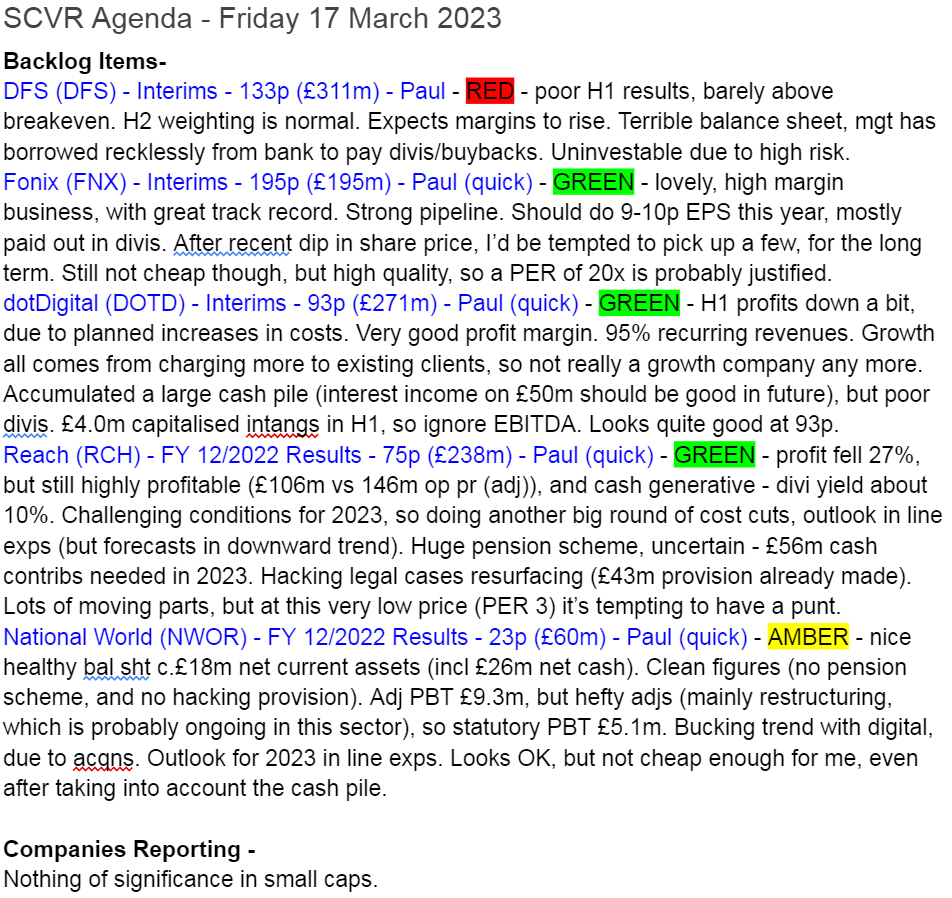
Small Cap Value Report (Fri 17 Mar 2023) - DFS, FNX, DOTD, RCH, NWOR

Good morning from Paul!
This week's "mystery share" for my podcast (i.e. my best value/GARP share of the week) is Eurocell (LON:ECEL) - also note that there was a decent -sized Director buy as well.
Very quiet (nothing, basically!) for small cap results/outlook today, so I've done a proper dig into figures from DFS Furniture (LON:DFS) from yesterday, and a few quick comments below from brief reviews of other value/GARP small cap results which caught my eye earlier this week.
Today's report is now finished. Thanks for reading/contributing, and have a lovely weekend!
Explanatory notes -
A quick reminder that we don’t recommend any stocks. We aim to review trading updates & results of the day and offer our opinions on them as possible candidates for further research if they interest you. Our opinions will sometimes turn out to be right, and sometimes wrong, because it's anybody's guess what direction market sentiment will take & nobody can predict the future with certainty. We are analysing the company fundamentals, not trying to predict market sentiment.
We stick to companies that have issued news on the day, with market caps up to about £700m. We avoid the smallest, and most speculative companies, and also avoid a few specialist sectors (e.g. natural resources, pharma/biotech).
A key assumption is that readers DYOR (do your own research), and make your own investment decisions. Reader comments are welcomed - please be civil, rational, and include the company name/ticker, otherwise people won't necessarily know what company you are referring to.
Agenda - there's no news today of interest, but I've got masses of backlog items, so will work my way through that list, until about 1-2pm finish time today.
Paul’s Section:
DFS Furniture (LON:DFS)
133p (y’day’s close)
Market cap £311m
DFS Furniture plc, the market-leading retailer of living room and upholstered furniture in the United Kingdom, today announces its interim results for the 26 week period ended 25 December 2022 (prior year comparative periods are the 26 weeks ended 26 December 2021 (H1 FY22) and the 26 week unaudited pro forma period ended 30 December 2018 (H1 FY19)).
I think it’s getting too complicated, and largely irrelevant now, to use pre-covid comparisons. Too much has changed (particularly big increases in costs like staff, and energy), and it’s easy enough for us to look back at pre-covid accounts anyway.
So I’ll ignore any pre-covid comparisons that DFS provides in these interim accounts.
Here are my notes, from reviewing the H1 (to Dec 2022) results -
H1 revenue £545m (down 2%)
Underlying PBT only £7.1m (LY H1: £23.3m) - I laughed when I saw that the table switches from percentage change, to pounds change, to avoid revealing that this is a 70% drop!
Note that H1 is seasonally weaker than H2, but even so, this is clearly a poor outcome for H1.
Basic u/l EPS is only 2.2p (down 70%)
Interim divi 1.5p - it shouldn’t be paying divis at all, given the shockingly weak, geared balance sheet. Guidance is for a 3.0p final divi, subject to H2 performance (Jan-Jun 2023)
Net bank debt £135.6m (up from £65.4m a year ago), debt which has been run up recently, paying out divis & buybacks - it’s absolutely crazy to have done this as the economy was turning down, just reckless actually. Borrowing to pay divis should never happen.
Outlook - cost headwinds abating, and profit margins expected to improve in H2 & beyond.
Working capital starting to normalise.
Guidance for FY 6/2023 - Adj PBT £30-35m (which it says is in line with market expectations)
Gross margins: H1 53.8%, expected to rise to 56% in H2, then 58% “exit rate” by June 2024 - that’s quite significant, on revenues of over £1bn, each 1% gross margin gain is an extra >£10m profit. Freight costs now back to pre-covid levels.
Medium term target - £1.4bn revenues, and PBT margin 8%+ - to be fair, if this is achieved, implying £112m annual profit, then the shares would probably be a good bit higher than now. But it hasn’t been achieved yet, this is just an aspiration.
Market share in upholstered products is very high, at 38% - fragmented market.
Note that EBITDA is meaningless here, because of the £40.2m depreciation charge, £29.4m of that relates to rents, not fixed assets.
Similarly, I think the £16.0m finance charge also includes costs related to leases. Higher interest rates, and much higher bank debt now, means finance charges will rise significantly I think.
Balance Sheet - this is what destroys the investment case completely for me. It’s one of the worst balance sheets I’ve ever seen, very stretched.
NAV is £230m, but that includes £535m of intangible assets. Strip that out, and NTAV is heavily negative, at £(305)m. How is the business able to function with such a bad balance sheet? It’s dependent on bank borrowings. Also, furniture retailers have negative working capital - i.e. they get paid by customers before they have to pay their factories.
As I’ve mentioned before, smaller competitor SCS (LON:SCS) is super-conservative with customers cash, and keeps it on the balance sheet. DFS is the opposite, super-reckless, it has spent all the customers cash, and run up a big overdraft on top.
It’s a pity, because DFS is a much better business than SCS, but the terrible balance sheet continues to make DFS uninvestable for me, because it’s much too high risk.
I also question whether the big divis recently were legal, given that the retained profit line on the balance sheet is heavily negative?
Cashflow statement - is also very revealing.
The £59.9m operating cashflow in H1 looks good. Until you realise that this excludes rent-related costs further down, of £11.8m interest on leases, and £35.4m “payment of lease liabilities”. That leaves only £12.7m of cashflow, once these rent-related cash outflows are taken into account.
Look at the finance section too, it’s horrible - £75m drawdown of loans in H1, to fund divis & buybacks. Whilst performance was deteriorating badly. Crazy!
In summary then, it’s NOT generating cash, and is drawing heavily on the bank facility to pay divis and fund share buybacks. This is so bad, that the point needs to be laboured.
A key bank covenant is net debt must not exceed 3.0x EBITDA. The trouble is, the EBITDA isn’t real! I wonder when banks will figure this out?!
Going concern note - gives itself a clean bill of health, which I don’t find credible at all.
In the severe but plausible downside case, it relies on cost cutting to theoretically comply with bank covenants. But cutting costs (e.g. marketing) would have consequences - lower revenues.
My opinion - as you have probably already gathered, I remain extremely negative on this share, because of its precarious balance sheet, and the bizarre, reckless policy of management to almost max out the bank borrowings, in order to fund shareholder returns (divis and buybacks) over the last year or so. They might get away with it, but if trading gets any worse, then it might need to do an emergency placing just to stay afloat.
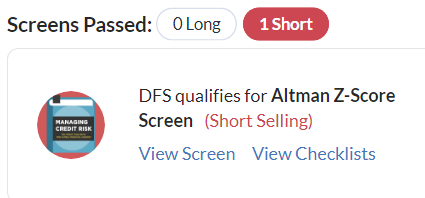
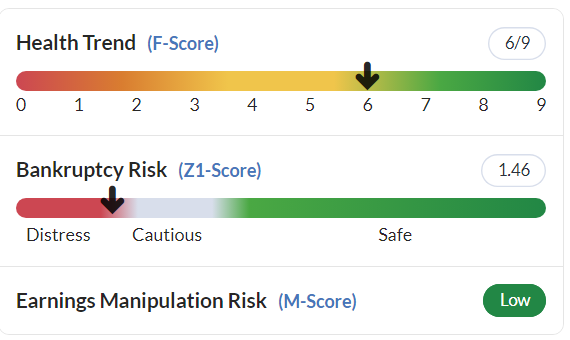
It’s not just me that doesn’t like the precarious balance sheet - DFS only qualifies for 1 Stockopedia screen, which is a shorting screen based on its weak Altman Z-Score.
I think investors in DFS are taking much more risk than they perhaps realise. They need both a significant improvement in trading, and an assumption that the bank will remain co-operative, to justify the existing valuation.
On the upside, with cost pressures abating, and gross margins rising, this could be the low point for earnings possibly? Also, if DFS does deliver the results in its growth strategy, then I could see this share doing well (maybe doubling or more?). It’s just a pity that management are sailing so close to the wind, running up bank debt to pay out divis at the worst point in the cycle.
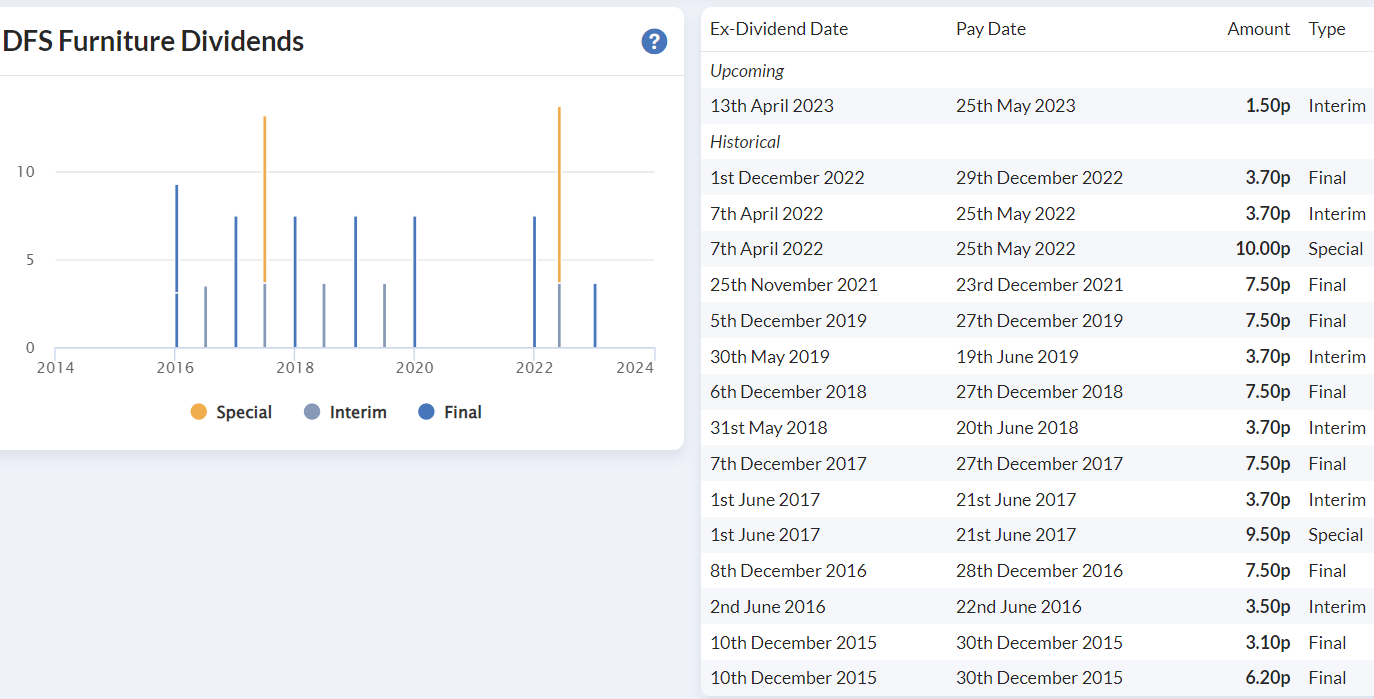
Note a good track record since it listed. Although it has paid out 89.8p in total divis (including 2 specials of 9.5p and 10.0p) since it listed. Although the recent divis have been funded by drawing down on bank borrowings)
.
.
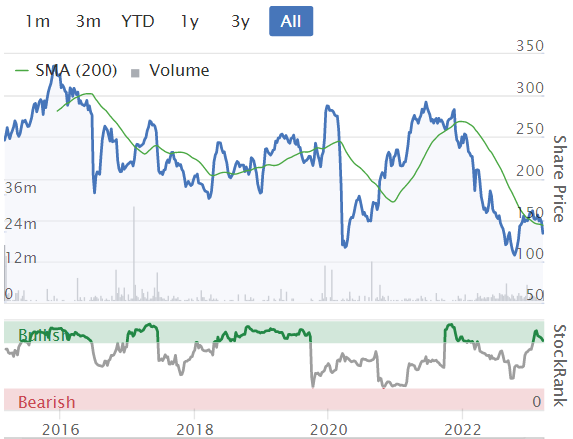
Although the StockRank is quite high, note that a solvency warning is sounded by the Altman Z-score, which is important to check in conjunction with StockRanks.
Disclaimer
This is not financial advice. Our content is intended to be used and must be used for information and education purposes only. Please read our disclaimer and terms and conditions to understand our obligations.

84 comments
What, the, actual, ****?
£15 mil worth SVB Bonuses paid out days after bailout news.
Hi Paul, don't know if it is just old age slowing down my eyes and brain function, but the interesting quotes that appear when I log on seem to now disappear a fraction of a second before I can read them!
Agree with OTB and Volex looking cheap now and have been buying myself..
Hi simmsc,
I've also been keeping an eye on Volex (LON:VLX) with a view to buying a few for my SIPP. However, I held back because my strategy is usually to only buy after a recent, acceptable trading update/outlook statement. In this case, whilst I like Volex as a company, it hasn't updated the market since 9 Nov 2022 when interims were released. Given all that's happening in the world, leaving a gap of well over 4 months now to update shareholders & the market generally, is just too long.
I think all companies should be required to issue trading updates at least quarterly, stating whether they are trading in line with expectations or not, and what the average daily net cash/debt position is.
Rather than giving precise guidance figures, I think all companies should give quarterly guidance on the expected range of possible outcomes for the full year. If that's a wide range due to uncertainty, fine. This would also give us a good way to measure how accurate or not management guidance is over the long-term.
All too often, especially in downturns like now, when I see a share price consistently drifting down, and a long delay in news on trading, a profit warning suddenly appears, and the share price gets a second bash. A good recent example was Wincanton (LON:WIN)
Equally, sometimes companies come out and say everything's fine, so we never really know what's going on, hence why more frequent trading updates really are needed.
With Volex, it concerns me that the share price went into a noticeable downtrend in February, when many other small caps were enjoying a short-lived bounce. That worries me - why was it bucking the trend? More sellers than buyers obviously, but the risk is the seller(s) might know something we don't (that trading could be deteriorating).
As regards On Beach group (LON:OTB) I'm not so worried. We did comment here that it was looking over-stretched when it was knocking on the door of 200p. It's now down to 141p, in what strikes me as looking like a general market wobble, rather than anything company-specific.
OTB last reported on 27 Jan 2023, which I covered here saying that the TU was a bit vague, and maybe profit taking at 190p might be a good idea after a good run?
Broker forecasts have edged slightly up in the last 2 months on OTB.
My other question, is why are they using such an awful TV ad, which seems to be on constantly, with an obese child going crazy at the sight of a help-yourself buffet!?
Regards, Paul.
The recent market sell-off seems to have created a few opportunities on things - would welcome other views. Including
The banks also look cheap as per others' comments but it's not a sector I understand very well which always makes me nervous!
AJBell did a funds webinar yesterday. Ben Rogoff of Polar Capital Technology Trust (LON:PCT) impressive straight talker. AI (ChatGPT etc) the future requiring data, processing power so favours semiconductors. Advanced Micro Devices (NSQ:AMD) is a volatile one if want to play trader.
I'm waiting for Saga (LON:SAGA) to start falling and top up. It's quite a dip down. Wonder if there's something we don't know? down another 8+% so far today.
It's down a lot - I think a combination of market nervousness (Saga's high debt probably makes it more prone to moving on market nervousness) and also following a failed attempt to sell its underwriting business. But as you say it's down particularly today so I don't know if there is some other news I'm not aware of too.
some banks are easier to understand like Close brothers. at around £9 I think it is reasonable priced. diversified and paying good dividend.
Close Brothers (LON:CBG) someone commented on here the other day that they had taken more risky investments recently. I don't hold.
They are often among, the highest interest rate paying accounts you can get, I have some savings with them.
Yes Close used to be pretty focused. They charge high rates, but not as high as other niche lenders. However, they diversified under new leadership a few years ago, into financing legal cases and got into all sorts of trouble. Massive losses there. They are now selling/ closing down those terrible purchases to get back to what they do very well, which is to charge high rates to finance property developers etc.
Sorry, think you misunderstood my comment, I said pay high interest not about lending rates, which maybe so. High interest rates on savings, tend to fixed rate, long term bonds, ie 1-5 years, these will be low risk, as you can't withdraw the money. I will have look more into Close Brothers (LON:CBG) . Thanks for the information.
One of the problems with Close Brothers (LON:CBG) (I used to hold) is that they have been under-providing for the disastrous investment in their specialist legal finance arm, Novitas, which they are trying to extricate themselves from. From the RNS Tuesday:
Half Year Results for the Six Months to 31 January 2023 "...significantly impacted by the increased provisions in relation to Novitas, as announced previously in January 2023. .... additional provision of £89.8 million, with the total provisions in relation to Novitas taken in H1 2023 at £114.6 million. As a result, statutory operating profit before tax decreased to £11.7 million (H1 2022: £128.9 million). Excluding Novitas, adjusted operating profit decreased to £117.5 million (H1 2022: £160.5 million)
I feel queasy about the increasing provisions for Novitas and I don't know if they are able to draw a line under this mess. Perhaps they have finished making provisions, but perhaps not, and I suspect the market thinks not.
And there's this: Although underlying credit performance remains resilient, the increased uncertainty in the economic outlook has been reflected in higher forward-looking impairment provisions and a rise in arrears in Motor Finance. As a result, the annualised bad debt ratio (excluding Novitas) was 1.1% (H1 2022: 0.2%)
Also they are lending heavily for BEVs (electric cars)....with over £90 million lent in the first half towards our ambition to provide £1 billion of funding for battery electric vehicles over five years - what are the residuals going to be like in a few years' time?
And they are getting into Buy-to-Let bridging finance:- ...successful piloting of a specialist buy-to-let extension to our existing Property bridging finance clients Hmm. The government's Bill to "reform" B2L is expected this session. It will abolish "no fault" s21 repossessions and introduce rent controls for the first time since the Housing Act 1988. The government says there won't be rent controls but I've read the papers, and submitted my own paper which was included in the post-consultation report (my name is in the footnotes), and I say they are going to introduce rent controls. Labour say they will ban evictions for non-payment of rent if they win the next election. I wouldn't lend against B2L myself.
The best they could say about Winterflood is: Winterflood's performance continued to reflect challenging market conditions
Close Brothers (LON:CBG) is a "good" business, it's done well in the past, and it's not going bust. I wouldn't buy myself at the moment and I'm glad I sold at 1100 on 9 March.
I agree with your view that Fund managers look cheap - although they may get even cheaper in the short term!
I have built holdings in:
Impax Asset Management (LON:IPX) - forecast yield 3.6%
Liontrust Asset Management (LON:LIO) forecast yield 6.9%
Polar Capital Holdings (LON:POLR) forecast yield 9.9%
The ROE and ROCE stats are pretty impressive for all three (30-50% figures) and i think on a 2/3 year view with inflation hopefully falling back to 2-3% in that timescale i believe they represent an attractive opportunity.
Given they are geared to the stock market the share prices are likely to be volatile as seen over the past week or so. The other risk is of a dividend cut in the short term to conserve cash.
Centamin (LON:CEY) really odd price action going on. Gold prices going up and improving outlook but SP going down in a yo-yo fashion.
Plus CEO buying the dip at £1.007. Doubled his holding by adding £100k.
Doesn’t make sense but then there are very strange market movements all over the place at the moment.
I always accept that a share price can move different to how I think it should move.
One should never assume they have ALL the info and news related to a company. Therefore I always assume I only know partial information, and thus if a share price moves differently to my prediction, there's a logical explanation - others know more than I do.
In Centamin (LON:CEY) maybe it's Egypt related. Maybe a big shareholder dumping. Maybe some mine issue that has leaked. Maybe just passive ETFs seeing outflows. Maybe CEO is about to be indicted for fraud. Maybe some broker research out. Or a short selling report out. None of us have the resources or mental capacity to to have the whole information.
I sold my holding yesterday after the results - I could see lots of positive numbers including gross profits BUT when I looked at how much actually came to Centamin it seemed that a large amount of the post tax profit went to others , including Egyptian government impacting cash for Centamin, I suspect I was missing something or not understanding something but this spooked me as I will not invest in a share I could not understand.
Like you Nick, I sold my holding in Centamin (LON:CEY) yesterday. I quite liked the company, wanted exposure to gold and thought the management explained their business well on the calls. But over 6 months the company never answered a few simple questions, which they promised to deal with.
Interestingly enough, one of these questions was on the payments to the"non-controlling interest in SGM" which are shown in these accounts FY22: $35.5m (vs turnover of $788m), FY21: $75.2m (vs turnover of $733m). I couldn't get my head around why they were so different. There is some sort of explanation in the announcement, but it is one of those where you have to understand in the first place and doesn't show how to estimate these payments.
Also I don't understand mining enough to judge the "stripping activity" which is capitalised and on the balance sheet at the end of FY22 at $141m FY21:$59m). In my world it certainly makes an EBITDA number meaningless.
Despite being happy to hold and invest in gold miners, I’ve always avoided Centamin (LON:CEY) as the mine grades don’t cut it for me. There are many better alternatives imo. One of my largest holdings is Shanta Gold (LON:SHG) .
Problem with Shanta Gold (LON:SHG) is there is a seller and I’m not sure investors really trust Eric Zurrin.
DFS Furniture (LON:DFS)
Interesting point Paul raises on possible illegal dividends.
Dividends generally have to be made from distributable reserves, and these are normally the reserved profits on the balance sheet.
Its not a small thing as Directors have personal liability if things go wrong having made such distributions.
I think some CEO's believe that because they have they cash they can distribute dividends, but that is not the test.
I would be a little bit surprised if the auditors had not raised this. Admittedly non cash items such as large depreciation charges etc can go through the p&l and damage reserves, but I would have thought they would want to flag this as an issue. Problem is, dividends can declared on an interim basis after an audit year end, when the auditors are off the scene.
Thanks Trident!
Re distributable reserves and divis, I was only flagging it as a question to raise on DFS, not something I'm certain about.
I think we came across this point before at another company, and it turned out they had enough distributable reserves within the trading subsidiary that was paying the divis, or something like that - can anyone remember?
On the other hand, it's not uncommon for listed companies to sometimes announce that they have accidentally paid illegal divis, and have had to hurriedly apply to the courts for the reserves to be reorganised. But it's not usually a problem, as nobody's going to sue them. Unless the company goes bust, in which case Directors could be in hot water.
Regards, Paul.
Nanoco (LON:NANO) is an example of a company which wants to distribute cash to investors but has no distributable reserves. See the RNS of 3 February: 'The Group expects to have net negative distributable reserves in a number of subsidiary companies and in the parent company itself after the impact of the transactions noted above. The Group will therefore review options for its future capital structure prior to the receipt of the second tranche of proceeds around February 2024 in order to facilitate a possible return of funds to shareholders.'
Re distributable reserves and divis,
Paul - Lookers (LON:LOOK) was one who had paid illegal dividends because they had failed to upload the cash from subsidiaries to the parent company:
from https://www.lookersplc.com/med...
More reports are fine if they can be covered but a key attraction of this site is the daily cover and comments on the undercovered small cap space. I would be very disappointed to lose that
Hi Aislabie,
More reports are fine if they can be covered but a key attraction of this site is the daily cover and comments on the undercovered small cap space. I would be very disappointed to lose that
Don't worry, you're not going to lose anything! If we can see that a company looks interesting/underpriced/hidden gem, whatever, we'll flag it up in the SCVRs, regardless of market cap!
It admittedly irritates me at the time, when people say, things like why are you writing about this company, it's rubbish! But once I've calmed down, it's usually actually quite helpful. We obviously have to cover profit warnings though, and remember that half the benefit of these reports is to hopefully steer people away from companies where there are serious problems & high risk. Although it's usually so obvious, that we don't bother even writing about the detritus at the bottom of AIM - Tom Winnifrith covers all that, but I don't read his stuff any more, because I wouldn't go near any of the things he writes about in the first place, just from a cursory glance at the StockReports.
We raise plenty of red flags here, for higher risk shares, which I think is helpful. At least people who want to invest anyway are armed with the full facts. And sometimes those high risk things can be crazy multibaggers, at least in the short term.
Right, I'd better get back to looking at a couple more companies before signing off here, and updating my spreadsheet!!
Regards, Paul.
I couldn’t agree more. So I send this from Uganda! Warnings are just as valuable as recommendations.
Journeo (LON:JNEO) ... Could someone provide insight into why a company may have had no trades on a specific day? I have noticed that this company has been potentially forming a Volatility Contraction Pattern (VCP) and maintained a sideways movement during the recent turmoil, and I am wondering if this could be a sign of impending market activity. Does anyone have any thoughts or opinions on this matter?
My JNEO chart
Low cap often means no trades on many days. VCP patterns usually work best on issues with good daily trade vol, so when you get real demand/supply tightening on the handle, before the break this is very obvious to spot. With JNEO you cant see this as a normal day could be zero trades. One of the principles of VCP is to follow institutional demand, hence why it can work in US high vol/lots insts. Interesting for a 22m cap there is a good level of Jan23 inst demand as per Major Shareholders list. All the best with your investments.
Off today's topic but did anyone else notice the FT piece yesterday on payments companies? I know there are Equals holders on here and I am thinking of joining them but does the warning apply to them too? "In a scathing letter to 291 chief executives on Thursday, Matthew Long director of payments and digital assets at the Financial Conduct Authority, criticised payments companies for not adequately safeguarding clients' money or conducting anti-money laundering checks and for failures of governance. He warned he will shut them down unless they fix problems that pose an unacceptable risk to consumers and the wider system.
Off today's topic but did anyone else notice the FT piece yesterday on payments companies? I know there are Equals holders on here and I am thinking of joining them but does the warning apply to them too?
RE: Equals (LON:EQLS)
Well as we don't know who the 291 companies are it's not possible to know if Equals are one of them, but this specifically applies to e-money institutions of whom Equals are one - so they could be included. There were over 1000 e-money issuers in the UK the last time I looked.
The issues generally relate to safeguarding of client funds so that in the event that the company goes belly-up the customer funds are safely held in accounts with other institutions separately from the company's own funds. This is a basic requirement so it's quite alarming that the FCA is warning about this. It's an existential issue as well - if the FCA is concerned it can shut the firm down overnight.
So, for example, when the fraud at Wirecard finally came to light the FCA stopped Wirecard UK from doing any more business and customers lost access to their funds. But because the funds were safeguarded properly the management hadn't been able to divert them for their own purposes and everyone eventually got made whole.
Personally, I wouldn't keep any money with any smaller company regardless of what benefits they provide, including lower fees, it's just not worth the risk. I also wouldn't invest in any of the smaller payment companies for the same reason - it's too opaque and hard to figure out what's going on. Many of them making a living by serving customers that the larger providers won't touch, so there's always risk associated with them anyway.
timarr
Hi JASVFS
Re: Equals Group. (LON:EQLS)
I also read Mathew Long FCA letter regarding risks posed by payments groups.
As well as concerns about the risks Matthew also says in his letter that he welcomes:
"the competition and innovation we have seen in the payments sector and the improved choice, convenience and value this can provide."
So it seems to me that the cowboys are likely to be in the firing line which could be well be beneficial to the professional companies in this arena.
I hold Equals.
Re DFS Furniture (LON:DFS) thank you Paul for that lesson in 'accounts stripping'! I continue to learn so much on the balance sheet side of businesses you review.
I don't remember whether you have ever talked with management here to get some feedback on e.g. their decisions to pay divis our of borrowings?
Looking at the Stocko ratings, it is interesting to see that of the 6 brokers commenting, 2 were strong buys and 2 buys - yet presumably they only have a couple of brokers at most. Why are the broker estimates are so far away from yours?
Something to smile about:
Paul S (or other helpful reader/contributor), would you please give me the access details again to your weekly podcast and your traffic light analysis. I have had computer problems, and I am no techie nerd. 'Nuff said! Thank you. Will try not to lose it this time.
You can find Paul’s podcast on the Apple podcast app very easily
Thanks BnB. Use Android. Dont use Apple. Yes, there are some of us out there! Lol. Any other suggestions please?
You can download Google podcasts on Android and search for Paul Scott and select it from the list.
Or From Paul's Website https://qualitysmallcaps.co.uk
Mr Scott, can you give me the access method to your weekly podcast. I have lost it!
http://qualitysmallcaps.co.uk/
Hi ridavies, and others,
my weekend podcasts are available on all the main podcast platforms, just search for "Paul Scott small caps". Or direct on my personal website, as others have linked to above.
As regards my SCVR summary spreadsheet, I'm afraid I've been negligent in updating it, and it's 2 weeks in arrears now. I'll fix that this evening, with a bottle of chardonnary, so it should be up to date tomorrow. It's here (please don't share this link on social media, as it's supposed to be exclusively for Stockopedia subscribers, who after all pay for me to do the analysis)
Paul's SCVR summary spreadsheet, link not for sharing please
Morning All,
I was hoping for a bit of help. Is there a way of finding the free cash flow yield of a company on the site / filtering for it?
Any help much appreciated.
Thanks, Rich
Is someone here able to provide definitive guidance on if/how pension scheme deficits have been reducing since the rise in interest rates? Many stocks have been, and still are, encumbered by the size of their pension scheme deficits. The large amounts that De La Rue (LON:DLAR) have to pay into their pension scheme yearly was the main reason I never bought any shares.
I increasingly read that pension scheme deficits have been reducing and even surpluses being achieved as a result of interest rate rises. Is that correct and, if so, why? I can understand that being the case if pension scheme funds were being held in cash but that will not be the case.
Clearly, if pension scheme deficits are now universally reducing, it will become a more attractive proposition to invest in companies, the share price of which had been held back by the size of their pension scheme deficits.
Pension scheme liabilities are caclulated using a discount rate that is related to long term interest rates and bond yields. If interest rates rise, the discount rate used to calculate the net present value (NPV) of the liabilities (pensions that will be paid eventually) rises which causes the NPV of those liabilities to fall, hence the deficit reduces.
Peter thanks but thanks too complex - is it possible to explain it in simpler terms?
Hi Ben,
In terms of pension liabilities, ie what the company pension must pay out to its pensioners , simplistically if as an example, say an employee has a pension that pays £10,000 per annum for say another 5 years. Then you might expect that the company records a liability of £50,000. However the pension valuation rules allow the company to reduce the liability by a discount rate (the government bonds risk free rate). There is an inherent assumption that the company can invest money to meet the pension liability in govt bonds. So for example if the govt bond rate is 2% then if a company has to pay the pensioner £10,000 next year it could invest £9,800 in govt bonds for a year, receive £200 in interest and pay the £10,000. If govt bond rates move to say 4% then it could invest £9,600 today in order to pay the £10,000. So the company liability recorded falls if rates rise - also as you can imagine if we took our 5 year example out to the full 5 years the impact of compounding has an even more material effect on the liability. In the example the £10,000 due in 5 years at 2% would be recorded as a liability of £9,057. But at 4% it would be only £8,219.
Clearly there are a lot more moving parts in pensions - eg inflation clauses, the impact on interest rates on pension assets etc but hope this helps answer your specific question.
Liabilities are the amount of money that an organization owes to others, such as pensions that will be paid in the future. To calculate these liabilities, we use a number called the discount rate. The discount rate is based on how much money we could earn if we invested the same amount of money today. If interest rates are high, then the discount rate is high, and if interest rates are low, then the discount rate is low.
When we use a higher discount rate to calculate the liabilities, it means that we expect to earn more money in the future, so the amount of money we owe in the future is worth less today. In other words, using a higher discount rate reduces the amount of money we owe in the future (the liabilities), which reduces the deficit.
So, if interest rates rise, the discount rate used to calculate the liabilities will also rise, which means the amount of money owed in the future will be worth less today. This, in turn, will reduce the deficit because the amount of money we owe in the future is now lower.
Thanks Peter. Is it possible to give a very simplistic worked example? If we assume that a company has at the moment to pay in £10 million a year for 10 years to reduce their pension scheme deficit and that interest rates over this whole period have now increased from 0 to 3%, by how much would the £10 million yearly payment reduce? Roughly
hi rogerh
It is important to understand that the term 'pension deficit' refers to two very different numbers, thus causing much confusion.
Firstly there is the pension deficit that appears in the company balance sheet. This is calculated annually by the company and is of limited use. It is not a figure that is used to calculate the level of defiit contributions needed to be paid. It is little more than a bit of accountancy window dressing.
Secondly there is the more important tri-annual actuarial review conducted by the pension trustees and actuaries which culminates in a negotiation (and often heated disagreement) with the sponsoring company as to the level of any future annual deficit payments that may be deemed necessary.
Therefore you may well have a pension surplus appearing in the year end balance sheet but in actual fact the company are still tied to paying an agreed annual level of deficit contributions under the latest tri-annual review.
It is the commitment to pay annual deficit contributions that is the crucial number to focus on as it is soley this that affects current and future cash flows.
Snazzy
Hi Snazzy,
Thanks. Yes, it is the pension deficit contributions that I am interested in and how the increase in interest rates will affect the triennial valuations. The reply by Paulcity26 was helpful in this respect. For example, I had been interested in Mothercare. In Paul's last review he highlighted how the company existed purely to pay off pension contributions. These have reduced from last September but are still very onerous in my view. Their triennial valuation is taking place this month, so I was trying to get a feel for how much the contributions could reduce, although many other companies are in a similar situation.
Is someone here able to provide definitive guidance on if/how pension scheme deficits have been reducing since the rise in interest rates?
Not in any way a broad study, but I've just had the annual summary from my pension fund, USS, showing that their actuarial deficit has more than halved over the past year and their funding ratio has improved from 94% to 98%. I suspect that sort of experience is not uncommon.
I was hoping for a bit of help. Is there a way of finding the free cash flow yield of a company on the site / filtering for it?
Any help much appreciated.
You can just use P/FCF. Free Cash Flow Yield = FCF/P i.e. it is the Stocko P/FCF value inverted.
So, if you want to filter for FCF yield then using the rule P/CF < 20 will find companies with a FCF yield > 5%. The shame is you can only use P./FCF TTM.
All the best, Si
Hi Simoan, thank you very much for your swift response, really appreciate it. I'll give it a go later.
My morning smallcap tweet: Hoist the smallcap spinnaker
Non-Standard Finance (LON:NSF) Capital & Regional (LON:CAL) Circle Property (LON:CRC) Yourgene Health (LON:YGEN)
◄Non-Standard Finance (NSF)► proposes £14m scheme of arrangement to limit compensation claims. Plans recapitalisation with £95m placing, lender haircut and extension of the maturity date. Alternative is insolvency. [SP=0.45 Cap=1m]
◄Capital & Regional (CAL)► completes sale of its interest in The Mall, Luton for £58m. [SP=57 Cap=96m]
◄Circle Property (CRC)► B shares worth158p go ex-entitlement today. Expects another one of 51p in April. [SP=206 Cap=60m]
◄Yourgene Health (YGEN)► CFO steps down, will remain as Company Secretary. He is thanked. [SP=0.3 Cap=9m]
You pay 1% stamp duty on Irish shares.
Thank you slopsjon. Pay who?
The irish government
On a relatively quiet day, I would like to ask the knowledgeable contributors to this board for some advice on a couple of matters where I am thinking of changing some elements of my investment strategy to some extent based on their experience.
First, about dealing in Euros via my normal online brokers ii and also to some extent HL. Naturally I want to keep my total dealing costs to a minimum and of course that will involve some exchange rate element. How do you handle it? Can you /do you have a Euro account with these brokers, and if it is possible is it advantageous to do so?
Secondly, I am increasingly in the short term increasingly attracted to Ireland - the Republic - where the low rate of corporation tax seems increasingly attractive to inward investment, and additionally where a number of companies have been performing rather well, and are forecasting to do well in 2023 and probably even better comparatively versus the UK in 2024.
Increasingly companies are either moving to Ireland or changing their development plans eg building new plants there rather than in the UK - GSK was it recently made such a decision? With a level of Corporation Tax rate of 12%? versus the changing rate in the UK from 19% to 25%, which company wouldn't consider it very seriously?
The Euro issue comes up again here, but also the liquidity of these stocks, ranging from banks like Bank of Ireland, material suppliers and distributors like CRH to house builders like Cairn and Glenveagh.
There may be other factors which I have missed and would be material. If so please feel free to add your further insights - and of course thank you in advance for any contributions on what is one is probably the most generous investor board in preparedness to share experience and expertise.
I use XE Money Transfer at https://www.xe.com and am very satisfied with their service, which is quick and efficient, and seems to offer very competitive rates.
Thanks for that Watchdog. Extra question - to do what? To do the transfer from sterling to Euros, I can understand but then to put it in the coffers of Interactive Investor or HL with a special account, or what?
Re Investing in Irish domiciled companies.
The liquidity is usually related to two factors: where are they listed and where do they trade operationally? I hold a number of notionally Irish names but really they are mostly US companies, listed in the US, with deep liquidity, eg Accenture and Medtronic. There are a few Irish-born but LSE-listed examples, Kingspan and Smurfit being a couple I own, and again, no liquidity issues encountered so far. Frankly I think the liquidity is much better than for typical UK mid caps.
How do you deal in them with the Euro issue? Pay the broker, eg Interactive Investor or HL in my case, an exchange rate charge or do they run Euro accounts separately? Thanks for your help, BnB
I run multiple accounts in every required currency, essentially GBP, EUR, USD, JPY, plus DKK, SEK, NOK because the Scandies don’t do Euros.
If you have a SIPP/SSAS with ii, you can hold euros within the account. So if, for example, you purchase a stock for 10000 euros, you will pay the FX charges to convert sterling into euros for the purchase. Subsequently, if you sell the stock again, you can retain the euros in the account and buy another euro-denominated stock with the proceeds without further FX charges. You can also hold $US and a variety of other non-sterling currencies within the account. This does not, however, apply to ISAs, as far as I know, which are universally sterling accounts, so each time you buy and sell a non-UK stock, you will incur FX charges.
I would add that ii are getting rid of their SSAS accountholders, so the above will only apply to SIPP accounts. But please check with them too!
Thanks for that, rogerh. Unfortunately (from this point of view), I live in the Isle of Man and in this so called 'tax dodging' island (and I'm sure some do, tough not on the scale of London and the UK), we don't enjoy such tax avoidance schemes like that here.
If you are talking about simple trading accounts rather than ISAs or Sipps I would recommend taking a serious look at Degiro. I have an Isa with Interactive Brokers and a trading account with Degiro, both used for shares from all over Europe. Both are very much cheaper both in execution costs and exchange costs than ii. The main difference between the two is that Degiro, who don't do ISAs unfortunately for me, seem to cover everything I've ever looked at from a German £14m small cap to the big stuff, and from Latvia to Ireland and all the rest of Europe, whereas IBKR are really geared to frenetic traders, imo, and there have been at least half a dozen shares in the last six months that I wanted to buy in my, or my wife's ISA, that you couldn't get with IB, but were easy to get on DG. Most of those shares were in companies with a market cap between £150 - 300 million.
I switched everything over to interactive brokers! Far better and cheaper
RiDavies
I do have some knowledge of Irish market. The economy is doing well and country has benefited greatly by the low corporation tax rate as it attracted many US companies in both tech and pharmeceutical sectors.
The number of quality companies are limited and they all make the majority of their profits overseas. Just a word of warning Irish domiciled companies have different tax deduction rates to UK companies.
You mentioned a UK co recently decided to build a plant there because of corporation tax. It was Astrazeneca.
I do hold shares in several Irish registered companies and they have proved a good investment and I will continue to hold.
Stamp duty on Irish companies is 1%.
like bank shares around the world Irish bank shares have taken a severe beating this week and it may create a good entry point. The only sector of concern there is commercial property and that could attract provisions in next reporting round.
Ryanair shares can only be purchased by residents of EU.
Hope this of of help.
Tom
Tom,
If a UK resident wants to purchase Ryanair shares there is an alternative. They can be bought on the US market (RYAAY). I bought some in the last 12 months through Interactive Investors.
Morning Paul, Small-cap value report is brilliant. Can Stockopedia add Mid-cap value report as well? Thanks
That's a nice idea, I'd definitely like to extend more into mid-caps, as there are lots of interesting companies in that part of the market. But we would need another team member to make it happen.
Mid caps - we would need another team member to make it happen.
I think this is well understood by the forum members. But I believe it would be a popular addition to Stocko. The extra liquidity and price stability offered by larger, but still growing companies is, to me, the sweet spot in UK investing. I hope Ed is reading. Perhaps we could see less of BT vs Vodafone and more of Diploma (note the positive price action after last night’s discounted placement), Keywords, Network International, Spirent (upgraded to BUY this week), YouGov etc.
Please get Stocko to get you a new team mate!
A comment on expanding the cover to Mid cap.
A great deal of praise has been said regarding Paul and Graham comments on small caps here. They richly deserve all said.
The contribution of the community members should equally be appreciated and encouraged. We all benefit from this.
Paul and Graham cover the mid cap do not need to be so comprehensive for two reasons: the availability of information and research in this sector is much bigger than the small cap and second: a greater number of subscribers are here who can contribute more to the debate. This makes it more informative and interesting.
Personally I would prefer not to see Stocko expand thus as it would have to charge a subscription proportionally higher and besides, I need to keep some time for myself on my own research.
The point of Stocko is to do your own research, that's why I signed up. The SCV report is useful as a guide to show how to analyse companies' fundamentals, and yes while it would be great if coverage of every single share in the UK markets is covered(my personal preference is energy and mining), but not at the expense of increasing the subscription.
The point of Stocko is to do your own research, that's why I signed up. The SCV report is useful as a guide to show how to analyse companies' fundamentals
And a mid-cap report would not be equally instructive? Stocko can widen the service without increasing the subscription by attracting more paying members. A mid-cap daily report could potentially draw in a good number of new investors as there is no equivalent elsewhere unless you count the various share rags like Investors Chronicle with its uncanny knack of giving the wrong rating to almost every share!
Great idea! However, this is not Paul's responsibility. Please consider contacting the Stokopedia management team with your request. Hopefully, they are able to find someone as brilliant as Paul.
Agreed. Be good to look at Mid- caps and I have no problem paying a higher subscription assuming the quality of info is as good as for Small-cap
I did raise the issue of Mid cap stocks with Ed and Paul at the Mello meeting in November 2022.
Ed passed me on to Paul! Ed was in the opinion that Paul can decide which stock he can cover, essentially he is free to do that on demand.
Paul clearly can not do the micro, small, aim and everything else in the time he has.
My suggestion was to cut some of the Aims, Micro and Small caps and do a bit more of the companies in the Mid cap.
I think if there is enough demand among the subscribers , this move make more sense.
For one, I am much less interested in sub £100 companies covered in this pages. My porto is mainly mid and large caps.
Paul's view that we need another team member to make this happen is a very valid point but that is up to Ed to decide and maybe we should ask him!
Hi Lucky dip,
"My suggestion was to cut some of the Aims, Micro and Small caps and do a bit more of the companies in the Mid cap."
I think we've already gone some of the way towards doing that. Graham and I are very conscious of the reader comments a while back, when some people were getting frustrated (rightly so, in hindsight) with us spending too much time on tiny companies.
So in response, over the last say 6 months, we've moved up our market cap limit to £1bn (it was originally only about £300m), and with market falls in the last year, that's also picking up a lot more companies now that have fallen into our net.
How about this - if readers spot an interesting mid-cap, then write something about it in the reader comments, telling us why it's interesting. If it floats mine or Graham's boat, we'll check it out and write something about it. This is actually often how we spot some of the best ideas here - readers flagging up things under the radar that Graham & I didn't notice.
I'm not rigid about market caps at all. We all want to make money from our shares, so if you find a cracking idea, tell us about it! I'll happily spend time looking at something if it ticks my value/GARP boxes, which I can ascertain very quickly from the StockReport, and you flagging up something game changing, or just very good, from an RNS that I might not have looked at.
I can recall reporting on many small caps over the last 11 years, which have continued performing brilliantly, then we lose them once they go over £1bn mkt cap, 4imprint (LON:FOUR) springs to mind as an example. It would be nice to keep reporting on the best companies like that, as they grow into mid caps, I might start doing that. Good idea!
Regards, Paul.
I think this sums it up. The point about 4imprint (LON:FOUR) dropping off the radar is very important. When Paul, Graham, and/or the members find a business which performs well consistently we should follow it until the day comes when the wheels fall off. Of course if the subscription base can cover the cost then an extra analyst would be great. I understand what Ed says about the Stockreport quant approach but I don't think it works on its own, one needs the human analysis as well, particularly when the quant data is out of date or we suspect it is wrong.
What is becoming essential to me is (a) reliable, sticky tags of the companies which are analysed by Paul and Graham so we can find their reports easily, AND a way for members to tag what they are discussing. If I click the "Discussion" tab on a Stockreport I want to see what members have said recently, not just the "bloggers" (in Stocko terms the SCVR is a blog).