Small Cap Value Report (Fri 24 April 2020) - TRI, TW., LUCE, DTG, PSN

Good morning, it's Paul here, with Friday's SCVR.
I'll start early, with some catch up sections from yesterday.
Estimated timings today - the lockdown seems to have turned me nocturnal, so I did 4 hours writing overnight, and needed to sleep more recently. I'm writing more now (from 11:57) and am likely to keep going until about 3pm.
Your Covid-19 comments - I read with considerable interest all the different views yesterday (and previously) about the virus, and how it might affect our investments. Can I just make one suggestion though? It seems that most people who are giving their views, and making predictions, phrase it as if their views are incontrovertible fact, and that anyone who disagrees is a fool! E.g. most comments seem to be phrased along the lines of "This or that will happen...", when actually all the comment really is, is educated guesswork. Nobody has any idea how this will pan out. All we can actually say is, "My view is that this or that might, or could possibly happen". Or, "I think the most likely outcome could be ....", etc.
This is a point made in a terrific book I'm reading at the moment, which I've mentioned here before, highly recommended: Super forecasting. This book points out that the media loves commentators (on economics, shares, world affairs, politics, etc) that are strident, emphatically give one point of view, don't change their minds even when they're wrong, and are very frequently wrong yet never called to account for their poor forecasting. It calls commentators like this "hedgehogs". This type of commentator is often strident & refuses to even contemplate alternative views. I think it's fair to say that I often fall into this trap myself. Hence I'm making a greater effort to mention different views on stocks when I remember. I'm also making an effort to change my "this will happen...." into "I think the most likely outcome is .... but there's a fair chance this other outcome could happen". Or this is the upside, and this is the downside case.
My personal view is that I think many of yesterday's reader comments seem way too pessimistic. I'm working on the basis that bars and restaurants could be open again by July. My suggestion would be to initially limit customers to healthy under-50s with no pre-existing health conditions (where the statistics show the risk to life is minimal), and for temperatures of every client to be taken on the door with a handheld thermometer, as they do in the Far East.
Just watching a TV report from Italy, people are now seriously questioning the lockdown, and the terrible impact it is having particularly on mental health. One person comments, "This is not life", meaning that they are finding the lockdown intolerable, the longer it goes on. I think greater efforts should be made to lock down the elderly & vulnerable, and that everyone else should (in stages) be allowed to resume reasonably normal life, with as much social distancing as possible. The effectiveness of South Korea's response is striking. We probably need to do more of what they're doing.
Trifast (LON:TRI)
Share price: 122p (flat on the day)
No. shares: 122.6m
Market cap: £149.6m
Trifast (Main market LSE Symbol: TRI) issues the following unaudited Trading Update covering the Group's financial year ended 31 March 2020 ahead of the announcement of its preliminary financial results.
"Holding the world together" - International specialist in the design, engineering, manufacture, and distribution of high quality industrial and Category 'C' fastenings principally to major global assembly industries
TRI issued a mild profit warning, which I covered here on 14 Feb 2020. Re-reading my notes from then, it's interesting to see that the Covid-19 worry at that time was about China supply chains. That was before the pandemic had happened globally. I didn't see any reason to get involved then. The share price has since dropped another 27%, as you would expect given the far worse macro picture currently.
FY 03/2020 turned out OK, although bear in mind that forecasts had been lowered several times (see graph below). Hence broadly in line isn't good, but Covid-19 would presumably have started to have some impact towards the end of the year (31 March).
Despite a challenging finish to the year:
o Revenue levels held up well against the prior year
o Underlying profit before tax remained broadly in line with market expectations
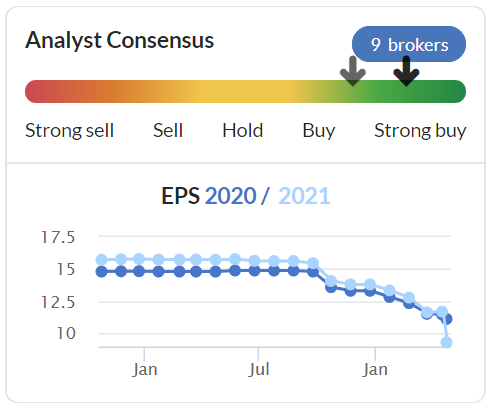
Covid-19 - the comments immediately below relate to the impact up to 31 March 2020, and presumably are likely to be a lot worse in the new financial year just started? I'll come on to that next.
Over the course of the last six weeks of FY2020, the effect of the Covid-19 pandemic significantly widened. Leading to government mandated temporary site closures in Malaysia, Italy and Spain and customer production line shutdowns predominantly in the automotive sector. This in conjunction with a general reduction in manufacturing volumes across almost all end markets, has reduced year end trading levels across the Group.
The impact of this weakness has led to a corresponding reduction in gross and operating margins against a semi-fixed cost base. However, despite these challenges underlying profit remains broadly in line with market expectations.
"Semi-fixed cost base" is ringing my alarm bells.
Actions taken are the usual that we're seeing from many companies - e.g. use of furlough schemes (not stated what % of workers), Board taking temporary 20% pay cut, cutting non-essential costs, no final divi (but does mention possibility of a special divi later) etc. All sensible stuff.
All sites are open for business, and have achieved "essential business lockdown exemptions" in some countries.
Current trading - uncertain, guidance removed for the new year, FY 03/2021. More confident about medium to longer term pipeline.
Liquidity - this sounds OK, providing the bank remains onside, and there are no covenant breaches;
Our balance sheet is in a strong position, with leverage well inside our banking covenants.
Significant undrawn revolving credit facilities, together with our existing cash resources, provide substantial liquidity headroom with which to navigate an extended period of uncertainty.
That's fine for now, but if EBITDA tumbles, then that could trigger issues with bank covenants later. That said, generally banks are being supportive for decent businesses, so it's not necessarily panic stations if trading deteriorates.
Balance sheet - as regulars know, for years I've been heavily focused on checking balance sheet strength here, which has turned out to be very pertinent in this crisis.
In this case, Trifast last reported its balance sheet on 30 Sept 2019, and it looks fine to me.
NTAV was £77.3m, which is good (I calculate NTAV as NAV, less intangible assets)
Working capital looks great, with a current ratio of 3.27.
Long-term interest-bearing debt is not excessive at £40.2m, and in any case was offset considerably by cash of £25.0m.
Overall then, I doubt the bank would play up, even if trading deteriorates in FY 03/2021, which I imagine is likely. It looks pretty secure.
My opinion - tricky one this. It seems a fundamentally sound, and well managed business. However, we've got no visibility for current year earnings, which I imagine are likely to be poor. As is the case with so many shares, this really gives investors 2 options;
- Ride out the current crisis, on the assumption that the business should survive (due to fairly strong balance sheet), and accept the risk that the share price could fall on lousy figures later this year, or
- Sit on the sidelines, and await clarity on earnings, and possibly buy in cheaper at a later date.
Those options are applicable to practically every share at the moment!
I don't have any particularly strong view either way with Trifast. It's not really a business that excites me, and the share price performance was lacklustre before Covid-19 struck, due to its exposure to the automotive sector. There must be thousands of companies worldwide that can make fastenings, so Trifast's strong (10%-ish) operating margins have always slightly puzzled me, but there we are. Presumably it might benefit from weaker competitors going bust this year, and that could present more acquisition opportunities.
There could be some upside here from 122p as economies start to come out of lockdown, possibly? Trifast probably won't need to raise fresh equity, therefore I can see some merit for buying/holding this share, if you're prepared to be patient, and take the risk of it plummeting if dire figures come out later this year. That may not happen, but it's a big risk, given that economies are tanking right now.

.
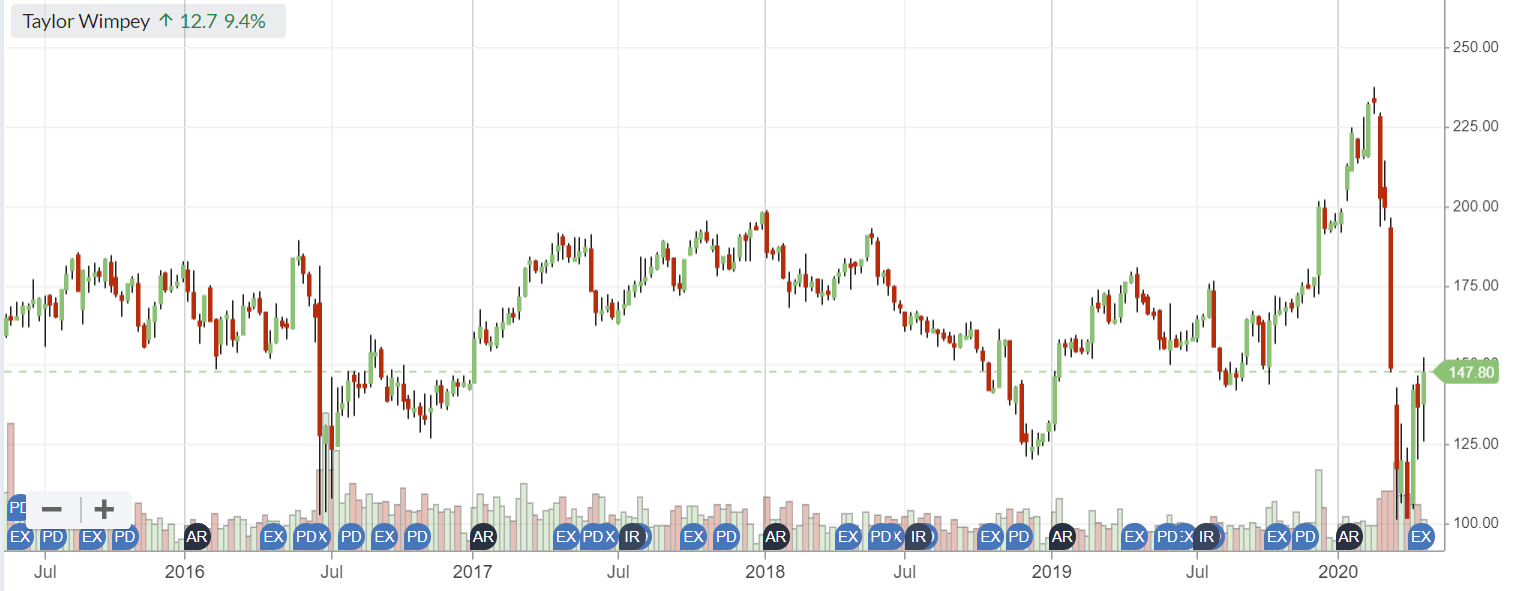
Taylor Wimpey (LON:TW.)
Share price: 148p (up 9% yesterday)
No. shares: 3,283.9m
Market cap: £4,860.2m
(at the time of writing, I hold a long position in this share)
Not a small cap, but it's interesting, so I'm going to write about it.
After reading the OBR report recently, which I reported about here on 15 April, I became convinced that lockdown has to end soon, in stages, due to it being staggeringly expensive, and on track to ruin millions of peoples' lives if it goes on much longer. For questionable benefits, that could arguably be achieved in other, less destructive ways.
That got me thinking about buying shares in companies that are likely to benefit from lockdown being removed. My earlier strategy of buying bombed-out but reasonably financially secure property REITs (Hammerson (LON:HMSO) and Newriver Reit (LON:NRR)) just wasn't working, so I've now ditched HMSO, and greatly reduced my position size in NRR. Instead I've turned my attention to housebuilders for this part of my portfolio.
I cannot see any reason why building sites were mothballed in the first place, given that it's mostly work in the outdoors, and social distancing is easy to do. Also, housebuilders generally have great balance sheets now, and demand for new houses is likely to continue, as long as interest rates remain low. Even though banks are tightening mortgage availability, I reckon there are probably enough buyers around to keep the housebuilders busy.
For this reason (and wider read-across to the whole economy), I'm interested in updates from housebuilders. I often cover them here, even in normal times, as they're a good gauge of the general health of the economy, and consumer confidence.
Here's what TW says today -
- Recap - it closed all its sites at the end of March, to assess situation
- Has plan in place, so will re-start (phased) from 4 May (only 2 weeks away)
- Sales have continued remotely, and digitally - encouraging, as clearly there is still demand
- Cancellations less that 1% of order book - that's fantastic I think
- Order book has continued to increase and as at week ending 19 April 2020, the total value stood at approximately £2,677 million (2019 week 16: £2,399 million) - wow, very impressive
- Strong balance sheet and gross cash position of c.£836 million as at 22 April 2020 - I'd rather have the gross, and net cash/(debt) positions.
Change in way new houses are sold - could this become permanent I wonder? Probably not, but why not, if it works?
Sales centres, show homes and regional offices to remain closed while we monitor latest guidance around social distancing. We will continue to provide service to customers and sell remotely and digitally
Balance sheet - is not just good, it's stunningly good. Consider this, as at 31 Dec 2019. Current assets were just under £5bn, including £630m in cash. The rest is mainly inventories of £4.2bn. Current liabilities? Only £1.1bn. Therefore, even if house prices halved, it would still have a comfortable working capital position. Is there tons of long-term debt? No, only £85m of bank debt. There's also an £85m pension deficit, and £500m of trade/other payables (presumably for deferred land purchases at a guess?), but the overall total of £745 long-term creditors look OK in the context of the huge working capital surplus higher up the balance sheet.
NTAV is £3.3bn, which supports 68% of the £4.86bn market cap .
My opinion - obviously as I'm long, I see things bullishly.
The key questions are whether we're heading for a house price crash, and whether Help To Buy scheme is likely to be extended, which has been a massive boost for housebuilders. Personally, I don't see any reason why the price of new houses would drop much, because mortgage payments are so cheap, people can easily afford new houses if they can come up with a decent deposit. Over time, that's the main driver of house prices - the level of interest rates on mortgages.
I don't know what will happen with Help To Buy, but I feel the share prices of housebuilders have probably factored in that risk.
If you take a more bearish view, that house prices could fall substantially, and that demand might dry up, then obviously this sector is one to avoid.
Casting my mind back to the Brexit vote in 2016, housebuilder shares got smashed up really badly there, and I remember thinking that was an opportunity & writing about it here. Sure enough, they came all the way back up again in less than a year. Maybe a similar thing could happen with this latest (more serious) shock to the system? Or maybe not, only time will tell.
.
Luceco (LON:LUCE)
Share price: 89p (up 5% yesterday)
No. shares: 160.8m
Market cap: £143.1m
Luceco plc ("Luceco", or the "Group" or the "Company"), a manufacturer and distributor of high quality and innovative wiring accessories, LED lighting products, and portable power products, today announces its audited results for the year ended 31 December 2019 ("FY 2019" or "the period").
Absolutely cracking results these, with adj PBT up 150% to £15.8m. That's 7.7p adj EPS (2018: 2.9p)
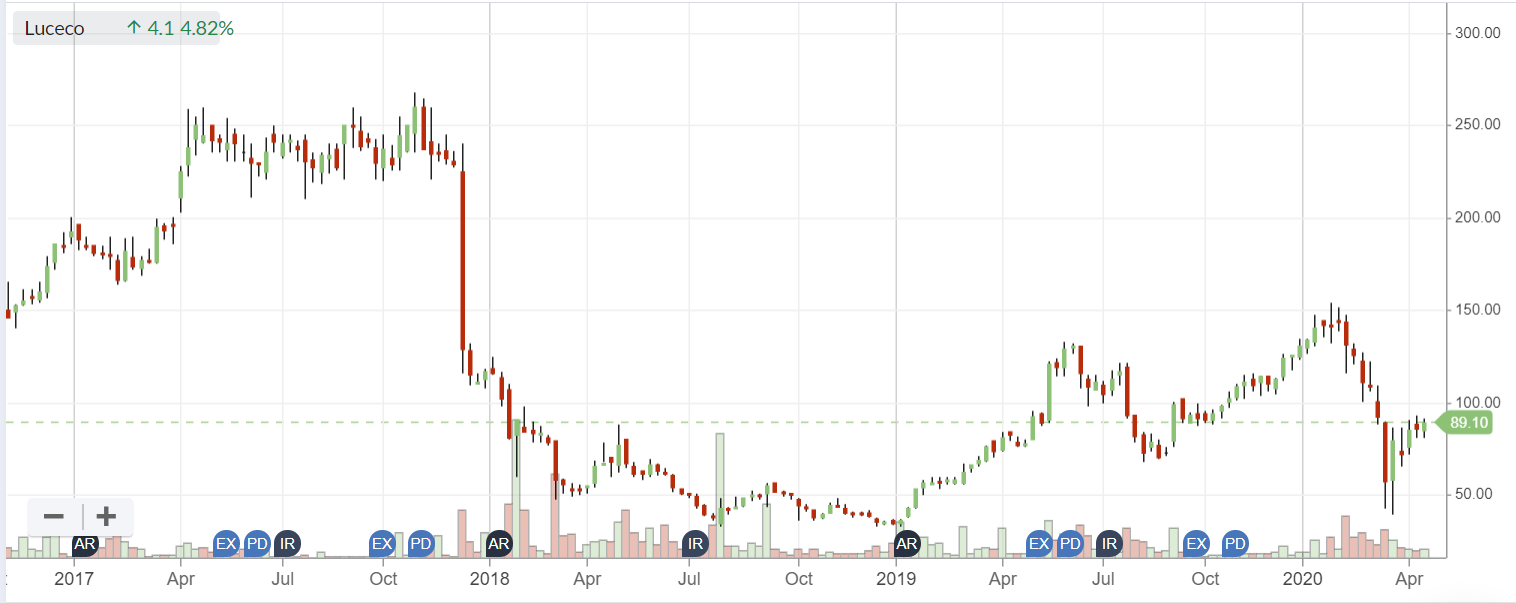
That's why the share price did so well in 2019, peaking in early 2020 at 146p. Of course, 2019 seems like a different world now, hence why the share price is now off about 40% from that peak.
Covid-19/outlook - this is all that matters now. Key points;
- Supply chain disruption from China in Feb/Mar, now resolved
- Demand now affected by European lockdown, running at half usual levels
- Monthly cash outflow running at £0.5m per month - hence the P&L monthly loss is probably worse than this, if it's deferring some creditor payments, as seems likely. Edit: actually I could be wrong on that, as it later says EBITDA is currently running close to breakeven
- Cash conservation measures similar to what many other companies are doing - e.g. divi paused, pay cuts, etc
Liquidity - some useful detail given on this;
o Adequate liquidity to fund this rate of loss: £24.5m of undrawn facilities at the end of Q1 2020, committed until end of 2021 · Resilience and optionality added to the funding plan:
o Agreement reached with relationship bank to: § Loosen banking covenants in late 2020 to accommodate severe downside scenarios
§ Swap £10.0m of existing invoice financing facility for £10.0m of Revolving Credit Facility to underpin debt capacity
o COVID Corporate Finance Facility applied for
o China mortgage lending available
I particularly like the bit about loosening banking covenants. That's very reassuring for shareholders.
Stress testing - this section below is absolutely superb, and really shows that management are on the ball, and fully in control. As opposed to potentially sleep-walking into a crisis later this year.
All companies should be publishing stress testing results like this (apologies for the huge copy/paste, but it's very interesting);
Coronavirus stress testing and liquidity assessment
We have reviewed and stress-tested our funding arrangements in light of the coronavirus. We have considered both base case and severe but plausible downside case scenarios.
In our base case, we have assumed that Group revenue remains at circa 50% of normal levels until the end of June 2020, gradually recovering to 80% by August 2020, then 100% from January 2021. We have assumed that the mitigating actions described in the Chief Executive Officer's Review remain in place to an appropriate extent for the duration of the downturn.
In our severe but plausible downside case, we have modelled a second virus-driven lockdown from September to November 2020, which leaves Group revenue at 25% of normal levels for its duration, gradually recovering to 100% of normal levels by February 2021. All other assumptions remain the same as the base case, including the application of the same mitigating actions for the duration of the second downturn.
In both scenarios, the Group has adequate headroom in existing bank facilities to fund itself. In the severe but plausible downside case only, the Group exceeds the financial covenants applicable to its existing facilities shown above in Q4 2020 and Q1 2021. Subject to contract, our relationship bank has therefore agreed to reset the covenants limits applicable in 2020 as shown....
That's so impressive, getting the bank covenants amended well in advance, for a downside case scenario.
Also, this is the first company that I have seen which is planning to cope with a second lockdown in autumn 2020, if Covid-19 resurges. Again, very impressive forethought.
China mortgage - the CFO has this in his back pocket. It would have been nice to have put a ballpark figure on this though, so I don't know if this is significant or not:
The Group has historically used mortgage lending in China and has the option to do so again.
Balance sheet - looks reasonably OK to me. NTAV is £24.5m
My opinion - this looks a good, well managed company. I particularly like the prompt action to strengthen & safeguard its liquidity, through amended facilities & covenants. The stress-testing section is absolutely superb.
This looks like the type of company that should survive 2020, and recover in 2021, assuming generally improving economic activity & the virus in retreat. That's a big assumption of course, and may not be the case.
For me, right now, it's not quite cheap enough. Also, bear in mind that things went badly wrong for this company from late 2017, for about a year. Before buying this share, I would want to look back at that again, and remind myself what wrong, and whether it could happen again?
.
Dart (LON:DTG)
Share price: 590p (down 3.6% today)
No. shares: 148.9m
Market cap: £878.5m
This airline/holiday/logistics group issues an update for FY 03/2020, and current trading.
It's high on my watch list, because it has a fantastic multi-year track record of growth, including setting up a highly successful package holidays business from scratch in recent years. Also I like the superb balance sheet, so it looks a rare bright spot in a sector (airlines) that I wouldn't normally touch with a bargepole, especially now.
With high fixed costs, and planes sitting idle on the ground, not to mention chaotic fuel price movements & hedging problems, plus the question of whether Governments should bail out airlines or not, this sector looks a total minefield.
Assuming Dart survives (which I think it should), and we get back to something like normality in 2021 or 2022, then Dart shares could possibly reach several times the current price. After all, it got close to 2000p per share recently, before covid. Look at the superb historical track record below. Obviously ignore the forecast light blue blobs, as they're defunct now;

.
Clearly there's going to be a terrible set of figures for FY 03/2021, but for patient investors, prepared to wait maybe 2 years, then I reckon earnings could reach new peaks. After all, DTG was trouncing the competition before covid, so why wouldn't it after (especially as there's likely to be less competition in future)?
FY 03/2020 results - a fantastic year, but this is already ancient history;
Further to the Trading Update issued on 18 March 2020, the Board expects to report pre-exceptional Group profit before foreign exchange revaluation and taxation for the financial year ended 31 March 2020 of between £265m - £270m, an increase of approximately 49% on the prior year.
Fuel & forex hedges went bad, and it will take a £109m exceptional charge in the FY 03/2020 results.
Hotel deposits - this is yet another problem, and seems likely to require another write-off. It's a pity that DTG doesn't give any guidance on the size of this problem. It might be in broker research, which I'll check out later. The risk must be high that hotels at destinations might go bust, taking DTG's deposits down with them. More clarity on this is needed from Dart.
We continue to actively monitor the financial health of our hotel counterparts in respect of our advance deposits and their potential for recovery. Contractually the majority of these deposits are able to be reallocated to future seasons' bookings.
Current year - too difficult, so they fob us off with this;
The impact and duration of Covid-19 remains difficult to determine, and the Board has no clarity as to how this will affect Group profit before foreign exchange revaluation and taxation for the financial year ending 31 March 2021.
We all know it's difficult, but as Luceco (LON:LUCE) demonstrated yesterday, it's possible to stress test outcomes on a base case, and a plausible downside case. We know Dart will have done those sums internally, they've just chosen to withhold the information from the market. That's just not good enough. More openness is required at this stage.
Action taken -
- Aircraft fleet grounded - I'm surprised at this. Surely they could be operating some planes, for freight, repatriations, etc.? Air Partner (LON:AIR) recently said it was doing OK, with that type of business (using other peoples' aircraft)
- 80% of staff furloughed under Govt schemes
- Reduced flying schedule on sale from 17 June 2020
- Cost-cutting & cash- preserving measures taken - including 30% pay cuts for everyone, including Directors. No bonuses or divis to be paid
Liquidity - not enough information given, but it does say this;
We have prudently fully drawn down our Revolving Credit Facility of £100m and have also begun the process to confirm our eligibility and access to the Covid Corporate Financing Facility, launched by the Bank of England. In addition, we remain in ongoing constructive discussions with our existing liquidity providers, who recognise the strength of our business model.
Customer bookings - this is very pleasing. I think a pattern is beginning to emerge of the UK public being more resilient, and less frightened, than might have been thought. See yesterday's report where I covered a surprisingly upbeat update from housebuilder Taylor Wimpey (LON:TW.) , saying that the order book is strong, demand high, and cancellations negligible. I reckon many (particularly younger) people are itching to go on holiday, and once the virus has subsided, my hunch is that demand could return strongly. Although perhaps older people might understandably not want to take the (for them) much higher risk. Judging by Dart's jet2.com TV ads, they seem to be already appealing to families, not pensioners.
Positively, and despite the considerable uncertainty, we are seeing customers still making bookings for late summer 20 and winter 20/21, with encouraging numbers choosing to rebook rather than cancel. In addition, and though very early, summer 21 bookings to date are very promising.
That's excellent news. Re-booking not cancelling means DTG gets to sit on the customers' cash, helping its liquidity.
Fowler Welch - distribution business, is doing well.
My opinion - it's a pity that today's update doesn't give enough clarity on the outlook. I was looking for some guidance, and stress-testing figures to base my investment decision on. Without that, it's too much like guesswork. Which is a pity, because I want to buy back into this share, but today's update doesn't give me enough information to make that decision.
Persimmon (LON:PSN)
Share price: 2194p (flat on the day)
No. shares: 318.9m
Market cap: £6,996.7m
I reported yesterday on a surprisingly upbeat statement from Taylor Wimpey (LON:TW.)
Today we have another big housebuilder updating. It is also about to resume work on its building sites, after a brief shutdown;
... phased restart to work on site with effect from 27 April 2020, in response to the UK Government's objective of getting the construction sector back to work.
Clearly that's good news, and has been anticipated by the stock market awarding 20%-ish price rises to housebuilding shares in recent weeks.
Persimmon's update is almost a carbon copy of what Taylor Wimpey said yesterday, e.g.;
... continued to serve new and existing customers, making use of online resources, including virtual viewings and digitalised reservation processes. This has resulted in c. 820 gross private sales reservations being secured in the five weeks ended 19 April 2020.
Cancellation rates remain at historically low levels.
People will always want to buy new houses, and there seem to be enough buyers able & willing to proceed, from what I can make out.
This is a strong statement;
The Group has not made use of the Government's Coronavirus Job Retention Scheme to furlough staff, has no current plans to access any of the UK Government's COVID-19 funding programmes and continues to pay all taxes promptly.
My opinion - I think it makes obvious sense to re-start the construction industry. This should also help the many suppliers to the sector to hopefully survive, and recover from the relatively short cessation of activity. That could have read-across to lots of smaller caps serving this sector.
Uncertainty remains over the crucial Help To Buy scheme.
Profit in 2020 is bound to be impacted to some extent by all this disruption.
Like Taylor Wimpey, Persimmon has a stunningly strong balance sheet. It's an absolute cash cow (partly thanks to Help To Buy), and personally I cannot see any reason why house prices would fall substantially, given that interest rates remain at historic lows.
I think there's a good chance that this sector could continue to see further recovery in share prices. Hence I'm happy to hold.
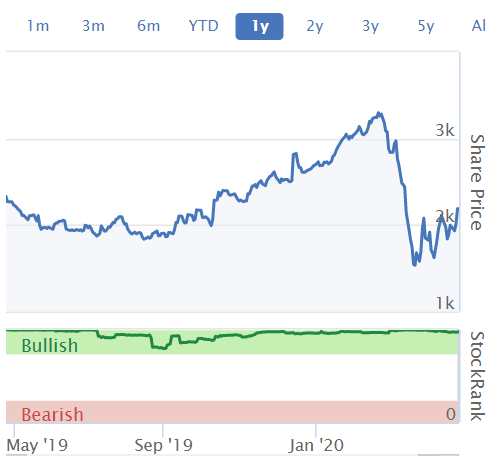
As you can see from the 1-year chart below, arguably the share price overshot on the upside, then overshot on the downside in the Covid-19 panic. Maybe it's settling back down in the middle now?
.
I'm taking a break for lunch now. I'll update on Lookers (LON:LOOK) at some point later today. There's about a 50% risk that I might succumb to sitting in the sun with a couple of cold tinnies. This lockdown is driving me round the bend, so I'll do whatever it takes to keep going!
Staffline (LON:STAF) - rats leaving the sinking ship possibly? This looks potentially terminal to me. I don't like the look of this, at all.
All I can remember, is the selling CEO, being so charming at about £10 per share, a few years ago, trying to sell the shares to private investors. What a piece of shit! He's running a hotel now apparently, with his ill-gotten gains. What a scumbag. People might feel cheated. My dogs left a small turd on our chequered pattern tiles this morning. I wiped it off, with disdain, and thought to myself, Staffline.
Disclaimer
This is not financial advice. Our content is intended to be used and must be used for information and education purposes only. Please read our disclaimer and terms and conditions to understand our obligations.

92 comments
The isle of man govt introduced a two week quarantine for
all visitors despite a high dependency on tourism. It will be interesting to see the course of play in an area so close to home
The over 60's have been more locked in/out/down/up than the unders (not opinion), and therefore less likely to have the virus or be carriers (hardly opinion). So we should be allowed to go to the pub, play golf, attend the the cinema, while the unders go to work and get the economy back on its feet. Just a disinterested opinion.
Reading through some of the comments here, does anyone else think that there are far too many people around with far too much time on their hands??? ; )
Paul, Staffline (LON:STAF) departing CEO was Andy Hogarth, profile here: https://www.linkedin.com/in/andy-hogarth-405b989/. His bio has the hotel as the Hogarth Hotel just south of Birmingham (https://goo.gl/maps/1YhLVxZXjr...). My overall sentiment towards what happened at Staffline is on a par at best, needless to say his hotel is on my newly created Hotel bargepole list!
Being a 70 year old man who is pretty fit and without any of the underlying health problems that are considered to be linked to Covid 19 deaths, i.e. diabetes, heart disorders, grossly overweight, lung disorders ( per my daughter who is a Consultant Anaesthetist specialising in Intensive Care at a leading London hospital) I think your idea of locking up the elderly in their homes to hopefully die of old age or something else, whilst the young have a good time in pubs and restaurants, is an appalling disgrace.
Hi - to what is this note responding too ie who has mentioned locking up the elderly to hopefully die as you have written? That sickens me if someone has written that but this post should be amended if nobody has said that.
As always great to read your views Paul and I am impressed that you rarely sit on the fence !! Although I share you view on Housebuilders and am long on a few,I disagree with you re bars and restaurants. As mentioned previously,I am a major shareholder in a fairly new London restaurant,and we have planned for at least another 3 months of Lockdown,and probably longer. Think it will be similar for bars.
Just do not think the Government will be prepared to take the very real risk,that relaxing the restrictions on drinking in public,will result in a large increase in Corid19 cases. Not suggesting you theory is not sensible ,just that the medical scientists and Government won’t be prepared to risk it.
Let’s hope you are correct !!
One of the most striking interviews I've watched in the last couple of days was the interview of a WHO scientist involved in receiving, validating and correlating all sorts of covid related news from health authorities all over the world. The statistic she gave which surprised me most, and makes me think it is unlikely that early lock - down releases are going to stick without absolutely dramatic increases in test, trace, and isolate capability, was that in controlled random population testing to find the proportion of the population of many countries that had developed antibodies (ie. those who had had the disease whether or not they suffered symptoms), the highest percentage encountered was 14% with most in single figures.
That percentage appears to have been validated by New York surveys which indicated 14% statewide and 20% in NY city, iirc. New York state appears to have the bit between its teeth in terms of building a test, trace, etc, process before release of lock down but I have my doubts about many other countries, including the UK, having that determination.
Now I am keeping a tab on Taylor Wimpy as a potential investment...Held them previously and made a small profit ..
Paul although I broadly like your Covid-19 piece I am not too keen on your ‘who should be allowed out of lockdown’ ideas.....I am 65 ,retired and reasonably fit and able...I take total exception with the thought that people who are older or even health compromised should have government enforced extended lockdown....I am lucky to live in a beautiful part of the country but am finding a lack of social interaction absolutely diabolical...
Let the younger ,fit and able plus those who are still lucky enough to have employment go back to work and get the financial money-go-round back into whirring action....Please let the poor bored kids go back to school to get properly educated and socially mixing...Its important.....If everyone was back where they should be the Monday to Friday 9- 4.30 The town streets would be then be empty enough so that we silver people could go out and about ,have a life and socially distance to our hearts content.....Just because I worked for 46 years (in NHS) and have lived most of my life being beholden to family ,kids, husband,job,children clubs and weekend /bank holiday work shifts doesn’t mean that I should now be locked away on the off chance I might catch a virus less deadly than influenza....I still wish to live my life without mental stresses and strains caused by isolation........Others may wish to live in isolation...Fine let them....It is their choice....Personally I am sensible enough how to stay away from others safely, how to wash my hands and face and how NOT to go out if I am ill....but I am not ready to die of inactivity...Yet...
“ .Just because I worked for 46 years (in NHS) ”.......
“ on the off chance I might catch a virus less deadly than influenza”
Sorry Penny, what was your role during this 46 years? I’m struggling to understand how you can say Covid-19 is less deadly than influenza if you have 46 years exposure to working in a medical environment.
Not sure anyone can conclusively say either way just yet! However, the sentiment behind the post is perfectly valid. Its also possible that not everyone who works in the NHS is a medically trained expert required to know the relative harm of different viruses.
Sam
I would have thought that anyone working in a medical environment for a very large number of years even if not a medically trained would have come to the conclusion that when the assessment of WHO, Sage etc. and an enormous number of other medical experts is that this is far more serious than flu that’s more than likely to be right.
So, my view is, sorry but it is not valid to say that COVID-19 is less serious than flu and to deny the evidence for that is ridiculous.
I am gobsmaked that there are people who still think this might be likely in any way. There’s more than 20,000 dead in New York in a matter of just a few weeks!
What the government could do, of course, is to allow pubs, bars & etc to open, so long as they cover the financial cost of any consequent rise in infection. Would require insurance and they'd have to put their prices up.
But it would treat the human costs of preventing people doing these things as equivalent to the human of cost of the people becoming ill and dying because of it.
'What the government could do, of course, is to allow pubs, bars & etc to open, so long as they cover the financial cost of any consequent rise in infection. Would require insurance and they'd have to put their prices up.'
How would that work? I go to the supermarket for a couple of items and stop off at the pub for a quick couple of pints on the way back. Later that week I come down with CV.
Who's to say I caught it off the handbasket around the supermarket or off the bar in the pub? Why should the pub have to purchase insurance and not the supermarket? An asymptomatic person could just as easy spread it at either establishment.
Well said Paul. I hope things do relax sooner like everyone I think that they must. Some stuff is just so unclear e.g. what is essential an off licence open is that really essential for instance. Not quite clear how the government can say science guided us to close down when as late as we did. NZ points the way that a quicker lock down and quarantining every individual arriving for 2 weeks paid massive dividends. I think at some stage we need to review the reality rather than the scientific view we all know scientists can have quite different views on the same thing and it is not exact - indeed it can not be there are simply too many variables. Science yes - but to take it as gospel as the government seem to seems to have left with the slow comment being faced which I think is right. Nobody lets face it wants to make the decisions that have had to be made and we all recognise that. Off of soap box...
So, as a 76 year old, I'm going to be denied my last supper at the Ivy. Paul, you are ludicrous, 18 year olds are checked for their age before entering night clubs because of their presumed behaviour. I think I can still hold a bottle of good claret.
If we raise the lockdown restrictions in part, infection and death rates (in the absence of a vaccine or treatment for the disease) will go up. So, we are close to 20,000 deaths now (in hospitals) what level of deaths are we prepared to accept? 5 times that, 10 times that?
It seems like drastic measures will still be necessary - keeping the vulnerable isolated, and a very extensive testing and contract tracing operation.
So, to those who are agitating for the lockdown to be released I have these two questions. As a price worth paying to restart the economy by lifting the lockdown in some way..
1. How many covid-19 deaths are you prepared to accept?
2. How much of your privacy and civil liberties are you prepared to give up and for how long?
Hi Graham,
How many covid-19 deaths are you prepared to accept?
You seem to assume that keeping the lockdown will mean no more deaths, and I really struggle with this logic. The virus is here to stay, we will not eradicate it by keeping the lockdown, people are still transmitting it, and people will continue to die, that is the reality. The rate of deaths are slowed by a lockdown but they are not saved, probably just delayed. Even if you keep 100% lockdown its a highly contagious virus and will still move through the population.
Hi John
“ You seem to assume that keeping the lockdown will mean no more deaths”
Not at all. Deaths are clearly going to increase for some time to come under the present arrangements and there may be additional deaths from other causes too. However, as you say, the spread of the disease is slowed down. This gives more time for effective medical treatments to be developed, which potentially saves many lives. Or expressed another way, more cases are delayed to the point where there’s some substantially better form of treatment for them that means the likelihood of the disease killing you is much reduced.
By contrast, lifting the lockdown now increases the speed of spread of the disease so a much higher number of cases and deaths occur in a short period of time.
My questions were deliberately a bit provocative because it seems to me that while a fair number of people are agitating for the lockdown to be lifted, they are not explaining what downsides of doing that they are prepared to accept.
I’m not arguing for or against lifting the lockdown. But I think that those who are strongly advocating lifting should also state clearly what they will tolerate as the consequences.
Assuming that we're in a position that the NHS can cope without the additional cases causing shortages or delays treating other issues, then isn't the answer to both of your questions that we should balance the number of cases and the social restrictions such that the expected QALYs gained by those restrictions don't cost any more than the NICE guidelines would allow spending on any intervention? The expected cost would clearly be an estimate and would need to take into account, inter alia, damage to economy, stimulus required, additional issues caused by lockdown, etc.
My initial understanding is that the current cost of each QALY gained from lock-down is running massively higher than the normal NICE guidelines would allow, but that's because we thought that otherwise the NHS would fall over. It seems that the demands on the NHS haven't been as bad as worst predictions, and this should probably be remodelled to see where we are now.
I think we will be watching other countries who are lifting their lockdowns such as Spain and Italy, I note that Spain has seen a rise in new cases in the last few days. I don’t think our Govt will be changing our lockdown for a while but some companies seem to be opening again, I hear B&Q is.
It is a difficult question, if you listen to the medical advise then they will want us to be in our homes for ages but there has to be a limit, I don’t think people will stand it for too long, maybe we will see scenes as in the US? Already people are going out more, if you look at the traffic volume figures.
Opening pubs for the under 50s
The flaw in this is where do the under 50s go when the pub is not open. They will mix with their parents, their work colleagues , other travellers on tubes buses and trains etc etc. They would quickly become a group of super carriers that would infect many more than the under 50s group
I find it increasingly difficult to foresee the re-opening of pubs until there is a proper control over the virus
Currently long in Revolution Bars (LON:RBG) but considering reducing my exposure
Might, rather than would.
Correction accepted. Thank you for all your hard work
The power of language!
"The effectiveness of South Korea's response is striking."
But are we not too late to do that sort of control, S. Korea only had about 10,000 cases, we currently have over 130,000 and that is only a small proportion of the real number which could well be over 5m by now, there out break was mainly in one group of people which they soon isolated, ours is all over the country. Singapore also did a good job but has suffered a serious outbreak recently. Do you think our Govt. have the staff and resources to do anything on the scale of South Korea? We should have done what Australia did but it's too late now, we let people go off to Italy and also let football fans visit from Spain, serious errors in my view.
£MGNS - I have been a long-term reader, but rarely post. I am in the final throes of negotiating the completion of a land sale for Affordable type housing to a developer, will sell the final product to a Housing Association. His company does retail sales as well as contract bulk sales. In conversation with him it is clear that his company is concerned about retail sales, because of public mortgage concerns – not least the reaction of lenders on Affordability.
My perception is that MGNS is probably better placed to do well with its USP.
Paul any thoughts?
Apologies for my multiple posts today, but there have been plenty of recent comments on companies developing drugs/vaccines/tests for SARS-CoV-2 this week and biotech is my specialist area. In case investors are not aware, I have just come across figures produced by the well respected research company, Pharma Intelligence, which indicates that there are currently over 140 drugs/vaccines in development worldwide for COVID-19 plus 115 ongoing clinical trials for drugs which have already been used for other conditions, but may be useful for COVID-19. Typically, you might expect a handful of drugs to end up being approved and perhaps one or two vaccines if we are lucky. These are more likely to be developed by cash-rich biotech or pharmaceutical companies which have the financial power to work quickly. It is also possible that this type of company may, at least initially, sell these products on a non-profit making basis. This is just to show that investing in any small, speculative company developing such products really is a long shot.
peterthegreat
I would be interested to know what your thoughts are with regard to the % chances of a pretty much fully working vaccine being developed before the end of the year - if you have any useful estimates? would you go over 50% or below 50%? or about 50%? - the fact the oxford group have said they think they have an 80% chance of sucess seems promising but there must be an element of them pimping their own product here if thats more likely to push themselves up the pecking order for cash support?
All very true Peter but a number of these companies are up 5 or 10 times from lows. The highest recent riser that I know was up 18 fold in less than one month and NCYT (a testing stock) has been up 90 fold in a six month period at its highs. It is tough not to get involved .....just don't put too much in and don't be slow to cash in on a major rise is my advice to those tempted to play this "pass the parcel" . The twitter crew are going crazy on some of these stocks....and it is true that some of them do just go up and up. I have a long list of such stocks and I freely admit that I had never heard of most of them before.
All very true Peter but a number of these companies are up 5 or 10 times from lows. The highest recent riser that I know was up 18 fold in less than one month and NCYT (a testing stock) has been up 90 fold in a six month period at its highs. It is tough not to get involved .....just don't put too much in and don't be slow to cash in on a major rise is my advice to those tempted to play this "pass the parcel" . The twitter crew are going crazy on some of these stocks....and it is true that some of them do just go up and up. I have a long list of such stocks and I freely admit that I had never heard of most of them before.
As always with these kinds of investments, it has nothing to do with intrinsic value or picking winners in a Keynesian style beauty contest. This is simply the Greater Fool Theory at work.
All the best, Si
https://www.trustnet.com/news/...
"My suggestion would be to initially limit customers to healthy under-50s with no pre-existing health conditions"
How would you suggest this could be implemented Paul?
In terms of age restrictions, bars could be required to ask everyone for ID, regardless of age. If people are over (say) 50, or 60, they are denied entry, same as under-18s. That reminds me of going for a drink last year, with my niece & nephew. They were asked for ID. I jokingly told the doorman that I hadn't brought my ID. He quipped, "That's not necessary sir, and we don't accept OAP bus passes anyway!", to general hilarity.
Re the other point on pre-existing health conditions, the doorperson at bars could easily have a clipboard, and require everyone coming in to sign a disclaimer, declaring that they
have no underlying health issues, and accept the risk of entering the bar.
Inside the door, there could be obligatory hand-washing stations, and a fixed station with hand sanitiser, dotted around the bar, with people maybe required to use the hand sanitiser before being allowed to buy each drink.
Obviously, more testing is the key thing. As herd immunity grows, what we need is that people with antibodies can resume economic activity. What about some sort of passport scheme for that? The trouble with that I suppose, is that people might then ignore hand-washing precautions, and inadvertently pass on the virus on their fingers? It's all very complicated, and I'm only bouncing ideas around & debating the issue, not pretending that I have all (or any) answers, just to be clear.
Obviously if I thought that bars wouldn't re-open this summer, then I wouldn't have bought a big position in Revolution Bars (LON:RBG) - its core customers are 18-25, low risk (but not zero risk), and from sounding out views in that age group, I think a lot of them can't wait to start partying again. We can't hide from this virus forever, especially younger people who are statistically at very low risk. Risk is there, all around us. Anyone could step in front of a bus when glued to their smartphone, or die in a car crash, or asleep when faulty wiring burns down their house, or a gas explosion occurs.
Obviously, more testing is the key thing. As herd immunity grows, what we need is that people with antibodies can resume economic activity. What about some sort of passport scheme for that?
It's in progress, there are lots of immunity passport projects under way right now. The problem is that if you're not careful you incentivise people to catch the virus, which is not really the idea. However, we have this contactless technology stuff on smartphones that means that other people don't have anything to touch :-)
It seems very likely that bars will re-open but with limitations - probably in terms of capacity, perhaps in terms of hours. But in the end it's all guesswork, if anyone had asked us 3 months ago if the UK government would shut down the entire economy and started paying a third of us to stay at home I strongly suspect that most of us would have got the answer very wrong.
In the long term everything will re-open, some behaviours - especially around working from home and commuting - may change permanently. In the short-term - frankly nobody knows. Or if they do, they're not telling.
timarr
P.S. I got id'd going to a pub after the Epsom Derby last year. Obviously, at my age, my face is my id. The bouncer was adamant, no id, no entry. So I had to slink off home on my own while my kids laughed their faces off. Sign of things to come, I suppose ...
Why can't 50 year olds drink? Maybe they should exclude ethnic minorities and people overweight as well? What do you mean by underlying health issues?
I think pubs will be one of the last places to reopen and some bar owners say it won't be variable to make a profit if they have to have social distancing rules.
Isolating older people is not so easy in shared houses, what are you going to do, lock them in a room all day?
Isolating older people is not so easy in shared houses, what are you going to do, lock them in a room all day?
Well I expect that would have to be he case. Its also difficult if they live alone or in a unit where everyone is designated 'over50s/vulnerable'. How are you going to ensure they do not escape into the general population ? How are you going to ensure they are properly identified ? I think it has got to be backed by criminal sanctions.
Some people my claim violation of human rights I guess but we have to remember that the purpose is to avoid pressure on the NHS and not primarily for the benefit of those groups.
It all seems an administrative nightmare
Hi Paul. You restate what appears to be a common hope that "..as herd immunity grows.... people with antibodies can resume economic activity" but what I think may be missing is that, for example, the common cold can be caused by one of several coronaviruses and this doesn't infer immunity or else we wouldn't keep catching colds. I don't believe there is evidence as yet that being infected with Covid-19 will infer future immunity. Hopefully I'm incorrect on this point - it would be good to hear an informed view of this. Thanks for all of your dedicated commentary.
No evidence as the WHO pointed out. A strong assumption.
In terms of age restrictions, bars could be required to ask everyone for ID, regardless of age. If people are over (say) 50, or 60
But that one it's own wouldn't help that much. They would need to be under 50s who don't live with/visit their parents, mix with older people at work or other places, or with other under 50s who do. Otherwise you would still see increased infection rates across the population, including the more vulnerable.
"Challenge 50 - if you are under the age of 50 but are unfortunate enough to look like a pensioner you might be asked to show identification proving your age" ;-)
I wonder if the casual dining sector might be better placed to deal with this on the basis that it's already geared up to spacing people out (at tables); keeping them "more in one place" for the duration of their visit (at table service); and controlling numbers (via reservations in advance).
It might be that bars change to a more table service based approach to achieve the same thing. There is a (big) flaw with this though, when you're in your 20s you go out with people that you know with a view to meeting people that you don't know, which would be rather difficult...
it's important to remember that the lock down is to protect the NHS not to protect people. People will do what they want to do, road traffic is already up dramatically last week. There was interesting survey in the FT last week about what people would feel most comfortable about returning to. Gyms, pubs and restaurants came out bottom. Leisure and hospitality have been hit hardest and will be last to come out of this. There will be no sudden lifting of lock down, we will be in a twilight zone of social distancing for months, people will change behaviour to avoid contact with others. They might go to quiet pubs, they won't go to busy ones, this will last for months to come. The economy won't recover to where we where for months - if ever. Some won't survive the structural change.
Taylor Wimpey provided detail of debt and cash - effectively comfortable net cash - in its trading update yesterday, Paul. I’m bullish too on the sector: fits your financially cautious ‘bill’ in terms of high ROCE, high margins, distributing surplus cash.
Havent the housebuilders all suspended divi’s though?
Hi Southendchelsea - absolutely, as I reported in the above article, the balance sheets of Taylor Wimpey (LON:TW.) and Persimmon (LON:PSN) are absolutely stunningly strong.
I can't remember if it was the 2000-2002 recession, or the 2008-9 recession, when the housebuilders' balance sheets were almost wiped out, due to geared reduction in asset values, and heavy debt, but the current situation couldn't look more different.
Housebuilders now have awesome balance sheets & solvency. It's so different to the past. Hence why their shares are far better, in terms of risk:reward, in my view.
Best wishes, Paul.
Interesting article here on Help to Buy and potential impact if withdrawn in 2023.
I picked up PSN after the Brexit vote for £12, but sold a bit too soon.
https://www.ukvalueinvestor.co...
I suspect there will be a fair few more of these trading updates of "business being near as per usual" and 5-10% or more rallies on those which are down about 40-60% since the start of March like.
Companies who have rallied or are in that situation like BT/ITV/TW/Barrats/Fevertree etc and I think there are quite a few. I wouldn't go near any of the directly hit companies like airlines etc myself, I don't see how they will get business back up and running for a long time yet.
I'm not sure about BT/ITV or Fevertree.
However, the housebuilders are starting to work again, after a brief pause. They had massive operating margins, up to 20%, and recent updates from TW. and PSN sound very promising - 1% cancellations, bulging order books, the best balance sheets ever (probably). That sounds fantastic to me.
Looking back to the late 1980s, I remember when house prices crashed about 30-40%. What caused it? Very simple - the economy took a downturn, but above all, interest rates went through the roof. I took lodgings in a luxury house, because the owners couldn't pay c.12-15% interest rates, on their relatively small mortgages.
We're nowhere near that now.
If you can stump up the deposit, then you'll get the cheapest mortgages % interest rate, ever imagined now. Way below what was imagined actually. Hence the logical thing to do, is to over-pay and reduce the capital, taking advantage of artificially low interest rates.
Agree on houses completely but I used Fevertree as an example because their recent update was pretty much "business is flat but we have lots of cash and will bounce back strong" and since it is up over 20% since that but up from 900p to over 1700p in about 2 weeks! I'm a long term holder of Fevertree and bought at around 1400p average after buying and selling at various points. (I sold out last year and bought back in March) I think Fevertree will be a brand similar but not as powerful as coca cola or pepsi at some stage and their business model is practically all outsourced on the production side so I think they are a great long term buy.
However, my point was, Fev and ITV and BT are stable businesses in this crisis but their prices were 60% down (ITV and BT still are roughly). I don't buy the argument they warrant that much of a beating and a 'business as usual or thereabouts' update could have a big impact on market perception, as with Fev this week.
Hi Paul,
Looking back to the late 1980s, I remember when house prices crashed about 30-40%. What caused it? Very simple - the economy took a downturn, but above all, interest rates went through the roof. I took lodgings in a luxury house, because the owners couldn't pay c.12-15% interest rates, on their relatively small mortgages.
We're nowhere near that now.
If you can stump up the deposit, then you'll get the cheapest mortgages % interest rate, ever imagined now. Way below what was imagined actually. Hence the logical thing to do, is to over-pay and reduce the capital, taking advantage of artificially low interest rates.
I remember it well! I think when it comes to housing we can learn a lot from history. When I took out my first mortgage at the start of the 90's people were almost giving property away because of the 15% interest rates. Of course, unemployment also reached 10% a few years later, but IMHO affordability is the key and with low interest rates and Help To Buy not going away anytime soon, UK housebuilders with strong balance sheets looks a very good call to me currently.
All the best, Si
Of course, unemployment also reached 10% a few years later, but IMHO affordability is the key and with low interest rates and Help To Buy not going away anytime soon, UK housebuilders with strong balance sheets looks a very good call to me currently.
True, but it also depends on unemployment and peoples' confidence in the security of their jobs. Typically when unemployment rises then the number of house sales drop - buyers won't buy because they're worried about their jobs. As Zoopla's recent report states:
House prices will largely be influenced by unemployment rates. The greater the economic shock and unemployment, the greater the potential impact on house prices over the spring and summer.
Zoopla Research modelling indicates a fall in the number of sales of up to 60% over the second quarter of 2020, continuing into the third quarter. Individual spring months may see newly agreed sales down by up to 80% on last year given the shutdown of normal life and knock on impact for the market.
Obviously that's all houses, not just new ones.
Normally house sales start rising before unemployment starts falling. Once the number of benefit claimants levels out then those who still have jobs start to buy.
At the moment it's difficult to know who will and who won't have a job - furloughing people only delays the inevitable for some companies and people. The latest CRR research estimates that 20,000 retail businesses will close this year and 250,000 people will lose their jobs. Not only that, but a lot of them will see significant amounts of business permanently move online which changes the labour / capital equation in favour of the latter. Retail Economics estimate online non-food spending will jump from 30% to 50% of the total. Basically, buy warehouses, sell retail.
In addition there are some specific issues - I know of two people who've been "asked" to take a pay cut. Not a temporary one, just a pay cut. No one's hiring, so people will grit their teeth and take the hit, but it all reduces overall confidence levels and affordability. Interest rates are only part of the story.
Still, I'm not disagreeing that housebuilders look decent value, but they've soared on the back of Help to Buy which, frankly, some of them have abused - the bonuses to Persimmon's ex-CEO Jeff Fairburn for merely turning up and taking the government's penny were outrageous (and, at last look, he still hadn't set up the charity he promised). I would expect any further government largesse - and I do expect further largesse - to be more carefully targeted.
Personally I favour Berkeley Group (LON:BKG) who have a billion in the bank and are still paying dividends, but higher risk companies will probably yield higher returns - although their assets, aka land banks, may melt away in a deep recession. As ever, you pays your money and you takes your choice.
timarr
Hi timarr,
House prices will largely be influenced by unemployment rates. The greater the economic shock and unemployment, the greater the potential impact on house prices over the spring and summer.
Zoopla Research modelling indicates a fall in the number of sales of up to 60% over the second quarter of 2020, continuing into the third quarter. Individual spring months may see newly agreed sales down by up to 80% on last year given the shutdown of normal life and knock on impact for the market.
This is a very short term outlook. I'm not a trader and you've got to look beyond the next 6 months to make a case for investing in anything tbh. Yes, unemployment will likely provide a headwind but I can't remember a time with such low interest rates and IMHO this will keep the housing market alive. For those people in secure jobs who are effectively forced savers during lockdown, there will be a wall of money that will be spent in the economy at some point, and I can't see it going on holidays anytime soon! I can only talk my own book, but our monthly bills this month and next (and who knows for how long?) will be a fraction of what they normally are.
In addition there are some specific issues - I know of two people who've been "asked" to take a pay cut. Not a temporary one, just a pay cut. No one's hiring, so people will grit their teeth and take the hit, but it all reduces overall confidence levels and affordability. Interest rates are only part of the story.
Of course this is quite circumstantial. You are always going to get employers who try and take advantage of a bad situation. In the long run this will come back to bite them, because I bet those two people and their colleagues are not going to forget how their employer shafted them when more normal times return.
Personally I favour Berkeley Group (LON:BKG) who have a billion in the bank and are still paying dividends, but higher risk companies will probably yield higher returns - although their assets, aka land banks, may melt away in a deep recession. As ever, you pays your money and you takes your choice.
I agree Berkeley Group (LON:BKG) is a solid company with very good management which I've held before but tbh I'd rather not stock pick at this stage. Why not hold more than one company to gain exposure? Ideally I'd like to invest in a UK Construction ETF (or similar) that held several housebuilders, brick makers, Marshalls (LON:MSLH) etc.
All the best, Si
This is a very short term outlook. I'm not a trader and you've got to look beyond the next 6 months to make a case for investing in anything tbh. Yes, unemployment will likely provide a headwind but I can't remember a time with such low interest rates and IMHO this will keep the housing market alive.
Hi Si
Me neither, and yes I'm absolutely looking beyond 6 months. But I'd rather not buy into stuff where there's even a trace of existential risk, let alone a reasonable probability of a fall.
Remember - in 2008 interest rates dropped from 5% to near zero. House prices responded by falling 20%. Over the same period the number of houses sold dropped from around 160,000 to about 40,000. To be fair that high number was artificial due to the stupid self-certifying mortage offers, but the long-term run rate is around 120,000. It took until 2015 for valuations and volumes to recover - probably not unrelated to the introduction of Help to Buy.
Low interest rates over long periods do lead to house prices rises, but in the short-term it's the rate of change of unemployment that matters as that's a proxy for buyer confidence. If unemployment is rising people stop buying, once it stabilises they start again.
Of course, it may be different this time - employment may hold up and the government will do everything it can to keep the housing market going. And many housebuilders look - or at least did look - very cheap. Everything has its price.
Anyway, I don't have a dog in this fight, so I'll leave it here.
timarr
Thanks to Paul for the Luceco comments as this has created a Eureka moment for me. Agree that detailed stress testing is good but the pandemic scenarios used by the Luceco CEO are complete fiction. His base level scenario is hopelessly optimistic and his "severe but plausible downside" scenario approximates to the most likely sequence of events. However, I do not understand why he thinks that the second lockdown will end in November 2020 in mid winter when the 2nd wave pandemic is likely to be at its worst. He surely can not have received proper scientic advice before drawing up these scenarios. This is a Eureka moment for me because if investment advisors, CEOs and investors honestly believe these scenarios, then this may help explain why share prices have rallied so strongly, which I have been puzzling about for some time. I also note an anguished comment from a hair salon owner on my local community web site as she had just read an article suggesting that hair salons will have to be closed for 6 months - surely it has been obvious for some time that establishments where people are in close contact, including bars and restaurants, will need to either remain closed or operate under profit-reducing regulations for at least 6 months. The sad thing is that the scientific community appears to have failed to communicate their views on the pandemic to the wider community, many of whom still apparently remain in denial.
Couldn't hair salons open now if they wore Personal Protection Equipment? I know PPE is in short supply at the moment, but that surely is a solvable problem. We could be moving to a world where PPE clothes will be everywhere and places like hair salons are certified for "virus safety" just like restaurant kitchens are certified for food safety.
Yes that is a good point about PPE for hairdressers chrisgb, but I am not sure when enough PPE, particularly masks, will become available. I have trying to help my GP practice get hold of sufficient PPE and antiviral hand sanitiser supplies (as I am a member of the Patient Participation Group) and some items are still in short supply, or have increased in price significantly if they are available.
Working in PPE is not comfortable, it is hot and cumbersome, I don't think many hairdressers would want to do it but in some countries such as Australia hairdressers are open. Australia who had far more restrictions, such as 14 day quarantine for all arrivals, has now got far less restrictions on businesses than we have.
And you have to change it for each person you work with. No going around a few customers.
Hi,
The Luceco 2017 accounting issue is referenced hear by Graham....
https://www.stockopedia.com/co...
An interesting bit of news which came out on the same day as £TW update was that bank lenders have relaxes mortgages terms again to allow 85% LTV and that they are also allowing furloughed salary to count as long as companies are topping up above the 80%.
This helped to push housebuilders even more and I think it is arguably the main driver for the buying in the last two days rather than the trading update which was largely the same as March.
I've held £TW. for a long time and previously Barrats and the mortgage availability was certainly my main concern.
Hi grout I'm new to trading so feel free to blow me out of the water :) Seems to me that React's business model is not a winning one. It's revenue, GP and NP have declined YonY since 2015.
While it may do quite well out of COVID in the short-term what is there about this business that's worth risking investing in?
Thanks for your comment -I wouldn't even attempt to blow you out of the water. We all have a view. I agree their model has not been good but we are now living in a new world where hygiene in certain scrupulously clean public areas etc are where React can operate successfully. What has happened in the past is not going to be the future. We are ina different world. I see short term improvements and longer term too.
Typically the way I treat these small firms is simply as an option. It either goes up or I lose my money but I dont invest so much that it keeps me awake.
I have been looking at React Group React (LON:REAT) . They seem to be on to something . Yes I know they are tiny....... but acorns and oak trees etc .
A financial journalist has written a couple of excellent recent articles about REAT, including an interview with the CEO - it's partly what got me interested here.
The full narrative is a must-read for those who haven't seen it, but here's just the intro and conclusion from the first article:
Https://www.safestocks.co.uk/2020/04/08/react-cleans-up-after-covid-19/
Https://www.safestocks.co.uk/2020/03/02/react-should-benefit-from-coronavirus-concerns/
"React cleans up after Covid-19
Posted on 8th April 2020
In an exclusive interview with Safestocks, Shaun Doak CEO of AIM minnow React (AIM:REAT) reveals that this specialist cleaning and decontamination company has benefitted from the high demand for its decontamination and infection control services to eliminate the virus responsible for the coronavirus.
Currently, React is carrying out Covid-19 decontamination clean-ups from everything from police vehicles to offices to manufacturing plants. “I can’t give you much detail, because it’s commercially sensitive IP, however the way we carry out our decontaminations is lot more thorough than many of our competitors, that is for sure. We do ‘before’ and ‘after’ testing to ensure we have decontaminated property to a high standard and certify swabbed areas are clear from traces of the virus. We use the correct chemicals and equip our operators beyond the standards required to ensure their health & safety. We set ourselves apart by doing things the right way.”
He continues: “Just to give you a little flavour of that, we do a lot of Covid-19 decontaminations that have already been decontaminated, allegedly, 2-3 days before. But they haven’t been done properly. The ATP-testing we apply hasn’t been done, which we do in order to certify the property as clear.”
Not only have its 90 staff been working flat out to meet demand for its specialist decontamination services but he also foresees that this pandemic may alter the mindset of people as to the importance of regular deep cleaning. “We’ve all worked in offices that have never experienced a deep clean but I think that moving forwards things may be very different. I think it has to be.”
"In summary, React is much more than a Covid-19 play and I believe the business will continue to grow profitably. As it does, the share price should appreciate substantially. Indeed, in time, I’d hope to see a dividend."
Despite the reference to "commercially sensitive IP" there was nothing in the description of their business that I could see being susceptible to protection with any registrable IP. On the face of it, their only "IP" seems likely to reside in know-how - how hard can it really be to clean "properly". I wouldn't dispute that other firms might be cleaning improperly, but does that mean that they couldn't clean properly , "use the right chemicals" and perform before and after checks, if there was a commercial imperative to do so?
I don't see anything commercially defensible in the above, but as they say, that's what makes a market!
I hold REAT and it has done very well for me. It recently announced on its website (no rns) "React Specialist Cleaning is delighted to announce the award of a c.£500k contract with one of its most important Tier-1 customers operating in the rail sector. The contract is for a discrete deep cleaning project spanning a 15-week period". I suspect there are many other contracts like this.
It is a tiny cleaning company. Never going to be a high flyer. Steady, solid hard work. Much higher margins likely even though staff are being paid higher wages. I doubt there is too much discussion about contract price at this time. All schools and retail and offices will need deep cleaning before they reopen. That is a lot of regular business up for grabs. REAT will get their fair share.
Nothing special imo but at this time and at this low mkt cap a very fair covid stock to consider.
Not really Paul's area, so apologies to those not interested in oil and gas, but there are a number of interesting situations opening up there. I hold Serica Energy (LON:SQZ) which reported yesterday. How many companies do you know of that are choosing this time to announce a maiden dividend, and a non-trivial one at that?
Paul, would welcome your comments on XL Media
Hi Chris,
I covered XLM recently, here on 22 April.
Best wishes, Paul.
Leon Boros was the guest on the Thursday piworld webinar yesterday. Here’s what he said, Investing in the Age of Uncertainty. Absolutely superb! Covers historic and current markets. YTD performance, and current holdings: Arcontech (LON:ARC), Wey Education (LON:WEY), Best Of The Best (LON:BOTB), Nintendo and a new holding Frankfurt listed 4Basebio. Placings and valuing companies including debt. Essential viewing for all investors.
Next week on the piworld webinar, we have David Buik. City pundit, who has worked through many bear markets. He’ll comment on the macro picture, and markets generally. Recently a consultant to Aquis Exchange (LON:AQX) so hopefully some comments on liquidity too. Register through this link.
Finally, please give your comments on CV19 communications by companies. We/PIs are being given the opportunity to be heard, by a survey initiated by Alma (financial PR), who ask 10 questions on CV19 RNSs. Please take time to complete here. Being asked for feedback by an advisor to companies is not to be missed. (It's annonymous. No data collection.)
Morning Tamzin, - I attended your high tech (in isolation) webinar yesterday and YES it was a great presentation from Leon - hope I can make attendance a regular thing as this and several previous presentations have been most worthwhile
However I am not a full time investor - I have been slaving over my analysis spreadsheets for my day job at home for the last 5 weeks, not my portfolio unfortunately so 1pm isn't the best time of day for me for a full on webinar as I am expected to be at my desk for core hours across the day
Thanks Ezlifeme. Glad you could make yesterday. We ntroduced the piworld Thursday lunchtime webinar to educate and inform during lockdown - to keep people entertained during the day. Don't you get a lunch break?! Appreciate your comments. There's always the recording to catch up afterwards.
Just to point out how the race for a vaccine or treatment for COVID is developing into a bigger and bigger bubble, Scancell Holdings (LON:SCLP) 's RNS today states that they have decided to throw their hat into the ring. The sp has climbed to 60% - 70%. This is despite the company saying that they are looking for funding and partners in the first place. And to boot, Phase 1 trials will not start until Q1 2021!
Crazy times.
I don't understand how someone can be very gloomy about the macro outlook, and yet bullish on housebuilders. Higher unemployment cannot be good for house prices.
House building is a shovel-ready activity that employs people and can respond quickly to Government stimulus. HMG will be desperate to create economic activity and to be seen to be doing things that appeal to voters.
Yes exactly. Holding time horizon for shares for me exceeds is much longer than how far a prediction of economy. Who can tell where we might be after a few years? There are too many unknowns to have any degree of accuracy. We could be in another depression, alternatively we could have a V-shaped recovery like it never happened. I don't know.
For instance, at the moment the situation regarding oil is terrible with much lower demand and massive supply. Yet I am bullish for the big producers. History has shown that the cure for cheap oil prices, is cheap oil prices (and vice-versa).
Anyway, I do feel that while HTB hasn't really served it's purpose that well (a negligible amount of affordable housing was created, and the average salary could not afford a new-build flat in many cases), that doesn't mean it'll be like this forever. The government also has something like 10bn tied up in equity loans since 2016 in properties that might not be worth as much any time soon (this is only based on my anecdotal observance of new flats that aren't HTB any more).
I do think that it's one of the easier levers to pull along with infrastructure investment. Would it not be easier for the government to just incentivise building rather than purchasing? This might see a structural shift away from the builders mainly going for 'luxury'. Even at 2014 profits, their shares are nicely priced considering the balance sheets.
I don't think house prices are driven by unemployment. Where is the evidence for that?
House prices are driven mainly by interest rates, i.e. affordability, as I said in the main article.
There's loads of pent-up demand for new houses. Despite the economy being under pressure, there are still millions of people with secure jobs, assistance from family, etc., who want to buy their own home rather than renting.
Look at what the housebuilders are actually saying right now - they're selling online, and with virtual viewings, demand is strong, and cancellations are negligible. Lockdown for building sites is now ending. Housebuilders have amazingly strong balance sheets. Those are the reasons I'm bullish, as explained above.
Agree Paul. Not sure why people have thumbs down this comment. It is true, demand is much higher than supply.
I would like to flag Timarr's post from 6:14pm yesterday, where he wrote a most excellent summary of the Scottish government's framework for exiting lockdown which some may have missed but which perhaps gives some clues about what lies ahead for all of us.
Timarr's post is here: https://www.stockopedia.com/co...
The actual document is here: https://www.gov.scot/binaries/...
So far as I can see this suggests a lot of investment categories must now be treated as bargepole, with knock-on effects to their suppliers.
Leon Boros was our guest on piworld's Thursday webinar, yesterday. Leon discussed, investing in the age of uncertainty. It was a cracking webinar which you can see here.
Leon covers historic markets. His ytd performance and his top 6 holdings including Bioventix (LON:BVXP), Wey Education (LON:WEY), Best Of The Best (LON:BOTB), Arcontech (LON:ARC), 4Basebio (ETR:4BSB), Nintendo (TYO:7974). The opportunities of recent placings and finally valuing a company to incorporate its debt. Absolutely invaluable for any investor.
Next week's Thursday piworld webinar 30th April at 1pm, is with David Buik. A City veteran, who has an MBE for services to Financial Services. David has worked through many bear markets, and will share his wisdom and experience to draw conclusions for investors today. Pre-register through this link.
Finally, the industry wants your feedback on companies' communications during CV19. This is an annonymous survey initiated by Alma PR. Please take the time to complete. We're being given an opportunity to be heard by an organisation that can influence communication, so please take the time to be heard. Please give your views here. 10 questions. Annonymous.
Hi Paul - further to your commentary on Taylor Wimpey (LON:TW.) , Persimmon (LON:PSN) has issued an update today, saying:
The Group is therefore announcing today that it will begin a phased re-opening of its construction sites from the morning of Monday 27 April 2020 which will allow us to support our customers by completing the construction of the new homes they have purchased in a safe and responsible manner.
Its getting harder and harder to sit on my hands waiting for the next leg of the W !
I've been wondering about the housebuilders and the macro outlook. Clearly, I missed a good opportunity from the bottom but perhaps £TW is not a bad punt from here still.
Would bank appetite for risk not feed into rates as well? I would assume banks would have a decent amount of assets parked on their books from the last few years which they may have to worry about. Despite the official statistics (which IMO come from vested interests), from what I can see London property is around 10% cheaper than peak prices of around 2018, and other areas like the South are stagnant (which would have a massive weighting). There have been some spots elsewhere in the country that have posted strong rises, but off low nominal bases.
If I were a banker, lending out money at c.2.5% at 85% LTV on a London-based asset was probably was adequate return for the risks in the good times, but the risks have increased since that time. And of course the banks hold more and more property on their books, assuming most mortgages are held to term.
I fear a broad shift away in cost for the marginal buyers: ie interest rates could go negative but credit would only remain cheap for those who do not need it.
I do wonder if Help to Buy may be a bit of a timebomb and has contributed to the decline in London prices? In my opinion their apartments are akin to new cars and you get a depreciation as soon as you own it (which is not present in old houses). There are flats near me that sold for £500,000 in 2016, but they cannot be sold for anywhere near as much today (because they are not new any more, and other new builds qualify for the 'bonus').
2013-2014 had relatively thin take-up but the following years will see previous cohorts start to see the 1.75% kick-in. For guys that bought the £500,000 flat in 2016 the situation will be: no capital appreciation in property value so cannot exit the loan or remortgage, plus a near £300 extra to find every month for the government loan repayment. I would guess that many took the loan on assumption their earnings would have gone up enough to pay for it, but allied to coming off the introductory rate, there may be pain for some people.
I am quite ambivalent on house prices. If it were a share I would say it was overpriced, but there clearly are other factors in play when it comes to ownership.
I have drifted a bit, but I feel that most of the London new developments I see are quite unviable if Help to Buy did not exist, as first-time buyers could not afford them, and other buyers would need equity from somewhere else (previous sale, BOMAD), which is a bit of a ponzi. For a regular buyer if you had a £100k deposit you would still need a salary of £100k to live in a generic 2-bed flat in an unremarkable location. Which doesn't seem right to me.
When you pay 0% on your deposit side, even 1% is a good return for 85% LTV asset, especially when the bank liabilities are short duration and you see a reducing interest rate environment where you need long duration assets to offset. 0.21% GILTs just won't do.
One major problem for the housing market is likely to be the surveyors who carry out mortgage valuations.
Following the 2008/9 crisis many firms of valuers faced very hefty negligence claims from mortgage lenders on the basis that they had over-valued properties.
Ever since then the professional indemnity premiums paid by firms of valuers have been consistently high, and this year the premiums were already increasing.
So when the housing market opens up again valuers are almost certainly going to be covering their backs by taking a very `conservative' view on residential valuations. - in other words they are likely to down value properties, possibly by a substantial margin.
This will obviously limit the amount lenders can lend, and combined with their own more stringent deposit requirements there is likely to be a significant reduction in lending capacity, meaning that many would be buyers simply won't be able to obtain loans to buy at or near the asking price.
I would also expect an increasing number of forced sellers, who need to sell to raise cash, which will depress prices.
As interest rates have been stupidly low for years now there's no further room for manoeuvre, so it’s difficult to see how the housing market can hope to revert to anywhere like pre-CV levels.
Valuers don't drive the sale price of houses, they just provide indicative values. The price paid is what people are willing to pay and dependent on demand. There is still a huge skew in demand for houses compared to supply, the country needs 2 million homes to be built per year to keep up with demand and only 200,000 are being built.
As for interest rates, it is not just about where the rates on assets can go to, it is also the rate of liabilities which creates capacity to lend. There is lots of room there, not to mention over $4trn has been injected into the money supply globally - in practical terms, that is $4trn of tomorrow's money today. That is nothing but good for asset prices today.
Paul, I haven't felt very enthusiastic about a number of your favourite shares, but I'm on board with the housebuilders. I've started to nibble at a range of them to spread the kind of idiosyncratic risk which is often uncovered at this kind of time. No doubt house prices will take a hit but I think this is one of the sectors that the govt will look to to drag it out of a hole, so it will be accomodating (!)
Morning Paul, re Balance sheet - is not just good, it's stunningly good. Consider this, as at 31 Dec 2019. Current assets were just under £5bn, including £630m in cash. The rest is mainly inventories of £4.2bn.
I did a lot of work in 2007 re houesbuilders and the recession. The most useful information is how a house builder prices land. They basically back out a 20% operating margin and this tells them how much they can pay. Land cost is 15% of a house price. Ok, so if you rework the model for a 10% fall in price, from £280k to £252k... this translates into a builder being able to pay half previous levels for land unless he can cost some cost. Even if he can the land price is 3-4x geared to house prices.
Why is this important. Of the mainly inventories above of £4.2bn... £2.4bn is land, mostly short term. This needs to be written down if you have a sustained fall in house prices otherwise the housebuilder cant operate with a profit. Also, the net cash is actually net debt when you account for the land creditor of £730m which is how £TW do it their reporting, just not on the front page.
As usual I don't disagree with you that should we avoid a recession and therefore period of house price weakness then these stocks look a good, or great, recovery play. However, I disagree you can argue a house builder has a stunningly good balance sheet. A 20% house price correction wipes out the balance sheet, unless they want to be a zombie for the next five years. Obviously the structural reasons to build are very strong but that doesn't necessarily protect shareholders and the company will need to be very active in the land market after any falls, if it wants to maintain its market position. Meanwhile cashflow is pushed to the limit by slower transactions and unsold stock compounding the issues with land creditors etc I have yet to witness a positive recession for housebuilders. Apologies for the gloom.
For house prices to fall 20% there needs to be real structural issues forcing people to sell or be foreclosed on. This was apparent in 2007 because the mortgages were often 100% or more LTV and people ended up in a vast amount of negative equity.
I don't see that being the situation today with the abundance of credit available and all mortgages in the past 10 years being less than 85% LTV (even help to buy as the gov plugs the gap) and staff being furloughed rather than redundant, generally speaking.
Existing home owners should have a significant amount of equity and the sustained plug of credit across all products should prevent their being a 'run' and forced home sales but crucially, their isn't anything close to the structural issues in terms of leverage valuations and leveraged lending on those valuations which was seen up to 2007.
This was really common in 2007-2009 because banks had leveraged up to 5 times on the basis of ever increasing house prices and then created duplicated synthetic versions of the properties and land they already held. Housebuilders and the housing industry in general was under pressure to keep up in terms of pricing which made it even worse.
"Land cost is 15% of a house price". I don't think that's right, land price is variable (I've seen between 10% and 50%)., primarily based on location. In principle it is the cost of the build that is fixed (certain caveats). It costs me the same to build the house wherever it is (approximately).
Trading update from £IGG. I
t's all verry positive, with several numbers, but no specific guidance.
Paul: are you able to run a slide rule over these numbers and guestimate the likely range of profit?
Trading update from Ig Group (LON:IGG)
Tiny bit big for the SCVR. And getting bigger by the day :)
Q4 revenue last year was £115 million, this year it's £173 million after 36 days of the trading period. Q4 revenue is already 24% higher than Q3.
These are extraordinary figures - although some of it is clearly unsustainable, impossible to estimate how much. Still, wish I'd bought more.timarr
My morning smallcap tweet:
Bilby (LON:BILB) Lookers (LON:LOOK) Senior (LON:SNR) Amiad Water Systems (LON:AFS) Petards (LON:PEG) Spaceandpeople (LON:SAL)
Bilby (BILB) guides FY(March) in line with rev at least £59m. Co experiencing delays in accessing certain residential and communal properties to undertake work, councils seeking to defer some jobs. At YE had comfortable covenant headroom.
Lookers (LOOK) new vehicle LFL in Jan, Feb -5%. Sold 7 sites by Dec for £17.6m net. Fraud investigation: £4m identified so far as non-cash charge in 2019. Expects U/L pretax profit in FY19. Too early to make any reasonable estimate of the financial impact of covid in FY20.
Senior (SNR) trading in 3 months to March slightly ahead of mgmt expectations. covid "causing significant disruptions to our end markets and their respective supply chains, with customer demand falling as activity levels have reduced". 17% of staff furloughed. Has agreed bank covenant relaxations for June and Dec and concluding discussions with US private placement investors to agree covenant relaxations. Group has sufficient liquidity under its existing committed facilities for lockdown scenarios. Decided not to sell Aerostructures business.
Amiad Water Systems (AFS) production is continuing, co focused on ensuring it can deliver to customers, as far as circumstances allow. Too early to assess covid impact on revenue and profitability.
Petards Group (PEG) offices and facilities operating effectively. A train building customer had a 2 week stoppage. "RTS, which provides software solutions and services to support the UK rail network, is actively negotiating a new contract with an existing customer to extend support services for a further four years, which if successful, will result in its budgeted revenue for the year being achieved." No significant supply chain problems. Cash at hand £0.6m, tax credit of £0.5m arriving in a week. £0.75m bank credit renewed for 2 yrs. Customer base comprises blue chip companies, Gov't and its agencies. No guidance.
SpaceandPeople (SAL) has developed a number of products and initiatives to fill vacant retail units with pop up retailers and creating 'enlivenment' [ugh] activity in vacant space. "This will position us at the forefront of the recovery of venue vibrancy [who writes this bollx?] as soon as restrictions are eased." Extra £1m credit line is close.
Mccarthy & Stone (LON:MCS) got to be up there £TW for bounceback