Small Cap Value Report (Fri 28 Aug 2020) - WRKS, TND, MACF

Good morning, it's Paul here with Friday's SCVR.
Estimated timings - I've got to stay in most of the afternoon for the electrician, so will keep typing away here until about mid-afternoon. Today's report is now finished.
Apologies for the site outages. The data centre fell over today, apparently.
US markets , Fed, inflation target - US markets hit new highs again yesterday, driven by a change in policy from the Fed. I listened to Powell's speech, and instead of his usual gloomy assessment about the economy (which usually drives markets down temporarily), he announced a change in inflation targeting policy.
Instead of targeting the specific figure of 2% inflation (which always struck me as odd), the Fed will now target an average 2% inflation rate over the long term. This means inflation will be allowed to overshoot 2%, if it had previously undershot.
This seems positive for markets, because it defers the possibility of interest rates rising to combat inflation. Did anyone actually think interest rates would rise? I think it's becoming increasingly clear that we are in a new world of permanently near-zero interest rates. Governments have too much debt to even consider raising interest rates meaningfully, because the cost of rolling over maturing debt would then become too expensive, and force them to cut spending elsewhere and/or raise taxes, which is electorally unacceptable.
What struck me about Powell's speech, is that he seems to have a certainty that the Fed is and can, control inflation, through its various policy measures. Where is the evidence for this? I think the internet, and globalisation, are the reasons that we've had low inflation for almost 3 decades. It's probably had little, if anything to do with central bank policy. Loose money should have stimulated inflation, but it hasn't. Instead, it's just driven up asset prices. Therefore, stepping out of the way, and just letting the economy do what it wants, is probably quite sensible at the moment.
Understanding conventional economics is actually a hindrance at the moment. The people making money from the stock market seem to be the least knowledgeable. Just buy a fancy tech stock, and watch it go up almost every day, and ignore valuation completely! We've been wasting our time doing analysis of fundamentals.
It feels increasingly like 1998-2000. Markets this exuberant never end well. That said, the big tech stocks of today are vastly superior to the ones that went crazy in 1998-2000, a lot of which was speculative rubbish.
On the bull side of things, if interest rates are going to stay at near zero forever, then many shares are probably still cheap, because a PER of 20 is an earnings yield of 5%, which is very attractive when you can't get a decent return on cash or safe bonds.
If inflation does rise in future (which it might do, if import tariffs and re-shoring drive up prices), then we're likely to see the mother of all bear markets, both in bonds (rising yields, falling capital values), and shares (which should fall when inflation & interest rates rise).
The danger I see is that if inflation does start to take hold again, at some point in the future (no idea if, or when), then if the Fed lets it rise to say 3-4% with no action taken, there's a danger inflation could then become self-fuelling.
We saw this in the 1970s. Two oil price shocks initially triggered high inflation, but it then became ingrained, as workers forced employers to award big pay rises in order to protect their standard of living. Therefore everything kept going up in price, as employers were forced to raise their selling prices in order to cover their increased costs.
Once inflation of say 10-20% is ingrained, everyone then begins anticipating further price rises, and taking pre-emptive action, thus fuelling a further acceleration in inflation. Governments are forced to raise taxes, borrow, and print money, as the public sector wage bill spirals upwards, fuelling more inflation, and slowing the economy.
The only way the Thatcher Govt was able to bring inflation back under control, was by allowing a severe recession to occur, to stifle demand, and raising interest rates sky high in the early 1980s - they didn't have any choice, as the Gilts market had dried up - for several months the Govt couldn't sell any new Gilts, there were no buyers [source: Charles Moore authorised biography of Thatcher].
I saw my grandparents life savings all but disappear in the 1970s and early 1980s, as inflation rapidly eroded the purchasing power of cash, and they were forced to dip into their savings, as the purchasing power of their pensions seemed to fall each year.
Therefore, the Fed is dicing with danger with this new policy. We might yet see the inflation genie escape from the bottle, and once it's out, getting it back in is extremely difficult.
These are probably worries for another day though. For now, the Fed has just lit the blue touch paper yet again, by effectively removing the risk of higher interest rates for the foreseeable future. That sounds very bullish for shares, for now anyway.
How much higher can things go? Your guess is as good as mine. There's little doubt now though, that we're in a bubble, in some parts of the market anyway. Irrational exuberance (e.g. the Tesla cult) is becoming more widespread in the States. I've never known the US markets shrug off so much bad news. They tend to drag our market in their wake, so it looks like there could be more upside to come, for the time being. Who knows what the trigger could be, to see markets correct to more sensible valuations? As we've seen in all exuberant markets in the past, sooner or later everything comes tumbling back to earth. Hence in my view, a big market correction is now only a question of when, not if.
.
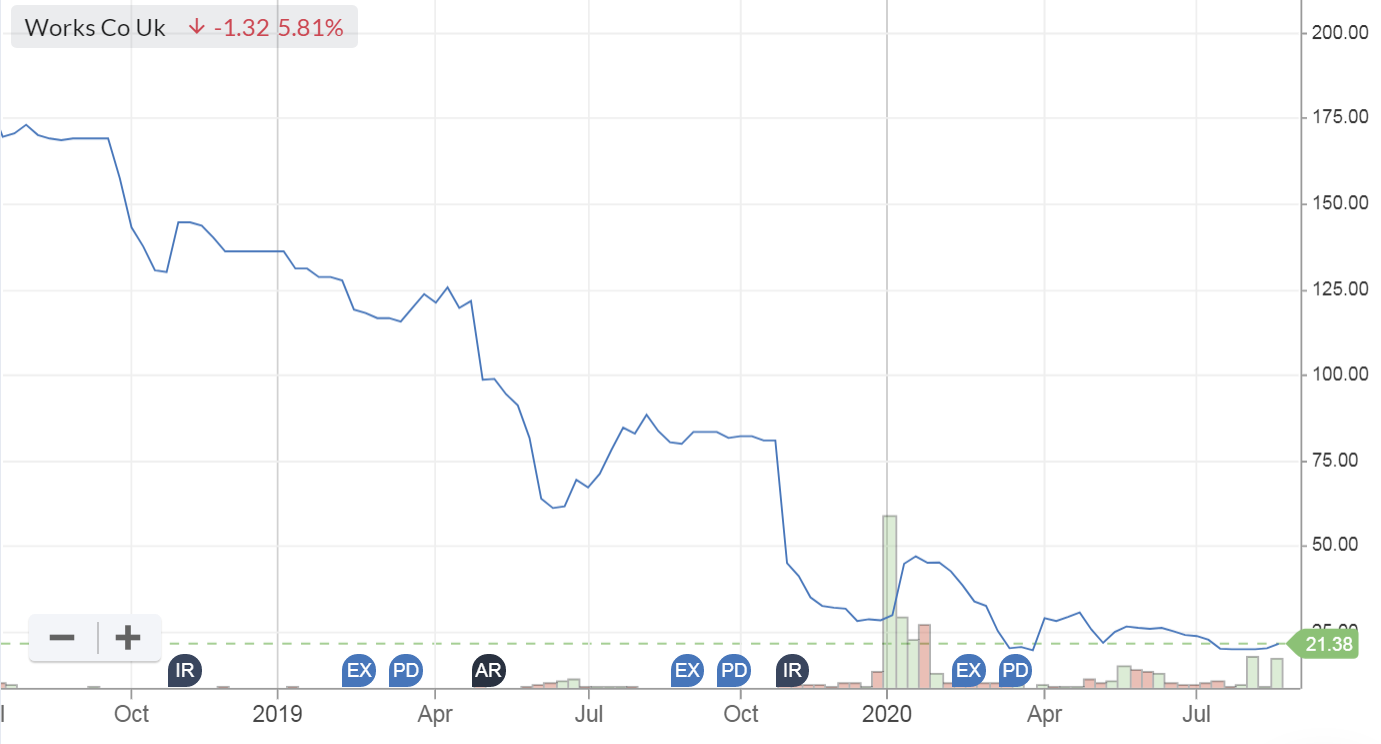
Works Co Uk (LON:WRKS)
Share price: 22p
No. shares: 62.5m
Market cap: £13.8m
(I'm long)
TheWorks.co.uk plc the multi-channel value retailer of gifts, arts, crafts, toys, books and stationery, announces today its preliminary results for the 52 weeks ended 26 April 2020 (the "Period" or "FY20").
I'll keep this brief, as the market cap is so small. These results came out yesterday, here are my notes on the key figures;
- FY 04/2020 adj EBITDA (a proxy for underlying cashflow in retail sector, before interest, tax & maintenance capex of course) looks quite good, at £10.8m (LY: £13.9m)
- Estimated profit impact of covid in March-April of £3m
- Large non-cash impairment charge of £19.5m, to write down goodwill and store fixed assets - doesn't really matter to me
- Adj basic EPS 3.0p vs 9.2p LY - not bad in the circumstances, in my view - at least it's still profitable on an underlying basis
- 37 new store openings, total now 534. Probably wishing they hadn't done this now - expect far fewer new store openings in future (although probably on cracking deals with landlords in future)
- Liquidity - £7.5m loan secured through CLBILS, and RCF extended to Sept 2022, so funding looks OK to me, and debt level modest & safe (since Govt guarantee, bank unlikely to get the jitters)
- Uncertainty = no guidance given - but see the going concern note for various scenarios.
.
Going Concern note - these are very enlightening, and I have to thank auditors generally for making companies include some very useful information in them. It's always worth doing a CTRL+F search of every results statement, searching for the term "Going concern", because that throws up these notes, which are easy to otherwise miss. Actually, I think the most important information in the RNS is in this going concern section!
WRKS outlines its base case, and reasonable worst case scenarios. Results are;
Under the Base Case scenario, the Group expects to have sufficient financial resources to continue to be viable and the Going Concern basis of preparation of the financial statements is appropriate.
Under the reasonable worst case scenario, things are tight, but manageable, "albeit with limited headroom". But more positively;
Actual trading results since the beginning of the FY21 financial year have been better than factored into the Base Case and RWC assumptions.
Overall then, this looks like things are financially tight, but no insolvency risk for the time being.
Longer term, I think the group might need to restructure, and raise more equity.
The going concern note ends with a material uncertainty conclusion, clearly this is a worry;
In light of this level of uncertainty over the duration and severity of any disruption, there are scenarios under which the Group could breach its EBITDA covenant, which represents a material uncertainty that may cast significant doubt on the Group's and the Company's ability to continue as a going concern.
Current trading - it says;
Sales from the online channel, during lockdown, and store sales since the end of lockdown, have been better than the Board's initial expectations. Despite this, there remains uncertainty, for example, over how long social distancing measures will be required to be in place and the possible effects on the level of consumer demand.
Peak trading at Xmas this year is very important;
The group's ability to meet the EBITDA covenant is heavily influenced by trading during the peak months of November and December.
Business rates relief is a huge benefit (so what happens if/when it ends?);
The Group will also benefit from approximately £13m of business rates relief between the beginning of lockdown and the end of FY21.
Furlough support from the taxpayer was £8m, again hugely significant.
Current trading (continued) - this does look encouraging, considering High Street footfall has been well down on prior year after re-opening;
LFL sales, 10 weeks after re-opening, to 23 August 2020: UP 0.7% - that's actually really good!
Most recent trading, LFL down "high single digits". This implies a burst of sales after re-opening, but settling down at a lower level now. Note that ATV (average transaction value) is up, but number of transactions is down. So fewer people spending, but basket size is larger.
In the circumstances, I think that's OK for now. The business rates holiday effectively funds a shortfall in sales of c.5-10% by my rough workings.
Online sales - no figures given, so this may or may not be significant. Obviously rose a lot during lockdown (over 3x LY), and is still running at 2x LY, even after stores re-opened.
Balance sheet - still solvent, but huge lease liabilities. That's not a problem if stores are trading profitably, but there must be a long tail of loss-making stores, given that the overall total is only very modest profitability.
My opinion - after going through the figures, this is riskier than I previously thought.
Judging by the large number of CVAs and pre-pack admins being undertaken at the moment by retailers & hospitality companies, I think this route is probably the only long-term option for WRKS too. It needs a step change in reduced property costs, and to jettison all those leases, some of which are bound to be uncompetitive now. Turnover rents are becoming the new normal for restructured companies, and companies which don't restructure in this way will basically be operating for the benefit of landlords in future. Where's the attraction in that, from our point of view as investors?
The good news is that the company is securely financed for the rest of this year, so no immediate panic. If it trades well over Xmas, then things could be looking up next year.
The product range strikes me as quite good, and good value, and I often make impulse purchases of books or greetings cards when passing by. The focus on kids & art/crafts is probably being boosted by schools being closed. A lot hinges on covid, second wave or not, etc.
This looks a fairly marginal business in the good times, so probably doesn't have much of a long term future in its current guise. On reflection, I think buying this share was probably a mistake. In future, I might sell into any rally (if there is one) later this year or early next year.
I'd like to maintain a toehold though, because if it announces a restructuring, and exits the leases, then I would want to buy more (something that Quiz (LON:QUIZ) did - I hold - which resets the cost base to a much lower level, and hence a decently profitable business should then emerge).
.
.
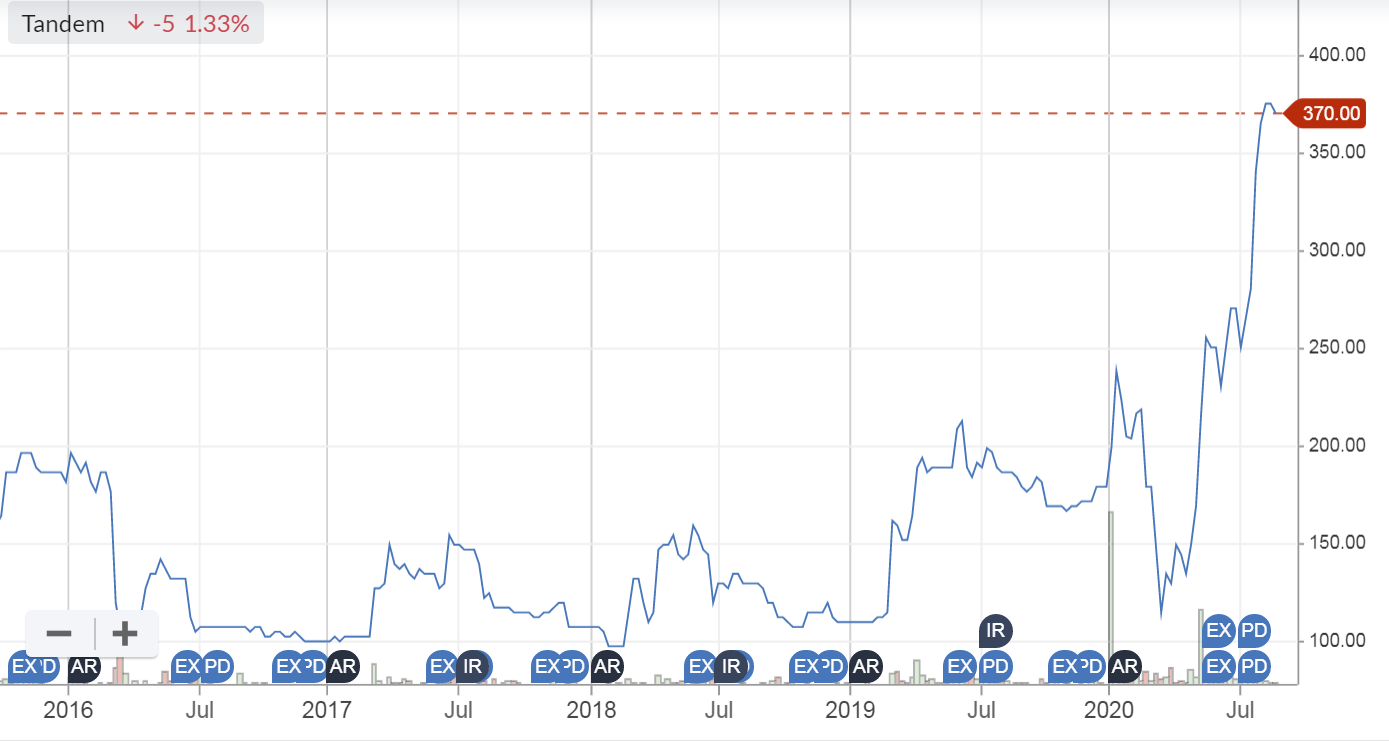
Tandem (LON:TND)
Share price: 385p (up 3% today, at 11:59)
No. shares: 5.03m
Market cap: £19.4m
Trading Update & Investor Meeting
The Board of Tandem Group plc (AIM: TND), designers, developers, distributors and retailers of sports, leisure and mobility equipment, announces a trading update and details for the forthcoming investor meeting.
H1 profits are up on last year;
As previously reported it has been a strong year for bicycles and outdoor products. Despite the reduction in FOB business, turnover and profit before and after tax for the 6 months to 30 June 2020 are expected to be ahead of the prior year.
Isn't it annoying when companies use jargon & abbreviations that they are familiar with, but others may not be? I remember from a former life importing from the Far East, that FOB means "Free On Board", but what is the significance of that in this context? Ideally, it's best not to use jargon/abbreviations, but if companies must do, then please provide an explanation in a footnote.
Other points;
- Supply chain under pressure - due to strong global demand for bikes, increased lead times
- Cautious buying from national chains
- Revenues fell below LY over the summer - lack of orders & limited supply
- Margins strong, and lower overheads
- "Difficult to confidently forecast" outcome for FY 12/2020 results
That all sounds a bit mixed.
Rather than suffering the vagaries of retailers, it sounds like Tandem should concentrate on selling direct to end customers via the web. Thus bagging both the distributor, and the retailer margins. It has lots of websites - here - so I'd be much more interested in this share, if it prioritised own website sales, and got in some digital markets wizards to aggressively grow that side of the business.
I bought a semi-circular parasol from its website, which is a terrific product. Checking its website here, out of 60 parasols, 56 are out of stock. Dear oh dear. Clearly they need a proper sort out of the eCommerce part of the business.
Both Graham and I have written previously about Tandem, so for more detail on the numbers, here is our archive of commentary.
Investor meeting - as previously announced in June.
This is a major breakthrough, as several investors have told me that, in the past, the company seemed at best off-hand, and at worst openly hostile towards its shareholders. There seems to have been a big shift in attitude, with the company now actively encouraging shareholder engagement, which is wonderful to see, well done to everyone involved.
Investor meeting
The Company announces that an investor meeting will be held at the Company's Birmingham offices on 22 September 2020 at 10am.
The day will include a presentation of the interim financial results, which will be released that morning, and strategy followed by a tour of showrooms where various products sold by the Group will be on display. There will also be an opportunity for investors to ask questions to the Board.
More detail on how to sign up for this - see the RNS.
As it's a slow day for news, let's have some fun by looking again at the outgoing Chairman, Mervyn Keene making a complete fool of himself in his outgoing remarks, in this corker of an RNS from Feb 2020. Just for your amusement, here is part of what he said again;
When I was appointed Non-Executive Chairman the share price was 110.5p. Today as I announce my intention to step down the price is 205p per share. Despite this, it is disappointing that internet posters, who often hide behind absurd pseudonyms, continue to type inaccurate statements and offensive remarks. There are an irritating few of these keyboard warriors who have no commercial experience but think that they could run the Group better.
If they're using an absurd pseudonym, then how come he knows they don't have any commercial experience? I can just imagine the broker saying to him, we really can't put this out, it's a very bad idea. No, I insist, I want to tell these keyboard warriors just what I think of them! Something like that probably happened, I guess, and it's amusing to imagine it.
The share price has nearly doubled again, since he announced his resignation, in a much shorter time than it previously took to double.
Should a listed company Chairman really be publishing stuff like that in an RNS? I very much doubt that shareholders miss Mr Keene.
I don't have any particular view on Tandem, so am neutral. I've held it in the past, but missed the big recent rise, so am not interested in chasing it now. It's got freehold property, but also a pension deficit, remember. If the eCommerce side of the business really started to fly, then I would take an interest here.
.
.
Macfarlane (LON:MACF)
Share price: 92.6p
No. shares: 157.8m
Market cap: £146.1m
This is a packaging manufacturing & distribution company, headquartered in Glasgow. Its website says it’s the UK’s largest.
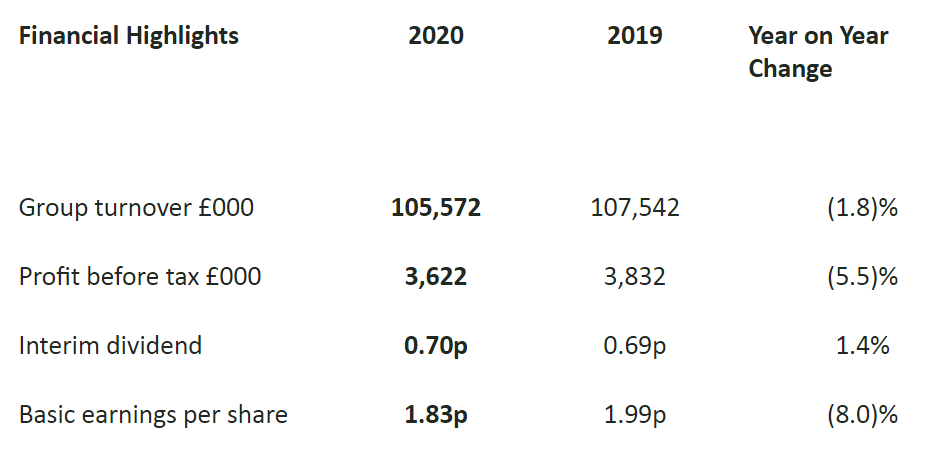
Considering we’ve been through such a turbulent period, these financial highlights look remarkably resilient, I’m impressed. Although the narrative mentions several acquisitions, and I can’t find the split of organic & acquired growth.
A good mix of customer sectors has helped (e.g. automotive down, eCommerce up).
.
.
No benefit from Govt support schemes, as these have since been repaid (I’m not saying anything!)
Net debt – interesting comments here, and great disclosure that the unusually low net debt at 30 June is explained;
Net bank debt at 30 June 2020 was £0.8m, £11.9m below its 31 December 2019 level of £12.7m. The improved cash position has been achieved through active management of working capital and reductions in the cost base. The net debt of £0.8m has benefited by £5.4m from the various government support and deferral programmes, all of which we have repaid since 30 June 2020.
The Group is operating well within its existing bank facility of £30.0m. We expect to pay an estimated £0.8m in deferred consideration, in the second half of 2020, relating to the acquisition of Ecopac in 2019 .
Dividends – previously the 2019 final divi was held back. Now resuming divis, paying a 0.7p interim divi.
Outlook – uncertainty mentioned, as practically all companies are saying at the moment, but this sounds reassuring;
Our future performance is largely dependent on our own efforts to grow sales, increase efficiencies and bring high quality acquisitions into the Group. Whilst we have experienced significant challenges from the Covid-19 pandemic and there are still uncertainties ahead, our strategy and business model have proved resilient and robust. We expect to deliver a solid sales and profit performance in 2020 and are well positioned to benefit as the economy recovers.
Looking at last year’s figures, it seems as if there might be an H2 bias to profitability.
It’s seen steadily rising EPS in recent years. 2020 could see a small step back maybe, but I would say c.6p looks about the right level to base valuation on. Hence at a PER of just over 15, it looks priced about right.
Balance sheet – looks OK overall. NTAV is only £9.7m, not brilliant, but not a concern either due to reliable profits generated over a very tough period. Therefore I can’t imagine the bank would have any worries about its exposure to MACF.
Cashflow statement – note the large depreciation charge. When that’s added back, the business looks highly cash generative both this year and last year. Remember that it repaid Govt support measures after 30 June 2020, so net debt will have risen post period end. Not a problem, I’m just flagging it.
Going concern – there’s just a short note to say everything is fine. Generally speaking, the longer the going concern note, the more of a concern it is!
Pension scheme – although the accounting deficit is small, the cashflow statement shows what seem to be deficit recovery payments of about £3m p.a., if I’m reading that correctly. In which case, the pension scheme is quite a significant thing. Remember that deficit recovery payments are real cash going out, which could otherwise have been paid out as dividends. So the valuation might need to come down, to take into account this long term liability. Especially as low interest rates make the liabilities grow in how they are accounted for. I’m flagging this as something for people to investigate yourselves, if you’re thinking of buying the shares, because it’s material to the valuation of the shares.
My opinion – this look a good business. Shares look priced about right, hence it doesn’t really interest me as a potential investment. There’s always going to be competition in supplying packaging, which limits growth and margins. Still, it seems well managed, and could continue growing by acquisition. If smaller competitors can be picked up the cheap, and efficiencies/cost savings made, then it might make a nice acquisition-based investment, maybe? It would be interesting to meet management, or see them present online.
Towards the end of a bull market, fairly staid companies like this can get very cheap, as the money is sucked into high growth, tech companies – exactly what happened in 1998-2000. Hence I don’t particularly want to pay a PER of 15 for a company with only modest growth prospects, as it could get cheaper.
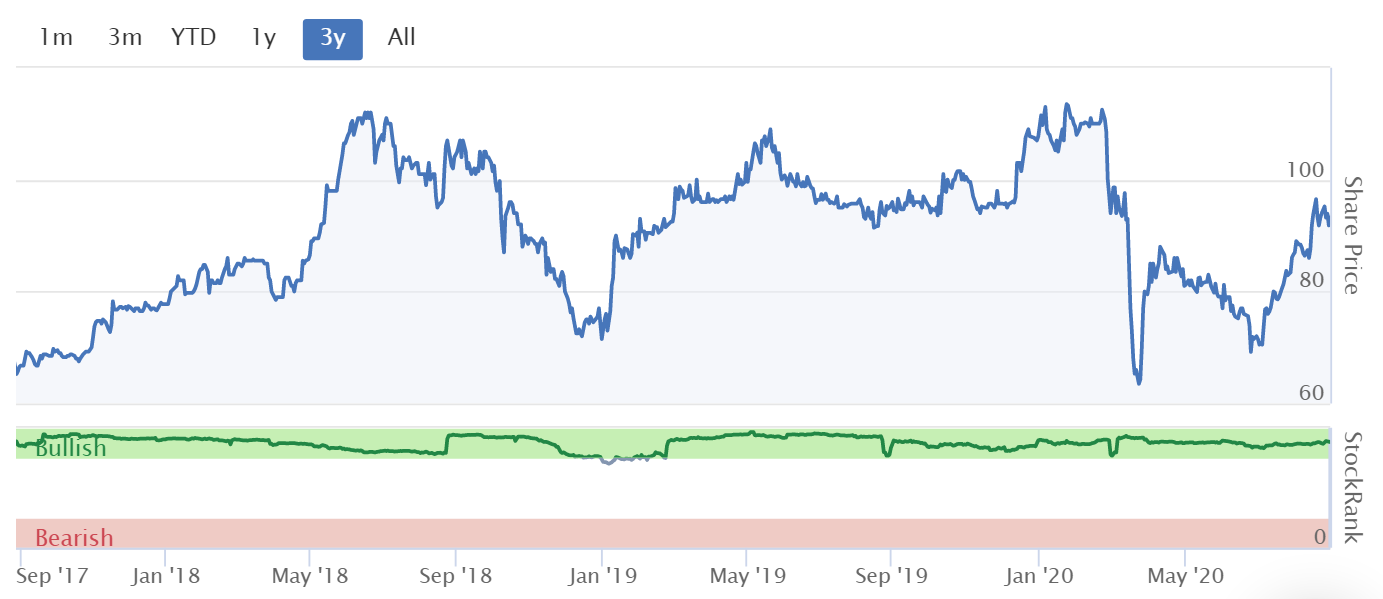
Note the sideways chart trend over the last 3 years, and consistently very strong StockRank;
.
.
All done for today, and the week! I hope you enjoy the long weekend.
Best wishes, Paul.
Disclaimer
This is not financial advice. Our content is intended to be used and must be used for information and education purposes only. Please read our disclaimer and terms and conditions to understand our obligations.

54 comments
Fresh accusations against Boohoo (LON:BOO) on working conditions, factories and pay being only £3.
Not sure these are fresh 'allegations'. Feels like slightly re-heated concerns expressed already about some aspects of the Supply chain.
Can anyone shed any light on the missing metrics for City Pub Group?
What do you do if you are a 30 something looking to save and invest for the future. Expected ten year returns on most asset classes are negative.
Bitcoin is the only investment that makes any sense to them in terms of asymetric and expected return and is the millenial equivalent of folk buying bonds and property in the 70's.
not really. You can live in a house and not pay rent. You can't live in a bitcoin.
"I've just been told by the office that the tech glitches should now be resolved. Apologies for any inconvenience."
Might just be me but Fantasy Funds don't seem to be working??
Neither are the thumbs up/down on the old site
ALWAYS!
John Authors of Bloomberg has an excellent write up today on the Fed policy speech & some pretty amazing graphs showing how 'odd' this period is.
the link for his email is below
http://link.mail.bloombergbusiness.com/join/4wm/opinion-authers-signup?source=article
There is actually a lot of evidence that the Fed can control inflation and it's not hard to find. There's no real debate about that other than on the crank extremes. With the high frequency data and tools they have available now, they could control average inflation at 2% for as long as they wanted to. Of course they can't control it month by month, but over the medium term: no problem. There is really no inflationary or deflationary impulse too big for them to be able to deal with.
The bigger issues are that (1) you can't control inflation without affecting something else e.g. growth, and (2) you have to have the freedom to do it. Central Bank independence is a fragile and recent phenomenon. In the UK, we've only had it for 23 years. It can be taken away by the politicians at any time. Trump has already tried to push the Fed around and I wouldn't be surprised to see him go further if he is elected.
It should also be remembered that the Fed has a dual mandate: maximum employment and stable prices. Since the monetarism of 1980s, the objective of stable prices has taken precedence. The balance of priorities might change, as might the targets. There is nothing sacred about 2% inflation. They might decide 4% is better. They may also switch to someting like "nominal GDP targeting" in which there is no inflation target.
For now we continue to live in a deflationary world. The developed world has been turning Japanese for the last 30 years and will continue to do so. Central banks will continue fighting deflationary pressure with inflationary policy. The only thing that will change that is if there is a real shortage of something (energy, food, labour ...) and the most likely way for that to happen is war or some other devastation, so let's hope it doesn't happen.
For now, there is no significant inflationary threat. Merely having lots of money around doesn't cause inflation. You have to have people willing and able to spend it on scarce goods to move prices. This is all so reminiscent of 2009. Back then you saw all the same talk of the 1970s and hyperinflation. It was never going to happen then and unless the current regime changes, it isn't going to happen now.
Could you provide the evidence that it can control inflation? What they are doping here is signalling that rates will stay low even if inflation temporarily rises above 2%. This is full on financial repression - keeping nominal interest rates below the rate of inflation. This forces savers into riskier assets to find a yield. But even there the Fed has pushed down yields by buying High Yield bonds. Thats why the stock exchange is rising. Better to own Apple shares than hold cash.
Evidence of the Fed and inflation/deflation can be found in Friedman and Schwartz's monetary history of the US. If you don't want to wade through the detail of history, just look at the big picture of recent years.
Over the last 20 years, US inflation has averaged close to the target of 2% despite severe inflationary pressure (e.g. oil at its most expensive ever in both nominal and real terms) and severe deflationary pressure (the great recession). How has that happened if the Fed has no control? Just by chance? Why has inflation averaged at 2% and not -30% or +240%?
If that's a fluke, then what about the UK? It has also averaged close to its 2% target but has a different currency, interest rates, money supply, unemployment rate etc. so inflation in the UK is a separate question to the US. If that's a fluke then what about all the other countries that have adopted inflation targeting? Since New Zealand in 1990, almost every developed and emerging economy has adopted inflation targeting because they've looked at the evidence and seen it works. The evidence shows lower volatility of inflation in those countries adopting inflation targeting, and other effects that would be unlikely to happen if the central banks had no control.
As I said above, they don't have complete control over inflation and can't impact it without impacting something else, but there is strong evidence that they can control it and have become better at doing so over the last few decades.
I agree that they are now signalling lower real rates, but that's what the economy requires. To move forward, the economy requires higher investment in real capital, such as infrastructure, factories, software, branding or whatever. Who would take the risk on those investments when they can earn a nice return on a risk free investment instead? Yes real interest rates are negative, which is bad news for savers like me, but no one is entitled to a positive return on any financial asset and they never were.
The other reason why the Fed may be keen on a bit of inflation is that it is a convenient way to shrink government debt in real terms. Deflation would effectively make it bigger!
Many government bonds are inflation linked so the case isn't clear cut.
No they're not. New issuance is almost always fixed rate.
Is 28% many?
https://assets.kpmg/content/da...
I'm not knowledgeable on govt bonds but I would imagine that it is only the interest payments that are inflation linked? Not the capital? So a period of inflation would reduce the value of the capital to be repaid in real terms. Of course, in the strange world we currently occupy the government would more than likely just issue more debt to pay off the expiring debt - so I suppose the real value of the debt is irrelevant. How can any of this make sense - seems so bizarre.
"I'm not knowledgeable on govt bonds but I would imagine that it is only the interest payments that are inflation linked? Not the capital?"
No, both the interest payments and the capital of index-linked gilts are inflation linked, according to this UK government website:
https://www.dmo.gov.uk/data/gilt-market/index-linked-gilts/
"Index-linked gilts differ from conventional gilts in that both the semi-annual coupon payments and the principal payment are adjusted in line with movements in the General Index of Retail Prices in the UK (also known as the RPI). "
Wow. Thanks for explaining that. Live and learn!
They may be keen on it but the are designed to control (i.e. reduce) it. They have no tools to increase inflation whatsoever.
Morses Club (LON:MCL) deferred its results yesterday without explanation and fell sharply. Poor shareholder relations. Is there any comment elsewhere that explains the reasons?
I hold too. It is probably nothing more ominous than the Covid impact on hard pressed accounting departments and many other companies are deferring too. Let's hope so.
If so, they should have said so rather than just giving a date for a trading update.
Creightons (LON:CRL) deferred by a week on Tuesday when results including presentations due Wednesday only stated auditors signing off
I do not hold anymore
Could it be due to RNS 14/8/20 : Artemis disposes shares, circa 1.7mn shares from my caln.
Possible overhang? I took a look at the daily volume levels for Morses Club (LON:MCL) - hard to say but 187k volume can move SP from 64p to 56p. Unlikely.
In any case, SP action yesterday was indeed peculiar.
I guess there were also quite a few potential buyers inspired from Provident Financial (LON:PFG), as I noticed SP up for International Personal Finance (LON:IPF) on same day Provident Financial (LON:PFG) was rock n rolling.
Morses Club (LON:MCL) volumes below
"Understanding conventional economics is actually a hindrance at the moment. The people making money from the stock market seem to be the least knowledgeable. Just buy a fancy tech stock, and watch it go up almost every day, and ignore valuation completely! We've been wasting our time doing analysis of fundamentals."
I have sympathy with you Paul but isn't this just a sign things are changing? The internet IS becoming more influential, your Boohoo and Sos picks certainly support that. Capitalism finds opportunity and we as investors provide funds for this. Backing the "old"cashflows isn't always going to be the way forward, otherwise it is just groundhog day. So I don't necessarily agree it is the " least knowledgeable" making money.
Yeah, I'm sure they were saying the same in the dotcom crash.
My point was actually about valuation of growth companies. People ignoring valuation completely, are making money (for now).
Nobody I am sure would dispute the fact that the internet has changed a lot of things.
(I am not an economist)
On inflation, it seems to me that there needs to be
1- a combination of a sudden change in the real world price of something the world needs a lot (e.g. someone doubles the price of oil)
2- then followed by a change in people's expectation of what inflation will be in future
The most likely thing (imo) that may suddenly change in price is the price of money. At some point someone will raise interest rates. If that is just from 0.25% to 0.75%, it is 3x what it was. There will be businesses that depended on low rates and so will pass the costs on or fail. This could trigger an inflationary cycle.
Looking at the FTSE and the FTAS
we are just below the mid range for the last year.
If you strip out the FAANG / tech stocks I suspect the US indices would look similar.
I do not see a structural collapse. I hold stocks pe 10-15 - and there are a lot out there.
Some valuations are indeed nuts. I thought the price of AMZN was too high in '15 and sold up.
Now i read that AMZN's parcel network is heading towards the same scale as the USPS.
The prices of such stocks expect that level of growth. Which is not sustainable. As Alexander the great did not say "there are no more worlds to conquer"
That is not to say there will not be a correction (in the UK) for other reasons. If the brexit deal is one that has the effect of significantly increasing the cost of doing business with the EU, or reducing trade volume, the UK economy will be hit in he short term at least and that will be reflected in equity prices.
Never mind the other more obvious drivers (war, famine, disease)
How about helicopter money direct from central banks to the general population in the form of universal basic grants/income? Even as a temporary measure at first to determine impact. At least if it's coming from the central bank, it doesn't increase the government deficit. Or is that too radical? Jeez, and all this time i thought I was an ultra-capitalist!
Lots of interesting comments from the 70's. I also started work in '71 and to me it seemed clear buying the family house was the only reliable way to acquire capital. Remember mortgage interest was chargeable against tax. As interest rates and taxes were sky high this was a big benefit. On the other hand investment income was heavily taxed, frankly making investment an irrational activity unless one was a pension fund, and even they suffered serious friction in the shape of 2% stamp duty. As the workers took over the broke Triumph motorcycle factory it really did feel like capitalism was dying in the UK.
Price comparison websites deflationary. Move from high street retailers to online retail deflationary. Money printing and QE inflationary if we are the Weimar Republic but not so if we are Japan. USA a special case because US dollar is reserve currency but may be it won’t be for long. The kids aren’t saving or spending because they are busy paying off their debts, in many cases from very low worth degrees, so deflationary there. Does anyone remember “Education, Education, Education”. Was supposed to be the route to a highly skilled work force that would drive up productivity and save the economy but it hasn’t worked out that way. Climate change may be inflationary if there are carbon taxes or low carbon energy costs us more than fossil fuel energy.
Far too many ifs, buts and maybes to say anything with any certainty. Economists don’t seem to be able to predict GDP, inflation etc. with much accuracy even a short way into the future even in normal times. So, I give any economic predictions a B grade, adjusted down to an E as per Ofqual guidance for their poor historical track record.
Meanwhile in small cap land I see that the long suffering shareholders of Modern Water (LON:MWG) are now to be part of Integumen (LON:SKIN) in an all equity offer. Probably a good thing as they weren’t going anywhere much otherwise.
Excellent post Paul, a good read on a par with the Bournemouth Beer chronicles :)
An important factor for keeping inflation in check should be the productivity of the country, i.e. is the supply of goods and services keeping pace with the supply of money.
Considering the possible after-shock from Covid, with a high umber of redundancies and businesses closing, there is a possibility that productivity in the US will decline, although this effect may be felt less by the behemoths of the Nasdaq, some of whom have benefitted from covid. I haven't checked the figures, but I believe the US has started adding large numbers of jobs again, a good sign.
Big money with low productivity = Zimbabwe.
Inflation possible but so is deflation, e.g. Japan. Japan runs fiscal deficits every year, was heavy on QE and even bought stocks with govt money. But because of an aging and declining population combined with no supply side constraints on goods due to globalisation, no inflation to be seen here.
We don't know what will happen here in the UK as the economy is a real time experiment, but somewhere the piper has to be paid. You cannot increase the general public's living standards for free.
The rebalance must come through goods and/or asset inflation (reduces the QE cash back to true value) debt default and recession (takes money back out of the system) currency devaluation (poorer relative to the world).
It could be any scenario or a combination. Interesting to see how this plays out.
Paul I saw the speech too. What he was saying is that we need to move away from anchoring our fear of inflation in the 1970s. I started work in 1974 and can remember 26% at one point. This was due to the Barber boom when he lost control of the money supply exacerbated by the quadrupling of oil prices. The big problem now is the risk of deflation with so much idle capacity - plant and people - around the world and the general downward impact that technology has on costs. The targeting of a higher inflation level is a good thing but how is it achieved in and environment when most major economies will have 10% or more unemployment? Reducing the latter seems to me the explicit reason for the change in inflation target.
Excellent, thought-provoking initial analysis - many thanks,
When it comes to inflation, remember more and more of both business and consumer spending is on subscription services. For normal goods, prices increase as demand increases. For subscription services, the cost of provision per user actually declines as demand increases. I think it will be incredibly difficult for central banks to force through materially higher inflation, as subscriptions/SAAS continue to take up a larger portion of The economy.
If you have a chance could you look at Frontier Developments (LON:FDEV), it feels to me like it may be ready to make a big breakout and has made significant announcements today on new launches, third party publishing and trading outlook
Enjoyed that preamble, thanks.
“Just driven up asset prices”.
So it has caused inflation, they (central banks) have just chosen not to measure it,
My thoughts exactly
and all the while there seems to be a belief that because a hard BREXIT is in no one's interests - it won't happen.
The drag for UK stocks from US markets might quickly dissipate if there's no deal.
Technology and globalisation are big anti-inflationary forces, but the biggest of them all is demographics. Baby boomers are now between 55-75, and are thus moving rapidly from being earners to being retired. Anyone in that age bracket know that on average, you spend much less. When an increasingly large percentage of the population no longer works and doesn't spend a huge deal, inflation may be hard to create. I increasingly believe inflation is, in almost every normal country, a demographic phenomenon.
Hi Paul,
interesting comments and one id add is where the Fed leads they all will follow, is there any western government, apart from the one white washed from existence by all media, Sweden, that has no choice but to run hot on inflation. Any fixed income in portfolios needs to be watched carefully, Bonds, PIBS.
An anecdote from the 70’s to highlight a different experience to your grandparents would be my dad, newly qualified teacher who had just bought his first house on a big mortgage, suffered of course with the rising prices but his memory is the 20% pay rises each year as a gov employee & the huge reduction of mortgage interest relative to income & value of his house, once inflation was tamed. Im not suggesting property is the hedge, or maybe it is, at least part of the solution in a diversified portfolio.
My house, like job redundancy entitlement isn't money in the bank. Paying for a home of your own is just one part of the cost of living and should not be seen as something to be bartered. I know of people who buy a cheap house, do it up while living in it, sell and repeat the process all the while escaping capital gains tax but that is an alternative way of life. My house was bought in the late sixties and suffered the ever rising mortgage interest costs as did your dad John, and I had an endowment mortgage so nothing was taken off the original loan much to my chagrin. In fact, I was only able to take part in Thatchers Privatisations as a first step to invest in equities after I had paid the mortgage off (and given up smoking).
Silver
Hi Silver moon,
Im more talking about property in your portfolio, and more REITS than some dubious M&G property fund, than your own home. Extrapolating that further in this current climate diversification is ever more important & that includes cash. Even though every institution will want you to invest it because its being ‘destroyed by inflation’ when a proper recession comes, and early 2021 id say, things will be on sale, maybe not shares but certainly a new boat if you consider that an investment.
Either way, diversification with some in property investment (again REITS before comments come about B2l). Long term, in a SIPP, zero interest rates, mkts flooded with money & threat of inflation, property looks a very attractive long term bet. And they are all bets at the end of the day.
Interesting insight thanks guys. I sit on the other side. I believe that property is a geared play on interest rates. Of course all assets are but property in particular because the layman can understand it easily and raise a mortgage. As Paul explained there have been spikes in interest rates over the period but the general direction has always been down. I don't believe the baby boom generation argument because there is always another demand group, in this case the rising middle class in China who far exceed baby boomers in number. So property has been a doddle to make money in for 3 decades I think the likes of Intu have found out that has changed. You cannot just raise huge amounts of debt and see your asset price rise (unless you are going to accept large amounts of nefarious money from Russia/China etc). I have got much further with this like where is a good place but I suspect commodities are going to start hitting the headlines. The wheat crop has been hit hard by global warming this year, I suspect that will add inflation.
I was starting an accountancy practice in the early 70's. Clients were buying houses with eye watering mortgages that I would not envisaged taking on myself. They finished up living in very expensive houses with easily repayable mortgages!
Some people get lucky with their timing. Others who did that at somewhat later stage in the property cycle ended up living with their parents again. How much is financial security worth and can one stomach the consequences if the market moves against you?
I started proper work in 1974 and there is some rose tinted glasses there. Your dad may also remember the actions taken to reduce inflation - 3m unemployed and mortgage rates of 17%. House prices did not go up by much and it was tough. His big mortgage was probably 3 times salary.
Hi khb1953,
I’m not commenting on the issues of the day and no rose coloured bifocals but he started out with a mortgage of 3 x salary and ended up with a much smaller relative mortgage to his salary.
The main point really, and to Paul's comments, is to apply this to government thinking, good inflation for governments is about 5% as over 10 year it reduces their relative debt by enormous amounts. Can they control inflation, probably not, do they have a choice to raise interest rates and not let inflation run hot. No way, no way is the UK , US or anyone going to raise taxes to pay off, or grow their way out of, this debt mountain.
The Fed effectively said this yesterday. The Fed have a mortgage 10 x salary and they are not getting any 20% pay rises any time soon!
My morning smallcap tweet: Patronising script at Hostel
Ceps (LON:CEPS) Blackbird (LON:BIRD) Hostelworld (LON:HSW) Tandem (LON:TND) Amigo Holdings (LON:AMGO)
CEPS (CEPS) director makes another unsecured loan, £100k, at nil interest and no repayment date to keep the lights on. [SP=24 Cap=4m]
Blackbird (BIRD) has partnered with Tata Communications, to launch its cloud-based video editing services for live video to the media & sports industry. It follows a multi-year order from Tata. [SP=16.7 Cap=56m]
Hostelworld (HSW) to make a script dividend or 'a bonus issue' instead of cash of €0.01. How patronising. [SP=62.7 Cap=72m]
Tandem (TND) guides H1 rev and pretax up YoY. "The supply chain, particularly for bicycles, remains under pressure with strong global demand on suppliers and increased lead times. In addition, national retailers continue to be cautious in their buying decisions. As anticipated, Group revenue fell behind the prior year during the summer period as a result of the lack of national retailer FOB orders and a limited supply of bicycles. However, margin from domestic business has remained strong." No FY guidance. [SP=367.8 Cap=19m]
Amigo (AMGO) Q1 rev down 32%, adj EPS 0.8p (4.3p). Complaints provision broadly unchanged at £116.4m. AT last on track to meet complaint backlog handling deadline imposed by FCA. "We are preparing to restart lending on a prudent basis by the end of 2020. However, until we do so, and until we have more clarity on the financial impact of Covid-19, the Board considers it too early to issue guidance." [SP=12 Cap=57m]
Just to mention a major spat at £amgo - announcement slipped out at 6.19pm last night:
“The Company has received formal notice from Richmond Group Limited requisitioning a general meeting of the Company's shareholders (the "Requisition Notice"). The Requisition Notice proposes resolutions to appoint James Benamor as a director of Amigo and remove each of Nayan Kisnadwala, Roger Lovering and Glen Crawford as directors of Amigo.”
I trust that they are not amigos :(