Small Cap Value Report (Fri 3 Mar 2023) - FNX, CPI, NEX

Good morning! It's just Paul here today, with plenty on the agenda from catch-up items from earlier this week.
Mystery shares in this weekend's (5 March) podcast are -
ME International (LON:MEGP) - see Wednesday's report. I'm really impressed with performance, and the future looks bright, with higher margins from raising prices, and the fast-growing laundry division is catching up with the core business, so it's no longer a one-trick pony. Shares have risen a lot of late, so it may need to consolidate, but valuation still looks good value, and I like the longer term outlook.
National Express (LON:NEX) - briefly covered in Friday's report. I think this looks a good recovery share, but need to do more work on it.
Capita (LON:CPI) - also briefly covered in Friday's report. Strong recovery in earnings, and previous concerns about excessive debt have now been fixed. Could be interesting, but again, I need to do more work on it, so more than ever, please make sure you DYOR.
Explanatory notes -
A quick reminder that we don’t recommend any stocks. We aim to review trading updates & results of the day and offer our opinions on them as possible candidates for further research if they interest you. Our opinions will sometimes turn out to be right, and sometimes wrong, because it's anybody's guess what direction market sentiment will take & nobody can predict the future with certainty. We are analysing the company fundamentals, not trying to predict market sentiment.
We stick to companies that have issued news on the day, with market caps up to about £700m. We avoid the smallest, and most speculative companies, and also avoid a few specialist sectors (e.g. natural resources, pharma/biotech).
A key assumption is that readers DYOR (do your own research), and make your own investment decisions. Reader comments are welcomed - please be civil, rational, and include the company name/ticker, otherwise people won't necessarily know what company you are referring to.
.
Paul’s Section:
National Express (LON:NEX)
139p (rose strongly yesterday)
Market cap £856m
I should emphasise that this is the first time I’ve looked at this international bus & rail operator. That’s because it’s been too big for the SCVRs here, but it’s near all time lows currently, and I’ve increased my upper limit to c.£1bn mkt cap.
I went through the FY 12/2022 results statement last night, but this was only a quick initial review, on a large and complex group, so please bear that in mind when reading this section - I’m not claiming to properly understand the group yet.
Key points (not comprehensive) -
UK operations returned to profit.
Dividend reinstated, at a fairly good 5.0p - indicating to me that financial health and debt are probably not a problem.
Underlying EPS 15.0p (seems ahead of 13.4p forecast), up from barely breakeven in 2021.
Covenant net debt £986m (2.8x EBITDA, so still quite high, but reduced from 3.6x)
Non-cash goodwill impairment charge of £261m - doesn’t matter to me, as I write-off all goodwill anyway.
Fuel 100% hedged for 2023, and 56% for 2024. Help or hindrance, now fuel costs are lower?
Q1 2022 was impacted by Omicron virus, but since then trading has recovered strongly.
Has negotiated price rises, to recover cost increases.
Outlook - 2023 expectations unchanged. Momentum continuing.
** This bit really made me sit up & take note. Cumulative (not clear what the starting point is though) free cashflow of £1.25bn expected by 2027. That’s considerably more than the market cap, so could mean the equity is too cheap? **
Covid support on costs & revenues was still big in 2022, at £132m (2021: £227m), so I’m not sure how trading will stand up in future without Govt support? But customers returning should presumably at least offset this? Needs more work.
Pensions - not big, £7.4m pa deficit recovery payments.
Debt facilities are a mixture of bonds, RCF, and leases.
Balance sheet overall looks weak, with negative NTAV of £(200)m - not a disaster by any means though, and large cash generative businesses can usually operate fine with balance sheets weaker than I’m accustomed to in the small caps world.
W.Midlands bus drivers have just gone on strike, not sure how material that is to the group?
If you look at the chart below, it’s clear that there could be recovery potential, as we hopefully normalise to a post-covid world. Note that the share count has risen from 513m to 614m over this period, but that still leaves plenty of upside in the share price, if valuation returns to pre-covid levels. Or will some investors be put off investing in transport shares at all, worrying about the risk from any future pandemics?
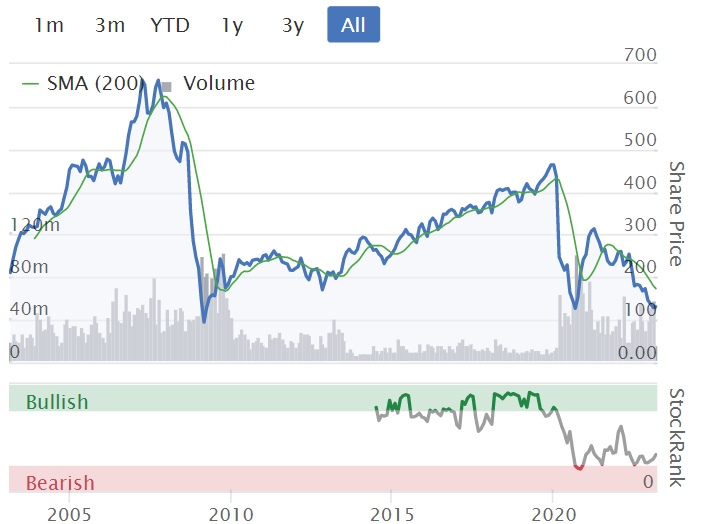
My opinion - I’ve only just started researching NEX, so my opinion is currently only on flimsy foundations. Notwithstanding that, I’ve seen enough to make me lean towards an initially positive view for this share, as a recovery trade (rather than something I’d want to hold forever). I’ll do more work on it in the future. What do readers think? I see Boon and Edmund Shing have both mentioned it in our discussion archive here.
Low StockRank, so that's a warning for us to be careful, or avoid it.
Disclaimer
This is not financial advice. Our content is intended to be used and must be used for information and education purposes only. Please read our disclaimer and terms and conditions to understand our obligations.

81 comments
Capita CPI is the ghastliest British company with which I have had the displeasure to deal. It is a monopoly unable to produce consistent earnings, nor shareholder value nor indeed satisafaction for any account. A classic exaple of failed British capitalism at its worst. Get thee gone o foul demon.
I'm no expert, but have researched extensively into this stock, including speaking to a few direct employees (albeit not at a level that I would class as "insiders").
This has a high insider and institutional ownership (about 95%), low daily trading volume and shorts currently borrow at least 2.5%.
The last institutional sell was in May 22 and the price at that time was around the £2.40 range. Since then the price has been halved and only just started to recover after Thursday's results. It appears to me that the drop has been caused largely by the shorts cleverly manipulating this down whilst 95% of the stock has remained unmoved.
I'm not sure if shorts still see money to be made here, but those results suggest this is undervalued to me and there's the added variable that in January Bloomberg said this was one of the top 10 most likely take over targets (again this could be a reason for the price being driven down, to make an offer seem more generous).
I'd be happy to be corrected by those who know more, but just thought I'd share my view from the research I've done.
Hi EdwinMoney,
I've being trying to guess which stock you're talking about! From deduction, I think it must be £NEX ?
Please can people try to remember to always put in the company name or ticker into every comment, because it's not obvious for some readers, depending on which layout you're using.
So whenever you find yourself typing "This company", or "this share...", etc, try to remember to replace that with the company name, before publishing your comment.
Thanks!
Paul.
Sorry you're right it was £nex I was referring to. Just replying to the original article so hadn't realised it would cause confusion. Thanks for the tip.
And remember stocko doesn't use £ anymore when tagging companies. Use @ instead.
Whoops. Not s good start at all. National Express (LON:NEX) sorry
Interesting cover on National Express. My wife and I travelled by them for a flight from Heathrow, travelling from Leicester. Coaches both ways were full which I think is possibly due to them capitalising on the rail strikes. I have to say that I was impressed with the service, much cheaper than rail or driving and parking. One to watch as I will definitely be using them again, might be a turnaround if they can provide a reliable and competitive service and fill coaches?
Hi GeeBee,
Yes I agree, I also use Nat Exp coaches when I fly from Gatwick or Heathrow. The service from Bournemouth really is excellent, and round the clock. It's pretty comfortable too, with a plug socket handy for charging phones, and allegedly they have WiFi, although I've never managed to get it working! Comfortable & quiet, and even with a decent loo at the back.
As you say, it's much cheaper and easier than driving up, and paying extortionate parking charges.
I hadn't realised that NEX also has so much international operations. I must listen to the recent results webinar, that's on my to do list for today!
Regards, Paul.
How did your further @nex research go Paul?
Happy the MC has been raised to £1b. This brings in the likes of Currys (LON:CURY) - a recent contributor said "could we do without this company" as a consideration. For me the choice, finance options, physical stores (AO World not comparable) it would be a sad day if this goes under. The only place to see a laptop, camera, TV etc in the flesh and may see something didn't know existed online.
Revenue has been consistent even through covid but went from good profit to bad loss in 2019, and debt went through the roof thereafter.
Maybe another pension fund with a company attached. No accountant so leave that to you chaps if interested.
I think Currys (LON:CURY) is getting its s--t together, better salesperson training perhaps but I have found it hard to go to just have a look-around inside without coming away with the most suitable thing for me.
I avoid Currys (LON:CURY) like the plague.
What are the factors that create this opinion if I may ask please Rusty2?
He's not a fan of spice
Agreed
Why does that response make too much sense? Lol
Past experience. Bad service, salesstaff who are clueless. Checking recent reviews seems things have not change. There are other shops to use, for TVs you can go to Argos, for expensive TVs then an audiovisual dealer woukd probably be better if you have one in your area. For computers I would use online.
I like spice, prefer Thai to Indian curries.
For purchases I like to visit to do some window shopping but usually revert to online thereafter.
Chart looks promising though…. If it can break above 87p, I’d consider a trade here on a retest and hold of that price point.
NB Global Monthly Income Fund (LON:NBMI) is having a compulsory partial redemption. I have never encountered this before:
NB Global Monthly Income Fund Ltd - Compulsory Partial Redemption
What is happening?
Further to our previous correspondence, NB Global Monthly Income Fund Ltd is undergoing a Compulsory Partial Redemption whereby holders as at the close of business on Monday 13 March 2023 are due to have approximately 19.49% of their shareholding redeemed, resulting in a payment of approximately 81p per share redeemed.
Please note that trading will be temporarily suspended from the close of business on Monday 13 March 2023 as a result of the Compulsory Partial Redemption but the new shares will be available for trading again from Tuesday 14 March 2023.
The redemption proceeds are due within 14 working days of the redemption date. Once the proceeds have been credited to your account, you will be sent confirmation.
NB Global Monthly Income Fund Ltd will return capital to shareholders predominantly by way of compulsory redemption of shares, until the net asset value of the shares decreases to a point where the directors consider it will be appropriate to place the company in to voluntary liquidation. We will contact you when further information about this becomes available.
The current buy price seems to be below the redemption price.
There are two threads running on Lemon Fool website regarding the wind down of NB Global Monthly Income Fund (LON:NBMI) which may be of interest.
One is in the Gilts and Bonds folder in thread “NBMI Proposed Managed Wind - Down”
https://www.lemonfool.co.uk/vi...
The other is in the Investment Trusts and Unit Trusts folder in thread “NBMI - NB Monthly Global Income Fund”
https://www.lemonfool.co.uk/vi...
I would find it really useful if Stockopedia provided a tool to analyse my historic trading, so that I could see more clearly how good my decision making has been and identify systematic problems. For example, what difference would it have made if I had delayed each trade by (n) days?
This would be the stuff of nightmares so no thanks :-(
Just seen this about De La Rue
https://news.sky.com/story/de-...
Well spotted, thanks! I've been wavering on De La Rue (LON:DLAR) (it's on the "speculative" tab on my 2023 watchlist spreadsheet here). I might ditch it, given this concerning news.
Thank you Paul for covering the National Express . I have followed the company for a long time and noticed it's share price recently hit another resistance low from which it bounced. My view is that it is more of a trading share (was a good price three days ago at 125) rather than buy and hold.
with the travel industry gradually returning to some normality I think I may try my luck soon!
Please update us whenever you make your mind up on this one!
Thanks agin.
On Capita (LON:CPI) (I hold)
There was a capital markets day (december 22?) where it was noted that _if_ the results are ok, institutions will start to buy in.
I think this is what is happening.
As PS noted, for a EPS of 6.2p, an sp of ~38p implies a per of ~6 (apparently cheap).
However a number of the larger contracts (I think) are not indexed. This is a big, disparate group still.
Many other contracts are based on NAE / RPI.
The question is, can they control costs well enough (I think they can)
These shares are not going to go back to £12 - this is a different (smaller) business now, but, _if_ CPI can demonstrate that a turn-around is going to plan in the 6m update , a per ~12 (serco) is credible (in my frequently incorrect opinion).
The management are trying to move the Co business model towards an IT consultancy like Accenture (per 24) as the margins are higher. I wish them luck.
I've held with National Express (LON:NEX) recently, but only for a short period of time. The amount of debt scares me, but I know it is somewhat asset backed, so rationally I know I should get comfortable, as this whole industry (transportation services) is usually high debt as the modus operandi.
Where I have nervousness is that Flixbus is eating its lunch in the UK, as well as in Europe. It is a, to my knowledge, PE backed and where the strategy has been aggressive growth. This has led to some price wars in the UK. Coupled with the fact that intercity bus transport is already quite a low margin business even before Flixbus entered the sphere, I am worried. Especially given the high debt, as any drop in EBITDA, at 2.8x debt, means covenants are at risk.
However, their passenger intercity services are just one part of the business. So there is that diversification which is good. And it looks like they have successfully expanded into running rail (albeit there is some risk there, they are not proven).
The pros: high fuel costs, recessionary environment (people can't afford cars), and also high used car costs (so the young and the poorest can't afford cars) are great for intercity bus demand, as well as city transit demand. Also on top of that, school bus services have secular demand growth globally. As fertility rates plummet, school "catchment" areas will get wider and wider, and thus necessitate school buses to get kids to and from school, instead of walking. I can see their USA division growing quite nicely over the next decade or so, just based on this.
The cons: just too many things to make me comfortable, really. There's the competition above. High debt means any shocks could wipe equity to zero. Maybe growth, maybe stagnant in the areas they operate in. Negative NTAV. Interest costs to rapidly increase in 2024 once fix ends. Recent shake-up of the board means quite a lot of leadership change. There are a few shorters on this.
I've sort-of filled this into the "too difficult" tray for now.
Re: Smallcaps Engagement Indicator As Contrary Buy & Sell Indicator
Thanks to Paul Scott for his very useful SCVR Summary Table (he posted a link to the spreadsheet in yesterday's SCVR Comments section).
As others have suggested, including I think Paul himself, I wonder if it would be useful plotting the number of SCVR comments over time - Stockopedia could set this up to log & plot automatically so it wouldn't increase Paul and Graham's workload. It would be interesting to plot the FTSE Smallcaps index on the same graph for comparison - I suspect the number of daily SCVR comments would provide an even-starker contrary buy/sell indicator than the Smallcaps index itself due to the relative preponderance of very small companies in the SCVR vs their lesser influence in the weighted index itself - obviously, in general, the smaller the company, the wilder the ride and the greater the fear and despair or the greed, FOMO and exuberance.
I would suggest that, by and large, actively commenting rather than merely passively reading the SCVR suggests a considerably higher motivation, interest and engagement with smallcaps investing.
Regards, yours sufferingly,
Ed
Seeing as it is a fairly quiet Friday…
A few weeks ago Record (LON:REC) held a Capital Markets Day or Teach-In as they referred to it. Yesterday Edison published a research note to reflect the CMD content which includes some decent profit upgrades for FY23 and FY24 - of course, the price is down today, despite these upgrades. Go figure! Here’s a link to the note for those interested https://www.edisongroup.com/re...
Avation (LON:AVAP) good half year results as expected this morning with NAV up past 280p so trading on a discount of 60%. Price is way below historic aircraft leasing valuations of 90-110% of NAV.
Key things for me - debt reduced $46m and un utilised fleet down to 2 now with both expected to be utilised before end June.
note the phrase " Scheduled loan repayments for the 2023 calendar year, amounting to around US$57 million, exceed the expected depreciation of the fleet over the same period. "
This means NAV is going higher. Growth starting to return to aircraft fleet too. I'm expecting NAV over 300p in the next year.
Avation (LON:AVAP)
Hi David
I've come full circle and now agree with you on the upside potential here.
What I'm less sure about is whether the NAV will return to 300p gradually over the next 4-5 years, which would be quite a wait (but still profitable.)
Large capital repayments of c.$411m will be due around 2027 and many aircraft will need to be sold to fund this at the time.
Current lease arrangements only fund interest and capital repayments until 2027 as far as I can make out.
The uncertainty of knowing whether aircraft prices will hold up until 2027 puts me off, especially as I keep reading about record orders being received by Boeing and Airbus.
---
One more thing I was wary about was the delivery of x2 ATRs in 2024.
Today's announcement indicated that more debt would need to be raised for these...but at what %?
Avation currently pays 4% and 8.25% respectively for their secured and unsecured debt, and presumably debt these days is even more expensive.
---
On a more positive note, I saw that 2 aircraft have moved from held-for-sale to PPE.
I guess the currently 2 unencumbered aircraft are due to be leased out and not sold then? This will undoubtedly help profitability over the coming few years if I've read the balance sheet correctly.
A
Hi Abtan
I expect NAV to hit 300p in the next 12-24 months, possibly even this financial year. I imagine the discount to NAV will also come back to more historic norms of around 1* but timing of that I'm less certain.
Massive push for greener planes and ATRs are one of the greenest so demand is strong. To give you context there is something like 1200 ATR type planes that are coming up for retirement globally and they only currently make 35 (40 next year) annually so Wouldn't be too concerned about record orders. Demand well outstrips supply.
Lease rates have gone up over 20% for ATRs and there just aren't many available. I have little doubt the new ATRs will get leased. Remember as well that Avation (LON:AVAP) have a locked in inflation cap on their options to buy which means that they immediately gain on the value of the new plane when they take delivery.
Cost of debt is a key focus. Average debt is 4.5%. To fund the new ATRs they will need to borrow around $30m - interest costs have inevitably gone up but then lease rates have also gone up a lot so it shouldn't be a major issue.
Your $411m debt repayment in 2027 is not quite right. Most debt is tied to the lease the plane, so as long as the lease performs the capital sum is paid down over the life of the lease leaving an unencumbered plane owned by Avation (LON:AVAP) at the end of the period.
The loan notes are unsecured though - these will amount to around $280m payable in 2026. What I think will happen is that around $100m of this will get paid off through cashflow and release of maintenance reserves. The rest will probably get restructured. When they did the last restructure times were tricky hence the coupon reflected some stress but if they were to do that in a couple of years time I expect the cost of funding may even come down from that level despite the rise in the risk free interest rate.
Avation (LON:AVAP)
Thanks for the response David. Some follow-up thoughts below.
---
The company included debt phasing by year in this presentation.
https://www.avation.net/files/...
I used this to create a mini-cashflow table (see below.)
I should add that I worked out interest payments by year as the debt is paid back, so it should be fairly accurate.
It might be off a little as I wasn't sure about the interest repayments for the unsecured note (the presentation above seemed to imply that interest on the unsecured notes was all due on maturity), but in any case the total amount should be right.
Note the large $411 capital repayment due in 2027.
As far as I can tell there will need to be some aircraft sales for this - the cashflow from unearned income (c$550m) less 2023-2027 Admin ($67m) and 2023-2027 Interest Payments ($194m) just won't cover this.
Also note the asset valuation in 2027 of $619m, which assumes depreciation remains steady at c$39m pa. That's a decent margin of safety for those aircraft sales in case prices are lower than hoped for.
The average cost of total debt is 6.1%.
I imagine this higher blended cost of debt will remain elevated as the entirety of the unsecured notes (less the small repayment announced today) pays out 8.25% and is not due to be repaid until 2027.
---
Interesting point on the ATR lease rates going up 20%.
I guess what makes me cautious is that they've only just leased 1 of their un-leased ATRs.
I would have expected that to happen a long time ago if demand was so high.
I believe that 1 of the remaining 2 unencumbered planes is also an ATR, which increases my concern on how easy it is to lease these planes.
I should add that I know nothing about this industry, so perhaps there's a logical reason for this.
---
I think I'll leave it there. For what it's worth, I think you're right and that there's value there. I just think it won't be realised for a few years.
Thanks again for sharing your insight.
A
The key play here is
1) reversion to the mean - ie aircraft leasing companies historically trade at 0.9 to 1.1 of book value so this discount should begin to unwind
2) irrespective of (1) growth should return given dynamics in airline market out into the foreseeable future.
So I look at it from the lens of 15% compound annual return target rate.
At 300p NAV I can wait 6 years for it to get there and still achieve that return. I don't expect it take anywhere near that long so it gives me a good margin for error
Avation (LON:AVAP)
Indeed, I calculate IRR of 25% over the next 4 years, so it really is about buying and being patient.
That high IRR should give some protection in case something does go wrong.
Perhaps it is worth buying in?
I'm already long but am tempted to buy some more at this type of level I have to say. I doubt this is going to rocket up but it should gradually re-rate on intermittent positive news flow.
The two key risks for me are a return to a pandemic type state and a fall in 2nd hand aircraft values. I think both feel most unlikely but if the last 3 years have taught me anything it is to never rule anything out completely !!
On a quiet day I raise a subject which is not much discussed here and that is the Investment trust charges. I read in the Sunday Times this week that there is fund called UIL investment trust with total charges of 7.71% comprising of: 1.83% investment cost, 0.5% advisor cost, 0.45% platform cost, 3.25% borrowing cost , etc
Some more familiar trust like Tritax Euro Box fund charges 3.4% and AEWU charges 4.7% fees. You need to add the platform fees and you end up paying close to 5%.
They are advertised as paying 4-6% dividend and used to carry a premium too!
No wonder the funds like SMT and Fundsmith were so popular.
It hardly pays to pay for active management funds.
I prefer to be my own fund manager or choose an ETF where I am not sure what to choose.
On EBOX the management fee is on a sliding scale starting at 0.7% up to £2bn to 0.4% over £3.5bn. Not sure where the 3.4% figure comes from - I presume this is the ongoing charges, but there is no standard way to calculate this especially for property companies. I wouldn't necessarily rely on the figure in the article (which I suspect is just plucked from some database). Looking through the accounts there doesn't seem to be anything too outrageous in terms of excessive charges or fees.
According to their half year reportAew UK Reit (LON:AEWU) charged 1.33% for the half year to September 22 compared to 1.35% for the previous full year. Not sure where the above figure comes from.
You have a very jaundiced view of Investment Trusts Lucky dip. My portfolio has been full of them for years. I currently hold 24 Investment Trusts. All are in profit, except recent buy £PDSL and the rest are up as much as 300% , and that’s excluding some very big dividends,
e.g Blackrock World Mining Trust (LON:BRWM) which I’ve held for years and has tripled has paid out 40% of my original stake just in dividends in the last 2 years!
And Aew UK Reit (LON:AEWU) I bought at 62p on a dip in 2020 when the dividend yield was 13%. It’s still 8% at the 98p price available now.
Many Trusts trade at discounts, and currently a few are at discounts of 50%. I.e pay 50p for an investment worth £1.
Investment Trusts are traded exactly the same way as shares. No need to pay all those charges you covered and some of your figures including for £AEWU are dubious too.
So rather than “it hardly pays to pay for active managed funds,” the reality is that it can and does pays off in spades for investors clued up on them.
Fully agree, I have made fantastic returns from investment trusts over the years and the ability to exploit discounts has provided an extra boost. These are not funds so there would be no platform fees as the original poster incorrectly stated.
Morning Paul! Thank you for all your hard work this week
If you have any spare time I would be interested to hear if you have any further thoughts on Beeks Financial Cloud (LON:BKS) following the IMC call.
Did Equals (LON:EQLS) ever get back to you by the way re the meeting?
Morning joshwood!
I've not yet watched the Beeks Financial Cloud (LON:BKS) (I hold) IMC webinar, that's probably for this afternoon or the weekend. I doubt it will change my view on anything, as the results RNS was pretty self-explanatory, and I know the company fairly well by now.
Equals (LON:EQLS) - yes they offered me a meeting ages ago, but I've not followed it up due to time constraints, and I'm just not excited by the sector move up for the listed forex dealers. Banks letting them skim off some business seems to me a not very solid business model. Particularly where it's so competitive & ultra low margin. I think EQLS looks fully priced now, and as mentioned before, I'm not entirely happy with the adjustments to the accounts. They could (and probably will) continue to do well, so I'm not saying it's bad, just that I can only cover so many things in detail, and have to find something interesting & like the business model, before committing scarce time & mental energy to talking to management (which needs a couple of hours preparation to not sound stupid!)
Regards, Paul.
As it's quieter today, I wondered if I could ask an idiot's question. I see sometimes RNS' say something like 'ordinary shares of 0.1 pence each.' I've never really understood what the significance of the 0.1p is (if any) - can anyone explain?
I believe its the "nominal" value of a share and it cannot be changed, its given on its inception. The share also cannot fall below its nominal value.
However, we all pay the "market" value for the share, which hopefully is many many time higher.
As GloucesterBob says, it is the nominal value of a share. Under English company law every share has to have a nominal value. The nominal value can be subdivided or consolidated by shareholder resolution. The nominal value of a share is really irrelevant for investors. What matters is what another party would pay to acquire that share.
hi Patrick
The nominal share value stems from a company's initial share issuance.
For example, a new company is formed with 100,000 new ordinary shares each with a nominal value of 10p. The companys share capital (as shown in the reserves) will therefore be £10,000 (100,000 x 10p).
Any price paid in excess of 10p for furure new shares (for example in a rights issue) will be split between share capital and share premium reserves. For example, a subsequent rights issue is declared for 10,000 new shares at 50p per share to raise £5000 and is fully taken up. The company share capital will increase by £1,000 (10,000 x 10p nominal value) and the share premium account will increase by £4,000 (10.000 x 40p being the excess paid above nominal value).
As for the ongoing share price this has no relation to the nominal value of a share. The share price is purely determined by daily stock market trading and is mostly influenced by such things as anticipated future cash flows / news flow / sentiment.
Finally, the nominal share price can change in future, for example, where there is a share split eg a 2 for 1 bonus issue. In such a case you would receive double the number of shares but the new nominal price would be halved so the share capital remains unchanged. The purpose of such a share split is normally to reduce the market price per share from a perceived 'high cost' so to buy 1 share after the spilt would only cost half as much, all other things being equal.
Hope that helps.
Snazzy
Many thanks for all the replies - much appreciated
For anyone who enjoys a ‘big picture’ read on the world of investing, I recommend the investment manager report in the year end announcement from Murray International Trust (LON:MYI) today.
Perhaps I am as much a curmudgeon as Bruce Stout, but what he says invariably has merit.
Would love to hear other opinions on Fonix Mobile (LON:FNX) Another good announcement this morning and probably another increase in Share price. Have made a nice 70% return on this since buying and it's now sitting 3rd in my holding. Clearly its a great business model and is very sticky with its clients, has strong opportunities to grow outside of the UK and the business scales very nicely.
Its tech though and always runs the risk of someone coming along with a better, cheaper version and as Paul says its expensive (could it be one of these stocks that forever expensive but carries on rising?)
For now I'm holding but considering doing some top slicing or something at some point, what are other people thoughts?
'Morning Brookeda, if it helps, I held Fonix Mobile (LON:FNX) for 6 months in 2021 and sold the lot at a healthy gain as the grass seemed greener elsewhere. Wishing now I'd top-sliced instead. Can't see the price rising much higher and the dividend lacking in strength but you have to DYOR and not take my word for anything.
Some other things that have just got more and more expensive have managed to hold onto those gains - for example Eagle Eye Solutions (LON:EYE) , Cerillion (LON:CER) and Bango (LON:BGO) . I would argue that Fonix Mobile (LON:FNX) is a better quality company than at least two of those.
The following comment
The extended commercial relationship will underpin Fonix's existing growth expectations for the years ahead.
suggests that this extension to the contract increases certainty about their growth forecasts with the potential for additional contract wins to result in growth in excess of their existing forecasts. To that extent, this announcement reduces risk and increases reward. The share price has been suspiciously strong over the last month on no news in a weakish market for small caps. Hence, likely to be some profit-taking from those who accurately 'guessed' that the company was doing well. But I can easily see this achieving FinnCap's 270p target and, with expansion in Europe perhaps going beyond?
I always try and look at the position the company is in at the point news comes along and ignore my gain or loss at that point. A share's price has nothing to do with your holding cost. Today's news, in my opinion, tilts the risk/reward favourably so I will continue to hold.
Fonix Mobile (LON:FNX) broker reckons they are fair value at 270p whatever thats worth
They are not expensive compared against other payment peers and the very sticky nature of customers will demand a premium PER rating. The expanded partnership with ITV demonstrates that quality well.
Further growth depends on their international expansion but plenty to go for.
I've top sliced a few. Experience is that sooner or later you wish you'd have done it. Good companies can stay expensive for a very long time though and ITV renewing makes me think there's still no one else in this niche.
Run your winners, cut your losers.
Morning Paul (Scott)
Yesterday in your review ff Vertu Motors (LON:VTU) they/you referred to used electric vehicle prices as follows.
Electric vehicle have plunged in price (as a stroke of luck, I sold my Taycan late last year, for more than I paid for it. Now it would be worth £20k less). I think the energy crisis has highlighted how vulnerable EV drivers are to spikes in electricity cost. Far more so than petrol/diesel drivers, where the % rise in price was much less pronounced, and has largely reversed now -
Im not sure I agree with you, believing it to be rather more complex. They also said that selling prices on all vehicles had fallen, becoming more normalized...so was that by say 10%? The difference then becomes say 7%.
In the last couple of years, although electric cars represent only a small % of total, there have been many more models and more producers at a wider range of prices (not just in the Taycan range!) Electric car % of total has risen. Hence 1-2 years later there will be more on the second hand market. Prices fall. QED?
As far as electric prices are concerned, your comments on volatility of electricity versus petrol/diesel are well made. However I heard recently in a radio programme that most electric car users charge overnight at home at reduced prices.
For me, the gap between say running costs for fuel for my other, diesel car are hugely more expensive than my electric one. The former costs me 8-10 x per mile than the latter so there is plenty of room for volatility! Hence my comment on a more complex picture, and my not being surprised about the discrepancy in current resale price trends currently.
My anecdotal take on cost per mile of EV's is that no one knows how much it is. When the cost of electricity was negligible it didnt really matter but now that is not the case how do you work out the TRUE cost to charge an EV ? You obviously have, would you mind sharing ?
Please.
Some people use solar to charge their e cars, so then the cost will be a lot lower.
we have solar panels and they would hardly charge a ipad in winter never mind a car
You should be getting over 20kw a day if sunny. Even on cloudy days you will get some electric. I know someone who has only 10 panels and he gets nearly 15kwh on some days in February.
Agree. Even on cloudy days now we generate 5kwh+ per day from solar. Yesterday was sunny afternoon only and achieved 17kwh - double what we need so had electric heaters on full blast all afternoon. Just have to keep the house below 4kw total consumption otherwise we would draw from the grid due to inverter constraints. December generated half of houses electric, jan was 2/3rds. Feb 95%.
I did get a quote for some about 8 years but it was expensive then, my roof is ESE facing so won't get any sun after about 2pm, it will also get some shading in winter from next door's roof. So I decided against it. I only consume about 2.5kwhs per day.
My solar panels generate more £'s than kW.
This shows real life with an electric car: (79) Electric Cars It's all LIES, MANIPULATION & PROPAGANDA! Here's what it's REALLY LIKE to OWN an EV! - YouTube considering it cost him £750 for service & £750 for 2 new tyres a couple of weeks ago would you buy one second hand?
That video is totally unrelated to the overall EV experience. As a new technology they are absolutely going to have "good" use cases and bad uses cases.
The video isn't really saying anything than long journeys aren't great for EVs right now. It's not so much the car's fault as the infrastructure.
I think saying that it isn't the future is a snapshot projected forward. It seems he has paranoid tendencies.
We have 16 solar panels (Edinburgh) from last May, S facing, and I have been shocked at how much we have been generating this winter. I was expecting about 2 months of downtime but in practice it has been an average of 3 days a week when we get nothing. Some days recently around midday we can run the dishwasher and still charge the batteries and it has been a rare week when we don't fill the batteries on at least one day. Batteries help a lot because most days you use power when the panels aren't generating.
(Desperately back on topic) a good investment for us!
True cost of charging my id3 at home is about 2.2p/mile in winter, and less in summer. Driving at 70 on the motorway. This is based on 3.2mi/kwh and octopus go.
Cost of driving petrol skoda octavia at same speed, same journey, same load, same season : 48 mpg at 147p/l is ~15p/mile.
I make the break even point at 48p/kwh which isn't a lot these days.
Cost of charging my ev with the solar is reduced (but I'm very privileged to be able to own both).
I think its way too early to write off electric technology. I think the infrastructure isn't great it seems from other people's story. But Shell are rapidly installing 150kw chargers at most busy stations.
Because the car's range is fairly well suited to my max return journey I am hardly troubled by more expensive fast charging.
One time the temperature dropped a lot and we had to deviate from m25 to shell garage and charge. Took 10 mins to charge enough to get home. Cost £5 ish iirc.
EV industry really needs to sort out the ultra low range, ultra cheap small journey vehicle. EV would lap this use case up. Problem here is that they report it isn't profitable to make such small batteries.
If they stopped wasting time on petrol equivalent range and crazy performance and actually focussed on marketing a tool for a job then we'd have better luck.
Hello Helvellyn. I have taken a very simple comparison of currently 11p per unit or so off peak / overnight, for my 40kwh car is £4.40 for the full charge which in winter is a bit lower at 180 miles, approx 2.4p per mile. My diesel VW Golf (20 years old, bless it and still going strong - the dog car!) is costing me £1.60 per litre, nearly £8 per gallon, 30 mpg, around 27p per mile. Hence my rough up to 1/10 of the cost of the EV versus the diesel.
We have just converted to all electric, with 36 solar units, 2 batteries, and air source heat pumps in the 2 buildings so it can get a lot cheaper than the 2.4p per mile, variable cost....... but high up front capital cost for all that. Pay back looking good at current price of electricity and fuel, which will change in the future, we hope.
We are not inhibited by the mileage limitation of the EV as some other people will be, but as I said in my note to Paul Scott, I feel reliably informed that most EV owners are in the same position. For the future of course, as we must achieve to reach our national goals, many more owners will not be in our happy position, and will be paying more for using public facilities, though still much cheaper than petrol/diesel.
Also, owning an EV has the extra implication of depreciation being higher - battery efficiency reduction, battery replacement cost, higher basic cost versus petrol/diesel car for similar model etc - but countered by the much lower service costs and frankly a much more pleasant driving experience (a personal view of a much older person!) as well as a good feeling about emissions.......but there again, what about the lithium!!!
Very complicated........and very personal....as you can see!
Would love to see the relative cost. I've never head of an order of magnitude difference.
e.g., for a typical diesel car doing 50mpg, and the current price of diesel (£7.60/gallon), you're getting 50 miles for £7.60.
I don't own an electric car, but apparently a Kia EV6 can do 250 miles on its 74kWh battery. I bet it does more like 200 miles, but let's give them their stated value and assume they aren't telling porkies.
Assuming no charging losses (generous) and assuming you're paying the current price cap (34p/kWh), that'll cost you £25.16 to charge... or £5.03 per 50 miles.
So a decent chunk cheaper than the Diesel, but let's be honest, if you factor in transmission losses, range losses in Winter, and everything else I've probably forgotten, I think you end up in about the same place.
I ask out of genuine curiosity - because I need to buy a new car, and this is part of the reason I can't justify buying an electric car, which looks
a) much more expensive to buy
b) less practical
c) not even any cheaper to run
d) much more uncertain residual value
The only upside I can see is that electricity prices are likely to fall, which will make my maths more generous, as I'm doing my calculations based on absolute peak energy prices. I guess if you have an Economy 7 tariff you can probably do better, too... but Eco 7 tariffs at the moment look awful for most consumption patterns.
Just to offer another example and perspective. My current EV range is 180 from an 80% charged 50kw battery - realistically 160 , and less in winter. My commute a couple of days a week is 100 miles. Mostly I can charge overnight via charger installed in my garage. Current best Octopus tariff
Night rate (23:30 - 05:30):
10p / kWh
Day rate (05:30 - 23:30):
40.23p / kWh
Standing charge:
47.99p / day
So six hours a night which will generally fully charge, at 10p/kwh = as low as £5 ish
The problem has been public charging when doing long journeys. The infrastructure has been terrible and totally unreliable for most of the two and a half years that I have had the car. I have noticed though a marked improvement in the last six months. Appearance of lots of new fast chargers which are pay as you go and reliable. The downside is that they are expensive to use. So, if you can home charge, it remains very much lower cost that running a petrol/diesel. If relying on fast public chargers, costs probably the same.
jimrog64 included the standing charge in the calculation of EV cost per mile but we all pay a standing charge whether or not we own an EV. Mine is charged at home but I also have an ICE car. I feel neither car warrants including the standing charge as part of the running costs. After all, I'll pay a standing charge even when I'm on holiday using just enough to power my fridge and freezer.
EV
That's interesting but I suppose you need to add in servicing costs being less on an EV and potential savings on from any sort of congestion charge etc.
I do think that if EV's were that much cheaper to run someone would be shouting it from the roof tops.
However I do believe that this is the way forward and what that means for Car Dealers I am not sure.
Care by Volvo I Car subscription I All-inclusive (volvocars.com)
hi ExpectingValue
One other important consideration, for those who are unable to charge at home, is the time expended on finding a public rapid charging point and having to hang around waiting for the charge to complete (well 80% actually). Then there is the possibility of having to queue at busy times and/or discovering that the charging points are out of order and having to then find another venue.
EV's remain a non starter if you can't charge at home.
There is a price premium to pay (not much nowadays) for the convenience and considerable time saving of petrol / diesel filling up which I am very happy to pay.
Snazzy
Longer term you have to bear in mind that overnight electricity charging from a domestic house comes with virtually no tax. In contrast, the cost of a tank of petrol or diesel is mostly fuel duty and VAT! The OBR says fuel duty amounts to £900 per household per year.
As low emmissions cars get more popular HM Treasury will have to close a large tax gap somehow, possibly by road use charging. All but inevitable. If you want evidence, look how Vehicle Excise Duty on hybrids has been stealthily changed from nero zero, toward more normal amounts.
We're investors, and perhaps these changes will be too slow to affect near term decisions. Just don't forget that EVs presently carry a juicy subsidy which in time will inevitably be taken away.
Hi Paul, I think I remember that Hercules Site Services (LON:HERC) were on the list earlier this week. I would be interested in your thoughts - only because they are local to me and I keep seeing positive news in the local business press about them.
Thanks for all your recent hard work.
Re Hercules Site Services (LON:HERC) it is tough for small companies to raise money at the moment. They have strong revenue expectations in future years as a result of HS2 especially but in the meantime these new guys have to provide the gear and have very very low operating margins. Result - have to issue new shares at a significant discount. Doesnt do a lot for the SP.
By the way, there seems to be a regular discussion about the insertion of £ sign or @ sign is needed these days for the company to come up properly on Stocko.. £ sign still works for me. What am I doing n wrong! Am I on the wrong platform in some way?
possibly the "£" method is still supported in order to maintain backward compatibility and not break historical postings?
But the "@" method is what is "officially" documented here now:
https://www.stockopedia.com/le...
under the "How to tag a stock" section.
hope this helps,
My morning smallcap tweet: Alright, but apart from the regulation, electronic trading, RNSs, tax breaks, dividends and capital gains, what has the stock market ever done for us?
Invinity Energy Systems (LON:IES) Quadrise Fuels International (LON:QFI) Fonix Mobile (LON:FNX) Mercantile Ports & Logistics (LON:MPL) Amte Power (LON:AMTE)
◄Invinity Energy Systems (IES)► to repay $2.1m convert debt. Redemption premium of 10%. [SP=NA Cap=NA]
◄Quadrise Fuels (QFI)► bioMSAR passes optical combustion and engine wear tests. [SP=NA Cap=NA]
◄Fonix Mobile (FNX)► ITV extends mobile interactive services 'partnership' to include SMS billing payments,. [SP=NA Cap=NA]
◄Mercantile Ports & Logistics (MPL)► 3 yr £0.5m PA contract to handle liquid commodities. [SP=NA Cap=NA]
◄AMTE Power (AMTE)► delivery of its first Ultra Prime cells to its customer for testing. [SP=NA Cap=NA]
Aquaducts, Roads, Law and Order.......?
there is also this trading update from Duke Royalty (LON:DUKE) :
Based on current trading, Duke expects to achieve recurring cash revenue* of £5.7 million in Q4 FY23. This represents a 21% year on year increase (Q4 FY22: £4.7 million) and an increase on the prior quarter, Q3 FY23, which saw the Company deliver record recurring cash revenue of £5.6 million.
Neil Johnson, CEO of Duke Royalty, said:
"These strong results follow the addition of another royalty partner in New Path Fire & Security to our portfolio, as well a follow-on investment into social care platform Tristone Healthcare during the period. Our increasing recurring cash revenues also reflect the good performance of our partners despite the headlines of economic headwinds and inflation worries.
"With Fairfax Financial as our new senior lender, we have a world class partner to continue our growth. As we look ahead to Duke's 2024 financial year, we believe we have a solid foundation to continue to grow the business and add royalty partners to continue revenue growth and portfolio diversification."
https://www.investegate.co.uk/...
For you personally Mr Contarian, how about Stocko fame, notoriety and admiration?