Small Cap Value Report (Fri 5 May 2023) - TPX, APTA

Good morning from Paul!
A very quiet day for news, so I had a leisurely start, and am gradually building up steam! I'll also do a couple of backlog items to supplement today's report.
Explanatory notes -
A quick reminder that we don’t recommend any stocks. We aim to review trading updates & results of the day and offer our opinions on them as possible candidates for further research if they interest you. Our opinions will sometimes turn out to be right, and sometimes wrong, because it's anybody's guess what direction market sentiment will take & nobody can predict the future with certainty. We are analysing the company fundamentals, not trying to predict market sentiment.
We stick to companies that have issued news on the day, with market caps up to about £700m. We avoid the smallest, and most speculative companies, and also avoid a few specialist sectors (e.g. natural resources, pharma/biotech).
A key assumption is that readers DYOR (do your own research), and make your own investment decisions. Reader comments are welcomed - please be civil, rational, and include the company name/ticker, otherwise people won't necessarily know what company you are referring to.
Tpximpact Holdings (LON:TPX)
Up 10% to 45.75p (£42m) - Trading Update - Paul - RED
TPXimpact Holdings PLC (AIM: TPX), the technology-enabled services company focused on digital transformation, is pleased to provide an update on its Q4 and full year trading for the year ended 31 March 2023 and to provide guidance for the full years ending 31 March 2024 and 2025.
This update reads well, with Q4 “at the higher end of previous guidance”.
Latest guidance is: revenues £83m, adj EBITDA of c.3%, so about £2.5m, for FY 3/2023.
Is adj EBITDA a reliable profit measure though? Not really. H1 adj EBITDA was £1.2m, which became £0.4m adj PBT. Statutory PBT was a hefty loss after tax of £(3.8)m from continuing operations, once a lot of restructuring, and other costs were taken into account. Although amortisation of (acquisition-related) intangible assets is hefty, at £3.2m, and most investors/analysts are happy to remove this charge from the P&L. It's doesn't seem to capitalise development spend into intangible assets, which is good.
H2 looks to have been about the same EBITDA as H1, so no sign of improvement yet, despite the upbeat tone of today’s update.
New business wins have been good, in particular the big Govt contracts announced recently.
Guidance for revenue growth in FY 3/2024 and FY 3/2025 has been raised today.
It is targeting adj EBITDA margin of 5-6%. I'm sure that would be positive for the share price, if it can raise EBITDA margin from 3% to 5-6%, but at the moment that's just an aspiration.
There’s good visibility, with £80m revenues already committed for FY 3/2024, double the equivalent backlog a year earlier.
Debt covenants - this is by far the most important issue. As mentioned previously, TPX is financially distressed, having breached covenants on its bank borrowings. The bank gave a covenant waiver on the last day, 31 March 2023. Today we’re told discussions with the bank are ongoing, which is clearly not good news. So I’m quite surprised the shares have gone up today, with the financial position still precarious, and in limbo.
Paul’s opinion - the risk is too high until it gets the bank facilities sorted out. Banks don’t like risk, and covenants are there to flag up when a borrower is an increased risk for the bank. It’s quite normal in these situations for banks to insist on an equity fundraising, to reduce their risk down to acceptable levels. Raising equity from a position of weakness often results in deeply discounted prices in placings. Therefore retail investors buying shares before a placing, are potentially cannon fodder to get the share price up, in advance of a discounted, dilutive placing that usually we can’t take part in. Although the worst placings sometimes filter down to private investors who pass the professional classification tests. I used to feel flattered when placings filtered their way down to me, but I’ve since realised that only happens because the institutions don’t think it’s any good!
For this reason, high risk of a dilutive/discounted placing, I have to mark TPX as RED. Also trading hasn’t actually improved, with H2 performance the same as H1. All the growth is talk at this stage. I would become less bearish if profit started rising, which they’re forecasting, but forecasts can be set at any level you like.
I’m not convinced by TPX’s business model. The contracts are won by competitive tender, therefore I imagine margins would be tight. Also TPX has demonstrated that it’s not very well managed. It could recover, but I wouldn’t want to gamble on that at this stage. At least if you do want to punt on this company recovering, you're aware of the high risk.
Aptamer (LON:APTA)
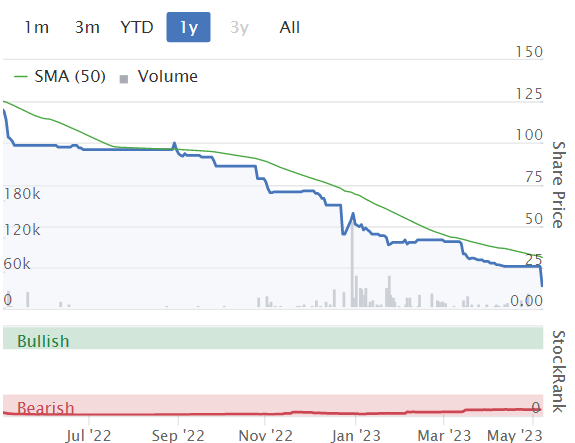
Down 46% to 13.8p (£9.5m) - Trading Update - Paul - RED
A disastrous trading update - a profit warning for FY 6/2023.
Revenues have almost dried up - it only did £1.0m revenues in H1, and is now saying only an additional £0.4m has been achieved in the 4 months since. Pipeline not converting into sales in time for FY 6/2023 year end.
It’s also run out of cash, with only £0.7m left of the previous £6.7m cash pile at June 2022. Cost savings being made, and exploring various funding options - good luck with that.
Paul’s opinion - I’ve only looked at this share once, here on 3 Jan 2023, when I warned readers away from it, pointing out that it looked to be running out of cash.
One of the worst floats I’ve ever seen, it’s been a disaster since listing as recently as Dec 2021. The culprits were SPARK Advisory Partners, and Liberum. It was mostly a VCT/EIS placing, at 117p. So it’s almost joined the -90% club. This could easily go to zero I think, so I continue to view this as a bargepole job. It’s a pity, because innovative companies need development funding, but I don’t think the stock market is the right place for that. Companies should only float once they have matured, and are profitable. The IPO market is dead now anyway, partly because brokers floated so many lousy companies, at excessive valuations, in order to gorge on the lucrative fees. That greed has very much killed the golden goose now, with IPOs likely to be few, to non-existent, in the current climate. A total re-think is needed. Actually, I’ve drawn up a list of a dozen changes that need to be made to the UK stock market to improve things, which I will publish here when I send it to the FCA for their consultation on markets.
Note the StockRank system has been warning us away from this share right from the start - a very useful function.
Disclaimer
This is not financial advice. Our content is intended to be used and must be used for information and education purposes only. Please read our disclaimer and terms and conditions to understand our obligations.

60 comments
Paul
I'd welcome your views on Cambridge Cognition Holdings (LON:COG) when you have a moment.
Got to wonder if the directors of the market will consider the future of the market?
With the IPOs Cash Grabs by insiders and the Delisting "manoeuvre" to allow 75% shareholders to grab the remaining 25% for almost free, we just need the Conservative Crew to follow through on the rumors of removing the IHT benefit of AIM - and it will all be over for Junior!
"The IPO market is dead now anyway, partly because brokers floated so many lousy companies"
Preach. It's all too easy to pick complete junk on AIM. I did a quick check. The AIM index rose13% over the last decade, whilst the Footsie rose 25%, and the FT250 by 35%. Dividends excluded. AIM provides little in the way of dividends, so the returns of the FT100 and 250 are going to be even higher. Whilst no index shot the lights out, I have long observed that the mid-caps do better over the long term.
AIM is pretty ropey, as you can see from the overall returns. Call me old-fashioned, but my idea is that the long-term returns from the AIM should be higher to compensate for higher risks. As the long-term performance indicates, it appears to be mostly dross.
Having said that, all that dross is undoubtedly masking a lot of good companies in there that must be shooting the lights out relative to the big board. AIM is not something I generally investigate, though.
I wonder if one solution is for the LSE to merge with another stock exchange, say on the continent or the US. There are some really good companies in Europe that are worth investing in.
Aquis listings- i own three companies listed on this exchange all bought as new issues. Interested to know if anyone has had positive experience in terms of being able to trade and liquidity. Whilst i appreciate liquidity in AIM/Small cap has been challenging for some time Aquis appears dysfunctional with trades executed in 1k volume at c40% discount to touch with no NMS. A classic lobster pot .
I have shares in Aquis Exchange (LON:AQX)
Which isn't quoted on Aquis Exchange rofl
Bully for you Paul, your view of Aptamer (LON:APTA) is pertinence in poetry. Wouldn't like to be on the receiving end!
XP Factory (LON:XPF) a change in the NOMAD and broker announced today via RNS. SP has dropped 8%. Paul I know this is one you are keen on/invested in. Market doesn't seem to like this news. Is there anything to read into this do you think? Bristol.
Just a guess.. A change of advisor is sometimes a prelude to a placing. I guess the market is expecting a discounted placing and has reacted by pre-empting some of the discount.
Without adding to the detail given below. I hold Palace Capital (LON:PCA) and will continue to do so. This morning's announcement together with the near term outlook for declining interest rates is positive, albeit it is difficult to work out the end game for the company.
I also have holdings also across family portfolios in LXi REIT (LON:LXI) Real Estate Investors (LON:RLE) and TR Property Investment Trust (LON:TRY) , albeit none of significant size. Great yields and all bought at more or less current prices, except Palace Capital (LON:PCA) where I was too early to the party.
Another slow Friday... I listened to Pauls enjoyable macro podcast and found it very balanced and surprisingly upbeat. I agree with you re the Fed ... clearly we are in something of a crisis. Hugh Hendry wants you to panic. Actually he wants you to buy an $80 cap...and subscribe to his YouTube channel. Telling everyone to panic generates more subscribers than appearing wishy-washy and saying everything will be ok. The thing is, as bad as GFC was, things were kind of ok... admittedly not as a bank investor...but depositors were all made good.
Anyway yesterday he went on Bloomberg and said the Fed should/might gate deposits...to try and stop the stampede out of banks. The GFC was caused by a solvency crisis that froze the wholesale mkt....this was a credit quality issue. As a result wholesale funding of loans was seen as bad...no more securitisation ... and loans were matched by deposits. Actually not enough loans...so banks lent to govt instead. The rapid rise in rates means those securities are under water....which is not really an issue BUT Banks can't increase deposit rates to match money market funds without losing lots of money. This is a timing issue.... the depositors want better rates of interest. Hugh alarmed people by saying they might gate deposits.ie stop them withdrawing. They could also close money market funds to new money for some time....which is better than saying you can't have your money back. OR they could just cut rates ... which would take some stress out of the situation.
The thing is, if we all know this then why did the Fed put rates up...by 25bps? Im not in the Fed are stupid camp... so why did they do something that doesn't make sense...? Obviously if I knew Id be invited onto Bloomberg... hmmm....
During the GFC we went home every Friday thinking they would announce something over the weekend....it took a long time to get the right policy in place. This seems similar....but it isn't anything like as difficult to sort out....mainly because US banks have NOT lent loads of money to someone who can't repay. Anyway my guess therefore is they put rates up because they don't want to scare people. They are aware they have a big problem and are working extremely hard to makes sure JPM do not end up buying everyone else. Deposits will have to be made safe....and a fudge around mark to market securities losses....to buy some time. Time is a banks friend because the actual loan book and the securities portfolio matures and can be reinvested at prevailing mkt rates. This allows deposit rates to rise...solving the problem.
So far index falls have been a bit of a shrug....the Nasdaq hasn't moved...the 250 is up.... the FTSE 100 is up 3% YTD but come back a bit ....the S&P is now up 5%.... things could well get worse.... normally when you see weird share price movements its just institutions liquidating .... and things rebound some weeks later. Im not inclined to do anything... for me personally the panic trades make me feel better for a few weeks, but months later or at the end of the year they actually cost me money. Some would say that's ok if you sleep better.... I understand that... we all have our pain thresholds but I am in the don't panic camp.
If putting up interest by 25bps causes the system to collapse, then it's a very fragile system and unfit for purpose.
I'm increasingly of the view that modern banking models can never be made to work. Sure, they work great when interest rates move downwards, and really badly when rates increase. As rates increase, the long-term debt goes into loss. If people take their money out, those losses crystallise.
What you have is a system, then, which rewards bankers/shareholders when things go well, but requires bailouts when things go against you. It's my contention that it doesn't really matter how competently and honestly you manage a bank, it's just a system that's inherently floored.
IIRC it was Nassim Taleb who suggested that banks should be owned and run by central banks and be part of the civil service. He's probably right.
Well I agree mostly.. I think the severity of the increases has caused problems. Yes, that's the Banks fault for sure....but I didn't mean to suggest it was the result of a 25bp rise. IMO this is pretty irrelevant. I meant to suggest that given the distress, it didn't help and actually the mkt is crying out for cuts. Paul put it better saying they have just moved too quickly. Not many businesses survive under such strain to be fair.
Companies seem very fond of using EBITDA to measure profitability - but what does it really measure? It doesn't seem to include costs like employee salaries, raw materials, and production-related expenses so from my perspective it is a bit useless? Opinions?
I completely agree Ben, pre tax profit is the measure I want to see. Warren Buffett hates EBITDA, his quote ”We won’t buy into companies where someone’s talking about EBITDA. If you look at all companies, and split them into companies that use EBITDA as a metric and those that don’t, I suspect you’ll find a lot more fraud in the former group. Look at companies like Wal-Mart, GE and Microsoft — they’ll never use EBITDA in their annual report.” Says it all for me.
Isn't post-tax profit better than pre-tax?
Tax is still money that the company can't spend.
Another Warren Buffett quote "Do they think assets grow on trees"
EBITDA may not be the best measure of profitability in many cases but I think you may have misinterpreted what it includes. It does generally include costs like employees salaries (part of operating expenses), raw materials (accounted for in Cost of goods sold and therefore gross profit) and production- related expenses (probably partly accounted for in gross profit and operating expenses). It is often seen as a proxy for cash flow. It can be manipulated by some expenses (E.g. R & D costs) being capitalised and therefore taken into the DA element of the measure (depreciation & amortisation).. I’m no expert on the accounting rules and regulations on what can & can’t be done but I’m sure it is open to interpretation!
are you sure? this is what I've found:
So EBITDA includes cost of sales such as employee salaries right?
NO! EBITDA generally does not include the cost of sales, which typically includes the direct costs associated with producing goods or providing services, such as employee salaries, raw materials, and production-related expenses. Instead, EBITDA focuses on operating expenses, such as rent, utilities, marketing, and other costs that are necessary to run the business but are not directly tied to the production of goods or services.
EBITDA stands for Earnings Before Interest, Tax, Depreciation and Amortisation.
It can be very useful for comparing companies in the same industry but with very different balance sheets, or with very different depreciation policies. EV/EBITDA takes into account all the capital involved in running the business, whereas you can distort the P/E with leverage.
No single ratio should be used on its own, you need to look at several, and in that context EBITDA can be useful. Ultimately cashflow related metrics are the most reliable because they are the most difficult for management to fudge, but they come with their own challenges (good luck forecasting inventories).
The cost of sales argument above is a red herring - some companies exclude certain costs from their headline revenues, but otherwise EBITDA will be after operating costs such as payroll.
This is complete and utter nonsense (it would be interesting to know the source!).
The easiest way to get to EBITDA is to take PBT and add back net interest charges, depreciation and amortisation. To put it in the context of the above, you would take everything from revenue down to the interest, depreciation and amortisation. Therefore, it includes COGS / Cost of Sales!
I hope this is helpful.
EBITDA stands for Earnings Before Interest, Tax, Depreciation & Amortisation and therefore, as the previous poster said, should include salaries, cost of sales etc. I’m firmly in the Munger/Buffett camp but I do look at EV/EBITDA as a valuation metric as it is widely used by private equity. Interestingly, I saw a PE presentation this week claiming that EBITDA was a proxy for cash flow and my immediate thoughts were a) if you ignore adjustments and b) what about debt interest, is that not paid from cash flow?
the source was chatgpt!!
Do you trust chatgpt? I’m sure it will improve over time but I have seen several examples where it is inaccurate and at least two where it made things up rather than admit it didn’t know the answer (spookily a rather human response).
bing replied likewise though so I'm still scratching my head!! does EBITDA include employee salaries or not!?
Chatgpg and Bing are both misleading and very WRONG.
Snazzytime, bensummers & Brilliant Leader
Some of my recent experiences with ChatGPT and Google's Bard.
I treat ChatGPT responses with great caution, especially where any numbers/stats are concerned.
It has not really been trained on any substantial or substantive numbers/stats models as far as I understand it. I think 'Wolfram Alpha' (Computational intelligence engine) plugins are available and might be available in the paid ChatGPT option (or other specialist AI platforms).
In addition, I always repeat any question prompts I put through ChatGPT by repeating them through Google Bard (it is free).
Google Bard also presents fallacious responses. Sometimes the same as ChatGPT or it creates its own 'illusions' (as the AI crowd call them).
That stated, by thinking quite carefully about what information I am actually seeking and then refining my question prompts in a sensible cascading/narrowing of scope manner I have obtained some really useful insightful responses.
I am continuing to use it quite frequently and have found it pretty useful for gaining rapid information about the contextual situation of a market sector, industry, comparisons of stock X vs Y vs Z. For digging into market penetration by different companies.
For example I got an extensive set of responses when I interrogated ChatGPT and Bard about the structure and main players within the US healthcare sector, but specifically companies focused on 'Healthcare, equipment & supplies'.
This session took me about 60 minutes and gave me a wealth of useful information as I did not know anything about that sub-sector before hand.
After assessing seven options identified through the session, I am now concentrating on two contenders, Boston Scientific (NYQ:BSX) and Stryker (NYQ:SYK) to see if I ought to consider an opening position. Two others offer possibilities Medtronic (NYQ:MDT) or Abbott Laboratories (NYQ:ABT) for further research.
I have held two of these in the past, but I could not have got to the clarity of possibilities so fast and with so much 'rich' contextual background information without ChatGPT and Bard.
Regards
Howard
https://www.stockopedia.com/ra...
It includes salaries except where the firm is capitalising them as part of the process of building an asset eg software companies capitalising the costs of developing software which then then capitalise and amortise in the same way that a manufacturer would gradually depreciate a piece of equipment
eg software companies capitalising the costs of developing software which they then amortise in the same way that a manufacturer would gradually depreciate a piece of equipment
So ChatGPT is wrong. And here is the source of the confusion. There are several levels of a p&l account. Direct costs (labour costs, raw materials) are taken off to get to gross profit. After that admin expenses and the rest take us down to the next level. ChatGPT is clearly talking about the costs taken off to reach EBITDA. labour and raw materials have already been taken out at a higher level (before gross profit). And, yes, I know I am talking about ChatGPT as if it were a person. Humour me please.
More importantly, Buffett and Munger are right. EBITDA and most "adjusted" versions of earnings are "b******t".
Charlie Munger hits the nail on the head - ”I think that every time you’re see the word EBITDA, you should substitute the words “bullshit earnings””.
Not really
EBITDA can be a useful measure for investors as long as it is used properly and therein lies the problem. Often companies use it to obfuscate.
Sometimes a company will have a decent pile of cash and earns interest on that cash. Is that a useful measure of future profitability of the business? Only if the cash pile is generally maintained across the cycle and interest rates are stable.
Or imagine a company that bought a lot of stuff historically that is now being depreciated at quite a lot p/a. The PBT number includes all that depreciation but actually that is historic, sunk cost. What matters to existing shareholders is what the business is earning going forward. By leaving the depreciation in the true earnings of the combined entities is masked and investors may under appreciate the business.
Anyway - this is offset by companies who also quote ebitda when they have a large amount of debt, thus a large amount of interest. Servicing the debt is imperative so the interest cost is an ongoing expense and should be taken account of by shareholders when valuing the business. It may also be used by companies who keep capitalising more and more costs, or effectively mortgaging the future. Again in this instance it is an inappropriate measure.
So - a saying like "bullshit earnings" is really just a soundbite that ignores good reasons for an ebitda measure. Like most measures of profitability the key is to look at them all and understand where the differences come from and then apply your judgement as to what should or shouldn't be included. Not dissimilar to looking at debt now that lease costs are included in accounts as net debt when they really aren't.
No it’s not a useful measure for any serious investor and this is the reason it is used far more by small cap companies that are trying to hide the true picture of their financial performance.
But I have to agree with you that it shouldn’t be compared as bullshit earnings.
Should just be renamed as bullshit earnings.
I think there are enough accurate explanations of EBITDA below to correct the above assumptions. Of course, Munger and Warren have appropriate cynicism as to its use because like all things it can be abused, or be wielded to frame a particular view of Adjusted earnings.
For example operating costs should not normally feature in adjusted earning, but some IT companies who develop software may attribute some annual salary costs for software development as capital expenditure, and amortise it. This is not uncommon but if they are annually recurring costs, it seems to me wrong in principle.
So you have be aware of how consistently they do this, and how much.
Private Equity are OK with EBITDA as this helps them compare with cash generation, though frankly cash generation should be evident from the Cashflow statement, but perhaps in some cases it is not?
Good morning Paul, any thoughts on today's XPF news, looks like shore capital are out and singer capital are in? XP Factory (LON:XPF)
Fundraise incoming for XP Factory (LON:XPF) ?
I really hope not, that's obviously what the market thinks though
That's the reason I didn't go into this one. Cash looked quite tight so risk of dilution looked v possible. It's a good business though and I'll look to buy in down the line I think
I agree on paper but the bars are little goldmines, and according to Richard should be running cash flow positive.
The only reason I can see for a raise would be an acquisition of Flip out or something similar which really doesn't seem prudent in the current climate if they need to dilute or borrow to acquire
I see Heiq (LON:HEIQ) has been suspended. Proof of the old adage - Bad results always take longer to add up. Somehow I managed to make money on this one in the Covid mayhem, but management always struck me as odd.
There are also constraints in the auditing industry - problem is that we don't know if it is dodgy dealings or constrained auditors. Market hates it either way.
Oh well another IPO that killed the golden goose. Be a long time or another generation of suckers before that market ever recovers. A good story on the face of it but he ho another write-off.
Heiq (LON:HEIQ) improving the lives of billions of people world-wide by innovating the materials people use every day. IP-rich pioneer which is at the forefront of global technology in the $10 billion antimicrobial fabrics and $24 billion textile chemicals market. It has also moved into the medical device, healthcare and probiotics markets, to help make hospitals and healthcare environments more hygienic.
HeiQ has created some of the most effective, durable and high-performance technologies and textile effects in the market today, which cool, warm, dry, repel, purify, and destroy viruses. Since 2005, HeiQ has developed over 200 technologies in partnership with 300 major brands. It has won multiple awards and gained a strong reputation for sustainability.
Facilities by ADF (LON:ADF) "founders" selling 4.2 million shares at 53p. Still hold 31m.
I wonder if they see some problems ahead with industry spending/job cuts or the writers strike causing a slowdown. Or is it a case of using any strength in an illiquid share to bank a profit.
Growth looks good if you believe broker updates. Any holders have thoughts?
Facilities by ADF (LON:ADF) "founders" selling 4.2 million shares at 53p
I’ve been there. You floated a year ago. The share price has round tripped and gone nowhere. Despite your IPO proceeds, most of your wealth is still tied up in an illiquid share and your ability to trade is constrained not just by the terms of the IPO but also by the scrutiny of your holding and the deleterious effect of any disposals. Meanwhile, recent market developments (screenwriters strike in this case) are unhelpful for short term earnings. You’re definitely looking to manage some of that risk.
Hi Wolf. I just sold all my Facilities by ADF (LON:ADF) at a tiny profit. I think the price will be falling for weeks following the big director sales. I will consider buying them back again after the price has stopped falling.
Decided to sell on a good profit after I had time to look at their cash flow statement in detail, (they are not really making any money) and the revenue growth seems very difficult to achieve. Also, it was one of these sharesthat was tipped in about all newsletters and newspapers (always a red flag for me).
Good luck to all holders.
PS. Worth a look on Arrow Exploration plc having just added it to my portfolio.
Tpximpact Holdings (LON:TPX) giving us holders some better news. Trading ahead and full year guidance raised for 23/4. They can clearly win new business and Paul has rightly questioned whether the margins, which are thin, (3%) can lead through to bottom line. Well they are improving their margins and time will tell if their cost control leads to happier days. As Paul says from here if they get it right it could be a multibagger (which i need to get back in black!).
As someone who has run a technology services business, I don't understand how Tpximpact Holdings (LON:TPX) could possibly provide and manage the wide range of services that it lists in its description.
I suggest it should focus on whatever subset is profitable and where it has some sustainable competitive advantage.
Palace Capital (LON:PCA) . Property disposals and a trading update announced today. Net debt is down to £18m and LTV to 12%, which looks very low and no doubt reflects a dash to cash as property values fall.
It looks interesting as the NAV is £192.4m (a 12% decline since September). They don't specifically say whether this is gross or net NAV but I suspect the former but the company is only valued at £94m, so the discount should still be substantial. Also the yield is 7.3% and looks secure for now.
In terms of EPC (Energy Performance Certificate), they say 96.2% is rated as A-D.
The discount to NAV, low debt and yield make this look superficially attractive but their focus on office space is clearly a problem in a work from home environment even if it is based outside of London, where values maybe more resilient as there is less space available.
The investment case must depend on whether the falls in office property values are close to their worse and while I suspect there are further falls to come, we are near the peak of the interest rate cycle and so could be close to the nadir.
I do though have no knowledge of the sector to have a view.
Are there any other property investors here with a more informed view?
The issue with the property let game just now is the rapidly increasing EPC requirements. This is potentially going to leave some landlords on the hook for expensive upgrades, or value write downs where compliance is not achieved. For commercial lets the current minimum std is E, this is set to increase to C by April 2027, before a further increase to B by April 2030. For private rented accommodation, a similar story is present, and is one reason many landlords are selling up leading to a reduced supply of properties available to the private rented sector.
https://vailwilliams.com/comme...
This is clearly a winding up situation (in a moderately positive sense), with an activist and very shrewd shareholder. The move into office at lower yields was pretty disastrous but I see this announcement as simplification prior to disposal or merger. I'm one of those who think that the York development was OK, if slow. I'm sitting on a substantial loss but will continue to hold and rate the stock as a Hold too. Interest rates are the real killer, because higher rates lead to inverse property prices. I see USA rates coming down but UK rates staying high. Our economy is a shambles, due to Brexit and huge debts run up by our ruling party.
I am a holder of Palace Capital (LON:PCA) - agree with much of what you say and Snowbum.
The main reason here to hold is the capital disposal and proceeds coming back to shareholders. I don't think the current share price looks fair in that regard. However, a lot of the commercial property sector is bombed out at the moment so while there could be c.100% upside given the NAV here (potentially more given you might expect NAV to improve once inflation comes down) there is also potentially 100% upside at other commercial property companies as well and ones which have a better portfolio of properties. Tritax EuroBox (LON:EBOX) is my favourite as it has index-linked rents and very high EPC ratings across its portfolio and v high occupancy rate plus 8% divi yield.
I do think Palace Capital (LON:PCA) is undervalued (with some risks such as the EPC issue Snowbum outlines) but for balance I think Tritax EuroBox (LON:EBOX) is probably better.
I agree that Tritax EuroBox (LON:EBOX) looks a stunning bargain and it’s trading at a very wide 44% discount to NAV too! AIC website is exceptionally good for all Investment Trusts. This link just takes readers to the 4 Commercial Property Europe Investment Trusts which are all on wide discounts. So too are some of the UK Commercial Property Trusts and again with big dividend yields
https://www.theaic.co.uk/aic/f...
Key reason for the share price falls is higher interest rates have made the high yields on Commercial Property Trusts less attractive. But with signs that interest rates have peaked and with falls ahead likely this should increase the popularity of these Trusts again. Meanwhile while waiting there’s those great yields …but best to be wary of the 12% yield on Regional REIT (LON:RGL) as a cut seems likely. Most of the others are paying covered dividends.
I hold Aew UK Reit (LON:AEWU) Alternative Income REIT (LON:AIRE) Ediston Property Investment (LON:EPIC) (dividend paid monthly) Schroder Real Estate Investment Trust (LON:SREI) Schroder European Real Estate Investment Trust (LON:SERE) as well as Tritax EuroBox (LON:EBOX)
Here’s the aic UK Commercial Property Trusts link:-
https://www.theaic.co.uk/aic/f...
I agree with most points raised about Reits. I do however, find their charges of 2.5 to 3.3 quite high.
I hold Reci with 2.9% charges and 8% divided. EBOX is probably on higher charges than that.
Fair point re charges, but unless ludicrously high I tend not to let that influence whether or not to buy. Counter argument for starters is that huge discount to NAV. Tritax EuroBox (LON:EBOX) and Tritax Big Box REIT (LON:BBOX) used to trade at premiums to NAV and a key reason for the very big share price falls across the sector has simply been those premiums going to massive discounts, or previously narrow discounts widening.
There’s a big chance this is another big buy opportunity across the sector. I bought most of mine in the even worse 2020 covid downturn, and despite the big recent falls, all are still in profit even excluding the dividends. And Aew UK Reit (LON:AEWU) gain is 100% if including the 13% dividend yield at my 2020 buy price.
Investment Trust sector is unloved and often unknown to investors. Even Paul Scott admits to not being clued up on them. But for the minority who do know the sector is a gold mine! Some of the Trusts have been in existence since the 1800s and some have increased their dividends every year for over 50 years, with the City of London Investment Trust (LON:CTY) increasing for 56 years in a row.
And they are a great way to invest all round the World, searching out quality solid performers on discounts to NAV.
Hi Ken, Thanks for your input re investment trusts as always. I do hold Tritax EuroBox (LON:EBOX) since it was at a premium but have wondered whether the huge discount is not only due to interest rate increases. I think a lot of their holdings are related to logistics for the e-commerce sector. Presumably there is the same trend in Europe as here i.e. a move away from e-commerce to physical shopping. I think Amazon has closed 3 centres in the UK already. Whilst this has not caused me to sell any shares, it has put me off buying more.
Thanks Roger
I rarely buy an Investment Trust trading at a premium because if it or the sector goes out of favour (as has just happened with Commercial Property Trusts) then the falling share price is made much worse still by the premium going to big discounts.
The opposite applies if buying when Trusts are on big discounts. I.e the rising share price getting an extra boost from the discount narrowing or even going to a premium.
Re your questions about Tritax EuroBox (LON:EBOX) I think your concerns might be overplayed. There have been some big falls in Commercial Property Trust NAVs, but the falls have been much bigger for the UK Trusts than the European ones. Also some REITS are now reporting increases in NAV and also property disposals higher than Dec 2022 NAV. E.g Aew UK Reit (LON:AEWU) . Why not use the link in my post this morning to check out your EBOX concerns. Clicking on the blue Trust heading brings up a wealth of info including (obviously) Results statements and also research like Quoted Data.
A current exception to my don’t buy at a premium rule might well be Henderson Far East Income (LON:HFEL) . It’s one of the Investment Trust dividend heroes with increased dividend for 16 years running. But overall performance has been dire as can be seen using this link giving 1,5 and 10 year performance. HFEL has badly underperformed the others in the sector. Now at rock bottom that near 10% dividend should underpin further share price falls and the Managers are well aware of the dire performance, so worst case now might be bumping along the bottom but 10% dividend to compensate while waiting for improved performance.
https://www.theaic.co.uk/aic/f...
I'm not sure this is all management charges though - would need to check but some of this likely to be building costs. Running a REIT is also a lot more hands on than running say a typical equity fund, so higher charges probably justified.
I agree with Patrick and Ken . Hopefully, the disposal by abrdn European Logistics Income (LON:ASLI) today at a small premium to NAV at 31/12/22 helps to reassure that the NAV of Tritax EuroBox (LON:EBOX) won't fall too far.