Small Cap Value Report - GBO, KOOV

Good afternoon!
Not a great start to the day - I've come down with the lurgy, so have been shivering in bed with a fever and a sore throat. Also it's taken me half an hour to crank a rather temperamental PC into action, further delaying things. So I'll write this report throughout the afternoon, hence if you refresh this page later in the day, more stuff will appear.
Globo (LON:GBO)
Share price: 40.75p
No. shares: 373.7m
Market cap: £152.3m
I had a look at the latest interim accounts from Globo (LON:GBO) last night, and all my concerns remain, indeed have strengthened. It's one of the most bizarre & unreal-looking balance sheets that I've ever seen. Once again the company reports huge profits, but once again the bizarre debit balances on the balance sheet pile up into ever larger & more unbelievable mountains.
Cash & debt - most companies have cash, or debt. There might be a bit of overlap, with some cash in transit, or cash at one subsidiary, and debt at another. Usually though the net picture makes sense. Not here! The group reports cash of E104.4m at 30 Jun 2015.
On the same date, it reports borrowings of E56.9m. Given that interest rates on cash deposits are close to zero, this is a staggeringly inefficient, indeed totally illogical arrangement. The P&L shows E368k of interest income, and E1,981k of interest cost, in just a six month period remember. Therefore, the first job I would if I became CFO of this group would be to repay all the bank debt from the cash pile. That would still leave the group with net cash of E47.5m, which looks ample.
However, by repaying all the bank debt, I would at a stroke have reduced the P&L interest charge by E1,981k * 2 = E3.96m. So there is a cost saving of nearly E4m p.a. interest charges just sitting on a plate, which could be taken today (unless there are early payment penalties on the debt).
The fact that Globo continues to report this huge net cash balance, whilst simultaneously holding significant, and expensive debt, is beyond bizarre. It's highly suspicious, since no rational company would allow this situation to persist for a considerable amount of time, as has happened here.
So the biggest, shiniest red flag is this weird cash & debt situation.
Debtors - this is the second big shiny red flag. Globo reports E54.5m trade receivables at 30 Jun 2015, which seems very high given that revenues for H1 were E72.4m. It's true that receivables includes VAT usually, whereas revenues doesn't, so that can skew things somewhat. However, I would always expect trade receivables to be less than half of interim revenues, or less than a quarter of full year revenues.
On that basis, Globo's trade receivables look excessive by about E18.3m to me.
However, it gets worse. There is another item called "Other current assets" of E35.8m, so a big number. There is no explanatory note given. So I looked back to the 2014 Annual Report, and the equivalent number is accrued income. The double entry for accrued income is this:
Dr Balance Sheet - Other current assets E35.8m
Cr P&L - Revenues (which drops straight through to profit) E35.8m
So this Other current assets line is effectively just more trade debtors, which haven't been billed yet. Add it to the other trade debtors figure, and you really have total trade debtors of E90.3m. That is equivalent to ALL of H2 2014 turnover (of E59.9m), plus E30.4m of H1 2015's turnover, or 42% of it. Therefore, there is nearly 9 months of sales sitting on the balance sheet, unpaid! What does that tell you? Answers on a postcard please, but it tells me that the company is probably booking fictitious revenues through the P&L on a huge scale.
That's always been the case in the past, when I've come across very excessive debtors like this. I can't think of a single case where excessive debtors has turned out to be absolutely fine in the long run. It's practically always the precursor to the wheels coming off, in some shape or form, accounts being restated, a huge write-off of junk on the balance sheet, Directors being kicked out - in fact that's exactly what happened at Quindell (LON:QPP) when I raised exactly the same concerns for several years before it eventually all fell apart.
It's always the same. To create fictitious profit, the debit entries are left on the balance sheet, and become more & more obvious for anyone who takes the trouble to look.
Another similarity between Quindell and Globo is that if you recall, once its debtors became insanely high. Quindell came up with its own definition of debtor days, which excluded a large chunk of total debtors. So it was nonsense. Globo has done exactly the same thing in these interim figures! There is a section where it tries to reassure on debtor days, see below;
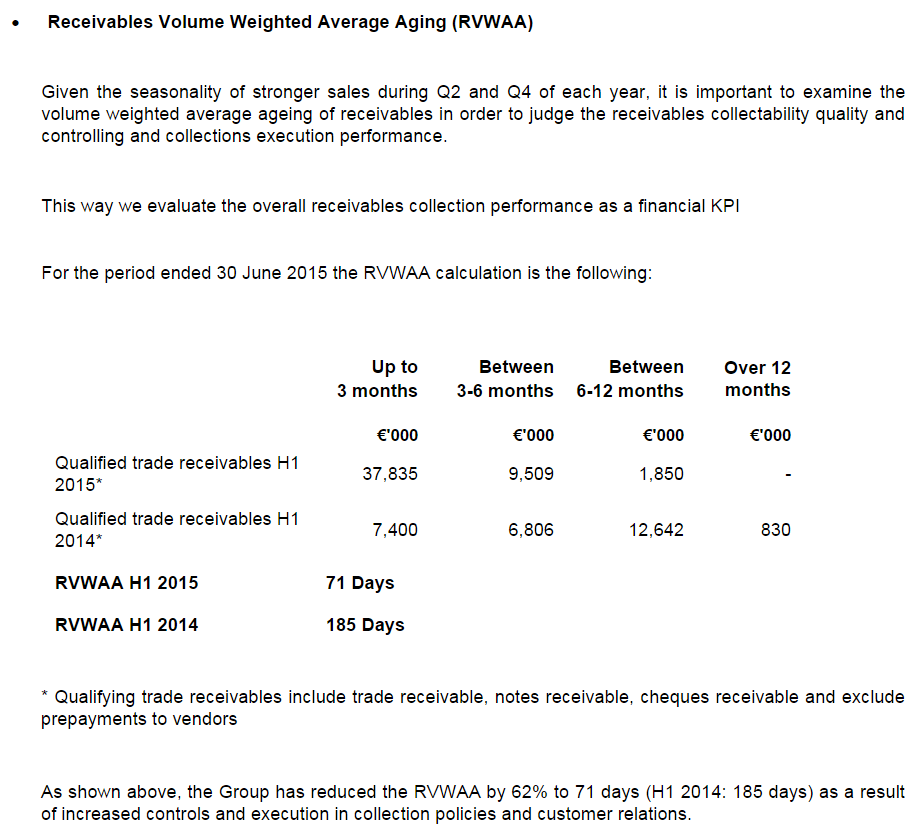
Needless to say, it shows a dramatically improved picture! That's because it's actually ignoring about half of the total debtors! So this is just utter nonsense, designed to deceive in my opinion. Some people want reassurance, and so they will lap it up. More fool them!
Cashflow - the top half of the cashflow statement is interesting (see below). This shows that the group does appear to be generating some genuine cashflow:
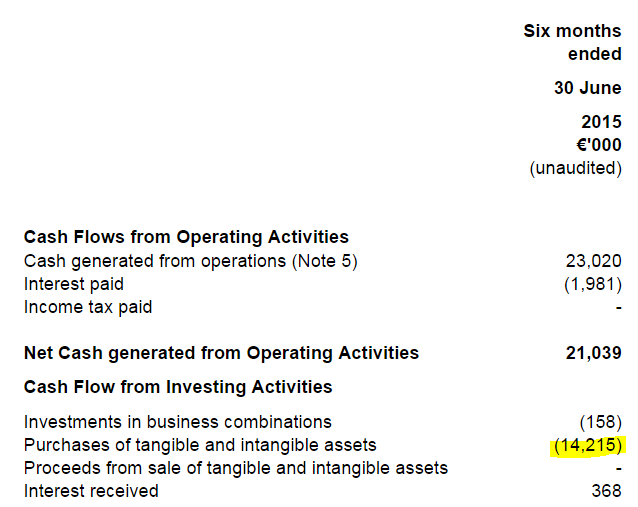
So the E23.0m cash generated from operations is largely consumed by purchasing intangible assets - i.e. costs that probably should have gone through the P&L, but instead have been capitalised. That takes cashflow down to E8.8m, or E7.2m after net interest costs.
So I concede that it's possible there might be a decent business somewhere in these numbers, but just not one generating anything like the profits that are shown on the P&L.
Acquisitions - the group says it is planning more acquisitions, and one (unnamed) target company was pre-announced recently. Today it says:
The Group has been targeting a series of acquisitions since the end of 2014 and we hope to progress certain of these over the coming months. We have recently announced the proposed acquisition of an innovative BYOD - Mobile Security Company in Europe for €14 million.
Our current cash position and cash flow covers all of our operating requirements and will enable us to pursue selective acquisition opportunities in the near term. In order to grow the business through more sizeable acquisitions, we continue our High Yield Bond discussions. The Company maintains a prudent view on the methods of financing its acquisition led growth.
Errr, hello! Earth calling Globo! A 10% p.a. interest junk bond is NOT a prudent way to finance acquisitions, at all. It's just another red flag actually - as the logical thing to do, would be to use your existing cash resources (supposedly substantial in this case) first, then only draw down any borrowings when actually needed. The way Globo is trying to do things looks plain fishy (like the rest of their accounts).
My opinion - as you can probably tell from the above, I think the figures for this company stink to high heaven. I would look very carefully at all the companies they acquire in future - are there any connected parties? Is the price reasonable (based on real profits, not adjusted EBITDA)? There is a risk that buying a lot of junk companies could just be a device to disappear the cash pile (if it hasn't already been disappeared).
Decent companies simply don't present their accounts in this way, nor run huge cash balances simultaneously with increasing borrowings. Remember the change of auditors, twice, some time ago, which was unconvincingly explained away but has since been forgotten by gullible shareholders, who just want the share price to go up, and don't care about reality.
There are so many issues with this company, that to my mind, and based on a lot of experience in the market, avoiding dodgy companies & warning people about them, it is inconceivable that everything will turn out fine here. I think it's a serious accident waiting to happen.
Even if I'm wrong (which is possible, albeit unlikely) why take the risk, when there are so many warning signs?
Koovs (LON:KOOV)
Share price: 44p (down 31% today)
No. shares: 24.1m
Market cap: £10.6m
Results y/e 31 Mar 2015 - these have been published just in the nick of time, as they're now 6 months old, and I think the shares would have been suspended if results had not come out today.
Anyone who thinks that it's easy to create & build a fashion website, should take a look at the mess that Lord Alli has made of things here. Remember too that he's experienced, having been involved with Asos for many years, so he should know how to do it.
The reality is that it's painfully slow, and very costly (especially marketing spending) to create a successful online retailer. Sure, there are few barriers to entry, but there are massive barriers to scaling up to a decent size. Creating a transactional website is easy, but getting large numbers of people to repeatedly buy from it, is very hard. Making a profit is harder still.
Koovs generated only £2.1m in revenue for the year, and incurred a staggering £10.8m operating loss! There was only £13.7m cash left in the bank, so only enough to take them into roughly mid-2016, at that rate of cash burn.
Bizarrely, the company confirmed on 2 Apr 2015 (which I reported on here) that it would need more funding. That's a terrible mistake, as it then means the existing shares can become virtually worthless, if providers of the next stage funding play hard ball. It's OK if there are financiers falling over themselves to invest, but on the back of the company's dismal performance to date, it's difficult to see why anyone rational would want to back this with more money.
Worse still, Koovs today says that it hopes to raise another £35m for continued losses, saying that the first tranche should be raised by the end of 2015. This means heavy dilution, as new investors are bound to demand a deep discount. The more dilution, probably at an even lower price, in 2016 and 2017.
My opinion - I think they should have adopted a far more modest business plan, instead of going for growth, and burning huge amounts of cash. It all hinges on whether new investors are prepared to throw substantial amounts of more money at it, or not? The existing shares have no attractions at all, in my view. I'd rather wait until it's properly funded, and is showing the first signs of being a viable business. It's a long way from that right now.
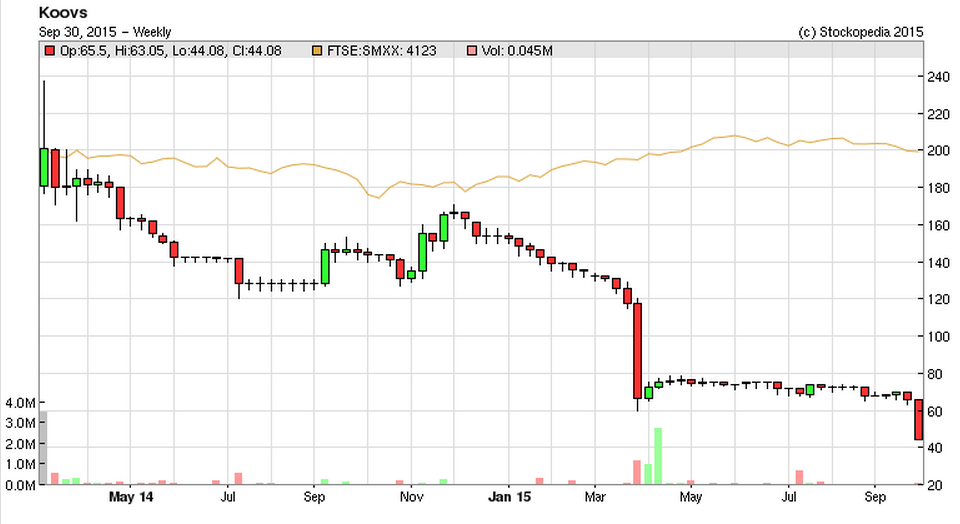
It's been a disaster for shareholders so far, as you can see from the chart below. Why invest in this, when you can invest in a successful, strongly growing, profitable, online retailer like Boohoo.Com (LON:BOO) (in which I hold a long position) at a reasonable price?
Apologies, I didn't get round to looking at any other companies today.
Regards, Paul.
(of the companies mentioned today, Paul has no long or short positions.
A fund management company with which Paul is associated may hold positions in companies mentioned.
Please DYOR. These reports are just Paul's personal opinions, which are fallible, and are never recommendations, nor advice)
Disclaimer
This is not financial advice. Our content is intended to be used and must be used for information and education purposes only. Please read our disclaimer and terms and conditions to understand our obligations.

41 comments
By way of an update, Forum have released their results here:
http://www.forumgruppe.de/en/listed-companies-public-equity/publications.html
They note that they demanded a board seat one week before the CFO confessed fraud.
Proposed high-yield bond not going ahead.
I assume they could find no takers for it.
http://www.investegate.co.uk/globo-plc--gbo-/rns/high-yield-bond/201510211328479867C/
Thanks Jaknife as ever invaluable information on how this works in practice. Obviously I'm just trying to understand why, if the cash balance is real, they'd not use it to clear expensive debt. The whole idea of issuing a further HY bond is even more weird. To be honest the whole company reeks quite a bit!
Log
Why would they want to repay them early, they are struggling to raise money now and replace a bank loan with a junk 10% bond, in fact I believe this the reason they are trying to raise funds, why can't they use their cash?
I'm sure that they could be repaid early but the question is whether a penalty would be applied. Given that the loans are due October next year, I wouldn't expect there to be a large penalty due now but it's not easy to tell as there's no "normal practice" for term loans.
Eg We did a seven year deal recently with a large UK company where there was a 2% penalty for prepayment on the 3rd anniversary, 1% on the 4th and 0% after the 5th anniversary with linear interpolation applying in between. There was no explicit option for pre-payment before the 3rd anniversary but we wouldn't say no, would just have to stick a very big penalty on at that time.
On the other hand I've written five year deals with no pre-payment penalties at all.
Thanks JakNife - now why didn't I find that? :-)
"Amounts
drawn down under the two term loan facilities are repayable in quarterly instalments commencing on April
2015 (for term loan A) and on April 2016 (for term loan B) and fully repayable until October 2016."
Does this mean that the term loans can't be repaid early e.g. they pay off as per the repayment schedule or is it that we just can't tell from what they've disclosed?
loglorry,
The details are in the annual reports:
http://globoplc.com/globo-at-a-glance/investors/
Eg note 29 on page 99 of the 2014 report. These note that they have bank facilities with Barclays Bank Plc and East West United Bank SA of which repayment of the term loan A was due to begin in April 2015.
JakNife
I don't know the answer Log, but it seems the majority of the cash is held in banks with very low investment grade /junk ratings (B-Baa3 & some CA). This contradicts what they reported I believe
I assume the recent holdings RNSs might make some think where there's muck there's brass, but there really are plenty of fish in the sea. In less murky waters.
Buffy
Has anyone found any info on the nature of GBO's long term debt? If it was a bond issued with a longer term then that might justify the high cash balances set against it. If it was short term or an overdraft facility then it makes no sense at all to have all that cash. I can't find any evidence of the type of debt issued.
Log
steveb3,
"Unlike Ennismore and TT Int, Forum spent a week with management, senior staff, sales people in the field, customers and major suppliers, as part of the extensive due diligence they do on the relatively small number of investments they make."
This is completely made up.
oneplusone
What makes you say that steveb3's comment is made up?
Disc : No position long or short ever.
Hi BlueFrew,
Yes, that appears to be the fund manager but the website is for the family office/fund manager and there's no details of the venture capital fund there, which is the entity for whom the disclosure has been made and presumably the entity to which steveb3 is referring.
Also, FWIW, I've seen comments elsewhere that what has actually happened is that the family office has transferred its interest to the venture capital fund and that's why the disclosure has had to be made.
JakNife
Hi JakNife,
Thanks. I had missed that it was Forum European Smallcaps GmbH who reported going above 3% on the 30th of July, yet Forum Venture Capital GmbH who submitted the TR-1 released today. Like you I can't find much about the Venture Capital fund, particularly where the 21% IRR comes from.
Perhaps Forum's next quarterly report might help clarify the situation. Looks like it might be out sometime next month.
(Disclosure: Short Globo)
I can't find their website steveb3, where is it please?
I believe this is the organisation concerned. http://www.forumgruppe.de/en/background-forum-family-office.html
Even the best investors make mistakes.
(Disclosure: Short Globo)
Highly encouraging to see FORUM European - a very high performing equity fund with a vastly superior long term investment performance compared to Ennismore - having generated a 21% IRR since they started in 2002, against Ennismore’s barely 10% over a similar time period - have doubled up on their long position, which now stands at 6.29%.
Unlike Ennismore and TT Int, Forum spent a week with management, senior staff, sales people in the field, customers and major suppliers, as part of the extensive due diligence they do on the relatively small number of investments they make.
I'm sure that Paul and Jaknife are correct. It says something about the need to add some subjectivity when using screeners, as GBO qualifies for 7 (long) screens!
NI
I'm with Paul 100%. There are significant red flags here that just don't make sense.
1. Large cash balances earning negligible interest yet debt being drawn down. Fails the basic common sense test, it's costing the group circa $4m a year at least!
2. Management seeking high-yield debt when the accounts suggest that there is cash available. Such fund raisings are normally closed quickly and hence I suspect that the issue has probably failed.
3. Material receivables and un-invoiced revenue.
4. Tax charge materially out of kilter with the claimed profits.
5. Capitalising of intangibles distorts the cash flow statement.
The big one for me personally is the accounts of the Greek subsidiary which have the overall appearance of a small business into which some very large inter-group transactions have been injected. You can use google translate to read here:
http://www.globomobile.gr/
I appreciate that the longers don't like me expressing my own personal opinion and seem to think that if I disagree with them then I must be committing market abuse but I'm afraid that that logic is flawed. IMHO this is in the same bucket as Quindell, the China companies, Cupid, Blinx, etc.
The chart looks good for a short now at 40p.
JakNife
steveb3,
Well good luck with Globo (LON:GBO) - you'll need it. At least you are armed with the full bull & bear views, so you can make an informed decision for yourself, that's what it's all about after all!
From my PoV, when I see things that look badly wrong in company accounts, I shout about it. That has saved readers here a lot of money.
Your comment here made me chuckle;
With respect, Quindell and the Chinese AIM stocks failing was as close to a one way bet as the stock market throws up - about as easy as predicting the result of an Iraqi election under Saddam Hussian's murderous Dictatorship.
If it was so easy to predict, how come I was one of only a handful of commentators who fought against the mass onslaught of press/PR/ army of private investors, talking up all those stocks?! Not a single person who was abusive towards me has apologised, which tells you everything you need to know about those people.
In fact, some Stockopedia subscribers even cancelled their subscriptions, in an attempt to get me sacked. Thankfully Ed and Dave are made of sterner stuff, and they put principle first, ahead of profits, and backed me.
It's very easy to turn round after the event, and say things were obvious, as indeed they were to me, but most people did not hold that view at the time, and I was widely abused for being bearish on Quindell & Chinese stocks, even though I was proven correct.
I'm sure that I'll be proven correct on Globo too - the inflated Intangibles & various forms of Receivables are screaming out to us that profits booked are probably in large part bogus. The PER of 4 is telling us exactly the same thing!
Also, the cash/debt positions is extremely worrying, and strongly suggests to me that something serious might be wrong.
Time will tell.
Paul.
Thank you Paul,
Thank you for responding but I must ask you to correct your statement as I think it is wrong and misleading (I am sure unintentionally). As part of your review, did you get a chance to listen to the web cast as it will help settle some of the misconceptions you have:
You said:
"So this other current assets line is effectively just more trade debtors, which haven't been billed yet. Add it to the other trade debtors figure, and you really have total trade debtors of E90.3m."
A trade debtor is not a debtor until it has been invoiced so as a trained accountant you will understand the distinction.
I saw the current assets of e35.8 in the interim report, but my question was about the annual report I cannot see the entry you refer to with the e35.8 figure, I can see a figure of e21,101, which is split 891k prepayments and e20,210m. Accrued income (see below)
What is stated there on note 25 under "other current assets" page 95 is that the figure of 20,210k is "accrued income and amounts recoverable on long term contracts" not a receivable.
So if the e35.8 in the interim report is the same it is for long projects that have been worked on but the value has been accrued in proportion to the level of the work done / value created. It is therefore not invoiced and cannot be seen as being a receivable. If I am correct it will be invoiced at the end of the project and it will then become a receivable.
The proportion of work being done on long term projects is a significant element of Globo’s revenue profile.
It is wrong and misleading in my view to add the e35.4 to the receivables making the 90m you state.
Additionally you have misrepresented the remainder of the receivables.
The company reported e49.1 as trade receivables to clients and 5.4m as receivables which prepayment to suppliers to help fund their work.
of the client receivables:
£37,8m < 90 days
9.5m >3month < 6 months
1.8m >6m>12m
and that the Last twelve month at H1 2015 is 71 days as compared to 185 in H1 2014
So the receivables are improving significantly
Propercharlie,
First of all, no one has to correct a statement, solely because you think it is wrong or misleading.
Including the, technically correct, distinction between trade debtors and accrued income does not alter the conclusion that no money has been received for a significant portion of the revenue recorded.
This distinction only acknowledges that a significant amount of revenue has not even been billed yet. If I were you I'd be happy about claiming that amount is trade debtors and not just project work, where Globo hopes it will lead to a conversion to receivables some time in the future.
On to the topic of receivables. You write "and that the Last twelve month at H1 2015 is 71 days as compared to 185 in H1 2014". It seems like you did forget quite some words in that sentence, but I guess what you wanted to write is:
"The metric which Globo uses to assess the quality of their receivables is the Receivables Volume Weighted Average Aging (RVWAA) metric. This metric has been invented by Globo and has never been used by a company before, but I am sure that means nothing. By this metric the Receivables Volume Weighted Average Aging has been reduced from 185 days in H1 2014 to 71 days in H1 2015"
It's funny when you look back at the H1 2014 interim results presentation. During the presentation Globo tried to explain the high receivables with the different payment terms in each segment (CitronGO!, EMM/MADP, MBS) and claimed receivables will improve when the revenues shifts aways from CitronGO! with long payment cycles towards EMM/MADP/MBS with significantly lower payment cycles. Well, now the revenue apparently has shifted towards EMM/MADP/MBS, but there still have been increasing DSO, the traditional metric used to determine the quality of the receivables. I guess if the receivables continue to grow at this high rate we will get the next explanation for this at the next years presentation.
Hi oneplusone,
Many thanks for saving me the trouble & time to respond to the nonsense posted above by propercharlie! I really do despair sometimes at how people who are long of a share become adept at deceiving themselves, let alone others, as to the true state of affairs.
Trying to draw a technical distinction between debtors that have been invoiced (trade receivables) and debtors that have not yet been invoiced, is I think a ridiculous suggestion. Both are debtors! Both are goods/services that a company claims it has delivered, but not yet been paid for. In the case of Globo, the combined total is wildly excessive, at nearly 9 months of revenues, so every word in the main article above that I wrote is correct, and stands.
Regards, Paul.
Hi Steveb3,
thanks for the input. Paul's identified some significant questions about the accounts that Globo have reported, but I don't think that he would argue that he knows Globo's market particularly well.
On the other hand, I do know Globo's market. I work extensively with the telecoms companies who provide the major distribution channel for enterprise mobility products. The market is incredibly fragmented at the moment with dozens of challengers vying for attention against a small number of leaders. This won't last forever, over time only two scenarios will work out here:
- the market will consolidate down to a small number of leaders (think, Microsoft in the 1990's, or Apple in the 2000's)
- open source alternatives will reduce revenue per device to the point where these mobility providers can't survive on their own.
The problem with your analysis is that Globo just isn't one of those leaders - companies like Airwatch, MobileIron, Fibrelink (now IBM), SOTI and Good are. I don't believe that Globo are big enough, functional enough or well capitalised enough to have a realistic chance of success.
Hi Kelvin ,
Nasdaq quoted MobileIron has about 600 employees. Did an IPO with $100m, valuing the company at $700m and now the market cap is about $300m. Why the drop in value? Growth has stalled, operating cash flow was negative $44m in the last year and they are burning through cash at such a speed they could be toast in a year unless somebody buys them(the massive marketing spend, highly competitive EMM and very high staff cost continues to be their achilles heel).
By way of comparison, Globo has around 320 employees. Net cash at the half year stage was £47.4m and with H2/2015 likely to be strongly cash generative, the full year net cash position should be at least £60m. GO! Enterprise monthly revenues are now larger than Mobileiron's and growing at more than 10 times the annual rate( mainly a result of the highly commercial EMM/MAPD/MBS product range and VERY LOW staff and operating costs).
The CEO's job is to build a great business that creates shareholder value - in this respect, the commercial success of GO!Enterprise since it came to market in 2012 has been outstanding - monthly revenues by Q2/2015 reached the total figure for all of 2013 - an exceptional growth rate, achieved while the company has been cash flow positive from the commercial launch - demonstrating well the huge advantage of having a commercially successful consumer mobile product already in the market place.
Considering the growth rate and value of the contracts the company is now securing, the quality of the marquee business partnerships it's forging in the US, and the commerciality and widespread independent technical validation and recognition of the product range - should the shareprice valuation continue to fail to catch up with the business: i strongly suspect Costis will opt to bring forward a Nasdaq listing - as he will be conscious the company is likely to become increasingly vulnerable to a US tech industry trade buyer, keen to gain exposure to this very fast growing sector, by acquiring one of the USA's 50 fastest growing tech companies on the cheap, and before he is ready to let go of 18 years of work.
I recommend reading the latest reports from industry experts that cover the mobile software sector: Gartner's MQ EMM and MADP Reports, Ovum Decision Matrix: MADP & EMM Reports, IDC MAPD and EMM Reports, the recent contract wins and partnerships and product feedback from major clients like Milton Keynes Council, who has since elected to extend the rollout of the product.
The average revenue per quarter achieved by the leading EMM vendors in 2014 according to the IDC report were:
$40.1m Airwatch
£34.2m Good Tech
$33.8m Blackberry
$32.5m Mobileiron
$28.3m SAP
$17.2m IBM
We know with the exception of Airwatch, Microsoft and Globo, many on the list have seen their revenue growth slow dramatically or even fall during 2014, despite the EMM market growing above forecast at 27%. This decline among many of the major players may be continuing into 2015 if Mobileiron's latest filings is a reliable guide.
To put Globo's stunning total GO!Enterprise(MAPD,EMM,MBS) revenue growth into perspective : in Q2/2015 they achieved circa $35m - a three figure level of Y on Y growth that strongly supports industry analysts views that a more complete Enterprise mobility solution is what the market will increasingly be looking for and the industry moving towards (this was highlighted as the primary reason for Globo's success in being awarded the Milton Keynes contract).
Hi Steveb3
I'm familiar with the analyst reports you reference. It reinforces the view that I have of Globo (and of the EMM market as a whole). Highly fragmented, revenue per subscriber falling rapidly even while subscriber volumes grow, even the obvious leaders struggling to turn market share into significant cash.
In this context, I ask myself "does Globo have a game changing and obvious technical advantage over all of the competition?". I can't see any evidence that this is true from the coalface (I see somewhere between 50 and 100 EMM opportunities coming through a sales pipeline each month, and Globo barely gets a mention whereas Airwatch, MobileIron, Good, Blackberry etc. all do). I can see evidence that the accounts include large amounts of uninvoiced or unpaid revenue. I conclude that this isn't a company I would want to invest in.
Of course, I could be wrong, that's what makes a market etc. I remain of the view that only vendors with a very large and well capitalised parent (e.g. VMWare for Airwatch, IBM for Fibrelink, perhaps Google for Blackberry...?) have any prospect of survival long term. The best case for Globo is that they get bought out by a major player, in which case shareholders will probably get a significant gain that the underlying company's financial performance won't deliver on its own.
Good luck whatever investing decision you make.
Hi Kelvin -
You say :
I can't see any evidence that this is true from the coalface (I see somewhere between 50 and 100 EMM opportunities coming through a sales pipeline each month, and Globo barely gets a mention whereas Airwatch, MobileIron, Good, Blackberry etc. all do).
I would be very interested to know the source of your statement. Is this gleaned from information in the public domain or because you work directly in this sector i.e. personal experience?
I work directly in the sector
Get well soon, Paul!
FORUM European Smallcaps GmbH - a high performing fund with a vastly superior long term investment performance compared to Ennismore - have generated a 21% IRR since they started in 2002, against Ennismore’s 10% over a similar time period, have continued to add to their long position this year.
Research suggests Ennismore have what can only be politely described as mixed success in their shorting strategies and their position in Globo should be seen in this context.
FORUM European Smallcaps GmbH investment performance since inception shows they clearly have a methodology, process and outstanding team for making smart investment decisions. They hold a far more concentrated portfolio which means a greater degree of conviction in any position – as of early 2015 they only held 11 positions(including Globo), in the part of the portfolio they term “Tactical”.
The following quote is from their “Mission Statement – Value Investing”:
“As part of a German Family Office, FORUM European Smallcaps GmbH (“FES”) invests in quality businesses displaying high customer “stickiness” and robust competitive advantages.
We select companies from the European Smallcap universe with a market capitalization of £35-350 m. as we believe this segment presents us with the most market inefficiencies. We target an absolute return of 20-25 % p.a. over a 5-10 year investment cycle.
They say of Globo: “Globo is using cash flow from a mature business to build up a new business in a high-growth category. We feel we have paid for the mature business and get the optionality of success in the new business – or a take-out – for free”
“The current Globo share price and valuation means that in effect you can buy the CitronGO! / GO!Social & Telecom business for what is very nearly a single digit PE multiple and the GO!Enterprise business is in for free.”
Ennismore Fund Management have held a short position in Globo Plc for over two years now, at a current average of around 45p. So, it is particularly interesting that a high conviction small cap fund with an outstanding investment track record is continuing to add to their long position which is now close to 4%.
I suspect Ennismore and TT expected by now to have the s/p lower than where it was 18 months ago, but have clearly been frustrated by the company continuing to report industry leading sales growth, and cash generation that is by far the best in this extremely fast growing sector – the recent results and market valuation of Nasdaq listed US competitor Mobileiron is worth looking at for a comparison, and demonstrates well why the Globo CEO is aiming for an early Nasdaq listing.
Time will tell who has made the better call and it is of course conceivable that both could make money from their respective positions albeit over different timeframes – however, my money is on Forum, as their long term investment track record is simply in a different league to Ennismore – and unlike Ennismore and TT Int, they have actually spent a week with the management, senior staff, sales people in the field, customers and major suppliers, as part of the extensive due diligence they do on the relatively small number of investments they make.
Paul - correctly, like Forum, you stress the importance of doing adequate research before considering an equity investment - yet a couple of years ago you had a long position in Globo, that was presumably based on carrying out the research you implore others to do before investing. How did you not find any of your so-called red flags then?
The bunch of London based investors and small hedge funds who have targeted Globo for a prolonged short attack are likely to be at risk of the mother of all short squeezes - if the views of Jack Madden, a highly respected US IT analyst that covers the EMM/BYOD sector are proved correct - he believes Globo as one of the few independents left in the EMM and MADP sector and recently revealed as one of the 50 fastest growing companies in the US, is at considerable risk of attracting an offer from a large IT group wishing to gain immediate access to the fast growing EMM and MADP IT sectors(which after half a decade continue to grow at a CAGR of 30%), though acquiring one of only four companies out of hundreds to make the highly prestigious Gartner Magic Quadrant for both EMM and MADP - for which Globo is in seriously good company, with IBM and SAP among the other two.
AIMHO DYOR
Hi steveb3,
You asked me;
Paul - correctly, like Forum, you stress the importance of doing adequate research before considering an equity investment - yet a couple of years ago you had a long position in Globo, that was presumably based on carrying out the research you implore others to do before investing. How did you not find any of your so-called red flags then?
Sometimes I invest, sometimes I punt. My money, my choice.
Do what you want with your own money. If you think Globo's great, then buy some, if you want to, it's no skin off my nose. I've flagged up what's wrong with it, and so my conscience is clear when the inevitable unravel happens. I've warned my readers that it looks like an accident waiting to happen.
I was right on Quindell (LON:QPP). I was also right on Chinese AIM stocks. And I'll be right on GBO in due course. If you want to ignore that, then that's entirely up to you.
Regards, Paul.
Hi Paul,
Many have already been proved correct on Globo: buying at an average price of 14p, i have since top sliced and now hold a near 7 figure position FOC.
With respect, Quindell and the Chinese AIM stocks failing was as close to a one way bet as the stock market throws up - about as easy as predicting the result of an Iraqi election under Saddam Hussian's murderous Dictatorship.
Paul, pls can you give me the page number on the annual accounts of the e35.8m figure. Thanks
Hi Propercharlie,
Paul, pls can you give me the page number on the annual accounts of the e35.8m figure. Thanks
No sorry, I have closed that tab, so you'll have to look back yourself. If you go to Globo's website, the investors section, then look at the 2014 Annual Report, simply look for the "Other current assets" line on the Balance Sheet.
This figure is E35.9m at 30 Jun 2015, but as I made clear in the article above, you need to look for the equivalent figure at the time 6 or 12 months ago. I have highlighted the big increase in the last six months for you below:
This large jump on "other current assets" and also the increase in intangible assets, is what we accountants think of as showing where the bodies are buried!
Fictitious profits always leave a trace on the balance sheet - with fictitious debits (assets). These are usually found in excessive debtors (which will be hidden as "other"), and in intangible (but totally worthless) assets.
In my view, Globo is a very straightforward case of book-cooking. It couldn't be more obvious.
Regards, Paul.
If I was a scammer, I would fix my accounts so they would show good F/ Z scores, and score well on Stocko as many investors use similar mechanical scoring systems...
... in other words (imo) if you have accounts that look very good to a mechanical system, but looks odd in your view as a human, that should be a vv big red flag in itself.
viz the published VAG emission / economy figures vs the MPG my uncle actually gets on his golf.
Hi andrewdb,
Absolutely - spot on!
It takes a human to say, hang on, something isn't right here! That's because of how we think - linking together lots of our previous experiences. Whereas computers are just told to do mathematical things, and can't actually think.
Combine the two, and I think you have a potentially very powerful approach. However, the difficult bit is how to decide when you let the computers override the humans, and vice versa! As humans, we're fallible, and likely to make terrible mistakes ourselves. There's no easy answer, as with most things!
Regards, Paul.
Excellent post.
Very useful heuristic ".... I would always expect trade receivables to be less than half of interim revenues, or less than a quarter of full year revenues."
Still interested in what you think of Polish pizza! Not so much from a balance sheet/ valuation perspective - but from a "boots on the ground" perspective? how well run do you think DPP is? Are stores in a good location?
Hi Bruce,
Unfortunately I didn't have time to visit any of DP Poland (LON:DPP) branches in Warsaw during my brief visit. However, I did spend time with Polish people, and chatted to them about it. They were unimpressed with Dominos, saying that you can get pizza anywhere in Warsaw, there are hundreds of pizza restaurants - a saturated market - also that wages are much lower than in the UK. The Min Wage is only about £300 per month, and the average wage in Warsaw is about £1,000 per month, before tax deductions. Wages are lower outside of Warsaw.
We ate pizzas in a local restaurant, and they were only about £3-4 each. There were dozens of pizza places run by locals all the way along the main street.
So I'm sceptical whether Dominos will work in Poland. They've probably gone into the market about 20 years too early. Incomes are not high enough yet for people to want, or afford, premium pizzas.
Regards, Paul.
Thanks Paul! Yes, I think I may well be too early on DPP. It's a small position, and not going to build on it until they turn a profit. I really hope it doesn't take 20 years!
I also heard similar comments from Polish students in Warsaw I've talked to. Although they had at least ordered the pizza's, liked the product, but thought it was pricey.
Paul
Your commentary on Globo (LON:GBO) is clearly based on a careful reading of the accounts. Meanwhile, the Quality and Health ratings on Stockopedia continue to portray a positive - nay, enticing - picture. Do you think it could be feasible for the Stockopedia computers and screens to identify the same red flags you see?
Hope you feel better soon
Colin
Hi Colin,
I think there will always be a place for human input, to sniff out accounts that are probably dodgy.
It should be possible to create a red flag system - I'll speak to Ed about this, might be a fun thing for us to do when time permits (the development team are working flat out on the new site at the moment).
Off the top of my head, the following red flags would be good ones to build into a dodgy companies warning system;
- excessive debtors (nearly always a tell-tale sign of something being wrong)
- rapid growth from lots of acquisitions
- high quality scores combined with ultra-cheap value scores - this is telling you that the market doesn't believe the numbers! (and the market is usually right, in the long run, on this)
- heavy capitalisation of costs into intangibles - this could be a warning sign if above x% of turnover
- substantial accrued revenues (i.e. booking sales too aggressively, in order to inflate profits)
Other warning signs are often non-financial, e.g.
- change of auditor, especially if unplanned
- rampy-sounding narrative & unnecessary RNSs designed to reassure investors - especially repeated clarification statements
- bear raids - whilst not infallible, bears tend to be the most experienced investors, and are more often right than wrong
Regards, Paul.
Thanks Paul. I guess that the current health scores (Piotroski etc) are based on the assumption that the accounts are true and fair. The trick would be introducing a 'smoke and mirrors' test and your list looks like a cracking start.
Regards, Colin