Small Cap Value Report (Mon 18 Jan 2021) - BEG, W7L, AUG, CPP

Good morning, it’s Paul here with the SCVR for Monday.
Timing - I'm hoping to be finished by the official end time of 1pm today. There's not much in the way of small cap news. Today's report is now finished.
Lockdown restrictions
Weekend press reports suggest that the Government is aiming to start lifting restrictions in a phased manner as early as March. Dominic Raab is quoted as saying that we’ll probably be heading back to a tiered system, with partial releasing of restrictions in regions which are seeing covid subside, and vaccinations progress well.
Another vaccine is apparently in the pipeline, from Johnson & Johnson, which is a single shot apparently, rather than two. Good news.
Overall then, the news seems supportive of my current portfolio view, that retail/leisure/hospitality/travel could be getting somewhere near back to normal in April/May. After that, my view is the “roaring twenties” view, that I think we could see a big surge in consumer spending, especially amongst the middle class, who have hoarded cash in 2020, being unable to spend on the usual things like eating out, holidays, etc. Which brings me on to…
Inflation & interest rates
We all probably think we’re brilliant stock pickers at the moment, because so many shares have gone up. However, if you look more closely, “multiple expansion” is a major factor behind that - i.e. shares which used to be valued on a PER of say 13 are now quite routinely valued on a PER of 20-30. That’s a one-off gain, and it could easily reverse (mean reversion). Hence why I’m so wary of high valuations at the moment, a lot of which look very risky to me, and investors seem complacent about this risk.
I think the key driver for current high valuations is the expectation of low interest rates forever. As for inflation, people under 35 barely know what it is, because they’ve never experienced it. People under 30 think that interest rates will always be zero, because that’s all they’ve ever experienced in their lives when they become aware of financial matters (from aged mid-teens perhaps).
All this could be in for a rude awakening, if inflation rears its ugly head again. The conditions are perfect - there’s been massive money-printing in all major economies, and Governments are running huge deficits, pouring money into the pockets of households & companies, both of which are hoarding some of that cash, for now.
We have a catalyst for a spending binge imminently - the gradual ending of covid lockdown restrictions. I think many households are likely to want to spend freely, on the basis that we survived this awful thing, you only live once, and let’s live for today. After all, that’s the attitude which fuelled the roaring 1920s - people wanted to live a little, having just experienced both WWI, and Spanish Flu (many times worse than covid-19, yet little more than a footnote in history now).
People spending freely, even recklessly, later this year, together with household bank accounts groaning with cash in many cases, are perfect conditions for businesses to raise their prices. Holidays, and flights especially, have variable pricing, based on demand. So I imagine it could be expensive to get away on holiday in 2021, and maybe 2022 also, as demand outstrips supply, possibly?
Plus some Govt support measures (e.g. lower VAT on leisure) unwind, therefore boosting inflation. I read an article (sorry cannot find the link) saying that Germany and the USA both have pent-up inflation about to appear, because of annualising of factors which had previously pushed down inflation a year earlier. Higher commodity prices were also mentioned as a factor behind looming higher inflation.
The big question is whether central banks would raise interest rates in response to rising inflation, or just leave rates near zero, and print enough money to buy up their own Govt’s bond issuance? As MMT points out, Government bonds don't actually need to exist at all. The whole lot could be bought back & cancelled, using newly created money. Then Govts could be directly funded by central banks printing the money needed to fund future deficits. It is astonishing to think that the national debt is actually an optional policy choice. It could be extinguished instantly, if the Govt wished to. After all, it's already effectively extinguished £895bn of the £2+ trn national debt. So this is real, not a pipe dream.
There are worrying articles appearing about the USA possibly raising interest rates sooner than expected. Even talk of 5-10% inflation in the USA occurring if the economy overheats from all this stimulus & infrastructure spending. Similar factors would be at play here in the UK too.
I’m worried about this. Inflation would kill off the QE wheeze. MMT supporters say that QE cannot be used to infinity. The limiting factor on QE is inflation remaining benign. If inflation takes off, then QE has to be stopped. Easier said than done! Once a Government is relying on money printing to fund a deficit, then it’s almost impossible to stop, as history shows. Inflationary pay rises for public sector staff, mean that inflation fuels greater Govt spending deficits. Just look at Thatcher, Howe & Lawson’s memoirs for vivid accounts of how difficult it was to tame Govt spending & inflation in the early 1980s. As fast as they cut spending, inflationary pressures pushed it back up again. Then tax receipts dropped as recession took hold. Money printing & reckless deficit spending wasn’t an option back then, as interest rates were so high.
All in all, I think conditions are looking ripe for a sharp correction in expensive US markets, so I’ve added to my index short positions there. I remember about 3-5 years ago, the Fed tried to start raising interest rates, and it triggered a big sell-off in equity markets. They had to reverse track, and put interest rates back down again. That demonstrated how sensitive expensive equity markets are to interest rate rises. Hence why I’m keeping a close eye on this issue.
Maybe it could be time to be a bit more cautious, and bank some profits on things that are looking extended in valuation? After all, to buy a future dip, we need to have some cash on hand. If we're 100% invested, then we can't buy the dip.
.
Begbies Traynor (LON:BEG)
(I hold)
Acquisition - this is noteworthy, as it's bigger than the usual smallish bolt on acquisitions that BEG has been doing in recent years, to supplement growth.
Begbies Traynor Group plc (the "group"), the business recovery, financial advisory and property services consultancy, today announces that it has completed the acquisition of CVR Global LLP ("CVR").
"A significant expansion of the group's scale and specialisms in business recovery and financial advisory"
CVR is a firm of insolvency practitioners.
Price paid: £12.0m initial cash, financed through existing borrowing facilities. Additional £4.0m maximum of contingent consideration, based on 3-year profit targets being met. Earn-out of up to £4.8m based on successful fee realisations on existing cases (so self-funding).
Valuation - CVR made profit normalised PBT of £1.2m, so the acquisition price of 10x PBT doesn't look a particular bargain. However, when you factor in the £0.75m of cost synergies, it makes more sense, at a multiple of 6.2x PBT. I make that a PER of about 7.6, for the acquisition, which does look good value.
My opinion - BEG has a good track record of making sensible acquisitions. This looks a good deal, and by my calculations should raise the next full year profitability by about 15-20%, once synergies are achieved. All funded with no new shares being issued. Expect brokers to raise forecasts, to take this deal into account. The shares look good value to me, so I might add to my existing small position at some stage.
.
Warpaint London (LON:W7L)
90p (up 8% at 08:05) - mkt cap £70m
Warpaint London plc (AIM: W7L), the specialist supplier of colour cosmetics and owner of the W7 and Technic brands, is pleased to announce an update on trading for the year ended 31 December 2020.
It’s good news -
Strong H2 trading and results expected to be ahead of previously stated guidance
Background - here are my notes from 25 Sept 2020, where I concluded with a “mildly positive” view of the shares. It traded around breakeven in H1, has a good balance sheet, continued paying divis, and the H2 outlook showed improvement.
Today’s update -
- Raises FY 12/2020 revenue guidance from £37m to be not less than £40m.
- Adjusted operating profit guidance raised from £2m to £2.6m (we have to be wary of operating profit, as it can overstate profitability due to IFRS 16 shifting some property rental costs further down, into finance costs).
- Non-cash charge of £0.4m relating to forex hedging, takes operating profit to £2.2m, 10% ahead of previous guidance
- Net cash £4.9m sounds healthy, and as previously mentioned, W7L has a good strong balance sheet - very necessary in these uncertain times
- Tesco trials have gone well, and being extended to more stores
- Fy 12/2020 results date vague - “in April 2021”
My opinion - all sounds good. I’m impressed with how well W7L has navigated such a difficult year in 2020.
I’m not really sure how to value this share, because it depends on how well future profits recover. Performance wasn’t great in 2018 & 2019, pre-covid, so given its patchy track record, I don’t see a compelling reason to buy this share. Therefore I’m neutral.
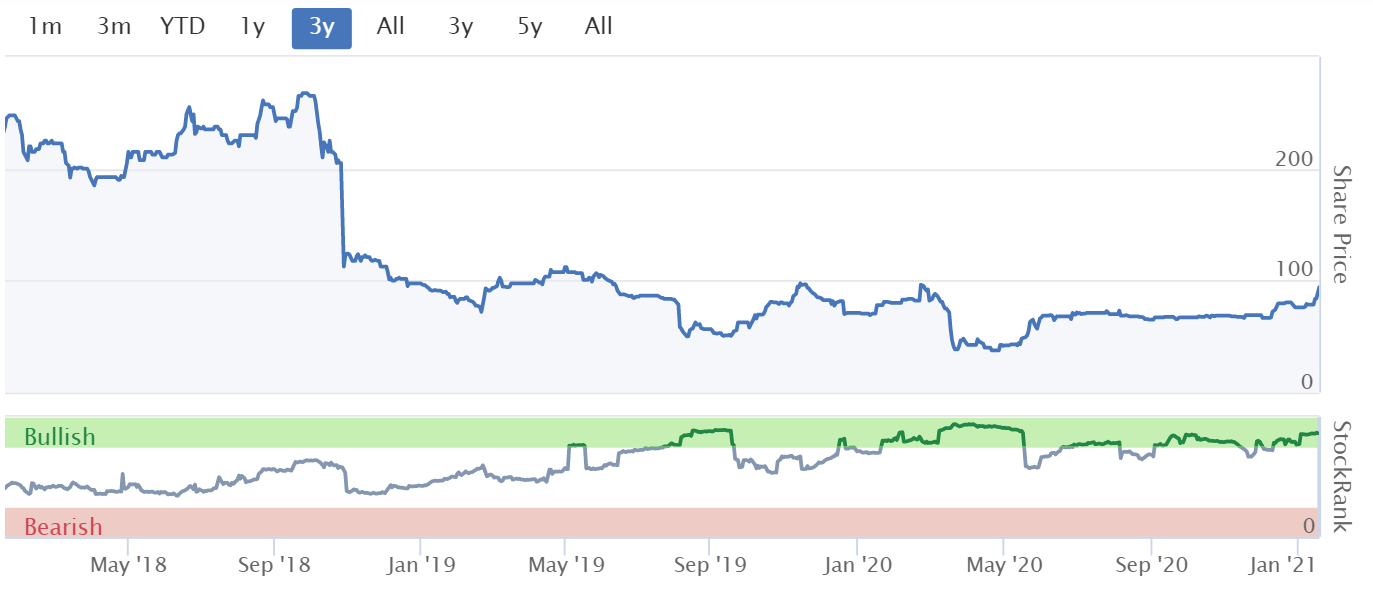
Note below that the share price seems to have formed a base, and the StockRank is high. Although the 2021 broker consensus forecasts look challenging, which might cause the value score to reduce in future, if they are lowered?
.
.
Augean (LON:AUG)
205p (up 9% at 09:14) - mkt cap £215m
This hazardous waste recycling company has been on my radar for a while, I reported on it here 6 times in 2020.
It looks a very good business, but has a large ongoing dispute with HMRC, £40.4m disputed landfill tax (paid in full by Augena). That’s equivalent to 19% of the market cap, so it’s a material issue.
Trading Update today -
Augean plc ("Augean") one of the UK's leading specialist waste management businesses, announces that trading has recovered strongly through the second half of the year and the Group expects, subject to audit, to report adjusted PBT for the year ended 31 December 2020 at least in line with the prior year despite the impact of Covid-19 and the resultant decline in the North Sea business.
To put that into context, at the half year stage, Augean was trading below LY -
Adjusted profit1 before taxation decreased 11% to £8.5m (2019: £9.6m)
[from 2020 interim results]
Looking back to FY 12/2019, it reported this -
Adjusted profit2 before taxation increased 68% to £19.2m (2018: £11.4m)
[from 2019 preliminary results]
Note the big rise in profit in 2019. So matching that result in 2020 (a turbulent year) strikes me as pretty good.
North Sea business - costs cut, to reflect forward trading conditions. £3m exceptional item will be included in 2020 results.
New contracts for £6m annualised revenue won, energy from waste.
R code - a completely unintelligible section on this, no idea what it means, but presumably positive, or they wouldn’t have mentioned it!
Net cash of £6.4m (excluding lease liabilities), which includes benefit of £3.5m VAT deferred until March 2021. Thank you for disclosing the creditor stretch. All companies should be doing this, as it’s vital information that investors need to know.
Diary date - preliminary results due “in early March 2021”
Dividends - Augean says these should resume in 2021, a good sign.
My opinion - I don’t feel confident in my ability to analyse this company, being so unfamiliar with the sector. There’s a really helpful update note out today from N+1 Singer, many thanks to them for this.
We’re looking at 15.0p forecast EPS for 2020, expected to rise further in subsequent years.
At 205p/share this means the PER looks modest, at only 13.7 on FY 12/2020 earnings (confirmed today, so no guesswork there), and that PER could fall further in future, if earnings rise.
The big dispute with HMRC has been paid in advance by Augean, so it doesn't look ruinous, even if they lose. If they win, then it's time to hang out the bunting.
Augean shares do look good, to my untrained eye. Investors probably need some sector knowledge to properly understand this one. So bear in mind that I might have missed something in my reviews.
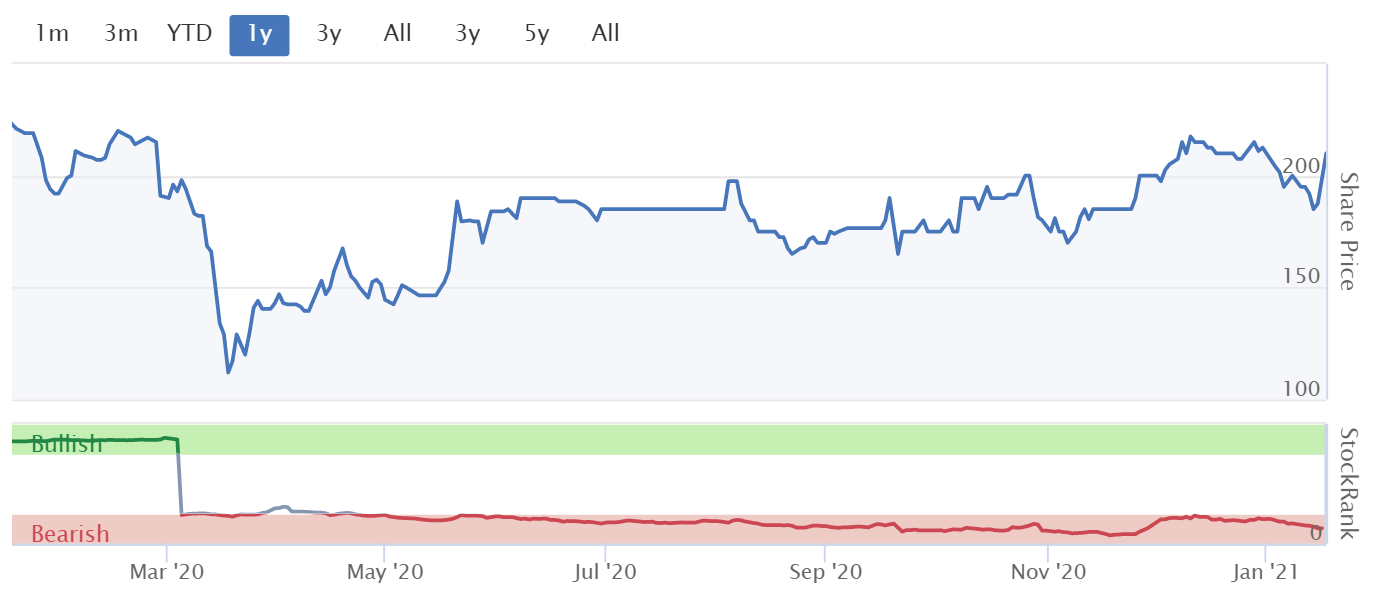
It's strange that the StockRank is so consistently low, am not sure why that is.
.
.
Cppgroup (LON:CPP)
A very quick comment on this micro cap, which is up 54% today on a positive trading update.
It says this today -
As a result, the Board expects revenue for the year to 31 December 2020 to be circa £140 million compared to the current *market consensus of £133 million.
In light of the solid trading performance and a proactive focus on cost management across the Group, the Board now expects to report EBITDA in the range of £7.1 million to £7.3 million, which is more than 10% ahead of the market consensus of £6.4 million.
I've gone through the numbers, and want to flag up that last year, £4m of the EBITDA isn't what I would regard as real profit. That's because the company capitalised around £2m of intangible assets, which looks like development spend. Plus there was c.£2m in rents which go through finance charges (IFRS 16).
Cash -
As a result the Group's financial position remains robust with a cash balance as at 31 December 2020 of £21.9 million.
If you check out the balance sheet, then most of the cash is offset by creditors. So overall, the balance sheet isn't particularly good, or not as good as the gross cash figure suggests.
My opinion - this company has a bit of a chequered past, it came very close to going bust a few years ago, and I think there might have been some regulatory issues too, possibly? Therefore, it needs careful scrutiny before getting carried away with a positive update today.
That said, the update sounds good, and it might be worth doing a bit more digging on this one.
.
I'll leave it there for today. Thanks for the interesting reader comments, some good stuff there, especially the podcast recommendation, which I found fascinating. Good book & podcast recommendations on shares/markets/economics are particularly welcome.
Best wishes, Paul.
Disclaimer
This is not financial advice. Our content is intended to be used and must be used for information and education purposes only. Please read our disclaimer and terms and conditions to understand our obligations.

86 comments
Hi dahokolomoki, this is true (currently) however if you watch the great presentation that Tamzin from PI World produced after their interims it seems like they are evaluating the installation of a mill to produce their own pulp and tissue and seem quite a distance along that road.
PI World - Accrol
Cppgroup (LON:CPP)
I looked at this briefly last year and noted that it didn't actually generate much cash.
EBITDA (c£7m) looks remarkable relative to the Market Cap (c£40m), but I will hold judgement until I see a cash flow statement.
A
I saw a management presentation by £cpp at a Mello. They were a shower!
Sorry, I don't know what this mean. Golden?
Augean (LON:AUG) (I hold)
WORST CASE
My estimate is that even if Augean is forced to pay the higher rate landfill tax going forward they will still be generating c £15m of free cash flow per year (that's after capex costs).
Given the niche it operates in I personally apply what I think is a conservative x15 multiple = £225m target.
The current EV is c£200m.
So my worst case scenario is higher than the current share price - downside risk should therefore be minimal.
BASE CASE
If, however, no higher rate landfill tax is due, then Cash Generation (again, after Capex) should be closer to £23m-£25m per year.
Applying my x15 multiple again = £345m-£375m ie. +80% from the current price.
HMRC
1 - For reference Biffa (LON:BIFF) (no position) recently stated the following with respect to what appears to be a similar landfill tax dispute with HMRC:
2 - And finally, for those interested here is a snippet from the management team talking about the HMRC issue and their observation that HMRC hadn't even visited any Augean sites when they retrospectively asked for higher landfill tax. It actually all sounds like a bit of a farce, with HMRC clutching at straws, but then management would say that.
Start from 09:45, and the important bit lasts for about 5 minutes.
https://www.youtube.com/watch?v=pJUfYj8jdX4&t=0s
Cheers
Abs
Hope Paul is right about the roaring twenties but i'm not sure.
I see a year of protests and discontent as business fail due to end of covid support and brexit and the realisation weve given northern ireland away.
We signed a deal with the EU which is for goods only, most of the goods are being imported not exported so its great for the EU, we've gotten nothing for services and banking which is 80% of the economy.
I really hope Paul is right but i see a bumpy 2021, personally i'm increasing my cash and precious metals
Just want to make one point, UK service sector is made up of retail, hotels, restaurants, transport, storage, IT, finance, insurance, real estate, administration and support services, professional, scientific and technical services, education, health, social work, arts, entertainment, recreation, public administration, defence and several more. (These all make up the 80% GDP)
Pure banking services make up about 6% of GDP and a much smaller portion of this is to EU companies - around 1-2%. There was never an agreement or 'trade deal' on banking services before Brexit and how regulators work together across boarders (or not so much) is still being discussed. This is improved by having the major agreement for goods in place - which is the real concern for Germany and France based on their economies.
E.g. Switzerland have just signed an agreement with us on share trading which was banned by the EU in June 2019 (27% of this was done in London so hit us most) and the EU has granted temporary access already for certain activities but the talks are ongoing until an expected agreement by March (whether this will be extended who knows?).
There is certainly a big question mark over covid and how services generally will bounce back but I think Brexit is largely a risk which has passed.
Accrol Group (LON:ACRL) H1 results presentation given as part of the roadshow last Friday (15.1.21). Strong cash generation, margins strengthening and FY21 at least in line with expectations.
Video or Podcast.
I was brought up on the fear of inflation following the 73/74 debacle. I have duly been expecting inflation to show and to no effect. But increasingly I am of the opinion the hostile weather we are starting to see will impact on some commodities. The US wakening to global warming. The weaknesses in the current finance system. The debt cycle created by Covid. These will all lead to a great reorganisation. A lot of the "bluechip" if they ever existed will disappear. As stated in an earlier comment we are living through great change. Investing like ours will have to capture what we can of it. The share price of ITM, Simec Atlantis, new energy stocks is sky high so a lot of progress is expected. ITM has a mkt cap of £3.5bn!!! The market is expecting the whole energy supply chain to change at a pace now. That will deliver great opportunity to a few service providers, like Pressure Tech or Lamprell. Whether this process could offset the issues with debt which is in part carried by the old guard leaves a lot to guess at. Consider the Oil companies which haven't even started depreciating the oil in the ground which they won't be able to move. So a lot of debt will have to be written off I suspect. Transport is under pressure with this Govt banning the petrol engine in the future. How much R&D is in the car manufacturers which will never be collected on? Should the High St ever come back? How will that affect the property cos, which are largely financial plays anyway? Can we continue to build houses on scarce land leading to poor choices like flood plain? Will we all fly like we have done in the past, having seen how covid has benefitted from the being able to get from China to Mr Trump so quickly. Meantime Govts have to pay for us all from taxes where are these going to come from? The soft under belly of our society will be exposed and we will have to change our approach to most things. We live in changing times and the change will take place faster than any other society has every experienced them on a global scale. Add inflation it will be very difficult. This of course is why money has become the god as people try to insulate themselves against something that needs to be handled by everyone together. Anyway I will go and take my pills now and dream of the good old days!!!
Totally off topic , sorry.
I subscribed to John Authers Bloomberg Newsletter, on Paul's recommendation ( thank you) but didnt receive one this morning !!
Did anyone get theirs or maybe he is on Vacation :-))
Did not get one either
Didn't get mine either, presume because its MLK day - US markets closed.
Martin Luther King Jr. Day
Of course, thank you.
Try Bill Blain’s Morning Porridge also amusing and insightful like John Authers and Paul https://morningporridge.com/th...
Hi Dicktrade,
I signed up the other day also and the e-mails came the following day, hopefully yours will also :)
Best wishes
Overall then, the news seems supportive of my current portfolio view, that retail/leisure/hospitality/travel could be getting somewhere near back to normal in April/May.
I take a more cautious view. That may well happen, there's no doubt that govt would like it to. But, it potentially carries risks that could lead to further restrictions later in the year. People are rightly becoming more worried about covid mutations. And the frequency of mutations is directly linked to the virus reproduction rate. That means that if people go back to "normal" behaviour once the older and more vulnerable have been vaccinated, there's a real risk of a large increase in infection rates amongs younger people. They may be much less likely to die, though many will suffer from the infection, but if a large pool of infection exists then there will be more mutations. And while most will be irrelevant or benign, some may be more infectious, more lethal and/or not protected from by existing vaccines. If that happens then further restictions could become necessary in the future, which is likely a worse economic outcome than easing restrictions cautiously and slowly.
The only real way round that is to vaccinate most of the population, so that reproduction rates become very low. And I think an awarness of that is behind some recent statements about aiming to get all adults vaccinated by end of June or so. So my expectation is that, the likely path is going to be a gradual easing of domestic restictions from around April, not a complete removal at once.
Add to that continuing high infection rates elsewhere in the world, and hence possible dangerous new mutations developing and I would not be surprised to see international travel restrictions being slower to lift.
And here we are, worried of being subject to invaders from Space and now, and in fact, by the microscopic.
Immigration too will have had a significant dampening effect on inflation.
Book your staycations now. Couldn't get a campsite summer 2019 (seems so long ago) and Mrs Farmer rented out her field with a portaloo and er shall we say oversubscribed. Suddenly a caravan becomes the hot investment of the century. Or how about a Campervan - but 20 mile traffic jams through A303 Stonehenge is no holiday - "are we there yet" - oh and lets not watch the 'battery indicator' :)
So that conservatory extension, loft (if can find a builder would trust with a blocked sink), Peloton cycle (nah) - no room anyway the 'gym' 'spare room' is the 'office' now. Upgrade house to the country? Nope.
Sainsbury (food Argos Bank) and M&S (website is quite good INHO) on my watchlist.
Pubs - went to a beer festival in Hackney 2019 - a million years ago. Thankfully have the photos for the grandkids album of how the oldun's used to live.
Tax - see some director outflows so Mr Sunak's plan will take 'skin' out of the game to lose another plus metric. The so called Middle Classes next.
Tax - a common them for the robber barons - buy-to-let tax no longer a benefit and with tenants at risk of losing their jobs makes it a 'sucker' game and sell then get CGT (let the govt build more then).
Inflation - ditto property with leverage. Food will benefit - already price up quality down IMHO.
Looked at China/Alibaba but "wheres Ma" - governments not good business make - but then?
NIO cars anyone - Tesla beating 0-60 in nanoseconds - but with Mr Plod's improving hand held tech and need to fund stuff - game over. Anyway we will all be in Total Recall Cab or Noddy Cars by 2030. If you can drive a nice car (sorry dirty horrible killing machine) then do so now - Best Of The Best (LON:BOTB) (got bored and sold a week back so ignore my insights).
There seems to be an investment law - the day you sell is the day it takes off. Same with Kromek - Mr Market knows how to squeeze the weak hands.
Hi Paul,
Thanks for your thoughts today
A couple of points....
Firstly on inflation:
Terry Smith in one of his annual shareholders meetings put forward and interesting theory on quantative easing and the lack of inflation.
His theory: a huge deflationary force that wasn't being recognised - globablisation and cheap manufacturing from China.
It makes sense that if we have an unrecognised deflationary force, QE could continue without inflation bubbling up in the economy.
He made a historic comparison to the USA in the late 19th/early 20th century, when the USA industrialised and was seen as a deflationary factor.
Secondly, on Augean (LON:AUG) stockranks:
These were high, until last year when Augean recognised a hit from the £40m payment to HMRC, which hit the quality metrics (ROCE etc), and value metrics (swung to an accounting loss).
Thanks,
Charlie
His theory: a huge deflationary force that wasn't being recognised - globablisation and cheap manufacturing from China. It makes sense that if we have an unrecognised deflationary force, QE could continue without inflation bubbling up in the economy.
Agreed - although it's hardly unrecognised. But how can demand outstrip supply when you have hundreds of millions of people still being connected to the global economy via smartphones and the internet?
The only plausible answer is via political unrest forcing the raising of trade barriers and border controls. But China's economy is probably beyond limiting now, so all that will do is allow China to influence even more of the world than it does already.
Locally - especially in the UK - there is a real chance of short term inflation. Globally it's not going to happen. MMT may trigger other sorts of issues, of course, but that's another matter.
timarr
Thanks for the response timarr,
I'm not sure I follow your point on demand and supply - are you saying that even though we are in lockdown demand continues remotely?
Cheers
Charlie
Hi Charlie
I'm not sure I follow your point on demand and supply - are you saying that even though we are in lockdown demand continues remotely?
No, it's nothing to do with the current situation, it's about the long term globalisation of the economy. Thirty years ago someone could earn a decent living as a semi-skilled worker in manufacturing. Now they're in competition with lots of people on lower wages in SE Asia.
Or, twenty years ago someone could demand a high salary as a software engineer in the UK, now they're in competition with hundreds of thousands of equivalently qualified programmers in India and China. Demand for those services has gone up and there's increasing specialisation, but overall the trend has been towards more competition for jobs and wages for many people have stagnated.
Wages can't increase if people can be easily replaced and if wages can't increase then people can't afford to pay more and if they can't pay more then inflation has a natural limit. That's deflationary. It doesn't matter how much money governments pump into the economy, if it doesn't end up in peoples' hands so they can spend it then it can't drive up prices.
The UK is a different matter. Raising trade barriers will force up prices. Either wages increase, decreasing profits or wages stagnate and people need to find ways of economising - which probably, but not necessarily, leads to recession. Against that we have a lot of pent up savings to be deployed and the government will pump money into infrastructure projects.
My guess is that wages will increase for the lower paid as limiting freedom of movement will reduce the pool of workers and increasing import costs will encourage more home production, requiring more workers. Company profits will probably be hit and this will be inflationary although how inflationary is hard to say. But the UK is a special case.
timarr
Thanks timarr,
I follow you now, and agree with what you're saying.
It will be interesting to see if UK workers can demand a higher wage post-brexit. Perhaps in some sectors where jobs cannot be moved overseas because the job needs to be done in the UK, such as care work, construction we could see an uplift.
I do think there is an interesting and perhaps serendipitous counter to this.
I don't read too much on this board or other forums I follow about the jobs crisis that is happening amongst our lower paid workers and frankly I would judge that some of those jobs won't be coming back. This could enable something of a reset.
If the "middle classes" exit the pandemic with pent up spending power then perhaps to some degree displaced "working class" former workers will step into (be forced to step into) the space vacated by "cheap foreigners".
I use stereotypes there to make the point more obvious - it is clearly far more nuanced than that. If you need to reshape the economy though , this might not be the worst time to do it.
There is a far more lengthy argument on this subject, that I have (very briefly) touched on before; but when ones get past the Brexiteer vs Remoaner narrative; the key factors will be more in depth and less obvious.
Hi Gromley
If the "middle classes" exit the pandemic with pent up spending power then perhaps to some degree displaced "working class" former workers will step into (be forced to step into) the space vacated by "cheap foreigners".
Well, ideally you'd import cheap overseas labour to do the low paid stuff and train up your citizens to perform higher value jobs, increase productivity and generate economic growth. As it stands, we'll likely see the wages of unskilled and semi-skilled workers rise for no productive benefit.
That's not a moral statement - I think raising wages at the low end and decreasing earnings dispersion is a social good. However, doing so without associated productivity increases will lower earnings and decrease profits and make us all poorer.
In addition the plan to manage the skills gap by importing talent is morally dubious. For example, should a rich country like the UK be importing medical staff from poorer countries where their skills are desperately needed? Nothing stops us training our own people other than the fact it's expensive and it's easier to poach skills from elsewhere.
But more generally, the pandemic has thrown into sharp relief the lack of scientific skills in the general community. It seems most people really don't understand what "exponential" means.
timarr
Inflation: “I read an article (sorry cannot find the link) saying that Germany and the USA both have pent-up inflation about to appear, because of annualising of factors which had previously pushed down inflation a year earlier. Higher commodity prices were also mentioned as a factor behind looming higher inflation.”
Paul Donovan UBS Chief Economist said on Bloomberg this morning that economists, central bankers and politicians would ignore this blip caused by the negative oil price a year ago.
Powell stated at the last Fed press conference stated that “the economy remains far from the Fed’s goals and he sees no reason to alter its highly accommodative stance “until the job is well and truly done”.
I do remember high interest rates and inflation. My first mortgage in 1985 had a rate of 15% within months of taking it out (and it was three times joint income ouch). The history of bank rates at https://www.bsa.org.uk/BSA/fil... makes quite interesting reading.
I used to get regular cost of living rises back then but they didn't keep up with my mortgage.
I took out a loan on buying a commercial property in 1978 at 3% over base. Base rate then went to 17% so I was paying 20% which was equal to the total loan repayments I was making. Hopefully, that will never happen again but somehow most people survived it.
Snippet below from Mark Brumby’s Langton Capital daily news email this morning which I think could cause some wage inflation at some stage of the recovery!
“• Where did all the kitchen and serving staff get to?
• A report by The Economic Statistics Centre of Excellence suggests that an 'unprecedented exodus' of foreign-born workers could have led to the UK populations shrinking by 1.3m last year. London alone could have seen its population fall by some 700,000. These will be mostly younger workers without dependents. It will have an impact on demand, output and the availability of labour.”
Firstly Paul, I’d like to thank you for the prodigious effort, work and insight that both you and Jack bring on a daily basis. It’s much appreciated!
Re the markets, I feel risk/reward is increasingly finely balanced. Vaccine news generally is good though virus news generally worsening perhaps and the markets clearly believe that ultimately we “beat” the virus whatever beat looks like.
However, there are plenty of near term downgrades coming through now as analysts readjust for the new lockdowns so recovery reasonable p/e are often out to 2023 assuming all goes well. The market was a no brainer for these names in late summer pre vaccine, it’s just not quite as obvious. Nor does it take into account the changed nature of a lot of the companies. Some will be leaner and stronger with better dynamics, others will have issued equity thus reducing upside. Others have taken on debt that needs to be serviced so it’s a very nuanced picture now.
As for inflation it has always been with us! Since GFC we have seen huge asset inflation rather than in goods and services. The QE taps have flowed and this has all gone into assets. If we were to see Biden and other governments actually boost fiscal spending this will ultimately see tapering on the monetary side. It’s why the $ a huge consensual short has started to rally as people begin to consider this and the implications for rates. My first flat I was paying 15% interest on the mortgage!! Clearly we’re not going back there but the world is built on an edifice of debt.
Finally Tesla does look totally crazy-it’s an inefficient car company! The other sectors though such as software and cloud are more interesting though. Optically they clearly look expensive. However, we are clearly in the middle of an industrial revolution and they are able to scale to a global level something that was never possible historically. It’s not a justification for the valuations and they absolutely cannot all be winners. Looking at the FAANGS though tells us some of these may well grow to huge sizes.
There is a tremendous amount going on in this market. I am probably worried that there is increasing consensus around a lot of big themes. In my experience that usually causes some serious volatility!
Inflation/(Deflation):
Savings have increased dramatically this year but lending has not increased at the same rate with loan to deposit (LDR) ratio dropping for all banks and it is watched closely by regulators for two reasons; they don't want over extended lending on high LTV loans with demand deposits, and they want them to buy higher ratios of HQLA (High Quality Liquid Assets i.e. gov bonds). This has also been driving the record rally in bonds.
This has a deflationary effect on the economy and why we do not see inflation from QE and why we did not see much inflation post GFC and the several rounds of QE and base rate being 0%. This can be seen in a graph comparing M0 money supply and inflation because huge increases in M0 have had little impact on inflation between 2010 and 2020 - particularly in the UK where inflation actually falls during a constant increase in money supply.
The Bank of England is now considering Monetary Stabilisation Bonds to 'soak' up this excess liquidity, rather than just adjusting reserve requirements, and it is something the Bank of Korea already use.
Why it hasn't happened?
A likely reason for this in the idiosyncrasy for the UK is fiscal spending decreased throughout this period and that is the key change in 2020. The enormous increase in fiscal spending will likely offset the strong deflationary pressures on the economy but should also lead to economic growth. I wouldn't say right now that 1970s style inflation are likely again though, I think that is only looking at one side at this stage because there are strong long term deflationary pressures and it is managed much better by the BofE and the Fed these days. That is not to say we won't see inflation, we most likely will.
What does this mean for shares?
Well two fold, yes higher rates will mean valuation will be cut, however, is that likely even with inflation? - Probably not. This is because central banks cannot raise rates even with inflation due to poor growth and other deflationary pressures, like raising taxes, and they have expressed little interest in doing so. The second is, the direct fiscal spending has benefitted companies like supermarkets but also companies like Apple as most Americans spend their direct cheques on iPhones.
This means not all frothy valuations are at significant risk if their benefits from fiscal spending outweigh the competing inflationary pressures. This is not to say some don't defy sound valuations and growth expectations, because some do, but more that it is a bit more finely posed than 'US tech is expense'/'growth is expensive' etc.
MMT
"Government bonds don't actually need to exist at all. The whole lot could be bought back & cancelled, using newly created money."
Monetising central bank government bond holdings does not work for two reasons; monetising the debt would not give any more money to governments and from a cash perspective is no different to 'means to an end' warehousing of debt which central banks are doing now based on set term-times. Crucially, it assumes this can happen repeatedly. However, if monetised once, who would then buy government issued bonds the next time? Who would use that currency if they saw an infinite issuing of debt and subsequent cancelling of it?
Secondly, the 'monetary base' or liabilities and free reserves of the central bank would become effectively worthless or at the very least undeterminable in value. That would cause havoc in the commercial banking industry who account for that monetary base.
A few links:
Why Markets Boomed in a year of misery:
https://www.nytimes.com/2021/0...
Money supply:
https://tradingeconomics.com/u....
Inflation:
https://tradingeconomics.com/u...
Why QE didn't cause inflation:
https://www.investopedia.com/a....
Gold will be king?
I'm not a fan of Gold, it has a purpose as an asset but usually when there is nothing else worth buying and it has a tenancy to drop a lot when a crisis subsides and particularly in 'risk on' which we are already starting to see a bit of.
Over many decades it will go up due to the accumulating long term credit cycle but I think it will be an underperformer for the near future and the horse has already bolted the stables in the near to medium-term in my opinion.
Warpaint will do better when the bargain shops such as B&M are in full swing post covid. I don't think they really had the chance to make the sales when the lock-down came into force. Not a bad mid term punt in my opinion. P/e 10 and reasonable dividend - cheap
£W7L. B&M never closed during lockdowns as they sell some food, so their sales were probably higher as some of their rivals were closed.
On "sharp correction in expensive US markets"
Scott McNealy (SUN) provided a very good quote on the .com boom in 2002 that I have used in the past many times
… two years ago we were selling at 10 times revenues when we were at $64. At 10
times revenues, to give you a 10-year payback, I have to pay you 100% of revenues
for 10 straight years in dividends. That assumes I can get that by my shareholders.
That assumes I have zero cost of goods sold, which is very hard for a computer
company. That assumes zero expenses, which is really hard with 39,000 employees.
That assumes I pay no taxes, which is very hard. And that assumes you pay no taxes
on your dividends, which is kind of illegal. And that assumes with zero R&D for the
next 10 years, I can maintain the current revenue run rate. Now, having done that,
would any of you like to buy my stock at $64? Do you realize how ridiculous those
basic assumptions are? You don't need any transparency. You don't need any
footnotes. What were you thinking?
It was reproduced in the latest Bronte Capital note and below the quote are some charts.
TSLA is on 25 x revenues, and is not the highest multiple.
To play devil's advocate - what if those revenues grow massively in the future?
I do agree though - valuations for some (particularly companies like Tesla and Palantir) are completely insane at the moment.
I was going to say the same thing and that is usually priced in pretty well for most companies - take the top line growth and make a discounted cashflow assumption from that on what it will mean for bottom line ROI over 10 years. Some companies at even 10x sales end up beating that ROI and provide a quicker return on price than those trading at 1x sales because their growth in top line is flat and their margins are wafer thin with no operational leverage.
There are subtleties in there.
A small start up, not much revenue, good moat, big market, 25 x revenues may be cheap.
A large manufacturer, lots of revenue, not much moat, sells ~0.5m cars into a market size ~11m
Average Price / Sales in the S&P 500 is ~2.7, , 25 x revenues may not be cheap.
Assuming long term reversion to mean, for the current SP, that manufacturer will need to occupy > 50% of the market.
Completely agree and it is all relative because a $10bn company could be in a $200bn market or a market which is growing at 20% per year itself; excluding the company's execution on growing its market share.
Conversely, it can can be in a very mature market that needs a huge amount of Capex to even retain share (I'm thinking old Telecoms which used to be so lucrative) but a small disrupter into this market can grow very quickly (I'm thinking Hyperoptic in the Telecoms market who had a different business model to BT etc.)
The expected growth in relation to the market size needs to be realistic.
Paul, thanks for thought provoking opening. I recently bought the audio book of Stephanie Kelton, The Deficit Myth which you recommended recently. I am not an economist and so wanted to understand MMT. If I understand them correctly, the theory seems to be that inflation is a warning sign of under capacity, and whilst some jobs have been protected through the furlough scheme, many have been lost. The same is true in the USA. So I would assume we have plenty of capacity to keep inflation at bay, as long as Companies and the Government provide jobs? Also if their theory is correct, the Government spending/QE shouldn't be an issue as the Government can buy back the bonds and cancel them, as they have been doing.
The question the book hasn't quite answered for me is the impact on the value of the currency. If the USA has printed so much more money in relative terms to other sovereign nations, why wouldn't their currency devalue, and couldn't that stoke inflation as they import more goods. Having said that, every other Sovereign Currency provider are doing the same (UK, Japan, China) so that should be contained. Also Japan has been doing this for years and inflation hasn't been a problem.
Having said all that, we are dependent on Ministers and the Treasury having read the same book and buying into the theory! Would recommend the book. Appreciate you and Ed for pointing it out.
Government spending/QE shouldn't be an issue as the Government can buy back the bonds and cancel them
Correct. In normal conditions. But once inflation is out of the bag, buying back more bonds will mean more newly printed money flowing to the system. Unless equal or more bonds are issued then that money has to go somewhere, causing more inflation.
You could then issue loads of bonds and suck out liquidity in the system. But that will cause prices of all bubblicious asset classes like shares, bitcoin, etc to collapse in value as people rush to sell to buy tempting bond yields. Triggering financial instability.
Once inflation gets high and cannot be tamed, there are no good options.
Re inflation, Paul, you are younger than me, so probably avoided all this, but when I was doing my accountancy training, we had to spend an inordinate amount of time on learning about inflation accounting. There were 2 different methods - Constant Purchasing Power, and one I have forgotten! The profession struggled to choose a preferred method.
My point is that significant inflation causes a big diversion of effort in the finance industry, and can easily lead to misallocations of capital.
Paul,
As always, a fascinating post. You describe your shorting/hedging strategy. How does that manifest itself? Do you short the Nasdaq? CFD or spreads? What sort of stop loss do you operate? I would love to know how you think about it/go about it.
Thanks
Paul,
I share your concern about the toppy valuations in US Tech stocks, EG $TSLA where I have a fair bit of exposure via several Baillie Gifford Trusts in my SIPP. I don't have a spreadbet account ( as I don't feel I have the experience) and have burnt myself on shorts before due to the daily volatility compounding effect. I'm tempted to buy £QQQS as insurance (3 x NASDAQ short) and would be interested in others views on the best insurance via a long term short?
Paul. I like your take on inflation this morning. As you say, for those of us that remember what havoc inflation can cause its a timely reminder. I wondered what your opinion is on inflation linked bonds if you have a view as a diversifier and possible protection?
@grout123
I have held £INXG since 2014 as as inflation hedge. I paid £13.25 then, they are now over £19. They have tended to act as a portfolio stabiliser, moving opposite to the short term moves in my portfolio of small cap shares, which helps me sleep better.
Martyn
Thanks FREng
There is a lot of evidence that inflation is heading our way... one small example of this:
https://www.bbc.co.uk/news/bus...
In my business - raw materials for industry, we have seen soaring ocean freight costs (now 10 times the rates in October) coupled with higher purchase prices due to increased oil prices.
The sales prices we have had for the last 3-4 years will need to be much higher this year.
Brexit is just compounding the problem with increased paperwork and costs of importation and (in the short-term at least) restrictions on supply.
All this is only just beginning to hit the consumer goods that our products go into - think household textiles and soft furnishings...
Dunelm (LON:DNLM) , Scs (LON:SCS) , Dfs Furniture (LON:DFS) and many more.
"There is a lot of evidence that inflation is heading our way... one small example of this:"
Indeed! Anyone else noticed how much bigger those cardboard tubes in the middle of toilet rolls have become over the past few weeks.
Maybe that's another bull point for Accrol Group (LON:ACRL)
They don't grow/manufacturer the raw pulp that goes into their toilet rolls....! Will be the first casualty of higher raw material prices.
Stand by for cardboard tubes the size of paint cans - and 5 sheets per roll. All for the same price, naturally.
Strix (LON:KETL) - updates today on the Halosouce business it bought back in March 2019 for c£1m.
The business purifies water, killing 99.99% bacteria and viruses and seems to be attracting interest from pig farming (where the technology kills African swine fever virus) and dentists/hospitals.
There could be more to come, buried in the release is the comment" "It is anticipated that there will be a policy change in China which will require regulated water for use in all livestock farms, hospitals and clinics".
It's an interesting update. I bought it for the kettle controls business, but there seems to be nice potential upside from this part of the business.
Apparently Dominic Raab has said that it is too soon to be booking foreign holidays.
Probably very few people listen to that so probably no effect on travel stocks. Of course, if it turns out that we can travel freely by the summer people will moan that they are having to pay higher prices because they couldn’t book early because of what Raab said. But if he says nothing and then it turns out that holidays have to be cancelled then they will also blame him. A no win situation.
Surely people can just book holidays with companies that have a flexible cancellation/amendment policy. I was looking at AirBnB over the weekend, for holiday ideas, and you can check a box saying: only include properties where host has a flexible cancellation policy.
people will need to look at the country they are visiting and access its healthcare status, south america anyone, brazil, india?.....
I do think that there is no such thing as a free lunch and because of that funding government spending by money printing must have a negative consequence somewhere. Inflation is a distinct possibility. Partly I think that’s going to depend on just how much productive capacity has been lost in the crisis. So, inflation may strike much harder in countries that have done less to help companies keep afloat during the crisis.
But I also think that the negative effect of money printing could easily show up in some way other than inflation. One other way may be a loss of confidence in that currency. In the case of the USD that could lead to it no longer being seen as a reserve currency. If organisations around the world decide to reduce their holdings of dollars in favour of something else then that could cause financial mayhem.
So, in general I am trying to stay diversified across countries and market cap and invest mainly in companies with little or no debt.
Yes, the US actually want the dollar to go lower and this benefits the developing markets in the Far East so diversify. Also if one looks at the agricultural commodity markets they are all completing base formations.
Good news coming from the travel sector https://www.cruisecritic.co.uk...
Good morning Paul, do you think that the potential imminent spending binge will be tempered by the millions who were less fortunate and had suffered a devastation to their own personal finances as a result of the recent lock downs? Amongst my friends and family I've seen a mix of lockdown winners (i.e. saved a few grand on travel and work from home) and lockdown losers (who simply lost their job or who's income was greatly diminished). I wonder if personal debt will increase as those who lost out will attempt to keep up.
Definitely a lot of pent up demand, from my own perspective not so much on luxury items or trinkets, but spending on going out and seeing people.
And what might the implications be of increased unemployment and inflation?
Hi dconnor85,
Absolutely, good points. There have definitely been winners & losers in the last year.
I think the only meaningful way to look at it, is the net increase in bank balances, which is what I've been loosely following. Can't find all the relevant links, but to give a flavour, this article from Bloomberg from 30 June 2020 said that UK households added £56.6bn to their bank accounts in 3 months of lockdown 1. The data is footnoted to Bank of England being the source, so I might have a rummage through the BoE website now for more recent data.
I also seem to recall a more recent article saying the household income "forced saving" in 2020 might have gone up to £90bn.
Hence the overall net effect of winners vs losers seems to be skewed heavily towards winners. That's why I'm persuaded that the "roaring twenties" scenario, of a big consumer spending splurge in 2021 is not only possible, but likely.
Regards, Paul.
Used to be called stagflation - recession coupled with inflation. The hardest of all to correct
Morning Paul,
This is something I had been thinking about over the weekend. The End Game Ep. 5 - Russell Napier on Podbean.
https://www.podbean.com/ea/pb-pssc3-e54d18
I have listened to quite a few of Russell's podcasts. I'm sure he did a moneyweek one not long ago too. Anyway I'm thinking I might up my gold exposure.
Another one I was thinking might work if we see a commodity/inflation boom is $brwm.
If we see inflation will this follow through to commodity prices and commodity related equities? If we don't see inflation then the Green revolution may push commodities higher. Seems like a double hedge to me.
I came across the The Grant Williams Podcast, as Ed had flagged it in the coments of the recent Naps update. Episode 3 - Mike Green is well worth a listen. And also Ep 10 Chris Cole.
The whole end game series with Grant Williams is great.
He also guested on the Macro Voices podcast episodes 251 and 252 which covered inflation and fiat debasement. Well worth a listen.
Hi Michael,
Thanks very much indeed for this outstanding podcast recommendation;
The End Game Ep. 5 - Russell Napier on Podbean.
I found it on Google Podcasts, which was handy, as I didn't want to download another podcast app.
Just finished listening to it, and reckon I understood about 90% of it, but the remaining 10% was a bit above my pay grade, and I only got about half of the in jokes! (the one about the fish asking what water was, completely lost me! And by the sounds of it, the delayed & half hearted chuckles from the hosts, suggests they didn't get it either lol)
I do like a forecaster who admits to getting many things wrong - that adds so much credibility.
He didn't explain financial repression (I think he called it something else beginning with p?) at all well. But apart from that, it was superb!
Thanks again, Paul.
Hi Paul,
Not often I can answer a question here.
.."the origin appears to be from a joke where one fish asks another fish "how's the water?" The other fish replies, "what the hell is water?" The point: it's easy to forget that what surrounds you is only normal because it's what you know. To others, those surroundings might seem pretty strange..."
HTH and ATB
"I only got about half of the in jokes! (the one about the fish asking what water was, completely lost me! And by the sounds of it, the delayed & half hearted chuckles from the hosts, suggests they didn't get it either lol)"
My favourite speech: This is Water , David Foster Wallace - https://www.youtube.com/watch?v=8CrOL-ydFMI
I thought I was a stock picking genius. Turns out I was a dart throwing monkey sat in one of all the boats floating on a rising tide. Wise words Paul. I think we'll see some of the froth blown off the market over the next few weeks. A massive recovery is already priced in. I expect more "taper tantrums" of a few years ago as markets start to worry about inflation.
Comments on the final results of Afh Financial (LON:AFHP) would be much appreciated
Sorry, I don't usually cover asset managers. I've pinged Jack to see if he's got any spare time to look at it.
My morning smallcap tweet: Good showing from Warpaint
Funding Circle Holdings (LON:FCH) Iconic Labs (LON:ICON) Equiniti (LON:EQN) CPPGroup (LON:CPP) Augean (LON:AUG) IQGeo (LON:IQG) £W7L Devro (LON:DVO) Velocys (LON:VLS) Faron Pharmaceuticals Oy (LON:FARN), Sourcebio International (LON:SBI)
Funding Circle (FCH) H2 total income of £121m and adj EBITDA at least £15m, well ahead of previous expectations (whose?). "As a result of Covid, we are seeing an acceleration in the shift towards online in small business lending. As the largest online SME loans platform we used our advanced technology to reach record levels of lending in 2020." [SP=90 Cap=318m]
Iconic Labs (ICON) repudiates press release issued by OTT Holdings which makes various allegations. Co has not had a 'valid' requisition for and EGM. [SP=0.01 Cap=3m]
Equiniti (EQN) in talks to sell Selftrade. This would be the third time it has been sold while I've been a client, since it was Comdirect. [SP=118.8 Cap=434m]
CPPGroup (CPP) guides FY(Dec) rec c. £140m vs consensus £133m. EBITDA £7.1-7.3m vs consensus £6.4m. Cites stronger than anticipated in India. [SP=326.5 Cap=29m]
Augean (AUG) guides FY(Dec) adj pretax at least flat "despite the impact of Covid-19 and the resultant decline in the North Sea business." £3m writedown in North Sea asset values after further rationalisation. Expects to resume divs this FY. [SP=189.28 Cap=199m]
IQGeo (IQG) guides FY(Dec) rev at least £9m (£7.8m) and adj EBITDA loss c. £2.5m (£4.8m). In line? "IQGeo sees continued strong market demand reflecting the fact that both telecoms and utilities markets have been less affected than other sectors during the Covid-19 epidemic." [SP=93.6 Cap=54m]
Warpaint London (W7L) guides FY(Dec) rev at least £40m vs board's expectation of at least £37m. Adj op profit over £2.6m before FX charge and over £2.2m net (guidance £2m). Tesco Express will stock 15 products in a further 469 stores and 96 more main Tescos to stock products. [SP=83.75 Cap=64m]
Devro (DVO) guides FY(Dec) op profit around upper end of analyst expectations. [SP=155 Cap=259m]
Velocys (VLS) Shell leaves has withdrawn from the Altalto JV "by mutual consent". Leaves British Airways as partner. [SP=10.4 Cap=111m]
Faron Pharmaceuticals (FARN) US Department of Defense has selected the HIBISCUS Study (for intravenous IFN beta, potential treatment for severe COVID-19 patients.) to receive $6.1m funding. Contract follows. [SP=279 Cap=131m]
In line: Sourcebio International (LON:SBI)
The problem Funding Circle Holdings (LON:FCH) have is the CBILS scheme was a one off. They earn money from arranging loans. Remember the loans are not theirs. They have arguably cannibalised their future opportunities as most businesses that qualify have taken a loan from someone. Going forward will their be demand? Will that demand pass through underwriting? Will they accept loans again at 20%?
The share never deserved a tech valuation and is still overpriced in my opinion.
It’s only hope would be a long term collaboration with a Starling or similar.
Funding Circle Holdings (LON:FCH) (no position)
Hi Camraid
CBILS (and PPP) were indeed the great opportunities and they flunked badly.
I was trying to go through the numbers today and I wasn't really sure what to make of them.
To make things even more confusing, it seems as though they have used an incorrect 2019 revenue number, unless I am missing something very obvious.
As for the future, I actually disagree somewhat.
The US looks like it's going nowhere, but the UK seems to be progressing. The hardest thing, as you say, is getting customers on-board, and they've done that to some degree. There will be demand in the future either from their current customers, or via referrals.
They have an automated approval process, which I believe is the first of its kind in the UK (decisions take hours, not days or weeks like traditional lenders) and if they can truly clear-up their balance sheet (a friend insists it is net cash anyway after accounting for the warehousing/ABS products) and they do truly remain EBIDTA positive, then there could be a gem here.
I, however, shall remain on the side lines.
Cheers
A
Hi Abtan,
As a business they create a lot of hot air.
Historically Funding Circle Holdings (LON:FCH) have spent 50% of revenue on marketing. The global expansion has pretty much been a failure and I believe some of their overseas offices are working as brokers rather than actual lenders.
They do have an automated approval process which is slick if the deal goes through without touching sides. If there are any questions that is where the problem starts. The quality of the front line staff is dreadful. I am not sure whether they just can't pay enough or that the training is poor.
My issue with the business is the tech like valuation. There is arguably no repeat income. The loan belongs to the investor and FCH charge a platform fee for arranging the loan. The argument that customers return for another loan is somewhat unproven. Insurance companies, etc.. talk about rates of renewal. Why don't Funding Circle? The loans in the main are 3 - 5 years and historically interest rates charged have been high (up to 20%).
So why are loans unlikely to renew?
Loans are typically for a specific purpose which is often one off and does not suit other finance products. A refurb of an office would be a good example. Cars and plant and machinery are renewed more often but are better suited to HP where the asset is used as security rather than directors guarantees.
Also don't forget that returning clients still have to go through the same underwriting process. If a client does want a new loan then due to financial performance or affordability criteria they may not qualify. If financial performance has improved and debts have reduced the business may well qualify for cheaper funding via the banks.
So in short there are 2 issues with renewals. Will the client need funding and if so will they need Funding Circle, and will Funding Circle approve the new application?
Demand is another issue. CBILS is an opportunity for them to shout about improved performance but this is a one off. I would suggest most businesses that qualified have taken a CBILS or Bounce Back loan from a bank, Funding Circle or another provider. This will mean for the foreseeable future they won't need a loan. The opportunity to refinance those loans will be minimal because in most cases the rates we so low compared to normal rates.
Let's assume a business does need a loan. It is likely do to ongoing distress caused by lockdowns. The actual criteria for CBILS has not changed so they are limited to 25% of turnover or 2 X wages. They are likely capped out. Their distressed financials and existing loans will also mean they don't meet the underwriting criteria.
Beyond CBILs the same issues apply and without the government offer FC an 80% guarantee. Underwriting loans will be tough. Demand will be lower and underwriting approvals will be lower.
The next issue is investors. FC have fallen out with retail investors like us and moved towards institutional investors. Read Trustpilot. FC only send review requests to client so by that they mean people they have approved and provided a loan to. As such the reviews are skewed in their favour. However, investors have found their way there and are unhappy as are those that have been declined.
Of the existing loans prior to Covid, what will the performance be? If bad debts are high will institutional investors want to continue supplying funds? Funding Circle sold some loans to a hedge fund recently. I think bad debts will increase and investment will be harder to come by. This may means institutional investors want a higher return forcing rates even higher than they were before. This will reduce demand.
Overall I think the model is flawed. There is no repeat income to talk about and the likelihood of renewal is not the same as with revolving credit facilities, log term loans like mortgages or insurance products.
This business was overvalued on hype and hot air. The business remains full of hot air although the hype has arguably dies down.
2021 will show it's true capabilities. Income will drop significantly from 2021.
Mr C - I also had a Comdirect a/c but I make this a potential 4th sale!
2004 "The buyers are Lloyds TSB Development Capital which will own just over 40%, comdirect's UK management with just over 30% and Numis Corporation, the institutional stockbroker. Comdirect has some 60,000 retail customers and handles an average of 2000 deals a day". https://www.thisismoney.co.uk/...
It changed name to Squaregain. A year later Lloyds sold its stake, which cost£6.8m to Boursorama for £51.2m. https://www.buyoutsinsider.com...
A year after that Boursoama's parent SocGen merged it with another unit and it became Selfrade. https://www.finextra.com/newsa...
Then in 2014 Equiniti took over. It ditched the Selftrade platform, which had been good, and I could see increased charges coming (Selftrade had no annual fee) so I got out
Me too. Also my Sharelink also become Schwab, became Barclays
Morning Paul, regarding interest rates, inflation and valuations. It’s certainly a thesis that I subscribe and I’ve generally positioned my portfolio towards debt free value (and value and growth at a reasonable price) stocks and funds whilst pocketing my tech related gains from last year. In theory it’s the indebted companies that will be impacted as their borrowing costs will jump, re the Tech sector.
One word of caution, the FED changed their policy in relation to rates last summer and are now happy to let inflation run hot for a prolonged period of time (above the usually 2% mark).
Will be interesting to see this play out. Have a good week.
Phil
Yes Philip, as so often, it’s all about the Fed! I have seen analysis that Trump measured his success by how the S&P 500 was doing and that President Joe will be different...but I wonder if the new administration would really be happy to allow a collapse in their stock markets to be facilitated?
That said portfolio positioning for possible inflation would seem to be pragmatic; accordingly I have the following components within mine:
* Commodities (PGM - via usual suspects of Tharisa (LON:THS) and Sylvania Platinum (LON:SLP))
* Gold (Small holdings in a couple of miners)
* Real Estate (via Investment Trusts)
* Cash (as Paul says to take advantage of opportunities from stock market swings)
* Equity with lowish valuations (both absolutely and in comparison to their own history) and low debt/strong balance sheets (thank you Paul) but with strong growth dynamics
* Some international holdings ( again via investment trusts) on the basis that businesses do not get impacted by inflation consistently across the world
Hopefully this will continue to be a profitable portfolio, inflation or not....but then there is always the next completely unexpected thing!
This is the approach I have garnered from my research and thinking, but as ever DYOR. Any other suggestions?
Martin
Hi Martin,
I think we have identical portfolios!
Re, commodities. I try not to buy individual resource stocks, partially for my sanity and time resource. For this reason I'm long the S&P GSCI commodity index which is a basket of all commodities, my thesis is demand will boom this year and supply will be constrained in large parts due to under investment and covid related labour issues.
I held gold and silver up until Q3/4 last year but rotated out of this in favour of a larger value based portfolio and Covid recovery stocks. I'm bullish on gold in the long run but I really think it's served it's purpose as a hedge against risk this year. I do intend to buy back into Silver as now the Democrats control the house and the senate I can see a large infrastructure package and green push coming which will require silver.
I'm also bullish tech, in-particular certain segments but valuations are too toppy for me and the risk/reward seems skewed to the downside in the short term, especially whilst theres so many great value & growth opportunities out there. I actually opened up a short on the Nasdaq circa 12700-13000, I'm uneasy with this so it's only a small position as portfolio insurance at this stage.
I hold a 10% position in the uranium sector (via Yellow Cake & GLC) and have done for several months, it's generally uncorrelated to the rest of my portfolio and a play on clean energy that the market is slowly waking up to. It's widely reported a spot price of circa $50 dollars is required to make a number of mines economical and I think they'll be a shortfall from wind and solar whilst the West race to being carbon natural. I also hold some other green related funds. China and India are actually building out their nuclear capacity still.
My main holding is value based and in-particular value and growth (the holly grail), it's hard to find these companies so I have a concentrated portfolio of less then ten holdings and then a number of global funds to help diversify. Trouble is the funds are slow and steady whilst my value and growth picks have all performed really well so I'm always tempted to go risk on and back my picks but common sense kicks in. I have tweaked my portfolio to ensure I always carry a meaningful portfolio weighting to my own picks, generally over 5% and usually no more than 10% otherwise I might as well just stick to funds!
I've been meaning to start a discussion about value and growth for sometime as I'm always eager to see what I've missed!
Thanks, Phil
Thought-provoking macro commentary regarding inflation risk. I am one of those who cannot remember a period of negligible interest rates (age: 39). What would the sensible portfolio-wide play be? A temporary shift to value, particularly recovery-bound value such as National Express (LON:NEX) or Redde Northgate (LON:REDD) with low P/E, to tide us over the next 12-18 months, then migrate back to growth? Do any sectors benefit in the short-term from inflationary pressure? Would a low P/E miner like Sylvania Platinum (LON:SLP) (I hold) be an extra smart play to ride through an inflation-spurred downturn?
This is my first recession as an investor and I have to say that I've learned more in the last 12 months about investing and myself, than in the previous 3-4 years combined. A lot of which I've learned right here- thanks Paul again for the received wisdom.
Thought-provoking macro commentary regarding inflation risk. I am one of those who cannot remember a period of negligible interest rates (age: 39). What would the sensible portfolio-wide play be?
You need to avoid businesses that have a high capex - basically with high inflation they're having to run just to stay still as the cost of their expenses rises. Ideally an investment should be able to raise prices easily without losing customers, although that's always true. You also need to be aware of the money illusion - company earnings will explode, but their costs will rise faster, cashflow is king.
Warren Buffett's letter's to Berkshire shareholders from the late 1970s and early 1980s talk a lot about this. However, the world today is a very different place to that.
It's also worth noting that over 200 years or so the burst of inflation in the 1970s and 1980s - when many of us started investing - is quite unusual. Interest rates are now exceptionally low, but the high rates of that period were very much the exception. I've noted over many years investors from my generation repeatedly warning about the possibility of inflation, but it hasn't happened yet. People tend to be scarred by formative experiences.
In the end inflation occurs when the demand for goods and services outstrips the supply. Since the beginning of the century the addition of over half a billion people to the global economy, most of them on what we would regard as low wages, competing with workers in developed nations, has been the dominant factor in driving down prices. That's led to wage stagnation in the developed world which has, ultimately, triggered political unrest.
To reverse that we'd see some significant shifts involving the raising of trade barriers pushing countries towards full employment and allowing workers to demand inflation busting wage increases. It's hard to see that happening globally although the UK may be a special case as we've just gone from being part of the largest free-trade area in the world to one that's smaller than our own borders. It would be surprising if the UK didn't see a burst of inflation - but outside of that it's hard to see where it's going to come from - most government spending is replacing lost income, not expanding it.
timarr
To fellow investors in ANGLE (LON:AGL), one person last week queried the difference between Angle’s Parsortix system and a simple blood draw, as utilised by liquid biopsy companies such as Guardant and Grail. I wrote to the company about this and received the below response.
ANGLE currently has a heady Stockrank of 3, so plenty of upside potential…
There are several differentiating features between the technology and approach adopted by the companies you mention, and those employed by ANGLE.
Guardant, Grail and other larger companies focused on the liquid biopsy space analyse fragments of dead cancer cells known as circulating tumor DNA (ctDNA). They are all essentially using the same technique which is to extract the plasma which contains the ctDNA and then undertake next generation sequencing analysis. The utility of this analysis is limited to analysing DNA alone and cannot be extended to RNA or protein analysis (since it is looking at tiny fragments of dead cells). ANGLE’s patented Parsortix platform, which captures intact living cancer cells and harvests them for downstream analysis, can provide this potentially valuable RNA and protein information, which is important for informing decision making during clinical trials and treatment options in a clinical setting. Further, as we capture intact cells then, unlike ctDNA, these can be cultured for multiple uses including drug testing and we have also had key opinion leaders with breakthrough research in relation to CTC clusters which have been shown to have up to 80X metastatic potential. The liquid biopsy market potential is huge and we believe there will be multiple winners as the most appropriate technique will depend on exactly what you are trying to achieve.
Further, whilst differentiated, we do not view these approaches as mutually exclusive. The companies focused on ctDNA are all potential customers for Parsortix, since the same blood sample from the patient can be used both for ctDNA and for CTCs if Parsortix is used.
In addition, all the big liquid biopsy companies operate as service laboratories which receive and can process blood samples and analyse them, but they do not have a product that can be sold to hospitals. Parsortix, in contrast, offers (i) patented product sales and the hospitals can analyse the patient samples themselves (which is what they would prefer to do so they can retain the value of the test) and (ii) we are also now setting up clinical laboratories of our own to speed up adoption of the technology as an accelerator and demonstrator.
rogerh, thank you so much for your extra research on the Angle (LON:AGL) comparative advantages versus other major competitors. I havwe been interested in this company for 7 years + after my daughter went through a very bad time with biopsies associated with breast cancer. Ditto a friend who has suffered the same recently with dramatic side effects for prospate cancer. I wouldnt wish that on anyone. This company seems to have proven itself in multiple impressive research centres, avoiding biopsies AND giving much better and flexible continuing routes to better more targeted treatment. If I get some financial return on my patient investment, so much the better - but that will be a bonus.