Small Cap Value Report (Mon 18 May 2020) - Covid, Indices, SCPA, AUG

Good morning, it's Paul here with Monday's SCVR.
Estimated timings - most of today's report is already up (at 11:24), but I'll carry on adding bits & bobs until about 2pm. Today's report is now finished.
Covid preamble
There's been lots of fascinating media coverage over the weekend, and it feels to me as if the tide might be starting to turn in a more favourable direction. Accordingly, I have now closed my index shorts.
I'm obviously not claiming to be in any way knowledgeable on the medical side of things. Instead, I'm a layman trying to diligently gather as much information & informed views as I can, then process it all to settle on an overall view. This is exactly the approach suggested in Super Forecasting (by Tetlock & Gardner), my latest favourite book. Over the weekend, I started typing up my notes, which is a very time-consuming process. Here's a link to my notes, for the early part of the book, which you might like to take a look at, to see if the book looks interesting to you, or not. When time permits, I'll carry on updating my notes.
So far, this approach has served me very well, in anticipating both the market plunge, and the market bottom, and positioning my portfolio reasonably well in advance of both. We can never get the timing exactly right, and I've made plenty of mistakes along the way, but getting the broad direction right works well enough. A vital factor in this is a willingness to change our minds when the facts change.
Key recent news includes;
Several newspapers are reporting that Doctors at Royal Brompton Hospital have discovered, using CT scans, that blood clotting around the lungs could be a significant factor. Therefore blood thinning drugs seem to help. This was also found in a study at Mount Sinai Health System in New York, with apparently striking results. Anything like this which makes the virus less deadly, could enable it to be more of a treatable condition, than a death sentence for the elderly & those with pre-existing conditions. That would enable us to move towards a herd immunity approach, very bullish for the retail & hospitality sectors of course, as they could open up again with few (if any) restrictions, if we get to a point where hardly anyone is actually dying from covid.
Although as I've been pointing out all along, the statistics show amazingly clearly, that healthy people below about 65, with no existing medical conditions and of normal weight, only have a tiny risk of death. Hence why the lockdown policy has been so wrong. We should have just locked down the vulnerable, and people coming into contact with the vulnerable, not the healthy who are at minimal risk. Instead we did the opposite - leaving the vulnerable badly exposed (e.g. in care homes), whilst wrecking the economy by terrifying healthy people into staying at home through horrifyingly misleading media coverage & Govt briefings.
The expert view seems to be that a vaccine is a long way off, if it happens at all. Therefore, the only alternative is to get herd immunity, whilst locking down the vulnerable. Why does R matter, if we lock down the vulnerable, so the only people exposed are healthy people who just recover at home? Millions of people have probably already had it, but we don't know because of the delays in getting tests up & running on a large scale.
Recent reports suggest the Imperial College model which seems to have so influenced the Govt into implementing lockdown, is apparently riddled with errors. This begs the question, why did the Govt take such drastic action, apparently on the basis of one report? This is a classic error, as pointed out in Super-Forecasting - never place too much reliance on one forecast. Instead, a number of credible sources should be consulted (but not too many). See interesting reader comments about this point, below.
This seems to be dawning on policymakers, hence another reason why I'm feeling more bullish that lockdown easing could happen faster than we think. There's increasing pressure from the public too. I see Jeremy Corbyn's brother was arrested at a protest against lockdown. My initial reaction was to mutter "silly old fool!", but on reflection I agree with him. (See reader comments below, clarifying this). Our civil liberties are incredibly valuable, but fragile. It's alarming how we acquiesced at their suspension, fully co-operating with largely unnecessary lockdown measures. There's a clear blueprint for anyone plotting to destroy democracy - first create a huge panic over a virus, tell people to stay at home, whilst democracy is dismantled. Scary stuff.
Latest news from the OBR is that it's rowing back on its previous, unrealistic suggestion that the economy is likely to have a V-shaped recovery. CityAM says this;
Last week, there was talk among some economists that the government’s furlough scheme was hiding how many businesses had really gone bust over the past two months and that mass lay offs will ensue when the scheme ends.
Chote said the prospect of permanent damage to the economy is a very real one and that it was unlikely for many sectors, such as hospitality, to go back to trading as they were pre-crisis.
As a former retailing FD myself, I can tell you that shops probably won't be re-opening en masse just yet, even when they are allowed to. It simply won't be economic to open many/most shops whilst the furlough scheme is underway. If you combine reinstating staff (so them dropping off the furlough scheme), with probably greatly reduced customer footfall, with a low gross margin due to having to sell off surplus stock cheaply, that combination would make shops much more heavily loss-making than keeping them shut! I'll crunch some numbers on this later, to illustrate the point. Without continuing massive Govt support, there will undoubtedly be millions of unemployed from failing retailers & hospitality sector companies.
Conclusion - putting this all together, I think we might be at the early stages of getting on top of "controlling the virus". That's bullish for the longer term. Even if a second wave does recur in the autumn/winter, by then we should hopefully be better placed to deal with it, once ubiquitous testing is available, tracing, and better treatments.
On the other hand, I don't think the market has yet fully appreciated just how serious, and permanent, the economic damage is likely to be. Govt finances are being shattered as we speak, and I think many companies are likely to be reporting horrendous numbers from July onwards. Therefore, I am very cautious about the picture for the rest of this year.
I like the potential for hospitality sector shares, if (as seems likely) we could be looking at many being able to re-open from July. Therefore, I think there's money to be made from the lockdown easing in the coming months. Although later this year, I think we could be looking at many shares selling off again, as the full extent of losses incurred in Q2 becomes apparent. What reinforced my view about this, was the recent 17% daily plunge in Countryside Properties (LON:CSP) on disappointing numbers. This erased much of the c.57% gain made in April, from the lows hit in late March. Could the recent rally just be a dead cat bounce? I don't know, answers on a postcard please!
I'm expecting to see a similar pattern with many other shares, as very poor numbers are released in the coming months. In my experience, even if bad numbers are expected, share prices still tend to sell off, especially in small caps, when the numbers are actually published. This factor is worsened by the fact that we have so few reliable forecasts available at the moment. Research departments at brokers seem to have collectively given up trying to forecast - right at the time when we need their forecasts the most.
Overall, most small caps look far too expensive to me, given the dreadful macro economic outlook for the next year or two. Hence more than ever, caveat emptor!
Another factor to consider is that many small caps will need to repair balance sheets with fundraisings. I'm worried that the market's appetite for refinancings could wane, especially if markets wither over the summer, which they often do. I read somewhere that about £3bn was raised in fresh equity in April. I imagine far more than that has been raised in fresh debt, using the Govt schemes. That's great for propping up businesses in a crisis, but debt has to be repaid at some point.
As always, the above are just my personal opinions. You don't have to agree with it. Some will turn out to be right, and some wrong.
US Indices
I did some digging over the weekend, to try to understand why US markets in particular have proven so resilient. It's essentially because we have two separate markets operating side by side, namely (1) multi-year boom (bubble, maybe) in technology shares, many of which are now priced for perfection, but are seen as beneficiaries of the current crisis, and (2) a sell-off in smaller caps, and vulnerable sectors such as travel & tourism.
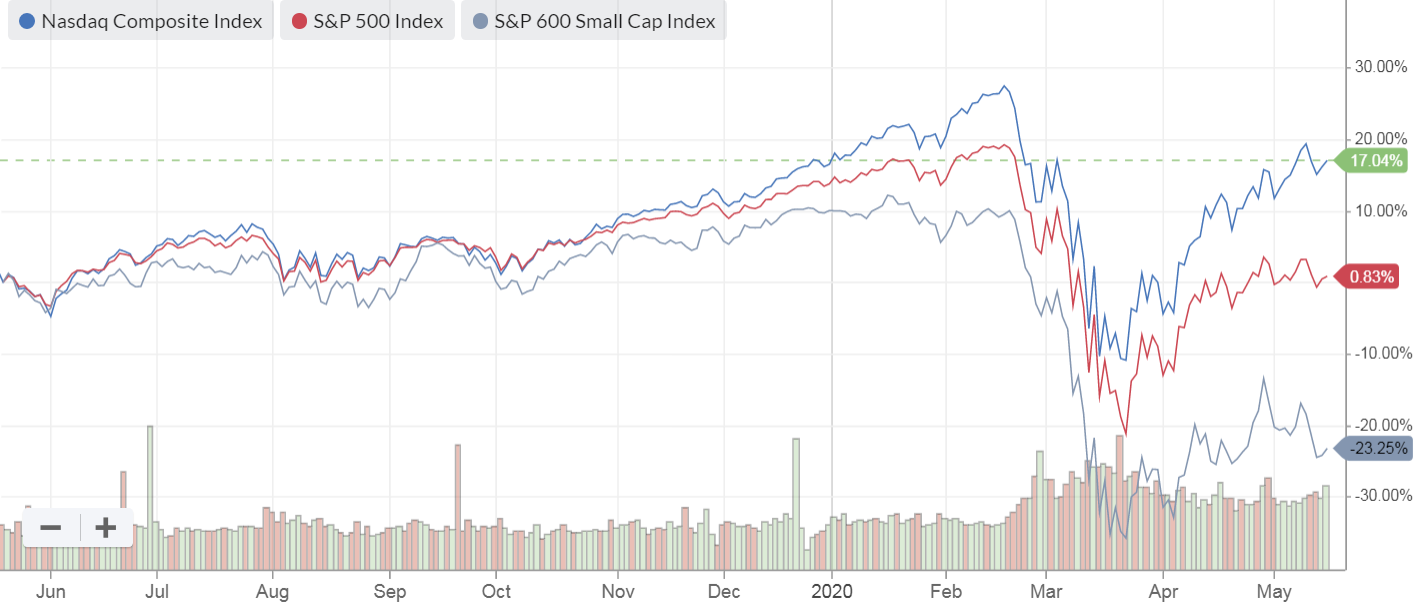
Note the striking divergence in the US indices below, over the last 12 months;
Nasdaq has performed amazingly well, and is 17% up against a year ago. Note its V-shaped recovery from the covid crisis.
S&P 500 - up just under 1% in the last year. It seems to be stabilising in the short term, having recouped about half the Covid sell-off.
S&P 600 Small Caps Index - down 23% in the last year, greatly lagging the larger caps. Note also how it has recently given back about half the April bounce.
.
This does make me wonder how long tech stocks can continue to out-perform, given that many are now so expensive? That said, this is a continuation of a long-term trend. If we expand the one year chart above, to 10 years, we can see that tech stocks (the top line) started to outperform in about 2017, with a remarkable acceleration starting in 2019. Valuations on the biggest US tech stocks are actually not particularly excessive, given the outstanding quality and dominance of businesses like Microsoft, Amazon, Google, Apple, Facebook. That said, Google & Facebook are basically advertising businesses, so they're not likely to be immune from the economic slowdown.
Note also from the chart below that small caps did well from 2010 to late 2018, but have since under-performed. The red line is the S&P 500, which crossed over & overtook small caps recently.
Last time we had a tech shares boom, in 1998-2000, it ended in disaster. That said, I think the tech shares of today are vastly better businesses than the more speculative tech stocks of the previous era. Sooner or later though, it all comes down to valuation. Therefore, some tech (and healthcare) stocks are looking very stretched in valuation right now, and could be vulnerable to a correction.
Maybe the small caps space is the place to look, for good value? Although last time we had a tech share boom, many punters sold off their small caps, in order to chase tech stocks ever higher, then the bubble burst in March 2000. Will we get reversion to the mean again this time, I wonder? Or will tech stocks be pricey forever more? Who can say?!
.

.
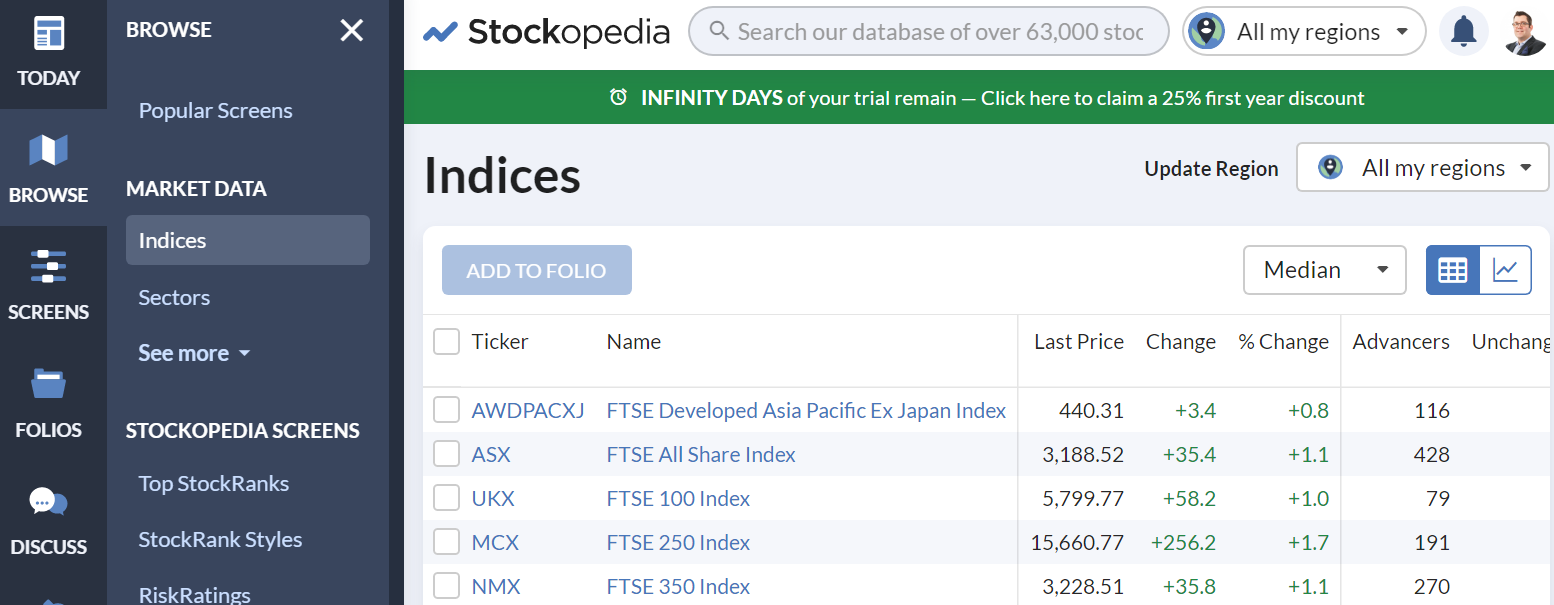
Stockopedia is very good for rummaging around indices, and their constituent parts. This is how you do it - Browse, then Indices (see screenshot below). Then you can sort in any way you want, and click through to the individual company StockReports, etc. I often have a play at the weekends, and sometimes come up with interesting ideas.
.
.
UK Indices
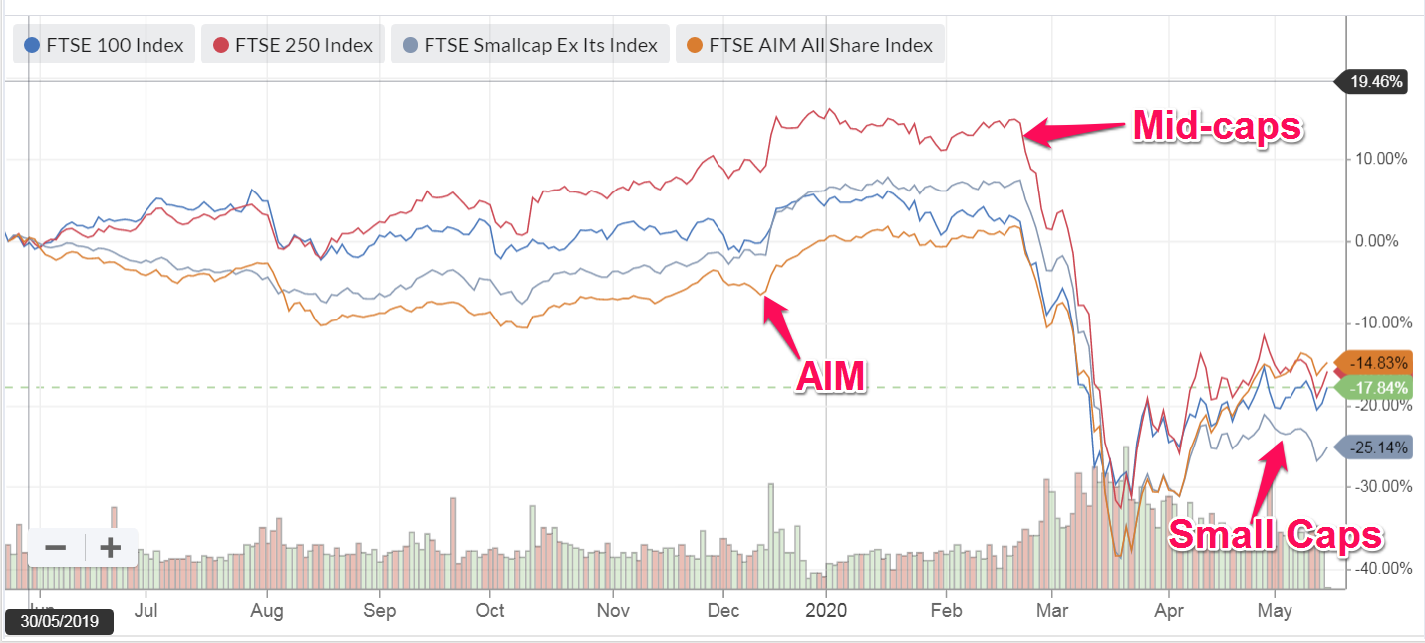
Running the same charts for UK Indices shows a very different picture.
Here you can see (below) that over the last year, mid caps were out-performing from last August, but gave it all back once the covid crisis began this year. The current position is that Mid caps, FTSE 100, and AIM all share are bunched closely together between about -15 and -17% over the last 12 months. Small caps have performed the worst, down -25% in the last year.
Why have US markets done so much better? I think it's because there's such a heavy tech weighting. Also, US markets contain much better companies than the UK market, to be brutally honest. The FTSE 100 has a heavy weighting in banks and oil, both of which are troubled sectors right now, for obvious reasons. Small caps can be hit the hardest in recessions, and so many UK listed small caps are just rubbish (especially some of the speculative junk on AIM). Although one Boohoo (LON:BOO) can offset the poor share price performance of many junk shares, in AIM.
.
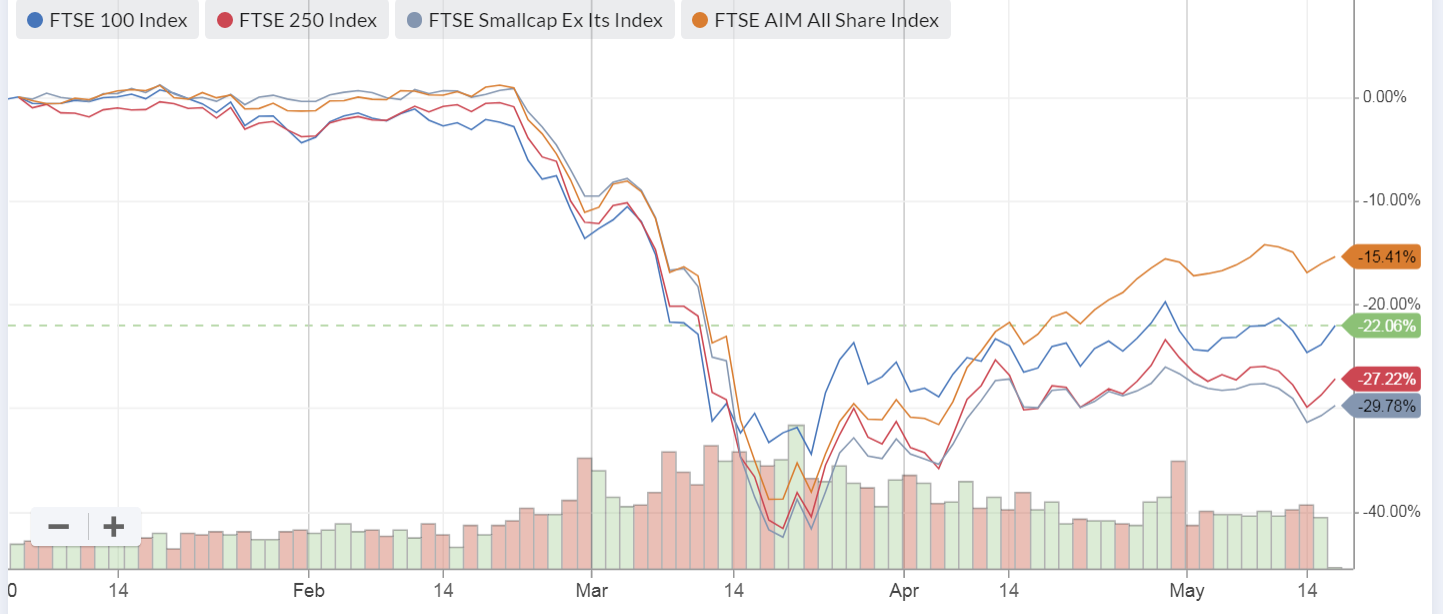
Looking below, at what has happened this year, to narrow it down to the covid impact, the best performer has been AIM All Share, down -15.4%, but this is so skewed by one or two large stocks like BOO, that I'm disregarding this. We really need a new AIM Index that excludes the handful of mid caps on AIM.
Following on, the FTSE 100 is down -22%, and mid & small caps are bunched together, at -27% and -30% for 2020 YTD.
Therefore, it's still worth looking at small to mid caps, as there could still be some bargains around, possibly?
.
.
Scapa (LON:SCPA)
Share price: 105.6p
No. shares: 155.7m before placing + 30.76m new placing shares = 186.5m
Market cap: £196.9m
(at the time of writing, I'm long)
Trading update, financing, and placing
This is left over from last week. I've picked up a small, starter sized position, to motivate & remind me to research it properly. That may be the wrong way around, but there we go.
Scapa Group plc (AIM: SCPA), the diversified Healthcare and Industrial company focused on bringing best-in-class innovation, design and manufacturing solutions to its customers, today issues an update on trading and management actions during a period of unprecedented disruption as a result of the COVID-19 pandemic.
Placing - this was successfully done last week - key details are;
- 105p placing price, modest 1.9% discount to previous day's price
- 30.76m new shares issued
- Gross proceeds £32.6m
- Directors/Mgt subscribed for 319k shares
- Numis & Berenberg were joint bookrunners - who clearly did a good job
Financing - this refers to banking arrangements;
- New £15m short term borrowing facility, plus existing £80m RCF (seems a lot)
- Temporary relaxation of bank covenants
I think it's perfectly reasonable for banks to require an equity fundraising, where possible, in return for increased borrowing facilities. Although that depends on whether they're making use of Govt guarantees or not.
Trading update - the above seems to have straightened out the finances, so how is it trading, and what's the outlook like?
Revenues FY 03/2020 - record revenues, despite loss of lucrative ConvaTec contract (disputed) of £320.6m. Flat against last year on LFL basis
Trading profit for FY 03/2020 is expected to be approximately £28 million, as announced in the trading update on 12 February 2020.
Adjusted net debt at 31 Mar 2020: £54.4m - recent placing should have reduced this considerably, as follows;
Taking together the impact of the management cost reduction initiatives, the Placing, the Subscription and the Additional Debt Facility, the Group is expecting adjusted net debt of approximately £34 million at the end of FY 2021. Consequently, the Company projects that, following the Placing and the Subscription, the Company's FY 2021 Net Debt / EBITDA ratio will be approximately 1.4x, compared to approximately 2.6x without the Placing and the Subscription.
Very clear guidance there, and after the placing, its debt position looks much more comfortable.
Covid - key points;
- Conserving cash - usual stuff, cutting capex, and costs, 20% mgt pay cuts (temporary), no pay rise or bonuses, divi & pension payments suspended, deferring tax payments
- Grant of $5m received under US PPP scheme - loan that is forgiven if US headcount is not reduced for 8 weeks - nice!
- Revenues substantially impacted in Q1 (Apr-Jun) and early Q2, before returning to more normal levels, per previous budget, from Q3 onwards (Oct-Dec 2020)
- Efficiency savings being implemented over next 6 months
Guidance - this clear, specific guidance is very useful, why can't all companies do this?
Under the COVID-19 scenario, the Group is expecting to generate FY 2021 revenue of around £272 million, being approximately 80% of the previously budgeted revenues for the year, generating approximately half of the trading profit that was originally forecast in management's FY 2021 pre-COVID-19 budget....
The Board therefore believe that revenue and profits will recover in FY 2022. It is expected that Group revenue will grow by between 5 and 10 per cent. from the FY 2021 level in FY 2022.
Trading profit is also expected to grow significantly from FY 2021 with a return to double digit margins, driven predominantly by volume recovery in both businesses, underpinned by the operational leverage and cost reductions across the Group and on-going restructuring in Healthcare.
The Board believe that, should revenue recover more slowly than anticipated, the Company has the necessary levers to protect and drive earnings through further cost optimisation in both businesses, a clear contingency plan that can be implemented and further restructuring, margin improvement and footprint consolidation.
I can't find any updated broker forecasts. Looking back a few months, pre-covid, consensus forecast seemed to be about 17.3p EPS for FY 03/2021. Halve that, and we're around 8.6p - for a PER of 12.3 - that looks great value, assuming I've understood this correctly, considering it's for the year which includes the covid impact. i.e. future years could see that PER drop significantly, as profits recover.
Outlook comments - some good stuff in here -
Healthcare sector;
- Healthcare spending should return to normal, as postponed elective surgery resumes
- Customers reviewing extended supply chains, especially from Asia - should benefit Scapa from re-shoring back to USA/Europe
- Possible benefit from customers streamlining product portfolios & do more outsourcing
- M&A opportunities at more attractive valuations
Industrial sector;
- Well diversified, non-cyclical products
- Covid having minimal impact on its cable segment
- Also could benefit from re-shoring
- Increased eCommerce, and re-opening of retail sector
My opinion - I need to do more research on this, in particular on the pension scheme.
The other query is on Scapa's legal action against ConvaTec, I wonder where that has got to?
In other respects though this share looks interesting, and worth a closer look.
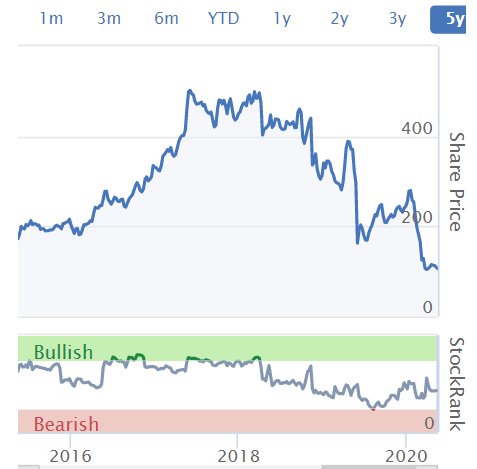
As you can see from the 5-year chart, it used to be over 4 times the current share price. It looks as if at least some of that could possibly be recouped, if trading improves later this year as indicated.
.
.
Augean (LON:AUG)
Share price: 146.5p (unchanged today, at 13:01)
No. shares: 104.1m
Market cap: £152.5m
Claim for repayment of landfill tax
Quite an interesting announcement today from this waste management company.
It's lodged a claim with HMRC for £11.1m repayment of landfill tax that it says is overpaid.
I'm not going into all the detail, but it sounds as if the case might have moved in a positive direction for Augean possibly;
This protects the Augean position in the light of legal challenges brought by other waste site operators that have successfully argued before the Upper Tax Tribunal that they can reclaim LFT accounted for on the 'Fluff layer'. HMRC has challenged the Upper Tribunal decision and it is expected the matter will be heard in the Court of Appeal at a yet to be determined date. The outcome of that appeal will have a direct bearing on the claim filed by Augean...
Augean has decided to reclaim the relevant LFT at this point given the success of other operators in the Upper Tax Tribunal. If the Group succeeds in its endeavours to reclaim the LFT the final quantum remains uncertain and the value quoted above excludes legal fees and other costs associated with the claim.
My opinion - potentially interesting.
There's nothing else of interest today, and I'm tired, so will leave it there for today.
Thanks for all the really interesting reader comments, keep 'em coming!
Best wishes, Paul.
Disclaimer
This is not financial advice. Our content is intended to be used and must be used for information and education purposes only. Please read our disclaimer and terms and conditions to understand our obligations.

123 comments
Points to note:- Johnsons & Johnsons baby powder is in trouble isnt it. Sued for billions due to cancer. Thalidomide scandal. It takes 10 years on average for a vaccine to be approved. 6% success rate of a vaccine being approved....... Put it this way I am not putting a needle in my arm from Oxford university & AZ for something rushed through. I'll take my chances with COVID. History has taught us some lessons, I am not an anti-vaxxer by any stretch but I will not be putting this AZ/Oxford Uni needle into my veins due to the 10yr average vaccination approval testing procedure. So @ 6% success rate of all vaccinations produced you have more chance of losing money in AZ shares if you have bought in at the recent surge.
A brutal dictatorship? You read and watch to much MSM Paul and watch to many hong kong protests and do not see the huge rallies & support for China due to MSM's neglect for ultimate aim of regime change. Just think about how many wars China has raged since its modern inception 80 years ago that Capitalism & British imperialism from the 1800's left it in ruin. Its zero wars isnt it? This young countries rise from capitalist ruin 80 years ago has been truly astonishing, proving that their system is superior to our corporate debt ridden system. Also in comparison to the wars the UK & US's imperialism for black gold or other commodities, but you say China is a brutal dictatorship...... it's actually more of a democracy than illusionary western democracy. Do we not see US influence in the South CHINA sea to?
Thank you for taking the time to reply.
My counter argument is that we don't have any "best data" and I certainly wouldn't take New York as a pointer. If our response has been a car crash, the US's response has been a pile up on the M1 in fog.
But taking your points in order:
Finally I am NOT saying we should do nothing (so the 19k figure is unrealistic) but that blanket shut down of the economy which is going to cost billions probably getting towards the trillion mark was the wrong course of action.
What is an acceptable figure for deaths under 60? Fighting Hitler in 1940 in was in the 384,000 military (and the same again wounded). The Falklands 258. We live in a world where much of the media and the twitteraty thing that acceptable figure is 0. They forget that while the economic pain we are almost certain to experience may not cause 19,000 deaths the misery will be horrendous.
Best wishes
Michael
Finally I am NOT saying we should do nothing (so the 19k figure is unrealistic) but that blanket shut down of the economy which is going to cost billions probably getting towards the trillion mark was the wrong course of action.
Well what else could we have done?
Sweden, which didn't go into lockdown has four times as many deaths per head of population as neighbouring Denmark, a higher mortality rate than the UK (and less testing, so it's probably worse) and the latest tests show that only about 7% of the population in Stockholm have had the disease - about the same as everywhere else - so they have no more general immunity than any other country.
And for what benefit? They're suffering as bad an economic downturn as everywhere else. But while Denmark, Finland and Norway are about to open their borders to each other they're keeping them shut with Sweden. Any country that fails to control its infection rate will become an international pariah and will suffer longer term consequences.
The idea that we could have done something other than lockdown and got a better outcome is a fantasy, I'm afraid. If we'd prepared better and locked down faster we would have suffered less damage, but that's another conversation entirely.
timarr
How refreshing it was to read some old=fashioned Common Sense regarding the Govt's epic bungling of who got locked down, and who didn't.
I'd get at least 3 Quotations to even repaint my kitchen, and our rulers relied on just ONE source of scientific advise, and thereby wrecked the economy? WOT?? You're kidding!
And me a Tory voter ....
Hi Paul
Really excellent post even better than usual. Personally I like brutal honesty particularly with oneself. Scapa is an interesting share.
I have held AMS for several years and have traded it a few times and have made money with it. Its product range is much narrower than Scapa’s. My initial reaction was not to buy but I think I will research scapa a bit more tomorrow.
Just come back to this this evening. The value of my ISA portfolio has increased by 6% today. It is getting ridiculous.
My Isa portfolio is largely composed of shares I have bought since 2011. After I retired in 1999. I got tired of financial advisors making appointments to see me expecting me to give them my money to loose and expecting to charge me for that privilege.
I had bought stocks over the previous 40 years but used execution only services. What impressed me when I started with the online platform was how often the opinion of the pundits was incorrect and how often they failed to suspect and detect often long going fraud e.g Enron. The most shocking in my view is described in Bad Blood by John Carreyrou of the Washington Post. Basically for those who do not know, it is the story Elizabeth Holmes scion of prosperous and wealthy American families, who, claimed to have invented a blood analysis machine which would make blood analysis faster and easier. Her backers and investors included the great and the good of America. Needless to say it all ended in tears. However he author received several prestigious awards for his work.
Aim and small cap indices do not attract the same level of scrutiny and approval ratings as the maim markets so they are easier to assess by the diligent researcher.
The problem of accurate forcasting is also problematic. I found the works of Nicholas Taleb Hassim helpful. For me the Black Swan, Fooled by Randomness and Antifragile shed some light on this. But some of the popular books of Chaos Theory might just be as good. He regards himself now as a fulltime philosopher His later books are also interesting, but they are mostly too difficult for me.
I have previously mentioned Warren Buffet and Stan Weinstein who have primarily shaped my thinking.
I do have a copy of the Intelligent Investor but after reading a few pages I have to go back to Michael Lewis who with John Grisham are two of my favourite authors.
sorry pasted my response twicw
STM Group news today is material and should mark the turn. cheap and momentum is shifting.
Really good article today Paul. Agree with every word.
For really small caps beaten down I'm pondering over N Brown Group.
90% down due to cash and debt worries, most debt is secured against receivables and their credit facility has been extended. They trading mainly on their app and online (Jacamo/JD Williams/Simply Be/Home Essentials) so have been open throughout the lockdown and it just seems over sold and I am doubtful they have a real insolvency problem but it is a risky one.
Thanks. N Brown is on my (very long!) list of things to try to look at. Will report back once I get some time to check it out.
Quite like the look of Augean (LON:AUG), before the crisis hit I looked like it had the wind in its sails, reporting revenue up 33% at the end of December. This HMRC issues is nasty point though, and it looks like they have had to take on debt to manage it. Although reading through some of their comments, they sound reasonably confident they will get some of this back.
Need to look further into this, but I cant imagine getting rid of radioactive waste, and disposing of other challenging material waste is an easy task to take on, which makes me wonder does this share benefit from having a competitive edge? does any body know of other competitors in this sector?
I imagine industrial waste is likely to be down throughout the year and will hit their next results hard.
I do find their comments very vague on their outlook though.
Paul. Could you possibly comment on Modern Water which has a Shareholder's Annual Meeting scheduled on Thursday. A small company with interesting water treatment technology. and recent funding and Board appointments which may well be gamechangers.
I normally only report here on results &trading updates (and these days, fundraisings). I see Modern Water (LON:MWG) is a £10m perennial loss-maker. I'd need a very good reason to want to waste mine or your time, to look at it! Maybe if the next trading update is good, then flag it to me, and why you think it's good, and I'll take a look. you've got to realise there are so many companies, and I'm above all a professional investor, so am only interested in writing about shares that look interesting.
Sorry The Telegraph.
https://www.telegraph.co.uk/technology/2020/05/16/coding-led-lockdown-totally-unreliable-buggy-mess-say-experts/
Here is the link to an article in the Times.
https://www.telegraph.co.uk/technology/2020/05/16/coding-led-lockdown-totally-unreliable-buggy-mess-say-experts/
Here is the link to an article in the Times.
This is ridiculous although I cannot read the whole article. Why have they asked the Chairman of a rubbish company like Wandisco (LON:WAND) ? When did he last write any code? And before taking what he thinks seriously, I suggest people look at the record of complete lack of profitability of his company and the fact that the share count has nearly doubled in five years. Nice work if you can get it!
All the best, Si
with indexes I find it interesting to look within to see what I'm actually holding....
Top 20 stocks in Nasdaq 100 (accounting for 75% of index by market cap). Basically, it's big tech plus a few friends. Microsoft, Apple, Amazon, Google and Facebook wade in at 55% ! I do wonder if the anti-trust movement hits them eventually. Or they just get taxed on revenue like a monopolistic utility.
Same top 20 for the FTSE100 accounting for 67% of the index
If the world went into a high inflationary growth environment the FTSE would do well with oil, iron ore and interest rates all up lifting big oil, miners and banks. Not sure that's the environment we are in though. Diageo probably not a bad long term keeper, it has some sort of moat around it's brands. If you think China will boom on debt fuelled infrastructure again, RIO is another one. Otherwise lots of beaten up 'value' plays here - banks, tobacco, telcos, insurance. These firms earn mostly in USD so you could hold FTSE as a hedge against Sterling depreciation.
If I had to pick between the two, it would be the Nasdaq. But, I'm sticking to the mid-cap and small-caps as there's more growth companies to pick through.
An enlightening post. It would be interesting to look more closely at this comparison, e.g. growth rates, margins, profits, FCF and ROC as I suspect the larger US companies win by sone distance.
It is also worth remembering that the larger NASDAQ companies hold $100 billions of dollars in cash, representing a significant competitive advantage and risk mitigant, while the FTSE firms tend to have meaningful debt levels to manage and service.
Very helpful, thanks JWebster. Query - have you adjusted the figures to remove the possible double-counting for different classes of the same shares?
I for one would really appreciate a Paul Scott Deep Dive(TM) on Scapa
I went through their annual report but could not find mention of contract cancellations or lawsuits. As I understand it, the company that broke contract with Scapa was experiencing financial difficulties and may have (or may not) have exploited a non-competition clause to get out of the deal. Then they filed a lawsuit against Scapa, which appeared to my distinctly untrained eye to be scurrilous.
In a recent PI-World interview, Keith Ashforth-Lord mentioned that the lawsuit filed against Scapa had been thrown out of a New Jersey court, and they were pursuing the remainder of the contracted sales. I've had no luck confirming this.
It seems to me there is a lot of upside potential, but lawsuits, a rotation of senior staff in the last 18 months, and the resignation of the CEO who then un-resigned when COVID hit (and whose heart probably isn't in it) are all qualitative red flags.
Still remains an interesting company for me though.
I did my best today, spent about 3 hours on Scapa. Was that dive not deep enough? I don't want to drown, or get the bends ;-)
Good piece I thought. Thx. I have been in and out of Scapa (LON:SCPA) - now back in albeit in small way. Ditto £AMS. Think both could increase quite significantly (both fallen long way) once things settle down medical wise and elective surgery starts and Covid fixation lessens. Not sure where the SCPA litigation is with Convatec. SCPA were pretty confident as I recall, but guess they would say that. Revenue was good even without it..... and the non medical side looks solid to me. The other healthcare small cap I have is Craneware (LON:CRW) which also had a fall from grace. Done ok with that since re-bought mid Covid.
Hi Paul,
Thanks for the piece on Scapa. There's a short section on the company in the recent Keith Ashworth-Lord interview on PI world https://www.piworld.co.uk/2020/05/08/piworld-thursday-webinar-keith-ashworth-lord-cio-sanford-deland-buffettology-fund/. Thought it might be useful background for you.
My comment is on Covid/ forecasting - not on investing.
The jobs for the governments of the world are really difficult, as the Covid episode shows. I don't thinkthe key is the accuracy of point forecasting (what is the likely number of deaths) but assessing the likely distribution of possible outcomes.
If we take a thought experiment that the International Space Station is falling to earth and will hit the earth in 24 hours. 4 expert models say there is a higher than 99% chance it will land harmlessly in the sea but one model says there is a 45% chance it will hit London and kill tens of thousands of people. Evacuating London would take 24 hours. You are Prime Minister. What do you do?
A) Decide the outlying model must be wrong - order it to be a state secret so not to cause panic?
B) Make a public announcement that one model says there is a chance many people will die but you have come to the conclusion that it is probably wrong and you have decided life should carry on as normal?
C) Publically announce the different models and say people should use their own common sense to decide what to do. Government should not tell people what to do?
D) Publically announce the different models and order an evacuation of London, knowing that many people will say that even the outlying model is predicting that the space station will miss (55%) London - and therefore compliance will be lower than it could be?
E) Order the evacuation of London and fudge the scientific evidence but say truthfully that while the models differ, none give a zero chance of London being hit and one says there is a very significant chance of London being hit. So while you hope for the best, you are planning for the worse?
Obviously the median forecast for the number of people being killed is zero. But the correct course of action is still not straightforward.
This is a case of damned if you do, and damned if you don't. Had lock down not happened and there were a large number of deaths the government would probably be damned for not imposing the lock down. Now we have lock down and the evidence seems to be suggesting it isn't necessary the government is being damned. Before we had lock down here other countries were introducing it and the government was criticised for not doing the same.
My view is that we should have isolated the vulnerable and gone for herd immunity, having said that I do not criticise the government for imposing lock down as I don't view it as wrong, instead I view it as just different. Either way a decision had to be made.
In my view we weren't damned either way at all. We were unprepared and slow to react. We sat around for weeks watching China build new hospitals in a week (oooh look at that!) and did sweet FA. Hancock declared there was a very low risk to the country and BoJo did his Princess Di routine shaking hands with everyone in a hospital corona ward on March 3th. Then he wondered why he woke up in ICU 3 weeks later. If we had been better prepared, moved more quickly and tested tested tested there would not have had to have been a lockdown at all, because we reacted late we were forced into an over reaction, a bit like the stockmarket. Even Ireland shut down the country on St Patrick's Day. Yet the same day we went ahead with Cheltenham Festival. Madness. This government crashed the economy and destroyed billions of value and exploded the national debt because it sat on its hands for 3 crucial weeks. Not that Corbyn would have done any better. There was an excellent programme on Channel 4 on how we should have handled it. I commend it to you. https://www.channel4.com/programmes/the-country-that-beat-the-virus It didn't have to be like this, hopefully there will be a full inquiry.
Was the advice at the beginning not herd immunity? As for being unprepared, when should we have been getting ready for it as it only started in December.
We can all be wise with hindsight.
As for being unprepared, when should we have been getting ready for it as it only started in December. We can all be wise with hindsight.
Patrick Vallance signed off on the 2019 National Security Risk Assessment and guess what was the number one threat? Yep, a pandemic. Included in the advice:
The capability requirements include disease surveillance systems, staff trained in enhanced infection control practices, adequate access to personalised protective equipment, adequate access to public health staff for contact tracing and follow-up, and excess death management capabilities (including potential infectious material). Decontamination services need to be available.
Appropriate specialist healthcare services eg, high level-isolation units must be accessible, as well as appropriate facilities for quarantine ... Total cost: £2,354,738,558,884 (131% of GDP).
The first cases in the UK were on 31st January, by March 1st we knew we had a major outbreak in Italy. And what did our Prime Minister do - he went to a Covid-19 ward and shook everyone's hand. He then decided to go to Twickenham (with his pregnant fiance) instead of COBRA, engaged in magical immune thinking and turned himself into a one man superspreader. You couldn't make it up.
No hindsight involved, just stupid leaders without appropriate qualifications who don't listen to their expert advisers until they need them as the poltical equivalent of human shields.
timarr
I can see where you are coming from but I believe
disease surveillance systems, - Tick
staff trained in enhanced infection control practices - tick
adequate access to personalised protective equipment - tick
adequate access to public health staff for contact tracing and follow-up - tick
excess death management capabilities (including potential infectious material). Decontamination services need to be available. - tick
Appropriate specialist healthcare services eg, high level-isolation units must be accessible, as well as appropriate facilities for quarantine - tick
All these were in place - i guess no one was clear on what adequate meant... It's such a great word adequate as it is devoid of any real commitment one way or another. Often used in situations where nobody really knows...
was it Jaws where they said "I think we're gonna need a bigger boat"
I'm guessing there was a bit of that from the "stupid leaders" we voted in when they realised adequate wasn't going to be enough.
I personally don't blame any one individual! I don't believe many people have the bandwidth or capability to make the right decisions in this situation without someone or something being adversely impacted. 2nd Biggest Country (Population) in Western Europe has largest number of deaths in Western Europe! What were the odds on that...
The biggest country (population wise) Germany that bastion of efficiency and great Government that we all admire (nearly 8k deaths - seems that's acceptable to many) with their Insurance based health system. Now here is an interesting fact. Their normal mortality rate is approx 20% higher than the UK. Their older population is also very female skewed. Is it possible that had we had Germany's poor mortality rate and skewed older population, maybe we too would have had less deaths as many of those who died in March and April may already have been dead. Just something that has been puzzling me.
To what extent did the NSRA say we needed to be prepared? Did it stipulate how many ventilators would be needed? How much PPE would be needed? We only know with hindsight.
Could we have been better prepared than we were? Probably. Could we have been fully prepared? Very doubtful.
Part of the reason that "Tech" has outperformed everything is that "Tech" isn't necessarily Tech at all. The Tech sector (in every index) is made up of companies who really belong in other sectors but have been very successful because they disrupted those industries using technology.
As Paul points out Google is an advertising company, Apple is a Manufacturer/Retailer, Rightmove is counted as a Tech company but aren't they really an estate agent or part of the estate agent services business? There are many, many more examples. The use of "Tech" as a sector was useful in the 1980's and 90's because it was new but arguably its been misused as a sector classification.
When you invest in the "Tech" sector (which is all I do now) you are really, in a lot of cases, investing in the disruptors and the best businesses in another sector entirely. In fact I would argue that instead of reducing your diversification by focusing on one sector you are actually increasing your diversification as really those companies belong in another sector.
So you are getting the best businesses in their class, often with first mover advantage, with consumer facing pricing power, great returns on capital etc etc.
It also raises the question, "is there really a Tech bubble"? arguably it could just be that the best companies in the index are looking expensive, and that is often the case at any point in time. It doesn't mean that anything is wrong with the sector because really there is no such thing as a Tech sector any more.
You've missed my point! I know about the AIM 50, AIM 100, etc. What I'd like to see is a new AIM Index that EXCLUDES the largest AIM shares, so we can see more clearly how much the dross is under-performing!
apologies, Paul, I thought you were coming from a different angle and that you were unhappy about the overinfluence of the bellwether big stocks on the index as a whole: I thought that mixing them in only with other companies of scale might adjust out some of that effect but I've not done the maths.
As an aside, another THREE companies left AIM today: Nektan, EIH and Diversified Gas & Oil (LON:DGOC).
Diversified Gas & Oil (LON:DGOC) has gone to the Main Market which is nice to see, AIM working as it 'should', a training pool for smaller companies.
EIH seems to have been wound up via the sale of assets over the last couple of years and Nektan just failed as a trading business.
This gives us around 860 companies remaining on AIM. Still plenty to run the rule over but many fewer than the rich target environment we had before the financial crisis. In fact, those days were remarkable: it seemed that at every investor gathering you attended one would learn of an excellent smallcap and find yourself saying "blimey, I'd never heard of that one, it sounds great, I must take a look'.
Asagi
Paul, respectfully cannot agree with your views on the tackling of the completely unforeseen set of circumstances which have arisen. The Govt. is damned if they do and damned if they don’t. It’s easy to be wise after the event. Of far more significance, I believe, than the the potential dimunition in civil liberty which you ascribe to the Govt’s actions will be the consequences of not recognising how the CCP has brought the world to its knees and yielded our businesses completely open to their manipulation. We need as a matter of urgency, I believe , to bring back and relevel our manufacturing base so that we are not so reliant on the Chinese. This however won’t happen unless we realise there is a price to pay for cheap imports which completely skew our independence. If this doesn’t occur I fear the next generation will be having their pensions paid in bowls of rice.
Rant over, thanks.
Hi Robert,
I agree completely re China. It's total madness for Western democracies to have not only allowed ourselves to become so heavily reliant on China, often for essentials now, not just cheap consumer goods. But we're also created our own future enemy - another superpower, whose economic strength has been fuelled by us, at least until it got big enough to be self-fuelling. It's a dangerous, brutal dictatorship, that sooner or later is likely to flex its muscles and risk WW3 - e.g. annexation of Taiwan eventually, which it sees as a rogue province, outcrops of rock turned into unsinkable aircraft carriers in the sea, etc.
How many millions of jobs has the West exported to China? It's false economy in my view, and needs to be reversed.
As regards your first point, to be fair, I've been questioning the wisdom of the lockdown policy of economic destruction here from day 1. But I appreciate the points you're making, which are fair.
Regards, Paul.
Hi Paul, Robert,
Both you of you need to stop yearning for an imperial past.
Kind regards from the East
I'm assuming that comment was tongue in cheek.
not so. The government did nothing, it was ill prepared and failed to react. It could have been different, other countries are testament to that, now we have the worst record in Europe. Yet we weren't the first country to have it. I remember clearly when my brother called me from York and said 'it's here, two Chinese students have been diagnosed'. I replied 'Olly, it's been here 3 weeks at least, we just didn't know it'. It is not hindsight, it was clear the government didn't have a clue what they were doing, I took my kids out of school weeks before the government closed the schools. That's not an easy thing to do when all the other sheep are raising their eyebrows and questioning your actions. I felt sorry for the teachers, they had to go in whether they agreed or not.
What difference did taking your kids out of school make? My kids continued to attend until they locked the gates and they will happily turn up on June 1st. The teachers refusing to work appear happy for others to stack shelves in supermarkets and deliver food for them. Double Standards I'm afraid. Let's get this party started! Baaaahh :)
Hi
Ref CV19. Something I think is not often mentioned about CV19 is that it seems to be rather nastier than other Sars viruses. Clearly health care systems have been uncovering multiple issues occurring with it, as suggested by this article.
https://www.bloomberg.com/news/features/2020-05-11/all-the-covid-19-symptoms-you-didn-t-know-about
Adding to the rather grim article about the 19 ways CV19 can affect the body (above), this next article digs deeper into the longer term effects.
Not an uplifting article, so don't read it if you don't want to. Needs to be read in light of how little is still known, as some depressing studies are countered by other more positive ones. Also (IMHO) Bloomberg likes to attack US and UK governments. They are politically biased against Trump and Johnson, so I treat this with some caution.
https://www.bloomberg.com/news/articles/2020-05-12/covid-19-s-health-effects-can-last-long-after-virus-is-gone
If these associated health issues are indeed true then I for one can understand why rather drastic actions were invoked at the early stages of ours, and other, governments encounters with this nasty virus.
Watching the horrors in Mexico City unfolding I am happy to have been in the UK when the virus hit. We cannot know what could have happened back then. I applaud all governments who have taken a save lives first approach and did not experiment with our lives at a time when virtually nothing was known about this virus.
EDIT: this just published https://www.gov.uk/government/news/statement-from-the-uk-chief-medical-officers-on-an-update-to-coronavirus-symptoms-18-march-2020?utm_source=da50a8b6-4a1c-4092-bfce-4bea6862f2fe&utm_medium=email&utm_campaign=govuk-notifications&utm_content=immediate
Regards
Howard
I wonder if the CCP will be taking a sideways look at President Xi JinPing, and saying how did we get into this situation with the US.
The old style revivals of the Imperial model have never worked particularly well for China and the Chinese people.
The paranoia that results from centralisation power in a country usually results in harm to its own citizens, and typically the diversionary tactic in the past has been war and/or severe repression.
Yes, and by making himself President for life he has derailed the ambitions of those who might have sought to follow him, so no friends made there.
With the lockdown we very nearly were not able to cope with the peak infection for those of any age who needed hospital care. Would the peak infection have been lower if we had not had lockdown, we can never know but it seems highly improbable.
Sweden is cited as the alternative, but this is not an entirely convincing argument. The Swedes benefitted from not being a world crossroads like London and, conveniently everyone around them locked down so helping the Swedes as well. And the Sweden story is far from over.
The storm over the Ferguson formula should also be seen in the light of the fact that it was agreed by the 74 members of SAGE (as has been publicly acknowledged by them), it was not a harebrained notion of one man.
The lockdown is not a curtailment of civil liberties, it is a decision that requires all to agree but the government's position is in no way stronger because of it (probably the reverse). Like the blackout in WW2 it cannot be made to work if anyone who wants to can leave their lights on.
Finally,those who believe that the working age population is less affected are undoubtedly correct, but we are not counting the number of those who needed hospital help for their survival. Without the lockdown the overwhelmed services could credibly have had many more deaths of younger people on their books.
A better model is that of South Korea - which has not locked down but instead rapidly built a mass community test-trace-and-isolate capability by which they have managed to keep Covid-19 isolated and contained. Paul said that in absence of effective treatments/vaccines, the only option we have is herd immunity (while sheltering the vulnerable), but in this he overlooked the potential for containment and relative normality once a mass community TTI infrastructure is in place and the number of infected people is sufficiently low that effective containment becomes possible. Oh, and imagine the relative economic advantage South Korea now has over almost every other country - not to mention all those deaths and suffering avoided - for its alert and speedy implementation of TTI at scale.
Haven't S Korea just reported a second outbreak?
Just a couple of points:
I remember a while back when the SCVR was put behind the pay wall that there was quite a lot of annoyance voiced but I would say that Paul’s C19 commentary and things like the book summary are probably worth the sub alone. And to think that on top of this he manages share portfolios (his and others) and has life is pretty impressive.
Secondly:
“Although as I've been pointing out all along, the statistics show amazingly clearly, that healthy people below about 65, with no existing medical conditions and of normal weight, only have a tiny risk of death. Hence why the lockdown policy has been so wrong.”
Precisely and akin to this was what Michael O’Leary was saying on the Today Programme this morning, pointing out what a nonsense the government policy was on 14 day quarantine after travelling by air into the UK. Justin Webb then said in so many words, so you are saying that government policy is wrong and you want people to break the rules. As though government policy on C19 as always been perfect.
I am no fan of O’Leary and to find myself agreeing with him was an odd experience but hopefully some of these sane views will gain some more traction in the media and will prevail and we get less of the of the “it’s the end of ######” insert your choice of word (travel, holidays, bars, restaurants, offices etc) as we know it, as though human beings have only been around since just before Christmas.
In case anybody has not yet found it the NHS spreadsheet detailing deaths is at:
https://www.england.nhs.uk/sta...
This shows deaths in hospitals of those under 60 at 2,158 and of these 253 had no pre-existing condition. It does seem bizarre to have furloughed so many people in this age category but maybe I am missing somthing.
There are 40 million people in this age group in England but we don’t know how many people who have actually had the disease, so you have to guess at the denominator. I have seen estimates of between 2.5m and 9m, which gives you a 0.0863% (0.01%) and 0.0239% (0.002%) mortality rate in the under 60’s in the UK. Bonkers.
There are 40 million people in this age group in England but we don’t know how many people who have actually had the disease, so you have to guess at the denominator. I have seen estimates of between 2.5m and 9m, which gives you a 0.0863% (0.01%) and 0.0239% (0.002%) mortality rate in the under 60’s in the UK. Bonkers.
Let's try and put a number on this. We can make an estimate of how many healthy under 65s would die if we didn't do anything. Let's assume that no under 19's die, so we're focussing on the 19 to 65 age group.
The best data we have so far is from New York:
Of that 1.4% if 4.5% of healthy under 65s die we can work out that the mortality rate of that group is 0.063%.
To achieve herd immunity in the UK we need two thirds of us to get Covid-19 - so 44 million people. Assuming we're shielding the 12 million over 65s so that none of them get it we have 54 million people we're letting roam loose - so 81% of the unshielded population must get it to achieve herd immunity.
In the UK there are about 38 million people between 19 and 65 and 81% of that is 30.78 million . Assuming they're all healthy and that the NHS is not overwhelmed that gets you a number for the total excess number of healthy under 65's that would die of Covid-19 if we did nothing other than provide medical care by multiplying the 30.78 million infected people by the 0.063% mortality rate.
19,391.
Which seems like quite a lot of young people to sacrifice to keeping the economy open, although of course it's quite small in overall terms.
timarr
To complete your analysis you need to offset that number by the increase in mental health issues, future deaths from delaying health treatments for non-covid illnesses etc.
The problem is that a lot of these "offsets" will be hidden, unlike the daily diet of Covid we get in the media.
Hi Tim
You might find the figures at :
https://www.cdc.gov/coronavirus/2019-ncov/hcp/planning-scenarios.html
where the CDC are using a
Symptomatic Case Fatality Ratio, stratified by age in years of:
0 - 49 - .0002 to .001
50 - 64 .001 to .006
This would lead to significantly lower number of deaths than your putative .014
Best wishes
Michael
This would lead to significantly lower number of deaths than your putative .014
It would, wouldn't it? If it was right. But we'll only know for sure when we have reliable data - the CDC figures are, as they state :
" ... intended to advance public health preparedness and planning. They are not predictions or estimates of the expected impact of COVID-19".
Worldometers use the CDC excess mortality data plus the data from New York to come up with their estimates:
https://www.worldometers.info/...
The difference between the CDC data and New York is probably population density - New York City has 26,000 people per square mile compared to 94 per square mile in the average of the USA. For comparison the UK has 1,000 people per square mile and London has 7,200.
However, at the moment the NY data is the best that we have so using that as an upper bound on the risks of mitigated Covid-19 seems like the safest thing to do. Unmitigated it would have been worse.
timarr
"Why have US markets done so much better? I think it's because there's such a heavy tech weighting. Also, US markets contain much better companies than the UK market, to be brutally honest."
Yes.
FTSE100 is stuffed with banks, insurance, miners, oil. Nasdaq is by definition large tech goodies.
This has been an enduring trend for a long time. For fun I charted FTSE100 divided by the Nasdaq since 2008. See above. Dividends not included. While the past is not an indicator of the future, the last ten years were good for the Nasdaq and woeful for the FTSE.
Amazon and Alphabet combined are worth more than all UK quoted stocks.
Now that's a sit up and listen statistic ! One or other must surely be due a correction
Nice chart! But the dividends would be highly significant over 10 years, because the FTSE 100 has/had a pretty decent yield, whereas it's very low for Nasdaq.
If the excess of FTSE 100 divis over Nasdaq divis was say 4% p.a. , over 10 years simplistically that's a 40% return, which would change your chart from -80% to -40% - a lot less dramatic! Plus the divis could have been reinvested, further narrowing the gap.
"If the excess of FTSE 100 divis over Nasdaq divis was say 4% p.a. , over 10 years simplistically that's a 40% return, which would change your chart from -80% to -40% - a lot less dramatic! Plus the divis could have been reinvested, further narrowing the gap."
1.04 to the power of 10 is 1.48 according to my calculator, so reinvesting the dividends would have changed the chart from -80% to -32%.
By my calculations NASDAQ has risen from about 2300 to 9000 over the last 10 yrs (x 3.91). FTSE 100 has risen from 5190 to 5920 (x 1.14).
I think the NASDAQ wins even taking into account the FTSE divis!
Agree, investing for dividends tends not to provide the best (or even average) return as 4% pa is just not enough risk premium for investing in companies that are distributing the majority of their profits to shareholders. Those firms that retain most of their cash profits to reinvest back into the business (ideally to strengthen any competitive advantage) are likely to deliver much better products and services leading to stronger balance sheets and higher risk-adjusted returns for equity holders. A number of companies actually increase their debt to pay dividends... not very smart !
I think this is something income-seekers should look at as they tend to be led down the path of income investing by advisors.
The indices or at least the constituent shares aren't quoted in the same currency. The pound is down approx 16% against the dollar over those ten years. So in dollar terms the FTSE is down slightly.
AA. released annual report today. Looks positive to me. Lots of debt; business is good though and with people encouraged to use cars rather than public transport I can see strong business here. Who would want to break down at the moment and not be covered? Still at lows....volatile and divides opinion. Ranked 95% for value here. Bought back in today as it seems fair value to me as the cars take to the roads again. Views welcome!
Not sure I will be joining you here.
AA trading remains weak with PBT (£107k) being marginally above 1% of annual revenues (£995m) - very little margin of safety even after a better year (relatively so). The FYE was to Jan '20 so before the impact of COVID.
However, the main problem for me remains the debt levels:
- net debt is £2.66 billion-v-market cap of c£125m
- leverage is 7.66x
- finance costs are too high with low cash cover even after +w/cap movements and further reduced Capex
- balance sheet is insolvent (£1.66 billion) with the company holding minimal assets and significant liablities
- they are still battling with a DB pension scheme deficit
- refinance risk is very high and likely to be very expensive given the junk rating
They expect membership to have declined during the lockdown meaning FYE 1/21 is likely to be worse.
I also find the strategy quite superficial.
There may be money to be made here, albeit I think the share only has option value being down 73% in one year, but the balance sheet risk is too high for me - the shares could double or half again.
Idle question perhaps, but how does a roadside breakdown recovery service get 2.6 billion quid in debt?
Previously had a private equity owner....a recurring theme. Quite why institutions fall for the IPO time and again remains a mystery, they've had enough warnings with the likes of Debenhams over the years.
Yes, loaded with debt since day 1 with the share price having fallen c95% from its high of 419p in 2015 - that level of systematic value destruction actually takes some doing even for the most incompetent management.
... and the final nail was that Woodford had a stake !!!
If they get through the next year or two, the elephant in the room is the refi risk - I cannot see lenders having much appetite for this.
You are correct imo that it is just option priced now. Made 60% on the last move to 28p in a few weeks so you are right there is money to be made at this bombed out level; it is a very well known brand name that has fallen from 400p to below 20p over the last five years. Been around for many years of course. Since the last World War. Back in today below 19p. Very risky of course. Thx for reply!
Can see your logic... good luck with it.
I wonder whether we should make a distinction between consumer facing business and B to B goods and services. Certainly. everything ends up with the consumer, but there must be many companies that will go straight back to something approaching normal. £TGP for instance - a quarter of it's sales and a quarter of it's inputs came from China, so its price was hammered. It provides security for undersea cables, particularly windfarms. It may grow more slowly, but seems likely to return to near normal fairly quickly. I hold.
I agree, Tekmar (LON:TGP) looks good, and I hold a tiny long position in it - couldn't get the stock, as it's so illiquid. Although when last looking at it, the valuation didn't strike me as a bargain, even if you factor in a recovery. It's got a nice niche, in a good growth area though, so could be one of those tuck away & forget type stocks that quietly do well over a number of years maybe?
Regards the US tech stocks, I think the trigger for a revaluation here is Trump and his escalation of US / China tensions. The US is basically making everyone choose sides for a Cold War. The latest news regards Taiwan Semiconductor, TSMC. They have announced that they are going to build a $12bn wafer fab in Arizona and will stop supplying Huawei. China depends on TSMC chips for their 5G implementation.
I saw reports the Americans are saying the same to us in trade talks - choose them or China.
Hi Paul, could you help with with some figures on BOTB Best of the Best, as I’ve just fully joined Stockopedia.
With Finncap’s latest upgrade, they give EPS as 33.2p an increase of 91%
With the current share price of 597.5p divided by 33.2p, I get P/E of 18
So PEG ratio, I get 18 divided by 91 = 0.12
But Stockopedia shows PEG of 2.8
Can somebody correct me please?
Etonkush, I always click on the item so in this case peg. That will give you an explanation of the stocko approach. If having applied that it still doesn't add up I send a message. Normally I get an answer within half an hour.
In this case Etonkush is using a FinnCap EPS growth estimate of 91% and Stocko is showing 8.1%.
BOTB has soared today to a high of 777.50...so you may need a bigger calculator. Ha ha. I hold I am pleased to say!
We really need a new AIM Index that excludes the handful of mid caps on AIM.
you might like to give the AIM UK 50 a whirl, Paul.
It is (from memory) the 50 largest UK-based companies on AIM. I like this index as it loses the never successful companies and the 'colourful' foreign ones.
https://www.londonstockexchange.com/exchange/prices-and-markets/stocks/indices/summary/summary-indices.html?index=AIM5
john2:
O'Leary got it wrong on the imposition of quarantine on people travelling to the UK from France - he seemed to be unaware of the UK's U-turn on May 15th
"Oh, this wasn't a u-turn minister."
"No?"
"No. The initial policy was for a quarantine on all incoming aviation passengers. We then issued a policy clarification to permit our longstanding friends and allies the French to freely travel."
"So it was a U-turn."
"No. Because then the EU complained. How could we allow the French to visit but not the Germans, the Italians, the Austrians and the Bulgarians? So we u-turned on the u-turn, meaning there was no u-turn, as everyone was facing the way that they were in the first place."
Asagi
You've missed my point! I know about the AIM 50, AIM 100, etc. What I'd like to see is a new AIM Index that EXCLUDES the largest AIM shares, so we can see more clearly how much the dross is under-performing!
I hesitate to put my thoughts on CV here, as I'm sure this has all been gone over before, but hey, work is quiet!
Please remember that a small, but significant proportion of young patients with CV require ventilation before they recover. Without lockdown, it is possible (trying to stick to Paul's rules about WILL etc) that intensive care beds would have run out - meaning that medical staff would likely have to choose who gets a ventilator and who doesn't. Or worse, a young, healthy person cannot be ventilated due to lack of beds. This potentially would have forced Government, or more likely NHS staff, to make somewhat arbitrary decisions on which groups of people were eligible for ventilation (personal observation, at the beginning of the crisis, a cut off of 60 was being discussed in at least one of my lcoal hospitals). This was the situation in Northern Italy and currently in Sao Paulo.
I do, however, believe that when the dust settles and we have a chance to look back over everything, that more harm will have come from the lockdown than good. Both in economic terms and also in health - a significant number of CV deaths are in people who are likely to have died within the next 6-12 months anyway. Would any Government survive if that decision had been made???
Anyway - as ever, thanks for all your work Paul and Graham - your thoughts and opinions on macro stuff as well as individual shares is always an interesting read!
Dave
Hi Dave
“Please remember that a small, but significant proportion of young patients with CV require ventilation before they recover.”
Do you have a source for this as it is something I have been trying to establish for own research but cannot find anything on this. The data at:
https://www.england.nhs.uk/sta...
gives deaths but nothing on admissions, those put into ICU and those requiring ventilation.
Thank you.
Michael.
Hi Michael,
This might be what you are looking for
ICNARC, our focus is on people who are likely to become, currently are, or are recovering from being critically ill.
https://www.icnarc.org/Our-Aud...
Good points, thanks.
Surely we should have thrown say £50bn at the NHS, to greatly expand capacity for ventilators, etc, rather than do £500bn+ damage (and counting) to the public finances, and heaven knows how much damage to the economy & the millions of mostly young people who are likely to become unemployed once furlough ends?
Still, it's easy to be critical, I certainly wouldn't want to be in a position of power, making momentous decisions. There again, people in positions of power sought those positions, so their feet should be held to the fire.
I just hope this current period is used as a time to really properly prepare for a potential second wave, rather than everyone getting relaxed & optimistic again.
We haven't talked about the seasonal, temperature issue re Covid-19 today. There have been lots of interesting articles speculating about what might occur due to temperature changes.
Michael - have to admit that this is "grapevine" talk amongst Doctors, mainly ICU consultants. I don't have figures to put to this - although the data should be there somewhere (ICUs in general use databases for patient management - the amount of data that should be available is huge).
Paul - the scale and pace of change was unprecedented, and the feeling I get is that money was no object. The basic problem is lack of trained staff. We went from 1 ITU nurse for two ventilated beds, to 1 trained ITU nurse managing 5 or 6 non-ITU trained nurses managing 12-18 or more ventilated beds. We simply don't have the number of trained staff to look after that many sick patients - and that's due to decades of training shortages. I remember the bad days when the first place for savings was staffing, and usually nursing staff - management consultants would walk in, say "you need to reduce your headcount by 10%" and walk off..... So we were at the stage where you could throw as much money as you like at the problem, but there was always going to be ceiling.
Dave
Bit more data from this observational study from Milan - https://www.ncbi.nlm.nih.gov/pmc/articles/PMC7136855/
(My except from the data)
126 (8%) of patients up to the age of 60 needed invasive ventilation. This number dwarfed by the 910 of those between 61 and 90, but you can see that without a massive increase in ITU beds and staff to look after them who services could easily be overwhelmed, leading to some very difficult decisions....
These figures support what I've been saying for a while, namely that for people under 40 there is virtually no serious risk from CV. They should therefore be effectively freed from lockdown, but told to avoid physical contact with elderly / ill people.
If we could just get this sector back to normal it would mean that they could resume going to work and also to bars, sports fixtures etc. As they are probably the large majority of people who do go to such places it would provide a great boost to those sectors of the economy.
It would also mean that schools, universities etc could re-open, on the basis that children / students are at virtually no risk and neither are any staff members under 40. It would seem sensible to abandon the normal academic summer holiday and work through to September, so as to catch up, though I can't see the unions agreeing to that.
It's unfortunate that older people are more at risk, but even with them they should be properly informed of the risks and then allowed to decide the level of risk they're willing to accept.
These figures support what I've been saying for a while, namely that for people under 40 there is virtually no serious risk from CV. They should therefore be effectively freed from lockdown, but told to avoid physical contact with elderly / ill people.
To get herd immunity you need two thirds of us to get Covid-19 - so 44 million people. There are only 33 million under 40, so this would put half the UK population under house arrest for an indeterminate amount of time. Which doesn't seem realistic, especially for a government largely elected by over 40's.
To lock up the vulnerable but still leave enough people in circulation to potentially get to herd immunity level you need to get to 65 but as noted earlier that would still mean over 19,000 excess deaths in otherwise healthy under 65s.
timarr
I think we tend to see civil liberties in a bit of a skewed way - mostly from how they affect us.
So, I cannot go along with the notion that the lockdown is ridiculously infringing our civil liberties when the alternative is to have a super hard lockdown of all the elderly and vulnerable for many months plus any one who comes into contact with them, (while the healthy and younger (who have no contact with the elderly and vulnerable at all gradually establish herd immunity to the point that it dies out) thereby trampling all over the civil liberties of those over 65 and vulnerable people and all those others who have some contact with them.
I also have a big problem with the whole Neil Ferguson’s modelling is pants notion. There are many epidemiologists involved with SAGE and NERVTAG (who input to SAGE) who would have pulled this apart if they had thought it was rubbish. But even more convincing is all the other countries who also pursued a lockdown strategy. France, Spain, Italy, Germany, USA and so on. So, their scientists came to broadly the same conclusion as ours despite the alleged inadequacy of the Imperial College modelling.
I also have a big problem with the whole Neil Ferguson’s modelling is pants notion. There are many epidemiologists involved with SAGE and NERVTAG (who input to SAGE) who would have pulled this apart if they had thought it was rubbish. But even more convincing is all the other countries who also pursued a lockdown strategy. France, Spain, Italy, Germany, USA and so on. So, their scientists came to broadly the same conclusion as ours despite the alleged inadequacy of the Imperial College modelling.
Of course, people just looking at code are missing the point entirely. I'm sure the control software for the Boeing 737 Max was beautifully coded, highly commented, structurally wonderful, formally verified and tested to death... and yet two planes full of people fell out of the sky. It's the kind of garbage you'd expect from the UK press, especially the Borisgraph. If there's one thing to come out of this whole horrible mess for me, it's that I will no longer pay any attention to anything I read in a UK newspaper ever again. I'm glad most of them are behind a paywall because given how bad the journalism is, and how politically biased they are, that's where they deserve to be.
I think we need to see the bigger picture here. There is an attempt to pull the wool of our collective eyes and the Telegraph's constant bashing of scientists is all a part of it. It should be no surprise to see that Boris no longer turns up for the daily briefing and that the scientific community are being denigrated on a daily basis as being the cause of the lockdown and hence economic problems. It is clear that the government is going to walk away largely unscathed whilst the scientists are thrown under the bus.
All the best, Si
And the point is that advice is advice. The Government doesn't need to take this advice - the ultimate responsibility rests with those in power, not the scientists.
But there's nothing new here: the closing of railways in the 1950s/60s is often referred to as the "Beeching Cuts" - but Beeching just produced the report. The ultimate decision was by Ernest Marples and the Conservative Government of the time. They deflected criticism by blaming Beeching just as the current Government is deflecting criticism by blaming the scientists.
Good points, well made!
You are only deferring infections, not eradicating.
The elderly and frail will need protecting until a vaccine appears, which is by no means guaranteed.
Ferguson and SAGE used a figure described as "laughable" by clinical experts for elderly ventilation in their model. Which led to the horrid consequences we've seen in care homes as hospitals discharged regardless to free up icu space.
"The elderly and frail will need protecting until a vaccine appears, which is by no means guaranteed."
- Or until effective containment once the number of infected is sufficiently low and mass test-trace-isolate infrastructure is in place (or treatments exist that ameliorate the disease sufficiently).
Why not instead do as the South Koreans did?
Interesting thoughts re Technology.
The degree of valuation stretch has never been higher, market willingness to tolerate very large but unprofitable, Tesla, Uver, Lyft, Beyond Meat.....etc etc never been greater. Some like AMZN have benefitted in terms of revenue growth.... but that will just cause a higher hurdle to clear in 2021, which they will miss...should the pendulum swing back to traditional retail. Bizarrely the technology trade is probably nothing more complicated than confidence of survival. As the economy recovers this confidence will broaden out ... benefitting more sectors. Also, further down the market cap spectrum as liquidity risk recedes.
However, bond yields don't believe it yet. They remain too low. Real yields are negative, which is why Gold continues to rise. Gold should be falling if we are getting more confident. I am watching 10 year treasury yields for signs of change. In currency markets, China, Brazil, Sth Africa, Euro, Turkey are all under pressure ... not a cyclical tailwind, so something to watch .
Silver has joined the party in the last week. Being an industrial metal its much more speculative than Gold... if bond yields don't confirm a better outlook, this move may be a sign of speculative excess in the safety/survival trade which is nearing an end. There is no good reason to own silver other than a recovery, it was terrible through the great depression, in contrast to Gold.
Whatever happens from here - the safety trade is looking less safe! It could suffer with rotation ... and will surely suffer in a correction too.
We all have our own investment-related stories about the disaster. Here's mine.
Went to Dunelm (LON:DNLM) on Friday. Website said open but turned out it is click and collect only, table blocking entrance. 'Have you got a folding step in stock?' 'Yes.' 'Can we see it?' 'No, go away and buy it on your phone then come back.' Tried this. Description on website inconclusive. Decided not to buy. My wife is a regular Dunelm customer, usually goes with a short list and comes home with at least one impulse buy. She says she won't be going again until back to normal. Went round block to Biz to buy some envelopes. Allowed in to this one but only up to the payment counter. Staff have to collect items from shelves. Would have needed half envelope shelf collected and displayed for me to choose what I want. Walked away vowing not to come back under these circumstances. When we got home bought both items online from other traders.
For years we have been told that retail must re-invent itself to become a pleasurable and exciting experience if it wants to fight back against online. Fat chance of that under these circumstances. But let's assume 25% of existing retail doesn't survive and doesn't return. This will reduce rental values by a huge percentage, so those retailers who can survive might find their profitability is enhanced by lower rental costs. I can't see lower competition helping because online will put a lid on prices and there is huge destruction of demand. But there could be a cost saving which goes through to the bottom line. Pets At Home (LON:PETS) ?
A worse-hit area is leisure/hospitality. Decision made on Friday at a leisure business:- If it can't re-open for staff re-training on Monday 6 July and then for the public at full capacity (NOT "Covid-safe") on Saturday 11 July it will be placed into administration, furlough or no furlough. Another leisure business I know about which has about 50 employees has decided that if full re-opening on 4 July isn't confirmed by 1 June the redundancy consultation will begin the next day, 2 June (30 day consultation for less than 100 employees, 45 days for bigger businesses) because the business isn't able to make the contribution towards furlough payments which becomes due from 1 August. The business will be mothballed with a caretaker supervising maintenance contractors, and hope to re-open in 2021.
It's not too late to stop the disaster getting worse but the clock is ticking.
Went to Homebase over the weekend. Shot well-managed queue. Access to all parts of the store. Found what we wanted. Check out well managed with safety built in. Only downside, albeit not for customers, was that they were allegedly only allowing 30 people in store at any one time. On the up side, virtually everybody entering the store seemed to be buying something.
"Went to Homebase over the weekend. Shot well-managed queue."
That seems a bit drastic. Lockdown getting to you is it?
Now that made old earnie chuckle
"For years we have been told that retail must re-invent itself to become a pleasurable and exciting experience if it wants to fight back against online"
I think this is an excellent point, unfortunately I think there we be few and far between that will actually achieve this, but its vital for survival. The sad reality is if the majority are complacent and believe we will just get back to normal once "lockdown is lifted" then we are in for a shock.
The reality of this pandemic has driven people to think outside the box and we have seen how creativity has really surfaced in peoples day to day lives. This is no different from what business's across the country should be embracing.
Superforecasting.
It is a great read. Dominic Cummings was also recommending it back in mid February -https://www.bbc.co.uk/news/uk-politics-51545541
Not sure though that the country has benefitted from what he took away from reading it.
The economist Roger Martin-Fagg makes a good case for why the recovery will be V shaped and he believes will take 6 months. It's something of a contrarian view but, as he points out, he is a behavioural economist, not one devoted to mathematical formulae. He points to the fact that it is in human nature to attempt to restore matters to a comfort zone, pointing to our behaviour after seeing monthly bank or card statements that differ from what we expect. We react and swiftly.
He points out that we are wealthy because we say we are and that the B of E will print as much money as it will take now we can justify it politically. Austerity is over because we say so and it damaged the economy anyway.
He notes that for a significant number of us, income has been nearly normal, while spending has been curtailed. We like to spend. The open a garden centres and suddenly, we're queueing round the block to spend. Those that sold up and are sitting on unaccustomed and possibly uncomfortable piles of cash will want to get back into trading as soon as confidence levels are right. As long as we don't get the much feared second spike and there is more good news than bad every day, Roger could well be right.
Could it be that, to be completely simplistic, the most money making this summer will be in the sectors that have been the hardest hit?
Thanks as ever for the macro comments Paul, very interesting.
I agree entirely with your thoughts on the lockdown policy having been an error. I suppose all that can be said in the governments defense is that we didn't know in the early stages all that we know now. But I do think they were pushed in to lockdown by the media and the fact that other countries were doing it. But we should expect leadership from our government not to just follow the crowd and media opinion.
I will get round to reading your notes from the book later. Just to say that I think it is important that we consider the politics of the situation as well as the logic and medical knowledge. I doubt the government will ever admit that locking down was unnecessary, so they won't necessarily follow the logically correct course out of this, they have to save face somehow. That I think is the problem they now have. They have frightened much of the population, and find it hard to say it is OK to go to work, school etc. without admitting their earlier policy was over the top. If a vaccine doesn't happen or is a long way off, how can they now suggest herd immunity was the answer all along, having been telling everyone to stay in their home for fear of catching it?
Recent reports suggest the Imperial College model which seems to have so influenced the Govt into implementing lockdown, is apparently riddled with errors.
Recent reports from the Daily Telegraph, where they got a couple of expert software developers (one of whom is apparently part of 'Lockdown Skeptics', an online message board) to examine the code and agree that it was messy. But, crucially, not from epidemiologists who critiqued the underlying structures of the disease model itself.
The big argument is that the code produces non-deterministic results so therefore is broken. All the models I have ever built include draws from probability distributions and are non-deterministic. That's why the model is run 10,000 times and results averaged.
Let's put our cynics hat on for a minute and ask ourselves who has been leading the charge to dismantle Prof. Ferguson's reputation, and why.
Full disclosure: I'm a HEOR modeller myself, currently studying a professional course in Survival Analysis out of Imperial College - I write appalling code too, yet NICE have never once chucked out one of my models.
Ps. I've ordered a copy of SuperForecasting, looks very interesting!
' Full disclosure: I'm a HEOR modeller myself, currently studying a professional course in Survival Analysis out of Imperial College - I write appalling code too, yet NICE have never once chucked out one of my models..'
I think your additional data point about Imperial College's coding standards will stick in my mind.
HEOR for those who are puzzled.
HEOR probably stands for Hero - but Data Scientists can't spell.
Paul's point still stands that they should have used many models. This is especially true at the early stages of a pandemic where none of the parameters is known.
The main issue is not the use of Fortan (assuming they are coding using the features of the 2018 standard and not the horrid spaghetti loop code that is impossible to untangle and verify common with its early iterations, from the view of other developers the latter may be the case however). Nor the use of repeated simulations which will give different outputs each time given the probabilistic nature of the underlying model.
The problem is the assumptions used in the model were not verified e.g. a key input was that 70% of elderly patients would be ventilated. If they'd bothered to ask critical care experts they'd tell you you'd never do anywhere near that number as they simply don't survive the invasive procedure. Off the back of that, hospitals were emptied to free space up for ICU beds...with the disaster of infections in care homes that results. It also assumed a high mortality rate of c1% while others such as Swedish epidemiologists believe it is c0.3%.
Disclosure - I've coded for decades, from 6502 assembler to C and 4GL's such as java and modelled using the likes of R, which has also included medical stats - one of the first rules for which is you validate your assumptions with people who know.
You keep on repeating this
“The problem is the assumptions used in the model were not verified e.g. a key input was that 70% of elderly patients would be ventilated. If they'd bothered to ask critical care experts they'd tell you you'd never do anywhere near that number as they simply don't survive the invasive procedure”
However, given that this is a new disease that shows different characteristics to others, it is a bit of a stretch to be so certain that UK critical care practioners would be a better judge of what should be done without them first having taken input from those with experience of actually treating patients with this disease.
Practioners in Italy and China would be far better informed having first hand experiences of the new disease. If there is evidence that the assumptions made were contrary to what the experts were saying in Italy and China that would be more convincing.
Additionally, the NERVTAG group that inputs to SAGE includes Dr Bob Winter who “ has been involved in the Intensive Care Society as a Council member (2002- 2012), Honorary Secretary (2004-2007) and President (2009-2011, May-Dec 2012) and is currently an elected member of the Board of the Faculty of Intensive Care Medicine”
So, it is NOT correct to say that our UK scientists didn’t have input from critical care experts.
I state it because it is the relevant fact.
You simply don't intubate elderly patients regardless - the procedure will kill them.
“There is no disease on the planet that would mean we would intubate and ventilate 70 percent of over 80 year olds, because they don’t survive - they’re too frail”.
“It appears they don't understand one of the guiding principles of intensive care, yet were happy to make predictions about it without seeking expert opinion," he added.
“That was a big early problem. We didn’t look at the models because we didn’t know what they were, and we just took on faith that we needed to prepare this vast surge capacity, which is what we did.”
To repeat, Dr Winter isn't on SAGE.
NERVTAG on which he sits stated that the ICU figures looked too high. They were ignored by SAGE.
This is all in the public domain.
“ I repeat it because it is the relevant fact.”
But it isn’t a fact. How many elderly COVID patients were being intubated in Italy?
You insisted that the government/SAGE were not getting wide enough advice and have claimed that they didn’t seek the advice of clinical care experts. NERVTAG are part of the group of committees advising government and SAGE and I have shown you that group has clinical care expertise. Additionally Neil Ferguson is part of both groups.
But you repeated claims that there was no input from clinical care experts. That is a clear falsehood that I have already pointed out on another thread so it should not be repeated.
If critical care experts state that no disease on the planet would lead to intubation in the UK at the levels modelled, it is a relevant fact relating to the validity of the model inputs.
I have not made any claims on my own account, you asked what the criticisms of SAGE were. I provided those that I was aware of.
So I stated per the criticism that SAGE was lacking various competencies, including molecular virology and critical care. In response you said there was a critical care expert on NERVTAG.
There is and NERVTAG which had the benefit of the critical care expert advised that the ICU figures used looked high. Imperial/SAGE did not revise.
Ferguson sitting on both is not relevant, in fact it probably isn't a good thing to have individuals sitting on multiple committees, the lines of responsibility become blurred.
Given the above is a repeat of what has been stated previously on the lock down thread I'd suggest we continue this on there if there is anything you'd like to add.
You have misrepresented what I said. Not considered the point about the levels of intubation in Italy and so on.
So, thanks for the offer to continue on the other thread but I see no point. Our debate about this can yield no progress.
So, I will desist posting responses to your posts on this topic.
Italy is irrelevant to the UK. UK clinical practice (which has been explained several times) is not to intubate the over 80's, why do you keep bringing up what a foreign country has done when the issue is the assumption made in a UK report for the purpose of UK policy guidance?
And no I do not believe I have misrepresented what you said.
If you are going to make claims like that, it would be better to provide something to substantiate it before taking your ball home.
Recent reports suggest the Imperial College model which seems to have so influenced the Govt into implementing lockdown, is apparently riddled with errors
The code looks like it was written by a 12 year old. Allegedly it produces inconsistent results when using the same data. On the other hand it appears to have underestimated the impact - to follow the strategy we have we should have locked down harder and quicker. Instead of which the PM wandered around attending rugby matches with his pregnant fiance, shaking everyone's hand, etc.
On the herd immunity v lockdown thing - in terms of economic impact it doesn't make any difference. Sweden has gone for the former approach and are still entering a deep recession. When borders shut everyone suffers.
Straws in the wind:
For me the most interesting figure is that internet purchases among the over 40's were up 15% in April: that group has, on average, over £800 per week more disposable income than under 40's and has been proportionately less likely to shop on line. If that behaviour sticks - and the longer this goes on the more likely that is - then you're looking at Armaggedon for discretionary High Street retailers.
timarrJust as an aside there is a very amusing interview at 07:23 this morning on Radio 4 with Michael O'Leary as he paraphrases repeated Government response to his questions on the 14 day proposed quarantine as " Uhhh.. don't know" , next question then "Uhhhh....we don't know". Love him or hate him he comes across well and captures the chaos in the thinking of the UK leadership.
O'Leary got it wrong on the imposition of quarantine on people travelling to the UK from France - he seemed to be unaware of the UK's U-turn on May 15th. He also quoted a dubious statistic about the effectiveness of masks in reducing transmission.
A 14 day quarantine rule for people entering the UK only makes sense for countries with a significantly higher infection rate than the UK. So I think they quickly need to move to country specific rules.
Also, with R0 less than 1 in most western European countries, the number of cases should fall. If R=0.7, that's a halving of the number of cases every 2 weeks.
Paul, Piers Corbyn has tweeted
THE CV PANDEMIC WAS SIMULATED OCT 2019 BY MEGA-RICH CONTROL FREAKS BILL GATES, GEORGE SOROS +CRONIES. NOW IT'S FOR REAL.
'THE AIM IS A WORLD POPULATION CULL ("PEOPLE cause #CO2 problem") by THEIR mass VACCINATION PLAN CONTAINING POISON. *REFUSE*CV*VACCINE*.
He also says that coronavirus vaccines will contain microchips to enable RF tracking of the population using 5G.
Careful who you say you agree with.
Very amusing! I can agree with anyone if they say something sensible. That doesn't mean I automatically agree with everything they have ever said!
I've been following this story for a while. The Corbett Report on Youtube is particularly thought-provoking.
I don't trust the mass vaccination plan at all. The whole thing has been rushed. If it takes around 5 years to develop a vaccine and we know the consequences of rushing vaccines to market (Thalidomide) would you trust your kids and family with one developed in less than a year?
@Bullsnbears: Thalidomide is a drug, not a vaccine.
It appears that Piers Corbyn has been modelling himself on the Jude Law character in the film Contagion. If anybody hasn't done so, it is well worth a watch. Unbelievably prescient, down to virus originating in bats. OTOH social disorder hasn't happened on the scale we might have predicted. We have perhaps been lucky that Covid doesn't have a particularly high mortality rate
Minor point of order but Piers Corbyn was at the protest to promote his anti-vaccination, '5G is the real killer', global depopulation, conspiracy theory poison, and not promote civil liberties.
He makes his brother Jeremy look eminently sensible by comparison.
Naaa
Paul! Thank you for the Super Forecasters summary. Going to have to get the book, reminds me of Gerd Gigerenzer's
Reckoning with Risk: Learning to Live with Uncertainty.
Thanks. I only got through about 30 pages of Super-Forecasting, in my notes, it takes so long to do. But hopefully gives people a flavour of this fascinating book, which I think all investors would benefit from reading.
Forgot to say, I listened to the audiobook of Super-Forecasting first, which makes it more digestible. Very amusing in parts, I remember laughing out loud at some of the anecdotes in it, whilst walking through Euston station & getting some funny looks!
If I really like an audiobook, then I buy the actual book, and go through it again with a highlighting pen. And type up notes, which usually only gets about 10% done. Using the methods in Super-Forecasting, I have forecast that I need to spend another 28 hours working to finish my notes on the full book!
My morning smallcap tweet:
Norman Broadbent (LON:NBB) OptiBiotix Health (LON:OPTI) E-Therapeutics (LON:ETX) Open Orphan (LON:ORPH) Collagen Solutions (LON:COS) Catenae Innovation (LON:CTEA) H C Slingsby (LON:SLNG) Augean (LON:AUG), SDCL Energy Efficiency Income Trust (LON:SEIT)
Norman Broadbent (NBB) FY(Dec) and trading. Lockdown slowed Search activity but the Interim and Solutions markets have yielded business opportunities from new and existing clients. Rev fall offset by cost cuts. EBITDA still positive in in March and April.
OptiBiotix Health (OPTI) Q1 sales of LPLDL and SlimBiome as ingredient or final product up 928%. Total Gp rev? "Investors are cautioned that at this stage of a company's development, both costs and income can vary widely month to month and the Company is not yet at a stage where it believes quarterly or half yearly income figures can be extrapolated to full year results."
e-Therapeutics (ETX) initiation of experimental testing on the first set of compounds for covid treatment that were identified Drug Discovery (NDD) platform.
Open Orphan (ORPH) re SP rise: confirms that MosaiQ COVID Antibody testing machine is on site at hVivo's. Has capacity of 3k tests/d.
Collagen Solutions (COS) as result of Strategic Review co has received indications of interest for (i) a purchase of the whole co, (ii) a purchase or investment in a part of the business or (iii) refinancing.
Catenae Innovation (CTEA) commenced trialling and finalisation of the Cov-ID app previously announced.
Slingsby (SLNG) FY(Dec). Has agreed £0.3m a year in deficit reduction contributions - no div to June '21. Q1 rev down 4%. "Large falls in demand from customers in certain adversely affected sectors and order concentration on a limited number of product lines and from a smaller number of customers." Going concern stmt: material uncertainty exists.
Augean (AUG) lodged a claim with HMRC for repayment of £11.1m of Landfill Tax. "This protects the Augean position in the light of legal challenges brought by other waste site operators that have successfully argued before the Upper Tax Tribunal that they can reclaim LFT accounted for on the 'Fluff layer'...The claim is in part a reclaim of Landfill Tax overpaid and in part a set off against the £40.4m Landfill Tax assessment paid."
In line: SDCL Energy Efficiency Income Trust (LON:SEIT)