Small Cap Value Report (Mon 18 Oct 2021) - Supply chains/inflation, TSTL, CNIC, SUP, MIND, BVXP

Good morning, it's Paul & Jack here with the SCVR for Monday.
Agenda -
Paul's Section:
Preamble on supply chains & inflation.
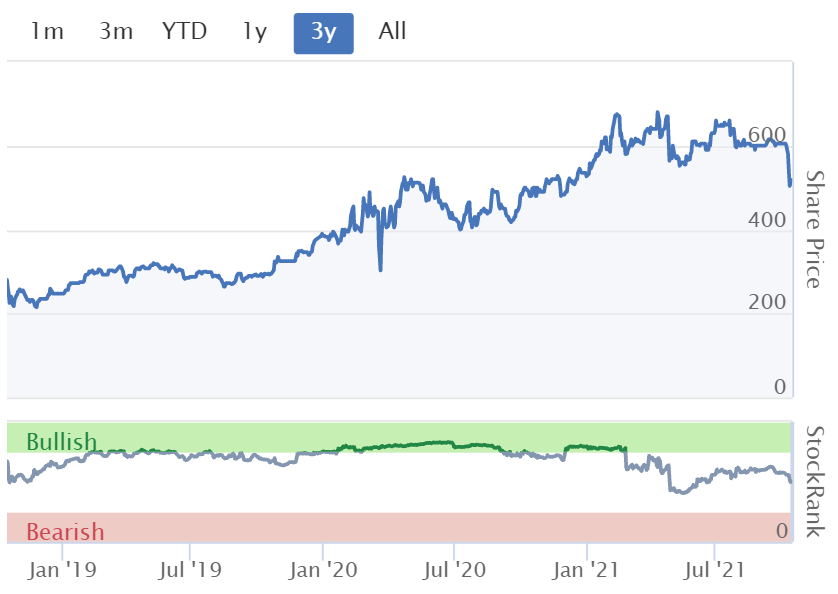
Tristel (LON:TSTL) - a quick look at FY 6/2021 results & outlook. After a "disappointing year" the outlook sees business returning to normal, and growth resuming. It's a nice little company, but I question the high valuation - it will need to seriously beat current forecasts, to justify the current share.
Supreme (LON:SUP) (I hold) - a reassuring trading update today, from this entrepreneurial company. It seems to hint at possible out-performance later this financial year? Valuation looks modest, and with good quality scores too. Looks good to me.
Jack's Section:
Centralnic (LON:CNIC) - profit to be at the upper end of guidance, with an improving organic growth trajectory. The valuation is modest relative to peers and the apparent growth prospects, but integrating multiple acquisitions while steering organic growth is tricky. Management is so far proving up to the task.
Mind Gym (LON:MIND) - revenue has returned more or less to pre-pandemic levels but the share price has risen faster than profits have recovered. The high valuation combined with a lack of share price liquidity is enough to keep me on the sidelines.
Bioventix (LON:BVXP) - a quick look over results for FY 06/2021. This is a remarkable little company, making a staggering profit margin for its niche disgnostic products (antibodies). Specialist knowledge is needed to assess this company's prospects/value, hence I'm neutral on it.
Explanatory notes -
A quick reminder that we don’t recommend any stocks. We aim to cover trading updates & results of the day and offer our opinions on them as possible candidates for further research if they interest you. Our opinions will sometimes turn out to be right, and sometimes wrong, because it's anybody's guess what direction market sentiment will take & nobody can predict the future with certainty. We are analysing the company fundamentals, not trying to predict market sentiment.
We stick to companies that have issued news on the day, with market caps up to about £700m. We avoid the smallest, and most speculative companies, and also avoid a few specialist sectors (e.g. natural resources, pharma/biotech).
A key assumption is that readers DYOR (do your own research), and make your own investment decisions. Reader comments are welcomed - please be civil, rational, and include the company name/ticker, otherwise people won't necessarily know what company you are referring to.
Paul's Section
Supply chains & inflation
Supply chain costs & delays, and higher inflation, are the key issues of the moment, impacting many companies around the world.
Inflation seems a straightforward issue - it’s here, it’s likely to persist for some time (we don’t know how long), and the key issue we need to ask all companies in webinars is: have they managed to pass on higher costs to end customers? If they have some pricing power, and can raise selling prices, then inflation doesn’t really matter, because profits should be unaffected. In some cases, supply shortages combined with rampant demand, have led to big increases in profitability - e.g. car dealers, and possibly some building supplies companies (e.g. James Latham (LON:LTHM) ).
Some of us here will remember the inflation of the 1970s and early & late 1980s. Although I was only a child, I do remember it being a big issue, and seeing my Gran’s modest savings destroyed in purchasing power over a few years. Most of the population seemed to be in a battle against rising living costs, and unionised workforces were constantly going on strike for higher pay. Inflation can achieve a horrible inertia once it gets going, since it creates not just price rises, but general expectations of further higher prices, which people begin to anticipate, hence making it self-fuelling.
Globalisation has protected us from inflation in recent decades, as we suck in cheap consumer goods, made from cheap labour. Has that process run its course now though? I see China factory output prices recently are up 10%, and of course China isn’t a low wage country any more, so I’m not sure how they’ve managed to dominate global production still?
Anyway, my main point is that we associate the inflation of the 1970s with bombed out share prices. However, I question whether higher inflation now is likely to produce low share prices again? There were all sorts of other economic problems in the 1970s, and the outlook was utterly grim. That’s not the case now.
With inflation rising, and interest rates still jammed at near-zero, negative real yields on cash and bonds mean that surely equities are the only game in town? Therefore I would imagine higher inflation, and maybe slightly higher interest rates, would make equities more attractive relative to other places to park your money which guarantee losses in real terms. Property being the only other attractive asset class that I can see (other than nonsense such as blockchain, which is just a classic speculative bubble).
Although there has been some evidence that very highly rated growth shares are losing momentum, possibly because the ratings don’t stack up when you factor in higher interest rates, who knows?
Anyway, I reserve the right to change my mind, as the facts change & develop, but this is just some pondering of where we might be at the moment. As always, we like the article to stimulate a debate in the comments section, so do please share your views too!
There's a fascinating book called "When Money Dies" by Adam Fergusson, which chronicles the hyper-inflation of Germany's Weimar Republic, which was one of the factors that laid the ground for Hitler & the Nazis (by wiping out peoples's savings). I think a reader here suggested it. What's interesting, is that money printing in earnest began in Germany (and neighbours such as Austria-Hungary) as early as 1913, and took c.10 years to finally destroy the currency through hyper-inflation. During that period, there was rampant speculation, and a massive stock market boom. Many people made fortunes, before the whole system finally collapsed, with a wheelbarrow full of bank notes needed just to buy a loaf of bread, famously. Obviously we're nowhere near hyper-inflation, but it does renew my worries about the wisdom of doing so much QE. Too much money creation leads to too much money chasing the same amount of goods/services, hence inflation. That's what's happening right now, I would argue, albeit on a modest scale.
Wage inflation is clearly feeding in also, as workers demand higher wages, to compensate for higher prices in the shops, energy bills rising, etc. Employers are having to pay up, due to skills shortages, and the low overall rate of unemployment.
Vertu Motors (LON:VTU) (I hold) said last week that its wages bill would rise by £12m annualised. Unfortunately, I can’t find the total figure for annual wages cost, which is usually in the Annual Report, but Vertu only seems to publish abbreviated accounts on its website.
Companies having to pay higher wages is an obvious threat to profits, if they cannot pass on higher costs. So I’m trying to avoid companies with wafer-thin profit margins, in competitive sectors. Also long-term fixed price contracts could prove ruinous, when costs are rising.
Supply chain - US markets seem to have already shrugged off this worry, whereas as usual UK small cap investors have panic sold, leading to plunging prices. Mind you, prices and volumes here are much more volatile, and it doesn’t take many small sells to smash a UK small cap price - opportunities for the bold to take advantage of a mid-season sale!
It’s too early to be sure, but based on the companies I’ve been speaking to recently, and webinars (where the question of supply chains always comes up), it seems as if most companies are coping alright, albeit with some additional costs. E.g.
Sosandar (LON:SOS) (I hold) - recently said they’re seeing additional freight costs, but have recouped them from margin improvements from larger order sizes. Placed autumn orders earlier, so are fully stocked for peak period.
Quiz (LON:QUIZ) (I hold) - has seen some delays from China (40% of production), and higher freight cost. So they’ve placed orders earlier. Autumn/partywear is in for peak season, happy with stocking situation. Can air freight product in, but occasionwear not as fashion sensitive as for other retailers.
Boohoo (LON:BOO) (I hold) a key point from its recent webinar, CEO said “we hire a jumbo, about once a fortnight” to air freight in product from China, if delays at ports. Main problem & costs is cost of carriage to customers. Of the £26m extra freight cost in H1, £20m relates to additional costs in getting product to customers abroad, especially USA. Solution in sight, from Nov 2021, when transatlantic passenger aircraft resume. This will greatly increase capacity, and lower costs, of transatlantic air freight, which passenger planes carry with them. Longer term solution is opening a £1bn distribution centre in USA, in 2023. Problems in Europe, but they’re prioritising USA, as bigger potential.
Scs (LON:SCS) (I hold) - delays with supply from Far East. But 50% is made in the UK, and 10% in Europe. Main issue is delays from such strong demand, factories working at capacity. But it sounded as if SCS can handle these issues. Orders are delayed, but not lost, so will catch up at some point. Cash pile grows when orders are delayed. Cash should normalise at about £57m once order backlogs have been cleared (still more than half market cap! Ludicrous).
Gear4music Holdings (LON:G4M) (I hold) - Jack reported last week here on its H1 trading update. This reassured on trading, and also confirmed that inventories are fine (despite it sourcing much product from China). The share price has quickly rebounded, and recouped a lot of the pullback from people selling (presumably over supply chain issues). I reduced my position size, over misplaced worries about supply chain, just in case, on the basis that I can always buy them back.
Smiths News (LON:SNWS) (I hold) - its distribution network uses self-employed van drivers, so shortage of HGV drivers shouldn’t be having any impact.
Obviously I look closest at companies where I hold positions, and the above comments show that, so far anyway, supply chain worries seem to be overblown. Even where companies have suffered, it’s only temporary. At some point, supply chains globally will undoubtedly settle down again - they always do. Does it really matter that a company misses its forecasts for one year, due to external factors outside its control? I don’t think so, but I tend to think long-term.
Maybe we’re seeing a period where money is being transferred from the impatient, to the patient? Who knows, let’s see what happens. It’s all about sentiment in the short-term, but fundamentals in the long-term.
So far, companies I've looked at seem to be coping alright with their supply chains, or reporting some additional costs & disruption, but nothing too drastic. However, I bet we'll see more profit warnings in the coming weeks & months. So maybe a good idea to keep sitting on a bit of cash, but also opportunities are now presenting themselves, with good companies having fallen too much, I reckon.
Tristel (LON:TSTL)
518p (pre market open) - mkt cap £244m
Tristel plc (AIM: TSTL), the manufacturer of infection prevention products announces its unaudited preliminary results for the year ended 30 June 2021.
Tristel says it had a “disappointing year”, due to the impact the pandemic had on hospitals not doing as many procedures. The NHS also previously stocked up on Tristel products to safeguard against potential Brexit disruption, but is now working through its stockpile. The commentary sounds upbeat about more normal activity resuming.
Briefly, here are the key FY 06/2021 numbers -
Revenues £31.0m (down 2% on LY)
High gross margin, flat at 80% - giving strong operational gearing, so profits should rise strongly if revenue growth resumes.
Underlying PBT £5.4m (down 24% on LY) - still decent profits, even in a bad year.
Net cash of £8.1m
Very strong balance sheet, as usual with this company, which is conservatively financed, reassuring for shareholders.
FDA decision “before June 2023”
Outlook - sounds encouraging, but no figures provided -
We are pleased to report that during the first quarter patient examinations in most of our markets have increased from earlier in the year. Furthermore, the UK NHS has been using up the stock of Tristel products that it purchased in late 2020 to safeguard against a disorderly Brexit, and this supply overhang has nearly disappeared. For the first time in eighteen months, we look forward confidently to a resumption of our normal predictable pattern of business and a return to our growth trajectory.
Forecasts - many thanks to Finncap for publishing an update note this morning.
It says adj fully diluted EPS is 9.6p (down 19% on LY), so the PER is 54 times. That’s high, but understandable, given performance was impacted by the pandemic.
Finncap pencils in 10.3p, and 10.7p for FY 06/2022 and FY 06/2023. That’s nowhere near enough to sustain a share price of 518p, so shareholders in Tristel are clearly betting that the company is likely to beat these forecasts.
There’s also potential upside in future years if/when the FDA approves Tristel products, which has been on the cards for a long time now.
My opinion - this share still looks too expensive to interest me. Why pay up-front for a doubling of profits, necessary to make the PER look vaguely reasonable? You’d have to be super-confident that performance is likely to greatly improve, and be prepared to wait, for the fundamentals to catch up with the current share price.
For me personally, the valuation still looks far too high, despite a recent correction. It’s quite a nice little business though, selling small amounts of niche product in lots of markets, for high margins. The only question mark, is what are the shares worth?
.
.
Supreme (LON:SUP) (I hold)
193p (up 7%, at 08:05) - mkt cap £226m
Supreme (AIM:SUP), a leading manufacturer, supplier, and brand owner of fast-moving consumer products, provides a trading update for the six months ended 30 September 2021.
This looks satisfactory -
The Board is pleased with the strong performance of the Group in the first half of the financial year and remains confident in achieving expectations for the full year.
Supply chain - this reassures, and it sounds like the group has everything under control. Also, note that Supreme's products are small items, so I don't suppose transport costs would amount to much as a proportion of total cost -
As manufacturing in Supreme's key vaping and sports nutrition categories is in-house, the Group has been relatively unaffected by global supply chain issues affecting other areas of the economy. In addition, active management in the Group's Batteries and Lighting divisions has also largely insulated Supreme from these issues.
Management remain cognisant of supply chain and labour constraints but are confident of being able to manage these risks in-line with the growth the Group is delivering.
Outlook - combined with the upbeat tone of the rest of the announcement, I think the following is hinting to us that we could be heading for a future upgrade, possibly? -
Overall, group margins have been particularly strong with significant year-on-year growth in profitability. Whilst it is too early to draw conclusions about the full year, the Board is pleased with the performance of the Group and looks ahead with confidence.
Diary date - 7 Dec 2021, for interims results to 30 Sept 2021.
My opinion - management came across very well in a webinar - this is an entrepreneurial business, seeking out profitable niches to supply to UK retailers, e.g. batteries, lighting, vaping, vitamins, etc.
With a positive update under our belts today, the valuation looks undemanding to me, so this gets a thumbs up from me as a decent value share, or GARP (growth at reasonable price) possibly, if the new product lines do well.
Note the low forward PER, and the decent dividend yield too. Quality scores are also impressive.
.

.

.
Bioventix (LON:BVXP)
3825p (down 3% at 10:17) - mkt cap £198m
Bioventix plc (BVXP), a UK company specialising in the development and commercial supply of high-affinity monoclonal antibodies for applications in clinical diagnostics, announces its audited results for the year ended 30 June 2021.
I wouldn’t normally cover something so specialised here, but know the story reasonably well, as I’ve followed the company for many years. It’s pretty much unique - having only about a dozen staff, and some very specialist niche products, which take years to develop. That gives it a big moat, and pricing power - hence the staggeringly high net profit margin - it typically makes about £7m profit on c.£10m revenues!
FY 06/2021 results, key numbers -
Revenues £10.93m (up 6%)
Profit before tax £8.12m (down 1%)
Profits & cashflows now mostly being paid out in divis: £7.7m paid in the year
Diluted EPS 128p - a PER of 29.9 - not outrageous, for the very high quality, high margin earnings. Although growth has been lacklustre in the last couple of years.
NAV: £11.8m, mostly receivables + cash, as it’s an asset light business model, relying on expertise, rather than equipment.
Reading through the narrative it’s becoming very obvious that I do not have any skills to analyse the business model or its prospects, that’s best left to sector experts.
My opinion - the investment case relies on properly understanding 2 key issues -
- How sustainable are current products/profits?
- How lucrative is the development pipeline likely to be?
I don’t have any idea on the answers to those questions, hence have no opinion on this share either.
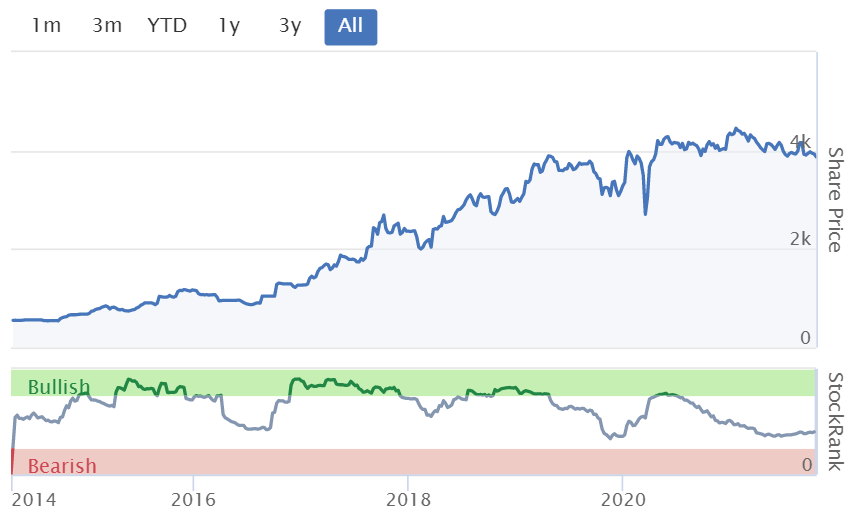
As you can see, the share price has been going sideways for the last c.3 years. Maybe it needs some clear catalyst on growth, and new products, to trigger another wave upwards?
.
Jack’s section
Centralnic (LON:CNIC)
Share price: 125p (+9.65%)
Shares in issue: 251,160,084
Market cap: £314m
(I hold)
CentralNic has been acquiring in recent years, consolidating in a fragmented market that it claims is $30bn in size. These acquisitions are increasingly taking the group into the rapidly growing world of marketing services (similar to Tremor International (LON:TRMR) ).
The group develops and manages software platforms which allow businesses globally to buy subscriptions to domain names for websites and email, monetise their websites, and acquire customers online. It focuses on acquiring cash-generative businesses in its industry with annuity revenue streams and exposure to growth markets. These new businesses are then integrated onto CentralNic’s software and operating platforms.
These recurring revenue and cash generation characteristics provide a solid base for reinvestment, organic growth, and further acquisitions. The management team is experienced and the group has some promising customers, including Fortune 500 ‘technology giants’, global brands, governments and SMBs.
Acquisitions have led to good revenue growth:

Shares in issue have increased nearly fourfold over six years however to finance these acquisitions. But earnings per share are forecast to jump this year as the dust settles. The shares in issue and earnings per share charts are below.


The share price has been strong recently but, if forecasts are anything to go by, there is still an opportunity at the present level to buy into that growth if it does appear sustainable (particularly relative to peers, many of whom are listed in the US). It’s riskier though, as it relies on future forecasts rather than proven historical financial performance.

CentralNic reports that, following its significant investment programme, organic growth has further accelerated during the nine months to 30 September 2021, up 29% year-on-year.
The company therefore expects revenue of at least $280m and adjusted EBITDA of at least $32m for the nine months ending 30 September 2021. This is an increase of at least 66% and 45% respectively over the $168.5m and $22.1m reported for the same period last year.
Cash rose from $28.7m at 31 December 2020 to $54m and net debt has reduced slightly from $85m to $79m, despite c.$13m being spent on the acquisitions of Safebrands and Wando and the final deferred consideration payment for Team Internet.
Adjusted operating cash conversion continues to be in excess of 100%.
Ben Crawford, CEO of CentralNic, said:
CentralNic's growth rally has further accelerated during the third quarter of the year with year-to-date organic growth now reaching a record 29%. The Company expects to trade comfortably at or above the upper end of market expectations for the year for both revenue and adjusted EBITDA. We are particularly pleased that the accelerated growth is now also starting to translate into higher profits.
Analyst expectations of revenue and adjusted EBITDA for the financial year ending 31 Dec 2021 range between $348.6m - $355.3m and $41.1m - $42.0m respectively.
The more detailed interim report for the nine months will be published on 22 November 2021, accompanied by management presentations to analysts and private investors.
https://www.investormeetcompany.com/centralnic-group-plc/register-investor
Conclusion
This is just a short Q3 announcement but it does flag the company up as worthy of further research. It takes some time to unpack its markets and just how the recent spate of acquisitions (accompanied by an increase in shares in issue) affect its earnings per share prospects.
The improvement in organic growth (the 29% organic growth for 9M FY21, up from 20% organic growth in H1 2021 and 9% in 2020, is some trajectory) and the confident guidance does suggest that acquisitions have been well thought out, although this area is famously the most variable capital allocation method of driving sustainable shareholder returns. Some companies and management teams do get it right though.
This profit upgrade follows several revenue upgrades throughout the financial year.
There have been three acquisitions since June 2020 but it’s worth noting that it’s not all been about acquisitions - CentralNic has been investing heavily in its existing operations too. FY20 investment included the streamlining of group operations and IT infrastructure, increasing headcount, and streamlining the internal supply chain.
The group has recently been loss-making and the historic quality metrics are subsequently poor, but the profit profile is improving. So that could mean the opportunity here is being missed.
There’s still risk of course as things get integrated, and online marketing services is a rapidly evolving area where the risk of obsolescence is also real, but the current direction of travel is positive.

Interestingly for a tech / software stock, it qualifies for the Charles Kirkpatrick Bargain Screen, which focuses on positive share price momentum and the price to sales valuation multiple. Some of CentralNic’s web services and online marketing peers are on much racier multiples.
Mind Gym (LON:MIND)
Share price: 190.2p (+0.11%)
Shares in issue: 100,105,660
Market cap: £190.5m
Mind Gym is a provider of human capital and business improvement solutions.
These solutions aim to deliver business improvement using scalable, proprietary products which are based on behavioural science. The group operates in three global markets: business transformation, human capital management and learning & development, and it says the addressable opportunity is some $100bn.
Mind Gym bounces back ahead of pre-COVID levels
Revenue +76% to £24.1m and +7% up on two years ago at constant currency, in line with the board's expectations. A total of 82% of revenues in the period were ‘digitally enabled’, with upcoming planned launches of a new digital product set.
Cash at bank was £11.9m. The group has recently entered into a £10m debt facility (£6m RCF, £4m accordion), which was undrawn as at 30 September 2021.
Octavius Black, Chief Executive Officer of Mind Gym, commented:
We are delighted to see strong growth in revenues in the first six months of the year, ahead of pre-COVID levels for the comparable period, driven by our digitally enabled capabilities with virtual delivery of our services providing clients with attractive workplace flexibility. We remain focused on our investments and new digital products and will update further at the time of our interim results in December.
Mind Gym will provide a further update with its interim results on 3 December 2021.
Conclusion
Another short update, albeit one confirming a recovery to pre-pandemic levels in terms of constant currency revenue.
The shares here are very illiquid, with a spread of around 526bps and a free float of around 32%. In reality, it’s probably smaller once you rule out the top 10 shareholders, who hold more than 90% of the shares.
This makes share price volatility more likely - you can see how the share price moves in the chart below.

That’s likely because the founders own more than half of the company (see Major Shareholders).

The group notes a $100bn identifiable market for its corporate behavioural science programs, which aim to make the workplace more productive and satisfying. The pandemic hit business hard and the group had to transition its workshops towards digital classes. It is forecast to break even this year but a return to pre-Covid profits is not expected by FY23.
When you compare that to the share price performance, it suggests that a degree of future recovery and growth is already priced in. Combine that with the lack of liquidity and it’s not hard to see a derating in the short term if the company disappoints. That’s not a view on the longer term prospects, but it’s a possibility in the near term given the slow forecast profit recovery and low share price liquidity.
But then again, Stockopedia flags up a 94 Quality Rank and revenues have risen fairly consistently over the years. So there must be some demand for its products.

I’m still unsure about that demand though. Are these programs seen by corporate customers as essential services, or just nice to have additions? That has implications for Mind Gym’s pricing and bargaining power.
There are some positives: high margins and good cash generation, a large and fragmented market. But I imagine demand for its services is cyclical - these types of programmes must be near the front of the line in terms of cost cutting - and the share price has recovered more than its profits have, so I don’t see much of an opportunity at the present valuation.

Disclaimer
This is not financial advice. Our content is intended to be used and must be used for information and education purposes only. Please read our disclaimer and terms and conditions to understand our obligations.

63 comments
Funny how no-one bothered thanking container lines or shipowners when container rates were low for year after year.
B2V
Smiths News (LON:SNWS) good analyst note out on Research Tree from Edison - 18 pages and pretty comprehensive.
Yes good note on Smiths News (LON:SNWS) perhaps the most interesting snippet is that (if I read it correctly) Smiths are able to pass on higher fuel or delivery costs to the retailer through a delivery charge. I suspect it's the potentially higher costs that have weighed on the share price recently so this was very welcome news.
Bioventix (LON:BVXP) - finnCap has issued a note this morning (free if you register https://www.finncap.com/resear... ). They suspended forecasts during the pandemic (hence the horizontal line on the Analyst Consensus section of the SR (that Stocko seems to be incapable of removing). Now restored they forecast Adj. eps of 127.3p then 129.0p compared to 132.8p just reported. The drop is mainly due to the loss of NT-proBNP revenues, which has been known for a long time. It looks as if we could be in for a long sideways move as we look to increasing Troponin revenues:
To date
finnCap say "Peak revenues of troponin in 2025 are still estimated to be in the £3-3.5m range". This compares to revenue of £1.28m for NT-proBNP for the year to last June.
Hi Paul,
With regards to the wages bill at Vertu, you said :
Unfortunately, I can’t find the total figure for annual wages cost, which is usually in the Annual Report, but Vertu only seems to publish abbreviated accounts on its website.
Don’t know if it helps but the wages are detailed in their annual accounts registered with companies house - see page 98 and 99 https://s3.eu-west-2.amazonaws...
Why not make a simple note and tell us. So much info not interested in random links sorry.
Dead link - you must've been signed in to an account when you cut and paste the link from your browser as your security token blob details are in the URL :)
Sorry about the link, was a copy and paste from the Companies House website.
On the subject of Container Ship capacity we recently had 3 huge ships anchored in Torbay with a total of 67,000 containers on board. They were waiting to get into Rotterdam which was full. I do not exaggerate when I say they had to wait 2 or 3 weeks!
Seems strange when some shipping companies are switching from Felixstowe to Rotterdam because they have to wait a few days. But this is a worldwide problem. Article in FT: https://www.ft.com/content/245...
Paul: "Too much money creation leads to too much money chasing the same amount
of goods/services, hence inflation. That's what's happening right now ..."
That's not true. Simplifying a little, inflation is either due to too much demand or too little supply. The problem we have is too little supply. The world is producing less than it would have done without covid interrupting growth. If supply wasn't a problem we would be producing much more to meet the demand and levels of real GDP would be higher.
The big picture is that inflation is doing eactly as expected post covid with 2 exceptions. On the big picture, we've had an extremely unusual recession. Normally in a recession, demand collapses while the majority of supply remains in place. This time, supply collpased while (due to government support) the majority of demand remained in place. Consequently, inflation was always expected to rise temporarily while supply caught up with demand. This is playing out as expected.
The 2 exceptions are in energy and low skilled labour. In both cases, for a variety of reasons, supply is failing to catch up as quickly as expected. The outlook for inflation is heavily dependent on what happens in these 2 areas. These are both global issues but both have particular complications in the UK.
If the problem was "too much money chasing the same amount of goods/services" then that would be an easy problem to solve. Simply raising interest rates a notch above their current extreme lows would be all that is required. Unfortunately that is not the real problem and the real problems will take longer to solve.
Doesn't too much money creation also have the effect of increasing demand so that we now have a situation where demand is increasing at the same time as supply is reducing?
The government were probably over generous in their various support schemes and this has created excess cash for many consumers, added to the fact that for most of 2020 they couldn't spend this excess, has exacerbated the situation.
With reference to cmpeckham's post, IMHO an increase in interest rates now will not have any effect on supply and therefore very little if any effect on short term inflation.
Richard
https://www.drewry.co.uk/suppl...
SCFI INDEX
https://en.sse.net.cn/indices/...
Morning Paul
Just to note that in relation to Smiths News (LON:SNWS) (I hold), while they use self employed van drivers, there is currently also a shortage of those. Smiths (along with Menzies) have launched a recruitment drive to try to ensure deliveries are still made, but it seems likely to me that there will be some cost pressures from that, as they try to incentivise drivers.
That said, Smiths are excellent at managing costs generally, and even a 15-20% increase in delivery labour costs in the near term would still leave healthy operating profits. These cost pressures are also quicker to resolve than HGV drivers, as the barriers to entry for labour are lower, given anyone with access to a van can fulfil the role.
M
Is there a read across to the likes of Redde Northgate (LON:REDD) for the demand of temporary vans, though looks like a lot more people are driving their own cars for deliveries to our road in the last few weeks with the occasional logoed van.
Tommy
There is a note out today on Smiths News (LON:SNWS) that you can see on Research Tree. It is quite comprehensive (about 18 pages). In one section it covers the distribution and apparently the retailer bears the cost of delivery so there is no risk to Smiths News (LON:SNWS) profitability from an increase in HGV driver wages etc.
They have a target of 77p on them. Ie around a PE of 8 and estimate FCF of circa 10p per share annually so that would still make a dividend yield of 6.5% even at that price (on a 2* cover)!
Only thing that concerns me a little is interest rate risk on debt though rates would probably have to go up well past 3% before it becomes too material, so probably not an immediate concern and they should be at 1* EBITDA in next couple of years anyway.
Hi Paul,
Thanks for the comments onTristel (LON:TSTL). I was interested by what you did and didn’t highlight from the outlook statement. For me, the part that, at least for the near term, prompted questions was,
“Furthermore, the UK NHS has been using up the stock of Tristel products that it purchased in late 2020 to safeguard against a disorderly Brexit, and this supply overhang has nearly disappeared”.
This suggests to me a risk of a soft first half and if I was dealing into any results calls today, I would ask the company to expand on this point.
Hi 1James1n1,
You must have missed it, but I did mention the point about the NHS using up stockpiled supplies, in the first paragraph of my article about Tristel (LON:TSTL) - which I took to read positively, as it sounds as if normal order levels should return in due course.
Are earnings likely to grow enough to justify paying a current PER of 54 times? That's a tough one.
Regards, Paul.
You did indeed Paul! It was unclear to me if this disclosure from the company was something that would impact the 1H for this new year or not, but it sounded like it should.
I agree that the forward rating is very challenging!
Tristel (LON:TSTL)
There's certainly a lot of good news in the price and a large proportion of that surely hinges on US approvals. They are certainly dragging their feet and I wonder if this isn't US protectionism in action. It reminds me of Sportingbet's experience where a visiting director was arrested while they sorted out the law to make on-line betting equivalent to phone betting because it threatened the Casinos. The directors like selling too, is TSTL's patent protection running out soon? I no longer hold, I hope the bear case doesn't offend.
Morning Paul & all,
I respectfully disagree with this: (other than nonsense such as blockchain, which is just a classic speculative bubble).
So I find it useful to divide the space into 3 categories.
one of those parts is exactly as you describe Paul, tradable tokens whose value rests on the “greater fool theory” that a greater fool will pay more for it next week.
The other 2 categories would be:
- Blockchain infrastructure projects. These are a complex set of interoperable protocols that are in development to tackle real world problems. Their value is likely to be closely related to their application to real world use cases.
- Stablecoins. These are very interesting and have been gathering much of the attention from the SEC and other regulators recently.
Essentially these tokens are created in such a way that they always match the value of a real world price that they are matched to. Putting aside any natural scepticism that we may have that this is technically possible, I think we could all see a potential use case for being able to move an inflating currency into a digital asset that is pegged to assets that hold their value.
Lol "stable coins". I'm with @Bitfinexed
John Gibson
"Essentially these tokens are created in such a way that they always match the value of a real world price that they are matched to. Putting aside any natural scepticism that we may have that this is technically possible, I think we could all see a potential use case for being able to move an inflating currency into a digital asset that is pegged to assets that hold their value."
My problem with anything like this is who is providing the gaurantee that when it comes to cashing in your chips you will be able to do so? Are these items always backed by government - if not then surely there must be an element (huge?)of risk that the system will come down crashing down at some stage before you want to cash out?
Am i correct in saying that Bitcoinn only survives really due to the fact that bods are willing to use massive processing power to validate transactions ? what happens if the bitcoin value crashes 99% and its in no ones interests to waste their electric keeping the system ticking over verifying transactions ? - is that not an obvious end game?. This would be accelerted to such as soon as mass panic is created by it being flagged up to the "masses" that their investment could be worthless - ala Northern Rock where the mere mention was enough for punters to immediately take action to withdraw their funds.
Hi rmillaree,
Both your paragraphs contain issues that any investor would need to explore to their satisfaction.
On the Bitcoin related stuff, you are right that it uses a lot of computing power, whilst newer cryptographic methods can get the same security for orders of magnitude less power.
Personally I don’t find Bitcoin so interesting- it is the only blockchain that has this socially agreed ‘store of value’ narrative that is, now, accepted by enough people to become part of the financial worlds furniture, so to speak.
On the first paragraph, I’d put the issues you raised into the ‘technical execution’ box.
The ‘ability to cash out’ question would relate to the way the ‘coins’ are created and how they are traded. Definitely something to investigate in depth and get comfortable with before investing. I think a similar question could be asked regarding stocks instead of blockchain tokens, and centralised stock markets instead of decentralised blockchain markets.
The guarantee comes from peer reviewed cryptographic science, as opposed to politicians and central bank employees. I think it’s valid for anyone to make an argument and then a choice between those two.
The reason I, in my own head(!), try to separate the technical problems from the potential applications of the technology is because the tech is 12 years old from the launch of Bitcoin. And so I think that dismissing the tech now would be like dismissing aeroplanes 12 years after the Wright brothers. You might not want to get in a plane, but there might be enough of interest there to keep an eye on!
Warm wishes
The guarantee comes from peer reviewed cryptographic science, as opposed to politicians and central bank employees. I think it’s valid for anyone to make an argument and then a choice between those two.
While I agree with much of what you say this statement isn't correct, as the "guarantee" is that the stablecoin remains pegged to the underlying basket of currencies, not that the cryptocurrency itself is secure. The pegging process itself is the focus here - how does the issuer of the stablecoin ensure that it can be converted back at any time into the underlying currencies? The potential for the equivalent of a run on a bank is the obvious concern.
The other issue is the behaviour of central banks themselves. Members of the Fed are arguing that allowing private currencies at all is undesirable in terms of financial stability. Much of the current interest in Central Bank Digital Currencies stems from central bankers' concerns over Facebook's Libra, the archetypical stablecoin.
There is much that can be said for and against both cryptocurrencies and blockchain but this isn't really the place to do it.
On an investment related note Dispersion Holdings (OFEX:DEFI) today announced they are buying Accru Finance who are a platform for lending out cryptocurrencies. What that means is a mystery, but DEFI and Nft Investments (OFEX:NFT) are an interesting, if highly speculative, way of playing the crypto / token / blockchain theme.
timarr
Interesting thread. But, in regards to: ".... being able to move an inflating currency into a digital asset that is pegged to assets that hold their value."
- I am intrigued to know what asset is guaranteed to hold it's value? Relative to what?
There is a report in this weekend's FT that the Tether stablecoin has had to pay a $41million penalty to resolve a US regulator's claims that it had falsely represented that its digital tokens were fully backed by dollars. The CFTC found that Tether held sufficient financial reserves in its accounts to fully back tokens in circulation for only 27.6% of the days from September 2016 to November 2018.
Tether has issued more than $69 billion of stablecoins - presumably they are not expected to have the full $69 billion in their accounts?
From an article in IC over the weekend on Blockchain:- "Last week, a story in Bloomberg Businessweek detailed how the stablecoin is not backing a one-to-one USD valuation with safe assets, which would include actual hard currency, short dated Treasury Bills and money market instruments. Instead it has been buying the lower-quality paper of Chinese companies, and - in a further twist - includes receivables crypto-backed loans to crypto exchanges in its reserves."
Sounds stable AF. So unless you have faith in your stable coin provider, or its properly backed by assets, it sound's very sketchy, and in either case anathema to true believers as they don't like fiat as it relies on trust in government (or other centralised power), and wouldn't want to back their coin with assets (gold is for boomers), the coin is the asset. However I don't know how the crypto world feels about stablecoins.
When I think of crypto I remember the pyramid schemes where new money is needed at the base so those that have been in it for a while - Mr&Mrs Rich - get their commission. Diluting the full coin value into multiples allows new blood - Mr&Mrs Wannabee-rich into the ‘opportunity’. Nowadays don’t need to sell soap etc products to your mates with boxes in the lounge - just a few clicks on the pc.
Evening all,
This wee thread has included many interesting and respectfully forwarded opinions, surely a first in crypto discussions!?
Regarding Tether and other stablecoins that are backed by reserves - yes, you do need faith in the issuer, and I personally wouldn’t touch Tether.
However the next evolution of the technology is ‘algorithmic’ stablecoins, so , as an example, they are created by a protocol when you deposit a digital asset into a online smart contract (eg a contract to lock your asset for a time period, at a certain interest rate) in exchange for an amount of the stablecoin. When you return the stablecoin they are destroyed and your original digital asset is returned. All done by cryptographic math, and no trusted counterparty risk or risk of a ‘bank run’ scenario.
If that sounds opaque, in practice it is like this: you own Bitcoin, the price has gone up, you’re in profit but selling would be a tax event. Interest on borrowing is tax deductible and so you borrow against it, and still hold the bitcoin.
If the Bitcoin price goes up while it’s locked in the borrowing contract you get the upside when you end the borrowing contract.
If the Bitcoin price goes down you have the deductible interest payments and if you sell the Bitcoin there’s less of a gain to declare.
Or, even simpler example, imagine you want to trade in and out of Bitcoin, but every time you sell Bitcoin for pounds, it’s a tax event. But if you just trade for a stable coin token it’s not, so you hold your capital gain there. And maybe you do that trading on a decentralised exchange, again run by cryptographic math and resident in no specific country…
This, I should add, is not something I do! And this is probably a horrible explanation, but hopefully enough for anyone who’s interested to investigate further.- and you can see why central banks and governments are starting to sweat, even if retail investors dismiss the whole thing.
Jack, there is a recurring problem with your diagrams on my Windows 10 computer. The total revenue and diluted weighted graphs display OK, whatever comes after diluted weighted is a random alphanumeric string, the stock report displays OK and the final diagram is a random alphanumeric string.
Same problem here.
Same for me - but I am on a MacBP.
Re: graphs displaying as reference number - I quite often get this but not today. I think this is something to do with the computer's capacity to load and often find that hitting the refresh button will rectify it.
I did hit refresh a few times without success. I'm on a workstation grade PC with a 500 MB fibre connection.
You are on the ball this morning, Paul and Jack. Thank you for your industry and insight. SCVR is an indispensable part of Stockopedia and worth the subscription price on its own.
Confident update from Supreme and as Paul has suggested may be a prelude to an earnings beat, anecdotal, but who knows. Also a pretty good results from £BVXP in the circumstances. I hold both.
A reasonably positive update from SUPREME PLC today. Paul has commented previously on the potential in this business as the CEO Sandy Chadra buys, builds and develops new categories. Interesting to read that their vertically integrated Supply Chain model seems resilient during these times, and instead of suffering gross margin compression through COGS inflation, they guide that GM is strong. Still a lot to prove but looking positive in these early days heading into interims.
Thanks Paul for this interesting positive intro. By coincidence we were having a breakfast chat about online fashion shares. We noted that Sosandar (LON:SOS) is ranked 200 out of 246 on Trustpilot for women's clothing with Superdry (LON:SDRY) , Ted Baker (LON:TED) and Boohoo (LON:BOO) ranked higher at 158, 159and 187 respectively. In fairness, the list is dominated by small retail shops but may be worth bearing in mind. Having looked at a few more damning reviews - now considering selling Next (LON:NXT)
Some of our suppliers in China have said they are going to be forced to shut factories for several days a week - they usually operate 7 days a week, but will be operating 4 days a week (I believe because of energy concerns). While I do wonder if one or two might have exaggerated the issue to bring forward orders, if this is across the board it might further impact supply, especially as it will be in the run up to Chinese New Year, when production essentially halts.
Just wondering if the CCP is diverting resources to strategic destinations, that's all.
Hi Paul
Have you had the chance to have a look at the prospectus relating to the proposed demerger of Hostmore?
Your opinion is always much appreciated.
Thanks in advance.
Hi yiannos1,
Have you had the chance to have a look at the prospectus relating to the proposed demerger of Hostmore?
No I haven't, and didn't realise it had been issued, so thank you for the prompt. I'll check it out at some point, but am happy with Hostmore, having looked into it previously. At present I'm viewing my soon to be received Hostmore shares as a long-term investment, as I like both the TGI and 63rd+1st brands, and want to be along for the ride as the ambitious management team roll them out.
Regards, Paul.
Good thinking Paul, thank you for this wake-up call. The answer to your question must surely be Momentum.
Silver
Electra Private Equity (LON:ELTA) (I hold) demerger: Over the weekend I looked at the prospectus for Hostmore PLC (aka Fridays) and the other materials published on Friday. A few things leapt out at me - some of these points might have been in the public domain previously, I can't remember, but either way they have now properly caught my attention:
I'm starting to feel more sceptical about the value in Electra Private Equity (LON:ELTA) - would welcome an opposing view.
Yes I sold out of Electra Private Equity (LON:ELTA) a couple of weeks ago. I haven't done your level of analysis, but mainly I just felt TGI is a rather tired brand and can't see it attracting a premium valuation (recent broker note implied 13x ev/ebitda is feasible based on valuation of peers, but this would equate to a PE ratio of 25-30 - I really can't see that!)
The trading update that accompanied last week's RNS was a bit soft. LFL trading broadly flat against 2019 - given the staycation boom and fact that many competitors wiped out I would have hoped for much better. Look at boom in trading at Franca Manca and Wagamama.
Finally there is the issue of finding hospitality staff and feel this could put pressure on costs.
On the other hand TGI is being valued in the ELTA NAV at fairly modest multiple, so I think the current share price (on a small premium) looks about right, although not low enough to tempt me.
Re Vertu Motors (LON:VTU) (I hold)
Re increased wages at £12M
I think you'll find that most of that increase is simply extra commission and bonuses being paid as sales volumes are so high, arguably a good thing, provided extra profit generated more than covers additional wage s costs Of course!
RE: Vertu Motors (LON:VTU)
I think you'll find that most of that increase is simply extra commission and bonuses being paid as sales volumes are so high, arguably a good thing, provided extra profit generated more than covers additional wage s costs Of course!
That may be the case but it's not obvious from what they said:
A key objective for the Group in the remainder of FY22 is to significantly reduce the number of outstanding vacancies and colleague turnover ... or example, the Group recently enhanced its benefits by a significant improvement in maternity pay provisions, increasing these from the statutory minimum to 90% of pay for up to six months. In addition, the Group is currently undertaking pay reviews for all colleagues which will be actioned by 1 January 2022.
https://www.investegate.co.uk/...
timarr
Good read Paul, thank you.
Spoke to an owner of a UK company last night about the costs of a 40 foot shipping container. He quoted £40k cost. Told his supplier that they had to cover the cost if they wanted to carry on supplying to him. They laughed and said no. Got back to him later on and agreed. He was a little surprised and said their profit margins must of been higher than expected.
There was an interesting article in the weekend press, saying that the large shipping lines are operating a cartel, and are set to make profits of $150bn this year, more than they've made in the previous 20 years.
I wonder if legal action is likely, from disgruntled companies & Governments? This seems almost like a giant global tax, being syphoned off by the shipping companies.
I can't remember the source, but did read somewhere that the number of container ships in production is currently high, so a free market solution of more capacity is in the pipeline, but obviously takes time to build more ships.
It's going to get sorted out, timing is the only unknown, hence why I don't think supply chain issues should lead to radically lower pricing of shares impacted.
No surprise there at the $150b profits when ships carry about 21000 containers!
FWIW
21000 containers would be one of the biggest ships in the world and that would refer to 21000 x 20foot containers , so 10500 40fts.
An average container ship would be around 10-14000 TEU ( 20ft equivalent units).
Richard
The largest are now around 24,000. The Evergreen ones, such as the one that got stuck in the Suez canal and go into Felixstowe, are around 20,000.
These are TEUs which are 20 foot containers.
duplicate
Shipping cartel article appeared in Telegraph at weekend : https://www.telegraph.co.uk/bu...
The first two made me properly laugh out loud, thanks Mr C.
Recommended cash bid for gaming software company Playtech (LON:PTEC) at 680p/58% premium to Friday’s close.
https://www.investegate.co.uk/...
Nice start to the week.
Gus.
Irrevocable undertakings or letters of intent in respect of a total of 63,412,083 Playtech Shares representing, in aggregate, approximately 20.70 per cent. of Playtech's issued ordinary share capital.
Could get interesting here.
why could it get interesting? I actually thought the end game for Playtech would be with Scientific Games but it seems Aristocrat is taking the step.
With less than 21% acceptances there’s a good chance that notwithstanding a 58% bid premium for Playtech (LON:PTEC) there is plenty of scope for another bidder (such as Scientific Games) to get into the action creating a bidding contest similar to the recent situation at Augean (LON:AUG) and Wm Morrison Supermarkets P L C (LON:MRW) .
Gus.