Small Cap Value Report (Mon 23 Oct 2023) - TMG, NTBR, KLR

Good morning from Paul & Graham!
Explanatory notes -
A quick reminder that we don’t recommend any stocks. We aim to review trading updates & results of the day and offer our opinions on them as possible candidates for further research if they interest you. Our opinions will sometimes turn out to be right, and sometimes wrong, because it's anybody's guess what direction market sentiment will take & nobody can predict the future with certainty. We are analysing the company fundamentals, not trying to predict market sentiment.
We stick to companies that have issued news on the day, with market caps (usually) between £10m and £1bn. We usually avoid the smallest, and most speculative companies, and also avoid a few specialist sectors (e.g. natural resources, pharma/biotech).
A key assumption is that readers DYOR (do your own research), and make your own investment decisions. Reader comments are welcomed - please be civil, rational, and include the company name/ticker, otherwise people won't necessarily know what company you are referring to.
What does our colour-coding mean? Will it guarantee instant, easy riches? Sadly not! Share prices move up or down for many reasons, and can often detach from the company fundamentals. So we're not making any predictions about what share prices will do.
Green (thumbs up) - means in our opinion, a company is well-financed (so low risk of dilution/insolvency), is trading well, and has a reasonably good outlook, with the shares reasonably priced.
Amber - means we don't have a strong view either way, and can see some positives, and some negatives. Often companies like this are good, but expensive.
Red (thumbs down) - means we see significant, or serious problems, so anyone looking at the share needs to be aware of the high risk. Sometimes risky shares can produce high returns, if they survive/recover. So again, we're not saying the share price will necessarily under-perform, we're just flagging the high risk.
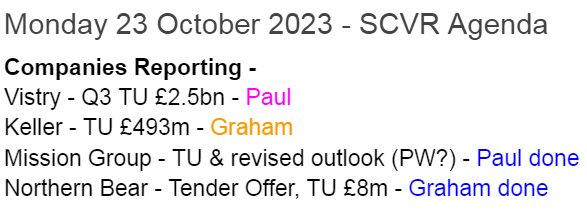
Agenda - quiet for news today.
Summaries
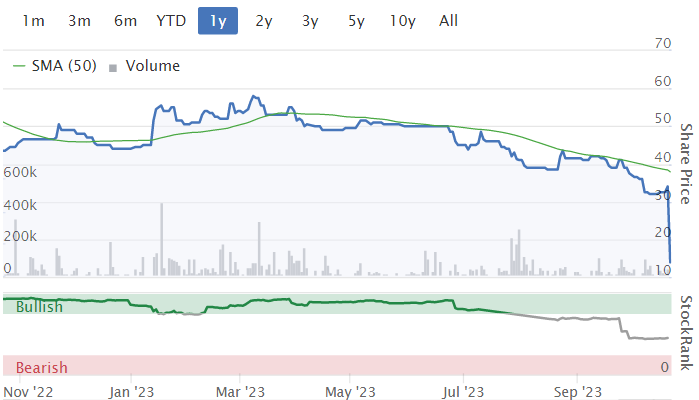
Mission (LON:TMG) - down 59% to 14.0p (at 08:44) £13m - Trading Update & Revised Outlook for 2023 - Paul - RED
A disastrous profit warning, with H2 performance having greatly deteriorated, but still profitable. Of far more concern is the bank situation, with a large increase in net debt to dangerous levels. The bank seems to have extended the facilities, but a covenant breach is expected in Dec 2023. Now way too high risk to get involved, in my view. We previously flagged the weak balance sheet & debt, here on 28 July.
Northern Bear (LON:NTBR) - up 29% to 57.6p (£11m) - Tender Offer & TU - Graham - GREEN
The Chairman has decided to move on, and the company is proposing to accommodate him with a 62p tender offer. All shareholders will be able to participate in the offer. Despite increased leverage, I remain positive on this as I think the PER will remain around 4x.
Keller (LON:KLR) - up 15% to 771p (£561m) - Trading Update - Graham - AMBER
Excellent news from this “geotechnical specialist contractor”, as full-year operating profit is set to be “materially ahead”. The company is carrying a modest amount of debt and the PER reflects this at around 6x. Fundamentally low quality but offering reasonable value.
Paul’s Section:
Mission (LON:TMG)
Down 59% to 14.0p (at 08:44) £13m - Trading Update & Revised Outlook for 2023 - Paul - RED
That’s an ominous title to the RNS above. Since it’s a cyclical group, marketing agencies, then it’s likely to be a profit warning if they’re revising the outlook, given toughening macro conditions.
MISSION Group plc (AIM: TMG), creator of Work That CountsTM, comprising a group of digital marketing and communications Agencies, wishes to provide an update on current trading and the Group's outlook for the remainder of the 2023 financial year to 31 December 2023 ("FY2023").
On 26 Sept it said that an H2 weighting was expected in 2023, and trading was in line with FY expectations.
Throw that out of the window, as today it says -
…recent trading has rapidly become more challenging than previously anticipated.
These sectors are under pressure, which should be useful to us in considering wider read-across to other shares -
This has been especially marked in the Consumer & Lifestyle, Property, and Technology & Mobility business units, where client wins have been more than offset by losses and several clients choosing to defer or significantly reduce spending. The Board now believes these more challenging trading conditions will continue for the remainder of the year and is taking a materially more cautious view on H2 2023 and therefore the FY2023 outturn.
Operational review is being carried out, with “initial cost reductions” starting, and to be “fully implemented by year end”. A second round of cost & efficiency savings is planned for 2024.
Revised guidance is a bit confusing, so I’ve referred to an update note helpfully published by Canaccord on Research Tree.
Adj PBT for FY 12/2023 is now £3.1m, down 60% from previous forecast. It did actual adj PBT of £1.0m in H1, which implies £2.0m in H2 - not a disaster, but nowhere near enough to support the net debt position which is now dangerously high at £25.5m.
Financial position - this is ringing my alarm bells.
Net debt has soared from £14.9m at June 2023, to £25.5m now (as at 20 Oct 2023). Reasons given -
As a result of the reduced trading performance, the payment of the final FY2022 dividend, and in particular the rapid reduction in pre-payments from certain clients
This sounds like the bank facility has been exceeded slightly -
The Group's committed bank facilities comprise a revolving credit facility of £20.0m, with an option to increase the facility by £5.0m, which expires on 5 April 2025.
But Nat West has given them additional facilities it seems, for the time being -
In addition to its committed facilities, the Group has available an overdraft facility of up to £6.0m with interest payable by reference to National Westminster Bank plc (Natwest) Base Rate plus 2.25%. Instead of increasing the revolving credit facility by £5.0m, the Group has agreed with Natwest that the overdraft limit of £6.0m will be increased to £10.0m, until further notice and subject to regular review.
Net debt not expected to change much in the short term -
Net debt is expected to be approximately £24.0m as at 31 December 2023 after a working capital outflow due to the forecast increase in turnover in Q4, resulting in an increase in trade debtors which is not expected to convert into cash until early 2024.
Covenant breach imminent -
The Group continues to be in compliance with its banking covenants but is now expecting the net debt / Adjusted EBITDA covenant in Q4 to be above current covenant limits at 31 December 2023. The Group is in constructive dialogue with Natwest regarding a covenant waiver.
Interim dividend, due to be paid shortly, is being cancelled. I would assume that no more divis are likely for the foreseeable future, as it’s now financially distressed and will have to get bank debt down significantly.
Paul’s opinion - this is bad, really bad.
We flagged here on 28 July that TMG had a stretched, overly indebted balance sheet, and that “the risk of another profit warning in the more important H2 looks quite high to me. For that reason I’d be reluctant to get involved at this stage”. Sorry to sound like a smart Alec, but I just want to reinforce that (a point covered in this weekend’s podcast) problems like this are often preceded by warning signs several months earlier. And of course the simplest balance sheet checks allow us to steer clear of any company with problem levels of bank borrowings such as TMG.
There’s another issue that occurs to me - plenty of cyclical companies have said that they’re trading as normal in H1 of this year. But it now looks as if signs of recession are beginning to spread into more sectors. So I think cyclical companies which seemed to be doing alright earlier this year, are now much more likely to be issuing profit warnings. Especially in B2B sectors, where there’s mounting evidence of customers reining-in discretionary, and project-based spending.
So maybe we need to focus on companies with high contractually agreed recurring revenues, and essential, non-cyclical products/sectors where demand is buoyant?
Plus of course my personal obsession - balance sheets! I’ll happily take a punt on a bombed out share being a cyclical recovery in due course, but only if it’s got a bulletproof balance sheet with net cash. If it’s got high bank debt, like TMG, then forget it. That's because banks don't like risk lending, and becoming quasi-equity. So they'll be pushing for an equity raise to bail them out, which often happen on ruinously dilutive terms in a downturn like this.
Note also with TMG how it says the big spike up in net debt has mainly been caused by customers no longer being so generous in paying up-front. That makes sense, since companies can now earn interest on their cash, so companies that rely on generous up-front payments from customers might find that generosity being scaled back, causing their own net debt to shoot up.
Overall, I think TMG has got so much worse than when we last looked, that our AMBER/RED warning on 23 July has to move now to bright RED.
The share price has crashed 60% to 13.5p at 08:33, so market cap now only about £14m, which means the window for doing a placing is rapidly closing I imagine, and could involve serious dilution now.
I can’t believe management has done this again. They over-expanded, using borrowed money, back in the early noughties, and ran slap bang into the 2008 financial crisis with too much debt, and almost went bust. Here we are again, in the same situation.
Graham’s Section:
Northern Bear (LON:NTBR)
Share price: 57.6p (+29%)
Market cap: £11m
This building services company has in recent years attracted the interest of micro-cap value investors. Indeed, a Canadian investor acquired 25% of the company and became Chairman of the Board (I’ll refer to him as “JB” from now on!).
Financial results were solid until 2021/2022, when goodwill impairments caused some statutory losses:

I last covered the stock in April, noting the small £7m market cap vs. operating profit of £2m for FY 2023.
Today we have news of a tender offer by the company at 62p, which is a 39% premium to last night’s close.
The max number of shares which will be bought is 5 million, or 26.7% of the current share count.
After a long period of strategic review - including discussions of Northern Bear’s M&A strategy, which I’ve commented on before - it seems that JB has decided to move on from the company.
He wishes to retire from the Board, and will do so if the tender offer goes ahead. He is also looking to sell his entire investment in the company, and will offer all of his shares to the tender offer.
Here’s my analysis of the situation:
Total share count: 18.7 million
JB’s shareholding: 4.7 million
Directors and other shareholders who have undertaken not to tender their shares: 4.7 million
Other shares which might be tendered: 9.3 million
Total number of shares which might be tendered: 14 million
So it seems inevitable that those who tender their shares will get scaled back, i.e. there will be far more shares tendered than the maximum 5 million the company is willing to buy.
Rationale
The Tender is proposed
“primarily as an accretive event for Shareholders and secondarily as a means of shareholders who wish to sell their investments, including Jeff Baryshnik, exiting their investments in an orderly manner, while still ensuring the Company could secure sufficient funding to pursue its growth strategy.”
It will
“create an exit strategy for Shareholders who wish to sell their investments” and “remove the prolonged uncertainty that an overhang of shares would create, should any significant Shareholders wish to sell their holdings through the market”.
Net cash at the most recent financial year-end was £3.2m, although average month-end cash since then was only £1.3m.
The tender offer will cost up to £3.1m, so the company will be looking to increase its debt facility, “with modest leverage required in relation to historical profit levels”.
Trading update: the current financial year remains in line with management expectations and is still “ahead of strong prior year results”.
The Board continues to monitor ongoing uncertainties in the macroeconomic climate in which the Company operates, including the challenges of attracting and retaining high quality employees in the construction industry as has been noted in previous trading updates.
Graham’s view
Firstly, you may be wondering why I’m reviewing a company as small as this. The reason is that NTBR is one of the more intriguing micro-cap “value” stocks. The P/E multiple fell to 4x last week:
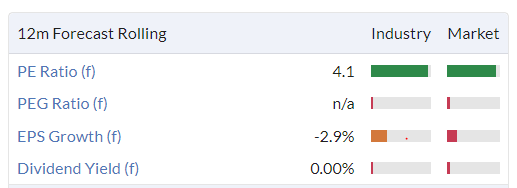
This morning, the share price has risen towards the tender offer price, which is surely a better reflection of fair value.
Reasons for shareholders to be happy today:
They will be able to sell at least a portion of their shares at 62p.
For shareholders who don’t tender their shares, the new market cap at the reduced share count (assuming a share price of 60p) would be just over £8m, so the PER would still be around 4x.
The strategic direction of the company is clear enough now. As I reported in April, they are now satisfied with “organic progress of the Group’s businesses and, to the extent accretive, bolt-on acquisitions”.
For those who care about the current share price, the tender offer has woken up the market to the value on offer here, and boosted the share price.
Reasons why shareholders might be less pleased:
The company’s balance sheet will be leveraged and it might take a year or two to get it back into a comfortable net cash position (assuming no acquisitions over that time).
The tender offer has been designed in part to create an exit strategy for the Chairman. All shareholders will be able to participate in it, so that no one has been disadvantaged, but shareholders who aren’t selling might feel that there is no reason to offer a premium price of 62p to the Chairman and others who wish to exit.
I’m going to maintain my positive stance on these shares. While ordinarily I would be very cautious towards a leveraged company in the building services sector, I am inclined to have faith in Northern Bear paying it off - it has the track record to suggest that it can do it.
Keller (LON:KLR)
- Share price: 771p (+15%)
- Market cap: £561m
Keller Group plc ('Keller' or 'the Group'), the world's largest geotechnical specialist contractor, issues a trading update for the period ended 30 September 2023.
Let’s get up to speed on the Q3 trading update from this group.
The headline is excellent:
On track for a record year; full year operating profit to be materially ahead of market expectations
Key points:
Positive trading momentum maintained
North America: “more resilient pricing than expected” at Suncoast, boosting operating margin, although this is expected to moderate in 2024.
Europe: “the macro-economic environment remains a challenge”, with weak demand. There is a “competitive pricing environment” and “some challenging projects”. Profitability improvement in H2 is less than expected.
Debt: cash generation is “considerably ahead of the prior year and better than our expectations”, so that year-end net debt/EBITDA should be below 1x (normally considered to be a very safe level).
Adjusted net debt at the end of H1 was £245m, so debt management is an important issue for the company. However, it looks like the company has the earnings power to handle this. EBITDA this year will be well north of £200m.
Graham’s view
This one may be of interest to value hunters:
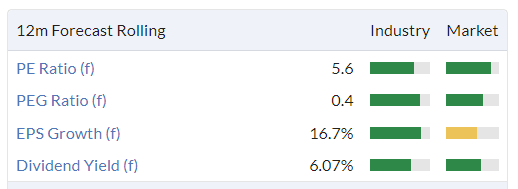
Given that it’s a construction/engineering stock, it’s quite low margin (£3 billion of sales converting to less than £100m of net income). I don’t see it ever fitting into a “quality” portfolio but maybe at a lower share price, the yield could be interesting. I’m inclined to agree with Paul that a 6% yield would not be enough to tempt me here, in the current environment.
So in my book this is offering reasonable value, but I’m inclined to stick with a neutral stance.
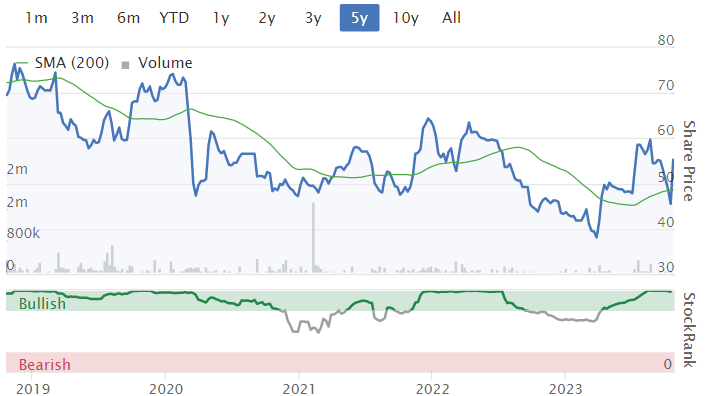
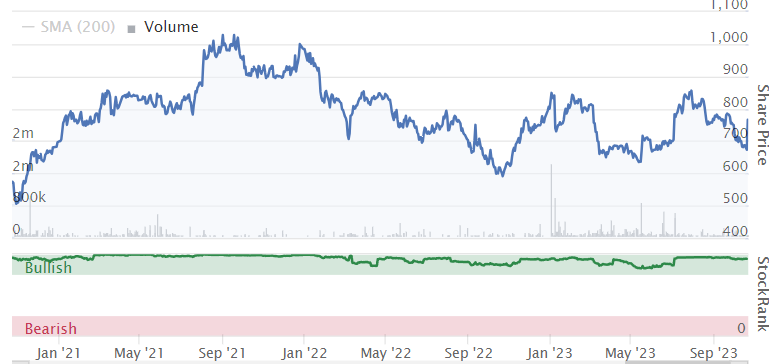
A three-year chart shows it staying within a range:
PS: My YouTube show today will be available at this link. It broadcasts live at 11.30am and then the replay is available afterwards. Cheers!
Disclaimer
This is not financial advice. Our content is intended to be used and must be used for information and education purposes only. Please read our disclaimer and terms and conditions to understand our obligations.

84 comments
Looking at the data they work reasonably well over shorter-time periods, but are very costly over a long-time period. WisdomTree Multi Asset Issuer (LON:3UKS) did go from c1,000 to c2,500 on the Covid-19 crash, so did pretty much what it said on the tin, but now only stands at c350, so they must have lost c20% a year given the FTSE-100 is still about the same as pre-Covid-19.
Good comments, so thanks again. Safest form of insurance is cash and short-dated gilts, but always good to explore options. I am reasonably happy with the shares I own by the way...just want to be best positioned for the next bull market which means max. cash!
Good luck all. UK markets will bounce one day!
City of London Investment (LON:CLIG) update is interesting - look at the votes against a number of the resolutions! It looks like George Karpus, who retired recently, isn't happy with some of the Board.
not a specific stock question but can i ask for views on how others are investing their CASH holdings in an ISA and SIPP i.e. is it possible to get better rates than the broker offers and not have the CASH locked up for long periods. many thanks.
I'm mostly cash in SIPP and ISA as I have been trading lately more than investing.AJ Bell do pay interest (not sure how much) I dont use money market /bond funds ,Equities only currently.
can i ask for views on how others are investing their CASH holdings in an ISA and SIPP
Gilts across a range of maturities. Easily tradeable on platforms like HL. Short-dated ones are much less volatile and they are all tax free on redemption so best to choose the lowest coupon. That might sound counter-intuitive but a bit of reading around the subject will illuminate. Essentially, low coupons deliver capital gain, high coupons pay income.
I've got a feeling I read that some vendors allow you to move cash in and out during the year - not of interest to me, but worth searching along those lines.
Only an option with Flexible ISA. Not an option with SIPP
I use Lyxor Smart Overnight Return - IE (LON:CSH2) for both my ISA & SIPP with Interactive Investor. There are some costs with ii (If my notes are correct I think 0.11% & £11 for below <£100k). There is the trading commision as well to consider, but as an accumulator ETF it is fairly efficient if you want to move in and out of cash quickly.
Can I ask for views on how others are investing their CASH holdings in an ISA and SIPP?
Personally I think short-dated UK government bonds (gilts) are the best place to park a substantial chunk of surplus cash at present within an ISA or SIPP. These are guaranteed by the UK government, and furthermore you know exactly what your return will be at the moment of purchase. During the period of ownership the price of the gilt can go up or down, but every conventional gilt (there are also index-linked gilts) is redeemed for £100 at maturity whatever the price fluctuations in the meantime.
Let me point you to a short YouTube video on the subject of holding short-dated gilts from Ramin Nakisa of PensionCraft:
https://www.youtube.com/watch?v=2EgUzuabUJk
As Ramin explains, if you’re investing in gilts outside of a tax-free wrapper (ISA or SIPP) then it’s best to buy ones with a low coupon (interest rate) as the bulk of your returns will be from capital gains rather than interest, and there is no CGT on gilts held by an individual. In contrast, within an ISA or SIPP it doesn’t matter which gilt you buy as both the capital gains and interest are free of tax, so the choice of gilts is wider.
You can find a list of conventional gilts and their current yields at the following link:
https://www.yieldgimp.com/gilt-yields
The two Redemption Yields columns give the Gross return and the Net percentage return from the gilt after 40% tax. Note that this is an ANNUALISED number, which makes comparisons meaningful. So if you were to buy the TN24 gilt which matures in Jan 2024, you’re not actually going to get a return of 4.75% because you will only be holding it for 3.5 months, but the return you get will be equivalent to an annual rate of c. 4.75%.
There’s nothing to stop you selling a gilt at any time, so you can revert back to cash to buy shares whenever you like. It’s possible that you may sell the gilt for less than you paid for it, but the closer we get to the maturity date, the closer the gilt price will be to £100, so there won’t be all that much price volatility on a gilt with only a year or so to redemption.
When the gilt matures you don’t incur any selling costs. Your broker will simply credit your account with the maturity amount, so it’s best to have a diary reminder of the maturity date so that you can reinvest the funds as soon as they become available.
Buying individual gilts used to require a phone call to your broker, but several trading platforms now allow online trading of gilts (e.g. Hargreaves Lansdown, Interactive Investor, AJ Bell and X-O). Buying the gilt is just like trading a share – to buy the 0.125% 2024 gilt, for example, you would enter TN24 as the ticker. The one minor quirk is that gilt prices are quoted for 100 units, so if I were investing approx. £10,000 into the TN24 gilt at a price of £98.76, I would want to buy 10,000 units, not 100.
Hope this may be of some help.
Thanks Luthrin, very informative! Much appreciated
Thanks Luthrin
I have just had some corporate bonds mature. I used Fixed income Investor but it no longer exists. Do you know of a website like gimpyield for corporates?
Do you know of a website like yieldgimp for corporates?
Sorry Threepeat, I'm not aware of one.
ACounsell: Thanks for the correction re AJ Bell
Useful information - particularly the link to the site with gross and net percentage return from the gilt after 40% tax. I had built my own spreadsheet to do exactly the same calculation for low coupon gilts out to 2035. One point though you can't trade gilts on line with AJ Bell you have to call their dealing services but charge is still £9.95 . From the website
You can’t currently buy and sell bonds on our website or app.
How to buy bonds
There are also a range of historically bargain basement index linked stocks the private investor might usefully buy. For e.g. I hold the 2036 1/8% bond currently clean priced at about 88. So this gives a redemption 'real' yield of about 1% - i.e. income on top of inflation . Only the nominal interest of 1/8% is taxed (unless in an ISA / SIPP). They currently adjust to RPI but I think (too lazy to check properly) that changes to CPI in the late 2020's in a classic piece of government sleaze!
With an election looming I expect the government to encourage reduced interest rates, which might mean inflation instead stays "higher for longer" - at least relative to interest rates.
Personally this is how I am holding cash I don't (yet) want to put into equities.
Most prices are quoted clean (i.e without indexation) including trading platforms. However the true closing prices can be found for free at
https://reports.tradeweb.com/
A major benefit is these index linked gilts do not have to be held in an ISA or SIPP to be tax efficient.
Like cheeky_minnows, I use Lyxor Smart Overnight Return - IE (LON:CSH2) but alsoXtrackers II GBP Overnight Rate Swap UCITS ETF 1 D (LON:XSTR) . The overnight rate is based on SONIA .
For my sins my ISA and SIPP are with Hargreaves Lansdown (LON:HL.) and i feel the interest rates they offer on cash held within these are reasonable.
Interest rates for HL Accounts | Hargreaves Lansdown
*Scroll down as the rates for relevant accounts are near the bottom of page
many thanks all for the inputs. really useful.
Construction Forecasts for 23 & 24
CPA Press Release - CPA have announced their view on the construction markets for next year. Snippets below.
'Construction output is expected to fall by 6.8% in 2023, before a further marginal fall of 0.3% in 2024. This is a revision down from the 0.7% growth forecast in the Summer'
'Private housing is both the largest construction sector and the sector forecast to be the worst affected by prevailing economic conditions this year, As a result, after a 19.0% fall in completions and output this year, completions are forecast to remain flat in 2024 with no growth until 2025.'
'Private housing rm&i is the second-largest construction sector and activity continues to be on a general downward trend after the ‘race for space’ spike between 2020 and 2022. Output is forecast to fall 11.0% this year, output flat in 2024'
'In the third-largest sector, infrastructure activity remains strong down on the ground due to work continuing on major projects such as HS2 between Old Oak Common and Birmingham, the Thames Tideway Tunnel and Hinkley Point C. Overall, infrastructure output is expected to fall by 0.5% in 2023, from its current high level, before remaining broadly flat (-0.1%) in 2024.'
Sunday Times suggesting Saga (LON:SAGA) on the PE hit list:
Advisers are licking their lips. EY-Parthenon, a division of accountancy firm EY, put Royal Mail, Saga, Iceland, John Lewis and Zoopla on a list of “targets” with major debt maturities in 2024 and 2025. The names are in a tightly controlled document seen by The Sunday Times: Turnaround and Restructuring Strategy Watch List
what is the PE hit list?
do they try and destablise the company to take private on the cheap ?
That's what I was thinking. Why would they have an interest in companies with short Bond maturities?
Now is the time to do it if Private Equity outfits are going to do it. They are the bane of the PI who didn't stop-loss.
"there’s mounting evidence of customers reining-in discretionary, and project-based spending."
That makes sense. I've held the view that these higher interest rates have yet to fully feed into the system. It's why I don't own any housebuilders. The escalating strife in the Middle East certainly won't help inflation.
I think now it's more important than ever to consider balance sheets before investing. We may be about to go through times where we're going to have to tough it out. Weaklings will be culled.
I don't know much about balance sheets, but there are some quick-and-dirty tip-offs that I use to spot problems. Mission (LON:TMG) has an EV of £64m and a mkt cap of £31m. These numbers can be picked right off the top of the Stocko report. EV of twice the mkt cap tells me immediately that the company has a big debt problem. Other simple indicators are that the interest cover is 0.53. That's atrocious. I prefer at least 5. Having net cash is even better. I also want to see net debt to net profits as less than 5. 2023 estimated net profit is £5.9m (this will almost certainly need to be adjusted downwards) with net debt of £33.1m. It fails this test, too.
I wonder if what we're seeing in discretionary spending will have an impact on Google and Facebook. I presume it will. I'm also suspicious of Apple. People are classing it as a defensive, I think mostly because they have the consumer trussed up like a christmas turkey with Tim Cook giving them a full parsley, sage, rosemary and thyme stuffing. But do we really need all these expensive glittery things?
I find Paul's reports to be valuable when it comes to looking at balance sheets. I think he is much more adept at spotting potential hidden problems than I am likely to.
Another down day for the markets. Oh well.
Apple's sure interesting as i watched some of the 7 plus streamed hours of the Berkshire agm this year on youtube and CNBC, who ran the coverage, say that Buffett sees Apple as his best business and much better than any of his other holdings.Although i don't think he is buying anymore at the current price.It makes up a fair proportion of his portfolio admittedly, which i spose makes sense there.
I do wish i hadn't been put off buying when it topped the $1 trillion mark as the first FAANG company to do so, as i distinctly remember chatting about that with a mate when it happened.Although apparently Apple wasn't the first trillion dollar public company, when you account for inflation and the company bubbles such as the South Sea Bubble, although the Washington Post reported it was.I probably will regret in a few years time still not buying at this price probably!!
You will find this interesting. It was something Terry Smith wrote in, I estimate, Sep 2019. He looked at share price performance since Jan 1973. During that time, the price return of the MSCI World index over that period was 6.2%pa. He asked what were the PE ratios you would have paid back then to get a return 7%pa over the same period.
I didn't write down all of them, I just cherry-picked a few interesting ones: L'Oreal 281, Colgate 126, Heinekin 115, Pernod-Ricard 72, Kellogg 70, BAT 65, coca Cola 63, Reckitt Benkiser 52, Nestle 51, P&G 44, Unilever 31, Diageo 21.
I'm quite a bah-humbug value type investor, so I usually baulk at there quite racy valuations. One thing that put me off about Apple is that it has grown so large, how could it possibly grow any larger? Despite my fears, the big seven have managed to grown way beyond what I thought was possible. I have been wrong in my assessment of these companies, so it's best if everyone ignores what I say.
Apple has had a PE of around 20, Currently at 29. So a buy at $120 is possibly OK. But it's difficult to say. Maybe they'll be a lot of bearishness if it reaches that point. I don't know. I'm a rubbish tech investor.
I have been slagging off TSLA (Tesla) for a long time, mind. A PE of 60 in a cyclical industry facing economic headwinds. Seems a bit of a recipe for disaster that one. It peaked at slightly over $400 in Nov 2021, and failed to make that back. It went up to $274 earlier this year and is now down to $209.
I'm also pretty sceptical on NVDA (Nvidia). PE of 101 and the hype train is in full swing on that.
There's an interesting video by Mohnish Pabrai on YouTube about the Nifty Fifty. Alas, I can't find the videos link. It largely backs up what Terry Smith says.
Very interesting. Growth stocks can be great but the problem is separating them from story stocks a.k.a. jam tomorrow stocks which are terrible investments. The reason that on average value stocks beat growth stocks in the long term.
I jumped on the Instem (LON:INS) bandwagon om Friday, and off it again this morning at only a small loss:
- if it looks too good to be true, it probably is
- clever people marked it down and have held it there
-surely the potential buyer would be buying hard at a 10% discount if there wasn't a question mark over the deal - he wouldn't be insider trading
But two large purchases this morning so I'll probably miss out - but if there's a whiff of impropriety, the downside could be quite large
Oh dear, another massive buy - I'll stop looking.
Hi Sneeza
There are a number of "special opportunities" out there, where a bid or offer is in progress such as Instem (LON:INS) or DX (Group) (LON:DX.) where the share price has settled below the offer price. So there is theoretically money to be made for those who understand and are prepared to take that risk.
I have done this in the past and had it go both ways being honest, bid approved price goes up to pretty much the offer (and sell in the open market) or wait for the final payment to come through, and bid fail and price plumets and cut my losses and see what I can learn for the next time?
It is about understanding and doing your research and what are your risk versus reward criteria and stake sizing. This will work for some, but not for others. I think anecdotally Paul comments about sell half in the market and let the rest run, but each has their own plan.
There are other situations out there such as NB Global Monthly Income Fund (LON:NBMI) where they are in close down so buying back on a regular basis at Net Asset Value and it is trading below that, so personally I take the redemption and reinvest straight back in there again for them to buy back from me in 3 months time with a positive return. But again research, understand the risk, manage the stake accordingly! This is a small part of one portfolio.
If it is not right for you, getting out is the right thing to do. So well done. Cut losses and walk away to fight another day! There will always be another opportunity, well lots of opportunities.
Good luck
Tommy
Ps. I hold DX (Group) (LON:DX.) and NB Global Monthly Income Fund (LON:NBMI)
Fair play - sometimes these situations pay off sometimes they dont . Managing risk is the name of the game
Sosandar (LON:SOS) (I don’t hold) FYI, this is the new fashion hub at Sainsburys opened in the last month. Sosander is included in the 25% off sale.
Albm7 - Re Sosandar - I do hold and wrote to them today to express my disappointment at the abrupt and poorly sign-posted change in strategy (and profit miss). I think the online pureplay strategy was working, especially since they brought on board 3rd online sellers and that international was more than enough for 'exciting growth plans'.
These pictures explain why - this store based display is a sad, cheap and wholly generic presentation of an upmarket brand. The stores from the concept shared in the company presentation look a bit better but will be vastly more expensive and still very old school; not the 'magazine' style image they portray online, in brochures and even in TV and there is no underserve of independent fashionista stores in upmarket small towns. So they are under-mining the brand, and increasing risk for no real gain
I fear the co-founders are being being crowded into listening to plausible consultants as the corporate scale increases: £100mn in another 5 years would have been fine for me and should have been for them.
Now they have crashed the price, I need to think if they are a value situation because so many especially small investors will be ditching them right now.
Frankly, my inclination is to drop them but I think their branding and target market were excellent and these strengths remain for the moment.
Nice post. Same here.
Sosandar (LON:SOS) I tend to agree with your view and I was just checking the other sellers of their clothes Next (LON:NXT) and their own website and they are for example selling the same coat as in Sainsbury’s at full price. I’m not sure as you say a great pivot unless they will stop selling in these shops but by then I think customers would be use to not paying full price. Also just over hearing admittedly only 2 customers in Sainsbury’s I’m not really sure they will be reaching their target market…marks and spencer is right next door and next is on the same retail park… possibly would have been more suitable but that’s just my take.
hedge end where I work? sbry Staff discount on sos clothing as well
Totally agree ..... really sad actually.
Thanks for posting that .... I am glad I sold. Frankly, It looks awful. Cheap and nasty. How to destroy your brand in 3 months. The MBAs are all over it now (MBA = Master of Bugger All). I have to say, I really feel quite sad, not for my loss on a few shares, but for a lost opportunity for what I thought was a sparky, engaging and competent team.
Excellent podcast thank you, however I don't think Michael Caine blew the doors off his mini.
Thanks Paul for the podcasts every week, and of course Graham too for the recent additions on You Tube. I took a year off Stockopedia to take a step back, at the same time as being swamped at work including acquisitions we were doing (dealing with the competition commission was an interesting experience…). But your podcasts were a great way to keep connected Paul and now re-subscribed to Stocko and will stay for good - the podcasts are great platform for showing how great Stocko & your reports are, and have recommended to others. They are ofc a great way to learn as a private investor - but actually I hope lots of other businesses listen to them too. You learn a heck of a lot reading & watching other businesses, and your analysis is a good step back too. Finally conscious you mention from time to time some PIs giving you a hard time, criticising old views etc; please ignore any such comments. I know you say you do but they must sometimes hurt. That’s similar to business, some will blame others when it’s only you who hits the buy/sell button. 4 most important letters in investing for me are DYOR. So a huge thanks to you both & keep up the great work.
That's made my day, thank you Investment4Adam! :-)
I agree that the weekend podcasts are a great help to reflect and contextualise a busy way of newsflow - thanks Paul.
I also think engaging with the type using such chat forums is beneath your dignity Paul . . . . . . . . ADVFN (and some of its "contributors") is to intelligent, dispassionate discourse on investment what dive bars are to well-mixed cocktails.
Worth noting Victoria (LON:VCP) are to have meeting to approve accounts and reappoint Grant Thornton as auditor.
Just a comment on the weekend podcast, Paul. You referred to Surface Transforms (LON:SCE) as being the market leader in automotive carbon fibre brakes. Realise you probably didn't intend to be so specific but not sure this is right. Had some involvement in a related engineering business not so long ago supplying brake components. A lot of the high end stuff in this segment historically has been produced in Germany, Italy, Japan. In the automotive space generally the supply chain is squeezed by the balls on costs and margins. In the more specialist areas, this is more difficult. I think what is happening here is the industry a bit trying to support a new entrant. But the manufacturing processes for this sort of thing are not easy - even if you have a process you think works, curve balls get thrown trying to do it repeatedly. Surface Transforms (LON:SCE) has previously reported problems in this area, and I'd reckon on it happening again at some stage especially as they try to scale to bigger volumes. And then if and when they've successfully scaled, they'll be forever negotiating with notoriously tight buyers. Personally would have to think twice to go near it, more risks than average imo relative to the rewards.
Hi M48,
Re Surface Transforms (LON:SCE)
How interesting, thanks. I agree re execution, scaling-up risk, with a technically complicated product. Plus it might need another fundraise I think. Although the product and contract wins sound exciting.
Sorry if my overview brief description of the company in my last podcast wasn't entirely accurate. Next time I mention SCE, I might call it something more general, eg. a specialist high end brake disc manufacturer, rather than claiming it's the market leader, when I didn't actually know if it is or isn't. So a slip of the tongue really.
So yes you're right to pull me up on this, thank you! We try to get things right wherever possible.
Regards, Paul.
I've heard mention before that a company called Brembo is the main incumbent in this market, for high-end ceramic brakes?
If so this is an attractive situation for a new entrant - only up against one competitor (for now), and judging by the range of OEMs they have signed (umbrella, not firm orders) contracts with, a demand for that diversification you mention.
I do buy the long term argument that margins are likely to be squeezed long-term, as more entrants come in and it becomes more competitive, almost commoditised.
For now, looking at the huge gross margins that Surface Transforms (LON:SCE) have been declaring, it seems like that point of squeezed margins might be many, many more years in the future.
Of course, Brembo might decide to flex their financial power and start a price war...
But you're right that a key risk is further manufacturing setbacks, especially as they scale. Their cash runway can ill-afford any more slip-ups; any further ones in the next 6-12 months will probably lead to another equity fundraising. But it is looking clearer that they can have at least a few months of good production from their current setup, show those monthly/quarterly P&L to a bank, and hopefully secure an RCF to tap debt rather than equity.
(I hold SCE in the Boon Fund)
My understanding is that Brembo are pretty much the only large scale producer of ceramic brake discs - Surface Transforms (LON:SCE) (I hold, small position c2%, partly as they have fallen so much) are the disruptor focussing on the higher end of carbon ceramic brake discs - so effectively now one of only 2 mainstream suppliers in the world. I seem to recall they said the potential market was £2nd/yr in the performance and luxury car markets on which they are focusing. They also claim that their product is cheaper and better quality.
My main concern is being able to scale up and how they finance it. The latest £100m OEM over (over 7 years?) cant be done in their existing facility of c£75m pa. So they need a new one or a new cell. How do they finance that when the equity has fallen so much, down by half in the last 12 months. Interesting the OEMs must believe they have the capability to do so.
I think investors need to decide if they will really become a world class competitor or not. Or will they end up another Trackwise Designs (LON:TWD^I23) (I also held before selling too late). My only other question which I don't remember seeing debated is if Brembo would take them out? Their market cap is cEur3.5bn. #SCE is now c£50m. If they thought they would be a competitor long term & their tech was better surely they would cough up Eur100m? I need to learn from the Art of Execution and decide what to do next…
Supply chain disruption is the top concern of medium-sized businesses ahead of winter, a survey has found, as rising costs put pressure on revenue targets.
The poll of 500 medium-sized business leaders by consultancy BDO showed nearly a quarter fear that supply chain issues, including suppliers folding and stock shortages, could endanger revenue targets this year
https://www.cityam.com/medium-...
An interesting dilemma for those who follow director buys or the collapsing share prices of listed energy storage battery funds - such as Gore Street Energy Storage Fund (LON:GSF) or Gresham House Energy Storage Fund (LON:GRID)
Today all five directors (all NEDs) bought shares in Harmony Energy Income Trust (LON:HEIT) - but only £2,000 each. I generally view small or token share purchases by board members (after a sharp price fall) as a negative - on the basis that they are clearly not restricted nor are they philosophically against buying shares but they are not prepared to put serious money into the company.
I know opinions on this differ and some view any director buy a positive and I must admit when all directors buy together that is more convincing. Interested in other views or views on the battery funds in general. (No position but I am interested.)
I wonder how many of these NEDs are actually interested in the business - or they're just for the prestige and the remuneration-these share purchases represent a tiny fraction of their Directors Pay - but that said the whole sector is suffering. Look at NextEnergy Solar Fund (LON:NESF) well established and paying give or take 10% divi at todays SP. Where are all the ESG investors
Seems like all the ESG investors have jumped ship as soon as people started selling.SolarEdge Technologies (Sedg) warned on profits on Friday in the US, and was marked down almost 30% on the day, due to higher than average inventory levels at distributors and much lower than expected European demand.And Enphase (Enph), supplying similar (i believe) solar components for the consumer end market, sold off 15% in sympathy on the news.Although NextEnergy Solar Fund seems to be more infratsructure solar and not publicly listed companies..?
The whole renewables sector does seem a little spooked along with the wind energy renewable sector post Siemens Energy and Orsted profit warnings and the recent UK wind auction flop.
"I generally view small or token share purchases by board members (after a sharp price fall) as a negative"
I agree entirely. Token buys look like putting on a brave face to me, with the worst yet to come. It's much better to look for meaningful buys (over £100k) where there is clear value.
Loosely related - has anyone noticed the extraordinary price performance of Good Energy (LON:GOOD) since Oct 9 of about 50%. I bought some on a mention in SCSW because they looked ridiculously under-valued and had a stock rank of 99! Still surprised by the share price jump though. Not to brag too much - overall I am well underwater in that period :-(
Hi Paul, apologies to readers here but since you’re not on Twitter/X anymore I can’t message you there, but thanks for the podcast, mandatory listening every weeknd! I’m always sorry to hear you getting despondent about markets, remember if you’re finding it hard just think how the rest of us are doing! But you should have more confidence in yourself, you’ve a proven track record over decades and seen many market cycles, you will return and your performance on the upside is always far greater and stronger than the losses on the downside.
I was interested to hear your comment about Question Time from Lisburn, NI. You’re indeed right re the political left and right on a general view on the Middle East situation but in Northern Ireland it’s even more complicated. When I came over a few years ago, not recently, to visit relatives I couldn’t believe that there were Israeli flags flying in predominantly Unionist areas and Palestinian flags flying in predominantly Nationalist areas!! Despite the “peace” agreement here, the opposing sides couldn’t wait to get involved in a conflict thousands of miles away!
Thanks Ox,
Oh I know, it's infuriating, but let's not open that particular can of worms here. My podcast comment was just to emphasise that it's best to avoid taking ill-informed, partisan stances on a subject that's immensely complicated and vitriolic.
One of my favourite quotes came recently from an article by David Davies, who said something like this -
"The validity of your view is not determined by the passion with which you express it".
Lots of us could benefit from keeping that in mind (memo to self!)
I appreciate your kind comments.
Regards, Paul.
Frasers keep increasing ASOS (LON:ASC) stake. Now up to 23%. Will there be a short squeeze here?
https://www.retailgazette.co.u...
Investment Trust Discounts
Short piece in the S Times about Boaz Weinstein's Saba Capital taking stakes in ITs worth at least £300m. 10 funds listed.... JP EU Discovery (27%), Blackrock Smaller Cos (25%), Schroder UK Midcap (21%), Henderson Opportunities (26%), Herald (26%), European Opportunities (14%), CQS Nat Resources (28%), Edinburgh Worldwide (31%), Keystone positive (25%), BG US Growth (26%)...... the discount look attractive but no view o any of these funds ... I don't own.
Some of those figures might be a bit screwy, possibly. For example, Schroder UK Mid Cap Fund (LON:SCP) lists a PBV of 0.79, consistent with the 21% discount quoted. BUT, those are based on historical figures. The NAV posted for SCP on Friday was 555.8p ex income, and 573.24p cum income.
Perhaps people would like to discuss the issue as to whether "ex" or "cum" is the fairest value to use, but I'm going to use 573.24p on the basis that it's actually what the trust has. Now the PBV is 0.87 (=499/573), a much more modest discount of 13%.
The discrepancy is presumably due to the decline on asset value from the accounts used by Stocko and the current actual value.
apologies you are right I looked at pbx.... which needs a bit of checking before jumping in...discounts are perhaps not quite as high as they looked.
I use CUM for the same reasons as you.
Thanks for this news, RDHOWARTH. It's a shame they aren't buying any of mine, for instance GCP Infrastructure Investments (LON:GCP) , Gore Street Energy Storage Fund (LON:GSF) or Triple Point Energy Transition (LON:TENT) . I have just bought more GCP Infrastructure Investments (LON:GCP) for 61.5p, after their NAV announcement this morning, 109.79p, a decline of 0.42p. But price has declined from 82p, at which a Director bought £50k in July. ITs like this are not going bust. Just back to 82p would be a third higher. Does nobody believe rates and inflation are at least close to their highs? And part of their income is inflation-protected anyway.
I don't get it. Aren't ITs, mainly in energy transition, paying 10% div not a home for part of everyone's cash? Anyway, PLEASE, Stockopedia, improve the IT reporting we have requested for years. Just easy portfolio screening of disc/prem to NAV would help visibility. Yes, I can do that with a portfolio on the AIC website, but it's all part of improving their status. I know quite a few of us use ITs as important balance to individual companies. And these are traded equities with profit potential. I don't want to see them go into wind-up, like VPC Specialty Lending Investments (LON:VSL) , which we also hold. Victory Park Capital just fed up with the London IT listing that doesn't get them anywhere, as you can't expand with the mingy discounts applied by the market. We should make 30% plus divs over the next three years, but that's not my idea of a long-term hold.
Is anyone looking at additional portfolio protection measures?
I mention this from the perspective of a probable US, UK and Europe recession in the next 6-12 months based on the 15 month long inversion of the 2-year & 10-year yield curve. This reached -1% in the US but is now -0.14. This is bad for equities and is a strong indicator of a forthcoming recession along with the fact that on average the US historically enters a recession 8 months after the FED pauses, which points to maybe Q2 or Q3 2024.
I have taken my portfolio to c40% cash, partly due to locking in gains and partly through somewhat painful drawdowns in 2022 and, to a lesser extent so far, in 2023. I am now looking at 3x short ETFs on the FTSE-100 )(WisdomTree Multi Asset Issuer (LON:3UKS) ) and S&P500 (WisdomTree Multi Asset Issuer (LON:3ULS) ) – I’ve been dabbling with them at a small scale to see how they behave. They are certainly not perfect for hedging as they are a daily ETF which means that their performance may differ from the index over a longer time frame, and the FTSE-100 is the closest you can get to the FTSE-All Share Index (which is the benchmark I use). There are also risks of using 3ULS unless you have a US portfolio weighting (i.e., US shares go up further and UK shares continue down further, which I think Paul mentioned at some point), but it possibly stands to gain more in a stock market crash led by the US. Although it feels uncomfortable, taking a bigger short can limit drawdowns if a crash situation arises, or the main indexes enter a clear downtrend (which despite the pain in small caps, they haven’t yet)!
Anyone any thoughts on this please or any better portfolio hedging tools that they use?
isn't it a bit too late to dabble in shorts on UK equities? Most have already been heavily battered.
Agree far too late (stable doors etc), and at this point better to ensure portfolios are reasonably defensive as well as being positioned for future recovery
Personally I would only use 3xETFs for very short term trades that you expect to play out in weeks. They are very poor longer term hedges because volatility eats away at the price and as we know weak markets tend to be very volatile. I think put options are a better alternative. (To see the erosion ... take 100 and apply -20% +20% to it a few times and see value fall. The problem with these etfs is the rebalance which means rather than a 25% rise after a fall of 20% you only collect 20%.....so you get back to 96! and lose 4%.
I managed to glance over a Pantheon Economics deck re the UK economy and find myself somewhat sanguine actually. Govt finances are pretty good and the outlook for inflation is to fall further as we lap the energy spike of last Autumn, so there is less pressure to raise rates. Maybe in H1 24 they are even falling. Should that play out I don't see much downside in UK equities...and as we know small and midcap are beaten up and historically cheap. The US could upset things but Id view that as temporary....Im not sure how much you can rely on the inversion due to QT...but there are obvious stresses out there. Just my thoughts as always.
Those geared products are designed to be held for a day or two. Have a look at the performance over several months/years and you'll see that they lose most of their value over that time, because you are continually paying for the embedded options that prevent the payoff from becoming negative, amongst other things.
The geared ETFs can be attractive for speculative trading, but you will lose money in the vast majority of cases unless you're a wizard at market timing and chart reading.
I've previously tried to hedge by buying puts on the S&P500 index, but found that it is almost impossible to time it so that you hold the protection at the right time.
In my experience of working in the options industry, most of the 'hedging products' are designed to make money for the broker, rather than to be of any great use to your portfolio. In my opinion, they're best avoided altogether.
I think you’ve already hedged very significantly by going 40% to cash. My bank never goes higher than 10% to cash in its discretionary portfolios because the CIO admits that, most of the time, he hasn’t the faintest idea what markets will do next. And that after 40 years in the game and rising to the top of one the world’s most respected wealth managers. What chance for the rest of us? No one knows, not you, not me, not John Authers, not Buffet, not Jay Powell, nor even the yield curve, whether we are going into recession, and even if that is more certain, whether markets have already discounted the probability and might be about to focus on recovery. In your position I’d be more worried that you’ll be left stranded by a new bull that you misinterpret as a bearish bounce than I would be by the fear of further falls. This bear market is two years old, remember. If you’re worried a recession will kill your companies’ profits, then invest in better ones.
As for your short positions, it’s a lottery whether they pay off or not. I believe you’ve done enough by holding so much cash and earning 5% on it. I’d drop the experiment.
I agree with BNB. . As a private investor you don't have to report your performance to anyone, you can tolerate drawdown. Hedge funds need to justify 2 and 20 fee structures. Losses eat into performance fees so they can't be tolerated. I ran such a fund for 10 years. I have decided investment insurance is expensive like most insurance. I would rather self insure and invest in companies I do not have to sell just because it's not working out.
The surprise COVID bear market went very well for me... as I had hedges in place .... I felt good having not lost much money. I will never forget the turn. I received a message from a former colleague - "Did we just miss the turn? ""No chance, there will be a dip." Everyone agreed with me. That was the trouble. Six months later my hedging profits were losses and I was underinvested in the rally. I missed the big picture. Over the two years the outcome was fine but I could have done so much better. I decided all the anguish or trying to get everything right just wasn't worth it. Im not trying to retain 2 and 20 fees so I don't need to pretend I can predict the future.
Find good investments and stick with them. It amazes me how much talent is on X predicting the end of things. So little talent focussed on what to buy.
Thanks for all the feedback on WisdomTree Multi Asset Issuer (LON:3UKS) and WisdomTree Multi Asset Issuer (LON:3ULS) . It's certainly better short-term than long-term. It's the only useful protection, other than cash, that I can find to take insurance in a maket collapse scenario, other than getting into more complicated derivatives.
Just noticed that the 10 year US treasury has broken 5%. Could be quite a week in the markets. It's difficult to be anything but negative short-term, but lets see.
I've set over 300 alerts on all my shares and watch list to only buy them when the trend changes. Stockopedia is great for that. This will undoubtedly miss the bottom, but better than buying falling knives.
I looked up earlier this year and realised that most of my holdings are low pe stocks that pay dividends that are biased towards defensives.
You could call then jam yesterday stocks, I would say a bit unfair, but then that is what I hold.
At the moment that is where I am content to be.
I have successfully timed the market in a very small was on ig in the past, but utterly failed with stocks I hols, so don't try.
Sorry about the spelling.
Personally I would not hold these double and triple short products for more than a couple of days. If you do want to hedge why not use non leveraged products? I am short SPX via Xtrackers S&P 500 Inverse Daily Swap UCITS ETF 1C (LON:XSPS) and for the FTSE 100 (I don’t hold) there is Xtrackers FTSE 100 Short Daily Swap UCITS ETF (LON:XUKS) .
I would reiterate the comment from RDHOWARTH re the volatility and costs associated with daily rebalancing eating into the performance.
I would be careful with the daily leveraged ETFs - they are not designed to be held long term and because of the way they're calculated will almost certainly lose a lot of value even in flat or falling markets
There has been work elsewhere that says that geared ETFs are bad both on the long and short side they do not do what you may think they do.
Don't. I prefer cash and gold. The UK market is already on its knees and actually offers good long term value. I like the UK, Poland and Japan ...all offer outstanding value.
R&Q Insurance Holdings (LON:RQIH) After the market closed on Friday, the company announced that is was planning to sell its largest division for considerably more than its market value. Expecting the sp to soar today.
R&Q Insurance Holdings (LON:RQIH) doesn't seem like any of this is earmarked for shareholders
The Available Net Cash Proceeds will be entirely used to facilitate a material de-leveraging of R&Q.
It’s rather sore!
Plexus Holdings (LON:POS) Treasury share sale at 19.97p is an interesting level. Decent demand here would be a positive indicator for levels for any raise that goes with the convertible conversion! If that makes sense... depends who took it of course but would appear positive to me ?
Excellent podcast as usual Paul. Many thanks. On Sosandar (LON:SOS) you were quite correct to point out that the warnings were there in the previous update with a slowing growth in online sales. I wonder when they last raised funds (which I recall you questioned the need for ) they were already planning for the change of strategy.
also in relistening to their presentation they skirted around the fact the company was going to lose money. In my view it’s 50/50 whether they can turn it around.
Hi richardho,
Just to clarify for anyone who didn't listen to my latest podcast, the context on Sosandar (LON:SOS) was that I was looking back and wondering why I was so bullish on it in July, when there were clear warning signs (slow Q1 growth and a big FY growth target) that things were not going to plan. I allowed myself to be convinced by mgt that they would still hit what was in hindsight, an unrealistic forecast.
So in future, think I'll be more brutal, in cutting positions earlier, at the first sign of trouble. That seems highly relevant given the macro picture - as we've seen today from Mission (LON:TMG) - only recently they said they'd hit the H2 weighting and full year target, then today they tell us they've missed by a mile, and look close to bankruptcy - or at least totally dependent on the kindness of the bank.
As it turned out SOS (I hold) is only a small position, and the modest loss greatly exceeded by a decent profit on the OnTheMarket (LON:OTMP) takeover bid, so a lucky escape there. Although it does remind me to reassess all my current position sizes, and not hold anything cyclical and/or with debt. Why take the risk, when it does look like the economy (or at least parts of it) could be heading into a recession?
Regards, Paul.
My morning smallcap tweet: unpleasant emission from Mission. HeiQ accounts stink.
Mission (LON:TMG) Northern Bear (LON:NTBR) Advanced Oncotherapy (LON:AVO) Heiq (LON:HEIQ) Nuformix (LON:NFX) AFC Energy (LON:AFC) OptiBiotix Health (LON:OPTI)
◄Mission Group (TMG)► warns FY23 rev up 8-9% but headline pretax only £3.1m max, inc £1.2m from business expected to be classified as discontinued at year end. Blames clients deferring work and loss of clients. Expects covenant breach at yr end. Cancels announced interim div. [SP=35 Cap=31m]
◄Northern Bear (NTBR)► 62p tender offer for 27% of cap. Tradng in line. [SP=45.9 Cap=8m]. I hold.
◄Advanced Oncotherapy (AVO)► c.$80m non-binding term sheet for debt and equity funding. Gets £150k short-term funds under its secured convertible loan note agreement. Co remains in discussions under the Formal Sale Process [SP=1.75 Cap=9m]
◄HeiQ (HEIQ)► FY-Dec accounts and H1-June will be published this week, leading to unsuspension. Will defer $4m revs over 4 yrs that were originally recognised in H1 2022 and H2 2022 from certain milestone partnership agreements. Co "continues to have adequate resources". [SP=19.28 Cap=28m]
◄Nuformix (NFX)► gets NXP002 Patent in Japan. [SP=0.25 Cap=2m]
◄AFC Energy (AFC)► next generation ammonia cracker technology achieves 99.99% hydrogen from single reactor testing by the National Physical Laboratory. [SP=13.42 Cap=100m]
◄OptiBiotix Health (OPTI)► license agreement with Tata Chemicals to incorporate its proprietary Fossence into SlimBiome and LeanBiome for the Indian market. [SP=27.5 Cap=24m]
Keller (LON:KLR) Trading update: Both profits and cash generation to be materially ahead.
Not bad for a company on a p/e of less than 6x
I hold a few.
Keller (LON:KLR) strong statement again, weak share price still .... something odd must be going on in the US since mkt just doesn't care. Id have said this thing was slam dunk to miss numbers this year, instead they have nearly doubled profits in the US for a variety of reasons... stock looks cheap .... the reliance on the US is not a plus for me though.
Thanks to RDHOWARTH and ChrisW, for the heads ups on Keller (LON:KLR) - I noticed it was up c.15% today, strange for a construction/engineering type business. I'll look at this one next.
Best wishes, Paul.