Small Cap Value Report (Mon 24 July 2023) - BOOM, BKS, ARC, SFOR, SOM, SAG

Good morning from Paul & Graham!
Today's report is now finished.
A fresh start this week - let's have polite, and constructive reader comments only from now on please. Standards slipped last week, from a handful of people, and we don't want that happening in future. Nobody wants the community here to turn into advfn!
Explanatory notes -
A quick reminder that we don’t recommend any stocks. We aim to review trading updates & results of the day and offer our opinions on them as possible candidates for further research if they interest you. Our opinions will sometimes turn out to be right, and sometimes wrong, because it's anybody's guess what direction market sentiment will take & nobody can predict the future with certainty. We are analysing the company fundamentals, not trying to predict market sentiment.
We stick to companies that have issued news on the day, with market caps up to about £1bn. We avoid the smallest, and most speculative companies, and also avoid a few specialist sectors (e.g. natural resources, pharma/biotech).
A key assumption is that readers DYOR (do your own research), and make your own investment decisions. Reader comments are welcomed - please be civil, rational, and include the company name/ticker, otherwise people won't necessarily know what company you are referring to.
What does our colour-coding mean? Will it guarantee instant, easy riches? Sadly not! Share prices move up or down for many reasons, and can often detach from the company fundamentals. So we're not making any predictions about what share prices will do.
Green (thumbs up) - means in our opinion, a company is well-financed (so low risk of dilution/insolvency), is trading well, and has a reasonably good outlook, with the shares reasonably priced.
Amber - means we don't have a strong view either way, and can see some positives, and some negatives. Often companies like this are good, but expensive.
Red (thumbs down) - means we see significant, or serious problems, so anyone looking at the share needs to be aware of the high risk.
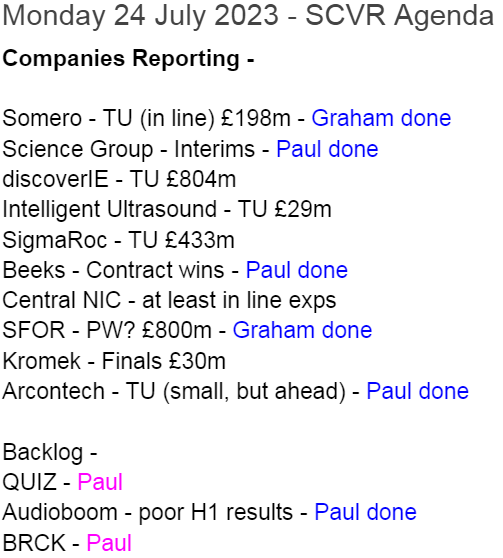
Summaries of main sections below
Audioboom (LON:BOOM) - 225p (£37m) - Interim Report - Paul - RED
A large onerous contract write-off has incurred a hefty loss, heavily dented the balance sheet, and now made the prospect of dividends fade away. I'm finding it difficult to see any value in this share, but who knows, someone might bid for it, given the low market cap.
Beeks Financial Cloud (LON:BKS) (Paul holds) - Up 6% to 108p (£71m) - Private Cloud Contract Wins - Paul - GREEN
Nice to see some contract wins announced today, but nothing said about trading overall vs market expectations. Assuming no profit warning is in prospect, then this company looks a bargain to me, once the next bull market starts.
Arcontech (LON:ARC) Up 3% to 66p (£9m) - Trading Update - Paul - AMBER
An ahead of expectations update caught my eye, but on a closer look it's not of any great significance. The big cash pile, and consistent profitability make this a potentially interesting special situation value share. But is its product old hat?
S4 Capital (LON:SFOR) - down 20% to 111p (£644m) - Trading update (profit warning) - Graham - RED
This advertising group had a difficult H1 and lowers its forecasts for 2023. Analysts have also slashed expectations for 2024. Doubtless there are factors beyond S4’s control which contributed to this. Even accepting that, I fail to find many attractive features to this stock.
Somero Enterprises (LON:SOM) - down 3% to 346p (£193m) - Trading update (in line) - Graham - AMBER
This update is in line after a recent profit warning. Somero is hopeful that activity will pick up in North America in H2, as the construction industry there was challenged in H1 by a range of macro factors. I like this company and the shares but there are some niggling doubts.
Science (LON:SAG) - Unch 415p (£188m) - Interim Results - Paul - GREEN
Not the easiest share to understand, and I'm a little baffled by the moving parts - with profits collapsing at its Frontier division, but more than replaced by growth (helped by TPG acquisition) in Consultancy. It's soundly financed though, and reasonably valued, so could be a situation where you just back owner/management, without really understanding what's going on!
Paul’s Section:
Audioboom (LON:BOOM)
225p (£37m) - Interim Report - Paul - RED
H1 numbers came out on Weds week (19 July 2023), for this podcasting company. I watched the management webinar on IMC, and have to say it put me off the company even more than before.
Background - BOOM looked a basket case for years, it’s been around on AIM since 2003. In recent years though, new management successfully turned it around, growing revenues impressively, and stemming the losses, with more recent profitability (on an adjusted basis - with the profit being consumed by excessive share option charges).
A maiden dividend had been declared for payment in 2024, although I suspect that might be pulled, due to a disastrous onerous contract mis-step.
So far this year, I’ve reviewed BOOM as follows -
23 Jan 2023: AMBER. 405p - Profit warning concealed in an upbeat-sounding TU (trading update) . Missed 2022 revenues by 10%.
24 March 2023: RED. 435p - OK results, but share option charges consume all the profit! Hence I switch to a negative view.
23 June 2023: RED. 210p - down 26% on the day, profit warning.
Results, 6 months to 30 June 2023
Audioboom (AIM: BOOM), the leading global podcast company, announces its unaudited half-year results for the six months ended 30 June 2023.
Not good at all. Revenue is down 22% to $31.8m in H1, which it blames primarily on a lost contract (called “Morbid”) which switched to another provider - which is the main problem with BOOM’s business model - the podcast makers shop around for the best deal.
Divis likely to be stopped.
Excessive share based payments
Onerous contract has incurred a disastrous $8.9m loss.
Loss before tax is $(10.6)m
Advertising market is tough (this is BOOM’s income), and smaller advertisers are stepping away from podcasting ads - I don’t blame them, as end users hate the interruptions from podcast ads, so I think advertising in podcasts is a mistake and does damage to brands that do it.
Balance sheet has taken a big hit from the onerous contract provision, with NAV down from $17.5m at Dec 2022, to $9.3m at June 2023. Cash is OK (for now) at $5.3m.
Paul’s opinion - this onerous contract problem (some kind of uncompetitive agreement entered into at the peak of the advertising market) is a big red flag to me. How did this happen, and what’s to stop it happening again?
This seems a weak business model, and I see little to no value in the shares.
However, it is a US-based business, and someone might come along to bid for it a tech valuation, you never know. Podcasting is a very crowded & competitive market, with low margins, so there’s little to attract investors into this.
BOOM has done well to avoid insolvency, but I can’t see much potential for it to generate decent profits in future. Although maybe the retrenching of Spotify and others, might leave more pickings for BOOM?
The market cap is only £37m now, so it might be a speculative punt for more adventurous and optimistic investors?
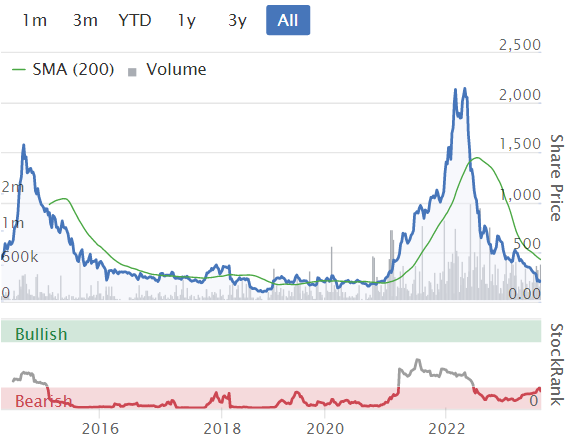
Good growth at the time, and takeover rumours, helped fuel the crazy spike up in price in 2021-2 -
Beeks Financial Cloud (LON:BKS) (Paul holds)
Up 6% to 108p (£71m) - Private Cloud Contract Wins - Paul - GREEN
Beeks Financial Cloud Group plc (AIM: BKS), a cloud computing and connectivity provider for financial markets…
New contracts signed, valued at >$4m (but not stated over what time period)
One contract is with one of the UK’s largest banks, won via a partner.
“Good contract momentum”...”increasing levels of revenue visibility for FY24 and beyond”.
“Strong & growing pipeline”
The largest contracts, Exchange Cloud, “have the ability for considerable expansion”, with a pipeline or similar opportunities (which take time to progress to signing).
Paul’s opinion - it’s nice to have news of contract wins - this is the type of share that needs a regular boost from positive newsflow. Otherwise shareholders get bored, and drift away, assuming that a profit warning might be in the pipeline.
What’s missing today is any mention of whether the company is trading in line with expectations or not! I can’t see the point in just announcing contract wins in isolation, with no confirmation on how overall trading is going.
We’ve not had a proper update since the interim results on 27 Feb 2023, which I reviewed here. that’s 5 months ago, much too long. We need updates at least quarterly, I think, from all companies, especially in bear markets, when investors worry more.
Broker forecast (only one broker) don’t seem to have changed this year, with Canaccord helpfully providing an update note today - FY 6/2023 revenues of £25.0m (up 37%) and aPBT £3.1m. There are also sponsored research notes from Progressive.
In my view, it’s very unusual to find a high organic growth tech company, that’s already profitable (just), at a valuation of only £67m. I think BKS could re-rate significantly once the next small caps bull market starts (which I think could already be starting now), so how you view this share will also hinge on your overall macro/markets outlook.
The customers are sticky, there doesn’t seem to be much competition, and it’s nicely building recurring revenues. Also the moat seems good, in that financial institutions won’t commit to a supplier unless they’ve been around for a while, and the tech is proven. Once committed, they stick around, and contracts tend to grow. This share looks a good opportunity to me.
For balance, bears tend to dislike the up-front capex that BKS has to undertake with new contracts (buying servers, and cabling). Also there are too many adjustments to the figures, and I tend to put share options back in, as these are clearly recurring staff remuneration, not one-offs.
Overall, I’m keeping my GREEN view, as I think it’s a reasonably priced growth share (GARP).
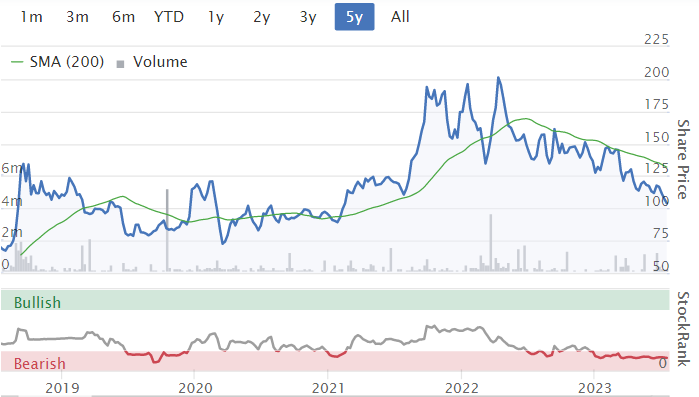
The share price is back down to historic levels, despite the company having made a lot of progress and growth over this time -
Arcontech (LON:ARC)
Up 3% to 66p (£9m) - Trading Update - Paul - AMBER
Arcontech (AIM: ARC), the provider of products and services for real-time financial market data processing and trading…
Trading update for FY 6/2023 - key points are -
Revenue in line with market expectations.
Profitability ahead expectations (EBITDA by 31%, and aPBT by 49%)
Outperformance caused by one-off staff cost savings, so nothing to get excited about.
Current year FY 6/2024 expectations unchanged.
Results due out in early Sept 2023.
Paul’s opinion - move on now, nothing to see here!
I’ve looked at Arcontech several times over the years, and it seems far too small to be listed on the stock market. It cannot make sense to incur all the costs of an AIM listing, which is usually c.£300-400k pa, for a company that is only doing £2.7m revenues (at high margins though).
The worry is that Arcontech looks to be in a mature, legacy software spot, seemingly unable to generate any growth. So whilst it’s generating regular profits of £0.5m to £1.0m pa, I wonder how long that is likely to continue for, and what the end game is? It's probably also dependent on a small number of key people, what happens if they decide to leave?
Divis are good, at c.5.6% yield.
The balance sheet is unnecessarily strong, with £5.9m in net cash (although I would deduct £1.85m deferred income from that) - so most of the market cap is cash. Interesting.
One for special situations value investors I think. Although the lack of liquidity makes me wonder if it’s the type of share that you can buy, but then never get out of. There could be worse situations to be stuck in though, at least this is cheap, profitable, and cash rich.
I only looked at it because it seemed to be an out-perform update, so might have been an interesting buying opportunity, but it’s not really out-performing.
Probably priced about right, but there could be a catalyst eg if it does a tender offer?
Science (LON:SAG)
Unch 415p (£188m) - Interim Results - Paul - GREEN
Science Group is a science & technology business providing consultancy and systems to an international client base. The Group comprises five operating divisions, supported by a strong balance sheet including significant cash resources and freehold property assets.
Background - SAG is a rather unusual business, but we’ve covered it positively here in previous SCVRs -
24 Mar 2023 - GREEN - 387p - Good FY 12/2022 results. Modest valuation. Great track record. Cautious outlook. Very good balance sheet. Thumbs up!
18 May 2023 - GREEN - 400p - In line AGM TU. Good value at 12x PER. Good track record. Owner managed.
Revenue £56.1m (up 25%) - helped by acquisition of TP Group.
There are a range of profit measures as you can see below (bold is H1 this year, unbold is last year H1 comp) -
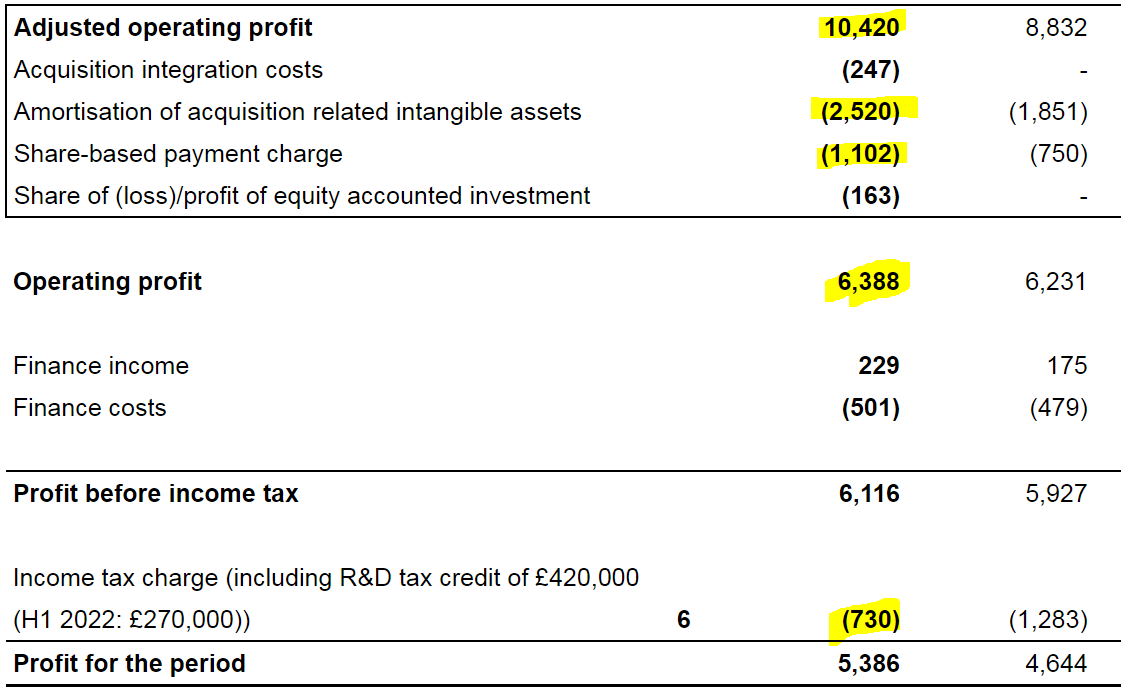
Where adjustments create quite a big uplift compared with statutory profit, I always like to carefully consider if these adjustments are valid or not for my valuation purposes.
The largest adj of £2.5m is one I’m happy with, being goodwill (or similar) amortisation - which is customary, and sensible, to adjust out.
Share-based payments I don’t think are valid adjustments, especially where it’s a recurring part of remuneration, as it clearly is here.
The other items are too small to worry about.
So my personal adj operating profit would be £10,420k - £1,102k share options = £9,318k, or 11% lower than the company’s figure.
Note the lower taxation charge this year has flattered a 3.2% increase in PBT into a 16.0% increase in PAT (which of course drives EPS), so caution is needed here, because EPS has only really gone up mainly because of a favourable tax movement.
Adj basic EPS up 14% to 16.6p (FY 12/2023 forecast is 30.8p, so that looks reasonable).
The divisional commentary shows good performance from most divisions, plus the acquisition of TPG, mopping up what looks a very sharp downturn in the Frontier Smart Tech division, which does digital radio modules, and saw revenue plunge almost two-thirds to only £5.4m, generating a “small loss”. (see my table below)
There are quite a lot of moving parts here, and it’s not simple to analyse what’s going on.
TPG looks a bit of a can of worms, needing a good sort out, which I think was already known, eg. onerous contracts, since resolved.
Freehold property is in the books at £20.7m, with the last valuation being £21-35m, which seems a very wide range, and is now historic, being from March 2021. That could have gone down a lot, in the new higher interest rate environment, so I would have preferred a more up-to-date valuation. Anyway, it’s decent asset backing.
Summary & outlook - a bit too vague, but continues the cautious theme from earlier this year -
In summary, the first half of 2023 has continued the Group's track record of resilient performance, delivering record results in line with the Board's expectations. However the Board does not underestimate the potential impact of the prolonged uncertainty in the current economic environment, both UK and international, and is maintaining its conservative attitude to risk, governance and financial discipline.
At the same time, economic downturns may present further acquisition and/or investment opportunities for Science Group. With a very strong balance sheet, including significant cash resources and undrawn debt facilities, Science Group is well placed to explore any such opportunities.
Balance sheet - companies claiming they have a strong balance sheet is like a red rag to a bull for me! I have to check, as often they’re misleading us.
Goodwill & other intangible assets have shot up at June 2023, after the big acquisition of TPG, to £52.5m (up from £25.8m at Dec 202”)
Fixed assets of £25.3m is mainly the freehold property of £20.7m, providing a nice asset.
Current assets includes a healthy cas pile of £29.2m, albeit down from £43.6m 6-months ago.
Creditors include £13.5m “borrowings”, does that include leases I wonder? No, lease liabilities are listed separately.
More information on the borrowings is provided in note 10, which seems to have locked in some cheap facilities, which are worth running to expiry I’d say -

Overall, the balance sheet has NAV of £81m, from which I’ll deduct the intangible assets of £52.5m, and the (usually related) deferred tax creditor of £4.3m.
That gives me NTAV of £32.8m, which looks a comfortable, well-financed position.
Net cash is £15.7m, which also looks comfortable, and gives scope for more acquisitions I think.
Hence SAG’s balance sheet survives my careful scrutiny!
Going concern statement - is fine, short & sweet, as I would expect for a well-financed business.
Cashflow statement - often more useful than the P&L.
This shows decent cashflow generation.
The big item is a £17.8m acquisition cost, relating to buying the remainder of TPG not already owned.
£2.25m was spend on paying divis, and £1.1m on purchasing its own shares.
Very interestingly, it funded the TPG acquisition from its own cash pile, which fell £14.6m, rather than taking on any more debt, and no dilution of equity. Very nicely done I’d say. Owner/managers do excel in protecting equity usually, which is why we normally like them, apart from when the odd one stuffs small shareholders with a cheap takeover bid, or delisting threat.
Segmental analysis - note 4 gives me the information I’ve been wanting, ie where does the profit come from? So I’ve summarised it in a spreadsheet -
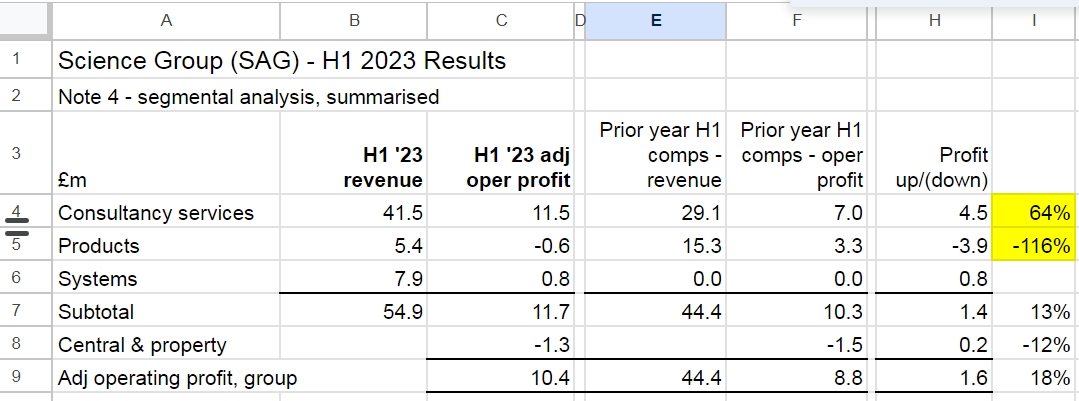
As you can see, the collapse in profits within Systems (DAB radios) was more than offset by strong profit growth within Consultancy services, which includes a contribution from part of TPG. Also note the new Systems division has no prior year comps.
I really don’t know what to make of this! Sum of the parts if the obvious way to value SAG shares, but I don’t feel I have enough information to do that.
Can the “Products” division return to profitability in future?
Nearly all the profit is now coming from the Consultancy services division, so I’d want to understand more about what that business is, how it makes money, what the competition is like, etc.? Any major client risk? Any key people?
Another question is what potential does TPG have? It was a dog when listed independently, so have SAG turned it around, and what profit can we expect from it in future? Are there any remaining contract disputes or liabilities?
Paul’s opinion - all rather a lot to take in!
Broker Liberum (with thanks) has indicated 30.8p EPS for FY 12/2023, giving a PER of 13.5x which seems reasonable, especially given that we have an in line with expectations update today.
The increased profit in H1 obscures a collapse in profits within the DAB division, Frontier. That worries me a bit.
The TPG acquisition looks to be very important to group performance, and we need more information about its prospects under SAG’s new management. If they can turn it around, then there could be nice upside.
Overall then, I still like SAG, and will keep it as GREEN, but I definitely need to understand the business better, and cannot ascertain what the future potential is, either way.
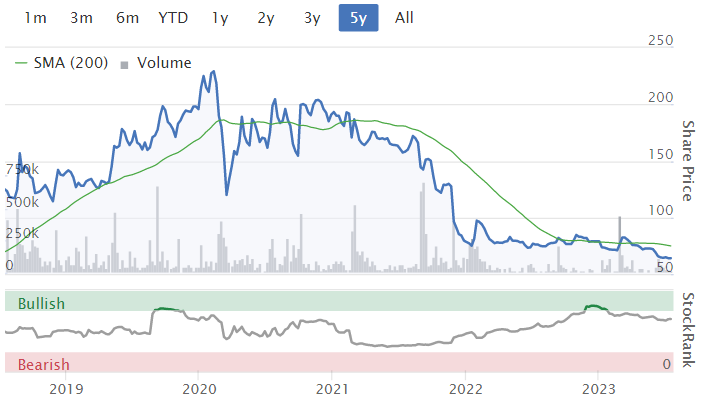
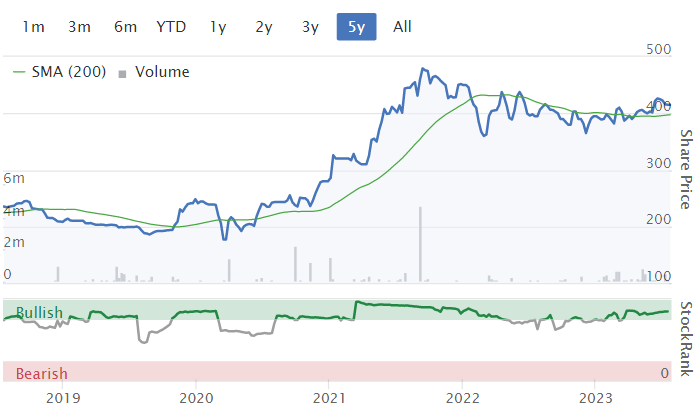
This looks a remarkable chart, considering we've had an awful 2-year bear market for small caps -
Very good StockRank too.
Graham’s Section:
S4 Capital (LON:SFOR)
Share price: 111p (-20%)
Market cap: £644m
I see that Paul may have been onto something when he gave this the thumbs down in May and again in June.
The stock marched to the top of the hill during the Covid rally, and then marched all the way down again, back into small-cap territory:

S4 Capital is Sir Martin Sorrell’s new venture (since 2018), after his long association with WPP. The mission of S4 is to “build a purely digital advertising and marketing services business”.
Today’s update brings bad news:
Net revenue in the second quarter was below budget with May and June in particular, reflecting the challenging macroeconomic conditions and clients, especially those in the technology sector, remaining cautious and very focussed on the short term. We continue to see longer sales cycles, particularly for larger transformation projects.
H1 sees like-for-like net revenue growth of 5% and the company is now only targeting net revenue growth of 2-4% for the year. It was previously targeting 6-10%. So we’ve gone from a company whose revenue was maybe keeping up with inflation to a company that is now materially behind inflation.
Of course there are knock-on effects for margins and profits; the latest note from Dowgate suggests “Normalised” PBT for 2023 of £99m (previously £112.5m).
Looking further out, the Normalised PBT forecast for 2024 gets an even bigger cut, down by 19% to £129m.
These may sound like big numbers relative to the current market cap, but remember the adjustments that get applied to S4’s accounts tend to be extraordinarily large.
When it comes to explaining the 20% decline in the share price this morning, I don’t think we need to look any further than the percentage decline in the 2024 forecasts. Better growth was baked into the cake, and those hopes have now been quashed.
Net debt improved during the quarter to £115m (it was £136m at the end of Q1), but is expected to rise to £180-220m by year-end.
The company says its balance sheet is “strong with sufficient liquidity and long-dated maturities”, and says net debt can reduce again in 2024.
While that may be true, the debt position means that profit warnings such as today’s can have an outsized impact on the share price (as they introduce an elevated financial risk).
Graham’s view
It’s hard to argue against Martin Sorrell, as WPP has been an undisputed success. However, there are a couple of important points to bear in mind.
Firstly in terms of valuation: since S4 is unprofitable, the best option for now might be to look at its price to sales ratio: it's currently trading at around 0.6x. This is the same as WPP currently trades at.
Both companies carry significant levels of debt (compared to their respective market caps), and I would not be enthusiastic about investing in either of them. But it looks like they are being valued in a similar way by the market.
The key difference, of course, is that WPP is already at substantial scale and is profitable.
Also, I note that WPP’s guidance, issued in April, was for LfL revenue growth of 3-5% for the year. That’s similar to, but higher than, the guidance just issued by S4.
Therefore, I have to say that WPP strikes me as being possibly a more interesting prospect than S4. It has a very large debt pile but at least it is profitable, and it might outperform its much smaller rival in terms of LfL growth this year. And yet it is being valued similarly on a Price/Sales basis.
I’m going to give S4 the thumbs down today. That might be a little harsh, but it just doesn’t tick enough positive boxes for me. And if someone wants to invest in the advertising industry, they have a reasonable alternative in the form of WPP. But perhaps Martin Sorrell can prove the doubters wrong again?
Here is WPP’s StockRank:
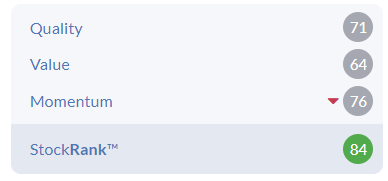
And here is S4’s (as of last night):

Somero Enterprises (LON:SOM)
Share price: 346p (-3%)
Market cap: £193m ($248m)
We frequently cover this American maker of construction equipment, so let’s catch up with its latest trading update.
The most important sentence is the final one: the company is “confident” that 2023 results will be in line with expectations.
Expectations call for revenues of c. $120m (2022 revenues: $134m), EBITDA c. $36m, and year-end cash c. $32m.
These are lowered forecasts following a profit warning in June that was covered by Paul. A wide variety of issues had combined to hurt the company’s revenues: interest rates/bank lending to US construction, planning permits being delayed, and a limited supply of concrete.
The problems appear to be concentrated in North America. By contrast, Europe, Australia, Latin America and the Middle East are all up compared to H1 2022.
Somero is looking forward to a better H2 in North America:
…the Company anticipates improvement in H2 2023 trading in North America compared to H1 2023 driven by increased availability of the S-22EZ, supported by direct feedback from customers indicating healthy non-residential construction activity across a wide range of project types that translates to extended project backlogs. The Company also anticipates healthy contributions to H2 2023 trading from Europe and Australia, and H2 2023 trading comparable to H1 2023 in the Rest of World territories.
Graham’s view
There’s no reason to change your view on this stock today, as it’s merely an “in line” trading update. Although the slight reduction in the share price suggests that some people may have been hoping for more positive news?
The big picture is simple enough: everybody knows that construction activity is cyclical, and that Somero (regardless of its other high-quality characteristics) has no ability to control this cycle. US construction is currently challenged by macro forces, and so the company is going through one of its occasional rough patches.
Long-term progress still looks good:
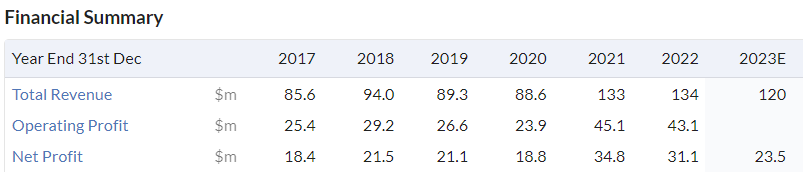
In January 2023, at 400p, I stayed neutral on these shares, arguing that it was impossible to tell when growth would return. The company was already on a downward slope from peak profitability in 2021.
Today, the company’s financial performance is in retreat and the shares are below 350p.
Arguably we are at bargain levels already, although the same could have been said in January:
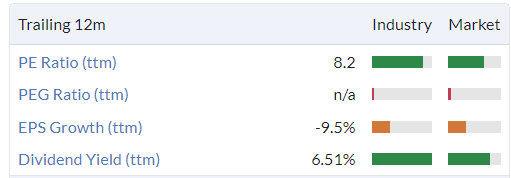
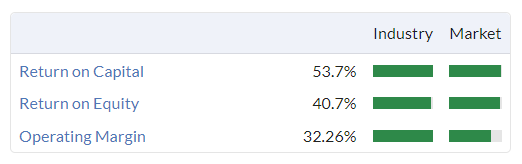
In the end, I don’t have enough conviction to give this one the thumbs up, but I do recommend it for deeper research. It’s just so tricky to form a view on trends in the construction industry! I am inclined to think that Somero’s customers in this industry will have to get used to higher rates for the foreseeable future, and that this could be an ongoing headwind.
There’s one final point I’d like to mention, before finishing up: for many years, I thought that Somero had little or no competition in the design of advanced concrete levelling equipment.
However, there is a company called Ligchine, founded in 2007, that appears to be a direct competitor. It turns out that Somero attempted to sue Ligchine in 2020 for patent infringement, but the case was dismissed in 2021 “with prejudice” (i.e. the case can’t be brought back again). Ligchine lists its own patents on its website.
So I wonder if competition might start to become a factor for Somero? It has enjoyed very high returns for many years. Perhaps it won’t be quite so easy to do that moving forward, if there are others who are trying to muscle in and get some of these profits for themselves?
Disclaimer
This is not financial advice. Our content is intended to be used and must be used for information and education purposes only. Please read our disclaimer and terms and conditions to understand our obligations.

102 comments
Re currency and inflation comments in this SCVR:
This youtube short from Peter Zeihan is interesting
I generally agree. Zeihan's a good follow for his daily 'geopolitics' update. I often don't agree and he has a tendency to being overly dramatic and almost a US propagandist at times...but he presents some interesting perspectives and information
Interesting discussion on mmt.
Correlation doesn’t always equal causation, but increasing the money supply massively and quickly, at a time when productivity fell off a cliff was totally irresponsible.
It astonishes me that highly educated people is positions of such authority couldn’t have understood this - or perhaps they did, but continued anyway as it was politically expedient to do so, at a time when people were voraciously demanding “more”.
Was it the money supply or was it the goods supply? Chicken, egg
I find the analysis and conclusions impossible here. Hindsight is a fine thing…but would a deflationary episode followed by a reflation be better than inflation followed by (hoped) disinflation.
Imo the problem was closing the economy down (we can argue about this but opinion is it was the wrong step for multitude of reasons with economy not at top)…and then once that decisions was taken then keeping the markets open to price the madness.
I think the CBs weren’t left with much choice but to monetise the spending at that point. Maybe they could have been more precise in doing it…but it was all a giant experiment
It was absolutely the money supply, combined with productivity declining sharply - but even if productivity remained constant, you can't just pump more money into the system, and into the hands of consumers without it being inflationary (I.e. Being devalued).
You don't need an economics degree for this, it's just common sense.
Productivity decline was significantly a supply shock. Just because we attach labels and numbers to economic quantities, doesn’t mean in reality they are orthogonal forces easily parsed by common sense.
It’s all very hindsight billionaire to say it was obvious we should have done something else and the outcome would have been fine.
When faced with a gargantuan supply/demand/productivity shock (chicken, egg) should central banks have erred on side of caution and do too little or risk doing too much? Getting the porridge just right was not likely and certainly not targetable.
Your focus on productivity as stick to beat central bank is intellectually narrow imo…you are implying that they should have tightened rates/monetary conditions to combat so killing more demand than the shutdown did. Clearly you believe stable prices could have been engineered. I’m sceptical of such wizardry. Like you I’ve got a low opinion of central bankers…in fact I’d get rid of the charade of independence (as clearly the idea that rates and monetary operations can manage inflation-growth trade off is magical thinking)…and no, politicians ain’t very good either, but they are accountable and sackable.
I think when discussions about money and central banks take place they usually turn into moralising and some political projections
It’s all very hindsight billionaire to say it was obvious we should have done something else and the outcome would have been fine.
Not sure where this came from, I didn't suggest anything of the sort.
The decision was whether to have economic pain due to the constraints imposed on the economy through covid at the time, and aim for a fast recovery, or intervene during covid and have longer-term pain in the form of inflation and all that entails at some point in the future.
I'm also not sure what you mean by 'you believe stable prices could have been engineered'. Actually I'm advocating less engineering of the economy. Yes, IMO they should have employed a (relatively) tight monetary policy to allow the economy to find its natural equilibrium at a time of productivity decline.
What they actually did was to support the economy artificially with money printing and spending - that is engineering, and the result is inflation, because the money supply is not demanded by economic activity, but rather dropped into the lap of population who's productivity has sharply declined.
I'm generally in favour of minimising governmental intervention in the economy.
I couldn't disagree more. Since the 1930s and the emergence of consumer-proletariat in western societies (first US obvs, then 50s-70s Europe caught up) there is no country of continuing consequence that has chosen deeply deflationary stance and persists as a power today.
Germany chose mild deflation thro the Hartz reforms in early Noughties but as an explicitly mercantilist country within a economic/currency union that kept 'true' german currency value low relative to both the internal EU market and external market and so had a stable exterior environment to play with...mercantilist countries normally blow up unless they can switch to domestic consumption driver (imo this is highly likely in Germany and is one the best structural arguments for Brexit). Japan has effectively taken a similar route since 1990 (gain steam in Noughties too). Some eastern european countries did deflate to emerge into the EU/western economic world but with a much higher industrial 'productivity' plus a really cunning and probably unrepeatable for anyone else outsourcing of productive capacity overseas.
I believe what you are proposing as policy is madness...suicide. Thankfully the 'fools' (fallible humans too) in charge didn't go that route. The deflation would have been v difficult to escape...and in a country like the UK with minimal natural bounty of all sorts, low domestic industrial production, very open trade borders and a reliance on consulting, research , design, arts and high end services at the top end it would be questionable we would be able to rebound in such a situation. Starvation and mass death through poverty possible. We are terribly reliant on the RoW functioning decently. We don't need them to be great but we definitely don't want global deep retrenchment.
Closing econs due to covid was madness societally and economically...could have been a suicide letter. Once that decision was taken 'policy makers' got many things wrong...but they stopped the worst from happening.
I believe your points are 100% ahistorical and based on ideology rather than reality.
I'm going to fold on the argument now in SCVR setting. If you want to take it on elsewhere then create a new thread.
Best wishes
PS Apologies for inadvertently hurting your feelings though I stick by points made
I can assure you that you didn't hurt my feelings - this is an objective discussion and we can and do respectfully disagree.
That Correlation doesn’t always equal causation is true
But
Your graphs look like Granger causality to my (untrained) eye.
Mr Scott. Not SCVR but know you look at the bigger boys, and think this has drawn comment before.
Just had PrimaryBid offering Unite (LON:UTG) at unspecified book build (want £300m - ps.so do I).
With a MC of 3.8bn then presume either a 'special opportunity' cannot be resisted or well as you've said in the past 'keep the lights on' - which of course is not a sustainable investment.
Stocko protects me in giving a quick head up - Q:49 (fail); SR:48 (fail), V:32 (run for the hills).
But margin 94% wow.
History of dilution 238 - 400m.
Canadian Pension Fund biggest shareholder - can't make anything from that.
The name on the tin says 'students' so maco wise is the UK still a good place for education and is it sustainable where even now maybe the Chinese are looking at their loved ones expenses. Someone knows but not us.
Anyway they want cash and not sure what for or why I would want to give it to them.
Unite (LON:UTG)
Anyway they want cash and not sure what for or why I would want to give it to them.
Well, they released three RNSs this evening, which goes some way towards explaining their thinking ...
Firstly, their interim results showed adjusted eps up 15%, record forward reservations of 98%, expected rental value growth of 7%, market conditions "strongest we have seen for many years": https://www.investegate.co.uk/...
They pointed out that "Higher interest rates have reduced the attractiveness of debt as a funding source for new investment. We will seek to fund future capital commitments through equity, where accretive to shareholder returns."
They also released RNSs on the equity raise, one for the institutional placing and one for the retail offer. Unsurprisingly this is to fund development: https://www.investegate.co.uk/...
In particular:
The Net Proceeds will be used to:
Unite (LON:UTG) is a quality outfit, whether it floats anyone's boat is down to them, but I don't think it's fair to say that they haven't explained why they want the money.
My main bugbears here are the ridiculous time of the release of the interim results, presumably to link to the fundraising, and the parallel payment of the dividend along with the equity raise. I assume that's to satisfy the REIT rules, but it's still stupid.
timarr
On Unite (LON:UTG)
Yes, a class operation. I held from ~2011-late aug 2020. Sold because
- lockdown
- growth of online teaching replacing in-person learning
- underlying assumption the number of undergrads (and foreign students) will not fall
- my employer decided to dump a lot of office space
... and they are now almost exactly the same price as when I sold.
The concerns I had seem to have gone away.
Somero Enterprises (LON:SOM)
Per Graham
"However, there is a company called Ligchine, founded in 2007, that appears to be a direct competitor. It turns out that Somero attempted to sue Ligchine in 2020 for patent infringement, but the case was dismissed in 2021 “with prejudice” (i.e. the case can’t be brought back again). Ligchine lists its own patents on its website."
From a practical perspective does anyone know if the reason for the termination of the proceedings was an agreed settlement between both parties - rather than Somero's claim being dismissed by the court (ie somero losing) ?
The following link seems to indicate both parties agreed to end further action with settlement terms being kept confidential. If thats the case although its "case dismissed" it could have been with acceptable outcome for Somero rather than them losing their case.
https://casetext.com/admin-law...
I have held shares in Science (LON:SAG) (85p purchase) since my then Mech Eng daughter did a Uni year-out in industry about 10 years ago.
Thanks for the update Paul. You wrote "Nearly all the profit is now coming from the Consultancy services division, so I’d want to understand more about what that business is, how it makes money, what the competition is like, etc.?"
My understanding is they are simply guns for hire in the Research and Development arena. Companies who don't want to employ their own scientists or engineers directly go to Science instead to try and solve a problem or create a new product. I don't think there is much risk to Science as they are paid to do the research work either way.
At her interview she was asked how she might have solved their recent task of providing a way for televised poker to display to viewers what cards the players held. She surprised the interviewer by telling her she knew the answer because she had read the poster about it that was displayed in the waiting room! (Microchips in the cards and chip reader in the table,)
Lot’s of macro back and forth today! No one has yet touched on the fact that since Covid, it’s Government that is now in full control of monetary policy despite what the central bankers appear to think! These pieces by Russell Napier are worth some time to read and digest imo.
https://themarket.ch/interview...
https://citywire.com/wealth-ma...
Edit: mojo just laid it out right there :-)
Interesting article. Might haul in some of my Investments in far flung places.
Interested on your thoughts Paul on CentralNic (LON:CNIC) . I hold but am considering selling out as I'm not convinced by management, especially the latest decision to increase the buyback despite increasing debt.
Hi KiwiCam,
Sorry we didn't get round to looking at CentralNic (LON:CNIC)
I looked at it in a fair bit of detail recently, concluding that the cash flow does look genuine, but I'm not convinced it has long-term sustainability. Often these type of online ad companies can be milking a rich vein of profits, that can suddenly dry up.
Hence why I didn't prioritise looking at that one today, sorry about that.
Regards, Paul.
Wonder if anything brewing at Kitwave (LON:KITW) today? Rising with lots of small buys...
Personally I just think they're a little bit undervalued. They have solid top line growth and their margins are improving following recent acquisitions (from memory it's their foodservice division which attracts a higher margin, which is now a bigger portion of their income.) They're nicely cash generative which offsets their current debt and management seem to have their heads screwed on.
I think forward looking fwd PE rating of 11 is a little low and deserves to be more around the 16 mark which quality small companies seem to be attracting at the moment... All my own opinion of course!
Paul, for clarity will you be confirming the 3 x Mystery Shares you identified in the weekend podcast - from the Tuesday and Thursday reports, for memory?
I think you effectively "outed" another which would then make 4?
You'll find them mentioned in last Friday's SCVR at the top of the comments section
https://www.stockopedia.com/co...
Hi The Jayman,
My weekend podcasts are now up.
Mystery shares this week, just FYI (my best ideas that I hold back for Stockopedia readers) are -
Brickability (LON:BRCK) - very good webinar induced me to go up to GREEN (Monday)
Concurrent Technologies (LON:CNC) - very impressive update (see Monday's SCVR)
Cohort (LON:CHRT) - really impressed me, see Weds SCVR.
I think the one I accidentally mentioned was Fonix Mobile (LON:FNX)
I hope you're enjoying the rain, it's good for the garden LOL! :-)
Also my SCVR summary spreadsheet is now fully up-to-date, for people who find it useful (if you don't then ignore).
Just wanted to flag-up and interesting Podcast I've just listened to by Bloomberg. Its called Merryn talks Money. Merryn Somerset webb interviews Lord Mervyn King and his views on Central Banks, Qauntitive Easing and Inflation among other things. Well worth a listen to in my opinion.
Errrm....!
Something looks like it’s brewing in Covid era favourite Novacyt SA (LON:NCYT) , looks like a bottom has been found - currently trading at significant discount to cash. I hold as SB.
Facilities by ADF (LON:ADF)
A lot of action in the name this morning with a big sell-off finding buyer support, including from me, once it dropped below 40p. I know there's a current problem with TV and film production derived from the actor and writer strikes. But those will end in due course and are certainly not affecting all UK-based productions. I'm slightly more concerned about the streaming industry itself - some participants are going to fail. But TV is not going back to cable or traditional broadcast. And the shares look incredibly cheap when compared to Ashtead (LON:AHT) or Ashtead Technology Holdings (LON:AT.) for similar growth prospects medium term. Alternatively they are priced like VP (LON:VP.) for much greater potential growth.
The journey may be volatile for a few months yet, but I like the risk/reward here.
RE: Facilities by ADF (LON:ADF)
It does look interesting, but I note the lock-up agreement on the founders expired a couple of weeks ago, so their 48% of the company's shares are now in play. Whether they'd want to sell at what looks like a depressed price is another matter, but as far as I can see none of them have any role in the company any more.
In fact it looks like it's the other major shareholder, BGF, who are selling at the moment.
Leaving aside the short-term overhang issues, it does look very cheap.
timarr
Hi timarr
I can't see the founders selling out at what one assumes is close to the bottom. There is a lot of bad news baked in at 40p, despite the writers/actors strike,. I hold a reasonable amount and am tempted to add but will wait for a trading update, due shortly I think.
Given the money invested by the major American film studios in UK film and high end TV production facilities there is a significant runway for growth for Facilities by ADF (LON:ADF) which is the UK market leader. I can't imagine that the former will 'cut their own throats' so a compromise will be reached sooner or later and any backlog should propel demand.
Also the current situation may create acquisition opportunities for Facilities by ADF (LON:ADF) which has a decent balance sheet.
Facilities by ADF (LON:ADF)
Hi jonno
I can't see the founders selling out at what one assumes is close to the bottom.
Well, it depends - it's always hard to know why and when people will sell. They only took 6 million out of the company when it floated, and they don't seem to have any active role, so they could decide to sell down. My main concern is that they could be tempted by a low ball bid.
But really all I was trying to do was to present a possible downside. As Munger says, always try to disconfirm your hypotheses, any fool can find evidence to support them (and usually I am that fool).
Beyond that, and the obvious short-term issues that BnB highlighted, I can't see much to not like here.
timarr
Fair point timarr, Charlie Munger has talked about reverse engineering one's investment case. In other words what would have to happen to really screw up the investment hypothesis.
Thanks for S4 Capital (LON:SFOR) write up Graham...was about to ask why it had fallen >30% early doors. I don't follow closely but from 30,000ft it was looking a big drop on the news...
What are peoples thoughts of Jolyon Harrison becoming new CEO of Inland Homes (LON:INL) ? He made a huge impact as CEO at Gleeson Homes between 2014 and 2019. Appears to be going back to the low cost housebuilding model that has worked before. Paul previously commented that he thought Inland Homes looked increasingly likely, by the day, to go to zero. Could this be the turning point that the company needed?
Could be…. You’d imagine he’s done his homework on the financial viability of the Inland Homes (LON:INL) business going forwards as well so I’d imagine things have been going on behind the scenes to make sure debt is manageable.
Exactly the sort of exec management the company needs as well.
As it is suspended you can’t buy anyway but I’m keeping a keen interest on what the return from suspension looks like and what sort of shape the overall business is in at that point. There is a lot of real NAV, multiples of the share price at suspension but as we all know that alone won’t stop a company drowning in debt!
If this is sorted out then could be a good recovery play over a 2 to 3 year window but still too little info available to make any meaningful call.
Inland Homes (LON:INL) A 75 year old newly-appointed CEO who states it will take some time to turn a business around; looks like a gamble on his longevity. Based on current shareholdings and the issue of 40m additional shares it looks as if Messrs Harrison, Wicks and Padley, with family interests, will hold c. 37% of the enlarged INL. Well at least they have skin in the game however I can't see any justification for me to get involved. Additional background: https://www.theconstructionind...
Hopefully yes but my own thoughts concern the dilution of my holding. 40 million new shares against the what, 228 million as of now?
Some disgraceful hidden self-dealing discovered by FRP Advisory Trading investigation involving Wicks and also the current CFO Malde https://www.investegate.co.uk/...
Beeks Financial Cloud (LON:BKS)
Good morning all. I'm a holder in Beeks, I like the company, it has a good founder, it has a big market, got good clients etc. etc.. But I'm convinced (well, above 70% probability) that there will be a placing rolling along in the next couple of months.
At the time of the interim results presentation in Feb, someone asked a question like "will you be raising equity again soon?", and Gordon McArthur gave such a rubbish answer, not only did he not rule it out, but he made it sound like it was a dead cert..
Now the current contract wins RNSs look very similar to what happened ahead of the placing in April 2022 - a couple of nice sounding contract wins in the two months before, and then BLAMMO, a placing.
Watch this space...
Cheers (I hope I'm wrong)
Chris
Raising money is not necessarily a bad thing if that money generates a strong investment return. After all what are Capital markets for if not to facilitate companies access to capital !
The question is always price, quantum and ROI on that capital. If management fritters it or achieves poor investment returns then that is indeed a bad thing. But if it generates strong long term returns then it’s good.
Clearly at the update in Feb management were coy on raising more equity because they don’t know how quickly new contract wins will happen and therefore the capital requirements associated with that. I’d say the more successful the sales are the more likely a placing is. But this will be sticky recurring business for a long time once purchased. so to hold the share you need to be comfortable to accept there may be capital required, which may also hold back profitability in the short term, but the cash it can throw off a couple of years down the line could be prodigious if contracts accelerate from here.
Brokers think todays update underpins ARR with no change to forecasts, which presumably has been socialised with the board.
Thanks David.
Yes, I accept those points, and that's basically the (current) investment case summed up. It's just that it forces you as an existing shareholder to keep stumping up money if you want to take part in the (assumed) growth at the same pace, which is not always possible.
Let's see.
Cheers
Chris
Beeks Financial Cloud (LON:BKS)
A couple of years ago I attended a Beeks presentation at Mello. Mello presentations are an excellent opportunity for PIs to get a closer look at management and feel for how they operate.
At the time Gordon McArthur CEO had been talking about securing a Tier One contract for ages but hadn't secured one at that point.
At the end of his presentation and in front of the whole room, I asked if Beeks would definitely secure a Tier One contract before the end of that accounting period?.
McArthur replied "yes."
But they did not secure a Tier one in that period. There are many ways he could have answered my question such as 'we are very confident' or 'highly likely' but he was adamant.
This is not how I want a CEO to respond. I want measured, correct and sensible replies and why I don't invest in Beeks.
GLAH.
Thanks Paul. Re Beeks Financial Cloud (LON:BKS) , I was one of those shareholders only last week getting worried at lack of news. Entirely agree that quarterly updates even if only saying ‘in line, no other news’ should be the norm. Do you or anyone else know if AIM/LSE publishes best practice guidelines in this area?
Cheers
Mark
Sigmaroc (LON:SRC) a very comprehensive update. trading in line. Having met the management team, I am very much a fan. They are very entrepreneurial and think outside the box. I hold.
Off SVCR topic but if you have not read The Deficit Myth by Stephanie Kelton its definitely worth a read. A real eye opener. Its about Modern Montetary Theory (MMT).
Would be interesting to hear Pauls views on it
For those of you who are time-poor, the book is well summarised here: https://blogs.lse.ac.uk/lserev...
MMT is either a brave new world or magic money tree trick. Take your pick.
Yes it's a fascinating book by Stephanie Kelton, on MMT, I've read it 3 times now! Deeply flawed of course. If something sounds too good to be true, that's because it is!
Her central idea is that Govt debt isn't really debt, it's just part of the money supply, and it could all be bought back and cancelled by Govts if they did however much QE was needed to buy it all back. Therefore in future, Govts can spend pretty much whatever they like on top class public services, all funded by newly printed money. Except that the moment it starts to cause inflation, then taxes are jacked up, to instantly stop inflation.
I think there are some interesting nuggets in MMT, because the whole covid pandemic was funded by £400bn in QE done at the start, and over the next couple of years, the Bank of England bought ALL newly issued Govt debt. That's why they could peg the yields so low, because pricing was completely rigged, having the central bank buying up debt issued by the Treasury. For a while, it didn't result in inflation. And Japan has been doing something like this for decades, without causing inflation, so I wouldn't just totally dismiss it, these things are worth a debate at least.
Many people (including me) didn't think that QE would ever end, but it has, although I do wonder if the current situation might turn out to be an aberration, and maybe we'll end up going back to zero interest rates & QE - how else is the US Govt in particular going to finance itself?
There' a brilliant podcast I listened to over the weekend, "Merryn Talks Money", where Merryn Somerset-Webb (she has such a strange accent, I have no idea what it is, but it sounds a bit like the recorded lady announcer at railway stations) interviews former Bank of England Governor Mervyn King. His key points were -
High inflation now has been caused partly by supply shocks (lockdowns, Ukraine invasion), but mainly from excessive QE in 2020-1 - which increased money supply just at the point that the productive capacity of the economy was being throttled by lockdowns. So too much money chasing too few goods = inflation, absolutely classic case of what has been seen previously, many times in history.
Second mistake from central banks was being too slow to tighten, should have been done in 2022.
Now they're likely to make another policy mistake by over-tightening, and possibly causing an unnecessary recession, in order to attempt to regain some lost credibility.
Underlying problem is in the economics profession - they found Friedman's monetarism in the 1980s too right wing, so economists have instead abandoned the idea that money supply growth can cause inflation. This groupthink took over the economics profession about 15 years ago, and these people are now running central banks all over the world. They believe inflation naturally comes back down to 2%, and is always transitory. They believe MMT.
They've now realised their error, and are over-aggressively tightening, going too far the other way.
Nobody in central banks now remembers the inflation of the 1970s, so they were blind to the risks of excessive money printing.
A fascinating interview.
I've just found a link which says it has a transcript. EDIT - I think that needs a login.
Try this link instead for Merryn's excellent podcast - highly recommended.
Regards, Paul.
Paul, back in the Seventies, I was there, getting Cost of Living rises every few months to help me with my mortgage. I was also swapping 12-hour day shifts for 12-hour night shifts at the factory to scrape up a few pounds more each week. I have to question your bit about money printing. Didn't the loan from the International Monetary Fund have a lot to do with inflation, plus the decimalisation of the Pound in 1971?
Thanks for your reply Paul. Will take a listen to the interview.
Good morning Paul, following on from your comments on the Merryn Talks Money podcast and concerning the central bank’s, William McChesney Martin, a former chairman of the US Federal Reserve, said the central bank’s role is to take away the punch bowl before the party gets going. According to the Sunday Telegraph’s Jeremy Warner, they did the opposite and added another couple of bottles of vodka as the party raged. An everyday analogy explaining the events over the past few years that everybody can understand. Keep up the great work.
I just do not buy MMT. I think it's a handy tool for a generation of weak western politicians who don't like taking tough choices, so willingly surrender their decision making to unelected global bodies and utopian thinkers.
What happens if these very clever people are wrong? there's no real way back. If your debt to GDP is 200% with inflation 15-20% then it's a country killer. If sometime in the future China invades Taiwan then sanctions would have to be imposed. Prices would rise, shortages would become the norm, production would have to move to other countries, global disruption everywhere. It would make Russia invading Ukraine look a walk in the park in comparison. That's just one scenario. No politician thought there would be a war in Europe 2 years ago, can anyone completely rule out the possibility MMT and it's unintended consequences may cause a 20's style depression in the 2030's.
So why allow your economy to become so unresilient in the first place. As the old saying goes 'Hard times create strong men. Strong men create good times. Good times create weak men. And, weak men create hard times.'
This sums up the complacency for me, from the LSE blog link above (June 2020)
"In the present moment, inflation is no threat whatsoever. The severe lack of consumption demand from households and investment demand from businesses makes deflation a greater worry than inflation. Once the economy begins to recover, policymakers will have to keep their eye on inflation. Nonetheless, for nearly 40 years, inflation has been well controlled. Partially this is due to international supply-chain competition and the business models of big corporations (Amazon, Wal-Mart, etc) that are built on low prices. There are several forces that will keep low inflation intact.
With no inflation and no bottlenecks, the government can address the true deficits (Chapter Seven), such as the good jobs deficit, the healthcare deficit, the education deficit, the infrastructure deficit, the green climate deficit and the democracy deficit, with no fiscal constraint. "
How did that work out?
MMT is functionally how money works so there isn't anything to dispute functionally ie the govt creates money to spend and then chooses (ie doesn't functionally need to do it) to tax to get some back. This is how in days of old the sovereign ensured he could finance himself...money isn't endogenous, its an exogenous insertion derived from the prior endogenous tradition of credit arrangements (barter was never a reality at any scale) - a fact well established by anthropologists even if ignored by economists). Govt doesn't tax and/or issue debt to be able to spend. There is no functional reason that the govt needs to issue debt to finance itself as spending and debt issuance are entirely disconnected but convention and heuristic have strongly related the two with the massive misconception that govt finance is like household or business finance. I guess the gold standard may have cemented this idea as it effectively created an international barter system at the country level...but the gold standard was an anomalous blip in economic history even though bizarrely so many people think it is the norm (gold is a long standing money or medium of exchange...but a hard coded gold standard isn't)
A recognition of the 'fundamental truth' of govt finance and money has lead some economists often labelled MMTers to suggest a more fluid less archaically restricted approach to govt finance. This is controversial...imo the MMTers are more right than their conventional critics (who are wrong all the time...inc with the 'great' Reagan and Thatcher and what they did)
A great mystery for the economically conventionally minded is why the US economy and market has held up so well during a very aggressive rate rising process. Warren Mosler ('father' of MMTers) has been saying from the outset that raising rates is a monetary stimulus to the US economy more than a hinderance. He doesn't dispute that it creates some pressures for households and businesses but his point is that in such a high govt debt environment following covid the extra interest the govt pays is a huge stimulus into the economy
' it doesn't tax and/or issue debt to be able to spend'
Patently the government does both tax and issue debt in order to spend. The pronouncements of chancellors through the ages demonstrate this.
I'll repeat...this is functionally untrue. Patently, govts and chancellors state they must do that...but that is easily debunked at functional level by looking at the repeat incidence of unfunded spending. If it needed to be funded the spending wouldn't happen...and no the govt doesn't issue debt to meet the unfunded (maybe unplanned but not always) spending...it just spends and carries on with the debt schedule planned. It then tends to as a bookkeeping exercise somewhat balance those items, though not always (particularly true of the US)
As a related aside...the institute for fiscal studies and office for budget responsibility and idiotic constructs and unnecessary hinderance to UK policy created by the fool Osbourne to undergird his idiotic 'austerity' reasoning (surely we can all see how silly that was now?)
We saw this with Liz Truss, didn't we? She made enormous unfunded spending promises, the pound collapsed and interest rates shot up. The only way for the government to fund their spending promises was to issue debt, and investors were sufficiently suspicious of her economic competence that they were not prepared to buy the debt at the currently prevailing interest rate.
No. We saw nothing of sort. We saw markets lose confidence in UK alongside a global govt debt market stress that was underway due to rapid re-pricing and then UK managed to find itself at the very sharp end.
Mad LIz and Kamikwazi didn't change the way that govt money works. 'Markets' just didn't like her brand of unfunded.
You have it the wrong way round. You say, ' the govt creates money to spend'. It does not. The government obtains money through taxation and the issuance of debt.
A neat illustration of this is the mechanism of quantitative easing. The Bank of England (which is independent of the government) creates money which it uses to buy government bonds from the banks which have bought them from the government. The banks now have lots of cash which they can lend to people and companies at relatively low interest rates. There is more money in the economy, but it was created by the BOE not the government.
By the way, when you say, 'Markets just didn't like her brand of unfunded' what do you mean by unfunded? It is generally thought to mean government spending not funded either by taxation or the issuance of debt.
Banks don't lend out bank reserves (ie QE)
We'll just need to disagree. I'm 100% sure I'm technically correct. But we'll just go round in circles as you have a belief (that is the majority view tbc) that is technically incorrect. Just imagine how crazy and constrained our modern 'social democratic' high govt involvement economies would be if the govt needed to collect all money in (including from debt issuance as well as taxes) before it could do anything? Where is the surplus buffer of cash the govt keeps to ensure that things operate smoothly without interruption?
Quantitive easing doesn't create money for the private sphere. It creates bank reserves which aren't money that we or cos spend. Quantitive easing is money creation illusion. It can create money for the govt to spend tho which is what happened during covid very explicitly..though it has been the case before covid just not so transparently reported/acknowledged
You are correct.... the major misconception is that "borrowing" / taxing precedes spending. The opposite is the case. The government spends first. That's where the money comes from in order to pay taxes or buy bonds.
Unfortunately it defies belief and it's much easier for the masses to view public finances as household finances.
Exactly! I'm not an expert in any way...but I follow the dissonant clues and end up where you say!
'The government spends first'
Where does the government get the money that it spends from?
Where do you think money comes from in the first place? Rather than fill up this thread I'd highly recommend doing some research on MMT. There are very good detailed lectures by Professor L. Randall Wray online.
That is not an answer to my question.
Fiat money is created by someone pressing a button at the Bank of England in the case of QE and more usually by a commercial bank making a loan.
I could bat back and forth all day long on this but I really think it's better to go watch a lecture by Randall Wray.
By the way QE creates bank reserves. Banks don't lend that out.
Where does the government get the money that it spends from?
That's the wrong way around. The government spends money and in so doing creates it. Central banks are the mechanism by which money is created, but the government can (and does) demand that it loans it the money it needs to fund expenditure.
Tax, on the other hand, does not fund government expenditure. Tax destroys money by taking it out of circulation. Issuance of gilts has a similar, but not quite equivalent, effect.
If you think that's a form of madness you're right, but that's how it works.
timarr
I concur.
You are correct.... the major misconception is that "borrowing" / taxing precedes spending. The opposite is the case. The government spends first. That's where the money comes from in order to pay taxes or buy bonds.
Surely this is a pointless point? Taxing, borrowing & spending all just happen at the same time. So there's no issue with which comes first or not!!
It's not pointless Paul. The government regularly questions "where will we get the money from?" when it has no constraints on money itself (other than constraints self imposed). The actual constraints are real world resources and the risks of causing inflation.
In addition Paul...given modern state operations (vast and essential) it would be nearly impossible to operate a ledger system like individuals and businesses do unless the govt was always holding a very significant cash excess. It could not afford the risk of cash mistiming. This is perhaps circumstantial type evidence but I believe if one digests the info its compelling...the govt/CB must create money! There is no basic functional need for govt to issue debt to balance the money created.
I'm assuming SJRen is not the famed investor (macro, credit) guy messing around in microcaps with us minnows ;)
I do some macro and credit... but alas I'm not too famous.
Just to add... it is potentially the case that the practice of issuing gilts as a reserve drain (ie "borrowing") is due to the legacy of gold convertibility. Money was convertible, so there was always a risk that with too much money, the holders could drain the gold.... but gilts weren't convertible and instead paid interest.
"given modern state operations (vast and essential) it would be nearly impossible to operate a ledger system like individuals and businesses do unless the govt was always holding a very significant cash excess. It could not afford the risk of cash mistiming. This is perhaps circumstantial type evidence but I believe if one digests the info its compelling...the govt/CB must create money!"
This simply isn't the case mojo. The government's financial position is monitored and managed very carefully throughout the day via liaison between HM Treasury and the UK Debt Management Office (DMO). Planning for any particular day will begin weeks in advance, when forecasts will be drawn up for the government's net cash position for that day. Many expenditures and receipts are fairly predictable based on established taxation patterns, known budgeting and scheduled gilt operations, so the day's cash deficit or surplus can be reasonably estimated.
Then throughout the day the DMO's treasury dealing team will trade with counterparties (mainly via gilt repo) with the express purpose of ensuring that the government's funding position is flat at the end of the day (e.g. if the govt spends more than it receives that day, the dealers will effectively issue short-term debt to cover the difference). Obviously the net position (known as 'the swing') will be changing throughout the day, but HM Treasury keeps the DMO updated on the latest balance. On occasions the swing can change materially towards the end of the day, in which case the DMO has special arrangements with the clearing banks for overnight cover, or in extreme circumstances they can use a special borrowing facility with the Bank of England (it used to be a max of £200m, but I'm not sure what it is now).
It has to be like this, or the liquidity volatility would play havoc with the money markets and wreck the Bank of England's monetary policy. This was part of the promise made when the government's cash management function was taken away from the BoE in April 2000 – if the government's funding position wasn't kept flat and HM Treasury was randomly adding or withdrawing money to/from the economy, how could the BoE's monetary policy possibly work?
I’ll take your word for it re mechanics/practice of daily debt operations. I’m above my knowledge re day to to day debt operations and maybe over extended an analogous analysis too far…
Nevertheless the point re govt financing not be debt issuance or tax income then spend is 100% functionally correct. An association may be chosen but it is not functionally required and that is the heart of the discussion
Including his attack on the PRS which is now having horrendous results for tenants.
"raising rates is a monetary stimulus to the US economy"? That's certainly a contrary view.
Higher interest only applies to newly issued debt, so it depends how much the gov't has to roll over PA, and on its budget deficit. So it's not an immediate big boost to holders of T-notes.
US debt has been short tenure
Hi mojo,
Interesting points, thanks, especially this bit -
in such a high govt debt environment following covid the extra interest the govt pays is a huge stimulus into the economy
I was thinking along the same lines after listening to Merryn & Mervyn (sounds like a 70's US comedy show!)
As they pointed out, increasing interest rates now has a much more smoothed out, delayed impact on households with mortgages, because most are on unexpired fixed rates, which spreads the pain gradually over about 2-3 years. Compare that with say the 1970s or 1980s, when everyone was on floating rate mortgages, which caused instant pain. In the US apparently many householders are on fixed rates for the whole mortgage term, so they're not squeezed at all.
As you say, in the meantime, savers are receiving interest often for the first time! It's a stimulus as you say (although inflation is silently killing the purchasing power of savings in real terms).
All fascinating stuff, so I enjoy bouncing ideas around & hearing everyone's perspectives. Bottom line, absolutely nobody fully understand how all this stuff really works! Hence why it's so fascinating.
Regards, Paul.
Hi Paul ,
Coming from a country that QE is a national sport!; I will try to explain this in brief.
QE is nothing else than increasing the money supply in the real financial world. In the short term it drives down the interest rates as by buying bonds the central bank helps yields immediately to comes down. A recent example is the Liz/Kwasi era and the intervention of the Bank of England and of course the Covid era.
However, this increase in money supply in the long run it creates inflation. Recent examples are the Euro financial crisis; Portugal , Spain , Italy , Greece and Cyprus. A never ending QE that , although in the beginning has driven the yields to nothing and help all these countries ti borrow at normal levels, in the long run inflation seems to be uncontrollable. A tool , in my opinion , that benefited Germany (the mastermind of the Euro QE) as they have been borrowing money for years on a negative yield and with a spread of over 4-5% in relation to some other Eurozone countries.
Wouldn’t it be nice if we can all borrow money on negative yields?
Hope that helps.
But the potency of any stimulus depends on the marginal propensity to consume (MPC) of the group of people whose disposable income is increasing versus the MPC of the group of people whose disposable income is falling. The MPC of people with lots of savings especially Gilt-holders is relatively very low (say less than 0.5), whereas the MPC of people who have borrowings especially those with large mortgages is very high, typically 0.9- 1.
Hence, a lot of the income injection received by the savers due to the interest rate rate is not spent, whereas the opposite is true of the group with large borrowings - they spend almost all of whatever their disposable income is; so when interest rates rise, and the disposable income of the borrowers falls sharply, their consumption falls sharply, and this fall in consumption of the borrowers far outweighs any rise in consumption due to the savers having more income. So, the net effect of the interest rate rise is deflationary on the economy. This is the policy rationale for the rises in interest rates.
With you on MMT Wolf. Misguided Muddled Thinking and a recipe for a repeat of the Weimar Republic collapse of the value of money. A out as sensible as a Universal Income. Others will of course have different views.
I always thought the BoE under Carnage should have put Base Rate back to 2% in 2012 which might have reduced the asset price inflation which has made life for succeeding generations very difficult. And right now I'd move to quarterly changes to interest rates so we can see the impact. The changes have a lag effect and surely we've had enough to do the job I'd held for 12 months.
Hopefully close to a pause anyway. Apparently the Aussies are often a lead for this and they are on pause now. Thanks for your weekly reviews too.
Love her podcasts. And yours!
Haha thanks Raleigh4343!
Merryn S-W knows vastly more than I do about economics, so she's always fascinating to hear from I think.
Although I probably pip her to the post on UK small caps knowledge! :-)
Sadly people never seem to learn from history. Groupthink is becoming a big problem everywhere, I think it is due to the cancel culture, people are too afraid to come out with a different opinion, but a society that cannot discuss all the options surely is bound to fail?
What do you think about CBDC as their idea to solve the issue of debt. I dont agree with it for multiple reasons, but have a feeling the banks/governments think that is their solution.
Kromek Group (LON:KMK) have released FY23 results, and we have a full note out introducing FY25 forecasts. FY24 outlook and our fair value are unchanged, as you can read here: https://www.equitydevelopment....
Have you seen the long term destruction of shareholder value of Kromek (LON:KMK) I'm staying well clear, having held years ago, how this company still manages to sucker more people in, I have no idea.
Your Beeks Financial Cloud (LON:BKS) share price may be missing a zero, otherwise it is super cheap.
Ooops, thanks GB, I've fixed that typo. Apologies, Paul.
Morning all,
Good interims from Science (LON:SAG) this morning. Revenue, profits and earnings up. 15.7M cash even after acquisition of TPG and buybacks and divis. Lovely freehold property to boot on the books!
A solid, under the radar holding.
I hold.
Could Science Group be the new Judges Scientific ? The latter trade on 25 PE compared to 12 for SAG and win 22/37 when you use Stockos comparison tool. Just a suggestion .
Thanks JohnDoe2378, a nice synopsis of Science (LON:SAG)
We like SAG here at the SCVR, so think I'll review that one next.
We'll get round to Somero Enterprises (LON:SOM) (popular with readers) later this morning, but as it's only in line, that's lower down the list.
Thanks Paul! Any bear points welcomed! Frontier is currently loss making, so in theory any pick up there will see profits increase. Maybe this division could be sold off though?
Hello John,
Science (LON:SAG) (I hold) - to be honest I was hoping for - not - a lot in these H1 interim results - and I'm delighted. Mainly because I'm still building my holding - it's one of my highest conviction investments, but not one of my top holdings. Something I am trying to rectify, but as I am fully invested - is proving a tough one to crack.
Anyway I've only had time for a quick skim here - and looks to me like a lot of good progress, but time yet for the results to show. And for me to buy a few more. Quite a few more over time. It's not that cheap on current results, but it is relative to my view of management, prospects and quality of the business.
Frontier - interesing, When acquired it was a basket-case. Became a major contributor of profits and cash in the last couple of years. Management strategic review concluded better to keep than to sell. I anticipate that they have plans for this division - and are investing for the future. Increased orderflow or traction on new products can quickly change the state of profitability - operating leverage is huge. I'd back management on this one. But then backing management is why I'm investing here?
CMS2 - I'm impressed here that this is already returned to a small operating profit. I initially thought they would dispose of it. But what do I know? Management have done well to renegotiate all contracts and improve so much before integrating from TPG. Again management timing appears to be excellent - Submarine critical systems are likely to be increasingly important in the new environment of China, Russia tensions and conflict and with AUKUS could prove a major long term boost.
The new 5 division structure looks intriguing. Plenty of room for growth and perhaps further acquisitions? That SAG has already managed a defence contract into the R&D division on the back of the TPG acquisition bodes well for future synergies from the two combined operations.
Revenue of £56m looks a little short in view of the £132m forecast, but H1 only includes 5 months of the TGP acquisition and defence revenue can be lumpy. No panic but I might get an opportunity to buy at a lower price perhaps? Adjusted eps of 16.6p looks in line with the FY forecast of 31.5p despite the lack of contribution from Frontier, and with the USD/GBP hedged 'til the end of the year. Perhaps I won't?
cheers
Mark
LON:SAG
Look forward to receiving your report Paul, I concur with JohnDoe comments that very good interims even with two of the divisions not adding anything to the profits but with a fair wind judging by the comments, looking likely to in the next few years. Share price has barely shifted though, what does it take nowadays for anything to move upwards? No doubt similar decrease in profits would have led to a severe decimation.
Hello,
To be fair, i didn't expect much of an uplift this morning.
One where you can quietly add here and there. I am hoping a larger entity takes note, and will wake up to a nice 30-40% bid premiuim!
US Markets
S&P 500 was up 1% on the week. Risk/reward here is starting to look stretched in my opinion, a selloff back to 50 and 200d ma would be a 4.5% and 10.5% drop which could happen over the next few weeks. Doesnt mean it will of course but wouldnt be a total surprise. The bears will be out again at that point, but personally Id use it as a buying opportunity.
Fear+Greed Index well into extreme greed.
The rally is broadening out tho, as the breakout in the Dow shows. Nice MACD buy signal on the monthly chart, first since late 2020.
Latest GDP estimate
Heres some Q2 earnings data so far
.....and economic surprise index
UK Markets
FTSE 250
Had probably its best week this year, up 3%. Now just about sitting on top of all averages after the MACD buy signal triggered 2 weeks ago. Inflation figures provided a nice boost.
If it can have another positive week, make a higher high above 19,500.... moving averages will start to turn up, exactly what you want at the start of an uptrend developing. The volume is still pretty poor tho.
228 Up – 18 Down (Last week 212 Up – 31 Down)
94 shares above 50 + 200d moving average (54 last week)
Only 5 above 2 x normal weekly volume (6 last week)
AIM All Share
Was up 2% and is nowhere near as bullish looking as the 250 but I sense more fund buying here on individual companies. Id imagine fund managers chomping at the bit to buy but need redemptions to stop and some money to start flowing back in. MACD buy signal still in play from 2 weeks ago.
Volume at a few caught my eye- Focusright, Kinovo, Concurrent. (Full market- Motorpoint, Foresight)
146 shares above 50 + 200d moving average (Last week 126)
292 Up – 265Down ( 248Up – 294 down last week)
84 over 2 x normal volume ( 59)
Hope everyone has a great week.
My morning smallcap tweet: A cluster of news bomblets
Arcontech (LON:ARC) Inland Homes (LON:INL) CentralNic (LON:CNIC) Trackwise Designs (LON:TWD) Beeks Financial Cloud (LON:BKS) SIMEC Atlantis Energy (LON:SAE) Intelligent Ultrasound (LON:IUG) Haydale Graphene Industries (LON:HAYD) Quantum Blockchain Technologies (LON:QBT) PayPoint (LON:PAY) Kromek (LON:KMK), Cab Payments Holdings (LON:CABP), Sigmaroc (LON:SRC), Somero Enterprises (LON:SOM), Science (LON:SAG)
◄Arcontech (ARC)► guides FY-June rev in line and adj pretax ahead of market expectations by c.49%. Cites one-off savings of lower than anticipated staff related costs arising from lower variable costs and delayed hires. [SP=62.55 Cap=9m]
◄Inland Homes (INL)► related-party klaxon! New CEO, Jolyon Harrison appointed. Agrees terms to buy his 51% owned NorthCountry for £4m in paper. Subject to shareholder vote and restoration to trading. [SP=8.5 Cap=23m]
◄CentralNic (CNIC)► guides H1 net rev up 11% and adj EBITDA up 15%+. Expects FY at least in line with market expectations. [SP=127.4 Cap=358m]
◄Trackwise Designs (TWD)► hoists For Sale flag. [SP=NA Cap=NA]
◄Beeks Financial Cloud (BKS)► wins contracts worth of $4m. No period stated. [SP=104.86 Cap=69m]
◄SIMEC Atlantis Energy (SAE)► cash-strapped renewable energy tiddler receives next payment, of £4m, for BESS project at Uskmouth. Expects to publish its late AR this month. and unsuspend shares [SP=0.95 Cap=7m]
◄Intelligent Ultrasound (IUG)► guides H1-June rev up 3% but 25% excluding one-off last yr. "Cash utilisation in H2 is expected to be materially lower and the Group remains on target to reach profitability with its current cash." [SP=8.95 Cap=29m]
◄Haydale Graphene Industries (HAYD)► £350k one yr contract to develop graphene ink-based low-power radiator heaters. [SP=1.13 Cap=9m]
◄Quantum Blockchain Technologies (QBT)► applies for UK patent for Bitcoin mining technique. [SP=1.5 Cap=17m]
◄PayPoint (PAY)► guides FY-Mar adj pretax at the top end of the range of market expectations. [SP=447.5 Cap=325m]
◄Kromek (KMK)► FY-Apr rev up 44%. Adj EBITDA loss £1m (£1.2m), significantly ahead of market expectations. Outlook - expects substantial increase in revenue and positive adj EBITDA. [SP=5 Cap=30m]
In line: CABP, SRC, SOM, SAG
Thanks for the weekend podcasts Paul.
Always worthwhile reflecting on unwelcome profits warnings and potential lessons learnt.
Many listening will have been gently amused by the starting gun soundtrack signalling your gentle declaration of a nascent bull phase. Its so hard to call the bottom, and the reality is there will be a phased movement towards it and then rebounding in recovery from it by individual sectors
I miss the ethereal jingle you used for a time to announced the near-weekly Mystery Shares "reveal" - in my mind reminiscent of the Twilight Zone opening credits music.
Thanks TJ!
I'll see what I can do reviving the mystery share jingle!
I hope my starting pistol (of a new small caps bull market) sound didn't blow anyone's ear drums ;-)
It's subjective, and difficult to predict, but I did get a feeling last week that something's changing, and I sense that small caps are over the worst now. So a good time to be getting stuck into those oversold, decent quality small caps I think. Blink and you miss the best part of a recovery in some shares. So it's not a time to be cautious in my view. But other people may have their own, different opinions. If we wait for the macro to get sorted, we'll have to pay a lot more for many shares. I've done very well historically by spotting the start of a new bull market and going fully invested at the right time. 2003 was a stunningly good year for me, and I turned bearish to bullish within 1 week of the low in March 2020. Let's hope I can make it a hat-trick!
Regards, Paul.
Someone once observed that when you're investing during war-time you have to do so on the basis that the war will be won.
There's cross-over to equity bear markets . . . . . the longer and deeper they tick-down the more defeated people feel, with many giving in, but it will come to an end. Sometimes it can be with a final violent sell-off though.
With this in mind, anyone buying a diversified portfolio of quality small caps now will be well-rewarded medium term. Sure, some of those will warn on profits, but the market reaction may be short-term and over-done and a buying opportunity. Other companies won't warn on profits and when it becomes clear they have growth/improved metrics they will re-rate.
So if Paul is wrong about the the market bottom and sentiment change happening now, he's right about the relative position of the market in 36 months from today.
All the buying I'm doing is in proven businesses, with profits and cash flow. I'm also looking mainly at the weakest performers on my watch list which are drifting down, e.g. personally I think SDG (I have a starter position only, so far) is drifting down to buying levels but their October update may actually confirm softened trade and push it down a bit more.
Let's see, but Godspeed to all fellow readers on their investment journey.
I strongly agree with Paul (and Warren Buffett!) that the time to buy is when shares and many sectors are cheap and the more so after a long bad spell like now and when a lot of commentators are saying stay away.
I don’t know whether he was right, but a commentator on CNBC last week claimed that Apple was now worth more than every share in the US Russell (small cap) index! He was pointing out that many US shares were cheap too with the major Nasdaq and Dow Jones (just 30 shares) indexes, sometimes dominated by a few high flying shares. That’s distorting those indexes to the upside, making the US Markets look overvalued when the reality is that many shares there too are on low ratings.
Small caps have had a really bad time. That won’t last for ever and maybe we’re very near the end of the long bad run, and where better than the superb analysis here for must know information for starters!
After years of underperforming, the FTSE100 has been one of the top performers over the last year or so, but here too hat reflects a few sectors and some big International shares that have outperformed.
AND apparently Apple is now worth about the same as EVERY share in the UK FTSE100! That’s more than Shell (market cap £185 billion) Astra Zeneca (£166 billion) , HSBC (£126 billion) Unilever, Rio Tinto, BP,Diageo, and the other 92 in the FTSE100 index, which is itself only about 10% higher than it was at the end of the last Century.
There are bargains galore with now looking a great time to accumulate
for maximum benefit.
Another couple of dollars and Apple will worth more than the whole of the UK’s GDP!