Small Cap Value Report (Mon 30 March 2020) - Covid-19, EZJ, PURP, NMRP, AFX, BOOM, FIN, TENG, NUM

Good morning!
The Covid-19 outlook has not improved over the weekend - expectations for the duration of the 'lockdown' period are lengthening.
This report won't be locked down, however. Business as usual here.
At 7.30am, FTSE futures are trading almost unchanged at c. 5500.
Cheers
Graham
Agenda for today (COVID-19)
There are a vast number of RNS updates, again, as companies scramble to update investors in light of the Coronavirus situation.
I can't help the feeling that we are in some type of a "doomsday" scenario for many businesses. Even during wars and recessions, many businesses were still open and operational.
This virus (or the government's response to it, depending on your point of view) has completely shut down huge parts of the economy. It's an unthinkable scenario - who could ever have imagined it?
It's a punishing situation for people who are leveraged, in their portfolios or their personal lives.
I thought that I was sufficiently careful, only buying shares in financially strong corporates and using only a very modest degree of leverage in my trading account.
It turns out that I might not have been careful enough: even financially strong companies such as Next (LON:NXT) (in which I have long position) may struggle, if they are forced to stay shut for six months. And while I wasn't forced to close any positions (e.g. due to margin calls), March has been an uncomfortable month.
But again, who could have predicted a scenario in which vast swathes of the economy would be forced to shut down?
I am loath to get involved in a political debate on a financial blog, but I do feel compelled to share this article by Professor John Lee (retired).
While demonstrating some important ways to understand the statistics you see in the media, the article also strengthens my suspicion that government policies are being driven by fear, not by a calm understanding of the facts and the alternatives.
However, there is nothing that I can do to influence policy. The only thing I can do is manage my portfolio as best as I can, and try to share a few nuggets of wisdom with you.
Discussed today:
- Easyjet (LON:EZJ)
- Purplebricks (LON:PURP)
- National Milk Records (OFEX:NMRP)
- Alpha FX (LON:AFX)
- Audioboom (LON:BOOM)
- Finablr (LON:FIN)
- Ten Lifestyle (LON:TENG)
I failed to get to: Numis (LON:NUM), Somero Enterprises Inc (LON:SOM), United Carpets (LON:UCG), Macfarlane (LON:MACF), Franchise Brands (LON:FRAN).
Timings: Finished at 4.50pm.
Easyjet (LON:EZJ)
- Share cap: 551.2p (-7%)
- No. of shares: 397 million
- Market cap: £2.2 billion
Not a small-cap. However, since air travel is basic to the functioning of a modern economy, I think this is worth a mention.
Easyjet has "fully grounded its entire fleet of aircraft":
easyJet and Unite the union have collaboratively reached an agreement on furlough arrangements for its cabin crew. The agreement will be effective from 1 April 2020 for a period of two months and means that crew will be paid 80% of their average pay through the Government job retention scheme.
The company says it has no debt refinancings until 2022 - that's some comfort, I suppose. And with the job retention scheme in place, a great deal of the cost base will be covered.
As of year-end, EZJ had cash of £1.6 billion and borrowings of £1.9 billion, giving rise to a small net debt position of £0.3 billion.
That £1.6 billion warchest would, you'd think, give it plenty of flexibility to deal with serious problems in the short-term.
Ryanair Holdings (LON:RYA) is a much bigger company and yet it has a similar positioning: net debt of €460 million as of September 2019, and a huge cash pile of c. €4 billion.
Earlier this month, Michael O'Leary said:
Ryanair is a resilient airline group, with a very strong balance sheet, and substantial cash liquidity, and we can, and will, with appropriate and timely action, survive through a prolonged period of reduced or even zero flight schedules...
My view
I don't invest in airlines when times are good, and I can't see myself buying shares in them when their fleets are grounded. Maybe at a big discount to tangible book value, I could start to get a little bit interested?
Purplebricks (LON:PURP)
- Share price: 38.55p (+2%)
- No. of shares: 307 million
- Market cap: £118 million
As a "hybrid" estate agency, PURP should be better-prepared than most of its peers for the shift online.
There is nothing it can do, however, about the fact that house transactions are likely to collapse in the short-term.
Government advice is to delay house moves until the "stay-at-home" measures are ended (only vacant properties are excluded). PURP references this advice in today's RNS.
Company response: PURP is doing what all companies are doing now - preserving cash, examining its costs, reducing overheads. No more advertising, and the marketing budget has been slashed.
Cash balance - £35 million, and no debt. That's what you want to hear, in times like this.
Cash was £41.6 million at the end of October, so the burn has been c. £1.3 million per month.
My view - I never said much that was positive about this company.
My stance on it is now changing, because:
- it has given up on the disastrous expansion plan in the US, and in Australia
- it can probably make money in the UK, and is around breakeven in Canada
- the cash balance, mentioned already, can underwrite its valuation
- the share price is now much, much lower than before
At the current share price, cash accounts for c. 30% of its market cap.
In other words, there is no need for me to be uber-bearish on this stock anymore. It has fallen enough.
If it keeps falling, and approaches the value of its cash reserves, then I might even start to think that it is cheap.
Incidentally, that could be a great signal that the stock market is cheap - when there are large numbers of "net-nets" (stocks trading below the value of their net working capital).
National Milk Records (OFEX:NMRP)
- Share price: 109p (unch.)
- No. of shares: 21 million
- Market cap: £23 million
This is a niche company that provides data services to the cattle industry. Please note that it is listed on the NEX Exchange, not AIM.
NMR staff are considered "key workers", since they are part of the food supply chain. This helps, though NMR says childcare availability could be an issue (there is a question mark over whether schools will open during Easter, for the children of key workers).
Other issues:
- NMR's core milk testing service will be "largely uninterrupted"
- Farmers may need to collect their own samples and this may impact earnings while the Covid-19 outbreak is ongoing.
Balance sheet - at the end of H1, this company was not exactly groaning with cash. It had just £0.3 million, down £1 million from a year earlier.
It had been affected by some one-off factors, including an unusually large debtor balance which was expected to unwind.
Today, the Directors say they "remain assured that the Company has sufficient liquid funds and access to debt facilities for its current purposes. We are nevertheless acting prudently to preserve cash to ensure investment in new projects planned for 2020 can go ahead."
My view - this business might get through the crisis relatively unscathed. The demand for milk isn't going to change much, and farmers will still want the data that NMR provides. I also would tend to agree that the cash balance is likely to improve, as debts are collected.
The market shares my view - NMR's share price is virtually unchanged, year-to-date.
Alpha FX (LON:AFX)
- Share price: 382p (-41%)
- No. of shares: 37 million
- Market cap: £142 million
This update starts off with a sales and profit warning - no surprise, since we are clearly on course for a recession and international trade is taking a huge hit.
Then we get bombshell news:
- 223 clients faced margin calls as a consequence of the very sharp currency movements. That's a third of all clients.
- One client, a food exporter, "requires more time" to make £30.2 million in payments to AFX. A payment plan is being negotiated, so that AFX will get its money back by mid-2022.
- The delay "has created a temporary shortfall" in AFX's own cash, which it needs to use as collateral for the running of its own business.
For context, AFX's operating profit over the last two years adds up to £23 million - less than the amount owed by this single client.
For more context, AFX's adjusted net cash figure was £38.6 million at the end of 2019. The delay in payment by the client has, I guess, blown a huge hole in this number.
What were the signs?
Not many people (myself included) though that this sort of blow-up was possible.
I've dug up the 2018 Annual Report, and found this in the Risk Management section:
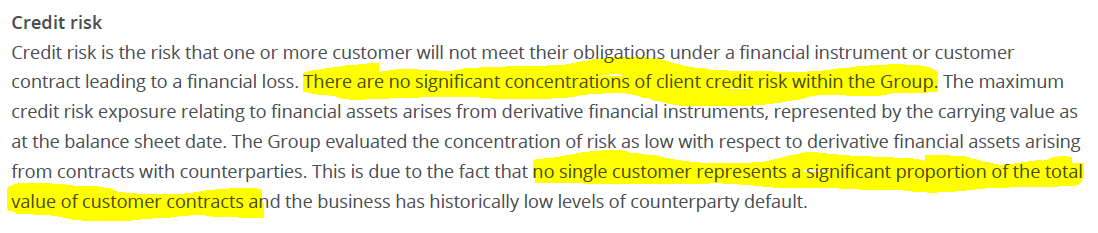
This should be a calming paragraph. In hindsight, it's quite alarming!
If it's still true that "no single customer represents a significant proportion of the total value of customer contracts", then the food exporter currently in default must not be particularly large, relative to other credit risks at AFX and the total credit risk it faces. There must be many other large risks on AFX's books.
However, today's announcement also states that the defaulting client was previously responsible for 15% of AFX's forward book. In that case, how can the statement from 2018 regarding credit risk be true? Perhaps this client did not become particularly important until 2019?
That might be the explanation which makes the most sense, based on AFX's disclosures.
It also says today:
Outside of this, Alpha's next largest position is a Dollar-Polish Zloty exposure split across two separate clients, representing c. 1% of the total forward book
So the most likely scenario, to me, is that the AFX customer base used to be well-diversified, but then one client become extremely large during 2019.
Unfortunately, this does not reflect well on the quality of the revenue growth that was recently reported for 2019.
Underlying leverage
In Note 14 of the 2018 Annual Report, AFX reported derivative assets with notional principal of £1.05 billion and derivate liabilities with notional principal of £0.7 billion. Most of these deals are with customers, not with banks.
These big numbers represent the underlying amounts being hedged by currency deals.
The same numbers for 2019 will have been significantly larger.
Up until now, the associated risks have been well-managed at AFX.
But the recent volatility has truly been extraordinary, and not just in the equity market (where the VIX reached an all-time high this month).
We have seen crazy swings in the currency market too, where the perceived safe haven of the dollar in a crisis has resulted in the value of other currencies dropping dramatically.
The sharp drop in the Norwegian Krone (NOK) is what caused the problem for AFX's client. According to AFX, the recent weekly move in NOK was "nearly three times its previous largest fall", which was during the 2008 crisis.
Hedges are supposed to reduce risk for AFX's clients. What we've just seen is an example of what happens when hedges go wrong, and increase risk, by creating cash flow problems that can't be solved.
My view
If the client fails to make the repayments, that will clearly be a huge blow. On the basis that the client will make the repayments, then there are further grounds for optimism:
- the remaining customer base is said to be well-diversified
- international trade is currently at a low, but will presumably recover and the recent volatility will help to justify the use of hedging strategies
- the cancellation of the dividend will provide AFX with some extra cash to use as collateral (£2 million)
- £9 million of collateral has been released from the ex-client's account, and can be used as collateral for other clients
AFX will have to rebuild trust among its investors, and probably won't enjoy the very high multiple that it did before, for some time.
If it is as well-capitalised as it says it is, and the shortfall it is currently experiencing is truly temporary, then it may offer long-term value at the current level.
Not something I would have the conviction to bet on personally.
Audioboom (LON:BOOM)
- Share price: 150p (-4%)
- No. of shares: 14 million
- Market cap: £21 million
This podcasting company has been burning cash for years. 2019 is no exception.
The main event in 2019 was that the long-standing CEO decided to call it a day.
Farcically, he said on the day of his resignation that:
The business is now entering a more mature phase and I believe that the time is now right for me to pursue more entrepreneurial opportunities.
There is little evidence of maturity as far as the share price is concerned.
The new Board is trying to sell the company, but admits that this could be difficult in the current environment:
A number of interested parties are actively engaged in the process, but it is possible that Covid-19 could impact the planned timeline. At this point, potential buyer interest in the Company suggests the process will stay the course, but we will continue to evaluate the impact of Covid-19 over the coming weeks.
Even if the natural demand for podcasting content remains high while people are locked indoors, the rout in equities means that valuations generally are lower - and a lower price can be expected for BOOM's disposal, all else being equal.
I would steer clear of this. If a generous takeover fails to materialise, the cash-guzzling is likely to continue. $47 million in cumulative losses so far, and counting.
Finablr (LON:FIN)
- Share price: 11p (suspended)
- No. of shares: 700 million
- Market cap: £77 million
Auditor Resignation and Board Changes
This company has been suspended under the stench of corruption. It is closely related to NMC Health (LON:NMC), having the same shareholders who appear to have engaged in dodgy dealings.
Both companies had liabilities which weren't disclosed and which "may" have benefited third-parties.
On 12th March, it said:
...the Board has been reassured that the Company has no undisclosed related-party transactions or unrecorded on or off-balance-sheet financing arrangements.
On 16th March, it said:
the Board has been informed of the presence of cheques (written by Group companies and dating back to before the IPO), which may have been used as security for financing arrangements for the benefit of third parties. A preliminary view is that the amount of these cheques totals approximately US$100 million. The existence of these cheques has only recently been brought to the attention of the Board and urgent investigations are ongoing.
And now the auditors have had enough:
The Company announces that it has been notified by Ernst & Young LLP ("EY") of their resignation as auditor of the Company. In their letter of resignation, EY cited "concerns arising out of recent events at the Company and NMC Health plc…the composition of the Board of the Company, the adequacy of corporate governance concerns and the recent issues that have caused the Company to commission an independent review of the Company's financial arrangements, including of related party transactions and on and off- balance-sheet debt".
It's hard enough to make money when companies are honest. When they are corrupt, it's simply impossible.
Not all foreign companies which list in the UK are fraudulent, but enough of them are. Avoiding all of them is a sensible decision.
Unless there is a very good reason to list in the UK, rather than somewhere else, it is safer to assume that it's a fraud.
Ten Lifestyle (LON:TENG)
- Share price: 46.15p (-5%)
- No. of shares: 80.7 million
- Market cap: £37 million
Covid-19 update and cost-saving initiatives
This provides a high-class concierge service. It has been hit hard by the slowdown in travel bookings and expects the a reduction in restaurant and entertainment-related services.
In more positive news, it had net cash of £9.6 million at the end of February, and no debt - excellent.
And 150 employees and contractors have backed it by taking options priced at 70p, exercisable for three years, in lieu of their normal salary payments. This saves the company £0.8 million in cash.
That's an excellent sign of conviction by insiders, who are cleverly taking advantage of the reduced share price. They clearly think that this can recover to its former highs, around 120p.
Out of time for today. Paul will be back tomorrow.
Cheers
Graham
Disclaimer
This is not financial advice. Our content is intended to be used and must be used for information and education purposes only. Please read our disclaimer and terms and conditions to understand our obligations.

96 comments
I think it about time that this column reverted to its guiding aim namely what do we think is going to happen to the economy overall (don't say GDP will decrease!) and which sectors are most impacted,and hence which shares. It is futile railing against Gov policy when you cannot influence it and are offering comments based on minimal data nor any knowledge of the detailed modelling involved. Recommendations are not just based on the Imperial College work and no doubt a range of possible scenarios will be presented via SAGE to Government as anyone who has ever done any modelling knows. ( think of the Bollinger Bands on share price trends)
As the data set grows the models will be refined and curbs relaxed as confidence grows.The fact that 119 countries so far are in some form of isolation/lockdown must mean something? I sense that some of the anger expressed in recent days may be as a result of decimated portfolios rather than based on rational analysis.
One common theme across most of my holdings - when issuing updates, most if not all are suspending dividends - and majority are not over leveraged.
If you’re a pension fund, or retired, the combined impact of a massive drop in value of investments, coupled with a drastic drop in dividend income must be causing immense strain.
This has got to shift funds into stocks who can at least maintain dividends, let alone grow them...
Re comments comparing covid with flu, or comparing covid fatalities with a general background of normal fatality rates I feel is missing the point. This is not normal business as usual, and does require action.
If you doubt this, simply consider the massive increase in NHS capacity and ventilator requirements. If this was simply BAU then our need for such facilities would not be required. Equally if these measures weren't put in place, consider what figures we would be dealing with.
I recognise that I may get a thumbs down for this because its not directly investing related, so be it, but equally my ask of Paul and Graham is not to proffer perspectives on how the government is managing the crisis, as this simply fuels the debate. Stick to what we see thru a corporate lens.
"At 7.30am, FTSE futures are trading almost unchanged at c. 5500" Graham, apologies for the stupid question, but where does one go to find this information?
Google IG Market Insight and you will get futures indicators across a number of assett classes, ftse, DOW, Gold, etc
Thank you for that.
I am sick of all the opinions espoused on Covid 19 and the government's response to it.
If anyone has a comment to make on this or a suggestion, please write to your MP and let this board be about investing.
Tough to separate the two greenhat !
How do we separate investment decisions from Covid-19? Isn’t pretty much every asset class and every investment opportunity within it affected by it currently?
How do we separate investment decisions from Covid-19? Isn’t pretty much every asset class and every investment opportunity within it affected by it currently?
True but almost none of the posts on this board today have been about investment. I understand that people are anxious and worried but long debates about what government policy should be are besides the point, it won't change anything. What would be productive is what we, as investors, can do given the policies as they are today.
As noted elsewhere we saw two companies - Bioventix (LON:BVXP) and Chesnara (LON:CSN) - indicating that they don't see much impact and there was another on Friday in Mattioli Woods (LON:MTW). We've seen really significant director purchases at Plus500 (LON:PLUS), Genel Energy (LON:GENL) Micro Focus International (LON:MCRO), Bae Systems (LON:BA.) and 3i (LON:III) and sells at Ocado (LON:OCDO) and Cranswick (LON:CWK). Elsewhere Starling Bank announced that they'd seen online transactions overtake face-to-face for the first time and they'd seen a drop in payments at supermarkets in the past few days. These are all canaries in the coalmine and if the collective here puts its minds to it I'm sure we can generate more ideas.
Rationally the economy must start to re-open in around, at worst, 8 weeks but probably with ongoing social distancing and restrictions on large gatherings. Meanwhile there is a massive shift to online underway. These are trends we can ride if we're smart enough.
If the worst happens and economies collapse and money becomes worthless then the one place you want to be is in productive assets - equities. That's what Stockopedia supposed to be about, isn't it?
timarr
Agree timarr (though guilty today!) that there have now been more than enough coronavirus posts with no investment content.
Key worry ahead could indeed be inflation out of control. Agree that equities are likely to be safer than cash, but aside from gold have little idea which sectors. Property Investment Trusts perhaps? Some are at huge NAV discounts. Insurance Companies? Keen to read of other suggestions including small companies of course as appropriate for this bb.
Thank you Ken for your still, small voice of calm. ( Netcall (LON:NET) may be of interest. (Great management, good product, money in the bank)).
Have just read again all Graham’s Company updates today, and they really do reinforce your point timarr. A real tour de force but with far less, or even zero, useful follow up comment that were the norm pre coronavirus.
One company managed a positive RNS today - Chesnara (LON:CSN) says it is well capitalised and is so confident that it is actually increasing its dividend.
Thanks, Laughton. I've held Chesnara (LON:CSN) since 2012 (just about as long as I've been investing in shares). It's held up pretty well during this crisis and pays a good dividend that it regularly manages to increase c2-3% a year. I wish all my investments were as boring as Chesnara (LON:CSN).
I am a bit concerned about the idea that this was predicted.
I don’t know anyone who predicted that this pandemic would occur this year. Many have predicted It will come sometime but whether that would be in 2 years, 10 years, 50 years or 100 years time no one could say. So, if you’re the government those predictions are not very helpful for deciding to build huge numbers of ICU beds or stockpiles of PPE (which goes out of date).
A little nostalgia....
Does anyone remember the TV series “Survivors” broadcast around 1975? Virus escaped from a Chinese lab in that case I think.
Apologies to those who don’t like posts that aren’t about shares.
Michael C - I’m worried you may be right. The rational part of me says your scenario needs to be factored in. The emotional part of me is in denial about it however. I just don’t want to believe it!
"Men, it has been well said, think in herds; it will be seen that they go mad in herds, while they only recover their senses slowly, and one by one." (the madness of crowds)
I never thought I would see this behaviour in governments...
Since we're into quotes today, here's one from Lord Rutherford, one of the greatest scientists of the last century:
"If you need statistics to prove an experiment, you need to redesign your experiment"
AFX - there are two more things to think of. First, the client was closed out at the bottom, lost his hedge, and the FX rebounded - so he's lost money on the other side. This may push him into administration, meaning he won't be able to make payments to AFX.
Second, if just one client of 232 can do this much damage, what happens if some more clients run into problems?
Many thanks as always for the insightful analysis.
And just one disagreement. You say of the Covid-19 pandemic and the various governments' responses to it that "It's an unthinkable scenario - who could ever have imagined it?"
And yet health professionals have been warning about the possible devastating effect of the next big flu epidemic for years and highlighting the preparations needed to mitigate the health and economic effects of the epidemic. For those who have not seen it already, Bill Gates's 2015 TED talk (maybe already highlighted in these discussions a few days ago) gave a very clear warning of the risks and a clear prescription of how to prepare for it. He even put up a big picture of a Corona virus.
Sadly human beings (and especially politicians and leaders) have an inbuilt bias towards dealing with immediate problems and ignoring longer term (though potentially more damaging) issues. We can see this in the huge efforts now being taken to deal with Covid-19 (now that it is an immediate threat) as compared to the preparations we failed to make over recent years and the lack of willingness to deal with climate change.
This is Bill Gates's 2015 TED talk on the biggest dangers facing humanity
That is the problem with prophecy and the broken clock - every so often it turns out to be accurate. My grandfather told me the secret to giving successful share and horse tips was to do it exceedingly often.
Bonitabeach
The fear that is being generated by this virus is all rooted in the ultimate fear of death. Everyone is afraid of death, but especially afraid in a society that does not direct any attention towards the meaning of life, instead finding value in a system that prioritises maximum growth, profit and consumption.
One general comment that I've expected to have seen somewhere, but haven't, is that many companies will use this as an opportunity to reset their dividends. Initial freeze followed by reinstatement next year at a lower level.
Lies, damn lies and statistics - as my former maths teacher used to say quoting someone I don’t recall.
I really do think that the epidemiologists are widely involved with the government. I don’t think they are relying on just the analysis provided by one prof at one university. And hasn’t the argument about the number of overall deaths being in line with previous figures already been rebutted on the basis that we don’t have sufficient data in yet to make that analysis valid?
But whatever way we feel about the figures surely the fact that Spain has had to turn an ice rink into a temporary morgue because existing facilities cannot cope shows that the “just let the old folks die” approach is not feasible.
It’s all very well to say that in the overall scheme of things the economic shutdown makes no sense but the bodies don’t pile up spread out over the year they pile up at an exponential rate over weeks.
A long term view is fine but problematic when the acute situation deviates so enormously from the long term average.
Mark Twain, I believe
We don't know how many of the deaths are really to do with Covid-19 and how many are to do with underlying problems and the person just happen to have Covid-19 (sometimes caught in the hospital.) We don't know how many people have caught Covid-19 and recovered. We don't know the degree to which washing hands helps. We don't know the degree to which social isolation helps. We don't know if the distance of separation should be 1m, 2m or what. We don't know how long this virus lives on surfaces. We don't know the effects of closing schools and universities and football games. And we certainly don't know the number of additional deaths that will be caused by the lock down. In such circumstances, modelling is based on guesswork. I think the Ferguson paper was poor in not representing the range of uncertainty. One of the papers I read today (sorry - can't remember which) said that rushed science is usually bad science.
I think the Ferguson paper was poor in not representing the range of uncertainty. One of the papers I read today (sorry - can't remember which) said that rushed science is usually bad science.
Well, the Ferguson, and all other, studies are clearly limited by the lack of full evidence, until this is well over. But a responsible society cannot respond by saying we don't know, lets not do too much, or anything. You have to act on the best infromation and analysis that's available.
It was quite clear sometime ago from Wuhan that this virus is more contageous and more lethal than "normal" winter flu. There had to be a reponse, and it was also clear that the sort of shut down imposed on Wuhan shut down new infections, at least while it lasted.
Some have argued in effect that the virus is much more contageous, but much less lethal, so that a far greater proportion of the population have it than is realised, and many of them showing no symptoms, but already having immunity. Perhaps there is some truth in that, but acting on that possiblity with out any clear evidence it's true would seem to be staggeringly irresponsible. This may prove to be an overreaction, but it may also prove to be an under reaction, we won't know for sure for some time. In the meantime there are very good reasons for the cautious approach taken - in the absence of the ability to do mass testing, which would open up other options. That may come.
Apparently a later derivative of: "Simple liars, damned liars and experts".
Bonitabeach
I rarely comment on subjects outside of investing but I feel one major aspect of the current situation that isn't getting much attention is mental health. The way governments have chosen to deal with Covid is going to have a huge impact on their citizens. The opening post today mentions a friend commiting suicide. Yesterday my neighbour told me a friends 13 year old daughter had commited suicide a week ago.
My wife is a mental health professional that deals with children and teenagers, the lockdown has had a major impact on them. The economist reports nearly a billion children are not going to school, how many millions were due to take exams this year?
It is certain the suicide rate will rise, particularly among young people.
Totally agree, unwise. The immense stress caused by health worries combined with financial worries must weigh on the vulnerable in our society like never before. No one is talking about any psychological safety net for them. Hate to say this, suicide and mental illness rates are bound to rise.
Absolutely the most interesting part of many announcements today is this from Alpha FX (LON:AFX)
"The £30.2m owed to Alpha is derived from the Group's largest forward contract client, a global exporter of food produce, previously representing approximately 15% of the Group's forward book."
Several FX businesses have been targeting an area traditionally owned by the clearers and it is clear from this announcement that these new comers may be still somewhat reliant on a small number of customers. I hold Argentex (LON:AGFX) and will look at this with a new perspective.
The growth in bad debts from the COVID slowdown is just beginning
Slowdown? This isn't a slowdown, it's a depression the likes of which has never been seen before in the history of the world. Think Tennesee and British coal mining areas in the 1930s, but not isolated pockets, it will be everywhere, all at once. It is going to destroy capital beyond all imagination, which governments will try to replace with funny money that eventually nobody will have any confidence in. I find it extraordinary that nobody seems to be able to connect the dots and work out how bad this is going to be if it carries on. Apart from anything else it won't be possible to maintain social order with people running out of money to buy food and going mental because of being cooped up day after day with nothing to do. The novelty and the need for urgent adjustments made the first week OK, a bit like a holiday for some. We are in the second week which will be taken up with further adjustments. By the end of the third or fourth week people will be getting bored and restless. By the 6th week there will be localised disturbances as people start pushing to see where the boundaries lie. By the 12th week there will be burned-out supermarkets and French mayors hanging from lamp posts. The insurance industry will fail, en masse. Pensions will become worthless and any company with outstanding pension liabilities will go bust. You cannot shut the whole world down and expect our society to survive.
https://www.gulf-times.com/sto...
Alpha Fx (LON:AFX) as well if possible please
I'm on the case re: AFX. Thanks all. G
Looks like the client in question is a large Norwegian Seafood company
I get the Spectator and I found the Professor John Lee article very interesting.
How is that that Frau Merkel gets infected with Covid-19, which indicates some kind of wide spread of infection (or is it just bad luck), when the German statistics are so benign. It suggests as John Lee intimates that maybe there is a different basis of compiling the figures between different countries, not through deliberate manipulation, but just by adopting differing methodologies.
I think it is incumbent on the Govt to introduce other potential models into the overall analysis other than the Imperial College one, just for balance. This is not to denigrate the Imperial College work, but to track which model accords with a somewhat changing reality.
Govt could find itself on the end of endless law suits if it trashes the economy based on the research lead by one person's view (Ferguson of Imperial College). It should ask other modellers to triangulate their projections. Hopefully that wouldn't be as difficult as getting economists to agree!
Yes I have read that Germany only counts Coronavirus deaths when there are no other underlying causes, hence the low mortality rates for this virus. Germany has over 62,000 recorded cases. An article in the Telegraph, I think, it was says the UK could have 2.8m infected people by yesterday, recorded cases are just the tip of the iceberg. The Govt. is now talking about 6 months of this self-isolation, will people put up with that, I'm already seeing people not abiding by it.
I cannot imagine that there will be an acceptance of an extension of social isolating beyond 3 months, even with the government policies of assistance. We shall see.
I also cannot really believe the high death rate scenarios that appear in the press (up to 500k excess deaths) mainly because I strongly suspect that the death rate is wildly extrapolated upon really poor data. However as I am an expert in nothing, WTFDIK. This is purely my uninformed opinion.
While not denying at all that it can be a very unpleasant and debilitating illness ( I had what we now call seasonal flu twice in my 30's and that was most unpleasant and this is much worse) I do rather favour the Swedish response.
Yet Sweden in 2017 had even less hospital beds than the UK at 2.2 beds per 1,000 person, the UK has 2.55/1,000. Only time will tell which is the right method.
Just heard from someone who arrived at Heathrow yesterday and there was absolutely no checks, even though he was expecting to be checked as from a "high risk" country. No temperature checks, no sanitiser. There was no separation of passengers on different flights and everyone was just queued up as usual.
Seems bizarre to me that many have to stay at home most of the day and not go within 2m of anyone, yet people are still packed on trains on the London underground.
At 6 months IMHO the so called cure will DEF be worse than the disease
It seems that others agree that new models are needed urgently. I have just seen this from the Royal Society:
Urgent call for modellers to support epidemic modelling
The Royal Society is coordinating a call for Rapid Assistance in Modelling the Pandemic (RAMP).
This urgent call to action is addressed to the scientific modelling community, and is a scheme to allow those with modelling skills (including data science) to contribute to current UK efforts in modelling the COVID-19 pandemic.
A willingness to work on specified tasks, and to deadlines, is needed. However, no previous experience in epidemic modelling, as such, is required of RAMP participants.
Full details of the scheme, with an online form to volunteer on behalf of your research group can be found here:
https://epcced.github.io/ramp/
If this link delivers an error message, please try pasting it directly into your browser or alternatively try:
http://www.damtp.cam.ac.uk/research/softmatter/research
Please draw this scheme to the attention of colleagues who may be interested.
The online survey form should be filled out as soon as practicable and, if at all possible, by 5pm on Thursday 2 April. The survey form will cease to operate completely a day or two after that.
Note that RAMP does not address molecular modelling of the virus itself or of new antivirals, vaccines, etc. These avenues are already the subject of various efforts and initiatives internationally, such as http://www.hecbiosim.ac.uk/covid-19
Best wishes
Venki Ramakrishnan
President
NERVTAG ( SPI-M (SPI-M) advise Government, they don’t formulate policy on the basis of one model or one modeller (Eg : Neil Ferguson/Imperial)
John,
This must surely qualify as the most crass and insensitive post I have seen on SCVR and it is even more disturbing to see the number of likes it has attracted.
Dominic Cummings would be proud.
Andy
I think this is very unfair. As John points out, as the budget of the NHS is limited NICE regularly has to make calculations in this vein to decide whether or not a treatment is value for money. I don't think NICE is being crass--it's allocating limited resources as best it can. If similar calculations were made in this case the conclusion would almost certainly be that the "treatment" for coronavirus (ie the lockdown) is *not* value for money. At the very least John has pointed out an apparent inconsistency in the government's approach to funding measures to tackle the corona virus epidemic vs its approach to NHS funding in general.
I write mainly from the perspective of one who appears to be recovering from an attack of Covid 19. I have never been so ill in my entire life, nor have I experienced such a prolonged period of unrelenting fever, prostration and weight loss. Even now, three days since my temperature came down, I have night sweats and I am as weak as water.
Before I became ill, I had reduced my portfolio by about 30% but subsequently been able to resume some positions at far lower levels. Never myself ever leveraged, I do worry about those who are. My losses are only theoretical and I make the assumption that many out there are sitting on warchests of fruitless cash, most of us merely hunkering down, awaiting global developments. Unless capitalism itself takes a hit as a philosophy, many will be only too pleased to fall back eventually into our customary fools' paradise. Those of us able to wait it out are the lucky ones. Even if our total wealth is lower, as a survivor of Covid 19, I measure my luck differently!
Some things have fascinated me. Has Covid had a global effect on our sweet tooth? Do we really think it no longer useful to own shares in Tate & Lyle (LON:TATE)? Will the inevitable death of our elderley and otherwise infirm solve the global population crisis if only 2%? Will we now not have a housing crisis in the UK? Will Zytronic (LON:ZYT) touchscreens need more frequent wiping? Will we learn to love living like hermits and no longer look forward to jetting off to a beach somewhere? Is diesel fuel really our biggest enemy? Will we truly "need" another Heathrow runway? HS2? Will we be happy going forward to run an NHS "lean" like a car factory, with no slack in the system for cleaning the fan? Where do they keep the "magic money tree", those bilionaires who laughed at our naivete and insisted it didn't exist?
Some things will change quickly, some will change slowly and some won't change at all.
If I had to guess the way we work will change slowly at first (due to leases) but increasingly, the way we holiday won't change at all.
Thank you for sharing the link to the article by Prof Lee - makes a lot of sense. I will also have a closer look at the mag whence it came from!
Thanks for sharing the reassuring Spectator article by John Lee.
Sweden seems to have decided against any social distancing. A news story quoted their chief epidemiologist as saying that he thinks the assumptions used in the Imperial College simulation are unreasonably pessimistic. The progress of the infection in Sweden may provide useful guidance for the UK.
I haven't yet seen or heard anyone saying "It'll all be over by Christmas", so I'll say it first, despite the unfortunate precedent of WWI.
Langton Capital provide quite a good daily update email & you can read it here, it covers a lot of retail & leisure, what's left of it anyway.
http://www.langtoncapital.co.uk/daily-notes/langton-capital-2020-03-30-administrations-fund-raises-dpp-cruising-hotels-other/
It reads like a summary of the last decades bad news. This type of news is quickly going to start hitting the US & you have to have a lot of faith, or maybe other peoples money, to buy into the market at the moment.
My morning smallcap tweet: Part 2/2
Belvoir (LON:BLV) Billing Services (LON:BILL) United Carpets (LON:UCG) Tanfield (LON:TAN) Redx Pharma (LON:REDX) DP Poland (LON:DPP) Crimson Tide (LON:TIDE) ImmuPharma (LON:IMM) Audioboom (LON:BOOM) Sureserve (LON:SUR) Bidstack (LON:BIDS) Maintel Holdings (LON:MAI) Residential Secure Income (LON:RESI) Inland Homes (LON:INL) Morses Club (LON:MCL) Kier (LON:KIE) ASA International (LON:ASAI)
Belvoir Group (BLV) FY rev up 43%. Current trading in line but Covid-19 expected to have a significant impact. Passing div.
Billing Services (BILL) proposes delisting since it has sold its trading subsidiary.
United Carpets (UCG) stores closed, working through the Government's range of COVID-19 related, financial assistance packages.
Tanfield Group (TAN) gets loan of up to £700k to continue its 2 court cases. Several existing shareholders have subscribed to the Loan. Snorkel and SKL are trying to take Tanfield's 49% of Snorkel.
Redx Pharma (REDX) £5m short term loan from largest shareholder at 10% for 3 months then 20%.
DP Poland (DPP) still delivering and is well placed to trade 'relatively well' during the lock down. "In this new world I believe that DPP occupies an important position in the Polish Food & Beverage industry." Just pizzas mate.
Crimson Tide (TIDE) recently made a COVID-19 mpro5 flow available for free to all NHS workers. App has procedures for cleaning hospital areas. Net cash £0.4m and undrawn overdraft of £0.25m. Negligible disruption to normal business patterns.
Immupharma (IMM) £1.5m placing at 10p, a 7% discount, to fund expansion of R&D pipeline. The pipeline will now comprise four therapy areas, which are Autoimmunity; Anti-Infectives; Metabolism and Cancer.
Audioboom (BOOM) FY rev up 91%. Pretax -$7.5m (-$8.4m). First time it's ever beaten f/c. Q1 bookings ahead of management expectations. Sale process: in bid talks with a no of parties.
Sureserve (SUR) a number of companies within the group classed as Key Service providers. Confirms final div.
Bidstack (BIDS) co's virtual out of home environment experiencing high levels of demand from advertising agencies. Co is "working with multiple agency groups, both inside and outside our existing trading frameworks, to help them fill the gap generated by the absence of live sporting events." Co's business is largely able to proceed as normal.
Maintel (MAI) guides FY to Dec in line. Starting to see customers putting some projects on hold and delaying placing orders. 70% rev in last FY was recurring
Residential Secure Income (RESI) believes that increased unemployment is unlikely to have a material impact on performance. Main covid impact will be a delay in expanding income generating portfolio and an increase in void levels within the retirement portfolio. Will continue divs but the time before the dividend is fully covered by net rental income is likely to be extended.
Inland Homes (INL) to close and suspend construction works on most of its sites. Guides £12m cash at end H1. Has credit headroom of £6.3m plus an accordion facility of £10m. Cancels div.
Morses Club (MCL) Customer response to paying remotely has been very strong. Co in "robust overall financial position, and positive negotiations continue with existing funding providers. Cash flows are being supported by the temporary cessation of home collected credit loans, significant tightening of online lending decisions, cutting discretionary expenditure and the increased focus on collections." Passes div.
Kier Group (KIE) in last FY 73% of core Construction and Infrastructure Services activities related to work for Government departments or quasi-governmental entities. Another 13% related to the provision of services to regulated entities.80% of our sites or workplaces continue to operate. Disposal of Kier Living and the evaluation of the options for our Property business have both been paused.
ASA International Group (ASAI) covid expected to materially impact the income generating capacity of clients and reduce the ability of staff to conduct regular client meetings and collect loan instalments. $75m of unrestricted cash and over $15m of undrawn credit facilities.
Outstanding summary MrC
Nice to see someone buying tiny Crimson Tide (LON:TIDE) again. Very reassuring RNS today.
Good set of results from Belvoir (LON:BLV), but there is the inevitable and understandable Covid 19 caveat. Not unexpectedly dividend withdrawn,
Also Bioventix (LON:BVXP) a very positive set of results.
I hold. Graham do you have views on either or both?
Best wishes
jonno, I don't see myself getting around to those. We have as many announcements today as you would get in an entire week during the quiet season! Thanks for mentioning them anyway.
Hi Jonno
I no longer hold Bioventix (LON:BVXP) but I like to keep an eye on it.
Agreed, today's numbers look good as per usual. However, I can't bring myself to buy again as I just can't fathom why a company that makes c £6-7m a year could be worth £200m.
Even assuming Troponin revenues increase (and there is competition from other providers and I have no idea which one provides the best product or if increased competition could reduce royalty pricing power) the significant NT proBNP revenues currently received by the company are due to drop to zero from 2022.
For reference revenues for NT proBNP were £1.25m in FY19.
By my rough calculations, which assumes an increase in Troponin revenue from £0.6m this year to £2.0m in 2023, the annual PBT will therefore not be greater than £6-7m for the next 3-4 years.
Again, that's a hefty premium to pay for a company that has a big chance of not materially growing for at least 4 years.
I do hold Belvoir (LON:BLV) , and the only reason I didn't sell in the recent months is because:
After today's update I saw no reason to change my thinking.
I plan to top up, but expect a further fall given the sector that it operates in and I am happy to wait on the sidelines until then. If the situation improves sooner rather than later, then I am similarly happy to top up at a higher valuation.
Cheers
A
Cracking set of interim results from Bioventix (LON:BVXP) with revenue up 21%, PBT up 31% and interim dividend up 20%. Vitamin D still growing strongly, dispite 4 years of Bioventix (LON:BVXP) expecting it to plateau, and my GP contacts informing me that primary care use of vit-D testing in the UK is dropping. Troponin growing but "not as fast as expected", however I view this (HS-Troponin) as a long term winner, and I would imagine in the short term global health services have other things on their plates than switching test protocols right now.
They seem reasonably sanguine about COVID-19 - there will be some impact due to less routine testing, but they are financially strong.
At the other end of the daily gainers/fallers for my portfolio, Somero Enterprises Inc (LON:SOM) have deferred their already-declared final dividend for the year, and will pass the interim dividend when interim results come round this year. Have also suspended their buyback. Makes sense.
Somero Enterprises Inc (LON:SOM) unsurprisingly have announced a significant impact outside of China from recent lock downs. Operational gearing here is significant so I would expect a minimum 50% cut to earnings on a 20-25% cut in revenue. Working capital will largely depend on speculative build but demand hit to larger machines will be more severe which accentuates the operational gearing, revenue and profit impact. So it looks like its on c10x at the moment and from there, V, U or L will determine your view. This is slightly immaterial for now until you see the actual revenue impact in May and beyond. The big plus is the current cash balance but obviously you don't need much unsold kit and/or cancelled orders to consume that, hence the dividend deferral. Definitely one for the other side but with some rough water to cross first.
A distinct lack of RNS from Restaurant (LON:RTN) . It has appointed administrators to two of its subsidiaries but can't be bothered to tell shareholders.
https://www.bighospitality.co....
Hi Graham,
would very much appreciate your thoughts on Alpha Fx (LON:AFX) if you have the time to look at it today.
https://www.investegate.co.uk/alpha-fx-group-plc--afx-/rns/covid-19-trading-update/202003300700079626H/
Graham, I’d like to second the request for a look at Alpha Fx (LON:AFX) . The share price is down 47% on today’s trading update which says
* in general trading and expectations are good. Full year expectations are in line with last year (not bad at all in the circumstances)
* but one client is currently unable to pay the £30m that it owes Alpha Fx (LON:AFX)
Interesting. I have held, I don’t currently hold, Alpha Fx (LON:AFX) is on my buy after Covid-19 wishlist
My morning smallcap tweet: Part 1/2
Numis (LON:NUM) Macfarlane (LON:MACF) Fusion Antibodies (LON:FAB) Velocity Composites (LON:VEL) Ten Lifestyle (LON:TENG) Somero Enterprises Inc (LON:SOM) ValiRx (LON:VAL) John Lewis of Hungerford (LON:JLH) Iconic Labs (LON:ICON) Novacyt SA (LON:NCYT)
Numis (NUM) guides H1 rev up 10%. It's too early to predict timing of a recovery in Investment Banking pipeline. Has 35m undrawn credit.
Macfarlane (MACF) expects a marked slowdown in activity. Hygiene, household etc strong but sectors such as automotive, aerospace and segments within retail have been materially impacted. Net debt £9.6m, bank facility is £30m. Passes div.
Fusion Antibodies (FAB) very limited covid impact. Co has been engaged by clients and received further expressions of interest regarding its services for a number of projects re covid.
Velocity Composites (VEL) Trading until the end of February was in line. Short-term demand has now begun to be significantly impacted bu covid. Has £2.7m cash and £2.6m undrawn factoring facilty.
Ten Lifestyle Group (TENG) record numbers of members using the service and a record number of individual requests being placed with the service in March. "However, travel bookings have been significantly impacted with high levels of cancellations and refunds. This will impact revenue from commission payments." Cutting costs.
Somero (SOM) dramatic increase in pressure on non-China markets. CO has strong financial position. Defers div. I hold.
Valirx (VAL) cash crisis co is in discussions with a number of funders who may invest if resolutions are passed at a GM. GM was deferred due to covid.
John Lewis Of Hungerford (JLH) showrooms closed, production stopped. Reduced visibility on the financial implications. Negotiating a loan secured on property and applyng for a loan under the Coronavirus Business Interruption Loan Scheme.
Iconic Labs (ICON) unsuspended following compliance breach re share issuing.
Novacyt (NCYT) has sold and received total orders for over £17.8m of its research use only COVID-19 tests.
I want to pick up and develop some of the points that Paul raised in Friday’s report. Like Paul I feel the Governments approach is wrong and, in a sense, we are mortgaging the futures of a whole generation of young people to save a much smaller number of predominately old sick people.
In moral terms life is impossible to value but in practice when allocating resources for example in the NHS we need a yard stick to decide if a treatment is worth paying for. The National Institute for Health and Care Excellence (NICE) use a figure of between £20,000 and £30,000 for each Quality Adjusted Life Year (QALY) saved by a treatment. If a life is impaired for example by a pre-existing medical condition, they have a scale used to reduce the financial threshold. These calculations are being made continuously to decide if treatments justify the cost.
I thought I would do some rough calculations to work out how much the NHS would normally spend to save the lives currently threatened by Covid-19. What follows contains a lot of estimates but I want to establish the order of magnitude of the expenditure using NICE guidelines.
The estimates I have taken from the BBC News web site of 250,000 deaths if we had the degree of social distancing prior to the lockdown and 500,000 if no action was taken. I based my calculations on the worst projected case of 500,000.
Most of the deaths will be people over 80 with pre-existing medical conditions. Google tells me the life expectancy of a 80 year old is 9 years for a woman and 7 years for a man. Average 8 years.
I have taken the higher NICE figure of £30,000 even though the lives are all impaired and NICE would discount this down in their calculations and, also used a life expectancy of 8 years even though with impaired lives they would be expected to have a shorter life expectancy than the average. This compensates for the smaller number of younger people with pre-existing conditions who won’t survive the virus.
So, 500,000 people times £30,000 times 8 QALY’s = £120 Billion and half this if we continued with the social distancing measures in place before the lockdown,
On 17 March the chancellor launched a £350 billion package to help business that will just be a fraction of the total cost of the shutdown and ongoing damage to the economy. Peoples mental health will suffer I have already heard of a suicide of a friend, what will this do to our children’s future?
When I play with the numbers like this, distasteful though it is I can’t help but feel we should put our resources into quarantining and protecting the vulnerable and the rest of us should go back to work
John. This chap https://drmalcolmkendrick.org/2020/03/29/a-health-economic-perspective-on-covid-19/ has a blog that you may find interesting. He is a GP in Macclesfield and thoughtfully discusses just these points.
This is a super article. Thanks.
I was expecting to see an analysis of the costs of the “do nothing” strategy as a counterpoint. E.g. If we “do nothing” there will be a considerable proportion of the working population off work for a number of weeks and there is a cost to that. Even those being “left to die” need caring for and there is a cost to that and so on...
And isn’t it wrong to think that cancer treatments can go ahead under the do nothing strategy because with the virus much more widespread there is a much increased risk to those with depressed immune systems such as those on chemo?
It seems to me that it is near impossible to make a robust analysis as too many assumptions must be made.
Totally agree - the assumption that ending the selective and partial lockdown would be beneficial to the economy is not necessarily true for the reasons you give
The economic cost of do nothing would be close to zero. It is not the economically active who would take time off work or need hospital admission. There would be normal staff levels (as opposed to reduced), there would be no more ventilators, no field hospitals, no salvation packages. The human cost would be paying for young lives, with older lives. Besides, most people suggesting alternate modelling are suggesting there would be a much more economically efficient way to achieve the balance (rather than do nothing).
Most of this is simply wrong
Arguably, discussing NICE principles in the context of a pandemic like coronavirus has very limited relevance. NICE was set up in conditions where they are discussing cases and situations often involving 10s or 100s. Moreover, decisions are often overturned or U-turned. Interesting blog but.......
Many NICE recommendations are for conditions affecting millions.
Your views are likely to be very different if you or members of your family worked for the NHS. Our NHS scheme would break down under pressure if everybody went back to work.
Agreed if people hadn’t been able to get their relatives into the NHS for the treatment that they have come to expect/ feel entitled to, with no stings attached, there would have been uproar and riots, a media field day, and major political chaos.
Also, this has been a global decision lead by China and compounded and pushed along by the spread in Italy and Spain. It will be interesting to watch the US they’re trying to push business as usual for those that can work.
Even a very old writer in the Sun is kicking off about this today
https://www.thesun.co.uk/news/11282990/hysteria-has-forced-the-uk-into-lockdown-crashed-the-economy-and-will-kill-more-than-coronavirus/
Clearly the economic cost of lockdown is far greater than the economic benefit (in the short and long term). However, that doesn't mean there is an alternative to lockdowns.
What are really ill people supposed to do? Presumably stay and home an die quietly and cheaply? If they go to a hospital then the NHS will be engulfed. The focus has not been "Stay at home to win against the virus" it is "stay at home to save the NHS".
What are really ill people supposed to do? Presumably stay and home an die quietly and cheaply?
In essence I suppose the answer would be yes. In practice it is likely that the majority would get to hospital but be not much treated due to staffing constraints. A practical problem I understand is the actual number of beds to put people who will die into.
Personally I would rather die at home but the idea of doing that quietly is probably a misnomer as I understand that death is due to slow suffocation.
I agree that we are isolating to avoid being a burden on the NHS rather than some narcissistic concern for our personal well being.
And it also to buy time, so that the NHS can be shored up, so that additional essential equipment can arrive, so that funtional tests can be developed and produced, and possible treatment regimes developed and improved. There are many good reasons for flattening the curve. They will ultimately reduce the death rate, and they will allow a gradual return to nomality.
And as Graham F has said, the hands off approach would be far from cost free. There would be massive costs and disruption involved.
Yes that is true, now manufacturers of ventilators are saying they can't produce the numbers ordered within 2 weeks which is when the peak may occur, so if we can shift the peak by 1-2 weeks it will help considerably.
If hospitals are all full up with coronavirus patients then what about everyone else who needs intensive care?
John, this not to mention the release of assets to heirs and heiresses in such a scenario, in fact nobody mentions this in any scenario.
Or the IHT take from those dying........
A point worth raising as well is that 50% of the money the NHS spends on the average person is done so in the last 6 weeks of their life (source 3 senior doctors I know well). This is completely nutty. One of the outcomes of this crisis will be to put this elephant on the table. The NHS is full of wonderful dedicated people but they are more a sick service than a health service. I've long since believed that if the NHS (and the nation) don't get a grip on this then it will get a grip on them - it seems the latter might be happening.
One problem is that you only know the last 6 weeks have occurred after the client has died. Trying to predict winners/losers would be a tricky guessing game. A bit like trying to guess which shares are going to go up - my hit rate is 50/50 - don't know about you? So you would end up spending money on the losers and withdrawing support from those who would have survived.
I agree that an analysis of NHS expenditure should be carried out and the results made explicit. Then as a country we would be better able to assess whether this is money well spent.
The discussion of the economic cost/benefit analysis of lockdowns reminds me of a story of famous 1980's free-market economist Milton Friedman.
Milton recalled travelling to an Asian country in the 1960s and visiting a site where a new canal was being built. He was shocked to see that, instead of modern tractors and earth movers, the workers had shovels. He asked why there were so few machines. The government bureaucrat explained: “You don’t understand. This is a jobs program.” To which Milton replied: “Oh, I thought you were trying to build a canal. If it’s jobs you want, then you should give these workers spoons, not shovels.”
If curtailing covid lockdowns is to be considered for economic benefit then we should look at an economic cost benefit analysis of all social/health costs. Then consider our approach to any expenditure that does not have clear long term financial benefit. I imagine that the list of activities to cull would be quite long and a bit distasteful. Not sure we're quite ready for that yet.
That is interesting, I was reading an article about beds in the NHS and it said: "Over this same period, the number of overnight general and acute beds has fallen by 44 per cent – from around 181,000 to 101,000. However, within this category beds for the long-term care of older people fell more substantially.2 Between 1987/88 and 2009/10 – when beds for older people were recorded separately – numbers fell 61 per cent, from more than 53,000 to slightly less than 21,000. The number of acute beds reduced by only 21 per cent over the same period.
The largest percentage falls have occurred in overnight mental health and learning disability beds, which fell by 73 and 97 per cent respectively between 1987/88 and 2019/20. This was underpinned by a policy shift to providing care for people with mental health problems and learning disabilities in the community rather than in institutional settings (see Reducing reliance on hospital care). The number of maternity beds has fallen by around 52 per cent over the same period, mainly as a result of changes in how long mothers stay in hospital before and after birth."
The whole article is here: https://www.kingsfund.org.uk/publications/nhs-hospital-bed-numbers
I think one of the issues is people are staying in hospital shorter times, so that could affect the costs, so people who stay in hospital 6 weeks are seriously ill and probably terminal. I think there are many more hospices now so does that take a burden away from the NHS? But then people are living longer and the elderly cost far more than younger patients, one report says over 85s costs the NHS 5x as much as a 30 year old.
Very good point about a Health Service which introduces a very important parallel kind of sevice where much more money in future is put into prevention rather than cure. Not easy in any society, telling people what to do for their own good; even less in a democracy....but we have to try and perhaps that is one of the good things that could come out of this mess. Whether it will or not, I have my doubts, unfortunately.
Next point, how about a parallel organisation similar to NICE based on the level of self destruct a person has gone through which has led to a current condition? Personally, I wouldn't come out too well on that! That doesnt mean that it isnt the right way to go.
Lots we don't know would impact such an analysis. Eg how much permanent damage is done to the lungs of young survivors. And I believe the published numbers were polished upwards to support the political shift.
In general health and economic terms I've consistently had a preference for our original strategy, which seems still to be being followed in Sweden. But that always contained periods of greater restriction (not in your analysis), which might have been localised, though localising London isn't practically possible. However it quickly became politically unacceptable. Just as continued lockdown will probably become acceptable at some point. I do believe that cocooning of the vulnerable should have received much greater emphasis throughout.
It would also have brought anger at the triage process (which is always there in any medical system) which would have been directed at the NHS staff. And the anger would have been greater because of the high numbers of young people dying without full care.
Johns 54, and others. I have read your well argued thoughts in the past few days with interest. I cannot disagree with the calculations and those better able than you or I to do so which you have quoted. However, I think that you forget to take into account what is a very important factor in a civilised society (my words and there are no doubt many different definitions of what this means). Most people dont do statistics; they live, they breathe, they breed, they work, they enjoy leisure activities, they have faiths, they die (nothing sequential nor comprehensive here!). Most of all in a democracy we have many freedoms and will not accept being told what to do or believe. So, you forget to take into account that people will will in general not accept this statistically based genocide (genocide of an age group). If imposed many will feel morally scarred with guilt for life. Last but not least, you are also forgetting that many in the younger age ranges would perish, with or without pre-existing conditions. There is no forecast I know of which predicts how the virus would progress in a free-range process, and probably the figures are worth the paper they are written on either.
Strongly agree with most of your post Johns54.
It's very likely history will show coronavirus crisis has been terribly handled, with a total shutdown of industry in so many Countries. High risk these could lead to the worst depression ever and also risk of major shortages, including food ahead, along with mass unemployment and also hyper inflation.
Except in areas where cases are high, there is such a strong case for compromise/limited shut down so that Companies big and small can at least survive this. e.g a small work force working on a rota basis so that social distancing can be kept. Far better surely for the likes of Next than shutting down ALL on line? If this shut down lasts for weeks even the likes of Next, previously throwing off cash, could go bust! The economic effects of all this could have disastrous consequences for years to come unless common sense returns soon.
Same applies to restaurants and chains like Marstons and Wetherspoon. Limited staff and limited customers who have to book would mean at least some income against unprecedented, even in both World Wars, total shutdown.
Decisions are being made on the hoof, and are often lll thought out panic measures. Parts of Sunday Times Business section yesterday were frightening from business angle. Coronavirus is terrifying from health angle too, but a balance has to be kept.
Every extra death is terrible.....but what is happening now from economic angle is far worse than in either of the World Wars.
AND in both Wars men were sent to their deaths in vast numbers And in the prime of their lives and thanks to conscription from 1916 with no choice either. Nearly every day in World War1 far more were killed and critically injured than the total current coronavirus figures now. 20,000 were killed on the first day of the Battle of the Somme alone with another 20000 critically injured. And slaughter like that happened day after day for 4 years. And somehow places were found to cope with those vast numbers of critically injured servicemen.
And at the end of that came an epidemic so far far worse than this one that killed as many again.
Now Governments are gong to extreme lengths just to delay the peak for a couple more weeks so that the NHS can cope better, and to keep deaths far far lower than 1 day deaths in World War1.
What seems so scandalous is the total lack of planning for this terrible epidemic. It's scandalous that STILL NHS staff on front line haven’t got proper protective clothing or face masks. They are not only working under extreme pressure but thanks to lack of planning, to terrible risk for their own health too.. Why is the Government in panic mode trying to get ventilators and increase vital testing now when some of the vast number of NHS Managers (presumably their focus on "ologies" and "isms" instead) should have been ensuring that our Health Service was fully prepared for an event Bill Gates warned about years ago.
What's more whole areas of our Country are in total shutdown and people advised only to go out once a day in areas with only a handful of cases. Yet in London, the epicentre of UK outbreak people INCLUDING NHS STAFF IN THEIR ILL PROTECTED UNIFORMS are still travelling in very overcrowded tube carriages.
Government Ministers including the PM didn't even keep to their own social distance advice. Nor their advice about hand gel use. And public implored to use hand gels but still none in our shops. So much done so badly and in panic and on the hoof decisions.
Those still convinced that the UK Government and their many advisers and the huge number of NHS Managers have not put a foot wrong perhaps ignore so many obvious life threatening errors being made.
There has to be a balance between Governments doing what is right and what is over the top. And total lockdown is before (hope to goodness this doesn’t happen) coronavirus mutates in to far more terrifying form. Believe it or not Trump might not be far out with his warnings about the cure being worse than the virus.
And total lockdown is before (hope to goodness this doesn’t happen) coronavirus mutates in to far more terrifying form.
One piece of good news in all this is that evidence so far suggests that Covid 19 does not mutate fast (at least in flu and virus terms). So any treatments and vaccines that are developed are likely to remain effective for at least a while.
One piece of good news in all this is that evidence so far suggests that Covid 19 does not mutate fast (at least in flu and virus terms). So any treatments and vaccines that are developed are likely to remain effective for at least a while.
And, of course, in general when viruses mutate they become less lethal, as killing your host is not an optimal survival strategy for a species.timarr
"And total lockdown is before (hope to goodness this doesn’t happen) coronavirus mutates in to far more terrifying form."
Fortunately, viruses within a population generally mutate into a less lethal form, since the less lethal evolutions retain their hosts longer and hence prosper relatively to more lethal evoluations.
Agree your Trump comment may ring true - the cure being deadlier than the disease. If he's proved right, and there's a chance he might be - then his ego will know no bounds!
It was a Washington Post article that flagged this and I assume some of his team (there are some very smart people around him) and no matter when the US goes back Trump will make it the optimal time and there is nothing to prove otherwise.
As much as he has shown to be a competent liar and completely off his rocker he has played the game well. I am sure history will show him as one of the worst leaders but thats no indication that he wont get a 2nd term
John54. That is quite simply the most insensitive and in the current climate, outrageous post that I have ever read on this website. State sanctioned euthanasia of many thousands of elderly people to bolster the economy and benefit younger citizens. You may not have noticed that an alarming proportion of deaths now include those below 35 years of age and with no underlying health issues. You (and those liking your comment) represent the unattractive face of capitalism and greed. Don't bother replying, because I will not enter into a pointless and protracted discussion.
Arturo.
Have you wondered whether your post is the outrageous one? It is the sort of intemperate post allowed too frequently on some other bbs but this bb is for quality comment. If you are not willing to have your opinion challenged, the answer is simple. Don't post!
Every single death from coronavirus is to be regretted. BUT as John54 was trying to point out (but your rant reply suggests you didn't understand) there are times when very difficult decisions have to be made as to who should die and who shouldn't. AND a similar point applies to shutting everything down. It's NOT about the "unattractive face of capitalism and greed."
There could well be many more non coronavirus deaths than those from it, if total lockdowns last for many weeks, e.g IF deciding to prioritise saving very elderly critically ill coronavirus sufferers with other serious medical condition, over, say, young cancer patients whose vital life saving operations have to be postponed. Did that sort of thing never occur to you before you posted?
Same applies from economic angle too. Thinks of all the small and previously successful businesses built up over many years that will be ruined if total lockdowns continue. That will drive some heartbroken people to suicide.
And in poorer Countries like India and Bangladesh the economic effects are catastrophic for the poor. Many more are likely to die as a result from the extreme poverty caused. There's a big risk many of them will starve.
A rule I have which you might like to consider is never to post while in a temper. If a post makes us angry then post a reasoned reply when we have calmed down. And if not prepared to have our posts challenged then don't post at all.
Speaking as an actual health economist, I have to say your reasoning is sound, though the final number likely too low for the following reasons:
If treatment for COVID-19 was considered an end-of-life treatment, i.e. if life expectancy was 2 years or less (without treatment) and said treatment extended survival by 3 months or more, then the willingness to pay threshold creeps up closer to £50k per QALY.
Also the variability in the standard ICER from £20-30k is driven by uncertainty around benefit and unmet need in the treatment space, not the fact that older people have lower quality of life. NICE would not adjust the WTP threshold down. it would simply take into account lower utility saved.
It's also not reasonable to assume everyone who dies is 80. Case fatality rates are estimated at:
80-89 = 14.8%
70-79 = 8.0%
60-69 = 3.6%
Let's assume there are no physical/social distancing rules and everyone in each age group gets the disease (pop based on England & Wales mid-2019 figures as that's all I had to hand):
80-89 = 1,837,874 *14.8% = 272,005
70-79 = 3,771,455 * 8% = 301,716
60-69 = 4,939,537 * 3.6% = 177,823
That gives us a total dead for over 60s of 691,544
Now for average QALYs (assuming no sequalae and return to full health, and 89 is life expectancy)
80-89 = 4.66
70-79 = 14
60-69 = 23
So the calculation is more like:
272,005 * 50k * 4.66 QALYs +
301,716 * 50k * 14 QALYS +
177,823 *50k * 23 QALYs
= £479.08 Billion
My numbers are likely low too, as no Scottish population and no deaths of anyone below 60. Add in the people who were just regular sick who couldn't receive treatment due to COVID-19 and you could well be pushing north of £500-600 billion.
That was fun, thanks for the prompt!
Also this is only willingness to pay for those who get sick and die, there will be more costs associated with 'get sick and live', which would have to be considered as quality of life is severely albeit temporarily affected for millions.
Fantastic analysis. If social distancing and lock down was a drug or suggested treatment, it would be
1.) Thrown out by drug companies due to the appauling standard of research behind it
2.) Thrown out by NICE due to the above low value for cost.