Small Cap Value Report (Mon 8 Aug 2022) - ADF, JOUL, WRKS, MCON, BIDS

Good morning from Paul & Graham!
Episode 6 of my weekly SCVR summary podcast went up on Saturday lunchtime. I rambled way past time, longer than ever (hitting the 32Mb upload limit!), but it's all relevant I think. As well as reviewing the key announcements of the week, I also talk about how I'm coping with heavy losses in this brutal bear market for small caps. It's important that people talk about this, rather than bottling up the anguish.
Renold CEO interview - In case you missed it, I interviewed (over the phone) Robert Purcell, CEO of Renold (LON:RNO) on Friday, an interesting small cap I think (no position personally at the moment).
Agenda -
Paul's Section:
Facilities by ADF (LON:ADF) (I hold) (£47m) - I had a look at its last trading update over the weekend. Looks a good business, although I'm wondering if the boom in UK TV/film production might have have peaked?
Joules (LON:JOUL) (I hold) (£37m) (no section below) - confirms the weekend reports re discussions with Next (LON:NXT) . Given the market cap is currently £37m (at 33p per share), then a £15m fresh raise from Next would imply Next ending up with c.29% of the company. Sky News reckons Next is aiming for 25%, which would equate to a price of c.40p per new share to raise £15m. This would certainly be preferable to raising money at a discount from the stock market, and would address worries about Joules' solvency. Then we need a new CEO & a proper turnaround strategy. So it's early days for a recovery, and it's still risky. Very disappointing to date.
Joules, the premium British lifestyle group, provides a statement in response to recent media speculation.
Joules confirms that it is in discussions with Next Plc ("Next") about adopting its Total Platform services to support the Group's long term growth plans.
Additionally, in conjunction, Joules confirms it is in discussions with Next about a potential equity investment raising proceeds for Joules of c.GBP15 million at no less than Joules' current market price, which would result in Next becoming a strategic minority shareholder in the Group. The equity investment would be subject to approval by Joules' shareholders.
There can be no certainty these discussions will lead to any agreement. A further announcement will be made if and when appropriate.
Works co uk (LON:WRKS) (£21m) - results for FY 4/2022 are better than expected, due to reduced stock provisions. But there's a profit warning (not quantified, and no broker notes available) for FY 4/2023. Hence I'm in an information vacuum, and can't value the shares. I don't think this is a good business, so remain uninterested in this share, especially now guidance is coming down. Business rates relief was a huge boost, so with that gone, higher costs and softer consumer demand seem likely to slash the wafer thin profit margin. It's not for me. Tiny market cap though, so there could be upside if it performs better than expected in the key Xmas trading period (how likely is that though when its customers will be worrying about the utility bills?)
Graham's Section:
Mincon (LON:MCON) (£188m) - Solid results from this drilling equipment manufacturer and supplier. Revenues are up by 27%, as export values are boosted by a strong dollar and the company uses unusual shipping methods to reduce its order backlog. The decision to reduce the backlog as quickly as possible has hurt margins in the short-term but is likely to have kept customers happy and should be good for the long-term value of the businesses. Inflation is also a factor when it comes to margins being compressed; Mincon is passing on price increases to customers and this should improve margins for H2. I’m a fan of this business and its excellent track record over many years, and I’m looking forward to seeing the outcome of its “Greenhammer” project.
ECO Animal Health (LON:EAH) (£69m) (-20%) [no section below] - investors at this company are patiently waiting for results for FY March 2022. Today brings a trading update with news that revenues for that year were £82m and EBITDA around £6.5m. This is below expectations, despite an exchange rate gain of £1m. There is a problem with sales tax in a foreign country: £2.5m has been provisioned but the final cost, if any, is unclear. In addition, £0.3m of development costs have failed an accounting test and must be expensed rather than capitalised. This doesn’t change the underlying business performance, but it does raise a question about whether the so-called development costs are really just an ongoing business expense? In combination with the sales tax confusion and the lateness of this update, it paints a picture of a disorganised company.
On top of that, Q1 FY 2023 sales to the Chinese market are “significantly below” the prior year, as the prior year’s high demand is described as being exceptional in nature. Despite revenues from the rest of the world growing strongly, EAH’s broker has warned that it is likely to reduce its estimates for FY 2023. Shareholders might end up with a no-growth year: hardly a disaster, but it’s not easy to justify last night’s £80m+ market cap when the company isn’t growing, looks disorganised, and is only earning c. £3m - £4m in net income.
Bidstack (LON:BIDS) (£31m) (-1%) [no section below] - this company claims to have technology that improves in-game advertising. Revenues have been minimal so far, but do show improvement. H1 sales this year are £2m (H1 last year: less than £1m). Unfortunately, any gross profits continue to be dwarfed by Bidstack’s operating expenses. The operating cash burn is £3.4m over the six-month period, leaving just £3.7m in the bank. An R&D tax credit was received so that the cash balance may have recovered to £5m, temporarily. How long will this last? Even optimistic broker forecasts are expecting continued losses for the rest of this year and for next year, despite an anticipated surge in revenues. This is likely to be an entertaining punt but until the cash burn stops threatening the company’s solvency (see the going concern note), it’s a low-grade investment.
Explanatory notes -
A quick reminder that we don’t recommend any stocks. We aim to review trading updates & results of the day and offer our opinions on them as possible candidates for further research if they interest you. Our opinions will sometimes turn out to be right, and sometimes wrong, because it's anybody's guess what direction market sentiment will take & nobody can predict the future with certainty. We are analysing the company fundamentals, not trying to predict market sentiment.
We stick to companies that have issued news on the day, with market caps up to about £700m. We avoid the smallest, and most speculative companies, and also avoid a few specialist sectors (e.g. natural resources, pharma/biotech).
A key assumption is that readers DYOR (do your own research), and make your own investment decisions. Reader comments are welcomed - please be civil, rational, and include the company name/ticker, otherwise people won't necessarily know what company you are referring to.
Paul's Section:
Facilities by ADF (LON:ADF) (I hold)
62p
Market cap £47m
Facilities by ADF, the leading provider of premium serviced production facilities to the UK film and high-end television industry, today provides an update on trading for the half year ended 30 June 2022 ("H1-FY22"), ahead of announcing its half year results in mid-September.
“Continued to trade strongly throughout H1”
High levels of fleet utilisation.
H1 revenues “marginally ahead” of “exceptional” prior year H1 comparatives.
Shorter hire periods this year has meant more costs moving equipment around.
“Strong order visibility for the remainder” of FY 12/2022 - order book almost full for 2022.
Overall trading - looks fine -
“continues to trade in line with market expectations for the FY22 year*
*FY22 market expectations as at the date of this announcement of £31.8 million revenue and adjusted EBITDA** of £7.8 million.”
Outlook -
Additionally, market dynamics remain strong, with continued robust demand for film and high-end television the UK and the Group's 2023 order book continues to grow. Therefore, the Group remains confident of further success.
The Group raised £15m of gross proceeds on admission to trading on AIM and a portion of these funds have been deployed in increasing the size of the Group's fleet to meet demand. Management also continues to actively review initial acquisition opportunities in line with the Group's strategy detailed at Admission.
My opinion - I’ve covered ADF a few times before. In particular, the SCVR for 5 Jan 2022 looked at ADF on its listing at 50p, and I formed a favourable view - which we hardly ever do here for new issues. ADF was one of very few decent small cap recent floats. In particular, the valuation was sensible, and the funds raised were for expanding its hire fleet of TV production vehicles, not previous owners cashing out at an inflated valuation.
Since listing, performance has been good. ADF is benefiting from strong demand for its equipment, given a recovery in TV/film production post pandemic. Also the growth in streaming services is boosting the sector - also noticeable at Zoo Digital (LON:ZOO) . Whether this lasts, is the big question, because streaming services seem vulnerable to customers cancelling subscriptions. Could that have a knock-on impact on ADF in due course, if its customers begin to rein in production of new shows? No idea, you’d have to ask a sector expert.
For now though, ADF looks a decent niche business, and priced reasonably, on a forward PER of 12.4.
My main question is over European expansion. ADF already has a big UK market share, so expansion was planned, by acquisition, into Europe. Has management got the experience & bandwidth to execute on that strategy? Sometimes it’s better to focus on what you do best, and dominate a niche, rather than over-reach.
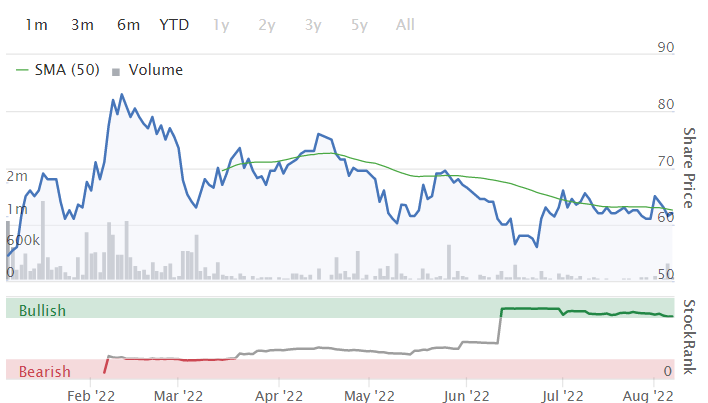
ADF is still above its 50p float price (Jan 2022), testament to the fact that Cenkos priced this deal sensibly.
Note that the Stockopedia algorithms have taken a shine to it more recently too.
.
.
Works co uk (LON:WRKS)
35.5p (down 24% at 08:46)
Market cap £22m
TheWorks.co.uk plc, the multi-channel value retailer of arts, crafts, toys, books and stationery, announces an update on FY22 results and current trading for the 13 weeks ended 31 July 2022 (the "Period" or "Q1").(1)
TheWorks has an unusual 4/2022 year end. So its Q1 period covers May, June & July 2022.
I last looked at it here on 20 May 2022, being a bit sceptical because performance appeared to be getting a major boost from business rates relief, and other reasons.
Today we’re told -
FY 4/2022 underlying EBITDA now guided up, to £16.5m (WRKS guided £15.0m in its y/end update on 20 May).
Profit boosted by lower than expected provisioning against inventories.
Dividend of 2.4p reiterated for the year - the first one since the pandemic hit.
FY 4/2023 - Q1 trading - store sales were up 1.4% on a like-for-like basis (the best measure of underlying performance, as it strips out site openings/closures).
Improving trend within Q1, May was bad (no figures. Tough comps due to prior year re-opening - fair enough), by July LFL sales had improved to 7.6% for the month - pretty good.
The smaller online division (only 10% of total sales) dropped a striking -28.6% in Q1 revenues (still up 40% on pre-covid). This seems to be the fallout from a previously disclosed “cyber security incident”, which sounds as if it was more serious than I previously imagined. It makes negative noises about online, but maybe it’s just not very good at selling online? Or these types of products are more appealing in-store, for browsing & impulse buys? e.g. children demanding particular products from their parents in-store?!
Outlook - market outlook has deteriorated, heightened degree of uncertainty, especially re forthcoming Christmas (peak trading period).
Still expecting sales growth this year though, not sure at what level.
Cost headwinds mentioned, wages, and freight “showing little sign of abating in the short term” - this is surprising, because shipping costs are falling now, so maybe WRKS has contracted at higher prices? Worth querying this, if anyone speaks to the company.
Profit warning - here’s the hammer blow - “materially” usually means at least 10% -
…the Board has materially lowered its expectations in relation to FY23's result.
Bank facility - good news here. The interim results indicated a facility (RCF) with HSBC of £22.5m, stepping down to £20.0m in Jan 2022. Expiry Sept 2022. Today we’re told that a larger, £30.0m facility has been agreed until Nov 2025. That’s really good news actually, as it shows the bank must be comfortable, at a time when we might expect them to be nervous due to macro factors.
Scrutinising the bank covenants, and the going concern note, will be important when the results come out on 23 September 2022 (a very slow reporting schedule, which I dislike).
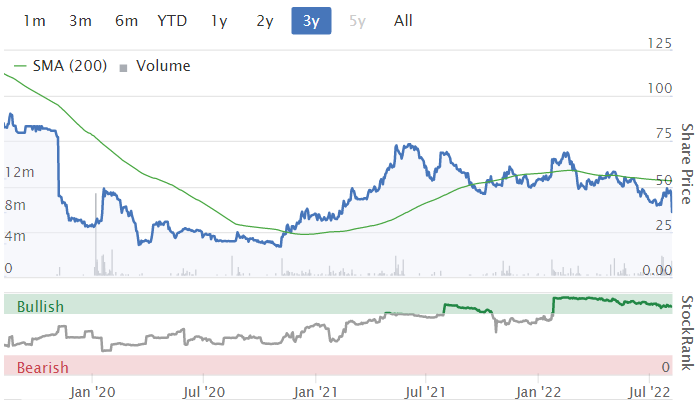
My opinion - I remain unconvinced with this share. As mentioned here back in May, SHOE looks a tons better business than WRKS.
There’s no broker research available, so I have no idea how much the company is guiding down FY 4/2023 expectations by. Therefore, with this lack of information from the company and brokers, it’s currently not possible to accurately value this share.
It seems obvious that FY 4/2022 profits are not sustainable, with rising costs, and withdrawal of business rates relief, and little prospect of imminent revenue growth due to consumer retrenchment. Also, remember that actual profit is nowhere near the distorted, misleading EBITDA figures quoted.
If consumers rein in spending, as one imagines they might, then it wouldn’t surprise me if WRKS warns on profits again, and struggles to make any genuine profit at all this year. That’s the trouble with a largely fixed cost business, operating on a wafer thin net profit margin. It was struggling pre-pandemic, remember.
Although the market cap is peanuts now, so if things go better than expected, it could be a good punt. It’s not for me though, too much uncertainty.
The balance sheet is OK, if you strip out the IFRS 16 entries, which have a considerable deficit - indicating there are some problem sites with onerous leases.
I need to see the full figures, in late September, we don’t have enough information currently.
.
.
Mincon (LON:MCON)
- Share price: 95p
- Market cap: £188m (€224m)
This is an AIM-listed Irish engineering company. It is listed in pounds and pence, but reports sales, profits and dividends in terms of euros.
It has a fine track record of profitability stretching back over many years. It has also grown the top line considerably:
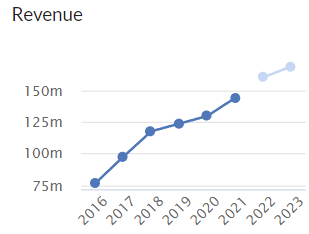
That’s a six-year chart but the view over fifteen years is excellent, too.
The company calls itself “The Driller’s Choice” and specialises in a wide range of drilling equipment that it sells internationally.
Let’s see what is reported in today’s interim results:
- Revenue +27% to €85.1 million, boosted by a strong dollar.
Most products sold by Mincon are manufactured by Mincon itself; sales of its own products are up 24%.
There was a small acquisition during the year (€1 million price tag).
Here’s an outline of the industries served by Mincon, and their share of revenues in each period:
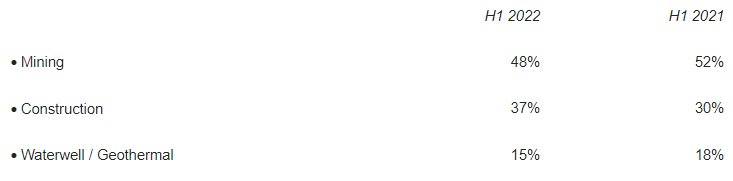
These are cyclical industries, but that doesn’t seem to have hurt Mincon’s performance much over the years. Remember how impressive the results from Somero Enterprises (LON:SOM) usually are, even though it also serves the construction industry.
Continuing with today’s results:
- Gross profit +18% to €27.1 million.
- Operating profit +18% to €8.8 million.
Results from Mincon tend to be clean, without the usual adjustments and excuses that you get from the average company that tries to make itself look bigger and more successful than it really is.
Revenues grew at a faster rate than profitability, i.e. margins have declined.
The CEO’s comments confirm this. There have been “cost increases across many fronts, but particularly in raw materials and energy, as well as freight, partly arising from the use of air freight to reduce our order backlog”.
Note the last part of this: margins hurt by a decision to swiftly meet high customer demand.
This is something I love to watch out for. I call it “a good profit warning” (though today’s results don’t constitute a profit warning).
It happens when a company is experiencing so much customer demand, that it is actually unable to meet that demand through normal operations.Companies in this situation sometimes make decisions that hurt their profitability, because they don’t want to let down their customers.
In the case of Mincon, they could have allowed their order backlog to fester, but they decided to use an expensive shipping method instead, even at the cost of lower margins and lower profits on these contracts.
But the decision will likely have positive long-term consequences: their customers will be satisfied and Mincon will maintain its reputation for the speedy fulfilment of orders. It has also increased its inventory of finished goods, to help facilitate this.
The difficulties in freight are part of the ongoing business backdrop, that includes high inflation and even shortages in some categories. Mincon’s CEO says:
We have implemented price increases, and these are starting to take effect, but constant vigilance is required to keep up with the pace of the cost inflationary pressures that we are seeing.
Paul and I agree on the importance of pricing power in this environment, and on the importance of businesses being able to pass on cost increases to customers without too much of a delay - any significant lag between cost increases and sale price increases could sink a struggling business. Mincon has started the process of sale price increases, but is clearly (and rightly, in my view) concerned that this could be an ongoing process for some time.
Product development - Mincon has a mysterious (to me) project called “Greenhammer”. This is a new, proprietary mining system that has been in the works for a long time. It sounds like it could be big, but who knows?
CEO comment:
…we are in discussions with a major mining contractor in Western Australia on commercialising the system and we hope to have a further update on this shortly. This is the culmination of many years of development work, and we are confident that it can have a significant impact on both Mincon and hard rock surface mining more generally. This Greenhammer development has not gone unnoticed by the mining industry in Western Australia, who are keen to monitor the performance of this new system.
I can’t put a value on this but it suggests some optionality with Mincon’s shares. Future results might be turbo-charged by Greenhammer, if it successfully takes off.
Outlook - nothing too specific here. Margins should improve in H2, with the help of price increases I’ve already mentioned, and the order backlog is reducing.
My view
Mincon’s shares haven’t travelled far over the years:
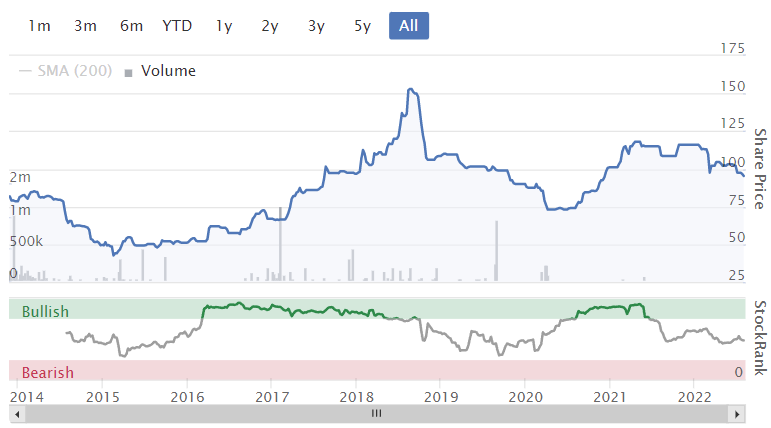
Why is this?
Five years ago, in August 2017, the company was generating €97 million of revenues and generating €10 million of net income.
This year, it is forecast to do over €160 million of revenues, and over €15 million of net income. And this is with margins temporarily suppressed, and with the Greenhammer project soon to complete.
Yet the share price now is the same as it was five years ago, despite the progress made since then. The P/E multiple is 15x - it could be argued this is fair for an engineering group, but maybe it’s too cheap, given the quality performance?

There’s a small dividend to keep investors happy, as they wait to see what happens with Greenhammer. I think Mincon shares look promising here.
Disclaimer
This is not financial advice. Our content is intended to be used and must be used for information and education purposes only. Please read our disclaimer and terms and conditions to understand our obligations.

68 comments
Thanks for the podcast Paul.
I have really enjoyed it your comments and analysis on ScS ( especially the blah blah blah and the crowing bits ).
Paul, thanks for the weekly recap and using your own time to interview the Renold (LON:RNO) CEO, I now hold from today.
Did enjoy the part where you said you would let us know in a future podcast how to cope with losses, only to spend the next 15 minutes telling us, had to take the long cycle home.
LOL I know what you mean, but sometimes we have to be spontaneous! Those are usually the times when interesting things happen! Wouldn't it be boring if everything was scripted?!
Hi Paul,
Thank you for the Renold (LON:RNO) (I hold) interview I found it interesting.
Talking about large director buys, Saga (LON:SAGA) director buy of £1,000,000 last November.
On a fcst p/e of 5 and peg of 0.1. Chart turning up here.
eParo, are you sure Saga (LON:SAGA) won't follow the direction of Mccoll'S Retail (LON:MCLS) instead of the Chart instead plummeting to a value of zero eventually? :)
After all there were big director buys in McColl's too! And about the same time... last Sep? So not much longer for Saga to follow the same trend? :)
(I hold Saga in the Boon Fund)
I've topped up recently, so expect worse from here
Thanks for the podcast Paul - entertaining, educational and helpful as usual
For significant director buying, it's hard to beat Sehat Sutardja, executive director of Alphawave IP (LON:AWE) . He has bought 12 times since May 9th, spending some £12m. His family company is also a buyer. Other directors are major shareholders. Disclosure: I don't know the company and have no position.
Yes ... this attracted my attention and after looking into the company I bought in a few weeks ago. Down at the moment, but hopeful.
wonder what Richard Crow thinks of the Works co uk (LON:WRKS) trading update Paul, as he was certainly very bullish in the podcast you did with him , released on the 22nd July !! He has such a good track record, that I am inclined to think this maybe a good buying opportunity. Like Saga (LON:SAGA) I think it’s a case of just being patient with bombed out shares !!
Maybe Richard Crow's judgement wasn't misplaced on this one? Another director buy today .
The Company has been notified of the following acquisition of ordinary shares of 1 pence each in the Company by Kate Morley a Person Closely Associated with Harry Morley, Non-executive Director and Person Discharging Managerial Responsibility:
Director
Position
Date of transaction
Shares acquired
Total shareholding following acquisition*
Kate Morley
Person Closely Associated with Harry Morley, Non-executive Director
10/08/2022
75,000
75,000
Down 8% today.
Can someone tell me where can I find Paul's SCVR podcast. Thanks.
Small Caps Podcast with Paul Scott – Episode 6 – Quality Small Caps
Paul's link to it was in his opening remarks, clicking on the blue Episode 6 would have got you there.
R
Many thanks Dicktrade. Old age has crept in
Hi Paul,
This is a really good one, especially the macro/market thoughts in the second half. Much to think about there.
Steve
https://masterinvestor.co.uk/p...
This link to an interview with Terry Smith was posted by Simoan last week and gives excellent food for thought.
Its possible that we are no where near the end of the bear market and that stock prices sometimes fall 2/3 in the last 1/3 of a bear market (the capitulation phase).
For me, I asked myself the question, could I cope with another significant drop in prices. For the majority of my funds the answer is no, so I’m being defensive, even if it means missing some profit
I think it is important for everyone to ask this question so they can sleep/survive if the worst happens.
I'm thinking that in the past companies were often buying back their own shares when their shares prices were at a high level. Today many mid-caps are buying their own shares back at a low level but, could not this low become the new high without anyone realising it?
Silver
Hi Paul
Listened to your podcast update whilst doing some gardening this morning. I was quite moved by the candid way you talked about how to cope with losses and using your own situation as an example.
The SCVR and the reader contributions are what makes Stockopedia unique IMO. Thanks
Hi Paul, re Facilities by ADF (LON:ADF) you mention a forward PE of 12.4, so quickly working backwards that’s an eps of 5p, so based on last FY profit after tax (£1.3m, 1.7p eps) adding on exceptional IPO costs (£1.3m) would have given PAT for FY21 of £2.6m (3.4p eps). Forecasts for FY22 are for 13% revenue uplift but only 1% increase in EBITDA, whereas the 5p eps is a 47% increase. Sorry but your forward PE of 12.4 doesn’t make sense to me (is it using EBITDA?), apologies upfront if I’ve just completely misunderstood and I’m being dense, if so just ignore my ramblings!. Thanks
Dear Discodave4
FacilitiesbyADF (LON-ADF)
The earnings per share is calculated on the profits after tax generated by a company rather than EBIT/EBITDA which is before the application of tax and interest costs. The IPO and exceptional costs of £2.6 million were included in the company’s figures for the year-ended December 2021, resulting in profits after tax of £1.3 million. Cenkos, the broker to the company, is expecting profits after tax of £3.5 million for the year-ending December 2022 which works out at 4.6p of earnings. For the year-ending December 2023, the respective figures are £4.5 million and 5.9p. Assuming a share price of 62p, the PE for 2022 is 13.5x, falling to 10.5x in the following year if forecasts are met. Perhaps Paul believes the company can deliver 5p of earnings this year?
Kind regards
Phillip
Thanks Phillip, hadn’t had sight of the Cenkos forecasts (are they the house brokers?). That said my point was more around how will eps increase to 4.6p or 5p if adjusted EBITDA for this FY is only increasing 1%, or to put it another way, FY21 PAT was only 17% of adjusted EBITDA so how will only a 1% increase correlate to a 47% uplift in bottom line (no BS!) profit and eps? (if that makes sense).
Dear Discodave4
FacilitiesbyADF (LON-ADF)
Cenkos is the house broker and its research can be found on the ResearchTree website for which there is a charge. Alternatively, I believe you can log on to the Cenkos website and obtain research there as, unlike many brokers, Cenkos does not charge for its research capability.
I think the answer to your question is that the EBITDA figure on which earnings are eventually calculated for 2021 is £5.1 million (after deducting £2.6 million of IPO and exceptional costs) versus the £7.8 million that is forecast for this year.
Kind regards
Phillip
thanks, got it!
Paul I tuned into your podcast to hear your macro views.
I completely agree with your view of the BBC it has become far too opinionated and has become a kind of left wing version of Fox News which to my mind invalidates the requirement for a TV licence as they are no longer impartial.
The BoE forecasts are very disappointing and defeatist. In the US they are still talking about the possibility of a soft landing whereas Andrew Bailey seems to have given up and is forecasting a recession. I'm not sure I'm comfortable about him holding the job for the next 8 years.
Your comments on losses were very interesting. I would add that opportunity usually follows crises like these and I have been buying good value companies rather than trying to time the market bottom.
It is interesting to note that recent editions of the Investors Chronicle show directors purchases far outweighing sales, and I think it is good to see that people in the know are buying at the moment.
Watched a woman interviewer on last nights BBC Nine O'clock News who persisted in winding up a Middle East representative over the Gaza Strip debacle. She should have been stood down.
Bidstack (LON:BIDS)
Don't be fooled by the revenue figures. They claim the publisher's revenue as a cost. They only get around 40% of the claimed revenue for their operations.
An expensive mistake I made thinking the surge in "revenue" was going to exceed costs or be about breakeven this year. Could be a couple of years yet depending on how growth goes.
They've also changed their business model quite substantially. I personally find them pretty shady in the way they communicate and high behind "market expectations", that are actually their chats to their own broker, to avoid issuing profit and revenue warnings. And they've got a contract in place that guarantees this revenue, they literally can't fail.
There's also a huge, huge slug of non-cost options for several directors with the "challenge" of meeting the market expectations the board set, as described above. Those expectations have not been documented or marked as a point in time, so if "expectations" fall they still get paid out. They even get paid out a significant amount of them if they fail to meet expectations and can claim the ones they missed out on next year if they get back on track.
This company is just awful. Absolutely awful.
Please, please could some of the institutional investors please get a grip of the management here.
Hi Paul
I just listened to your podcast and was very moved by your coments ant the end on how to deal with losses.
SYNTHOMER (SYNT)
Recent director buys. Current SP looks very attractive.
Yes Synthomer (LON:SYNT) has popped up on my screens and I can see it's fallen a lot. Not familiar with the company but heard some respected investors talk favourably about it. Hope to do a bit of research on this when time allows.
I have been buying Synthomer (LON:SYNT) recently. The business was boosted by sales of rubber gloves during the pandemic. There's a bit of a dip in sales of the Nitrile Rubber division whilst surplus stock is used up by their customers. On top of that they've made a major acquisition buying the Adhesive Technologies division from Eastman. I'm keep a close eye on that as there were certain negatives, such as the previous CEO making the acquisition before leaving. The rest of the business is growing reasonably well. I decided they were now cheap enough to invest in. Maybe I'm right and maybe I'm wrong.
I have been buying Synthomer (LON:SYNT) recently.
I have held in the past. I think it's a decent company but I, let alone the market, don't see any catalysts for a re-rating in the near term. Long term I expect patient investors will be rewarded and should enjoy a good dividend while they wait. But the dividend yield is flashing a warning that the recent massive fall in free cash flows emphasises. It might be better to buy when the market starts to anticipate an upturn in the economic cycle.
Thanks BnB. It's good to get a different perspective. I am trying to be a patient investor - when the day job gets busy I just don't have the time to time my investments well and made a few mistakes before I acknowledged that. I believe it is a decent company and that the fall in price is an over-reaction so it is cheap. Yes, it may take a while to re-rate. For a start nitrile rubber sales will have to recover and the new adhesive technologies division will have to turn out not to be a flop (that's my biggest risk to monitor). Other divisions that have been much less affected by the boom and bust of the pandemic are progressing nicely. And I agree the dividends have to be cut - they've already started with the next interim. But say dividends are 13p this next financial year that is still not to be sneezed at given where the price is now.
And anyway I still have only a small proportion of my portfolio in Synthomer (LON:SYNT) so far.
Synthomer (LON:SYNT) 13p is in the forecasts but be aware that in 2019, the last time the name faced a downturn in the cycle, dividends fell to only 4p.
Thanks. They've declared an interim dividend of 4p for Nov.
[Edit] I see. 4p in Nov 2019 and no dividend in summer 2020. I have to confess that I'd attributed that to the pandemic. Like everyone else I guess, I had several holdings at the time that went xd but didn't cough up, never mind suspending the dividend.
Do you remember whether Synthomer (LON:SYNT) suspended the dividend before the pandemic?
Do you remember whether Synthomer(LON:SYNT) suspended the dividend before the pandemic?
I’m afraid I don’t remember. But the pandemic gave the company a big boost so, logically, there would have been no reason to suspend the dividend. On the other hand, it must’ve made sense to do so in April and May 2020 when the pandemic benefits had yet to be appreciated. And it would be equally reasonable to assume that the monster dividends of 2021 were partly by way of distributing the postponed 2019 dividend
Thanks.
Supreme (SUP)
Interesting RNS , I was quite impressed be the CEO and founder recently sticking his hand into his pockets to buy a chunk of shares at market price.
Admittedly this is of course effectively with the cash he had already made on his flotation but none the less it seemed a good indication of a guy leading from the front.
Less impressed with an RNS today announcing sone zero cost shares to other members of the senior team albeit with sone hurdles . It’s shareholder theft .
Then gobsmacked to find this at the bottom of the RNS .
“Further options or share awards made at the discretion of the Remuneration
Committee following the date of this announcement (whether under the
Unapproved Share Option Scheme 2021 or any other share scheme) are subject to
a cap (inclusive of all other options granted following Admission) not
exceeding 10 per cent. of the issued share capital of the Company.”
That’s a total wind up to me, but it’s city standard and I find most investors tolerate it and accept it .
In football parlance Supreme which I had as almost on the buy list has just scored an own goal and will be avoided for now .
1-0 good stock market launch
2-0 hyped up share price
2-1 bear market hits
2-2 overstocked on batteries
2-3 profit warning share price plunge
3-3 ceo buys at market rate
3-4 freebies to management
Thanks planetx!
I love your football-style scoring system for company news by the way - that's really clever, and a nice way to represent newsflow.
You would think that, with a recession coming, people would be just grateful to have a good job, not needing to be "incentivised" with loads of free shares too. Maybe we need a recession, to shake up this type of thinking.
I think lots of us prefer companies where issuing new shares is like getting blood out of a stone, rather than them being thrown about like confetti. There again, at Supreme (LON:SUP) the major shareholder CEO won't want to dilute himself, so he must see value in rewarding key people with options.
Regards, Paul.
Perhaps it was inevitable once the CFO Suzanne Smith was asked in the last results presentation (shortly after the lighting problem switched off the share price) why she wasn't a shareholder and replied she didn't have any money to buy shares.
At least the options are 'performance' related.
Paul
Glad you like the football style scoring system.
Might be a new investment strategy to be built around that
Eg
Only invest when
- you are 3 points clear
- you have funds for the transfer market
- you have a great manager
- you have plenty of reserves
- you haven’t overpaid for a recent purchase
Not sure which of my portfolio is Liverpool and which is Rotherham FC .
Volex (LON:VLX) - US Senate passes Inflation Reduction Act. Incentive offered for electric cars:
"Meanwhile, some households could receive up to $7,500 in tax credit to buy an electric car, and $4,000 for a used car."
https://www.bbc.co.uk/news/world-us-canada-62457386
Paul - excellent podcast at the weekend thank you. And I found your ramblings/stream-of-consciousness on coping to be especially valuable, thank you for sharing it with us.
Director Buys - interesting idea. I share your feeling with regard to director buys but am not so concerned about a high threshold depending upon the company and the context. We tend to measure directors as if they are all risk taking ' entrepreneurs' like us - but for many it could not be furher from the truth? it's hard to assess how much free cash directors have and how they approach share dealing. When I was a director I remember being warned by other board members about 'putting all your eggs in one basket' - in other words, buying shares in the company you work for is failing to diversify your risk. It may be that even a modest seeming purchase is meaningful to some directors? But I agree we can't tell - so having a high threshold results in a much clearer signal. I seem to have talked myself around? But small puchases and multiple purchases can still be useful confirmation of director assessment of long term value - particularly in very small caps with relatively modest pay?
Taking Vianet (LON:VNET) (I hold) as an example, On 2nd Auvust Stella Panu, new NED purchased 30,000 shares - for about £20k. Doesn't strike me as someone who is likely to have been influenced into buying, and £20k is likely more than 'token' in the context of a new non-exec remuneration? On 4th August James Dickson Chairman and interim CEO also purchased 30,000 shares for around £20k bringing his holding to 17.1% and continuing his habit of adding to his holding. Not un-orchestrated. But also not clearly orchestrated? To add to that Vianet (LON:VNET) directors have bought shares together multiple times in recent years, but at much smaller levels - typically a few thousand shares.
I am clearly biased. and the company has a long history of not quite delivering on growth and these director buys on their own are not a clear indication of anything. Within the context I take this as a useful indicator that current trading is going according to plan, possible that chip supply problems are easing (at least not getting worse) and that the directors see good long value at the current share price, as recurring revenue streams continue to build. Directors see value if not a screaming short term buy? Others might quite reasonably argue that its another attempt to raise the share price with larger director purchases? But if so, why? I suppose I'm bringing it up as a marker - it will be interesting to see which one it turns out to be.
cheers
Mark
Having worked on a few cloud telecoms solution over the last few years I'm very wary of investing in suppliers in this area. The key question I would ask, with a bit of a pessamistic bias, is what is their moat? There are a lot of small players in this space who will probably not last. I've not specifically looked at Vianet (LON:VNET) so maybe their cloud telemetry niche will give them some protection, but I'd want to have some certainty before investing.
My take on rates and inflation...
We live in complex times. The virus first and then the war, have exasperated supply side tensions ... such that current global demand can't be serviced with supply. How can this be? Old supply lines simply aren't working the same... for a host of reasons, labour is less mobile, shipping lanes closed, some supply lost, poor food harvests and an energy crisis. Many of these things will be resolved. Structural tensions have flared though making things worse. In a nut shell we need to create capacity...which takes time.
Inflation is a funny one. If you are retired, working for yourself or living from investment return it may seem like the big risk. If your pension is losing its purchasing power at anything like 10% a year that's a scary thought. Working provides some protection through your salary. However I would argue my inflation rate is lower than that reported. Mainly because I don't spend huge sums of money on cars, houses, fuel, energy, clothes etc....as you get older the main rise you see is healthcare...most if this cost comes very late in life. To a decent degree I can economise and adjust my expenditure to mitigate changes in price. Not as negative as headlines suggest.
I agree equities give you a nominal return which can protect you from inflation. This is a long term trend however. UK large cap have faired much better in the current sell off. However Bonds, equities, commodities at the index levels are offering negative returns so far this year, no protection there. Even Index linked Govt bonds are down.... as they reflect the spike in rate expectations and the protection has yet to feed through. My point is that although real returns are negative on cash - so far they have been worse elsewhere. So I am less put off cash in the current environment. Especially now equities and bonds have rallied... on the perception that rate increases so far may be sufficient, although last weeks labour report ( a lagging indicator) suggests otherwise and Bonds sold off.
Clearly the last ten years the Fed has had a free hand to cut rates to support the economy. Now we have the reverse. Interest rates have always worked with a lag.... old wisdom was 6 months...maybe things have speeded up I Don't know. But there is still a lag. If we have to wait for inflation data to improve by definition rates will prove too high at that time. Therefore although I agree with Paul that levels of early 90s seem unthinkable...I don't see room to pause yet.... The energy crisis in Europe if anything makes it more likely that the central banks will not worry too much about dumping the economy into recession over the winter....to reduce the squeeze. Furthermore a rapid recovery would simply see the inflation problem return....this is going to take time.
Fortunately UK investors do have the FTSE 100 which has been so disappointing for 21 years but particularly since the GFC... that it has proved mega defensive to the trends we discuss. Small cap funds focussed on value rather than growth will do much better. I have read a few manager reports like Smithson Investment Trust (LON:SSON) over the weekend - 40% tech 40% US equities - and conclude these guys aren't for changing . Beware the fund flows that will naturally follow causing more underperformance. The Fed is reducing liquidity and that means risk capital is coming out of the system. My view is cash is ok until the Fed says it can halt the QT programme or better still reverse it. Until then I will be selective and defensive. Obviously I have a few mistakes but in aggregate they make much less than 10% ( now) so I will just run them.
In the long run cash has always been poor but at the moment its return is rising with only the theoretical inflation argument against it. Ofcourse a big chunk of current inflation should ease as supply chains rectify....but the twitter obsession with whether we have seen a bottom or not ....seems more in tune with the last decade not the one in front. None of us know how this will play out for sure... but for me its defensive as can be at the moment.
Apologies for the ramblings of an X fund manager... helps me cement my thoughts. You can listen to a podcast I did for Zeus ... A Different Perspective episode 6... rambling further.....
Good luck all.
"Interest rates have always worked with a lag.... old wisdom was 6 months"
I'm used to a rule of thumb that says 1 year. Some people say 2 years to have the full effect. This shows aggregate interest rate changes 15 months ahead of ISM new orders, which itself is a short leading indicator:
Yep and the market front runs the data which all makes sense..... for now don't fight it. Its why for the US, avoiding a hard landing is going to be so tricky. Bad for risk assets. Not necessarily so bad for UK equities.
Markets front run recoveries by an average of 4 months ... still a long way to get to that point. If UK equities escape a hard landing in the US then it would be the first time in history. This time would be different.
Where to find podcast RDHOWARTH please?
its available on apple podcasts - Zeus Capital A different perspective is the title - episode 6 - or poss try Zeus capital website if u don't have apple
Thanks for the heads-up on the podcast. I shall download it and listen to it later this week.
Re Facilities by ADF (LON:ADF) , media production on a large scale is highly dependent on exchange rates and government subsidy through tax incentives. Success here is dependent on a weak pound and state aid. The former may be a given, but the latter seems uncertain.
Facilities by ADF (LON:ADF) - Article in Sunday Times about Britain's booming film/TV studio space and productions "Welcome to Brollywood"....
https://www.thetimes.co.uk/article/welcome-to-brollywood-inside-britains-booming-film-and-tv-industry-mfhqt5xgg
ECO Animal Health (LON:EAH) (I hold)
As expected no dramatic turnaround yet but the board stated that they are optimistic looking forward.
China pork prices are strong and margins are good. ROW sales are strong.
I like that ECO Animal Health (LON:EAH) directors seem confident in their direction of travel and have protected their R&D spend through this tough time.
Tax hit was unfortunate but taken in their stride and now in the rear view mirror.
On Paul’s note below both the CEO and CFO were buying shares earlier this year (approx £120k between them). Looks like the CFO got in too early at approx 160p but the CEO bought at 117p.
As I write the shares are down to 100p. I might top up as I’m taking a long view on this one and I can’t see food prices coming down.
I have the opposite view from you that "china pork prices are strong and margins are good". My view, having tracked the industry for a while, is that the current prices are nowhere near break-even for the producers, due to huge input price increases.
Hence why ECO Animal Health (LON:EAH) have warned today that the China outlook is weak, because producers are struggling to afford even basic things like animal feed, let alone EAH's products, for their pigs.
Doesn't that mean that pork prices are more likely to increase Boon?
They will, eventually. As producers start to reduce their herds, then eventually there won't be enough supply. But when and how is the key question. And it seems like quite a boom/bust scenario. In 2019-2020 there was foot and mouth, and huge herds were culled. Then the pork price skyrocketed, and leading to early 2021s being a boom time where every Tom, Dick and Harry in China started breeding pigs. Then a major glut towards the end of 2022, persisting until the earlier part of this year. Then demand got hit, due to all the covid lockdowns, sapping business and leisure eating out. Now increased feed prices.
I do know that sometime in the next 3 years we'll probably get undersupply and a bit squeeze upwards in prices. But will it be sustainable or rapidly swing the other way? Or remain high?
ECO Animal Health (LON:EAH) will be interesting when they have a more diversified portfolio of products that target more animals, and different use cases. Also when they've diversified more away from China (hard, due to them being the world's largest pork consumer).
I still think it is a sound business, but valuation-wise I'm not sure it is good value for money yet. Need to re-do my analysis in the next few days, with the latest trading update.
Does anyone have any opinions on KPMG's resignation letter as auditors of Alliance Pharma (LON:APH) (I hold)? The share has been a steady performer for me over the years, but I don't know from the letter if it is just KPMG being a bit miffed at being replaced or whether there are deeper concerns behind it.
Yes, it does sound rather terse. My guess is that KPMG pushed Alliance Pharma (LON:APH) (I used to hold but sold about 3 months ago) to make their provision for their legal case. To be fair, many CFOs don't like to make a full provision on an outstanding legal case, because it looks like the company thinks it's going to lose, which is not a great look when going to court.
It is what you would expect from a firm with KPMG's refutation a fudge. If a Auditor is aware of any information whick they feel should be bourght to the attention of shareholders or creditors of a company they need to file a letter at companies house. It should be clear and specify what the issue is. I think they have done this to satisfy the regulator but not be seen as a whistleblower by their other clients
You're right; they'll disclose as little as they have to to meet the regulatory requirement.
I'm keeping an eye out for large (over £100k) Director buys in small caps, as that can be a good indicator of future performance, I've found (subjectively, I've never measured it).
This morning I see Purplebricks (LON:PURP) (I hold) CEO has just spent £100k on buying shares in the open market at 15.9p
I only spot ones that are on my watchlist, so perhaps readers could post any more big Director buys that you spot, hence we could build a nice alert system here to benefit all. Significant buys, not orchestrated token amounts - which I think are meaningless.
Thanks, Paul.
Morning Paul ,
If I am not mistaken the CEO of ScS bought at over £2 around £150000 worth of shares.
Some directors of TheWorks bought as well at over 40p and I remember some directors of Superdry were buying at around 250p. Directors of Hostmore and Unbound were buying at prices well above their current market prices.
I think the biggest one though was the Mccolls one that the CEO registered for £3m new shares at 20p!!
I do not think that any buys from directors are to be taken seriously for any future investment case. Most of the times politics are behind all these transactions.
Have a nice week everyone.
Earlier this month the Chair of Purplebricks (LON:PURP) bought £369k worth of shares. So now that is two directors buying significant stock this month. (I have just bought some too.)
Caveat - not fully foolproof, to look at director buys. Two spring to mind - Mccoll'S Retail (LON:MCLS) and also Saga (LON:SAGA) where huge director buys weren't a signal of value for money share prices. McColl's is now a final case, while Saga is still yet to be seen whether it will recover....
(I hold SAGA in the Boon Fund)
Litigation Capital Management (LON:LIT) (hold) non execution chairman (J Moulds) has made six purchases since Oct 21 now totalling just under £2 million and 1.7% of the company, four of the purchases being this year. Previously a COO at Barclays and head of European business for BOA.
The sp has dropped after the last update. Even though profits expected to be higher the length of time for cases to run has increased so I’m guessing some holders just losing patience with this one?