Small Cap Value Report (Mon 8 Mar 2021) - SHOE, PCIP, Mello,

Good morning, it's Paul here with the SCVR for Monday.
Timing - TBC
Agenda -
Pci- Pal (LON:PCIP) (I hold) - Interim results
Shoe Zone (LON:SHOE) (I hold) - Final results 52 weeks ended 3 Oct 2020
.
Mello Monday - tonight
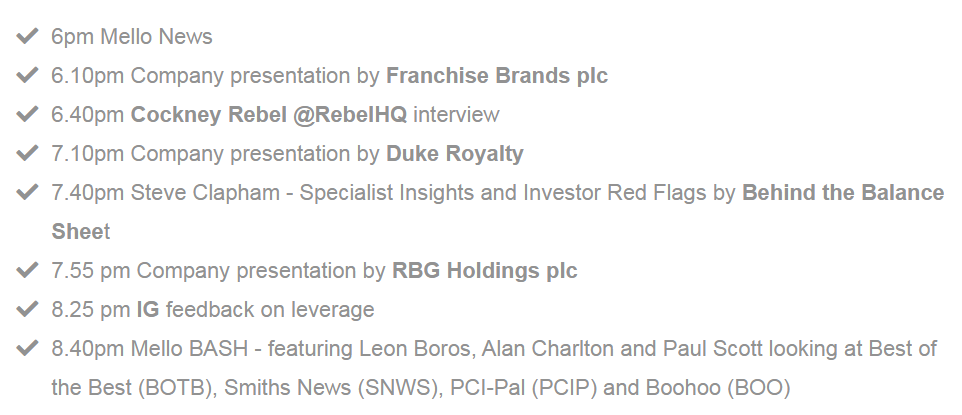
The fortnightly shares extravaganza on zoom, starts at 6pm tonight.
Here’s the agenda below, lots of interesting stuff here. I’ve been roped into doing the BASH panel discussion near the end, so I’d better start doing some preparation for that later. I hope you can join us!
.
.
My thoughts on the Budget
I prepared this over the weekend.
Budget - having had time to absorb it all, my overall impression is positive. The measures strike me as mostly sensible measures to extend support where it’s needed most.
Hospitality sector - helpful measures that should give a decent boost once they are able to re-open. The BBC is reporting that pubs which have recently opened up online bookings, have been inundated. Revolution Bars (LON:RBG) (I hold) talked about pent-up demand in an update last week. Therefore I think there’s little doubt the UK is likely to be heading back to pubs, restaurants and nightclubs en masse this summer. Hence why I want continued exposure to this sector. Despite a strong recent rise, I’ve decided to sit tight on my RBG shares, and look forward to a we’re trading our socks off type of announcement later this year. It’s a much better business now, because all the problem sites have been disposed of, and rent reductions agreed on every site where it was needed. Remember the CVA only dealt with a handful of sites where they were not able to agree a consensual rent reduction with the landlords.
As regards restaurants, everything in that sector looks too expensive to me now, so unfortunately the only thing I could find was a highly speculative/risky position in Tasty (LON:TAST) when it was about 3p. It’s doubled since, so I sold most of them at 6p, but have kept a few for the longer term.
Stamp Duty - reductions have been extended as expected, but I feel the Govt should be much more radical, and abolish this tax altogether. It doesn’t raise much revenue in the overall scheme of things, and probably costs a great deal of lost revenue from other taxes. Imagine if buying/selling houses was quick, easy, and cheap, with no tax to pay. There would be a great surge in moving house, which would stimulate lots of areas in the economy, such as DIY, building, carpets, plus higher payroll taxes from estate agents, lawyers, etc.
The new Govt guarantee for 95% mortgages sounds a good way to help frustrated younger people into home ownership.
Quantitative Easing - also known as the magic money tree! Financial journalists just don’t understand QE at all, do they? I’ve read so many articles bemoaning the dangerous level of Govt debt, at c. £2,200bn. This apparently will be a burden for generations to come. Except of course that is completely untrue! The Bank of England owns £895bn of the Govt debt, so it’s not c.100% of GDP at all, it’s nearer 60-65%, which is quite modest, and very cheap to service (and getting cheaper all the time, as old gilts are rolled over into new ones at lower interest rates).
Sunak didn’t mention QE at all in the Budget, instead talking in conventional terms about the need for financial prudence. I tend to focus on what people do, not what they say. He’s done almost as much QE as every other Chancellor in history put together (£400bn since March 2020). His use of the word “honest” reportedly 15 times, is a very good indicator that he’s being dishonest! The truth is that QE has funded the covid crisis in full, and there is no need to raise taxes at all - because the deficit will naturally reduce greatly, once the covid support measures end, and backed up tax receipts roll in. But because few people understand that, the politicians instead just lie to us. It’s frightening that a humble shares blogger here has to explain the facts, which are being misreported everywhere else. I’m definitely right though - check out the QE section on the Bank of England’s website, to verify my facts & figures.
Corporation Tax - I think raising this from 19% to 25% delayed until 2023 was a terrible mistake. Ireland demonstrated how having a very low (10% 12.5%) rate of Corporation Tax attracts high quality businesses to their shores, e.g. financial services, and technology companies. Any foregone Corp tax is then offset somewhat through increased payroll taxes on highly paid staff. The whole economy is greatly stimulated, with the spending from those highly paid people.
Surely having just done Brexit, the Govt should have realised that keeping the UK competitive on Corp Tax was a vital ingredient to prevent companies leaving the UK, and even attract overseas companies into the UK? I’ve also heard from international companies that they have plenty of leeway within the rules to shift profits from one area to another, and obviously they’re going to make sure the UK division would make more profit, due to our lower rate of Corp Tax.
Changing tax rates changes behaviour, and I fear that Rishi has made a costly mistake here, raising Corp Tax when Brexit is the key issue determining many companies longer term planning. I can see the logic for why he’s done it - that companies have had great support from the taxpayer, and it’s payback time. That’s an emotional argument which doesn’t interest me. All I care about is maximising the UK’s competitiveness, and 19% to 25% will hurt that considerably.
Impact on company earnings - of higher Corporation Tax. With 19% Corp Tax, that means companies retain 81% of profits, available for any combination of: reinvestment/capex, paying divis, reducing debt, buybacks, or just hoarding cash. With the higher 25% rate of Corp Tax from 2023, this means only 75% of profits will be available (ignoring other changes). That’s a 7.4% reduction in earnings, from 2023, which theoretically should mean share prices should be 7.4% lower. That’s going to feed through into lower earnings estimates fro 2023 onwards, which inevitably must put a dampener on share prices. Although with small caps, many don’t yet have 2023 broker estimates, so the impact could be delayed. Brokers tend to be too pessimistic at this recovery stage of the economic cycle, so higher Corp Tax could be offset by earnings beats, possibly. Overall though, raising Corp Tax is unhelpful for share prices.
Super deduction for corporation tax, for investment spending. This does sound interesting, and the OBR has forecast it could drive a 10% rise in investment spending, clearly very good for the economy. This could boost shares in companies which provide capital equipment, or which are planning lots of capex.
Online sales/profit taxes - nothing mentioned in the Budget, but the Telegraph is reporting that March 23 will be a key day for a report on this subject. It says that Sunak is talking to other major countries, as these things have to be done through the OECD rules apparently. Janet Yelland is said to be receptive to change. A tax on online deliveries is mooted - tax raising dressed up as a green measure, the way I view it. Will a few pence on a delivery really alter behaviour? I doubt it.
Business rates - after discussing this subject with readers here, I have come round to the view that the Govt does need to level up the tax-raising playing field between physical and online retailers. Although we also need to consider that many online retailers don’t make much, if any, profit. Those that are profitable pay corporation tax on profits already.
Business rates is actually a tax on landlords, which is levied on the tenant. So in normal times, if business rates go down, then landlords just raise the rent. That’s being masked at the moment by the need to put rents down a lot, to reflect the high level of vacancies. Maybe the answer is to completely reform the system, and get all properties onto turnover rents, and a quarter of the turnover rent has to be paid by the landlord to the Govt? That would be much simpler to operate too. Lots of chartered surveyors would lose their jobs though, as appealing rateable values employs many people in unnecessary & unproductive jobs, under the existing outdated system.
Higher inflation & interest rates - this is a hot topic at the moment. Some are arguing that rising bond yields should trigger a fall in equity prices. That could be one factor that is causing the US markets to wobble, possibly? I note that NASDAQ has fallen about 10% from its recent peak.
I've got no idea what markets overall are likely to do. Although I do think it's a good time to consider banking profits on very highly rated shares, as many are currently on ridiculously high valuations.
I'm happy with everything in my portfolio, because I don't overpay for anything in the first place. Share prices need to take a breather from time to time, and personally I accept market volatility & don't get uptight about it.
.
Shoe Zone (LON:SHOE)
(I hold)
68.5p (down 8%, at 08:48) - mkt cap £34m
New FD - is called Terry Boot, who replaces Peter Foot. Possibly there might be subliminal bias in the recruitment process at Shoezone, favouring people with footwear-related surnames? I’ve got a friend who’s looking for an admin job in their area actually, so I’ve advised her to change her name by deed poll to Deidre Brogues, she’ll be a shoo-in! I’m here all week.
Final Results - 52 weeks ended 3 Oct 2020.
Not a pretty sight, these numbers.
Here are my notes (key points only, this doesn’t cover everything) -
Revenues down 24.3% to £122.6m - in line with the trading update on 28 Oct 2020 - obviously the covid lockdown closure of retailers has had a negative impact, no surprise there
Profitability - the company originally said on 28 Oct 2020 that the loss would be £10-12m. Then an update came out on 11 Feb 2021 which I reported on here, saying that the statutory loss would be worse, at £(14.6)m due to IFRS 16 lease adjustments. I note that the previous FD, Peter Foot, left the business 11 days later, with immediate effect, with no explanation provided, and he was not thanked. That sounds like a sacking, I wonder if that was linked to not being on top of IFRS 16?
The reported loss today is indeed £(14.6)m, so that’s exactly in line with revised guidance.
Closed 50 stores in the year, a lot. Says that average lease remaining term is only 2 years, but I’m struggling to reconcile that with the large lease liabilities shown on the balance sheet.
Gross margin still very good, at 61.4% - which means profitability should recover decently once the stores are allowed to open again.
Rents down 30.9% on renewal is positive - as with other retailers that have survived so far, rents are gradually resetting to lower levels, but only when leases come up for renewal or have break clauses.
Digital revenues - a bright spot, up 82% to £19.3m. Contribution to profit (i.e. before central costs) of £4.6m is impressive, although online revenues are only 16% of the total - not enough.
Online customer returns rate is only 8.4%, expected to rise to a more normal 10%. That surprises me in a good way, as it’s a fraction of the typical 40-50% returns rate for online fashion.
Re-opening of stores 12 April
Unable to forecast accurately, so no guidance provided
Stock overhang of winter products looks large, at £7m (at cost) - tying up a lot of capital until next autumn/winter
Freight rates - good to see this widespread problem being quantified. Cost is £6.5k per container, previously £1.9k), 100 containers per month, that’s £460k additional cost per month, or £5.5m per annum - that’s a huge problem, so I wonder if we’ll start to see a spate of profit warnings from other companies in any sector that imports a lot of product from the Far East? It’s looking that way.
Outlook - return to profitability unlikely this year.
Pension deficit - unusual for a smaller retailers, the deficit recovery payments are quite large at £1.4m for the year.
Dividends - we’re told not to expect anything until 2025 at the earliest! How can they forecast that, but not give us any guidance on earnings? Seems contradictory to me, as the two are obviously linked.
My opinion - even though the numbers are in line with the last trading update, it does all read as rather grim. Like a lot of other shares, the re-opening trade seems to have taken the share price up too far, so seeing the numbers is giving the market a reality check. I think that’s worth bearing in mind for many other re-opening type shares, which have also arguably run up too high (e.g. Card Factory (LON:CARD) as I mentioned last week).
A positive thing about SHOE, is that it’s got through the crisis without having to dilute shareholders, hence in time the share price potentially could recover to pre-covid levels.
I like the fact that owner/manager founders still have very large shareholdings.
On balance, I reckon the share price got ahead of itself here, it recently peaked at about 82p, more than double the November low of around 34p. So a pullback to c.70p today looks justified. Maybe it could drop a bit more, who knows? Although as we get closer to re-opening on 12 April - just over a month away - investors might start to look at the glass as being half full again?
As regards my own position here, I did top slice some into recent strength, so am happy to hang on to the rest for the foreseeable future. My feeling is that the vaccinations are clearly a game-changer, so this next re-opening should hopefully be permanent. If you disagree with that, then of course this share (as with all retailers) would very much be an avoid.
.
Pci- Pal (LON:PCIP)
(I hold)
84.5p (up 7%, at 10:10) - mkt cap £50m
Interim Results & Investor Presentation
PCI-PAL PLC (AIM: PCIP), the global cloud provider of secure payment solutions for business communications, is pleased to announce its unaudited interim results for the six months to 31 December 2020.
This is a niche software business, which sells to contact centres, allowing them to take secure credit card payments. It’s an add-on, which is bundled together with contact centre software, apparently.
The bull case is that it’s growing fast, with high margins, high recurring revenues, low customer churn, hence should explode into profitability in the not-too-distant future.
The bear case is that it’s historically loss-making, and could end up as another Cloudcall (LON:CALL) (I hold) where costs go up as fast as revenues, with breakeven permanently on the horizon but never reached.
Key points I noted down when reading today’s interim results -
Revenues - still small at £3.19m for the 6 months, but rising rapidly +56% organic growth is very impressive in a tough year with covid lockdowns
Recurring revenues are 86% of the total, giving excellent visibility
TACV is the company’s preferred measure, which I think is basically the annualised run rate of revenues currently £8.28m (up 59% vs a year ago)
Gross margin is high, at 73% and rising, because new contracts are cloud-based, hence higher margin that previous non-cloud contracts
Low customer churn of <5% - a vital metric for recurring revenue businesses, and this is very good
Loss-making still, at £(2.25)m - little changed from £(2.32)m H1 LY. I’m a bit disappointed that all the top line growth ended up swallowed by increased costs - I need to ask management to explain this.
Net cash looks OK at £2.11m, which has risen in the last 2 months, to £2.69m at 28 Feb 2021 - pleasing, as it means another placing could hopefully be avoided. Although with the market cap now up to £50m, a small top-up fundraise wouldn’t concern me, as the dilution would be under 10%
On track to achieve FY 06/2021 forecasts
Diary date - InvestorMeetCompany presentation is 10am on Thu 11 March.
Balance sheet - is OK, but not strong. The company has a favourable working capital setup, receiving cash up-front from customers, which means it can operate fine with a lean balance sheet.
£560k of receivables within fixed assets is unusual, I’d like to know what this is.
NAV: only £349k. Deduct the £2,296k intangible assets, and NTAV is negative at £(1,947)k - I can live with that, but it’s not ideal.
Development spend of £394k was capitalised in the half year, which is fine, but it needs to be taken into account if you use EBITDA for valuation purposes.
Query - either I’ve not had enough coffee yet, or there’s a typo below. Shouldn’t this read “weakening”, not “strengthening”?
Included in the administrative expenses is a charge for exchange movements of £0.37 million which has been caused by the strengthening of the US dollar from $1.2540 as at 30 June 2020 to $1.3497 as at 31 December 2020 (2019: £0.16 million) and a depreciation/amortisation charge of £0.35 million (2019: £0.25 million)
My opinion - so far so good, I’m very pleased with the share price here, as more investors are clearly buying into the growth, and the operational gearing which should drive it through to profitability.
As mentioned above, I would query why costs are rising such that all the increased gross profit has been absorbed? I recall in a previous presentation, management said their costs are mainly staff, and they now have the full team they need to continue growing, although I can’t remember what timescale that referred to?
To be achieving such strong growth, in a difficult time when many companies have been cancelling or deferring capex, is very impressive indeed.
I don’t know how to value this share, and it’s one where I don’t have any specific price target. I’m just going to run with it, and see what happens over the next few years. A market cap of £50m doesn’t strike me as excessive for a fast-growing business with a cloud-based product that is clearly very much in demand.
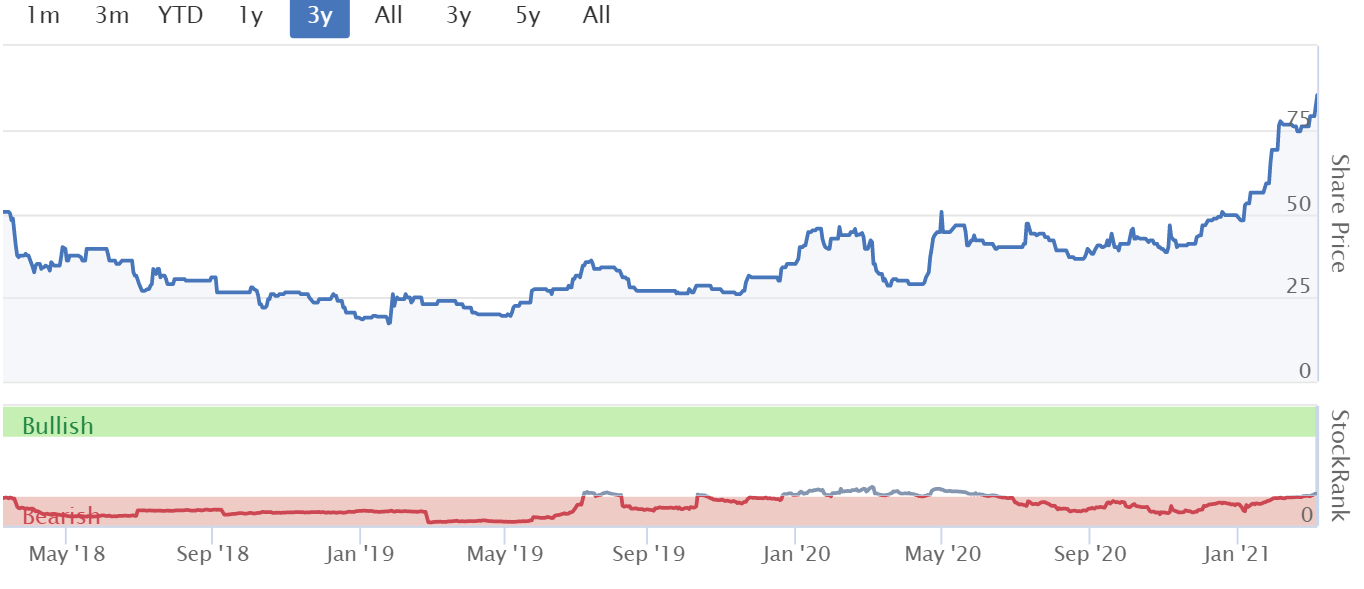
Note the consistently poor StockRank, a reminder that the Stockopedia computers do not like small, loss-making companies! It's a useful reminder that we have to be very careful with this type of share.
.
.
Disclaimer
This is not financial advice. Our content is intended to be used and must be used for information and education purposes only. Please read our disclaimer and terms and conditions to understand our obligations.

148 comments
Revolution Bars (LON:RBG)
https://www.walesonline.co.uk/...
"The owners of one of Swansea's best-known bars want to add a coffee shop, bakery and exhibition space to the venue - a move which chimes with plans for the area.
The Wind Street watering hole known to many as Revolution, and more recently Liberate, could also host independent food vendors, a florists or barber shop, and a pizza oven. The idea is to make it a day-time as well as a night-time venue - something Swansea Council wants more widely for the city's party street. The proposals would require a reconfigured interior, and the venue would still retain its bar function.
Revolution Bars Group has applied to the council to make the changes, but is of the view that formal planning permission would not be required given the venue's current uses.
A planning statement in support of the application said the proposals would create a better-balanced daytime and evening offering."
There is an error in the CT bit about Ireland. Prior to the change in 1980s to 12.5% there were two rates - 25% for most companies and 10% rate in the proportion of sales that were exported, so 100% of sales exported then 10% CT rate. There are practically no special or front loaded deductions so essentially you can see that the CT charge is 12,5% of the profit figure in the accounts. Personally prefer to see higher rate of CT for all companies with reduction in personal taxes which are much higher than UK.
High water benchmark just reached in the Bitcoin bull market? Primary Bid have just announced an Open Offer for Argo (LON:ARGO) at 200p/20% discount to today’s closing price. Time for me to sell everything and move on LOL.
Sorry fat thumb. Meant Argo Blockchain (LON:ARB) .
saw it too late. It closed at 6.15, they only gave us 15 minutes or so. Not a lot of time.
I nearly bought this morning around 250p! I thought I was better off holding crypto's directly as I do.
Think Bitcoin for good or bad will be around for a longtime yet like you bought £ARB bought after it’s first jump up when it pulled back late January sold all mine once the market price started to get over a £bn Sold Mode Global Holdings (LON:MODE) too will watch them both though as they will be interesting to early to tell if they will be new Baltimore tech and crash and burn time will tell
One commentator noted that George Obsborne lowered the headline rate of Corp Tax, but at the same time reduced the number of allowable offsets against profits, so that the tax take in the end was no less. Rishi has increased the tax rate, but allowed greater offsets against tax.
Its very hard to know what is more advantageous in terms of attracting investing companies etc. Arguably the better headline is reducing the rate
raising corporation tax always seems to be more palatable for the electorate, probably because 1) a significant minority have this notion that businesses are ‘greedy’ 2) many people don’t think it will affect them.
the problem is that corporations don’t pay tax. People pay tax - one way or another. Taxing a corporation means the cost still gets passed onto people through one or more of these channels;
- less people being employed
- pay freeze for existing employees
- prices going up, costing customers more
- letting profits and share price take the hit - affecting pension funds, retail investors etc
Hi Paul
Thanks for your thoughts on the budget.
I agree that raising Corp tax appears to be a mistake; it sends the wrong message to businesses that are already wondering whether to depart the UK due to Brexit.
A cut to 18% would have been a boost and made any business considering moving profit to another country reconsider.
But I don’t agree with you with regards rates on commercial premise.
I work for a property company, which is mainly residential but there are a few retail units. As I see it, rates are a payment to the local authority for the services used by the occupier. Why should the landlord pay these?
It’s the same as saying someone that rents out their flat or house should pay the council tax, but the tenant pays this, as they use the services.
Although rates and council tax are like an annual property tax, in that they are worked out on the value of the property, I think our system is much fairer than the way this works in many other countries.
I have several friends spread across the USA and Central America where there is an annual property tax. This is collected from the property owner.
My friend in New York State pays 2.37% pa property tax. So on a £600k property that would be about £14k pa. Others pay closer to 1%, but that’s still £6kpa on a £600k property.
After someone with a buy to let pays their mortgage and service charge, will it be worth continuing if they then have to pay £6-14kpa property tax?
The consequences of individuals selling their buy to let, which is most cases are destined to be their retirement income, could be a shortage of rental properties and increased rent, which could drive up wages and so on.
Freight rates - good to see this widespread problem being quantified. Cost is £6.5k per container, previously £1.9k), 100 containers per month, that’s £460k additional cost per month, or £5.5m per annum - that’s a huge problem, so I wonder if we’ll start to see a spate of profit warnings from other companies in any sector that imports a lot of product from the Far East? It’s looking that way.
Yes, most definitely... the impact has been barely considered IMO...
My import business has paid up to US$14,000 for a 40ft container from China to UK for Ocean Freight only, where the goods were needed and the client was willing to pay. Other import costs for delivery to warehouse will be between US$750~2000 depending how far the location is from the port, but excluding duties, etc.
We were paying US$1,600 for every container that we imported in September and the market was stable for the 1st 9 months of last year. This problem started in October and has only been growing in size.
Delays on arrival in UK ports are well documented and the associated costs of demurrage for goods staying on quay unable to be moved only add to the problem.
We are finally starting to see some signs of rates reducing with China main port rates now at circa US$6,000~7,500 but even so, no swift return to the sub US$2,000 levels are forecast any time soon, if at all...
If you are importing iPhones, all this will have little impact on your business. For our raw material business working on single digit gross margins and relatively low value per container, the problem is very significant.
Yesterday the Covid and vaccine figures were excellent.
22,213,112 first doses – a rise of 416,834 on the previous day. Deaths below 100....a low in nearly 6 months. Just 82. Zero in Scotland.
My wife (aged 50) is getting her first jab this Thursday. They now book second jabs at the same time. All 40 plus will be next in line and perhaps will start to be called by the middle of April. I estimate 33 million jabs by then. With apologies to the areas (and members) who are still well behind the rest of the UK. Plus friends in Europe of course.
We might well find this leads to a fall in markets. All those companies that have done well in the pandemic (food delivery, gambling, tech etc) may struggle to justify ratings and those due to open up seem to me to be on high ratings in anticipation. A regular columnist in the Sunday press yesterday said they were looking to sell shares as inflation and thus interest rates threaten to rise. Could that be the next "shock" to derail markets in time?
I find it so difficult to find real value at the moment but then I guess we have been spoiled over the last year with companies priced at multi year lows. Anyone else find it much easier to sell rather than find much to buy?
@barnetpeter Me too. Just a few weeks ago I was happily watching my portfolio ticking up nicely every day and thinking "This can't last". And then the bond markets ensured it didn't. I've now sold half of my holdings and as you say looking more likely to sell than buy this week.
Hi Paul,
Regarding Shoe Zone - "Dividends - we’re told not to expect anything until 2025 at the earliest! How can they forecast that, but not give us any guidance on earnings? Seems contradictory to me, as the two are obviously linked."
As the dividend announcement refers to c £22 million in obligations, clearly company wants to prioritise and tackle this first. And with 10 p ps dividend in normal times (translate to £5 million), it will take 4 years to clear these hoping the business resumes to normality. Suspect thats how they may arrived at 2025.
For those looking to attend Mello Monday tonight there is a special offer at the moment for annual pass buyers ...
£15 off #MELLOMonday annual passes. Includes all MelloMonday events through to October 2021 & the back catalogue of recordings from September 2020. Various discounts to partner organisations also available exclusively to pass holders. https://tickettailor.com/events/melloeventslimited/432933
I too think that the 23% Corporation tax is a bad move - it sends the wrong signal even if, as I hope, it's cancelled in due course. I also don't think there should be talk of pay rises for anyone until at least the Country is fully reopened. To get a pay rise the money needs first to be earned and UK PLC has not started to do that yet.
I am sorry to say you made a typo there. CT is going up to 25% not 23% so even worse! A 6% increase. I can't see it being reduced unless taxes are collected elsewhere (e.g. online deliveries) although I would have kept it unchanged myself.
Even at 25% I thought that UK Corporation tax is still one of the lowest in the G7?
It is as Rishi keeps telling us !
Interesting mid-day announcement relating to Zotefoams (LON:ZTF) .
So, who the heck are Sekisui ?
Sekisui Alveo develops, manufactures, and distributes high-quality polyolefin foams. (According to their website).
That's a bit odd, given that description could easily be applied to Zotefoams too.
I wasn't previously aware of this shareholding and hadn't read anything about any strategic partners.
It looks like Sekisui bought this shareholding in 2009, so I wonder what this all about - does anyone know?
Zotefoams (LON:ZTF) will be presenting their results via Investor Meet Company on the 23rd , so could be an opportunity to find out more then.
So the secondary placing in Zotefoams (LON:ZTF) shares was completed at a price of 350p / share!
Gutted that I had my phone on divert all day ;-(
I agree that Stamp Duty should be abolished, or at least abolished in certain circumstances.
Currently it can act as a restriction on labour market mobility for people who have experience in a specialist sector and the nearest alternative employer is 50 or more miles away.
In my case, I was quite keen to move jobs 5 years ago, however the nearest alternative employer that would pay enough to get out of bed for was about a 90 minute commute away. The right thing to do for my health and for the environment would be to move house, however Stamp Duty stops that.
I wasn't prepared to spend 3 hours per day commuting, so stayed in a job I was tired of until quitting to live off investments.
The tax system should make it easy for people to move close to their place of work & discourage excessive polluting commuting. So they should cut or eliminate stamp duty and stick the taxes on petrol & diesel instead.
Whilst we are on the subject of taxation, I believe the VAT rate on home insulation is 5%, the same as on gas & electric. The right thing to do is to cut VAT on insulation to zero and at least make up the revenue with taxes on gas & electric.
I tend to agree, I think stamp duty is a great tax, in that it's hard to avoid and easy to collect, however, the problem is that when it was introduced the bands meant that you'd only pay the higher amount on Mansions. Now in the south east, many normal houses fall into these high rates. It's at a point where people avoid moving, and instead extend. Or in your case, don't move jobs. Not good for the economy. I wonder if a flat 1% wouldn't be better, it would collect a bit of money from every transaction, but it wouldn't deter people from moving, so people would move more, and we might find that it collects as much or more tax per year.
This is all just a symptom of the government needing money and imposing a tax which people accept because they think they'll never have to pay it, until they find the step change in property prices means that they do, and this suffocates moving, and job mobility etc
I do agree that a meaningful annual property/wealth tax would be an improvement. Quite highly tiered (like stamp duty), index linked, and difficult to evade . It would produce a much steadier revenue stream than SDLT which is so sensitive to the housing market sales cycle and would enhance housing market efficiency by encouraging old biddies living in £1m mansions to downsize sooner rather than later. Not to mention the dampening of house price inflation as people begin to appreciate the costs of upscaling. Might also help bridge the north-south divide. Offer some form of time-limited deferral option for said old biddies. (And I wonder how many old biddies to forgot to notify their local ratings office after they've had extensions built, especially under permitted development rights.)
There's also the fact that 'house price dinner party bulls'/ chattering classes conveniently disregard the fact that realistically one should be paying perhaps 1-2% pa just to maintain one's asset, once it's no longer a premium new-build, albeit in lumpy not regular outgo.
Trouble is, UK gov't always feels it's easier to tax money when it moves (cf CGT, IT, IHT) than when it sits still.
"New FD - is called Terry Boot, who replaces Peter Foot. Possibly there might be subliminal bias in the recruitment process at Shoezone" ....
I don't know if it is a prerequisite but it would appear that if you want to become the First Minister of Scotland then you need to be named after a fish.... Alex Salmond, Nicola Sturgeon.
If we think QE is the magic money tree it sends a signal to other parties that there are no present consequences for shaking it, and that erodes the political ground for prudence, matching revenues to expenditure etc. Its the biggest can going to kick down the road going in political terms.
At the moment it is being used as a sticking plaster for lost income and structural issues such as unemployment, businesses destroyed etc by way of the Furlough, business loans/grants etc during lockdown. Can you imagine if some party thought this is a brilliant way to fund Public Sector pay awards, or the benefit system. It could be a giant Argentinian/Venezuelan style incentive to further political gerrymandering for election purposes.
At the moment the BOE has to be convinced of the Govt case for going along with it, but that is only because it is independent.
I don’t pretend to understand all the ins and outs of QE and I welcome being corrected. But here’s my take on the budget fwiw, which I think is a bit different to what’s been said already.
Does the debt matter? It seems to me that it does. There’s a chunk of it that we owe to other people (I.e. not to the BoE). There’s interest to pay on that. When interest rates increase (I think it is when rather than if as it seems highly unlikely they can stay this low in the longer term) our interest payments on that part of the debt will go up. The budget speech suggested a1% rise would increase debt interest payments by £25bn. Is that including or excluding the chunk that goes to the BoE? I’m not clear on that. But even if you take it that 50% of it is going to the BoE, that leaves £12.5bn extra that’s got to be paid to others. Doesn’t sound like much? Well, it’s about 10-15% of the education budget I think. So, there’s a danger here that the magic money tree is going to need to be tapped for money to service debt interest to others and not just the ‘funny money’ bit that goes round inside the state. If that interest we owe others starts to run out of control we’re in trouble, not quite as fast as you can say Robert Mugabe, but in trouble nevertheless. (It can only be covered by printing the lolly for a while before the lolly loses its value).
I’m not comfortable that Stamp Duty on house/land transactions raises a paltry amount of revenue. It’s something like £12bn. So, again, something like 10-15% of the education budget. So, not all that insignificant.
The corporation tax issue is hard to decide in my view. If the idea was that lowering it to 19% would increase investment in the UK, has it actually done that? I read somewhere no. But perhaps it was just not low enough or was overshadowed by Brexit. But as I understand it the higher rates will not apply to very low profits anyway. The figure given was that 70% of companies are excluded from the increase by that and there is a taper for those that do have higher profits. A large number of the shares discussed here wouldn’t be caught. The higher rates may never get implemented anyway. I think it may be more for the sake of keeping the markets confident that we will be able to pay our way in the future helping to keep those pesky interest rates low.
I think what Paul and others are suggesting is that we should have borrowed as much as we could on as long a term as possible. Increasing interest rates would not affect this. Last year Austria borrowed over 100 years at 2% and it went so well they did another 100 year issue at 0.6%. Inflation will erode any money owed. We took many years to repay the WWII debt but that was good with the value of War Loan reducing to around £15 per £100 at one stage.
With regard to 70% of companies being excluded from the 25% rate with profits of less than £50,000, the vast percentage are not proper companies as far as I am concerned. A huge number are dormant and many of the rest are one man businesses that probably shouldn't be limited companies in the first place (e.g. subcontractors who were required by agencies to operate through companies) and consequently a much larger percentage of trading companies will be caught.
Hello lutzlutz,
“ With regard to 70% of companies being excluded from the 25% rate with profits of less than £50,000, the vast percentage are not proper companies as far as I am concerned”
Steady on! You’re talking about some of Paul’s favourites! BOTB, HEAD, SAGA, RBG, DISH, BKS, FCN, IGP, VLX, VTU, JOUL and so on.
“ I think what Paul and others are suggesting is that we should have borrowed as much as we could on as long a term as possible.”
Have we not done this? What’s the evidence that we could have got better terms than we have considering that government bonds are sold by auction? But I thought Paul and others were mainly singing the praises of QE/printing money rather than borrowing it from others by issuing bonds. I’ve just had another look through what Paul’s said in his report and I don’t see a comment about raising more debt by issuance of ultra long dated government bonds. Perhaps I’ve missed it in a comment elsewhere.
Are you not confusing £50,000 with £50,000,000?
Not sure what you are saying Herbie if related to my comment. I was referring to GrahamF's comment that 70% of companies are excluded from the 25% rate. The 19% rate only applies to companies with profits below £50.000. That 70% of companies have profits below this is a meaningless percentage. I know individuals with 20 companies and only one of them actually trading.
I was replying to GrahamF and the companies he listed, nothing to do with your comment really. If you check those companies profits, many are well into the millions.
Doh! Oops!
Most of those are proper companies even if making temporary losses. Not sure about DISH!
Does the debt matter?
Your point that we still have to pay interest on the debt is valid. That is a consideration, but the key points are:
- Most of the debt is owed to ourselves. It is either owned by the BOE or by pension funds etc.
- The part not owed to ourselves is about 30% of the total.
- If interest rates go up 1%, we do not have to pay 1% more. For the vast majority, we still pay the same amount that was set when the bond was issued.
- We will have to pay more interest if and when the debt is rolled over at a higher rate, but for the UK that's a long way off. The average maturity of our debt is about 15 years, which is about twice the average for developed nations.
- If interest rates have gone up when we roll over the debt, then that means that either real growth and/or inflation have gone up in the intervening (average of 15) years.
- If inflation has gone up by x%, then the principal that we have to re-finance has decreased in real terms by an additional x% compounded over the years. We have to pay interest on a lower real debt.
- If real growth has gone up by y%, then the real economy has gone up by an additional y% compounded over the years. We have a bigger economy to service debt from.
So while the point you make is true, it is not the issue that you portrayed.
Call me an old cynic but I suspect QE is susceptible to the law of unintended consequences and sooner or later they will become obvious, and not in a good way.
Budget thoughts. Fine on a narrow financial basis and in the short term but it left very few clues on some serious underlying issues on Public services and their financing. I would have liked some clues on how issues like Social Care for the Elderly, additional Health Care costs, High Street regeneration etc etc might be financed. These do not seem to me to be issues which can be financed by the Magic Money Tree which simply builds up the risk of inflation and the potential need to control that. The only clue I got on those issues was that house prices are sacrosanct for this Government but I do worry that constant inflation in that commodity really is continually possible.
The CEO of Revolution Bars (LON:RBG) has been on the airwaves, and has clearly decided to front a PR campaign for his brand. Surprised to hear he was on an LBC phone in as a commentator of some kind post budget, but missed his contribution.
Paul, re: QE - I mentioned this exact same point to family yesterday. QE shouldn't require a substantial increase in taxes. I wonder if the chancellor is raising taxes as an excuse. The public believe it is likely necessary to pay for the debt. I guess from the gov perspective, why not raise some extra dosh for the public purse to spend later down the line (or ahead of the next election!).
QE could get inflated away over the coming decades as a loaf of kingsmill goes from £1 to £3, and a 3 bed semi in south London goes from £500k to £1.5m. In the long term, the vast QE/borrowings of 2020/21 could be a mere blip.
Education, innovation and growth are far more important factors to raise the wealth and living standards for all.
Would a reduction in stamp duty really make house moving more common?
Personally I am sceptical. Of course an initial surge, that's what we have seen.
Buying houses would be cheap, but selling houses would not be so. On a London property of even £500k, the associated selling costs may be over £10k.
The recent cut has seen an increase in moves as people now could afford more, but that has sent prices up by a bigger amount than the price saved.
At some point you will reach a stalemate where people want to move, but asking prices of the properties are too high for the average buyer to afford on the mortgage and the seller cannot cut the price because either they need it to move somewhere else, or it is going to go below what they paid and they will owe the bank money.
Tell me that isn't happening in lots of the new build blocks built around 2016 and later. I'm seeing that all the time in London. A large block I have saved on Rightmove has zero full-price resales (only shared ownership) in the 5 years since it was built despite dozens of listings. Even at a 10% loss on new-build price nobody is biting, because the initial price was heavily inflated with help-to-buy which isn't now available to buyers of these properties.
Enough time passes, and enough price rises of different types of property and the same mexican stand-off might happen, right? Then that's back to square one.... people complaining the market is stagnant and could be unlocked if only there was a prop....
Most people agree that in the UK what we have isn't working, particularly for the younger generations. I seem to be in a minority that the cure for it involves less props rather than more.
I had thought that the impression was that corporation tax wouldn’t actually be raised —that in time for the next general election the conservative govt would back-track on the planned rise as a sweetener to persuade people to vote for them. That is what the press were reporting on the day of the budget.
Here are my SCVR heat maps for today (prices as at ~10:25am).
Small Caps with RNS news today ("N!!" in bottom row of the heatmap tile means report / update today):
Big movers today in the SCVR world (moving more than a 20d EMA of the ATR against either yesterdays close, or today's open):
Warm regards, stay safe, and best of luck!
greensiax
PS: See my main heat map thread for more (non-SCVR specific) heat maps, and keys to the heat maps contents
Hi Paul/Everyone
I only have time to scan through your post and the comments below so apologies if this has been answered....
If there is no debt, why even increase Corporate Tax in a few years?
Thanks
A
they won't, or at the worst, it will be watered down.
Yes, I'm aware they might not increase corporation tax (as per my comment)
Let me ask in another way. If debt isn't a problem, why not just make corporation tax zero?
"why not just make corporation tax zero?"
It's the same as asking why not make any tax zero? There are 3 basic reasons, taxes can be used to:
- reduce inflation by taking money out of circulation
- disincentivise bad things e.g. use of carbon
- redistribute, or reduce inequality
Taxes aren't needed to allow spending, but they may be needed to allow spending in a non-inflationary way. We only have so many real resoucres to share around.
The key problem with Sunak's corporation tax measure is that it sends the wrong signals to corporations and entrepreneurs about their long term plans, while doing almost nothing to fight any theoretical inflation in the future. If there is any argument for it it would be that it promotes equality, but I doubt that's what Sunak was thinking of when he introduced it.
p.s. An MMT theorist would say that taxes perform a funtion of giving value to the currency. If you have to pay taxes in £, then £ has value, but to me this is a minor point.
"Taxes aren't needed to allow spending, but they may be needed to allow spending in a non-inflationary way. We only have so many real resoucres to share around."
I found this a particularly interesting comment, thank you
So governments can, if they choose, keep printing money, and they don't need to do anything with taxes in order to pay that money back.
But if inflation slows/increases too much, then taxes can be increased/decreased...but we don't know if we're there yet.
And if it looks like we can keep printing money without doing anything drastic to our tax rates (which is what everyone here seems to be saying), then we can literally start writing blank cheques for any social good we can think of, whether that be investments in public libraries, community centres, public sports facilities, etc...
I like to stay out of economics and politicals here, so I will stop there. I still can't quite get my head around how QE will have no consequences (nor how the US,EU and UK can do it, but South Korea and Taiwan don't need to without gaining some sort of advantage) but I'll save that for smarter people than I.
Thanks for taking the time to reply.
A
I should just add that while what I described is true (generally higher taxes would reduce inflation) it doesn't describe how the UK govt would actually react to inflation. In the UK, we draw a slightly imaginary distinction between fiscal and monetary policy, and make different people responsible for different parts. The result of this is that higher inflation would be addressed by tighter monetary policy rather than any change in taxes.
But we could use taxes and fiscal policy instead of monetary policy and arguably this would be a much better policy regime (avoiding low or negative interest rates that inflate assets and reward the wealthy, for example, and instead having a low or negative basic tax rate).
Paul, I agree with a lot of what you say about the budget. It's a shame that Rishi Sunak doesn't. He is as ignorant as the press that you rightly criticise. It's clear that many politicians genuinely believe in all the housewifey stuff about balancing the budget, George Osborne being a prime example. Sunak must be the same, I find it impossible to explain his decisions (e.g. on corporation tax) unless that's true. It's well past time that we should recognise that we control our own currency, so our constraint is inflation, not balancing the budget. We're not on the gold standard anymore.
My other major criticism of the budget is the same that I have made of every UK budget for years. Ever since the Thatcher years we have become reliant on propping up the housing market. This creates massive distortions. This budget perpetuated the problem by incentivising 95% mortgages. Pushing up the value of housing and then taxing transactions is just a bad idea all round. This is not an anti Tory rant btw, Labour are no better.
Tax and spending should really be about economic growth, incentives and social benefits, not about balancing the budget and repaying the debt. If we reached an understanding of that we might start incentivising the right things.
No government in the western world is going to take away the stilts under the housing market. It's an entire generation's pension pot, and if they don't spend it then their kids will be distraught at prospect of not cashing in - see the gnashing of teeth around prospect of homeowners paying for own social care. (Is a home a store of wealth? Hell no, not unless Timmy and Olivia are selling it for £££ once you die). In short, it would be electoral and economic suicide, particularly if they trap young people in 95% mortgages who end up staring down the barrel of negative equity.
One upside would be the impact of inflation on the mortgages, provided they negotiated a fixed-rate mortgage. Which no-one will have.
Seems the British are obsessed with house prices, other countries have less ownership and more rental properties, such as Germany. Why tie so much money up in housing?
I think that we came pretty high up the table for home ownership in years gone by but are much lower now than before. (The possible reasons have been talked about in the past so no point in repeating them here). Germany is low but is somewhat atypical for the rest of Europe.
https://www.statista.com/statistics/246355/home-ownership-rate-in-europe/
Why is the obsession so bad? Just because we don't do things like Germany does not mean its bad.
I don't see the benefit of having high house prices, young people being saddled with debt and if interest rates rise having problems paying the mortgage. Only benefit is if you sell and then rent or move to a cheaper property. The amount of money I spent in interest, when I was young could have been much better spent, IME.
There is no benefit in having high house prices as opposed to cheaper house prices but although buying a house gave me some debt at the time it now gives me a rent free house that would otherwise cost me a couple of thousand a month. Much better to have spent money repaying the mortgage when I was young.
It’s bad for a host of reasons but fundamentally because it distorts the economy - massive resources due to rising house prices are diverted into a non- productive asset. High prices prevent people from moving - labour mobility is significantly undermined and people struggle to move to where the jobs are
The UK is unusual in the extent to which it props up the property market, which dates back to before the Thatcher years, although Thatcher then amplified it by steering the benefits from North Sea Oil, privatisations and sales of council houses into property rather than industrial investments. I agree that in the UK, the government of the day is likely to continue propping it up for the reasons you state (which cushions property shares), but that applies less to other countries.
Uls Technology (LON:ULS) will be a beneficiary of a stimulus for first time buyers. With a nice lump of cash and a new much vaunted CEO, the future looks bright.
Thanks Paul for the Budget write up and agree with most of what you say though I don’t think he should have extended furlough etc to September. I am 59 and will have received both doses by June 3rd (first does late next week). On that basis I can see no reason for not completely unlocking the economy by early June but what do I know?
On the tax side I would have:
On stamp duty I am ambivalent. Compared to my experience in France and Italy we have it pretty good. I just bought an apartment in Venice for €180,000 and the cost of purchase was just shy of €20,000!!
Regards
Michael
You are lucky, still waiting for mine and I'm over 60. Someone else I know is 62, different area, her first one is 23rd March. So not everyone over 60 will have had their 2 jabs by early June.
I agree furlough is going on too long. We are paying for failing business to survive longer, is that a good thing?
"We are paying for failing business to survive longer, is that a good thing? "
He knows that but is hoping that enough "new" jobs will be created as soon as businesses are allowed to open up again that it will mask the true level of current "unemployment".
The way I see it, furlough is effectively temporary unemployment benefit. If the scheme ends now, then the taxpayer would end up still having to pay unemployment, and housing benefits, yet with their employer having gone bust. Surely it's better to pay furlough fora little longer, which gives most employers a fighting chance of survival, and probably doesn't cost a lot more than having millions of unemployed on other benefits.
Yes but very expensive temporary unemployment and is it like zero interest rates just creating more zombie companies who really should be surviving?
If you shut the economy down as it was in 2020 then it was necessary but even with we are still experiencing the worst (-10% GDP) performance of any G20 country, so one has to question whether it is the right economic policy.
I do think the budget could have been a lot more dynamic.
Regards
Michael.
If you shut the economy down as it was in 2020 then it was necessary but even with we are still experiencing the worst (-10% GDP) performance of any G20 country, so one has to question whether it is the right economic policy.
No we're not. Not that we're great, but the GDP stats lie.
You need to adjust for the fact that the UK measures GDP differently from other G20 countries. The UK tries to measure the actual output of non-economic areas such as the output of government services. Other countries don't.
To give a specific example, most countries measure the output of schools by making it equal to teachers' salaries. Obviously during the pandemic everyone has carried on paying teachers so in that case the GDP output of schools hasn't changed.
This is clearly wrong. Teachers have continued getting paid but kids aren't getting taught. In any real world view GDP output of schools has clearly gone down.
The UK tries to measure actual school output by looking at things like grades, number of pupils being taught, etc. Under these measures GDP output has fallen. Although this won't be accurate it is more accurate than the other method. Similar calculations occur in other state sectors such as healthcare.
The UK isn't alone in the G20 in measuring GDP in this way but we're probably the most accurate. If you adjust back for this we're stil one of the worst but we're not clearly the worst, just one of a very average bunch.
So - there you have it. You can't even trust GDP. But the good news is that GDP will start to recover sharply as schools reopen.
timarr
Should we also be deducting the amount of QE from GDP, Timarr?
Should we also be deducting the amount of QE from GDP, Timarr?
Remembering that GDP is supposed to measure the real economy the BoE estimates that the impact of QE is small. Specifically it took £375 billion of QE to drive a £25 billion uplift in the actual economy.
QE would be a really stupid way of boosting GDP because its direct impact is to boost the value of financial assets - which are overwhelmingly held by people who are already rich. They then need to sell those assets and buy themselves a new super yacht, or Debenhams, or something, for it to have an impact on the real economy.
If that was the intention then it's a facet of trickle-down economics which, as every economist knows, doesn't work. If you want to boost the real economy then, err, spend it on the real economy where it will benefit everyone, not just people who are already rich.
timarr
Thanks Tim I did not realise.
Thanks Tim I did not realise.
Hardly your fault - nobody does. I only found out by accident and I check everything. Everyone quotes GDP figures as standard, why would we think differently?
The UK isn't doing great, but we're no worse than the worst European economies and given where we are I reckon we'll recover faster.
timarr
"This is clearly wrong. Teachers have continued getting paid but kids aren't getting taught". I have put more hours in to teaching this year than any other, including catching covid. I even taught online live lessons isolated at home whilst ill with covid. The lesson I have learnt is how little society values teachers and after 10 years in it, I'm now looking to head back out of it into the industry I came from. A sad state of affairs since I'm in a shortage subject.
I don’t want to speak for him but I don’t think Timarr was criticizing teachers, only pointing out that although teachers are still being paid kids are learning a lot less from home schooling than they would in a school environment. As a father of 3, this is self evident to me and actually is proof of the amazing job my kids teachers do when they are allowed to. Any parent who doesn’t value the job teachers do after having been forced to try and do themselves and seen how damn difficult it is to do well is a fool...
Thanks for your reply, I agree.....just a long day yesterday . Your kind comments are appreciated too.
Hi Phil Mc
The lesson I have learnt is how little society values teachers and after 10 years in it, I'm now looking to head back out of it into the industry I came from. A sad state of affairs since I'm in a shortage subject.
My "This is clearly wrong. Teachers have continued getting paid but kids aren't getting taught" comment wasn't a value judgement about the worth of teachers but was a technical point about the way the teaching component of GDP output is calculated by the UK.
I hear almost daily reports about what's happening in schools. Between the government U-turning on advice on a daily basis, acting as the auxillary wing of social care, dealing with aggressive and non-compliant parents and having to find ways of teaching remotely it's wonder there's anyone left that wants to carry on.
It's a terrible shame that you and many people will leave the profession, but not all of society is blind to the sacrifices made.
timarr
Sorry , I think it was probably unwise of me to reply yesterday and pick up the wrong end of the stick. It was my first physical day back in the classroom so my head was probably not with it by the time I came to read scvr later on. Thanks for your comments by the way , I really appreciate it.
Hi Phil Mc
Sorry , I think it was probably unwise of me to reply yesterday and pick up the wrong end of the stick.
Not at all, I can only try and imagine how stressful your job must be right now. You and your colleagues have done a remarkable job under incredibly difficult circumstances.
timarr@herbie. You don't have to wait to be invited. As you qualify you can just book direct on the NHS website. That will book you in at one of the mass vaccination centres. That's how I got my first jab last week though I did have to drive from Wokingham to Basingstoke for it.
The local GP run centres seem to be operating their own booking systems.
Yes but I will have to drive many miles, when there is one within walking distance from my house. Even then it seems it's 2-3 weeks wait. Most people in this area have waited and then got it locally.
A couple of hours drive and then a couple of hours back for something that can save your life seems like a pretty good deal to me.
But it maybe quicker to wait for my local one.
herbie47 - as you qualify it might be worth logging onto that NHS site and going through at least part of the process. It could well be that one of the sites you get offered is the one that is close to you (assuming that you didn't mean that was your GP surgery).
If not then you don't have to complete the process, log off and wait to hear from your GP.
Yes I have been logging on to see what is available. But from older people in my location, they have had the letter but all waited a few days and then got the call to visit our one. I think there was a delay as they ran out of stock 1 week ago but they were doing them last week. Not sure if it's a GP one or not as it covers a wider area than just the GP area.
herbie47, I am not sure but the national web site may be run by Serco or a third party provider. However, in that .gov web site is a list of all available vaccination centres that you do have an option of downloading. This is an excel spreadsheet, which can easily be sorted by postcode. I did this to find a local medical centre on the list, and phoned them. It did take half an hour to get through, but they offered me a place in the surgery for vaccinations, and I got the appointment three days later. I’m 63 so am at the right time for the slots, so don’t feel I’ve nicked the vaccine from someone else. But definitely saved an hour and a half journey each way. Just a suggestion for you.
Just had an update on my local vaccination centre, they have had problems with supplies, only open 2 days a week 2 weeks ago, only open 1.5 days this week but should have enough vaccines next week for 4 days. I will see what happens next week. Hopefully I will get the call. Seems daft having a centre with lots of staff and volunteers but no vaccines.
Exactly - no one needs to wait to be asked just book and go !
Nope still not able to book. It depends where you are in the country maybe as friends younger than I were able to book into my local centre from 55 miles away in another county....
of course third world countries such as South Africa where I am living ,will be waiting till at least the end of the year before even people in my age group (over 70) will be vaccinated. All this talk about the rich ensuring the poor get their vaccines at the same time as the rich,is as usual a load of old codswallop. I’m all right Jack is fit and well .
"We are paying for failing business to survive longer, is that a good thing?"
I don't agree that this is true (in most cases at least).
Companies with staff on furlough still have staff costs (NI + Pension and from July 10% of wages, 20% from August), so if they know their business will fail or know that they won't need all of their staff in the future, will just let them go.
On the other hand businesses that have productive (profitable) work for their staff to do will pay them to do it once it is possible rather than keep them on furlough.
It is conceivable though that some businesses will still be running on limited capacity into September even if the unlock goes to plan (and remember that all of the dates are no earlier than).
Of course it is likely, that some businesses will fold or some staff be released at the end of furlough so arguably those furlough payments will have been "wasted" but unless there are lot of stupidly over optimistic business owners then that should be quite limited. The cost of furlough vs benefits & admin costs of benefits for this group will in my view be pretty small compared against the gains from job retention.
herbie47 Sorry for extrapolating on an n of 1 but still think that furlough is being extended too far in to the future?
Here in South Africa stamp duty is 9% !! And Estate agents fees average 5%. No wonder buying a home is mainly for the rich and transactions are low.
"Deidre Brogues, she’ll be a shoo-in!" Love it! As ever the life and "sole" of the party Paul. (Sorry Roger Baron couldn't help myself).
Re Shoe Zone... Nominative determinism is the hypothesis that people tend to gravitate towards areas of work that fit their names. [source: Wikipedia]
Paul, something that has been bothering me is the unfair positioning of those pub companies such as £RGB against the individual tenants. Corporate entities are able to shrug off leases or use their multi-outlet muscle to renegotiate leases to reduce costs. The individual tenant who signed the lease as an individual with personal responsibility, has no power to renegotiate. The pub owners are putting a publically caring face on helping their tenantry, while demanding the back rent from a year of, effectively, zero trade. During this time two stock inventories have had to be destroyed and a third has to be bought with no guarantee that customers will be allowed to mingle in the pubs or indeed return.
Typically, the deal offered is dependent on an extension of the lease with the rent repaid over the extended time, in many cases well beyond the planned retirement age of the tenant. Disposal will be problematic as, who in their right mind, is going to want to take on a leased pub owned by an uncaring landlord? Permanent pub closures are on the increase again at a rate of 2000 per year as individual tenants become bankrupt. This trend will acccelerate when the ability to harry tenants returns. It surprises me that the owners are prepared to destroy the capital value of their estates for the short term recovery of rent from what will clearly be an over-rented portfolio. I can only assume that their thinking is that the redundant pubs will sell for redevelopment at a good price.
It will be a depressing picture that emerges right accross the retail landscape as the above applies equally to the small independent and quirky shop tenants that make the High Street an interesting place.
Re "Financial journalists just don’t understand QE at all, do they? I’ve read so many articles bemoaning the dangerous level of Govt debt, at c. £2,200bn. This apparently will be a burden for generations to come."
I suspect that to an extent journo's don't understand, and can't be bothered to put in the time to try to understand it. When it is easier to write in the way they understand. But also presenting it that way allows them to portray it as a sensational, alarming story, and they think only doom and gloom stories sell nowadays.
Thanks for your thoughts on the Budget Paul,
I wonder if the Corporation Tax will in fact be implemented, or will it be a 'tax reduction' buy the Chancellor due to 'the success of his policies'?
The ironic thing about suggesting a green tax on delivery vans is that these days they are so efficient (ie doing so many deliveries within a small area) that they must be far far more environmentally friendly than us all jumping into our cars and heading off to the shopping centre!
Hi Paul, Quick correction even though the argument remains the same. Irish Corp Tax is 12.5%
Hi Efecx1892,
Hi Paul, Quick correction even though the argument remains the same. Irish Corp Tax is 12.5%
Quite right, my apologies. Thanks for pointing out my error, I've corrected it now.
Best wishes, Paul.
Hey Paul, Thanks for your thoughts on the budget - they are very much in line with my own. Good to hear you are rethinking on reform of online tax too - it's not pleasant or good for share prices, it's just the only option that is open here if you want to raise revenue and keep the playing field somewhat level for physical retailers.
On corporation tax, I think it is a very negative move but I find the way Rishi has tackled it to be very interesting:
1) Although the UK had one of lowest rates of corporation tax (only beaten by Switzerland on 18% and Singapore on 17%), they allowed far less deductions compared to rest of G20 nations meaning the effective rate was much higher (probably at best midtable). Worse, that model (low rate, low deductions) means companies may be incentivized to take profit here but they aren't incentivized to invest here meaning the UK often lagged on inward investment. This may be the main reason the UK has continually lagged behind in manufacturing compared to other G20 nations.
2) The "superdeduction" really is a game changer in this regard and shows that the UK is serious about generating growth. By time limiting it, he forces companies to bring forward plans for spending and really does have a chance to kickstart the economy.
3) He hasn't actually raised taxes, he has only said he is going to in 2023. In effect, with the superdeduction he has actually lowered taxes for the next two years. My guess is that he won't go back on it as companies will position themselves accordingly but he still has that option. Right now, the world and the economy are at a pretty crucial inflexion point and no-one has a clue how this is going to play out. He has given himself and UK options moving forward.
' the UK had one of lowest rates of corporation tax (only beaten by Switzerland on 18% and Singapore on 17%)'
and Ireland at 12.5%.
Sorry, wasn't clear - "lowest in G20"
Sorry, you're not doing very well.
The G20 comprises 19 countries and the European Union. The 19 countries are Argentina, Australia, Brazil, Canada, China, Germany, France, India, Indonesia, Italy, Japan, Mexico, Russia, Saudi Arabia, South Africa, South Korea, Turkey, the United Kingdom and the United States.
Don't know what to tell you - got the stats from the trading economics page -
https://tradingeconomics.com/c...
Quick count of their table equals 23 names not including the EU but including Switzerland, Singapore, Spain and Netherlands.
Bit weird - I'll look into it a bit more this evening...
Hmm. That's a list of 23 countries. Here's what Wikipedia says - G20 - Wikipedia
In my opinion, the "super-deduction" is more about trying to persuade companies not to defer capital expenditure until the 25% CT rate arrives. After all, if you were going to spend 100K in 2022 and save 19K in tax, or 100K in 2023 and save 25K in tax, which would you do? All the "super-deduction" does is make the tax saving approximately the same before April 2023 as it would be afterwards. It's very clever PR though.
Thanks Paul, I truly value your insights. I have moaned about our massive debt not being a debt due to QE for months to friends and family and they just think I'm talking bs. I saw a while back Rishi had raised £380Bn to pay for all Covid measure so we are in no more debt than before (but perhaps with an increased risk of inflation and a slower medium term economy due to job losses / changes etc )so I am sharing your quotes with all those who wouldn't listen!! Cheers
Thanks Mark!
That reminds me of an interesting anecdote in The Deficit Myth by Stephanie Kelton, where she explained QE to an American politician. He flatly refused to believe it, so she pressed the point. Eventually the lightbulb came on, and this politician said that he now understood how QE works. Excitedly, Kelton expected him to press for policy changes to reflect reality, but he replied that was impossible, because the electorate just wouldn't buy it!
Rishi Sunak is talking all the conventional stuff about being prudent, urgent need to control borrowing, etc, it's total nonsense! Debt hasn't actually gone up at all, once you net off the gilts owned by the Bank of England. The situation in Japan is even more extreme, where the central bank not only owns about half the national debt, but it's even buying up shares to prop up the stock market, with freshly printed money.
I've no idea where this all ends, nobody does, but history very clearly tells us that rampant inflation is the eventual outcome with money-printing. My feeling (and it's only a guess) is that QE does seem to have demonstrated that the economy has more capacity for stimulus than we previously thought. The problem is that, once inflation has returned, it might be very difficult to put back in the box. We'll see. I need to do some more reading on this fascinating topic!
Regards, Paul.
Admitting there is a magic money tree opens the floodgates to all kinds of demands for extra spending and could lead to a Zimbabwe-like situation. Also the pretence of intending to repay the debt (or reverse QE) is necessary to prevent a collapse in GBP.
Surely that’s only true if all other countries were not doing the same thing ?
Yes. it begs the question with QE and the magic money tree: where's the limit?
I think the limit to QE arrives when the foreign exchange markets decide that printing Sterling to buy other currencies must push down the relative value of Sterling.
MMT has been an interest to me for quite a while and I'm familiar with Kelton and Mosler ideas. Steve Keen has an interesting perspective, he's largely in agreement with the MMT crowd but his view is that it's private sector debt to GDP we should be more concerned about. Worth listening to his interviews / presentations.
So why do we pay any taxes at all Paul?
Hi Paul, have you ever looked at Tekcapital (LON:TEK) ? One of their portfolio companies, Belluscura (TEK capital holds a c17% stake), have received FDA approval for their portable oxygen concentrator after a long while and will be reviewing options for a float. The Times reports Belluscura is hoping to raise £10 -15 million from an IPO, valuing Belluscura at close to £50m, significantly higher than the last fundraise of £9m.
Interested in your thoughts if you have time. thxs
Paul, thank you for your thoughts on the Budget, that was more educational than bulk buying all the newspaper chip wrappers that Fleet St have sent out. I don’t know what I would do without you at times.
A general request for information from participants here, given that results will be coming up for a plethora of companies in the next month or so. In the past, I had a source of future announcements by company in the coming weeks, updated weekly and so giving useful, reminding information. I think that it covered several weeks forward, covering the whole UK market. It may have been iii before they messed around with their website totally a couple of years ago. You could then do your homework in advance and perhaps modify your investment programme in anticipation. Anyone know where this information continues to be available in such a highly usable form? Thanks in anticipation!
Financial Diary - calendar of economic and company events (lse.co.uk)
I think this may be what you are looking for.
Richard
Investegate.co.uk website has a 7 day and 1 month look forward for companies scheduled to report as well as their daily updates. It’s in the bottom right hand quadrant of their main screen. Not completely foolproof but pretty comprehensive.
Brilliant as always, perhaps you could have a go at everything else, punitive lockdowns and so on..
''It’s frightening that a humble shares blogger here has to explain the facts, which are being misreported everywhere else.''
OK so is Shoe Zone (LON:SHOE) having a laugh. Peter Foot is removed as CFO to be replaced by Terry Boot?!
Has anyone actually seen them? Maybe they are socks.
I have at last found out how to get a twenty bagger. I bought Shopify a few years ago and it became a thirty bagger but is now a twenty bagger and falling. Apologies to Richard Branson. I did sell two or three lots earlier and regretted it. Perhaps the best advice was given here a few days ago. This was sell some but leave enough to be pleased when the share goes north. I am sure I am not the only one who finds when to sell the most difficult decision.
There has been no reason to sell this great share previously and had you moved too quickly you would not have had a 20 bagger. After all it wasn't a 30 bagger for very long and you cannot expect to be able to time the very top. The recent fall is an inconsistency in the trend which may make me feel like selling some. Although that is due to the rotation out of high flying growth stocks into value stocks it may also be affected by Amazon having bought Selz with the intention of creating a site that sounds to me as if it will be a competitor to Shopify.
I try to top-slice slow, small amounts (and/or aim for a specific tranche to sell e.g. 15%) unless there is significant bad news or change of 'landscape' for the company where earnings could be impacted. Then you need to be bold. Best selling happens close to peaks while buying rewards the patient, once a price settles in a 'trough'. Rough advice.
Absolutely. Bad sales timing or hanging on too long (Fevertree Drinks (LON:FEVR)) has cost me far more money than picking a bad stock. And yet there seems to be very little on it (selling discipline). There is the Buffet, Terry Smith, David Gartner (Motley Fool) school of thought buy but never sell though even they do sell occasionally.
I am trying to work it out for myself but it is hard. An example is Sylvania Platinum (LON:SLP) which has done phenomenally for me up 125% and now my second largest holding over taking Boohoo (LON:BOO) because of relative performance. My own research etc is that it will go to 180p (broker target is 200p) and probably overshoot but of course nothing is certain. And then if I do top slice I have the additional problem of finding somewhere to put the proceeds though Anglo Asian Mining (LON:AAZ), Boohoo (LON:BOO), Tremor International (LON:TRMR) and Games Workshop (LON:GAW) are all 20% to 25% off their highs so deploying the funds would probably not be a problem and even makes the sale case stronger.
If anybody has any book suggestions on sell discipline that they have found helpful I would be interested to hear. Thanks.
Michael
HI Michael
I do not know of any books that are really good. I know @Michael Taylor references within his books from a Trading perspective, so when you buy you identify not only a good company, but like you talk about Sylvania Platinum (LON:SLP) what you are trying to achieve short and longer term.
So for Wynnstay (LON:WYN) I bought with a thought to a 10% CAGR as it has shown by starting to acquire bolt on companies in addition to organic growth (including ~3% dividend reinvested) it is now up >30% should I hold, double or sell I have no idea???
I am now trying to apply that a bit to my decision making this year so excellent for selling Novacyt Sa (LON:NCYT) ok I had watched it come down and go back up again and on the way down again I sold. It is starting to look a better sell for Dx (group) (LON:DX.) and I got it totally wrong with Solid State (LON:SOLI) so not a good record a couple of months in.
I have just sold out of Smithson Investment Trust (LON:SSON) today at -£7.60 after trading fees. Having watched it go up, doubling my stake, seeing it go up more and then come down from highs and I just feel that it is likely to go further. But then I also know in under a month I need to move funds from my Share account to my ISA so Smithson Investment Trust (LON:SSON) was always the planned sell, obviously no issue on CGT either way now.
Tommy
I would obviously add that Smithson Investment Trust (LON:SSON) is now going back up since I pressed the button this morning!
Hi Michael - Games Workshop (LON:GAW) selling on back of the Tech-OFF trade at the moment surely represents great opportunity -agree? GAW has out of sale stock, a new 'more efficient' factory about to open, and ongoing partnership with Marvel...I'm filling boots a bit as there's still 'life in this horse' yet? Plus many shops to re-open post COVID..
Yes , i never know when to sell - case in point was today when i noticed Kape Technologies (LON:KAPE) had gone up nearly a third when i sold much lower months ago , however was pleased to have kept a few as mentioned above !
Yes Kape Technologies (LON:KAPE) is a puzzle.
This is the second instantly highly accretive acquisition they have made recently.
Totally incredible!
Morning all,
Game changing acquisition by £kape this morning...
Regards.
Eqi (formerly Selftrade/Squaregain/comdirect) has sold some of its broker accounts to interactive investor.
https://www.investegate.co.uk/...
Their website says some accounts will move and some won't which is a bit odd IMO.
"As an EQi customer you will receive an email from us explaining what the transfer of part of EQi’s business to interactive investor means for you.
Some accounts will not be transferred and will remain with EQi.
Other accounts will be moved to the interactive investor platform in the summer. If your account is moving we will write to you in the coming weeks with more details on dates and what this means for you".
https://eqi.co.uk/info/interac...
I did some contract work for Equiniti (EQN) a few years back and found them incredibly disorganised with a lot of large legacy issues needing attention. I noticed they now have a new CEO so perhaps he will have more luck!
Their email this morning says "Customer accounts" will move, so I'd assume the retail broker arm, which was what was flagged previously and is most likely to affect anyone reading here.
This really is treating clients like cattle. Its not what they can do for you but what they can do with you.
Hi Paul,
would very much appreciate your views on the interim results announced by Beeks Beeks Financial Cloud (LON:BKS) - https://www.investegate.co.uk/... .
Financial Highlights
· Revenues increased by 24% to £5.29m (H1 2020: £4.28m), of which 91% recurring
· Annualised Committed Monthly Recurring Revenue (ACMRR) up 18% to £12.00m (H1 2020: £10.20m)
· Underlying gross profit up 18% to £2.59m (H1 2020: £2.19m)
· Underlying EBITDA* increased by 11% to £1.72m (H1 2020: £1.55m)
· Underlying profit before tax** down 8% to £0.55m (H1 2020: £0.60m) following increased investment into the business
· Underlying basic EPS** 0.94 pence (H1 2020: 1.01 pence)
· Period end net debt of £2.05m (H1 2020: Net cash £0.72m) comfortable at 0.6 times annualised EBITDA***
· Proposed interim dividend of 0.20p (H1 2020: 0.20p)
Gordon McArthur, CEO of Beeks Financial Cloud commented:
"Current trading is positive and we have entered the second half of the year with a solid pipeline of opportunities, supported by a significantly expanded business, increased customer base, broadened product offering and continued growth of our existing Tier 1 accounts. We have seen increased demand for our offering during the second half of the year to date, giving us confidence in our ability to service a wide range of financial services organisations across different geographies. Whilst we continue to assess the ongoing impact of Covid-19 on our business and operations, we are confident that Beeks is poised for considerable growth within a rapidly developing market."
This has been a long term hold of mine and one for the patient investor I would suggest. There's solid growth in the company and clear the share price has factored in significant growth in the future. Investment costs continue to be a significant factor reducing profitability and absorbing all the increased revenue and I guess this is the right thing for a company of this size. When you look at Amazon its generates about 30% profit from its cloud business so if you assume Beeks don't have the economies of scale and probably the pricing power but if you assume 20% margin after the continued investment cycle slows there's a good business developing here.
Again I think a lot of it is in the share price today. The other factor we should never discount is that this is a good potential takeover target for someone one day.
many thanks Brookeda - I also hold and your thoughts largely mirror my own. One observation is that initially the management highlighted the "low latency" aspect a lot as part of their particular USP ... i.e. the idea that because they are physically co-located in the same data centers as the financial exchanges, they could offer low latency connections that nobody else could really compete with. It seems to me there is less emphasis on this now and the concern is, that then potentially leaves many other generic systems integrators etc to go after the same customers ... my perspective may of course be totally misplaced, but I would like to get more comfortable with their "moat".
Hopefully they will provide some insights in the investor presentation on 11 March:
https://presentations.investor...
I remember a presentation they did a couple of years where they explained the value proposition and whilst I am not an expert in this area I came away with the feeling that there's a genuine value proposition.
Cloud services are typically quite sticky as well, once a company puts there data with someone it's quite complicated/risky to move it to others.
My morning smallcap tweet: Trophy win for SBI
Beeks Financial Cloud (LON:BKS) Melodyvr (LON:MVR) Scapa (LON:SCPA) ECO Animal Health (LON:EAH) DWF (LON:DWF) Avacta (LON:AVCT) McKay Securities (LON:MCKS) Induction Healthcare (LON:INHC) £James Equiniti (LON:EQN) Sourcebio International (LON:SBI) Blackbird (LON:BIRD) Old Mutual (LON:OMU)
Beeks Financial Cloud (BKS) H1. Trading: Two Tier 1 customers commit to the expansion of their use of the Beeks, with a number of Tier 1 client proof of concept deployments also secured. [SP=113.95 Cap=59m]
MelodyVR (MVR) becomes Napster tomorrow, ticker NAPS. [SP=3.1 Cap=80m]
Scapa (SCPA) recommended offer upped to 215p. [SP=212 Cap=398m]
Eco Animal Health (EAH) guides FY(Mar) rev and EBITDA significantly ahead of market expectations [SP=338.95 Cap=229m]
DWF (DWF) to rationalise the Group's Legal Advisory operations in Australia, with an orderly closure in Melbourne, Sydney and Newcastle. Guides FY at least in line with expectations. [SP=78 Cap=253m]
Avacta (AVCT) AffiDX covid rapid test detects the dominant variants: 'Kent' and D614G. [SP=199 Cap=504m]
McKay Securities (MCKS) £10m max buyback. [SP=197.5 Cap=186m]
Induction Healthcare (INHC) wins two contracts, with University of the West of England and South Gloucestershire Council, for Induction Booking (for COVID lateral flow tests). No £££. [SP=81.9 Cap=34m]
Cropper(James) (James) guides FY(Mar) rev c.£77m and profit over £3.5m, previous market expectations. [SP=NA Cap=NA]
Equiniti (EQN) sells EQi broker (was Selftrade) to interactive investor for £47.5m + £1m contingent. [SP=144.6 Cap=531m]
SourceBio (SBI) to provide covid testing to Premiership Rugby and the RFU in England. No £££. [SP=188.66 Cap=141m]
Blackbird (BIRD) partnership with EVS with launch deployments for international sporting events. "An ultra-green technology, Blackbird supports the sustainability goals of the media production industry." Ultra-green? Can it produce free energy from BS then? No £££. [SP=22.35 Cap=76m]
Old Mutual (OMU) significant impact of COVID-19 on claims and reserving has adversely affected earnings. Hikes net business interruption and business rescue reserves. Guides FY(Dec) adj EPS down 70-80%. [SP=64.38 Cap=63095m]
Important news from Shoe Zone (LON:SHOE) this morning: Mr Boot replaces Mr Foot as Finance Director.
I'm hoping they appoint Trainer as head of HR next.
You could not make it up!
I think they probably do don’t they?
Ah drat, you've ruined the gag I was planning on that LOL! :-D
So agree with you re QE none of the pundits seem to have a clue SKY, BBC the quality business newspapers when the Sky business fella was rambling on about the debt needing to be repaid I wanted to shout at the tv absolute b-------t these tax rises are like chipping an extra fiver off a 5 million pound mortgage.
They are either utterly clueless or have been told not to talk about QE from up above as you say Sunak in no hurry to educate the masses either.
I would add this isn't a criticism of using QE I thank my lucky stars we can pull it off or we would have been looking at unemployment north of 30% and the greatest depression in 100 years.
Its just interesting that the true way everything has been financed seems as big a secret as if there are flying saucers in area 51.
You could say the Boot's on the other Foot (or is that the other way round!?)
Classic case of nominative determinism - yes, this is a scientific phenomenon for those interested!
I'm afraid all these shoe puns are wearing a bit thin. Perhaps someone could step up and provide a bit of spit and polish here.
Yes pull your socks up everyone!
David Stredder tweeted today that if there is a Mr Stiletto out there there is probably a CEO job for you.
Surely this (the whole Boot/Foot thing has to be a joke?
Like my son pointed out that on Twitter KFC follows the five Spice Girls and six people with Herb in their name/twitter handle and nobody else.
I had to check that!
Mate, you’ve been had. It’s all cobblers.