Small Cap Value Report (Thu 14 May 2020) - SCPA, WIN, CSP

Good morning, it's Paul here with Thursday's SCVR.
Timings - I'm on the case nice and early today, so we should have a decent report up earlier than usual. I'll try to make some inroads into the backlog too, maybe with briefer comments later.
Covid/macro preamble - antibody testing
The most significant news yesterday was that a UK authority has given approval for a covid antibody test made by Roche, which has proven close to 100% accurate. The way I imagine how the future might look (important because small caps investing is fundamentally all about predicting the future), then I see an antibody test as being a game-changer an important step forward.
Take me for example, I'm fairly sure I had covid in March/April, because as I've previously mentioned here, in my London home all 4 of us came down with similar covid-like symptoms, at the same time. The eldest member of our household had to be hospitalised, tested positive, and died after spending a fortnight on a ventilator. The remaining 3 of us recovered, but it's taken about 2 months to actually start feeling well again.
Hence for that reason, I am fairly sure I've had covid, recovered without any medical intervention, and hence probably have immunity through antibodies. Although scientists are stressing they don't know for sure yet, nor how long the antibodies stick around for. As an aside, there's a suggestion that the under-40s immune systems deal with it in some different, unknown way, so not everyone who's recovered from it necessarily has antibodies apparently. Or maybe the tests didn't detect antibodies that were there, who knows?
The point being that if we can test everyone, then we'll know exactly who has had it, hence two things: (1) some kind of health passport could be given (maybe electronically via an app) to people who test positive for antibodies, and then allow them to mix freely with other similar people, in bars, restaurants, work, everywhere, and (2) we could then properly protect the vulnerable (e.g. in care homes) by only allowing contact with staff who have passed an antibody test. I think this could be the key to unlocking the whole situation, and allowing the economy to begin recovering from the catastrophic damage that the lockdown has caused.
In terms of shares, this makes me feel a lot more bullish on the bombed-out hospitality sector. As long as companies can survive a few more months, then business could realistically begin to resume in a reduced form. Whether that would be profitable or not, is the big question. It's not viable to socially distance in many/most bars or restaurants, so I think the antibody testing is crucial in determining who can visit (and work in) such establishments. That does raise ethical issues though, so furlough payments would still be needed to support staff who do not have antibodies. Would some people then try to catch the virus in order to develop antibodies so they can subsequently return to work? I fear we may have to trample over some issues, in order to achieve a better overall outcome. But that's for the politicians to worry about, and us to harangue them about!
The above also makes the risk of a second wave of covid much more manageable - i.e. it wouldn't require another general lockdown, unless the nightmare scenario were to be that it mutates into something that nobody has immunity against, or the antibodies wear off, etc. If that were to happen, then we're looking at an economic depression, not just a recession.
Economic damage
Newspaper articles are appearing which suggest that the UK Govt deficit this year could be a mind-boggling £300-500bn. Assuming GDP of roughly £2 trillion, then that's about 15-25%. This is off the scale. The deficit (an annual figure remember), peaked at roughly 10% in both the early 1990s and the 2008-9 recessions. Then it gradually declined each year over about 7 years (I'm doing this from memory, so these are just ballpark numbers) to get down to the more normal levels of around 2% of GDP (which is scrubbed off by inflation effectively, so isn't a problem at that lower level).
These articles are also reporting that the Govt is already considering tax rises, and a Govt spending squeeze, to bring the deficit down again. There will clearly be a one-off impact in the current year, with the deficit being so high due to one-off expenditure (furlough & other support schemes), and one-off reduction in tax receipts. Hence the deficit might naturally reduce in 2021/22 to something a lot lower, but still high in historic terms.
I mention this because we're realistically looking at many years of so-called austerity measures from the Govt, where it once again has to squeeze the annual increase in public expenditure (which never actually goes down), and raise taxes. This is bound to have an impact on company earnings (e.g. if corporation tax is raised, as seems likely), and indirectly through slower GDP growth.
Company earnings forecasts
For this reason, I think expectations of a V-shaped economic recovery seem way too optimistic. Indeed, companies that comment on the outlook do seem to be generally saying that recovery could take several years - e.g. Land Securities said this in a recent update. This means that current broker forecasts for 2021 are probably way too high in many cases. Therefore, I think we need to treat all broker forecasts with a large amount of salt.
Hence why, as you may have noticed, I am largely ignoring existing forecasts in my articles here, unless a company has confirmed that it is trading in line with expectations, as something did yesterday, ah yes it was Focusrite (LON:TUNE) - a very nice (but expensive) share. The PIWorld video/podcast of its interim results was very informative, I listened to the podcast version last night, and it helped me better understand the business.
I remain short of the Dow, as I think the Americans are wildly too optimistic at the moment, and I reckon US markets are overdue another correction. The recent huge rally, went too far in my view.
In the UK, I think a lot of investors don't seem to have fully grasped that company earnings are likely to be severely impacted this year, and only partially recover next year. Hence I think many valuations seem too high right now, but that's something we have to assess for each individual share. If we're being asked to pay top whack for shares where earnings are uncertain but likely to fall substantially, then where's the upside? Risk:reward look unfavourable to me, for many of the shares I'm currently looking at.
I'm not convinced that UK investors will necessarily "look through" terrible 2020 figures. In my experience, when terrible figures are published, even if they were expected, there are often enough people spooked into selling, to do significant damage to the share price. Also, people often forget the effect of operational gearing - so even if a (say) 20% drop in revenues might not sound too bad in the current situation, that could feed through to wipe out profits entirely, or generate a thumping loss at a company which was only making modest profits before.
This strikes me as a terrible time to be gung-ho, or cavalier in our attitudes towards shares, we should be very wary I think - because valuations (especially for anything tech or healthcare-related) are high, and yet earnings visibility is awful for many companies. Just look at how many have completely withdrawn earnings guidance.
My portfolio - themes
Looking at my portfolio, nearly everything falls into 2 categories;
1) Companies that are trading well despite covid, and still look reasonably priced (e.g. Best Of The Best (LON:BOTB) , Gear4music Holdings (LON:G4M) , Intercede (LON:IGP) , Spectra Systems (LON:SPSY) ) - I have increased my position size in all 3 of these,
2) Special situations where I've taken on unusually high risk (potential substantial losses, even 100% loss), but see potential multibagger upside once recovery begins (e.g. Revolution Bars (LON:RBG) , Bigdish (LON:DISH) , Newriver Reit (LON:NRR) ) - these won't suit most readers here for sure!
3) Larger, recovery potential shares, with less risk, but also less upside potential (e.g. Dunelm (LON:DNLM) , Marks And Spencer (LON:MKS) , housebuilders )
4) Companies which have recently refinanced, and are now seem in a more secure position for recovery & market share gains (e.g. Foxtons (LON:FOXT) ,
The main shares I'm trying to avoid at the moment are;
1) Too expensive, given uncertain outlook (this applies to most companies I look at, after the recent big rally!)
2) Balance sheet weakness, meaning a fundraising is likely. I'm worried that smaller companies could struggle to raise fresh equity, as the better companies seem to be moving fast, and might possibly exhaust investor appetite for refinancings? Especially if the market corrects downwards again, and funds might start to struggle with redemptions, and become forced sellers of their weaker positions, potentially smashing share prices - there was a lot of this in 2000-2002, and also in 2008-9 - forced sellers created amazing opportunities for anyone who held cash.
3) Very illiquid - hence I really don't want to buy anything under £50m market cap, unless it's a stupendously attractive opportunity. The reason being that if there's another market plunge, then you can't get out. Why take the risk? It's not such a problem when things are humming along nicely, but in a time of recession/crisis, very illiquid shares are best avoided in my view.
4) Companies which have gone eerily quiet, and are not updating the market. This is usually a sign of trouble ahead. At times like this more than ever I need an up-to-date trading statement to decide whether a share is worth buying or not. Otherwise, it's pure guesswork.
5) Speculative small companies jumping on the covid bandwagon, with little to nothing of any commercial value in terms of product or service - Filta Group (LON:FLTA) springs to mind.
You might want to completely ignore the above, and even do the opposite, as my strategy on long positions hasn't really worked very well so far. In fact there have been lots of big losses - with my existing holdings being particularly hit by covid, although I don't beat myself up about that, as I saw the risk, and hedged appropriately in late January - see SCVR 27 Jan 2020. Thankfully, my hedging/shorting activities have more than covered all the losses.
OK enough rambling, let's take a look at some company updates today.
Wincanton (LON:WIN)
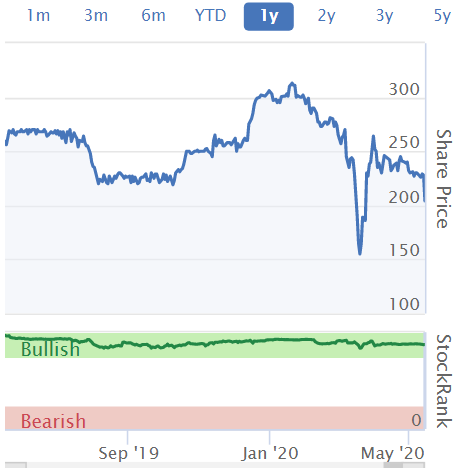
Share price: 208p (down 9% today, at 09:59)
No. shares: 124.5m
Market cap: £259.0m
Trading update & financing arrangements
This is a supply chain logistics company.
.
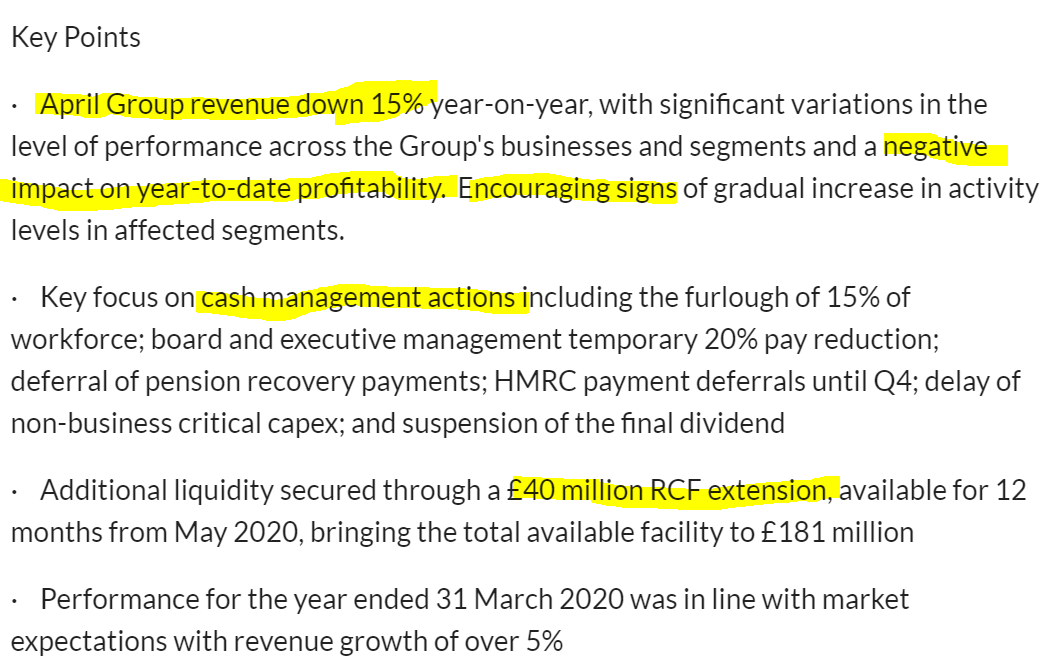
Revenues only down 15% in April seems quite good in the circumstances, given that many of its customers (e.g. retailers) would have been closed down. Some supply chains have shifted from stores to online.
Profits down, but it doesn't indicate how much.
Furloughed 15% of workforce
Bank facilities - existing RCF of £141m, matures Oct 2023. Additional £40m RCF available for 12 months, but replaces accordion facility, so to my mind that means no change in total facilities. The bank has required that any divis paid in the next 12 months must be matched by a reduction in the RCF - interesting, but it indicates to me that the banks may not be entirely comfortable here. That increases the risk of an equity fundraising being needed. The comment below also hints at a possible future placing. Not surprising at all, given that Wincanton has operated with an imprudently weak balance sheet for years, and paid imprudent (reckless even?) dividends. Hence why the banks have restricted the company's ability to pay out divis in the next year. Sooner or later weak balance sheets come home to roost.
We continue to monitor our trading and downside scenarios and will consider additional financing options in the longer term should they be required.
My opinion - I can see why this share is down 9% today. The balance sheet is stretched, there probably won't be divis this year, and we don't have much visibility on earnings. It sounds as if the banks might be grudgingly supporting the business, but reading between the lines I suspect an equity fundraising is likely to be necessary here at some stage. There's also now little headroom if we see a second wave of covid, as the company doesn't have the financial flexibility it would need. So this looks potentially quite high risk.
On the upside, revenues seem to be holding up OK, and with lockdown easing for retailers from 1 June, on a phased basis, then volumes should rise. Grocers seem to be its largest clients, so that's ongoing revenues as they can't shut down or we'll all starve. The shift towards online selling still needs logistics, which must be replacing some of the lost physical retail revenues.
This strikes me as a good company, clearly experts at what they do, but hampered by a weak balance sheet. The share could bounce as volumes from retailers return, but that's likely to be considerably less than before, and who knows what bad debt risk there is within receivables?
Overall then, I see risk:reward as unfavourable.
Countryside Properties (LON:CSP)
Share price: 307p (down 17% today)
No. shares: 405.0m
Market cap: 1,243.4m
I've been wondering why my housebuilder shares have been weak today. A look at the top % fallers today reveals why - mid-sized housebuilder Countryside is down a whopping 17% today on poor interim results to 31 March 2020.
I won't go through the numbers here, suffice it to say that the numbers and the outlook have clearly disappointed.
Housebuilding sector generally
The 17% fall in CSP's share price today has spooked me. Hence I've changed my mind on housebuilders generally, and decided to sell all my housebuilder shares today.
This also reinforces my general feeling that, once people see up-to-date figures from companies over the summer, we could see many shares drop heavily like this one. Therefore, the recent rally is looking increasingly like a dead cat bounce.
In this case, the H1 figures are to 31 March, which was only impacted by covid towards the end, yet profits dropped significantly. Maybe the bigger housebuilders are better set up, but I'm not going to stick around to find out!
Scapa (LON:SCPA)
Share price: 108.4p (up 1% today, at 12:25)
No. shares:
Market cap:
30.8m new shares have been placed with institutions at 105p per share - only a modest discount, so this has been a success. Therefore, now refinanced, I'm more interested in taking a closer look at this company, which I've always quite admired.
(work in progress)
Share price:
No. shares:
Market cap:
Share price:
No. shares:
Market cap:
(work in progress)
Disclaimer
This is not financial advice. Our content is intended to be used and must be used for information and education purposes only. Please read our disclaimer and terms and conditions to understand our obligations.

127 comments
HI Paul - what’s your view on the FAANG stocks at the moment since those dominate that Index?
They're all amazing companies. However, I think Google and Facebook in particular are essentially advertising companies. Therefore, earnings could fall.
The others, it's all about valuation. which look absurd, considering we seem to be going into an economic depression.
I'd say that there's maybe 50% downside on valuation for all of them, over the next 2 years.
Netflix looks the most vulnerable to me. Once furloughs turn into unemployment, then people cut the discretionary spending.
Thanks Paul for giving your thoughts most appreciated. I'd agree re. advertising revenues. The Amazons of this world probably going to do well. I've a bit in MSFT and V. and MA. hard to know with these as yes less spend with holidays but then more folk spending online and transfer away from cash is probably happening at a faster rate..
Netflix I'm less sure on it was an obvious do well share (stupid me for not buying) but the monthly fees are not that high and folk will be at home more. I think I'd get bored of the offerings though that is just me.
You said "you hedged appropriately" in January. Would be interested to know what you did and how you went about it. How about a hedging "teach-in"?
Oh no, I'd be useless at that! Just click on the link in the main report, where I explained my haphazard and amateurish attempts to hedge, which got lucky and worked.
I think the major FTSE100 housebuilders are worse placed than Countryside Properties as their revenues are almost exclusively from house sales, whereas 50% of CSP 's are from contract building for affordable housing and the private rented sector.
0.3% of the population have had COVID. So, a vaccine is a long way off. So are tests. Raising taxes on who? The mass unemployed / furloughed? Global debt increasing each year. Deficit never actually reduces. Record low interest rates. Capitalism is in its death throes IMO. Cant help think £10 a loaf of bread is round the corner and many more millions added to the poverty ranks. Whilst more middle class join the poverty ranks. Wealth simply needs to be spread. To much in the hands of to few.
0.3% of the population have had COVID.
No, no, no and no. No. Not true.
At the time of testing 0.27% of the population sampled were infected with Covid-19. That's after 2 months of lockdown and with R below zero.
It tells us nothing about how many have had it - millions, probably, although likely well short of herd immunity status.
On the other hand, I'd agree that a bit of wealth redistribution wouldn't be a bad thing.
timarr
PDiddy or Jeremy Corbyn ? Come on own up
What does wealth difference or capitalism have to do with a pandemic virus? Other than providing some tools of capital allocation to actually get the economy working again rather than the poisonous misallocation of capital leading to chronic low productivity that is socialism.
PDiddy - terrible series of slogans, what a load of rubbish!
Even a generalist like me can work out that if c.50k people in the UK have died from covid, when the death rate is reckoned by experts to be between 1% and 0.5%, then that means perhaps 5-10 million people in the UK might have had covid & recovered.
That's something like 7-15% of the population.
So where did you get your figure of 0.3%?
You should read "Super Forecasting - the art and science of prediction". In fact everyone here should read it, as it massively improves logic & thought processes. Something badly needed.
EDIT: Actually, to be fair, having read your post again, I do see where you're coming from. It's not just the slogans that it initially appears to be, I think you're trying to warn of the dangers of debasing currencies, and hyper-inflation. Weimar, Zimbabwe, etc, very valid points. So apologies for my initially sharp retort!
I like and enjoy reading your virus musings. One thing I think investors should bear in mind is that even after 7 weeks lock down the number of new daily cases is still over 3000 and will take a month or so to get to a manageable state. Hence I see a lot more companies getting into real trouble. Today is not yet the time to invest.
Paul, In a fairly recent SCVR you mentioned taking a punt on £alt for 50K shares. Does that mean you cashed-out? Thx. Aston
Hi aston_22,
ALT was a speculative punt for me, on a small scale, when we were in a roaring bull market. Things couldn't be more different now, since covid started. So yes, I must have chucked it out at some point, probably on a margin call - which have been frequent & painful this year.
Paul.
Interesting RNS from Boohoo (LON:BOO) after hours. Raising £200m in accelerated book build to take advantage of acquisition opportunities. Great time for them to do this.
cheers
Francis
Hi Paul, know its late in the day and only a trading update - but do you have a view on today's Byotrol (LON:BYOT) news?
Would seem a game changer to me and, given they are both licensing deals with some big cheeses (e.g. SC Johnson), transfer directly to the bottom line.
Understand if this is not the forum.
Re Robingate post:
I completely agree re aggressive reporting by BBC and ITV for that matter. Both channels seem to think that they have to be super argumentative on every point re virus. It is so easy to make cheap points from behind a camera!!
They create complete confusion in their reporting due to their argumentative stance and then say the public do not understand overall strategy!!
So much talk about testing, and not so much about today's (and yesterday's) market movements. What can we expect in the next few weeks? I've been expecting a 15-20% drop for a while, is now the time or is this just a temporary blip?
If the Govt really does start raising taxes and implementing austerity again then it has learnt nothing. Further taxation would disincentivize individuals and companies. Austerity has already left the country unable to tackle a virus successfully. It is inevitable that they will try to pick the country's pocket's somehow. I have a feeling that savers and investors who have been acting responsibly along with pensioners will be hit. When times are difficult government should invest and support. When times are good government should just get out of the way.
Whilst I can see the theory you propose, unfortunately, the reality is somewhat different.
Without austerity measures post the financial crisis the country would be in a serious financial mess - it took years to recover from the crisis and the only way to support this was to apply sensible financial management. One of the principles of business management is that you cannot grow yourself out of a problem although, unfortunately, many management teams are not aware of this and continue to try to do so.
The current state of affairs is possibly even worse which has necessitated the government borrowing >£300bn in a matter of weeks to support businesses and people as best they can. The biggest risk now is that the economy remains in a prolonged lockdown across the coming months (which they are trying to avoid more so than Scotland, NI and Wales) and the government literally runs out of money - meaning they would not be able to pay for the NHS, police, army, teachers, etc. They are raising debt through selling bonds and gilts but, like any company or household, this needs to be serviced and repaid (or refinanced) - fortunately interest rates are low otherwise we would have an even bigger problem. There will come a time when the demand for UK Government gilts dries-up and they cannot access additional borrowing (unless they pay penal rates)... then we have economic and financial armageddon?
In simple terms, the only way the government can reduce the current debt (which they will need to do) is to increase taxes and/or reduce spending - common sense would suggest they will need to adjust both. Additionally, corporate taxes will be obliterated this fiscal year, meaning more borrowing will be needed to bridge the gap, and personal taxes will also be much lower due to furloughing and increased unemployment, which is coming down the track.
Consequently, I would be much more worried if we had a reckless government that was unable to control the finances and not plan for some form of austerity.
I thought we had already reached the limit of the kindness of those strangers as most of the newly issued debt had been bought by the BoE - not directly of course but through secondary market. We are not Zimbabwe …………..
Yes, more recently, through the APF due to the (already) deteriorating market appetite for longer-term instruments and to keep the gilt market functioning.
We are in quite concerning territory!
The BofE Ways and Means program is just to smooth out the issuance. It is not for monetizing fiscal borrowing, it will be sold by the BofE again.
Agreed. The Keynsian view would be that in today's circumstances the governement can and should be willing to run a stonking big deficit to keep demand and services up as much as possible. As the UK is sovereign with its own currency, it can instruct the bank of England to create fresh pounds ad infinitum. A national economy is not a household and it is not a business- a mistake commonly main among those always wanting balanced budgets.
The danger of financing government spend by money printing is that it encourages bad decision make. (HS2 for example, the millenium Dome etc). The second danger is that in normal times money printing cause uncontrolled inflation and undermine confidence in the currency.
The chances of some sort of modest or high burst of inflation looks fairly high over the coming years. Maybe that's an explanation for apparently high share valuations? That plus almost zero interest rates for years ahead.
It is a political decision where to balance between spending and taxation. Too high taxes can be a disincentive. But a couple of decades of paring back the public sector aka austerity has indeed left us badly equiped for disasters like COVID.
Also, if the economy is to be reshaped with COVID being in the background for years e.g. those who worked in hospitality being retrained, then spend on benefits and training are going to be higher for some time.
My hunch is there has been a sea change in public appetites in favour of a bigger state. People always say they'd pay more taxes for better services (but don't always mean it). But I think this time,there will be at least some tax rises in the pipeline, but little of any spending cuts. I just hope the treasury does not trash the economy by taxing ahead of time. For now let them print the pounds we need!
Running a high deficit and having a high debt/GDP ratio is not a financial policy we should pursue in my view, e.g. Spain, Italy, Greece, etc., and the problems they have experienced as a consequence. Far too risky for such an uncertain and volatile world and I do not think the Chancellor would wish to follow that path.
Also, I would not expect to see a '... high burst of inflation' in the foreseeable future, with no sign of any upward pressure in demand (job uncertainty, unemployment, etc.), and this is certainly not the reason for current equity valuations.
In simple terms, the country has needed to unexpectedly spend colossal and incomparable sums of money in recent weeks and somebody will need to pay for it at some stage.
I have read a bit more this more this am about Antibody tests. My view for what it is worth is we need Antigen tests. It is good to know if you have had it (antibody test) but given we don't know yet if that gives you immunity it is not a key to opening up the economy which surely is what we all want. We need antigen tests which tell us if you have got the virus and therefore need to remain quarantined. I think whilst this deal with Roche is helpful it is still far short of what we need.
- but we are pretty sure it does give immunity. Obviously we are not sure for how long. Only time will give us increasing confidence on both counts.
We need both! Sorry, I should have made that clearer.
Off topic, but the Abbott Laboratories antibody test is now available ‘off the shelf’ for £89 from Medichecks. Three of our family have done it (you take 10 drops of blood at home via a pinprick, and send it off to the lab).
Two other family members probably had Covid, took a cheap Chinese home test, and came up positive (test almost impossible to buy).
I’m steadily adding to my S E Asia exposure due a) to low valuations b)currency movement; pound lower c) better handling of the virus.
I note some really big swings in Uk share prices today. Odd.
Hi Paul,I know you're very busy today with a long list of company covid problems but if time allows could you review sos as the price is very low for this distressed tech retailer,apart from a lack of funds does sos still have a future?
There's no new information from Sosandar (LON:SOS) for me to review.
I'll update once it issues the next trading update, as with everything.
I'm intrigued that nobody is mentioning the likelihood of an imminent class action against China-specifically- the CCP. Their negligence and deliberate obfuscation will be at the forefront of this. Governments like ours have debt repayments to China and in the event of an enquiry that- will undoubtedly find China culpable-that debt may not be serviced. Thoughts anyone?
Which court do you think would have jurisdiction?
If a judgment could be obtained against the CCP, how would it be enforced?
It depends which jurisdiction the company has chosen. You should be able to find it in the company documents or just ask google or phone the company and ask.
Because the idea that the US or UK would default or cancel debt held by China is so insane that only alt-right trolls on Facebook would entertain it. Defaulting on Chinese debt is effectively defaulting on all debt as you just made it worthless.
Our future ability to raise the debts that we are accruing at $14bn a month just for furlough would be smashed to pieces and global financial meltdown would likely occur.
Never underestimate the greed of US lawyers - https://www.law.com/dailybusinessreview/2020/03/13/class-action-filed-against-china-over-covid-19-outbreak/?slreturn=20200414090018
Are you actually mad?! Sounds like a good way to start WW3.
Apparently China has an innovative way of dealing with foreign lawyers who specialise in human rights - escorting them out of the country, and stopping off at a high bridge & throwing them off it. A very nasty & dangerous fascist/communist (same thing) regime. We're to blame - we created the monster, due to a desire for cheap consumer goods.
As an aside - ever guessed how China makes such cheap stuff whilst labour costs are going up? They don't! It's made in North Korea.
Thanks Paul. I've been thinking recently on something an owner of a few bars told me some years back that's stuck with me. He said that as a business they only made money 9 hours of the week, the rest of the time they ran at a loss, but they made so much money in those 9 hours it balanced out.
Obviously each business is different and no doubt that one had its own idiosyncrasies, but the underlying message holds I think; hospitality businesses often rely on a relatively small number of peak trading hours to turn a profit. The outlook as I see it, is the government effectively disallowing peak trading for the foreseeable future as it runs so counter to health based arguments. So I'm currently imaging a lot of hospitality businesses being able to reopen in the near future, but denied their profitable trading hours for a lot longer, possibly into 2021. I see this as potentially a deathnell for some hospitality businesses that are more Wet-trade focused.
Tom
For those that are interested in Novacyt I've been running a thread about companies that might profit from the drive in testing
Here's a specific comment where I'm trying to assess the impact of their initial order from UK government
I hold several of the companies discussed
Foundation for Inative New Diagnosists (FIND) have begun independent evaluations into Covid tests in order to combat the dodgy ones ...
Antibody tests here (no results yet)
Swab tests here and initial results here trickling in slowly
Somebody asked what taxes the gov could use to lower the debt. I imagine there'll be a small window in which the gov could get away with a real hit - 15% of all ISAs? Then hammer the elderly, and leave the rest to inflation - the more of it, the more the debt just disappears.
Nasty, sheeza. So much for Major's wealth cascading down the generations. Hopefully this is an iron much too hot for the Government to grip.
William
I would have thought the first place to increase taxes will be the corporation rate as it's on the lower end of the scale currently.
Pensions/ISAs - obvious place is to fiddle with the annual contribution cap and lower the lifetime allowance, i.e. target the larger pots on the margin. It upsets fewer people (voters) and is seen as taxing those most able to afford it.
Otherwise, a property tax would be a big earner. Probably start with second homes and first homes over £xxx.
Let's see, all in time.
Perhaps the most lucrative tax raise would be by abolishing the exemption from CGT on housing. I've never really seen the rationale for this, and it would be a highly progressive tax as it would have no effect on poor people but would raise a large amount from people who have acquired very large amounts of wealth purely by luck, and without having done anything to deserve it.
If it was thought too radical to remove the exemption from lifetime transactions it could at least be imposed on houses that are inherited, where the accrued capital gain is effectively disregarded at present.
CGT on primary residences doesn't work for lifetime transactions as anyone who's been in a property for a long time would be unable to ever move.
As I am still currently relatively affluent pensioner/investor, I am quite happy to pay my taxes, but not overpay. The answer to your question needs the following caveats: where is the money, what is politically acceptable and what is relatively easy to do
1. Means test pensioner all benefits
2 Remove reduction in council tax for single occupancy. Exclude those who cohabit but still retain pay council tax on their own house
3. Consider taxing ISA profits which have been crystalised. (And loose the next election)
1. Remove Triple Lock on state pension.
2. Raise Corporation Tax
3. Tax unoccupied second homes
4. Lifetime limit on ISAs
5. Lower ISA allowance
All of above would be fine with me. We need to look after the next generation cannot keep burdening them with debt we keep accruing.
Laffer curve would suggest raising corporation tax would generally be counterproductive and reducing the ISA limit certainly would. We need to incentivise investment not stifle it.
Laffer curve would suggest raising corporation tax would generally be counterproductive and reducing the ISA limit certainly would. We need to incentivise investment not stifle it.
As Laffer pointed out, the Laffer curve is bollox.
He produced it as a thought experiment for his students to show that the then orthodoxy that raising taxes always raises government income need not be true. However, a couple of guys called Cheney and Rumsveldt (yes, them) seized on it as a justification for Reagan-era trickle down economics and it's been popular among free market ideologues ever since. As Arthur Laffer carefully and repeatedly explained, the real world is far more complex than his curve can ever model.
There may or may not be reasons against raising taxes, but the Laffer curver isn't one of them.
timarr
Hi Paul...Great analysis this morning and enjoyed your portfolio themes discussion..,gives a good insight into how you are thinking ....we need more thoughts from guys like you....trouble is some of the contributors here must drive you nuts with their nitpicking.’
We can all make a valuable contribution and express an opinion here but the facts are simple, no one can predict what the market will do, what CV will do or what the long term looks like..
Each of us can do no more than make educated guesses..
I have 35% of my Sipp in cash, the rest is invested in stocks but whilst I am not intending to gamble away my 35% , I am prepared to accept that some of the companies I invest/punt in will go bust...I am totally prepared for this because in return I know some of the punts will win big time ...at the same time new opportunities emerge by the day and if we all put all our money in big safe boring companies , life would be boring but not safe completely due to CV.
Life is for living and investing and investing /betting a small amount of our money in highly speculative companies with big potential upsides is what life is all about.’.
We will not find the 10 baggers in Unilever, as much as we like them...
I have stated this before...our younger audience all want to retire early but they need to accept higher risk....your themes show us what and how you are thinking and based on your experiences that is great....and most enjoyable.
Let us get those posting here to give their themes....I am happy to do this as I have taken punts in Greatland Gold Greatland Gold (LON:GGP) and Avacta £AVCT...both could disappoint but hey I have had many disappointments in my life and anyone who invests in Small Companies needs to accept risk and reward , it’s what makes life exciting ...we all need excitement right now..? .it’s built into our DNA..
Thanks again Paul...
Paul, that must have been very hard to have an elderly member of your family die under those circumstances, it brings the human side and cost to a stocks / shares posting
Yes, Focusrite (LON:TUNE) analyst meeting was good. Here's the video if you'd like to see the slides too, or as a podcast, as Paul's link above. (Most piworld videos are available as podcasts, just go to the podcasts page.)
Join us for the piworld Thursday webinar today at 1pm. Everything you've wanted to know about Market Making, but never been able to ask. Our guest is Spencer Crooks, ex Director of Market Making at Winterfloods. I had the chance to interview him last year, but wanted to give all investors the chance to ask their questions. Come armed with your question. Register via this link.
Really good show Tamzin, although I felt there were still a few grey areas that Mr Crooks glossed over.I will promote PI World on my travels
Paul, with regard to Intercede I just wonder if a "new world" with many workers continuing to work from home will diminish the market for them.
I was thinking the opposite actually! Secure two-part logins are more important for people working from home, because laptops get stolen, lost, or malicious parties could abuse an unattended laptop. etc. Whereas it's a lot harder for a malicious party to get access to a work PC. Hence I imagine Intercede (LON:IGP) could see increased license sales for this reason.
Hi Paul. I work in the industry. What Intercede do is fairly specialist. There are a lot of easier and simpler ways for most companies to achieve what you are rightly thinking. I'm not saying they have a bad product, I don't know, only it would be for highly secure organisations. I.e lowish volume
I guess people will have views on where the market will go either way but the one thing I have noticed in the past month particularly is that volumes vs average volumes are way down! - some at 10% of average volumes. - Except in US tech stocks, which could have the opposite impact to the point I'm about to make by showing too much overconfidence.
The low volume will extenuate swings but also usually causes the slow drag downwards in the short-term.
That seems to be the market right now and most are just sitting by waiting for a trigger event to pile in.
I'm currently taking that 'deflationary price' - if I can use that term - view and waiting for a more attractive price to buy a stock on my watchlist.
Very good points, thanks. Bizarrely, the market now reminds me very much of 1998-2000, when tech, media & telecoms stocks went into a frenzy, which sucked money out of other sectors. People gave up on decent, solid, cheap companies, and instead chased up speculative TMT shares to insane valuations. Then the bubble burst in March 2000, as the economy went into recession, and it was total carnage for TMT shares, which crashed hugely.
The quality of US tech stocks is very much better now than it was in 1998-2000, but some valuations are looking crazily high.
Practically every interviewee on CNBC is currently saying that tech is overvalued in the US. Hence it's clearly in bubble territory, which combined with the worst recession in living memory underway, seems to me an extremely dangerous mix, an accident waiting to happen in my view. Sure, some tech stocks benefit from lockdown, so surely that means they could go backwards as lockdown is eased? Who knows! It's fascinating to think about & discuss.
Another potential risk is that the strong US tech stocks market has sucked in a lot of money from overseas, apparently, as well as hot money playing the momentum trade. But these people run for the exits once the trend turns. We've seen how fast markets move up & down.
Regards, Paul.
Got to agree with you Paul on the US Tech Stocks.
I've spent nigh on 30 years working for them either directly or indirectly and feel I've seen this all before. Everyone is being sucked into the remote working story - and there is mileage in this - but there is also a counter story. Many players are so large that they can not but be affected by the macro economy and this will show up in their numbers later in the year big time.
Additionally, and different from previous times, the big selling point for both the Cloud and SAAS was/is flexibility - if you need more users you can just add them - but equally if you need less you can dump them! If I was an CFO I would be sitting down with my CIO and asking "what's absolutely essential - bin the rest".
Marston's (LON:MARS) - Marstons - well for what its worth - think you will find they are doing well right now with bottled sales in the supermarkets...which seem to be promoting the brand.
Yeah, sure. Selling a few bottles in the supermarkets is helpful. Now all you have to worry about is the £1.4bn of debt and all the pubs that are shut indefinitely! A bit like emptying the rowing boat with a teaspoon whilst you have a huge hole in the side!
I am still a bit confused by the testing scene. My understanding was that there are essentially 2 types of test, an antigen test, which tells me if I have had the illness because it identifies antibodies that the body has created to fight it. The second type of test is antigen testing where they identify the protein in the virus and therefore can tell if you have it. If my understanding is correct antibody testing seems useful but not the answer. I want to know if somebody has the illness now. So how does the Roche test help us?
If the antibody is present, it means you have had it and would therefore have fought it off and had some immunity.
Most people (usually under 40/50 years old) who come into contact are in this camp and are asymptomatic.
They may think they just have a bit of a bad flu but not sure, I know several people who have felt this way over the past few months and are not sure whether it was covid or not.
Excellent explanation on the Roche website.
For example
https://www.roche.com/stronger...
Thankyou useful.
Batm Advanced Communications (LON:BVC) - BATM have both tests - shares are soaring , up 100% + in the last month
Paul
The WHO recommends caution about the growth in herd immunity.
WHO have been utterly useless.
And corrupt!
so furlough payments would still be needed to support staff who do not have antibodies. Would some people then try to catch the virus in order to develop antibodies so they can subsequently return to work?
More likely people would avoid having the test and hide positive results so they could continue to enjoy a nice paid holiday.
Great point!
Some cynical bas****s might do that! ;-)
The longer these schemes go on, giving out free money, the more fraud is likely. Still, fraudsters are likely to spend the money fast, so maybe that would boost the economy more quickly!
Unfortunately I share this cynical view at least for those with no caring (children or elderly parent) responsibilities. I suspect there will be a large proportion of furloughed employees who would be quite happy to ‘stay home’ on 80% of their salary up to £30K (£2500 pm) . In fact according to my accountant due to tax and NI effects the net salary (‘take home’ pay) of someone on average earnings of around £25K is around c 85% of their normal salary. When you add in the savings from travel to work costs and not eating/drinking out (admittedly partially offset by higher ‘in home’ food & drink) they are hardly any worse off sitting at home bingeing on the likes of Netflix!! It is difficult to believe, at least according to the media reports, that c 30% of the country’s workforce are furloughed at huge cost to the country. Given the above net salary statistics, the extension of the furlough scheme until end October, and the attitude of some Trade Unions getting some people back to work any time soon could prove problematic.
I quite agree. Moreover, a lot of furloughed people will also be taking advantage of the mortgage and car leasing payment holidays, and I'm aware that quite a lot of tenants have stopped paying rent, knowing they're safe from eviction, at least for the foreseeable future.
So in actual terms many people will have more cash available than they've ever had, and such is the feckless nature of the average UK citizen that it will just be frittered away leaving them even deeper in debt once something approaching normality returns.
I'm also very concerned by the Government's handout of money to businesses in the form of guaranteed loans. I'm seeing people with cr*p small companies that have always been on the brink of insolvency applying for and obtaining these loans within a couple of days, and just looking at them as a free gift, to be spent for the benefit of the company's owners, not for the company itself.
I've not the slightest doubt that these companies will be allowed to go into liquidation / be struck off once the money's been spent, without any sanction against those owners. And the rest of the business community, who run companies responsibly, will one way or the other be expected to pick up the bill.
"... antibody test made by Roche, which has proven 100% accurate."
Not quite. A news bulletin put out by Roche on its website says...
"
"
This is not nitpicking. It means there will be false positives. The note goes on to explain the false positives later in the text, but cannot quantify this part.
Great, thanks for the correction! I shall amend the article now, by inserting "close to..."
Think you mention your investments are in two categories..did you mean four?
I guess if there is 4 he meant 4!!
So two false positives in every 1000 tests, but no false negatives which is what you want to be avoiding. Better to be over cautious and isolate two persons unnecessarily, than let two infected be free to roam around. That's very good for a diagnostic test.
Very poor reporting by the BBC this morning.
Nothing in a biological setting is ever 100%.
They showed a, 'snap test,' these don't need any lab equipment as such. So it's probably NOT a snap test.
Just for once I'd like them to report some real facts.
Real facts from any part of the media would be a novelty! Even the Financial Times seems to have sunk to the level of the tabloids. Sensational headlines which on reading a few paragraphs into the article are rarely substantiated. Definitely not the paper it used to be!
I am getting increasingly angry with the BBC, which seems to have abandoned any attempt at impartial news reporting.
Replace BBC with any 24 hour News media acronym - they all have too much time compared to news on their hands
Same amount of news around but only report on one subject - interminably !
For any medical test that is very good indeed. I wish that all the tests on which I relied during my practice of medicine had been that good. The subsequent clinical trials may modify this result. If they do so adversely it does not necessarily mean these initial results were"fudged"
Marston's (LON:MARS)
This share has turned into a complete crapshoot due to the debt levels and current pub closures.
I feel their comments below today are slightly divorced from reality , or perhaps their secret plan is to pay down debt by issueing 100 billion new shares - this is now a complete binary situation that the low market cap means that any fundraising will destroy any bounceback chances for current shareholders.
We have made good progress to date towards our debt reduction targets and remain committed to our overall strategy to reduce the Company's leverage over the medium term. However, the temporary closure of our pub estate and the additional liquidity described above will impact that trajectory for the time being.
can they whether the storm without doing 50% plus dilution? - they seem optimistic that they have enough funds to see them through till at least 29/9/2020 (year end 28/9/20) as they say
We believe that this additional 180 day financing facility, together with ongoing Government support on employment costs, deferred tax payments and rent and rates relief, as well as continued income from beer sales into the off-trade, provide us with sufficient liquidity to meet our obligations beyond the end of the financial year even if pubs were closed until then. We have reached agreement with our banks to amend the Company's covenants for September 2020 and March 2021.
Note they do brew their own beer so they do have some income from the off trade sector at present.
If they can roll the dice and ride out the current storm without raising funds and progress towards normality next year - the shareprice could easily double or treble from here , i am guesisng they they really need thier pubs open by the end of september for this plan to work. Anyone investing here could easily see themselves wiped out 80%+ if they need to raise money soon - mr market is definately predicting they will be going cap in hand in that direction sooner or later.
How interesting, thanks for the briefing on Marston's (LON:MARS)
It's not one I cover closely.
@rmillaree: re Marston's (LON:MARS) the daily email from Langtons is more positive, saying
The group’s shares, despite a modest recovery from their mid-March lows, are still trading at historically very low levels
• But there is uncertainty. The earnings ability of the assets has not been diminished. None have been destroyed but the behaviour of consumers cannot be accurately predicted and a degree of caution with regard to financing was called for.
• Overall, this is a very reassuring development.
This share has turned into a complete crapshoot due to the debt levels and current pub closures.
I feel their comments below today are slightly divorced from reality , or perhaps their secret plan is to pay down debt by issueing 100 billion new shares - this is now a complete binary situation that the low market cap means that any fundraising will destroy any bounceback chances for current shareholders.
Frankly, this is a ridiculous assessment. It's like you're talking about a completely different company rather than Marston's (LON:MARS) . This is a company with real assets on a PTBV < 0.4. How you can analyse a company in this way by only looking at one part of the balance sheet is beyond me. This is a proper deep value situation. Risky, yes, but a long way from a crapshoot.
Si
Marston's (LON:MARS)
Hello simoan
How you can analyse a company in this way by only looking at one part of the balance sheet is beyond me.
I was simply concentrating on the epehant in the room which is the debt.
It's pretty simply to me that the market is expecting a fund raising and the lower the shareprice goes the more current shareholders will be shafted at such time if the shareprice remains depressed. Note when i say shafted the shareprice may do well from around the current levels or the level at which the rights issue is priced at but it will be much less likely to recover to anything like previous highs - and to boot when the dividend is restored i will have alot less of my pie. To me this is a crapshoot and nothing else - in that 29p could easy be 20p in 5 days time - and the lower it goes the worse off we will be if they raise funds at that price.
With the current market cap of £190 mill and debt of over £1 billion we are completely at the mercy of how the directors/banks and bondholders choose to proceed , if the market thinks they may have to do a discounted rights issue it could easily end up doubling the sharecount in issue.
Hopefully it won't come to this but thats the reason why the shares are are the low level they are IMHO.
In theory they have other options to survive and pay down debt - but as they supply beer to their outlets the last thing i want to see done is for their crown jewels to be sold of and then see future profits at a much reduced level.
I was simply concentrating on the epehant in the room which is the debt...
With the current market cap of £190 mill and debt of over £1 billion we are completely at the mercy of how the directors/banks and bondholders choose to proceed , if the market thinks they may have to do a discounted rights issue it could easily end up doubling the sharecount in issue..
But you also completely overlooked the company has £2.35 billion of mostly freehold property. It's pointless to ignore that and concentrate only on the debt - if nothing else it makes the elephant a baby one. This gives them various future financing options including sale and leaseback, assuming someone else doesn't come along and do it for them! If I held, that would be my biggest concern.
It's pretty simply to me that the market is expecting a fund raising and the lower the shareprice goes the more current shareholders will be shafted at such time if the shareprice remains depressed.
Well, the market should be disappointed today then because they have at least another 180 days through the new £70m financing facility. FWIW I don't believe in efficient markets and I thought it was inefficiencies in situations exactly like Marston's (LON:MARS) that we were all looking for? We're (mostly) intelligent people hereabouts so why would we bother if we couldn't find opportunities where the market misprices companies? I know I wouldn't!
I find Marston's (LON:MARS) an interesting situation. Risky, yes, but the news could change very quickly and you could be looking at a 100% gain in short order. To make out it is a complete basket case and a punt, as you did, is not correct.
Si
Marston's (LON:MARS)
To make out it is a complete basket case and a punt, as you did, is not correct.
I don't think its a basket case by any means - i do still hold my shares here .By saying crapshoot i meant there is a high variability here - big chance share may price go materially up or down depending on news - i will stick to my guns in that regard and see it as a risky investment at present.
There will have to be a fundraising here. They have diluted many times before, though previously always to fund acquisitions. The share count is up c20% in six years. These events have always been restricted, in recent years, to institutions. BUT the company has great assets: freehold breweries and pubs, and fantastic brands. A fifth of all the beer drunk in the UK is from Marston's (LON:MARS) . The business is thus really wet-led, so they are currently facing real problems. The dividend has been unsustainable for a couple of years, so there will be no quick return to that situation.
I cannot seem the firm going fins up, but dilution is inevitable. I hold a small remnant having luckily sold out 90% of my holding at just over a quid. I will not be adding until things are clearer, but I cannot see any point in selling either. Unsteady as she goes!
Great news about the antibody test and Roche have said they can supply us with a few hundred thousand a week. So very useful it will be in getting a more accurate view of what is going on in the population but it will be a long time before it is as freely available as a Macdonalds used to be. Also I am very weary of this Governments constant failure to deliver, maybe I should cross out 'to deliver'. I think there are many problems all over the world but that we are especially hamstrung by a useless executive in troubled times with the additional problems of Brexit as another kick in the *******. My guess is that one's portfolio should reflect that.
I do wonder what the government will tax?
We have to be looking at high unemployment so reduced PAYE. This will also suppress wages which will reduce PAYE.
Corporate profits are down(nonexistent)
Spending will be suppressed so VAT will be down.
I haven’t paid income tax for a couple of years, living off cash savings while I allowed my share portfolio to grow (that has not quite worked out :-)). The only taxable income I had was a holiday rental. That has gone to zero and almost certainly won’t deliver any taxable income until year end 2022.
How about taxing properly the FANGs which seem to dodge corporation tax but will have benefitted even more from the lockdown/Covid situation.
Me too !
Hi Paul,
Whilst on the Covid 19 theme. Please could you scan your eyes over the NCYT earnings release and onward statements. It mentions some new innovations coming to market including a mobile testing rig for care homes which has caught my eye. Interested in your thoughts. Cheers
Hi Hydro31,
I've had a quick look at the StockReport for Novacyt Sa (LON:NCYT) - it's not something I could add any value to at all, being small, loss-making, and in a sector I don't usually cover - because it needs specialist knowledge to work out which pharma type companies are good, and which (the vast majority I would say) end up failing, or at least being being wildly over-priced, over-promoted speculative junk.
Sorry about that!
Best wishes, Paul.
NCYT I thought the historical results were dire. But then to be fair it was a 6 pence micro cap company at the end of last year and has now been over 500p when it was valued at well over a third of a billion in market cap. My biggest winner of the year so far having bought at 75p and 64p. So my pocket has nothing bad to say about the company! It was very quickly off and running to get WHO approval.
I struggle though to see how all these testing stocks can be worth current valuations. For instance GDR went from 7 pence to 300 pence in just over one month. A 43 fold increase. Of course business may well be good and lots of different tests are needed but there is also an argument that this is a complete bubble with many private investors encouraged by outrageous statements on the various bulletin boards. My personal view is that most if not all of these Covid testing stocks are probably well over valued and some may turn out to be over hyped junk that will not actually deliver anything....and buying now is very risky as the big pharmas like Roche start to release products. Others firmly and completely believe that Covid has transformed some micro caps from a valuation of 6 million £ to a billion £ plus. Maybe they are right. We will only know that for certain with hindsight.
There again, I have had a load of fun in this sector and made lots of money too. There has been plenty of time to buy them, sell enough to at least recover initial investment and keep some as a free carry. That was always my plan.
Paul
For this reason, I think expectations of a V-shaped economic recovery seem way too optimistic. Indeed, companies that comment on the outlook do seem to be generally saying that recovery could take several years - e.g. Land Securities said this in a recent update. This means that current broker forecasts for 2021 are probably way too high in many cases. Therefore, I think we need to treat all broker forecasts with a large amount of salt.
On the basis that the lockdown period will probably be much worse this year say April-Dec than next year i am taking the opposite point of view. Against that Jan-Mar this year will be much better than Jan-Mar next year. But overall based on the almost complete standstill we have now i think next year will be better albeit it will be April-June 2020 before the stats turn positive. This is based on a kind of the middle of the road assumption that there will be some material covid measures in place but not as bad as we have now. Note i don't see this as being any sort of particularly good news i simply feel that the current lockdown numbers will be so bad it will be almost impossible to do worse next year than where we are now. Whether this is a V shaped or W shaped recovery who knows, if there are still measures in place next year this may give some soft stats that make it also likely 2022 numbers will be better than 2021 even if there is no real lfl growth generally - eg i can easily see 2021 being at a very low level for tourism and leisure and the real recovery in that sector may not take place till 2022. It will certainly be interesting to see how me manage next year if nothing else.
I think Pauls point is that when looking at 2021... you should assess it relative to 2019. If you think 2021 will be better than 2019 then your positive view will no doubt rewarded. However if you think that is unlikely then the opposite is true. Why so? With many companies running "optimised" balance sheets running into 2020 ... based on expected growth rates... if 2021<2019 ... then expect investment, capex, recruitment, and debt repayment to be disappointing. Equities will look expensive and facing a 5 year fallow period. Many will need to raise. Furthermore unemployment will remain higher for longer and smaller private companies will go top the wall. Just looking at 2021 relative to 2020 obviously doesn't give the full picture this time.
Thanks. I feel that many share prices seem to already be pricing in an earnings recovery in 2021. Sure, there should be some earnings recovery against 2020 numbers, but both could end up being far worse than current broker forecasts in my opinion.
If a share price is so bombed out that recovery potential is not priced in, then it's worth a look. Trouble is, that's usually a sign that the market fears insolvency risk.
It's difficult to generalise, because every share is unique.
You're right though about 2021 figures being up against soft comps! I wonder if any companies will actually report infinity% gain in revenues next year for Q2, if they do nil revenues in Q2 2020?! ;-)
Regards, Paul.
The way I imagine the future might look (important because small caps investing is fundamentally all about predicting the future), then I see an antibody test as being a game-changer.
It isn't, although it's an important step forward,
Immediately the most important thing about an antibody test is we'll be able to figure out how many people have had the disease. That opens up all sorts of research programs which will be critical in figuring out how we deal with it.
But we don't know if having had it confers immunity and, if it does, for how long - other coronavirus antibodies wear off over a period of 1 to 4 years. The current best guess is that if you have a strong dose of the virus you'll get temporary immunity.
As the WHO suggested yesterday, we may have to live with this forever. But we will find treatments - it's just that science doesn't operate on the same cycle as 24*7 news or the quarterly business cycle.
timarr
It depends how you define game-changer. "Important step forward" as you say, is saying the same thing that I intended. Maybe I'll change game-changer to important step forward, as your wording is better than mine!
Thanks, Paul.
The issue I see with antibody tests being used to give "CV19 passports" is that if only 4% of the population have been infected so far then how will the other 96% behave? Certainly a fair proportion, especially those judging themselves to be low risk, will see the advantage of becoming infected in the hope that they can then get a "CV19 passport" and be exempted from further lockdown measures. If this proportion was over 10% then we would likely see a second peak higher than the first, the NHS would be overwhelmed, ............................
There are various thoughts on the percentage population that has been infected. This Swedish professor thinks the percentage may be much higher. At least this Roche test will enable us to put some valid figure on this and move on from there. https://www.youtube.com/watch?v=bfN2JWifLCY
Paul, I got your little joke and appreciated it.
Cheers
William
My morning smallcap tweet: Duke's script a let down.
Global Invacom (LON:GINV) Pipehawk (LON:PIP) Sensyne Health (LON:SENS) Wincanton (LON:WIN) Byotrol (LON:BYOT) Duke Royalty (LON:DUKE) Brighton Pier (LON:PIER) ImmuPharma (LON:IMM) React (LON:REAT) Mountfield (LON:MOGP) Safestyle UK (LON:SFE) Bango (LON:BGO)
Global Invacom (GINV) Q1(March) rev down 31% due to reduced orders from our customers and some impact on our production facilities. "Group continues to see demand from its customers during this pandemic period and the Group is deemed an essential supplier for its supply of equipment to the Communications, Entertainment, Medical and Military markets."
PipeHawk (PIP) orders down in building services, automotive, aerospace etc but Adien and Thomson Engineering Design has remained buoyant. Unhelpfully, no figures. Confident in the Group's ability to withstand the current situation.
Sensyne Health (SENS) guides FY(Apr) rev £2.1m, slightly ahead of guidance. "Increasing demand for its products and technology as individuals, healthcare systems and the biopharmaceutical industry adapt to the current situation and make plans for a rapidly digitising healthcare future.". Guides FY21 in line.
Wincanton (WIN) April rev down 15%. Deferring pension deficit recovery payments by twelve months. £40m credit facility extended to May 2021.
Byotrol (BYOT) Sees record sales in Q1. Rev running at £1m pcm. 10 year exclusive license in Americas for Byotrol24 germ kill sanitiser spray. Initial fee $250k and quarterly royalty payments based on product sales. Also the new license previously alluded to is a multi-year agreement (previously short-term) with SC Johnson Professional in alcohol-free hand sanitisers.
Duke Royalty (DUKE) mgmt "pleased with the ongoing resilience demonstrated by the Group's portfolio as a whole". To help some partners has decided to accrue, capitalise or equitise its monthly cash payments. Apr cash payments £600k (March £1m), the reduction has not been waived or lost by Duke. Cash on hand of over £3m. Will pay script div in next Q. What's the point? Should call it 'window-dressing div'.
Brighton Pier Group (PIER) cutting costs and using covid loans. "Group continues to adopt a conservative approach to debt and will focus on reducing leverage below 1.5x by the end of FY 2022."
Immupharma (IMM) progressing Lupuzor into a new optimised Phase III trial this year in lupus patients. Study shows that Critically ill covid patients display lupus-like hallmarks of extraordinary B cell activation. Hopes Lupuzor may help to reduce or perhaps prevent the occurrence of the cytokine storm.
React Group (REAT) £400k 35-week contract to provide specialist deep cleaning services to one of its Tier-1 rail customers.
Mountfield (MOGP) £1.2m flooring contract.
Safestyle UK (SFE) AGM stmt: "Outlook remains uncertain, the Board has considered various scenarios as part of plans to re-start operations safely in response to customer demand and continues to target progress made in the Group's Turnaround Plan. Moreover, the business is more resilient with a leaner fixed cost base and considerable liquidity to underpin its ability to navigate through the challenges presented by the pandemic."
Bango (BGO) 3 year platform agreement with a major global telecoms provider. Worth at least £1.5m.
Bad news for insurers:
https://www.investegate.co.uk/lloyds-of-london/rns/lloyd-s-market-to-pay-up-to-us-4-3bn-to-customers/202005140700098857M/
Probably bad news for everyone as premiums will no doubt rise. Or insurers may withdraw Covid cover (or both).
Following yesterdays discussion on the Children's Covid situation, there is some more detail in the NYT newsfeed.
Link is here- though some subscription may be required.
Thanks, Beginner. These are staggering numbers. And yet the general insurance sector is up some 22% since the start of this year when compared to the FTSE100! These are undoubtedly strange and dangerous times.
Yes but some will not be exposed to Covid-19 claims or quite minor and the ones that do should be mostly covered by Excess of Loss reinsurance, it's the ones writing Excess of Loss reinsurance that will paying out or more precisely the Excess of Loss reinsurers, maybe some will go to the wall? Lloyds will be quite exposed to this.
Hi Herbie
I'm not sure that excess of loss reinsurance (XOL) will take most of the claims - I was UW Manager for a major reinsurer before escaping to the Highlands. I'm 10 years away from the market, but I'd be v surprised if the way XOL contracts are triggered has changed a lot.
Since a major UK insurer (? Sun Alliance) tried to claim "Winter" as an XOL claim, reinsurers have been v keen to pin down what is / is not an event under catastrophe reinsurance. Normally, an event will be limited in time - in this case, I'd guess to 168 hours (a week).
Yes, some insurers will claim that all the loss occurred the minute Boris stood up and mumbled his way through lockdown. But I'd not be at all sure that this will fly - and that approach MIGHT mean some insurers run out of cover. IF it becomes multiple XOL claims, then the deductibles under the reinsurance programmes will soak up much of the loss (leaving it with the insurers) - and, in any case, catastrophe XOL contracts are normally limited to 2 claims per year.
Personally, I'd be very very wary of buying any insurers who write commercial business and any reinsurers. I've no idea what the impact on life insurers / reinsurers will be - there will be SOME balance from their annuity underwriting.
And be very very VERY wary of insurers with exposure in the USA (nb Lloyds) as insurance is pretty political there.........
deleted.
This statement is difficult to take in - Yes this is a huge estimated claim - but how has it been estimated -A worst case scenario ? Does it take full account of the claims Hiscox and others have rejected - or just the sums they have agreed...Many questions here.... and anyway probably just too early....
It will be based on the claims they believe they are contractually obliged to pay out. The industry works on contracts.
There's a short interview with the Lloyds CEO here. He says it will be one to two years before the full impact is known.
https://www.cnbc.com/2020/05/14/lloyds-of-london-coronavirus-will-be-largest-loss-on-record-for-insurers.html
Antibody test are starting to become available (£89 at the one below).
https://www.covid-19.medicheck...
Thanks. I'm reluctant to order a test online for 2 reasons;
1) How do we know the tests are accurate, when they only seem to be available from websites that I've never heard of, and
2) I feel in the early stages that the tests should be prioritised for key workers, not non-key people like me!
Not a criticism, just a comment!
Regards, Paul.
I understand your concerns, I'll just add Medichecks is used by my doctors for my PSA testing, they do both phlebotomy and other types of testing. They are a genuine testing lab.
Ah, thanks. You should have said that in your first post!! :-)
Please don't buy online testing kits.
I work in healthcare outcomes research. The Roche test, which has 99.8% specificity (meaning it isn't confused by other antibodies 99.8% of the time) and 100% sensitivity (which means it always picks up SARS-COV-2 antibodies after PCR confirmation) is an incredible piece of work - generally if you develop a biochemistry test above 90% in both sensitivity and specificity you consider it a job well done.
If the numbers are correct, the Roche test should be viewed as a gold standard. The worst thing we can do as a population is start taking tests which are less than gold standard and generating false positive results, so that people who are susceptible think they are fine and wander out into the world to become carriers or victims.
I understand that people want information desperately, but sometimes no info is better than wrong info.
Medichecks use the test from Abbott which has 99.6% specificity. Many other countries find this adequate. These folk do it for £50: https://www.doctorcall.co.uk/products/coronavirus-covid-19-antibody-home-test-kit/gcov
-for information only--not a recommendation
https://abbott.mediaroom.com/2020-05-11-Abbott-Receives-FDA-Emergency-Use-Authorization-for-COVID-19-Antibody-Blood-Test-on-Alinity-TM-i-System
I'm not sure how much weight I'd put on a pin prick test, and would certainly not pay the £89 for the pleasure.
From my understanding, it is not possible to be sure whether one has antibodies to COVID-19 without a larger amount of blood to check.
Regards,
Dave S.
I agree, the antibodies have to be in the pin prick sample, so less chance of getting a correct result than phlebotomy.
However, its interesting that this and other private testing businesses are now offering these services.
Will it provide confidence for businesses to resume operations if they perceive they can encourage their key team members to share the test results. It would allow directors to know what percentage of their team may be susceptible in future and plan accordingly.
I found the Open Orphan presentation on piworld.co.uk informative on this. They are gearing up to use their lab to process the Quotient test in the U.K. which also claims 100% accuracy. The MD is dismissive of pin prick tests (he mentions Theranos) and says you can only be sure of tests that are based on a full blood draw taken by a medical professional.