Small Cap Value Report (Thu 16 Mar 2023) - Banks, PBEE, ECEL, GYM, TFW

Good morning from Paul & Graham, in these volatile times. I'm (Paul) just typing up some comments on the banking problems (is it a crisis yet? Have CNBC created a new logo for it yet?), so that should be up shortly.
Explanatory notes -
A quick reminder that we don’t recommend any stocks. We aim to review trading updates & results of the day and offer our opinions on them as possible candidates for further research if they interest you. Our opinions will sometimes turn out to be right, and sometimes wrong, because it's anybody's guess what direction market sentiment will take & nobody can predict the future with certainty. We are analysing the company fundamentals, not trying to predict market sentiment.
We stick to companies that have issued news on the day, with market caps up to about £700m. We avoid the smallest, and most speculative companies, and also avoid a few specialist sectors (e.g. natural resources, pharma/biotech).
A key assumption is that readers DYOR (do your own research), and make your own investment decisions. Reader comments are welcomed - please be civil, rational, and include the company name/ticker, otherwise people won't necessarily know what company you are referring to.
There's a lot on our to do list today, so I can't promise we'll get through all of these, especially if they're just in line with expectations (hence not price sensitive) -
Paul’s Section:
Comments on banking problems
I’m only loosely following what’s going on with the banks, and am not a banking expert, so this section is more a conversation starter than a pearl of wisdom!
As we’re all painfully aware, there has been a nasty sell-off in equities in the last few days, triggered by the strain in the banking sector (SVB going bust, and now Credit Suisse looking distinctly wobbly).
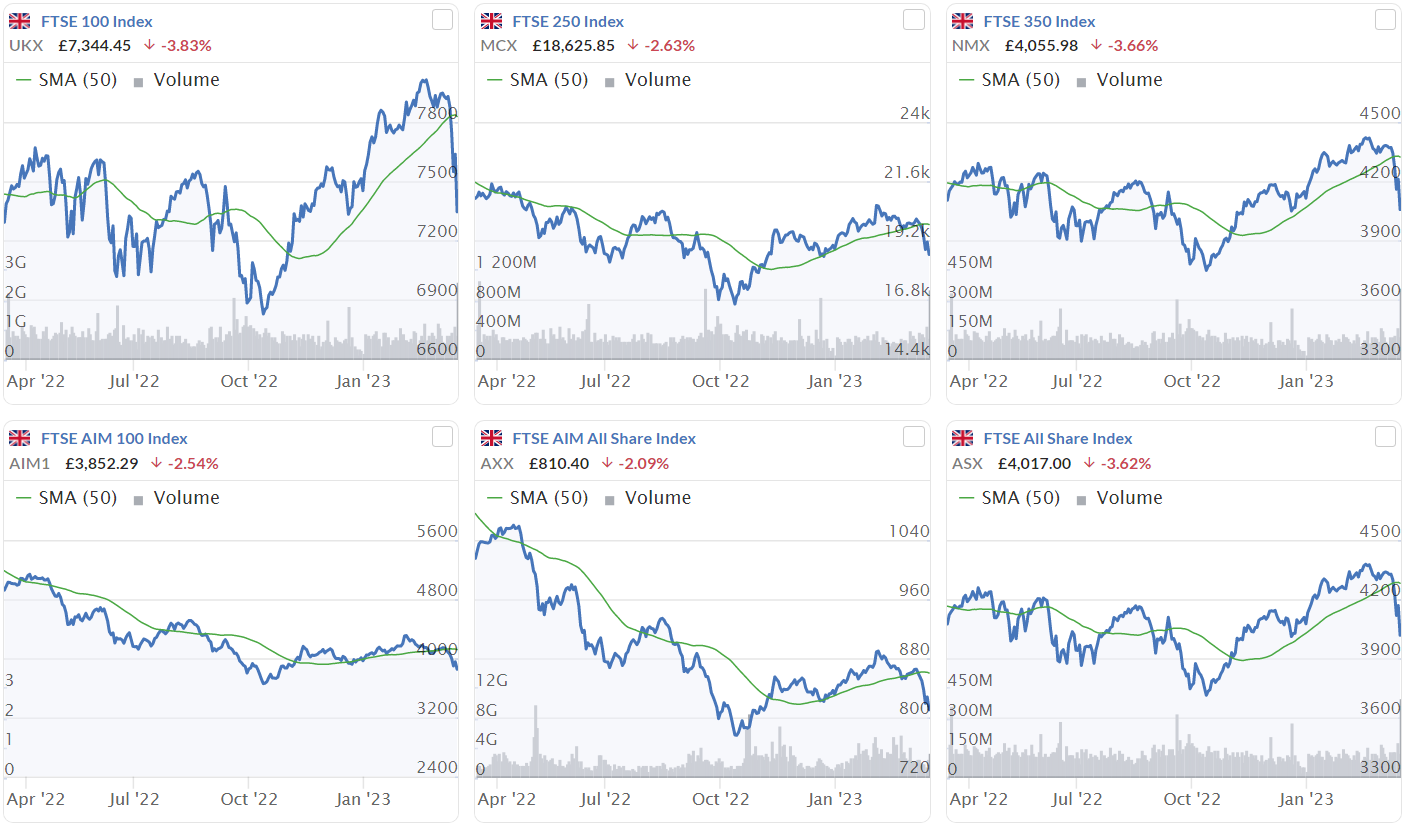
To put it in perspective though, see the UK indices below - 1 year view, with the % change being yesterday's change only. These show the same pattern - that we’ve given back the gains from a strong rally in early 2023, and are now roughly back to where we were at end 2022. Hardly a disaster (so far). This type of move is perfectly normal volatility, although it’s happened quite quickly, and could get worse of course, we don’t know at this stage. Futures (at 07:20) are pointing to a modest rebound today.
International indices look generally similar to the UK ones below.
Banks going wobbly happens from time to time. The problem is that if confidence falls in a particular bank, then the logical thing for depositors to do, is to remove their deposits and put the money in a stronger bank, asap. That creates a vicious circle, that can quickly escalate into a run on the bank.
This is made worse by the instantaneous nature of electronic banking. There was a story on CNBC of a coach load of venture capitalists going to a skiing resort recently (wouldn't they have been in limos, not a coach?!), but they were all busy on their phones, moving large amounts of client money out of SVB. The point being that runs on banks are now more likely to happen faster than in the old days when people formed an orderly queue outside a bank branch.
On the upside, everyone (Govts, regulators, central banks) know exactly what to do in this situation, as 2008 taught these lessons -
Guarantee deposits in full, to stop the run on the problem bank.
This time I think bondholders & shareholders should be left to their own devices, they knew the risks.
Move very fast to rescue the bank - either with a takeover by a stronger bank, or nationalisation.
Forcibly recapitalise banks that are weak, but refuse to strengthen their own balance sheets (as Gordon Brown did with the UK banks in 2008), to prevent further bank runs.
Senior Govt/Central Bank figures need to say strong things to the media (with gravitas) that restore confidence (remember Draghi’s “whatever it takes” comment, that might have saved the Euro from collapse).
It all raises the question, again, of moral hazard, and that the owners & senior management of banks enjoy the profits from risk-taking in the good times, whilst the taxpayer is forced to support them in the bad times, and when they make mistakes. But that’s a conversation for another day once this situation has passed.
I think it also raises the question about central banks raising interest rates, which has happened (just in my opinion, you may disagree) too far, and too fast, causing this crisis by crashing the value of bonds, equities, and property. No wonder banks and other financial institutions (I see Prudential was down 10% yesterday) are feeling the strain, as they’ve got a hole in their balance sheets as previously overvalued (by zero interest rates) assets drop sharply in value.
The whole system relies on confidence. Once that ebbs away, it all goes haywire.
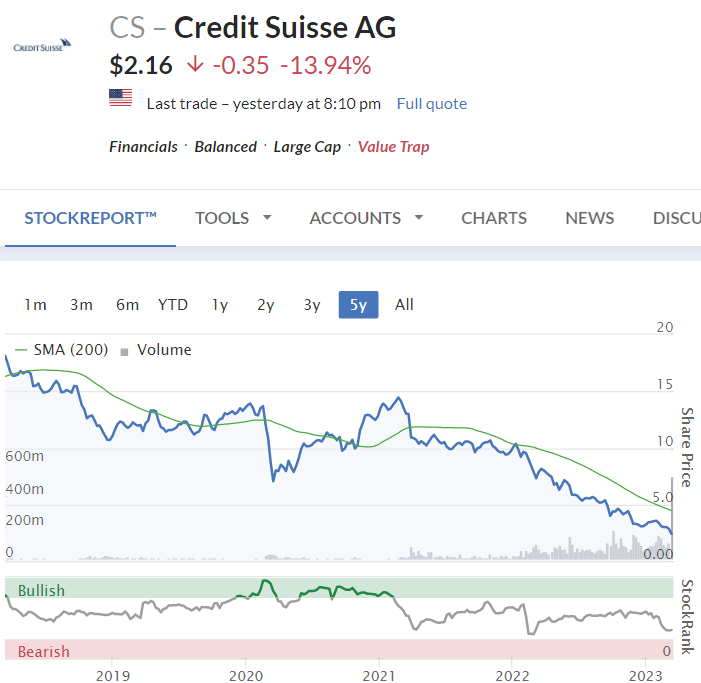
SVB is sorted out, and Credit Suisse is the next one causing problems. The Swiss National Bank apparently extended large liquidity (reportedly $54bn) to it yesterday, but will that be enough? We’ll have to wait and see. Credit Suisse has been beset with problems for several years, so confidence was already ebbing away before this latest crisis. 5 year chart -
What should we do, as small cap investors? That’s up to you - choose whether to play it safe by selling (but probably then missing out on the rebound). Or whether to just ignore this, or even see it as buying opportunity?
At the moment, I’m leaning towards the latter, and I’m not selling anything, and don't intend to.
My reasoning being that everyone knows what to do, to resolve weakness in the banks. So one way or another, it’s going to get sorted. And market timing is not my thing.
Good luck with your portfolios, whatever you decide to do. If you’re good at market timing, then you probably sold a couple of weeks ago, raising the question of when to buy back in? Again, that’s entirely your call, your money!
Overall, my hunch is that we’ll probably see more problems emerge at weaker banks, so this crisis could rumble on for some time to come. But it doesn’t affect my overall investing strategy at all, unless the whole system shakes itself to pieces again, like in 2008 (probably unlikely I’d say).
With no gearing now, I can serenely ignore market share prices, and just wait for the problems to pass. That is a great improvement on the past, where I would probably be a forced seller by now in my geared accounts (discontinued activities).
What’s your view? Am I being dangerously complacent? Should we be hiding under the bed with our savings in cash or gold? Let us know what you think, it’s always good to hear the community’s range of opinions.
Paul’s Section:
Eurocell (LON:ECEL)
138.5p (down 2% at 08:11)
Market cap £152m
Preliminary Results - FY 12/2022
Eurocell plc is a market leading, vertically integrated UK manufacturer, distributor and recycler of innovative window, door and roofline PVC building products
Solid financial performance and continuing to gain market share
I last looked at Eurocell here on 26 Jan 2023, when it issued an in line trading update for FY 12/2022, together with a cautious-sounding outlook for 2023.
Today we get the full numbers for FY 12/2022.
There’s a comprehensive key financials table, I’ve highlighted the most important numbers as I see it -
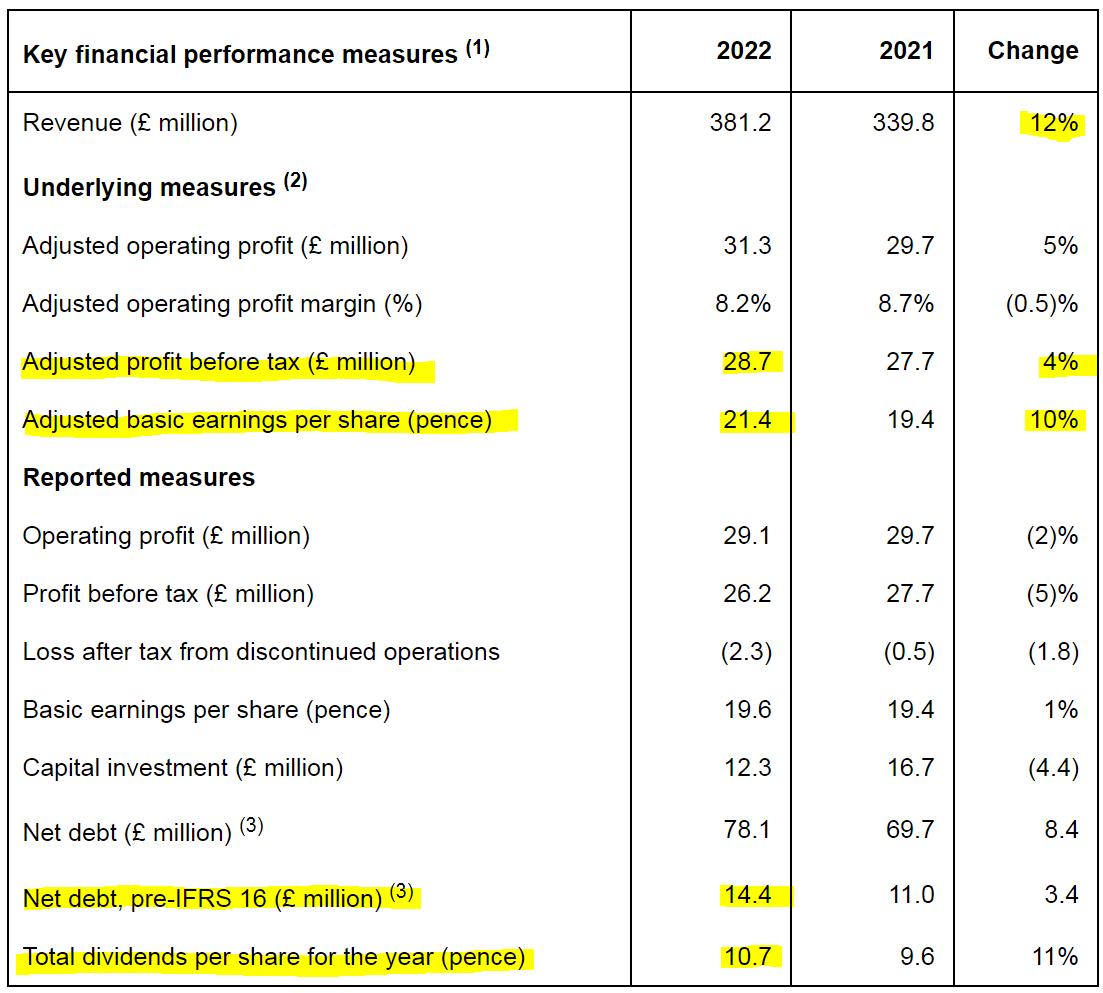
My comments on the table above -
Decent revenue growth of 12%, mainly through price rises. Note that the reported £381.2m is slightly lower than the £384m previously indicated in the last trading update.
Adj PBT of £28.7m is 7.5% of revenue - that’s a good profit margin, indicating a decent business with some pricing power, and products that customers must like.
Adj PBT is up 4%, but adj EPS is up 10% - the difference is caused by a lower tax charge in 2022 - see note 4 - due to a high £3.1m deferred tax charge in 2021, falling to only £0.2m deferred tax in 2022.
Adjustments to profit - are they reasonable? There were no adjustments in 2021, and in 2022 it was only £2.5m, relating to redundancies, so I think it’s OK to allow these adjs.
Valuation on 21.4p adj EPS is a PER of just 6.5x - but we can expect EPS to fall in 2023, so mustn't get too carried away with this low PER.
Net bank debt of only £14.4m is insignificant, given that annual PBT is about double that figure. Hence we don’t have to worry about gearing. It also has a £75m unsecured (very unusual) bank facility - ample.
Dividends - a superb yield of 7.7%, from 10.7p total divis, divided by share price of 138.5p - very attractive, but with a softer outlook there’s a possibility of 2023 divis being cut maybe?
Outlook - I’ve read most of the commentary alongside today’s results, and it all sounds similar to the previous updates - cautious on the outlook for 2023, but well-prepared for a downturn, having made £5m annualised cost savings already, and raised prices again in Jan 2023. It sounds like a well-managed business. Note that broker forecasts have been managed down recently, which I like, because it means a profit warning should be less likely -
For the current year, the latest construction industry forecasts recognise the currently challenging market conditions and ongoing macroeconomic uncertainty. However, we have acted swiftly on cost to prepare the business for 2023 and we expect our strategy to enable us to optimise performance in our markets.
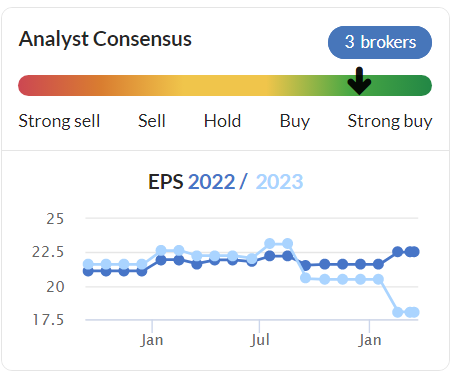
If we value ECEL shares on the latest (lower) 2023 forecast EPS of 18.0p, we get a 2023 PER of 7.7x - still really cheap! Although this sector tends to only attract modest valuations generally, especially when macro conditions are tough.
So the market seems to be pricing in a miss against this lower forecast, possibly? If the market is being rational, which it may not be!
Valuation - historically, EPS was very steady, at around 20p, so I think we can probably safely use that figure as a long-term way to value the share. Put that on a PER of say 10-12 (not demanding), and I get a personal valuation of this share of 200-240p. Hence its current price of 138.5p looks attractive to me.
Plus, shareholders get paid nice divis to wait for a re-rating. Also, little risk due to the strong balance sheet. It ticks a lot (well, all!) of my value investor boxes! Apart from management shareholdings, which are too low, and remuneration in 2021 looks too high.
Balance Sheet - looks excellent to me. NTAV is almost £100m, which is about two-thirds of the market cap - so this share is doubly supported, by earnings, and also assets.
The last annual report shows that it owned £7.3m freehold property, which is a nice bonus for investors.
My opinion - I really like this share, and give it an enthusiastic thumbs up. It’s exactly the type of solid value share that I should own, if I could stop getting distracted by more speculative stuff!
We have a low PER (both on 2022 actuals, and recently lowered 2023 forecasts), a thumping dividend yield, combined with a strong, ungeared balance sheet. What more could you ask for?
The downside risk is obviously a cautious outlook, and possibility of 2023 being a worse year than expected. Although I think it’s the type of company where I would see any temporary setbacks in trading as being buying opportunities.
It’s also got the financial firepower to make acquisitions, although that’s not a priority for 2023.
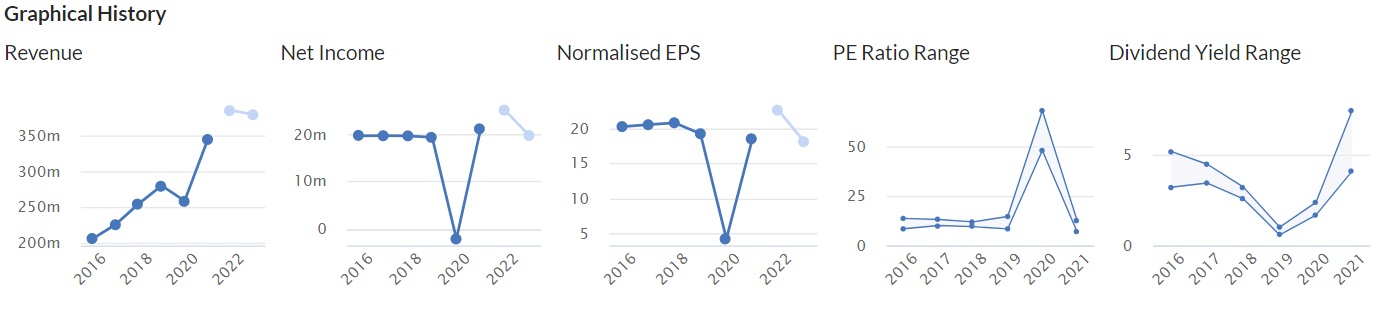
A consistently strong StockRank is the cherry on top!
Looking at the long-term chart, this share really does look oversold to me - and there's only been a little dilution from equity raised during the pandemic (now 112m shares in issue, vs 100m in 2016)
FW Thorpe (LON:TFW)
375p (unch)
Market cap £428m
Owner/managed lighting business.
Interim results to 31 Dec 2022
Strong numbers, with PBT up 25% to £10.6m for H1, on £81.9m H1 revenues, demonstrating a good profit margin at 13% of revenues.
No adjustments to figures.
Supply chain pressures are easing.
Balance sheet is still excellent and ungeared, although note that acquisitions mean goodwill is rising, and quite significant now at £71.6m. Acquisitions are also depleting the cash pile, now down to £21m
Forecasts - there don’t seem to be any!
Valuation - tricky one, with no forecasts (not even any broker consensus) to work on. It has an H2 weighting to profits. Last year was 17.0p EPS (a big jump on previous year). So if we assume this year might be between say 15-20p EPS, then that gives me a PER of 19-25x which strikes me as a tad too expensive to get me interested.
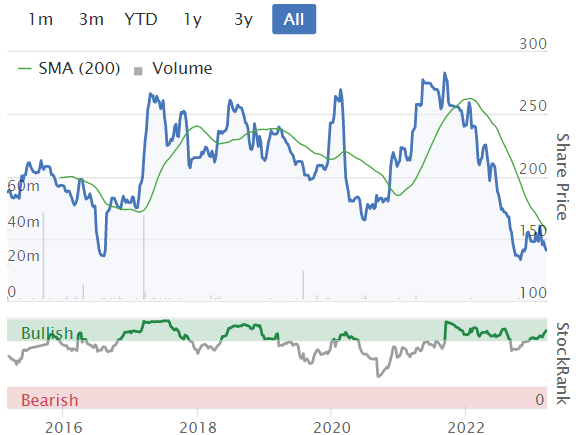
Although should we really be quibbling over valuation, when the long-term track record is stunning - a major multibagger, over 20 years -

Dividends - are modest, with it yielding roughly 1.7%.
Outlook - a bit mixed, but sounds alright overall. I wonder if the boost mentioned below from the imminent ban might be providing a one-off profit boost? -
High energy costs and the imminent ban on the sale of fluorescent lamps in the UK and EU are both stimulating activity in the Group's key market sectors. The outlook for the second half remains quite positive, although the revenue growth percentage is unlikely to be maintained at such a high level due to the good performance in the second half of last year.
My opinion - I like the business, it has that nice look & feel of conservative accounting, no adjustments, no debt, that you often find at family-controlled listed companies like this.
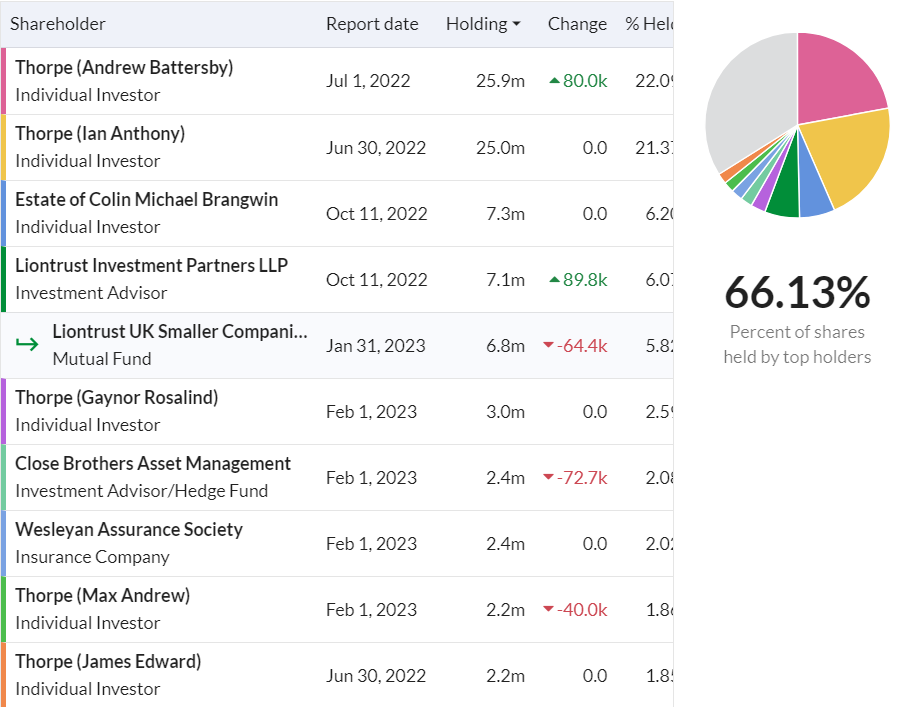
The 2 top shareholders are both Thorpes, and together own 43%, with 3 more smaller Thorpes further down the list! A lot of shrewd investors (e.g. Lord Lee, David Stredder, and others) favour family-run companies with long-term track records, and I agree. Although that comes with the risk that this type of company can be run like a private company with a listing, so you’re along for the ride, and have to just trust that the driver will look after you. Normally they do, in my experience, but it can’t be guaranteed.
Overall I can’t decide whether to go green, or amber. So for a super-long-term buy & hold, I see this as positive (green), due to TFW’s fantastic long-term track record. Even though the shares look too expensive in the short term (even after considerable falls of late).
It has a nice healthy StockRank too, although as I would expect, the Value score element is low, at 25.
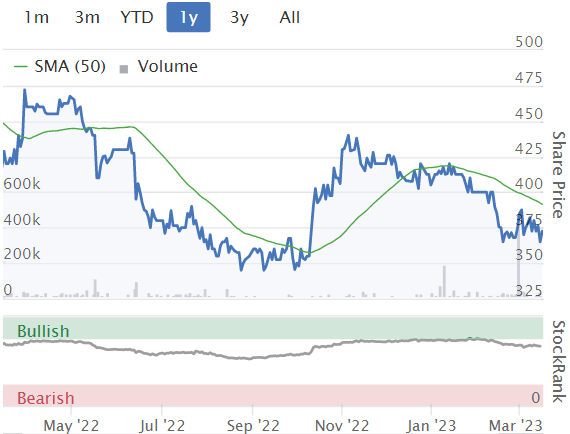
Do we have any shareholders in TFW here? If so, do post your views below. It seems tightly held, with few trades most days.
Graham’s Section:
Pensionbee (LON:PBEE)
Share price: 101p (+2%)
Market cap: £226m
This is a 2021 IPO I’ve commented on twice before - see here and here.
It’s an online pension provider, letting people combine their various defined contribution pensions into one pot and manage them on the PensionBee app. The annual charge by PensionBee is 0.5% to 0.95% of assets.
Let’s now take a look at the company’s full-year results for 2022:
Revenue +38% to £18m
Annual run-rate revenue at the end of the year £20m
Pre-tax loss £22m
Assets under administration +17% to £3bn
Invested customers +56% to 183,000
CEO comment:
Encouraged by strong year to date trading driven by customer growth and healthy net flows from new and existing customers, we are on track to achieve our primary objective of ongoing Adjusted EBITDA profitability by the end of 2023 and to become profitable for full year 2024. We will achieve this by continuing to reduce the Cost per Invested Customer, delivering innovative new features and making efficiency gains through our scalable technology platform.
I’ve just checked the note issued in January by Equity Development and it looks like we are still too early to have 2024 estimates. Given that the company’s 2022 losses are bigger than its revenues, perhaps we should rein in our estimates for 2023 and 2024?
If the company was “profitable” (according to adj. EBITDA) in 2024, I do agree that this would be an achievement. Adjusted EBITDA was minus £20m in 2022. According to the note issued in January, it is expected to be minus £9m in 2023.
Over the long-term (5-10 years), the company is pursuing a 2% market share of the defined contribution pension market, which implies 1 million customers and annual revenues of c. £150m.
Cost per invested customer (which measures the cost of customer acquisition) did not improve in 2022 and is currently £248. This is unfortunately still too high as the company only makes a little over £100 in revenue from each customer annually. Pensionbee’s stated acceptable threshold for this metric is £200 - £250, so they are only just within their own threshold.
More positively, I note the amazing reviews that Pensionbee gets on Trustpilot. We have to hope that this is not because the company is overspending on things like customer service. I find it surprising that every single customer gets their own dedicated account manager.
Balance sheet - in 2022, the cash balance more than halved from £43.5m to £21.3m.
My view
I think it’s right to be sceptical of the investment case here.
Some reasons for caution:
The company has already achieved brand awareness of 50% and nearly one million registered customers, of whom only about one-fifth have funded their account. Surely it won’t be very long before most potential customers have already heard of Pensionbee and made up their mind about switching to them or not?
If the company makes an adjusted EBITDA loss of £8m in 2023, the cash burn is unlikely to be any smaller than that. The company’s cash pile could easily fall to c. £10m, increasing the pressure on profitability in 2024 if they don’t wish to raise any new equity.
The current price to sales multiple is in excess of 10x. The market cap is higher even than the company’s long-term revenue target which it is hoping to hit over the next 5-10 years!
Bull points? Pensionbee did earn a barely positive “Adjusted EBITDA before Marketing” in Q4, i.e. their adjusted EBITDA is now around breakeven if you exclude all the costs that go with growing the business. There is the possibility that they could, at some point, pivot their business model from scale-up to profitability (a nice phrase used in FT Adviser in an article discussing the unprofitable Nutmeg).
I’m going to give this share the thumbs down for now - too overpriced and risky.
GYM (LON:GYM)
Share price: 97p (-18%)
Market cap: £173m
I‘ve gone back over my notes from the last time I covered this low-cost gym operator, to help remember what was on my mind in January. The company had at last decided to stop opening quite so many new sites, and was losing its long-standing CEO. With net debt rising to £76m (excluding rents), it looked an increasingly risky proposition.
Today we have full-year results for 2022.
Revenue +63% to £173m
Like-for-like revenues (vs. pre-Covid 2019) of 90%, with like-for-like customer numbers of 81% and yield per customer of 110%.
These are quite poor numbers, I think - remember that given the levels of inflation over the past few years, an increasing yield per customer should be a given. But with average customer numbers per site at only 81% of pre-Covid levels, that suggests a very significant hit taken at particular sites from the work-from-home trend, or possibly a general oversupply of gyms (or both?).
The outgoing CEO says:
It is now apparent that some members have not come back to in-gym workouts post Covid-19; therefore our work to recover pre Covid-19 levels of profitability is continuing.
Some of the members have been displaced because they have not fully returned to office working - just 16 sites out of our 154 sites that were open pre Covid-19 are significantly workforce-dependent and the rest are located in residential areas or have a strong student membership. We believe that there is further membership recovery to come in the medium term but this has been slowed in the short term by the cost-of-living pressures which are having an impact on underlying demand.
Market share in the low-cost gym space for this company is now at 29.3%, versus 16.7% in 2016. Unfortunately, there is little indication of pricing power feeding through to profitability, with this increased scale. There has been an improvement compared to the Covid-impacted 2021, but that isn’t saying much:
Adjusted loss £7m (2021: £28.5m)
Statutory loss £19m (2021: £35m)
Outlook
“Uneven start to 2023 vs Board expectations”
Like-for-like revenue vs pre-Covid at 97% in first two months.
Energy costs to be £10m higher this year (I think GYM’s hedges start to expire next year).
Profitability doesn’t sound very likely very soon:
Expect current difficult macroeconomic environment and its impact on consumer demand to continue throughout the year; therefore now anticipate full year revenue increases from yield improvements and new site openings to be broadly offset by cost increases
At least they have broadly admitted defeat when it comes to the expansion plans. They are now looking to open only twelve new sites in 2023. In January, they said they were going for 20 (it was 25-30 before that).
Succession plan - the Chairman says “we are making good progress in the search for our new CEO”.
Net debt finished the year at £76m, as previously disclosed. There was £15m of headroom on the RCF (seems quite low) and the RCF is due to expire in October 2024, so it will need to be extended or refinanced.
My view
The market cap has taken a hit since I last looked at this but I see little reason to change my view: I’ll stay negative. The company isn’t profitable and the prospects for profitability in the foreseeable future appear weak. It is highly leveraged. What more is there to say?
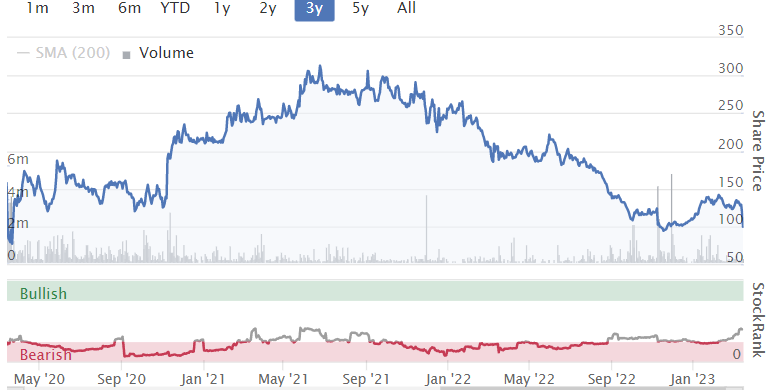
I remarked previously that the cost-of-living crisis was a factor here. It’s an interesting point because you might think that a low-cost operator would do well as people traded down from more expensive gyms. However, it might also be the case that when the economy was stronger, the low-cost operators attracted marginal gym goers who might not previously have joined any gym. Those marginal members appear to have left for good now - or until the economy picks up again.
Disclaimer
This is not financial advice. Our content is intended to be used and must be used for information and education purposes only. Please read our disclaimer and terms and conditions to understand our obligations.

83 comments
Today's posts and discussions on the taxation of pensions . . . .
There's been quite a few posts on this today given the changes announced yesterday
This post isn't political, rather thoughts on how investors might anticipate the taxation policy landscape and then make sane decisions . . . . . . This shouldn't be a political football rather a framework which encourages savers to invest for their retirement, with confidence.
I can't see Labour, if and when in power, allowing unlimited pension pots/increased annual limits to persist for long. In their mind these are an unjustified tax break for the "rich", although most people benefiting will work in the public sector - about the only place left with DB schemes open and accruing benefits.
Labour's last stated position (2021) was that they would reduce the LTA to a flat £1m (despite the fact it was frozen - why not just let inflation mask a cut unless you are desperate to make a point!) and more aggressively limit top-rate tax relief for high earners to basic rate at a far lower point than current and soon to increase taper thresholds.
Labour likes to characterise large pension pots as being the exclusive domain of those with high incomes and/or "the rich". This is false, and the reality, as is often the case, is more complex than political caricature . . . . . . . . .
The total value of a pension pot is determined by the interaction of 5 distinct factors: (i) the net cash amount contributed; (ii) the tax relief received; (iii) the investment period during which the funds are invested and returns compound before draw-down commences (the earlier contribution start and longer they continue i.e. the longer retirement is deferred then the larger the pot); (iv) the investment return during the investment period; and (vi) the costs borne by the pension pot through fees, charges and trading costs etc.
You would need an actuary to review an individual's pensions to determine which factors were most important and I bet you might be surprised . . . . . I know of high earners who have contributed surprisingly little and modest earners who have made sacrifices and been disciplined and saved surprising more than you might expect (do I want a new car now or in retirement). Also having an additional 0.5% of costs (difference between a cheap tracker or EO SIPP versus expensive active funds, PE funds etc) makes a significant difference over the decades.
With the above in mind the only justifiable, sane and equitable way of taxing pensions is to limit tax relief going in and then tax it coming out (during the lifetime after retirement through income tax and at death with a charge in lieu of IHT). In this way pensions would simply defer taxation.
If there is real unfairness in the current system its pots passing tax free to the next generation, a trend being amplified by IHT advice to the wealthy to run down their other assets before drawing down pensions.
But what do we do as savers and investors?
Well for starters take your tax-free lump while you can, particularly given its been fixed in nominal terms and its value will steadily erode. It might also be removed for those with larger pots which is sort of happening anyway with the frozen cash amount of £268,275.
But also beware, there are various Benefit Crystallisation Events ("BCE") where fund values are measured against any future re-introduced LTA that might apply at the relevant time, potentially triggering a charge to tax. The obvious one is age 75: where benefits not yet taken are measured against the LTA; but also for pots which were previously taken (after 55 before 75) these are re-measured against any LTA. Sounds retrospective but watch out and there is logic in that you shouldn't be building value but not paying tax.
I agree all savers and investors need a stable set of rules to plan around.
Pensionbee (LON:PBEE)
Interesting comments Graham - i thought this looked ultra risky last time i looked and shareprice was way higher than it is now. . But if they are anywhere close to getting EBITDA positive perhaps i will need revisit.
There seems to be no comment by you on what i would perceive to be the beauty of this business model.
Say they have x many clients signed up now - and have the same x many "active" clients in 10 years time.
With pension pots i would expect value of funds under mangement even for a static active customer count - would possibly be 3X 4X or perhaps 6X in 10 years time (X being where they are at say year 1) - simply due to many customers starting at nil saved and getting towards decent amount over 10 years. I would guess theer would be some graphs avaiualble if you look showing growth
This seems like a potentially beautiful business model in that once breakeven they may only need to kep numbers static to get decent growth each year - albeit customer retention will be key - ie if they are making great profits will large competitor come along and undercut them on price or provide superior service?
So to me posibly potentially woryh of more research to see how much "curent customer bank" will genrate in fees in 5-10 years compared to now assuming no customer numbers growth.
Signature Bank, a New York regional bank, also collapsed a few days ago.
Talking of Silicon Valley, there have been clear signs of a bubble in the tech industry.
In 2021, one analysis found that in US startups valued over $1b, 90% were unprofitable, and most likely would remain so.
GitLab reported results a few days ago. It lost 38% of its market cap after "weak" revenue forecasts, despite revenues rising 58% year over year. It has a TTM of $379m and a market cap of around $6.6b at the time of the announcement. Needless to say, it is loss-making. The valuation level is irrationally high. That a company with $379m cannot make a profit is also worrying.
I actually host code over on GitLab, so it was a company that naturally caught my attention.
It seems that low interest rate has played a part in highly speculative investment. The problem is, it's not even good investment. They're trying to catch the next Google or Facebook. But those two companies had enormous returns on capital, whereas the current batch don't. Ok, sure, VC means that you will inevitably pick a high percentage of duds. But then again, you shouldn't be valuing them at $1b either.
GitLab reported results a few days ago. It lost 38% of its market cap after "weak" revenue forecasts, despite revenues rising 58% year over year. The valuation level is irrationally high.
Your observations on valuations and interest rates are valid, but this has been a major discussion point for over a year. A year on and prices today are fully adjusted to the current level of interest rates and my bank has just encouraged me to switch back into growth from value, now that the peak of the interest rate cycle has been brought very near by this month’s banking panic.
As for Gitlab, actually it was the fall of 38% that was irrationally large, as witnessed by the upwards adjustment over subsequent days to a fall of barely 20% for a real shocker of revenue warning. I personally think the company has good prospects and they are making considerable efforts to balance the demands of growth and profitability. I would be very surprised if revenue growth rates don’t re-establish themselves at much higher levels than in 2023 once sales cycles for IT shorten again. Maybe a good entry point if you can stomach the valuation. I’d have added at the recent lows if I didn’t have a full position already.
Alphabet are upping their stake in Gitlab massively so there must be something there.
Burford Capita lBurford Capital (LON:BUR) link to Presentation which was due to commence at 2pm today GMT will not work.
It was issued last night by email but will not connect. Anyone else have the same issue?
So frustrating. I hold.
Managed to listen in and should be a replay facility on website. Market spooked by the change in accounting treatment and delay in accounts, but personally don't think anything to worry about - loaded up this morning when it was down 18% and already made good profit (don't normally trade like this but couldn't resist that). Market ignoring the far more important fact that case wins are now coming in thick and fast. Worth having a listen when you get a chance.
Equals (Eqls)
Obviously getting battered as in the sane sector as those naughty banks .
Has come right back to 76p level .
Can’t see how anything fundamental has changed at equals who help companies on international payments etc .
Management seem engaged and committed
No debt .
Anything I am missing or is it just a case of Mr Market chucking the baby out with the bath water and everything in the sector getting hammered .
Any other perspectives from holders that might change my view ?
I'm down 20% on these at the moment as i pretty much bought at the top. Final results due on the 27th March so hoping for some good news.
It is probably to do with the fact that any money held is not protected as a deposit would be under FSCS deposit guarantee - Many of these types of business or their business segments are authorised as 'e-money' by the FCA which are not protected by FSCS and many firms such as these rely on money being segregated or safeguarded at their partner banks....but with no FSCS backstop...
It's very difficult to know how this situation is going to play out. It is estimated U.S banks collectively have losses of $620 Billion on bonds they hold due to the fastest rise in history of the FED base rate. Not all of these losses show up in results, assets classified as long term investments don't have to be marked to market. Provided banks don't have to sell these bonds they should be okay but if they experience a "run" things could get messy quickly, the speed of SVB's downfall is incredible*. It's unlikely this is a U.S only problem, rates have shot up all over the developed world, I suspect there are lots of conversations happening between regulators and bank board rooms all over the globe.
To illustrate the potential problem in the U.K take a look at this:
https://www.ishares.com/uk/ind...
This ETF only buys UK gilts (supposed to be risk free) it lost 23.8% in 2022.
P.S SVB isn't a "bailout", unlike 2008/9 shareholders and bondholders are being wiped out.
* Equity value went from $15.8 Billion to zero in 4 days.
Couple of Director transactions that came up on my watchlist:
Eagle Eye Solutions (LON:EYE) - William Currie has reduced from 7.99% to 4.91%
Much smaller, but at Revolution Bars (LON:RBG) (I hold) the CEO has picked up £48k, and the CFO £15k. Not big amounts, but I don't think either Dirs are independently wealthy from what I've gathered (not certain). I wasn't happy with the last RBG results, when I finally got round to looking at them (as mentioned in my last podcast), and it looks finely balanced re excessive debt taken on for the Peach Pubs acquisition. Hence I'm reassured a bit by these Director buys.
Regards, Paul.
Bill Currie is no longer a non-exec at Eagle Eye Solutions (LON:EYE) . He resigned to focus on other ventures.
And at Oakley Capital Investments (LON:OCI) David Till puts in another £200k at a higher price than the £530k he spent on the shares in November. He may be richer than the RBG guys, but that's now £4.8m he has in. I do invest in individual companies, but Oakley Capital Investments (LON:OCI) has a very effective business model and is a firm recommendation for family investments. Do look at their 3 and 5-year chart through these 'interesting' years. Maybe I should convert my entire portfolio to then and Legal & General (LON:LGEN) (for the stonking and reliable dividend), and turn my computer off for the next 5 years...
I've looked at Oakley Capital Investments (LON:OCI) but their charges are pretty eye-watering, amounting to 8.3%pa (according to oakley themselves) compounded every year....Harbourvest Harbourvest Global Private Equity (LON:HVPE) is 'only' 5%....Still a helluva lot though!!
Yes, but their actual long-term performance is what counts. Remember, they do not mark company valuations up unless there's a liquidity event, and they only get paid those chunks on realisation of asset value, not siphoning off a little of individual values along the way, which is what a 'Fund Manager' does. They are seriously aligned with their projects (and therefore with a long-term management view).
National World (NWOR)
Nice set of results and seems to be spitting out cash increasing it’s already significant cash pile .
Online strategy heading in the right direction and they do seem to be delivering.
Priced about right for now but heading in the right direction and if the “transformation” kicks in which it seems to be starting to then not a bad bet .
Probably cheaper buys out there but quite happy to let this one unfold and they own the Yorkshire post which they are doing a good job with .
Thanks Paul for your review on Eurocell (LON:ECEL) (I hold), I have just listened to the management presentation and they seem very sensible; taking out cost, defer branch openings, grow market share, price increase from Feb 2023 for inflation and improve efficiency, hunkering down for a tough 2023. They have lowered market expectations and when you look at 2022, they have a record of slowing improving through the year. I added to my holding this morning.
Re Eurocell (LON:ECEL) hello martinck1 - and earlier Paul Scott, thinks for his report. I'm not so sanguine, and there seems little mention of cutting staff (mentions redundancy payments), selling a section off (Security Hardware) at a loss and SP already down around 40% this year.....and then there is the uncertainty of the market segment coming up.
I do like their niche in recycling but I think that the low PE is a feature of the market segment, and could even be lower to attract me - which it doesn't.
Friends I have working in this type of field are saying that things are really quiet right now, and I cant see it getting exciting in the foreseeable future.
The company is taking the right kind of focused action - hunkering down - but its not a rosy picture going forward - all IMHO of course.
The 2-year US Treasury Yield is flagging a worsening financial crisis. The Fed has backstopped all depositors of financial institutions but not the troubled banks. I don’t think this is just about the near term risk in the banks it’s how this developing crisis is furthering the shutdown of money availability. The Fed’s Senior Loan Office Survey was already at a level suggesting recession. Whilst many are focused on the events with regional banks I think the new risk is when investors have to mark their private equity & venture holdings to current market. The Fed has raised rates into a generationally levered system . The risk is not what you can see, it’s what you cannot see.
There still seems to be some ludicrous valuations - Deliveroo (LON:ROO) is an example this morning.
They are guiding for FY Dec23: adjusted EBITDA expected to continue to improve and to be in the range of £20-50 million, weighted to H2
Market cap of £1.66bn
Net cash of £1bn (but still negative FCF for FY23, given continued heavy investments)
If we expect maybe Net Cash at Dec23 year end to be like £900m (optimistic, I think mid case is more like £850m), then on a EV/ EBITDA earnings basis it is still 21x the EBITDA midpoint
And that's EBITDA! Depreciation & Amortisation took a £60m charge in FY22.
Given that top-line growth is only going to be only low to mid single digits for FY23, does it really justify a growth valuation still?
One of the issues in the US has been the banks not passing on higher rates of interest on deposits. As mentioned in comments here already money now can be moved pretty instantly. A raising of deposits rates would /will stem the outflows but impact the banks Net Interest Margin. You can buy 1 month US T-Bills every week which were yielding mid 4% - Today is the next auction.
Also I would ask where is the regulator/oversight, SVB had no Chief Risk Officer for the last 8 months, surely that should be red flag?
Here is an interesting short read on how SVB managed to stay away from tighter regualtion https://open.substack.com/pub/...
Just my my opinion I think regulators for most industries are reactive not proactive, even from recent events here with energy firms collapsing where none of those new entrants were hedging risk ( hedging costs money) and when you have a razor thin margin that is a cost too far. Most regulators would benefit from 'poachers turned game keepers'
Can someone from the UK buy those 1 month US T-Bills? How would you go about it? Is there any ticker?
My first thought is I don't believe a non US individual can buy T bills directly from the US Treasury, https://www.treasurydirect.gov... probably your best bet is to use a broker, I have a Schwab account but to be honest I've never tried.
But I have just checked the website and it has a W-8BEN form for foreign beneficial ownership so there maybe a way...
I know Vanguard do a range of US Treasury Vanguard USD Treasury Bond UCITS ETF Dis (LON:VDTY) whether these are in the short range so getting the yield or still tied up in previously issued low value I am not sure.
I have a ~3% holding of Vanguard USD Corporate Bond UCITS ETF USD Dis (LON:VUCP) within my Vanguard SIPP. Which I chose at the time as when I looked at the Treasury options the yield was a lot lower.
Sorry it is not available on Stocko, I also have a <1% holding of US Investment Grade Credit Index Fund through Vanguard again which is showing a 3.42% current yield but I have as an accumulation option.
Tommy
I'm using WisdomTree US Treasury 10Y 3x on AJBell platform. Couldn't find any other way. If anyone finds a similar way to buy US 2Yr please let me know.
Not a small cap but Centamin (LON:CEY) this morning announced reasonable long term prospects and ongoing turnaround IMO. Crazy price action first thing. Dropping 5% before rebounding to above its closing price yesterday. Just shows that reacting emotionally to price swings is a bad idea. The market makers are way ahead of us. Know your own mind....
As I posted elsewhere today, Gold priced in GBP hit its All Time High yesterday. These quality gold mining companies are still cheap as chips but most investors aren't paying attention to them. Last time we had stagflation in the 1970s this asset class was the best one to hold hence why I own a lot of them. I like the dividends and I like gold in an environment like this one.
I bought into Pan African Resources (LON:PAF) recently, thinking that the Mintails project that they have just borrowed alot of money to launch might be a long term winner. It is only a small position, as a lot of people here have already pointed out this morning - being honest about your own psychology is a wierd thing ! - I keep thinking of all the victorian novel characters that lose their money to a south african mining venture... yes that's you Hastings !
Hello Revs 8... re Centamin (LON:CEY) and then I take the dog for a walk, and the SP goes belly up again with a vengeance, for some reason!
It is quite a complex company given the bulk of it is a JV at Sukari with the Egyptian government. However, they are making big strides on cost and ESG with their solar, and (not mentioned today for some reason) their plans for joining the government electricity grid which will save them even more.
I worked for one of the big investment banks in trading. I never look at financial stocks. The businesses are run for the benefit of employees. When the market is good, there are better stocks to own. When the shit hits the fan they're always at the front of it. Its easier to ignore them.
I always have the balance sheet to ride out the storm otherwise markets can whipsaw you. Trading/investing is psychological warfare with yourself!
Personally I've felt this is more a traders market than an investors market for the best part of 18 months. We all have our ways of investing and coping so understanding yourself is a very big driver of this in my opinion.
Anyone following Burford Capital (LON:BUR) this morning. Released an update yesterday evening in the US and this morning here. Talking about how it is adapting its fair value accounting, it's working with the SEC regarding this and a big risk statement about potential consequences. Shares down 19%. Doesn't seem to have had an effect on Litigation Capital Management (LON:LIT) or Manolete Partners (LON:MANO) share price.
Burford Capital (LON:BUR)
Hi Mickeyg14
I'm a holder here and not entirely sure what the big deal is with the possible FV restatement...but that's mainly because I look at the cash flow statement and think the FV issue is exaggerated.
For context:
If there was any fraud taking place, you'd hope that they would be using FV accounting to book extra revenue instead.
ROIC - Underlying Cases
I thought the company sold themselves short on the returns of the cases beyond the anti-trust portfolio.
The ROIC for these cases was 81% for the full year and 95% for H2.
That's the highest it's been for quite a few years.
To put some numbers here $104.7m of deployed funds returned revenue of $189.7m, i.e. a profit of $85m.
These are not Fair Value numbers, this is cash received, and I imagine the majority of this $189.7m is included in the $328m of cash receipts in FY22.
ROIC - Anti-Trust Portfolio
The anti-trust portfolio delivered an excellent ROIC of 48%.
The company almost seemed to apologise for the "poor" performance here.
To put some numbers here $108.8m of deployed funds returned revenue of $160.5m, i.e. a profit of $51.7m.
OPEX
I'm not too worried about realisations.
With so many funds deployed and history showing decent returns, probability of future top line growth is on our side.
What I'm less happy about is the lack of disclosure around costs, which makes me think that they've gone up again.
These have been rising over the years and eating away at generated revenue. Profits are yet to reach the inflection point that I've been hoping for. Fingers crossed there's more detail soon.
I should add that I'm also looking forward to the quarterly reporting going forward.
Abtan, always appreciate your take on things.
This morning I listened to the analysts call from last night and couldn't quite see the issue with the fv restatement. Bogart and co were very robust in dealing with the analyst's questions, particularly around any potential effect on the bonds if financial statements are delayed. Hopefully the 2pm call will give them another opportunity to get the position across.
Banks!!! I know what they were originally set up to do, but I have no idea what they actually do. There may be the odd exception, but generally Machiavellian in the extreme. Don't understand them, don't trust them.
As an investment I have absolutely no interest.
I'm completely sanguine on the markets, been here before, staying 100% invested.
I'm much more annoyed by the ignorant and endless mucking about with pensions, which are the source of much stock market cash, often very stable cash.
To give you an example, the government lowers the pension cap. I have to stop saving in my SIPP and get a letter of protection. The government then chucks the cap away, and presumably chucks away my letter of protection. I haven't been able to contribute for the last 15 years. Labour then gets in, re-introduces a cap. I'm in the lurch because my SIPP value exceeds the new cap. I only exceed the cap because of good investment management.
If you don't understand the above, it's because non of the Conservative chancellors have either, and have completely messed up a good scheme introduced by Gordon Brown. You should cap contributions only, at a fair level. Otherwise you cripple good investment management.
Absolutely right! Dear old Rachel Reeves has said this morning that Labour will reverse the scrapping of the LTA for all pension holders except for Doctors in the NHS! There is near certainty that Labour will get into government so in the interests of long term pension planning (ha! ha!) she should be asked just what Labour plan to do. Will they reintroduce the existing LTA rules or, knowing Labour tax policy, lower the LTA and the annual contribution allowance even further and for longer! Also if there is to be one rule for NHS doctors and another for everyone else isn’t that setting a precedent for a tax system to become even more complex and unfair. Given there are plenty of public sector employees, even at middle mgt level, who will hit be a reintroduced LTA at the current level or lower is there potential for legal challenges and further strike action? Somebody needs to ask Rachel Reeve the question - if you are reversing this policy just what do you intend to replace it with ?- the country’s pensioners deserve to know!!
GP's need to have their rewards regulated downwards it's so obvious a cure.
You cant do that retrospectively - the original (EU...) barber judgement in '92 says pensions are deferred pay.
A new NHS scheme was introduced in '15 that is a _lot_ less generous than the old one ( I think it is a n/54ths CARE scheme ) so this whole issue will fade away over time.
It used to be that you could not have a pension > 2/3rds your salary, then that was replaced with a max salary then that was replaced with the LTA that was ~1.5m back in 2006 where you pay loads of tax if you pension is over a threshold (all that was a massive oversimplification).
This has led to a legislative forest where you will find a lot of lawyers, actuaries, consultants (hello) happy to help navigate at their hourly rate.
Having no LTA will be the first bit of Pensions simplification I have ever been told about (since a roman emperor solved his pension issues by executing them all)
But do not worry, it is not that simple. The AA (annual allowance) is now 60k
60,000 / 16 = 3750. If your senior NHS doctor's pension increases by more than that over a year, they get to pay tax! (that was a massive oversimplification too but the general point remains).
NHS Consultants (used to - not sure anymore) get a seniority award every 5y or so and some get merit awards - so it is likely to happen to the same group of people Hunt has removed LTA for. So the problem is not really solved to anyone's satisfaction.
Personally, I think we spend too much time looking at the 0.5% or less of people who have a possible tax issue. I do worry about the 20% or more of people who have no pension outside the basic state one.
I should have added that when the LTA was introduced, and when it was reduced, If you had a pension valued over the LTA at the point of change, you could 'preserve' the benefit you had at that point from tax.
So even if Ms Reeves re-introduces the LTA, it wont have the effect she probably thinks it will.
This post isn't political, rather thoughts on how investors might anticipate the taxation policy landscape and then make sane decisions . . . . . .
I can't see Labour, if and when in power, allowing unlimited pension pots/increased annual limits to persist for long. In their mind these are an unjustified tax break for the "rich", although most people benefiting will work in the public sector - about the only place left with DB schemes open and accruing benefits.
Labour's last stated position (2021) was that they would reduce the LTA to a flat £1m (despite the fact it was frozen - why not just let inflation mask a cut unless you are desperate to make a point!) and more aggressively limit top-rate tax relief for high earners to basic rate at a far lower point than current and soon to increase taper thresholds.
Labour likes to characterise large pension pots as being the exclusive domain of those with high incomes and/or "the rich". This is false, and the reality, as is often the case, is more complex than political caricature . . . . . . . . .
The total value of a pension pot is determined by the interaction of 5 distinct factors: (i) the net cash amount contributed; (ii) the tax relief received; (iii) the investment period during which the funds are invested and returns compound before draw-down commences (the earlier contribution start and longer they continue i.e. the longer retirement is deferred then the larger the pot); (iv) the investment return during the investment period; and (vi) the costs borne by the pension pot through fees, charges and trading costs etc.
You would need an actuary to review an individual's pensions to determine which factors were most important and I bet you might be surprised . . . . . I know of high earners who have contributed surprisingly little and modest earners who have made sacrifices and been disciplined and saved surprising more than you might expect (do I want a new car now or in retirement). Also having an additional 0.5% of costs (difference between a cheap tracker or EO SIPP versus expensive active funds, PE funds etc) makes a significant difference over the decades.
With the above in mind the only justifiable, sane and equitable way of taxing pensions is to limit tax relief going in and then tax it coming out (during the lifetime after retirement through income tax and at death with a charge in lieu of IHT). In this way pensions would simply defer taxation.
If there is real unfairness in the current system its pots passing tax free to the next generation, a trend being amplified by IHT advice to the wealthy to run down their other assets before drawing down pensions.
But what do we do as savers and investors?
Well for starters take your tax-free lump while you can, particularly given its been fixed in nominal terms and its value will steadily erode. It might also be removed for those with larger pots which is sort of happening anyway with the frozen cash amount of £268,275.
But also beware, there are various Benefit Crystallisation Events ("BCE") where fund values are measured against any future re-introduced LTA that might apply at the relevant time, potentially triggering a charge to tax. The obvious one is age 75: where benefits not yet taken are measured against the LTA; but also for pots which were previously taken (after 55 before 75) these are re-measured against any LTA. Sounds retrospective but watch out and there is logic in that you shouldn't be building value but not paying tax.
I agree all savers and investors need a stable set of rules to plan around.
I've suffered a lot this last two week and am actually down for the year now on my UK portfolio. I am not buying or selling but am adding to my EFT fund, I've bought a financial ETF and have put some more money into the Russel 2000 which has been hit in the US. I am holding some money back though in case it gets worse. Good luck everyone
Paul, just as life must go on so must buying and selling.
Great article from the FT on SVB and how the bank was run . WFH has its part to play in their downfall.
https://on.ft.com/3JJ12xj
Good thinking, Paul. Sit tight, this will pass
I'm just not a fan of buy and hold for the scenario we're seeing right now. I prefer to bend with the market, so use stops and profit take at reasonable points on charts or after trading updates/results. Ideally I want to be 50%+ cash during big selloffs
The main problem I have with being fully invested is the missed opportunity when markets tank. I had a pretty useless 2022 but ended September at 50% cash. I was fully invested by the end of October, took some profits, then fully invested again in December. Turned a crap year into my best since 2020.
I'm 35% cash just now. If markets go lower I'll raise more cash. Everyone is different tho, im more a trader than a long term investor.
It was only about 6 months ago this govt were saying we need less regulation in the city. It is hurting Bankers. I wonder if they read the newspapers and have any sense of "got it wrong". Is DB next?
With no gearing now, I can serenely ignore market share prices, and just wait for the problems to pass. That is a great improvement on the past, where I would probably be a forced seller by now in my geared accounts (discontinued activities).
Superb!
Genuine extract from IG this morning . Look for the typo which sums up the mood I think
which extract?
In a joint statement on Wednesday, the Swiss financial regulator FINMA and the nation's central bank sought to ease investor fears around Credit Suisse, saying it "meets the capital and liquidity requirements imposed on hysterically important banks." They said the bank could access liquidity from the central bank if needed.
Credit Suisse said it welcomed the statement of support from the Swiss National Bank and FINMA.
Thanks Old Bear, that gave me a good chuckle! "hysterically important banks" !!! :-)
Yes it made me laugh
Made me chuckle as well. Nice share.
I suspect that the financial regulator referred to the banks as historically important, not hysterically important.
This goof is costing banks credibility.
Pensionbee (LON:PBEE) FY results out this morning - we are hosting an investor presentation webinar with the CEO & CFO tomorrow (11.00am) if you'd like to sign up and register: https://www.equitydevelopment....
I always liked the intent behind Pensionbee (LON:PBEE) (Simplicity / Transparency / ESG / Inclusive / supporting the client at every step)
But am not sure there is a business that makes lots of money there.
Good:
The govt "Pensions Dashboard" has been delayed (again)
V. nice and clear site
No advice - they provide calculators and non-advice articles
Clients are quite sticky - many-most people will remain a client until death
Not so good:
It is a website that acts as a wrapper for some selected asset managers.
Moat - nothing stopping AV / LGEN / PRU setting up 'PensionButterfly' (apart from the name not being very good)
Pricing power - none, the industry is highly regulated and there is a lot of competition
The clients probably really want advice - how do you talk to someone without providing advice (ChatGPT 4?)
Clients are moveable - pensioners are open to low cost / joining incentives from other well-known platforms
But I may well be wrong.
I will register.
No wonder banks and other financial institutions (I see Prudential was down 10% yesterday) are feeling the strain, as they’ve got a hole in their balance sheets as previously overvalued (by zero interest rates) assets drop sharply in value.
The Prudential (LON:PRU) had the misfortune to announce results yesterday which disappointed due to a lack of a future strategy announcement, so more of a special case than something specifically linked to the banking crisis. Given its pivot to China and the reopening of the economy there this might be viewed as a buying opportunity.
More generally if systemically important banks like Credit Suisse are allowed to fail we're all eating each other, so that's not going to happen. If I were a shareholder in smaller banks I'd be considering my holdings - bank runs are often irrational and driven by contagion, so just because a bank is solvent it doesn't mean it's safe.
timarr
Surely it’s down to sone stone cold basics
- Invest in businesses you know and understand
- Invest in companies with management with integrity
Bloomsbury yesterday is a lovely example of a business within my circle of confidence as are pretty much all my holdings .
For banking shares
- does ANYONE trust a senior team of bankers to be true custodians of the company owners ? (Shareholders) whose every last decision and thought making process is for the benefit of shareholders and customers .
- does anyone actually know what is going on behind those big closed doors banks , very complex businesses that are not at all about providing banking and the scale and arrogance of leveraged risk free trading is one of the great scandals of our time that goes unchecked .
The world got lazy and fat with the freak economics of zero interest rates and endless printing of money and it would be nice if a bank was a business for widows and orphans to invest in, but the big banks and their management are nothing more than a big gravy train .
And Still cannot even open a bank account on our new company
Point is , thousands of great businesses with companies that are easy to understand with nice people managing them so why bother .
My morning smallcap tweet: Summing up takeaway
Kooth (LON:KOO) Ediston Property Investment (LON:EPIC) Home Reit (LON:HOME) Inspirit Energy Holdings (LON:INSP) Empiric Student Property (LON:ESP), Gelion (LON:GELN), DFS Furniture (LON:DFS)
◄Kooth (KOO)► selected as the primary vendor partner by the California Department of Health Care Servicesto deliver its digital mental well-being platform for children and young adults. No $$$. [SP=170 Cap=56m]
◄Ediston Property Investment Company (EPIC)► strategic review with a preference for structuring a merger with one or more REITs. Cites small size which "might deter some potential investors", and large discount to NAV. [SP=61.2 Cap=129m]
◄Home REIT (HOME)► extends PUSU deadline to 13 Apr [SP=38.05 Cap=301m]
◄Inspirit Energy (INSP)► operational update on Waste Heat Recovery device, Inspirit Charger. Tests so far show it has has met all co's expectations around reliability and performance. Stage two build and testing should be complete by the end of April. [SP=0.03 Cap=2m]
◄Empiric Student Property (ESP)► FY-Dec. EPRA NTA 115.4/sh up 8%. EPRA earnings 3.4p/sh (up 112%). Outlook "continue to see high levels of demand for our product for the 2023/24 academic year". [SP=83.74 Cap=505m]. I hold.
In line: GELN, DFS
It might be a crisis already Paul for anyone overweight bank shares. Roland's piece recently on the big banks was very interesting and they're all cheaper now. I'm tempted but will wait. To return to normal scvr, we hold CAPD reporting today and what a curate's egg it is, should I add, sell or continue trying to decipher the results, I need and would appreciate an analyst or knowledgeable subscribers to comment if you have time.
I would also be interested in thoughts on Capital (LON:CAPD) as operating cashflow strong but freecashflow less so as high capex business. Generally looks to be a good business and highly rated by stockopedia ranks. Small holding but not looking to add or sell for time being.
Greyster
Re Capital (LON:CAPD) does anyone know how profitable the MSLAB business is? I note the tease re "solar hybrid power solutions" in the CEOs statement- CAPD strikes me as fairly cheap based on their drilling business alone without these ancillary services
General response to Greyster and Wolfy on Capital (LON:CAPD) which is one of my holdings.
I guess that Paul S doesnt look at Capital (LON:CAPD) because he doesnt touch miners (though they are a service company) and perhaps Graham follows the same path (though Mincon (LON:MCON) was covered fully the other day)
I listened into the analyst's presentation this morning. A few comments, not in any particular order.
I was impressed by the new CEO, Peter Stokes who has been here for some month now. He comes across in a very professional and knowledgeable way, and I believe this new position and new person will be able to take the company forward in support of Jamie Boynton. I wish the same could be said for the CFO. All senior people should be trained in webinar presentations. He rarely looked the viewer in the eye which and his delivery was not impressive; content ok.
The company is quite complex, which Mark Simpson, a regular at Mello Mondays considered in his series at end 2021 I think on Added Value to be an advantage. He mentioned 2 extras as t were; the labs and the investments.
The labs go from strength to strength and I am sure are an advantage when it comes to bidding for new business. They are taking the company into new territories eg Canada; and they are cementing relationships with big Tier 1 gold producers in Africa. In terms of profitability, they do not have the same margin as he main part of the business but they a valuable extra.
The Investments are a more complex feature, and since they are essentially in unquoted companies can fluctuate significantly from year to year. This affects declared profitability and EPS. Also the company can be a net buyer or seller in any one year. This year they have been a net seller and as a lot of PE companies have found, valuations have fallen. This can be disturbing to investors in any one year - like this one, and especially when it is a fairly dramatic change versus last year, both extremes in their own way and not a happy one this year!!
On the other hand, to put the Investment process into context, it is worth looking at two charts from today's presentation referring to outside investments on the website which show that the company has benefited form the investments over time since they started the process (I suspect at Mr Boynton's behest?) and he makes the point that they also bring in business to the main focus of Capital (LON:CAPD) - the drilling etc.
The markets don't always like it - like today perhaps, and the management could spend a bit more time during the year explaining these elements - as they did with a trading up RNS on the labs a few weeks ago - so that the shock at Finals is more muted and better anticipated.
I am a holder and look forward to even better results going forward, since Capital (LON:CAPD) will IMHO benefit from their increasing reputation, but also from companies - their existing and potential new customers - investing more in future years in gold production.
Morning JASVFS!
Thanks, yes good point. I never invest in banking shares personally.
Viewing the sector graphs on Stockopedia's "Browse" then "Sectors" section, then clicking on the top right hand chart icon, pulls up a very useful chart view of any sector. Here's the banking services sector.
The one that surprises me the most, is how much Barclays has dropped recently. As a too big to fail bank, I would have thought the shares would be more robust.
Mind you, I think this time around, shareholders are likely to be hung out to dry (and bondholders) if the problems really get more serious. Since depositors rank first, then bondholders, then shareholders, personally I wouldn't want to be at the back of the queue being a shareholder right now.
Re Barclays, They also bought 10,000 million of their own shares for cancellation yesterday Paul otherwise it the sp would have gone even lower. In the 2008 crash they went down to 55p, we held too many and I said to admin (my wife) we should treble down but they could be subject to imminent Government "rescue". Admin said no but days later when they'd bounced well said I should have done it! We sold at about 180p several years ago but they've made a lot of profit since then and I am tempted!
I think you mean 10m, not 10bn There are only 15.8bn shares in issue.
The share buyback was 0.0655% of shares in issue
Senior moment brads13, I'd seen the actual number on the RNS. Thank you.
I know it's small cap value report but I see thr Swiss National Bank has bailed out Credit Suisse to the tune of something like £50bn. But who ultimately pays for that? US bank First Republic share graph is horrendous, that is also at serious risk. It will be interesting to see how markets react this morning. Interestingly I compared Lehmann Brothers assets under management when they collapsed and it was $600bn...... Credit Suisse $200bn today. First Republic also $200bn. But what else is waiting to 'pop' and would First Republic be bailed out? What are they linked to that could cause a domino effect for us all?
So, thinking more, this will mean the FED will likely not raise rates further due to these issues to Silicone Valley Bank and First Republic and god knows what else. Which also means inflation could be here to stay..... this is what happens after years of money printing.
Well, inflation in the US is falling nicely now, and down to about 6.5% I think in the most recent figures. So the cure for inflation is already in place. Raising interest rates further would be incredibly destructive I think. Remember the central banks are in the eye of the storm sorting out these banking crises, so I reckon they'll be fully aware of the danger of more interest rate raises. Paradoxically, that could turn out to be bullish for the markets - sentiment can flip so quickly, with so much speculative money sloshing around.
Agreed. There's definitely some bargain cigar butt's hanging around with a good few tokes left in them. But im not catching a falling knife. Let's see how this pans out before I dive in with my funds.
Well, inflation in the US is falling nicely now, and down to about 6.5% I think in the most recent figures. So the cure for inflation is already in place. Raising interest rates further would be incredibly destructive I think. Remember the central banks are in the eye of the storm sorting out these banking crises, so I reckon they'll be fully aware of the danger of more interest rate raises
Channelling my inner central banker, I think the Fed raises by 25 bps and hopes for good macro data before the next decision in May that will allow for a definitive pause. Yesterday’s price and retail data points to this being a possibility. The 50 bps Powell had intimated only last week should be off the table, while an immediate pause in the hiking cycle, or, heaven forbid, a cut, might be seen as a sign of outsize concern at the banking worries, thus precipitating genuine panic. A tricky balance to strike.
Initially, the reserve banks lend out money at current rates to shore up liquidity, so it's up to the bank to make sure it will be profitable in the longer term. This bank crisis is more about banks having mid or long term bonds that are marked down because of the rise in interest rates. The bonds, if left alone, will return the original face value and so the only harm is via a forced sale. Remove the need for a forced sale and the problem is resolved.
The other way, is the reserve banks guarantee the value of the bond at face value, and so market value risk no longer exists. This way, the reserve bank, if doing QT (current state) can burn these off the balance sheet instead of burning the bonds that have come to term. This should present very little costs to either party.
The big thing, look at all the bonds that banking and insurance hold and see how much it has been marked down - so the asset value goes down and the income statement shows a loss. Once the bonds come to term, this reverses. If the banks and insurance companies have stopped buying long term bonds, which they should have in the last 12 months, or purchase insurance via swap mechanisms, then there will magically appear an income increase and an increase in the value of assets on the balance sheet, in the next 12 months.
A very real short term financial re-rating, that can be benefitted from if you can understand how banks and insurance companies work broadly and at the individual level, and understand the income statement and balance sheet. I don't invest in banks, as I don't fully understand them. I do invest in insurance companies.
It's about nervous depositors too Mark B, they can now move their deposits very quickly, unlike in Northen Rock times and the long queues. Northern Rock also had a liquidity mismatch but in their case it was borrowing short and over-lending long.
Even in this case, the reserve bank guaranteeing liquidity, there isn't an issue for depositors. The bank could effectively run out of depositors, because people suffer from irrational fears, and then it become useless for owners/shareholders as it would not be able to make a profit. Who knows. I don't. But I do know, in Insurance, we don't have bank runs - we have claims, and in many cases, we can stretch these out to avoid liquidity issues.
I'm wondering if the next set of regulations for banks should include a % limit on deposits taken which can be instantly withdrawn? If that limit was set at a similar level to a bank's liquid assets, then it wouldn't be possible for a bank run to destroy a bank in just a few days.
This would lead to banks offering better interest rates to savers, to attract deposits which can't be touched for a minimum of say 30 days.
That would then create a firewall, giving problem banks time to raise more liquidity before a run of withdrawals was possible.
Maybe I should write to Jeremy Hunt, suggesting this?!
A bank could have a current account limit that mirrors the government guarantee. Perhaps, that would put irrational fears to rest.
hi Paul
Isn't there effectively already a limit on instant withdrawals?
For example, my bank (NatWest) has a daily maximum limit for all online payments which is set at £20,000 for personal customers and £50,000 for business customers. For online withdrawals and payments in excess of this you would need to send multiple payments over several days thus delaying your ability to instantly withdraw funds.
Snazzy
You could make a CHAPS payment for any amount that was in your account.
hi john2
That is correct. However (at NatWest) you cannot make a CHAPS payment online so you would need to visit the branch to arrange a CHAPS payment.
In a worst case scenario (e.g. Northern Rock), visiting the branch would mean joining the long queue outside. Try arranging a CHAPS payment then.
An extreme scenario of course but that's what happens when there is a run on a bank.
Snazzy
Great suggestion, though it already exists. It's called the Liquidity Coverage Ratio and is one of many things introduced as part of what's known as the Basel Accords which banks have been busy implementing for the past decade.