Small Cap Value Report (Thu 24 Aug 2023) - SPE, MACF, HTG, BMK

Good morning from Paul & Graham!
Explanatory notes -
A quick reminder that we don’t recommend any stocks. We aim to review trading updates & results of the day and offer our opinions on them as possible candidates for further research if they interest you. Our opinions will sometimes turn out to be right, and sometimes wrong, because it's anybody's guess what direction market sentiment will take & nobody can predict the future with certainty. We are analysing the company fundamentals, not trying to predict market sentiment.
We stick to companies that have issued news on the day, with market caps up to about £1bn. We avoid the smallest, and most speculative companies, and also avoid a few specialist sectors (e.g. natural resources, pharma/biotech).
A key assumption is that readers DYOR (do your own research), and make your own investment decisions. Reader comments are welcomed - please be civil, rational, and include the company name/ticker, otherwise people won't necessarily know what company you are referring to.
What does our colour-coding mean? Will it guarantee instant, easy riches? Sadly not! Share prices move up or down for many reasons, and can often detach from the company fundamentals. So we're not making any predictions about what share prices will do.
Green (thumbs up) - means in our opinion, a company is well-financed (so low risk of dilution/insolvency), is trading well, and has a reasonably good outlook, with the shares reasonably priced.
Amber - means we don't have a strong view either way, and can see some positives, and some negatives. Often companies like this are good, but expensive.
Red (thumbs down) - means we see significant, or serious problems, so anyone looking at the share needs to be aware of the high risk.
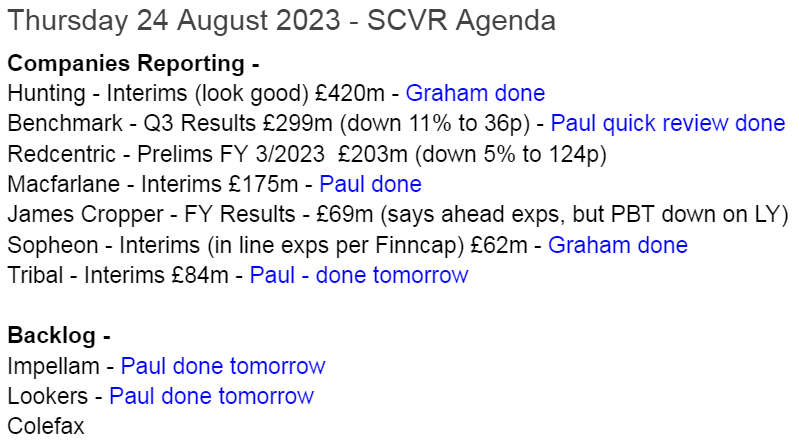
Summaries of main sections
Sopheon (LON:SPE) - down 2% at 575p (£58m/$74m) - Interim Results (in line) - Graham - AMBER
These results are in line. As usual, this software company shows limited organic growth, capitalises a few million dollars of its costs, and has to deal with some contract lumpiness. However the valuation is getting close to value territory in my view. It may already be there.
Macfarlane (LON:MACF) - 110p (pre market) (£174m) - Interim Results (in line) - Paul - GREEN
I have a really good rummage through the interim results from this packaging distribution group, and can't really find any negatives. Shares look cheap, it's performing well, with improved margins. The balance sheet stands up to scrutiny, cashflow is good. Acquisitive growth has doubled earnings over the last 3-4 years. It looks as if 2023 forecasts should be met/beaten. Lots to like here, a thumbs up from Paul.
Hunting (LON:HTG) - down 6% at 240p (£393m/$498m) - Interim Results (in line) - Graham - AMBER
This supplier to oil and gas reports EBITDA in line with expectations and an order book at the lower end of the range. The shares sell off as it moves into net debt and announces some restructuring initiatives. The shares offer a good way to bet on an oil and gas boom.
Benchmark Holdings (LON:BMK) - Down 7% to 37.8p (£280m) - Q3 Results - Paul - RED
[Quick review, no section below]
In compliance with the terms of the Company's unsecured Green bond, which requires it to publish quarterly financial information, Benchmark, the aquaculture biotechnology business, announces its unaudited results for the three months ended 30 June 2023 (the "Period"), which constitutes the third quarter for the fiscal year ("FY") 2023, and its year to date unaudited results for the nine months ended 30 June 2023.
It sounds in line -
the Group is trading within market expectations for the full year. [Paul: FY 9/2023]
A note from Equity Development (May 2023) forecast an adj PBT loss of £(5.6)m for FY 9/2023. It’s been heavily loss-making in the past too.
That is forecast to improve to a small, maiden profit of £1.6m adj PBT next year.
Hence I’m puzzled as to why the stock market is valuing BMK shares at £280m market cap?
The balance sheet seems to be carrying a lot of gross debt at £80m (excl leases). See note 10 for terms of the debt, including some bonds. Partly offset by £33m cash.
Paul’s opinion - on a brief review of the figures, I can clearly see this doesn’t interest me at all, and seems impossible to value on conventional grounds.
There might be a more involved reason as to why the company is valued at £280m, but it’s not obvious from the numbers. It might be a growth company with great future potential, which is what the valuation implies, but that sort of thing is outside the scope of our reviews here.
Note that 3 large shareholders dominate, with almost three-quarters of the shares.
Given the long history of disappointment and losses, plus too much debt, I can only view this as RED.
If any subscribers have looked into it in more detail, it would be interesting to hear your views in the reader comments.
Paul’s Section:
Macfarlane (LON:MACF)
110p (pre market) (£174m) - Interim Results - Paul - GREEN
Macfarlane Group PLC has been listed on the Premium segment of the Main Market of the London Stock Exchange (LSE: MACF) since 1973 with over 70 years' experience in the UK packaging industry. Through its two divisions, Macfarlane Group services a broad range of business customers, supplying them with high quality protective packaging products which help customers reduce supply chain costs, improve operational efficiencies and enhance their brand presentation…
RESILIENT H1 2023 PERFORMANCE - PROFIT EXPECTATIONS FOR THE FULL YEAR UNCHANGED
Checking my previous notes this year, for background, we like this packaging distribution group, as a GARP share -
23/2/2023 - GREEN - 108p - Strong results FY 11/2022, ahead mkt exps. Nice co, but whole sector is cheap.
9/5/2023 - GREEN - 116p - In line exps TU. 2 more acqns. Little net debt. Attractive valuation.
Track record is good as you can see below - with EPS having doubled in the last 3 years. Despite this, the market gives it no credit for a strong performance in difficult times, as graph 4 shows the PER in a declining trend, despite the growth track record in profits. Graph 5 shows the dividend yield improving. All this looks attractive to me, as a potentially good buying opportunity, for a possible re-rating at some stage in the next bull market?

Although investors need to be patient! The 5-year share price chart below shows MACF shares have been a safe place to hide since last autumn, in the current small caps bear market, which I find encouraging -

The Stockopedia computers consistently like it, being in the green section above for StockRank in the whole of the last 5 years, and currently rated at 93 -

The forward PER seems strikingly low for a decent quality business - the market is pricing in a recession, by the looks of it -

.
The above has set the scene, and motivated me to go through these numbers in detail (since they’re only in line, we would usually gloss over them, to focus on above/below reports elsewhere, which are price sensitive).
Good increases in profitability, despite revenues only being up 2%, so margins have improved (gross margin is 36.2%, usefully up on 33.8% in the last year comparative period).
Figures also boosted by acquisitions, offsetting lower demand in the UK, the commentary says -

.
Amortisation & forecasts - this is an important point with MACF, it doesn’t adjust out the goodwill amortisation charge from acquisitions, when reporting PBT and EPS. It does adjust out amortisation in the table above, but only for operating profit. Lower down, PBT and basic EPS are not adjusted. That’s different to what other companies do, where it’s normal to adjust out goodwill (and similar) amortisation charges. The amount is quite material too, a £2.0m charge in H1.
So adj PBT would be £12.0m in H1, and using the same 24.8% tax charge, adj PAT would be £9.0m, and referencing note 8 for the weighted average number of shares in issue of 159.9m (including only modest, c1% dilution from LTIP awards in issue), gives me an adj EPS for H1 of 5.63p, usefully higher than the 4.70p diluted EPS for H1 that the company reports. In fact that’s 20% higher, so this is material to how we value the shares.
This matters, because the company’s reported EPS numbers are really about 20% below how everyone else reports their EPS. You can see that on the StockReport, with 9.84p EPS reported for FY 12/2022, and then an apparent jump to broker forecast of 11.8p for FY 12/2023. Yet a helpful note from Shore Capital (many thanks) shows the adj EPS for 2022 as 12.1p, 23% above the company’s reported 9.8p.
Therefore this year’s forecast of 11.9p aEPS from Shore is actually a 2% drop against what was achieved in 2022. Since H1 actual EPS is up about 9% vs LY, then this suggests to me there’s probably a good chance MACF could beat forecasts for 2023. Hence risk of a profit warning seems low, and it’s more likely to be a profit beat than a miss for 2023, providing macro doesn’t go disastrously wrong, which is one of many possibilities.
Outlook - this sounds fine to me, given tough macro conditions at the moment -
"Whilst we expect the second half of 2023 to remain challenging, our good progress in Europe, diverse customer base, strong new business momentum and effective management of pricing and costs mean that our profit expectations for the full year remain unchanged."...
There will continue to be challenges in 2023, with rising costs and weak demand. However, our strategy and business model have proved to be resilient and we expect to deliver further growth in 2023 and beyond.
Valuation - using the adjusted EPS figures, as explained above, I reckon we’re probably looking at 12-13p aEPS this year FY 12/2023. That puts the PER at just 8.6x the mid point of my earnings range, using a 108p share price currently.
This strikes me as a very attractive valuation for what seems a decent, and growing business. However, it’s the type of share that always looks cheap, and remains so. Hence one for patient investors only I’d suggest.
Balance sheet - being an acquisitive group, the stand-out figure is £86.5m in goodwill & similar, at the top of the balance sheet.
Tangible fixed assets seem low at £9.1m, which thinking about it is probably because MACF is mainly a distributor, rather than manufacturer, hence it wouldn’t need a lot of fixed capital. Just lots of warehouses - indeed the risk section mentions that it has 1 owned site, and 52 leased sites - suggesting to me there might be inefficiencies from having acquired lots of smaller businesses, all with their own smallish warehouses perhaps? That would be a good question to ask on any webinars - in fact I’ve just pre-submitted that question on InvestorMeetCompany for the Interim results webinar, scheduled for 11:30 on 29 August.
Pension surplus of £12.8m is shown on the balance sheet, but as we know, surpluses are usually deficits. Note 11 indicates that it is indeed paying £1.25m pa in deficit recovery payments. So at the very least, we should remove the £12.8m asset from the balance sheet, and probably replace it with a £5.0m liability, which reflects the 4-year deficit recovery period. Oh actually, that was 4 years from 2020, so maybe just a £1.25m liability is needed. This could change up or down, when the 2023 actuarial calculations are done.
NAV is £111.0m, and I’ll adjust it as follows: remove £86.5m goodwill/similar, remove £12.8m pension surplus. Add £1.25m pension deficit liability. That gets me to NTAV of £13.0m - not a great deal really, but at least it’s positive.
I’ll leave in the lease asset of £35.3m, as it’s very similar to the £36.2m lease liabilities (multi-year, remember).
Actually, I’m going to remove the £10.4m deferred tax liability too, as note 12 indicates it’s almost all related to the pension scheme and goodwill. That improves adj NTAV to £23.4m, which is acceptable I think.
It seems to me that MACF enjoys favourable terms from its suppliers, because trade payables are almost the same as trade receivables. That implies MACF collects in cash more quickly than it pays it out - a nice position to be in. Although payables will also include other things that are not trade, eg tax, accrued costs, etc.
Inventories are quite low, suggesting stock comes in & out quickly, without hanging around too long, which is efficient.
Net debt - is modest. Cash of £5.9m mostly offsets £9.2m of bank borrowings, so net bank debt is only £(3.3)m. That could be window-dressed for the year end of course, we don’t know. However, note 5 (finance costs) indicates costs of only £399k “interest on bank borrowings” in H1. If we assume it might have paid an average of say 6% interest (4% base rate average in this period, plus I’ve assumed a 2% bank lending margin), then this implies an average of about £13m gross debt throughout H1, which is fairly close to the £9.2m reported gross debt on 30 June 2023. So it passes my reasonableness testing, i.e. the reported net debt looks about right compared with what the finance charge costs are.
No concerns over debt, indeed due to the cash generation at MACF, I think it could possibly borrow more for acquisitions, without it alarming me.
Cashflow statement - is highly impressive. Although it seems to have benefited in H1 from some one-off decreases in inventories and receivables turning into cash, which may reverse in H2, so I wouldn’t get too excited about the cash generation.
This has been useful though, in allowing MACF to fund £11.4m in acquisition-related payments, paying taxes & finance costs, £4m in divis, modest capex, all in H1, and without depleting its cash or drawing down any more bank borrowings. Very impressive.
Paul’s opinion - this strikes me as a really good business that has demonstrated its ability to manage serious external factors like the pandemic, energy crisis, higher inflation, and still manage to deliver a decently positive trend in profitability and EPS over the last few years. It’s easy for us to forget just how chaotic the world has been since 2020.
Despite this, MACF shares are only on a high single digit PER, for a successful growing (self-funded with no dilution since 2018) group, with an OK balance sheet, hardly any debt, and an OK dividend.
I think shareholders here can sleep at night, knowing that there’s probably little downside risk, and that with patience the market should eventually recognise MACF’s good track record, and reward it with a re-rating. That could give a nice upside from current levels I think. More a medium-long term investment I’d say, as it often just treads water in the shorter term. Re-ratings can be sudden, and unexpected though, when they happen. Someone might bid for it too, although the sector seems to be lowly rated generally.
Anyway, the figures get a clean bill of health from me, and a thumbs up.
Graham’s Section:
Sopheon (LON:SPE)
Share price: 575p (-2%)
Market cap: £58m ($74m)
This software company has published its H1 numbers.
Revenue highlights:
Revenue $17m (H1 last year: $15.7m). There was a very small acquisition in May 2022 that made some contribution to boost the performance this year.
SaaS recurring revenue of $15.2m (a year ago: $9.2m). All new customers are signing up on a “SaaS” basis.
Total recurring revenue $25.9m (a year ago: $21.9m).
Unfortunately, profits are lagging behind. Adjusted EBITDA in H1 is still just $2.9m (same as last year), which reflects “continued investment in product and commercial initiatives as per operating plans”.
PBT is just $0.2m, although it’s an improvement on the pre-tax loss of $0.8m in H1 last year.
Net cash is $22.4m, with no debt.
Acquisition - another very small acquisition was made at the start of H2, buying the company’s reseller in Australia.
Exec Chair comment/outlook statement doesn’t give much away but looks forward to a stronger sales pipeline in H2.
Strategy - the company is looking to serve more types of customers (more “verticals”!) and medium-sized companies, instead of being concentrated in large customers in just a few industries.
Estimates - these results are in line with expectations. Broker finnCap is forecasting adjusted EPS of 7.1p this year, before profits start to take off in 2024 with an adjusted EPS of 21.2p.
Graham’s view
Looking back on my previous notes in June and in March, I had some concerns over “limited organic growth, the capitalisation of costs putting a question mark over profitability, and the lumpy nature of contracts”.
Has anything changed in recent months? I don’t think so.
Organic growth - revenues are up 8% in an inflationary period, and that’s with a little bit of help from acquisitions. So real organic growth is not very high.
Capitalisation of costs - today’s cash flow statement shows $2.9m of costs being capitalised, the same as last year. Profits get a small boost from the company writing off (i.e. amortising) these intangible assets at a slower rate than it creates them.
So for me there is very little current profitability to write home about here. The adjusted EBITDA figure is meaningless to me because of the amortisation charge it ignores. That figure also leaves out a couple of hundreds thousand dollars of share-based payments to staff.
Lumpiness of contracts - revenue visibility is lower this year because last year, the company benefited from a large US Navy contract. This year, it reports that the sales pipeline includes “two significant perpetual extension orders from existing military customers, as well as many SaaS opportunities from private sector prospects and existing customers”. Perhaps there will be some improvement when it comes to the lumpiness of contracts?
More positively, Sopheon’s valuation has cooled down a lot in recent years, and it still has a substantial cash balance.

Subtract $22m of cash from the market cap and you get an enterprise value of $52m. The EV to sales multiple is then only 1.4x based on the current year. This is very cheap in the context of a software company with recurring revenues. I’m certain the valuation would be far higher if it was listed in the United States.
So I’m tempted to give this one the thumbs up on the basis of that cheap EV to sales multiple. It’s not as if there are any immediate solvency worries, after all - it’s just not very profitable yet.
At an EV to sales multiple of 1x, I think I would be forced to turn positive. For now I’ll stick with the neutral rating.
Hunting (LON:HTG)
Share price: 240p (-6%)
Market cap: £393m ($498m)
Hunting PLC (LSE:HTG), the global engineering group, today announces its unaudited half year results for the six months ended 30 June 2023.
This is a supplier to the oil and gas industry. Paul and I have both felt compelled to write about it over the past year, despite not being sector experts.
For many years it was valued at over £1 billion, so it was the wrong size for the SCVR:

Its financial results are volatile, so it’s an intriguing question as to whether these levels could offer turnaround and recovery potential.
Let’s get into these H1 results.
The numbers are promising, with a swing into substantial profits:
Revenue +42% to $478m
Order book +63% to $530m (according to Reuters, this is the lower end of the range estimated by Jefferies)
EBITDA of $48.7m is in line with expectations. Not a very helpful number due to depreciation and other charges.
Adjusted operating profits at $26.2m (H1 last year: $4.7m).
After-tax net income $17.4m (H1 last year: loss of $4m).
CEO comment argues that we are on the cusp a new boom in oil and gas investment:
"Today's results confirm the positive trend of increased investment in the oil and gas industry following years of under investment, driven by global energy demand and increased focus on energy security. We believe that the sector is in the early days of a long term growth cycle which, coupled with our non-energy businesses, positions the Company for increased revenue and earnings going forward.”
Outlook statement strikes a similar tone:
Global energy markets continue to display growth, stability and resilience, despite the macroeconomic narrative from some Western economies. Activity across the oil and gas industry continues to be strong, particularly within the offshore segment of the market and drilling continues to increase in momentum in South America, West Africa, the Middle East and Asia Pacific.
EBITDA in H2 is expected to be “similar” to H1. The broker note from Zeus confirms that this is in line with existing guidance, and they make no change to their forecasts.
A very large contract has been signed with Cairn Oil & Gas - Vedanta in India, with a value of up to $91m over three years.
Graham’s view
The revenue and profit figures are very encouraging, but the shares have been sold off. So I suppose we first need to try to understand why that might be.
A separate RNS today says the following:
…as part of a wider programme to drive higher operational efficiencies and reduce future cost outflows, it has commenced a further restructuring of its operating footprint, in addition to disposing of its legacy non-core exploration and production assets.
The planned restructuring includes the transfer of operations - a facility in the Netherlands will be closed, and various activities in Dubai will move to a larger site. There will also be a closure and transfer of activity in the United States/Mexico.
These sorts of changes don’t tend to come cheap, and so investors can look forward to large “exceptional” costs over the next year. Hopefully with benefits to the company in the years ahead.
Another point that stands out is the company moving from a cash position ($85.6m) to a debt position ($51.7m) over the last twelve months.
Hunting says that there will be “working capital efficiencies” in H2 of this year, with the borrowing position “expected to unwind by the year-end as larger projects are completed”. But it’s still a bit disconcerting to see such a huge drain of cash out of the company.
The cash flow statement for H1 shows a $50m increase in inventories, and $43m increase in receivables (amounts owed by customers). Largely because of these items, there is a significant cash outflow from operations ($34m).
So taking all of that into account, is Hunting currently in bargain basement territory?
If there is about to be an oil and gas boom, then the answer is still probably “yes”.
And if we have readers who have a strong view on oil and gas and have studied this company in more detail, I can see why they might take an outright positive stance on this stock today.
Based on current profitability, however, the current valuation seems fair to me:

The StockReport sees the same thing, giving it an almost perfectly average ValueRank of 47.
Speaking as someone who doesn’t have a strong opinion on prospects in oil and gas, I am therefore inclined to view this share as fairly valued. If it had a large net cash position and if its results were cleaner, I’d be more likely to take an outright positive stance.
Disclaimer
This is not financial advice. Our content is intended to be used and must be used for information and education purposes only. Please read our disclaimer and terms and conditions to understand our obligations.

45 comments
Benchmark Holdings (LON:BMK) - research report now available following recent Q3 numbers: https://www.equitydevelopment....
For the three months to 30th June 2023, Benchmark Holdings reported revenue of £34.3m, -5.5%YoY (currency-adjusted -1%YoY), as 10%YoY growth in Genetics (42% of total) was offset by the impact of reduced demand in global shrimp markets, resulting in a 17%YoY decline in Advanced Nutrition revenues (47% of total). Adjusted EBITDA1 declined 23%YoY (£5.1m), a 14.8% margin (Q3 22: 18.1%); on a currency-adjusted basis -13%YoY. Net operating cash inflow of £1.7m contrasted with £(1.0)m outflow in Q3 22, with net debt of £45.7m (FY22: £59.3m) and healthy cash reserves of £32.9m. Q3 under-performance in the Advanced Nutrition business area indicates a revision to our full year FY23 outlook and the basis for FY24 estimates; a 7.2% reduction in our FY23 (adj.) EBITDA outlook and -7.2% for FY24. We maintain our fair value at 63p/share, backed by sound cashflow management, confidence in Genetics salmon eggs demand and production capacity and prospects for Benchmark’s Ectosan®Vet and Clean Treat® treatments.
Can't remember if I've copied this here before, but when I was 15, I submitted a machine code program of a few numbers to Sinclair Programs, and they published it! Sending me a small cheque. Here it is -
(however laughable it seems now, all the ZX Spectrum could do was click! I made it sing with this little machine code routine that I wrote by accident!! LOL)
They did the cartoon - how rude (on reflection). Amateurs.
Brilliant Paul, makes sense now you could have been a computer scientist, I was lucky enough to persuade my dad to buy me what was a very expensive ( to us) 16k ZX spectrum from my well off mate at school who was going to send his back so he could have a new fangled VCR for Christmas, luckily for him it was VHS and not the Betamax variant.
I’d spend hours programming the free games from the magazines, remember one particularly long one was Defender which took about 5 or 6 hours , played it once and when exited it lost the lot and had to start writing it all again !
with hindsight it put me in good stead , ended up an hardware engineer that could program, not many around at the time and not many left!
You guys have probably heard of Lewis Robinson. He's a fan of Macfarlane (LON:MACF) . It's well worth checking out his Twitter account.
https://twitter.com/ExpectingV...
He points out that MACF is on a free cashflow yield of 9%.
I'll add my own tuppence: average ROCE is around the 15%, which is a nice healthy number. It's been growing its dividends at c 10% pa for the last 5 years.
The company is also presenting their intetims over on https://www.investormeetcompan...
on 29th Aug 11.30am.
I feel it's one of those companies that, if you held it in a portfolio of 10 such companies (good track record, quality, cheap price) you can't help but do well.
Someone has just put a bid in for Kinovo (LON:KINO) !? It has a 99 Stockopedia rating, and I bought a few shares as a starter position a few week ago and I had hope to buy a few more over the coming months.
Thank you Paul for digging into the MACF numbers, it's much appreciated and why I'm a subscriber. We hold and will add, their shares have been modestly kind to us previously and I think will be again when investors nerves improve.
I just came in from an afternoons golf and saw this, my expectation went up massively expecting to see a high bid offer only to be ultimately disappointed with the derisory offer
Thank you Paul for digging into the MACF numbers, it's much appreciated and why I'm a subscriber.
Thanks JASVFS. Love your royal we, by the way ;-)
Licensing
Go to the source.
Hi
For those interested in ARM (as per earlier posts), this is an interesting 24min vid (posted on X (Twitter as was)) explaining the full history of the company and how its unique technology (software) has established itself in the tech eco system.
The poster, John Coogan, summarised this .....
Here's what you need to know about the Arm IPO:
- They've shipped over a quarter TRILLION chips
- They have 99% market share in mobile
- 96% gross margins (26% operating margins)
- Aiming for ~65B market cap
https://twitter.com/johncoogan...
Regards
Howard
The poster, John Coogan, summarised this .....
Here's what you need to know about the Arm IPO:
- They've shipped over a quarter TRILLION chips
Please let’s not confuse idiotic ramblings on Twitter with facts. ARM DO NOT SHIP ANY CHIPS. They license Intellectual Property. Why listen to anyone that doesn’t even understand the basics of the business model?
I hope I don’t offend the more knowledgable and small cap investors on this quiet day, whom I respect enough to maintain my subscription here.
The YouTube link below to a bbc documentary called micro men has relevance to how the personal computers market began and how it ended with the beginning of ARM, I warn is it not investment related - so apologies up front - but a great snapshot of uk innovation at the time, I wonder if we can relate to any small uk companies out there today ?
?si=OMvNVSBmGTT1v_inunderstand if deleted
The YouTube link below to a bbc documentary called micro men has relevance to how the personal computers market began and how it ended with the beginning of ARM, I warn is it not investment related - so apologies up front - but a great snapshot of uk innovation at the time,
I remember watching Micro Men when it was first on the BBC. It's more a dramatisation of real event rather than documentary, but quite a lot of it really happened, including the fight between Chris Curry and Clive Sinclair in the Baron of Beef. Interesting little snippet for true nerds... the extra playing the barmaid serving drinks to Clive Sinclair in the Baron of Beef at the beginning is the real Sophie Wilson - designer of the original ARM RISC architecture instruction set.
I think Arm has changed their licensing model recently. It used to be based on the price of the chip, or something, but has shifted to the value of the whole manufactured device; meaning larger royalties for Arm.
RISC-V is an upcoming license-free alternative to Arm, with new devices hitting the markets. Expect to see many more RISC-V devices on the market. Arm beats RISC-V on performance, price and manufacturing know-how. Although RISC-V is ostensibly "free", to produce a board, a vendor would still likely license other IP blocks.
Eben Upton, the father of the Raspberry Pi, said that he would still choose Arm over RISC-V.
Nevertheless, RISC-V is snapping at the heels of Arm, and I expect it to make significant gains in the next 5 years.
Interesting article in the FT about the fortunes of major consumer goods companies right now - covers the familiar theme that price rises have managed to offset falling sales volume (like the Macfarlane (LON:MACF) update today). However, it sounds like some companies like Heinz think this approach might not be able to continue; raising the prospect of falling profits from companies that have so far managed to see reasonably robust trading. This is what I'm nervous about for the next six months from an investment perspective and why I think we should continue to be selective right now about what consumer-facing companies we should invest in.
Interesting article in the FT
This and many similar articles reflect the high fear factor which is prevalent in the market right now. Many shares are down not because the report or the forecast is not good but because the fear is it may not last .
As long as such a healthy fear factor exists and is expressed so wildly, I feel we are reassured that we are not at the peak of market euphoria!
I am selective in what I buy but not fearful. Even when the recession arrives, the market usually starts to rise as it had already expected this and usually priced it in.
"This and many similar articles reflect the high fear factor which is prevalent in the market right now. As long as such a healthy fear factor exists and is expressed so wildly, I feel we are reassured that we are not at the peak of market euphoria!"
Richard Buxton, manager of the Jupiter UK Alpha Fund said a few months ago "Shut your eyes and wait 10 years – you’ve always made money at these valuations"
https://www.ii.co.uk/analysis-...
Mirriad Advertising (LON:MIRI) posted HY results on Tuesday. Stephan Beringer, CEO, and members of the management team, will host a webinar for private investors today at 1pm to present those results. Plenty of time for Q&A at the end.
Register here
Yes I had a quick look at the figures from Mirriad Advertising (LON:MIRI) - I see it's managed to cling on, thanks to another fundraise to keep the lights on. Looks extremely high risk, and the clock's very much ticking, so mgt needs to pull something big out of the hat, or it's heading for zero.
Thanks Paul
A definite zero.
We can't say anything is <i>definite</i> zero. You're too adamant. We can say that it <i>might</i> be zero.
Macfarlane (LON:MACF) Interims (I hold) - Steady as she goes?
Revenue up 2% to £141.6m is hardly spectacular. Very slightly behind where I'd expected. But it is reassuring. And long term management tend to be cautious with the figures, particularly at the interims.
A look under the covers is more promising? With revenues flat despite acquisitions peforming well and volumes down significantly in the largest protective packaging distribution division. But margins have improved. Seems MACF are successfully passing on price rises to their customers as well as managing their own cost base and input costs. Inventories have fallen significantly. Leading to large cash inflow.
Aside from distribution the relatively small manufacturing operation continues to build revenue consistenty - with revenues up 13% to £17.6m and adj operating profit up 36% to £3.4m. Compared with results from packaging mfr Robinson (LON:RBN) the difference is stark? And largely reflects the managements careful selection of acquisitions and the ability to scale up the division in the medium term is promising.
Management ability here is quite possibly the key attribute of this company?
Overall this contriubutes to Operating profit (before amort) up 13% at £12.8m and PBT up 13% at £10m.
Improvements in working capital have boosted cashflow massively in comparison with the previous year - net operating cashflow £20.3m (£6.4m) - not adjusted for lease obligations of £3.5m - which has allowed £11.4m of acquisition costs, £1.4m of investment and some repayment of debt with cash flat at £5.1m.
Something of a tortoise rather than a hare here I think. But it seems to me that the acquisitions in the European distribution business, UK manufacturing and investment in improving the distributions business make this a more attractive business model in the longterm.
Research note out from Shore Capital this morning on Research Tree - similar to my thinking - with revenue expectations reduced slightly and profit expectations trimmed by less (edit - Whoops! typo actually they have ever so slightly raised eps forecast) . Although management outlook is for FY profits unchanged. At this stage its not unusual for management to keep a little in reserve, which adds to the credibility.
Overall very happy with this set of results - though with current economic and stock market conditions it may well be some time before I see that reflected in the share price? Although not my largest holding it is my highest conviction holding and I've been a shareholder for many years.
cheers
Mark
Thank you for that illiswilgig (Mark), we also hold Macfarlane and will probably add to our decent size investment in the company. The interim dividend raise was pleasing.
About as far away as you can get from a small cap company, but NVIDIA (NSQ:NVDA) results are worth a comment, as it becomes a trillion $ company. Sales up 170% this quarter to $166, revenue up 100% YOY to $13.51 billion (ahead of Bloomberg consensus estimate $11.04 billion). Data centre revenue alone $10.32 billion, up 171% YOY. $25 billion share buy back should help support the share price.
Anyone who think elephants can’t gallop should take a look at the share price chart for this company. I bought this share first back in July 2016 and topped up the holding in August the same year. I halved my holding in April 2017 when my holding had doubled in value (definitely regret that a bit, but consequently in for nothing now). There have definitely been some ups and downs and I have mulled the idea of top slicing on several occasions, but couldn’t see anything at those times that were much more appealing, so stuck with the knitting of running my winners. Biggest regret is not having the holding in my ISA.
Well played! Im debating joining the Nvidia party but might wait for a pullback which may never come
Maybe worth considering ARM holdings when it relists, but suspect it will be hyped initially, talking of regrets for those old enough to remember I wish I’d bought a lot more via acorn computers or of similar name ( wiki says element 14) before it was reversed and renamed ARM holdings on LSE in 1998
Yes I’ll be watching ARM listing as I held it in the past at the time of the takeover.
I also hold Volex (LON:VLX) and Alphawave IP (LON:AWE) which I believe will benefit from NVIDIA (NSQ:NVDA) ’s progression.
I wish I’d bought a lot more via acorn computers or of similar name ( wiki says element 14) before it was reversed and renamed ARM holdings on LSE in 1998
Acorn was a basket case by the time ARM was spun out, so I think it’s very unlikely anyone with a barge pole would have gone near it. Element 14 was also spun out of Acorn and developed early DSL technology and had nothing to do with ARM. It was subsequently bought by Broadcom.
Can’t disagree, yet we know investing is all about timing, there was an arbitrage at play for those savvy enough to realise, it’s a shame I had little spare cash at the time, ( hence the regret) however the reason for buying was clear and the rest is history holding the multi bagger ARM…
In May 1999, a deal was offered to Acorn Group plc shareholders by MSDW Investment Holdings Limited, a newly incorporated subsidiary of Morgan Stanley Dean Witter Group, in which the MSDW subsidiary would acquire Acorn by giving Acorn shareholders two ARM Holdings shares in exchange for every five Acorn Group shares being held.
ARM was actually a JV between Apple and Acorn, which was why Olivetti didn't manage to screw it up quite as badly as everything else Acorn related:
https://www.huffingtonpost.co....
I can confirm some very large UK institutions accessed ARM shares via Acorn.
ARM was actually a JV between Apple and Acorn
Also VLSI Technology who fabbed the early ARM chips such as the one used in the Apple Newton PDA and Acorn Archimedes computer. I know this stuff cos I was working with ARM and Acorn in the mid 90’s :)
Indeed - I can recall meetings with Saxby & Boland.
The Acorn rehash of the Psion was a rather bizarre episode.
The Archimedes was good, but sadly by then the PC snowball was rolling down the hill and Phoebe got cancelled :-(
I look back on them as the happy days of UK IT Hardware, when schoolboys would race to the computer room to grab the BBC Micros before they got left with the RM 380/480Zs and their (now comically) large floppy drives. Not to mention playground bragging rights over ZX Spectrums and Commodore 64s.
And isn't it funny how everyone has now forgotten about ARC, Tensilica, Parthus, and of course Transmeta (they didn't all die, some got swallowed up)
The hilarity of stockbrokers talking suddenly about the second coming of Linus Torvalds....or becoming instant experts in ray tracing as they touted Imagination Technology...
Sorry for boring everyone who (rather sensibly) couldn't give a damn about the rather obscure history of UK chip designers.
It looks like the opportunist Liontrust Asset Management (LON:LIO) bid for the Swiss asset management firm GAM Holding AG has failed with only 33% support giving rise to an £11m exceptional charge. https://www.londonstockexchang...
Oddly GAM Holding AG don't appear to have the funding to continue without Liontrust. Given GAMs star investment managers and management team had supported the bid, it makes you wonder whether some of these will defect to Liontrust anyway over time? All a bit of a mess!
I think the value was in the AUM, not the managers.
Market seems to like it, happy to hold with 72p divi maintained, what now for GAM?
In no particular order ...bucket, shop, barge , pole.......
Just thought I would add a little perspective to some recent comments re awful mkt conditions. It's been a slow month and what seems like a tough summer. UK markets have given back their gains. They lag US markets significantly and it's easy to think we are missing all the fun.
Since end July the FTSE 100 is -4.9%, SPX -4.3%, 250 -4.9% and Nasdaq -5.9%.... so all broadly similar.
Of course YTD SPX and Nasdaq remain +14% and +29% respectively.
UK indices are now down, just under 2% for the All Share, more for the 250 BUT the FTSE Small Cap index X IT is only down 0.7%. Aim worse at -12%. So YTD numbers are frustrating.
If you look back 2 years though....The FTSE 100 is much better also -2%....but 250 and Small cap are down 20%..... the Nasdaq despite this years rise is also -14%....and the SPX -9%. US small caps are also down significantly, S&P 600 Small -40%, very similar to AIM actually.
What to make of all this? The narrative loud and clear is we are heading into recession, an up tick in unemployment to reduce inflation. The market has voted accordingly...see small cap for detail. Nominal growth remains high... see recent bond market moves. A lot of fear is in the price. All in the price? we will never know of course. I find these numbers broadly reassuring as the US market is propped up by a small number of expensive stocks that investors are hiding in.
We received the positive month on month CPI no for July inline at 0.2%....if this number continues all year inflation will tick up....from 3% to 4%...leaving little room to cut rates. Yet the market was forecasting cuts. It is now changing its mind. This may lead to rotation in stocks or away from stocks.
The following is worth a read... it's just a different view.... https://research.gavekal.com/ Gavcal have taken the unusual step of publishing their Making Sense of the China Meltdown Story for free online. Have a read.... if true, then a the switch to value will be to the benefit of EM, UK, Small cap et al at the expense of US Tech. It's just another perspective but reason again not to be too negative.
I recently took a bit of money off the table, positioning etc is down to the individual... I think if you are in positive territory that's fine. Yes you can get a decent bank interest rate at the moment.... but everything other than very short bonds are down....so gains have been pushed into later years. No recession and better inflation numbers will bring those gains forward again and potentially allow equities (x US Tech) to rate back up.
Happy hunting everyone.
Very interesting article on China. Thank you
Following on from RDHoward, not seeing it in the broader figures yet, but in a lot of higher end areas I think it's already a recession. Anecdotal I know, but from what I can see the banks have cut pretty much all discretionary spend, they are making a lot of money, but are very fearful of the writedowns to come and liquidity (from talking to clients). Lot of projects getting cancelled and/or moved into 24 and 25 already. This is feeding across to professional services and supporting industries (lawyers/accountants/tech/recruiters etc) and some quite significant retrenchment is going on in the ibanks and around these supporting industries (I know a couple of places that are cutting ~25% atm).
Also seeing in the business I run (tech consulting), that attrition has dropped to zero so far this year (we usually run 15-20%), people are sitting tight and hiring is paused. So not surprised to see Robert Walters (LON:RWA) struggling and suspect others with similar exposure will do so as well for a while. I remember from 2001/2/3 and 2008/09 that a lot of this stuff only gets mentioned in the industry press (if at all) and only shows up in the broader measures much later.
So what to make for shares? The last couple of years have been a grind, but difficult as it seems, this is mostly (all?) priced in now, so personally sticking to my plan and steadily accumulating (less keen on UK than I was and tryign to address my home bias).
Good luck!
Also seeing in the business I run (tech consulting), that attrition has dropped to zero so far this year (we usually run 15-20%), people are sitting tight and hiring is paused.
My background is also running tech consulting businesses and this is a familiar circumstance. My experience has been that these fallow periods tend to last for 12-24 months, and we are a some way into it already. The taps turn back on quite suddenly and unpredictably. All that’s needed is some green shoots in the macro. But I feel that the US is comfortably ahead of Europe in that regard, where conditions are worsening instead of improving.
Agree it was an interesting article on China. There is a lot of Groupthink in the media. Certainly in Shanghai I have been told consumers are are very active. Whether this is big ticket items though, I don't know.
Benchmark Holdings (LON:BMK) published Q3 numbers this morning - just a reminder that we are hosting an investor presentation at 12pm today with the management team who will also be answering investor questions - you can sign up here: https:/www.equitydevelopment....
Paul. I would be interested in your views on Hunting (LON:HTG) as they have provided a positive looking half year update. I am away in stormy Normandie and trying to read on a small phone with only intermittent 4G. Certainly looks positive but cash flow negative suggesting high capex.
I have a starting position in SIPP.
Best wishes
Greyster
My morning smallcap tweet: Two drops fall on the desert of news
Malvern International (LON:MLVN) Ashington Innovation (LON:ASHI)
◄Malvern International (MLVN)► education tinpot continues to recover for its near-death experience. Guides H1-June rev c. £4.8m up c.109%. Return to profit. Cites strong University Pathways student intakes as well as 40% increase in English language teaching rev. In line? [SP=17.5 Cap=4m]
◄Ashington Innovation (ASHI)► this SPAC signs non-binding heads of terms to acquire Calon Cardio-Technology in all share deal. Subject to the completion of the proposed reverse takeover of Cell Therapy (RNS 19 Aug) plus due dil etc. [SP=2.75 Cap=2m]